This week’s Torah portion is Tetzaveh, which concludes God’s request for a tent sanctuary so God can dwell among the Israelites. Tetzaveh also describes the special garments the priests will wear as they perform their roles at the sanctuary.
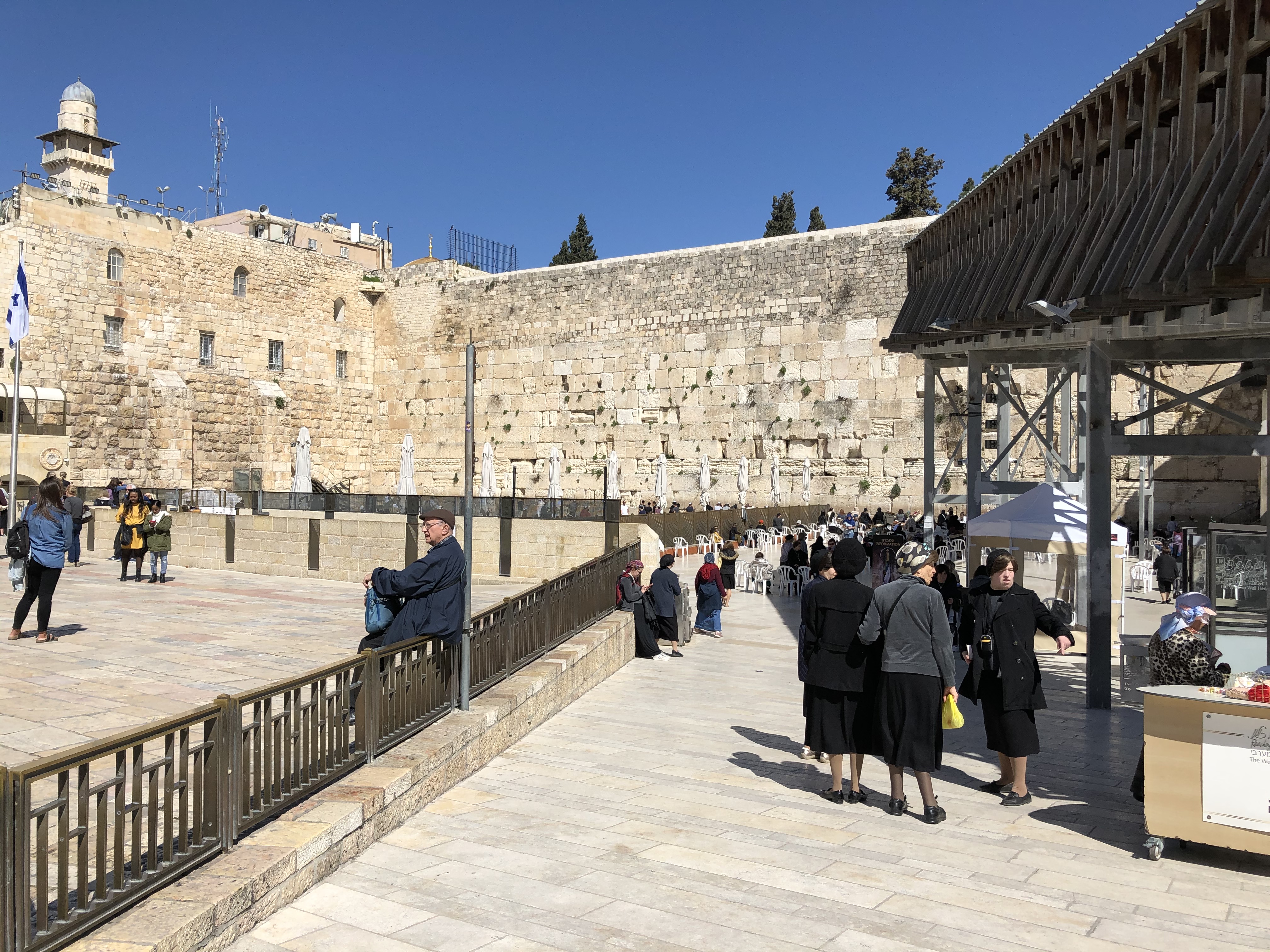
Approach to Western Wall, Jerusalem (photo by M.C.)
Special garments are also a feature of the book of Esther, which Jews read every year during the holiday of Purim. In most of the world, Purim falls this year on the evening of Monday, March 9, and the day of March 10. But in Jerusalem and ancient walled cities, we celebrate “Shushan Purim” the evening of Tuesday, March 10, and the day of March 11. This is the first time in my life I will be able to celebrate Shushan Purim. I plan to join a group of women reading Megillat Esther, the biblical book behind this holiday, at the Western Wall in Jerusalem!
Next year in this blog I hope to compare the costuming in the book of Esther and the Torah portion Tetzaveh. But this year I wanted to repost my essay on the curious phrase “Tent of Meeting” which first appears in the portion Tetzaveh. Why does God call for a tent-sanctuary that will be the place for scheduled meetings?
The question spoke to me after I visited the Israel Museum in Jerusalem and looked at artifacts from other ancient places where people went to meet with their gods. So I spent some time rewriting my 2014 post. You can find the improved version here: Tetzaveh: Meeting Room.
Standing stone from Hazor temple, 15th-13th century BCE, Israel Museum (photo by M.C.)
The standard floor plan for shrines and temples in the Ancient Near East had a large front room and a smaller, holier room in the back where the god was present. This is the plan of the Tent of Meeting in the book of Exodus, which is divided into a larger front chamber where the priests tend the menorah, the bread table, and the incense altar; and a smaller back chamber, the Holy of Holies where the ark stood.
A Canaanite temple and a small shrine archaeologists discovered in Hazor, north of the Sea of Galilee/Kinneret, follow the same basic plan. Both were built during the 15th to 13th century B.C.E. The temple’s back chamber or Holy of Holies contained a statue of the storm god and a standing stone or massebah carved with a horned sun disk.
One of the religious innovations in the Torah is the prohibition against making or worshiping either a god statue or a standing stone. The God of Israel must not be represented with a carved image, and the people must not worship any other gods.
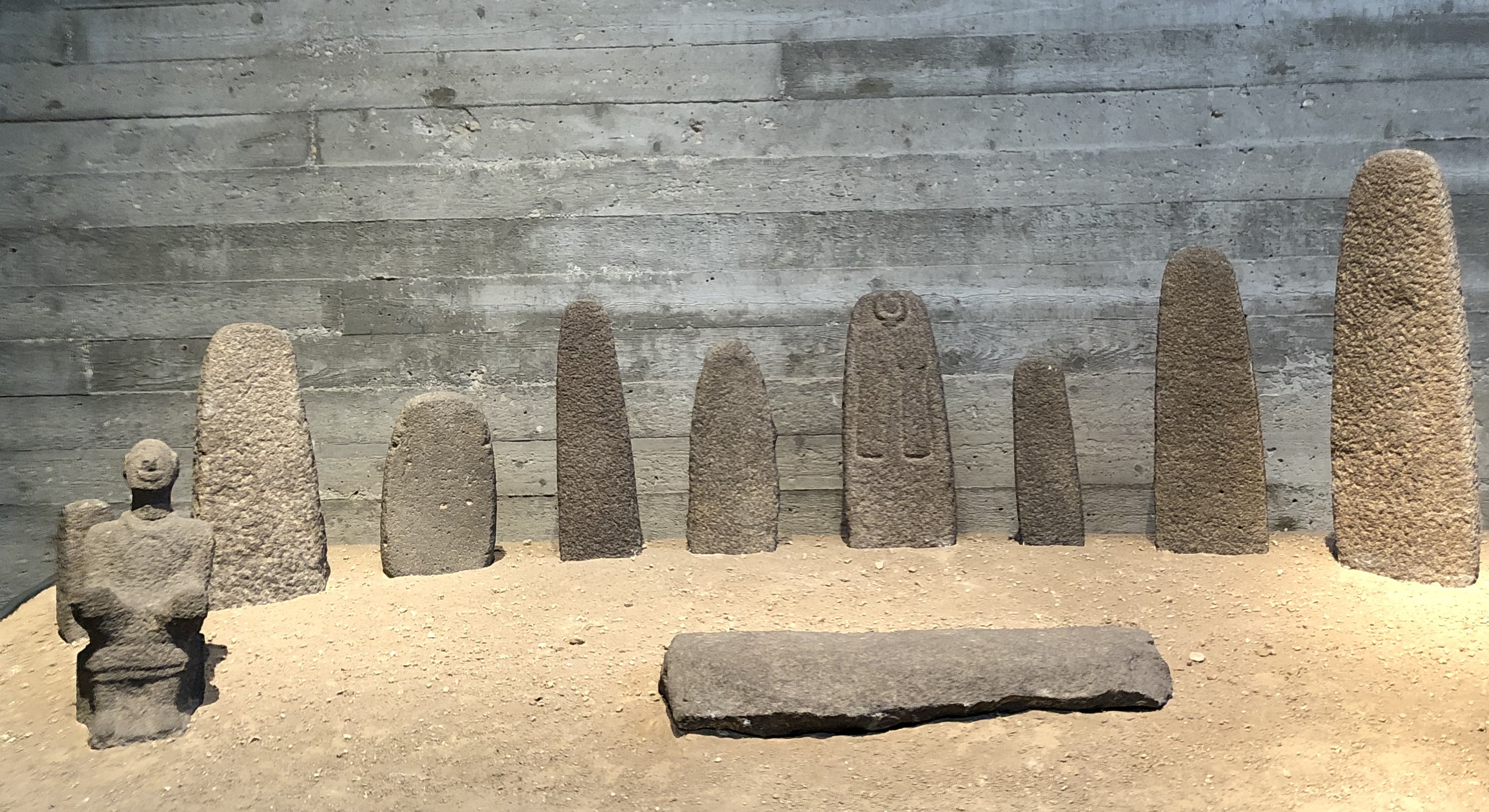
From a shrine in Hazor, 15th-13th century BCE, Israel Museum (photo by M.C.)
The smaller shrine in Hazor from the same period had only one room, and a shallow niche in the back wall for the holiest objects. The niche was lined with standing stones, including a central stone carved with two hands and a moon symbol. In front of the standing stones stood a table for offerings and a statue of someone wearing the symbol of the moon god Sin. This shrine was a place to meet the moon god.
In the second book of Samuel, which is set in the 10th century B.C.E., the temple that King Solomon builds in Jerusalem follows the same pattern as the Canaanite shrines and the Tent of Meeting described in Exodus. The temple’s Holy of Holies contains not only the ark, but also two carved winged figures based on the two figures on the lid of the ark in the Tent of Meeting. These pairs of winged figures are not considered idols in the Torah, perhaps because God only manifests in the empty space above the ark. (See my post Terumah: Cherubs Are Not for Valentine’s Day.)
Holy of Holies, 8th century B.C.E. shrine in Arad, Israel Museum (photo by M.C.)
Given the biblical history of furnishing the Holy of Holies, I was not surprised to learn that when archaeologists unearthed the 8th century B.C.E. fortress of Arad they found a shrine with a standing stone inside its Holy of Holies—even though Arad was in the kingdom of Judah, where the God of Israel was worshiped. For the people of Arad, the standing stone meant that God was present in their shrine, their own “Tent of Meeting”.
Eight centuries later, the people of Judah were building the first synagogues even before the Romans razed the temple in Jerusalem. These synagogues were buildings where people could encounter God through prayer and study instead of through offerings on the altar. The Israel Museum has restored part of the interior of an early synagogue built in Susiya, near Hebron.
Susiya Synagogue, Israel Museum
Its sacred enclosed space had three niches in the back wall, which held a Torah scroll flanked by two menorahs. It is no coincidence that a Torah scroll inside its ark is reminiscent of the stone tablets of commandments inside the ark that stood in the Tent of Meeting’s Holy of Holies.
How different is the shrine in Arad, with its standing stone, from the synagogue in Susiya, with its ark?
Today Jews still come to synagogues to encounter God through communal prayer at appointed times. The holiest place inside a synagogue is still the ark containing the Torah scroll.
It must be human nature to want an appointed place to meet God. Perhaps that is why I am going to the Western Wall on Shushan Purim.
We are in Jerusalem at last—or at least we are in an apartment in a suburb on a hill overlooking a freeway. We have not yet seen the old city. It’s raining today, and I just added illustrations to a blog post I wrote in 2010. You can read it here: Terumah: Cherubs Are Not for Valentine’s Day.
What did the keruvim on top of the ark look like? This week’s Torah portion, Terumah, only mentions their wings and faces, and says they must be hammered out of the same piece of solid gold as the lid. Other descriptions in the Torah are also sparse, though Ezekiel mentions calves’ hooves and says each keruv in his vision had four faces, only one of which was human.
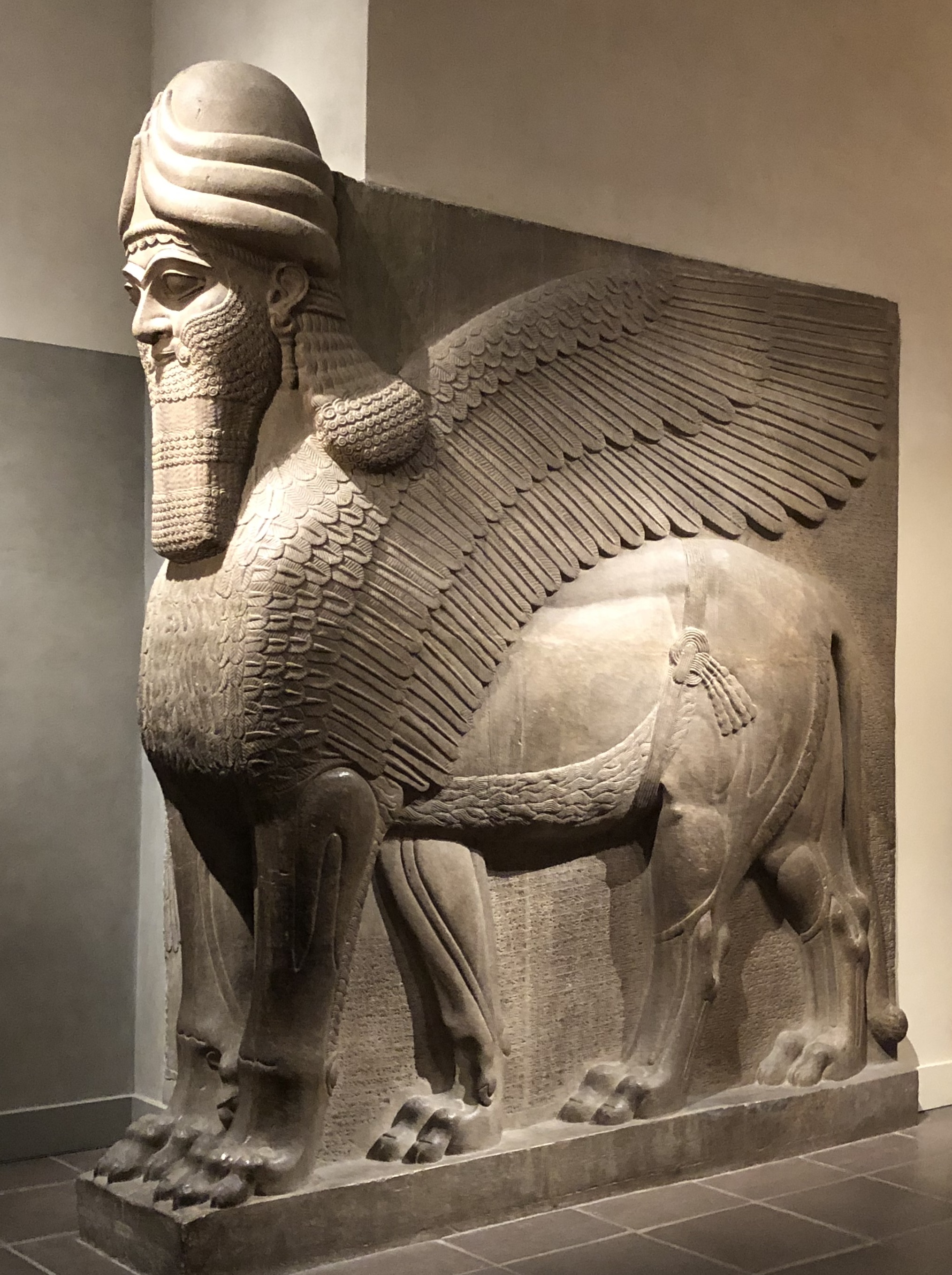
from Neo-Assyrian palace at Kalhu, 9th century BCE, stone (Metropolitan Art Museum collection). photo by MC
Keruvim were probably similar to the guardian figures sculpted by other cultures in the Ancient Near East: hybrid beasts featuring the legs of lions or oxen, the wings of birds, and the faces of humans. So I used one of my own photos from the beginning of our journey, when we visited the Metropolitan Art Museum in New York City and saw a pair of guardian figures from a Neo-Assyrian king’s palace. Here is a close-up of one of the stone sculptures.
The word keruv became “cherub” in English. And over two millennia of Christian art, depictions of cherubs have undergone a strange metamorphosis. Only their wings and their human faces have been retained.
One artistic approach was to infantilize cherubs, portraying them as small chubby boys or toddlers with wings too stubby for flying. In the Renaissance they were conflated with Roman putti, chubby winged boys associated with Cupid. The cherubs on Valentine’s Day cards are actually putti.
Titian, Madonna and Child with Saints, detail, Vatican Museums
Cherubs often appeared on painted ceilings surrounding someone rising into heaven, or trailing after God as part of a heavenly retinue. Having lost their former roles as guardians of gates or steeds for mystical chariots, these cherubs are merely decorative.
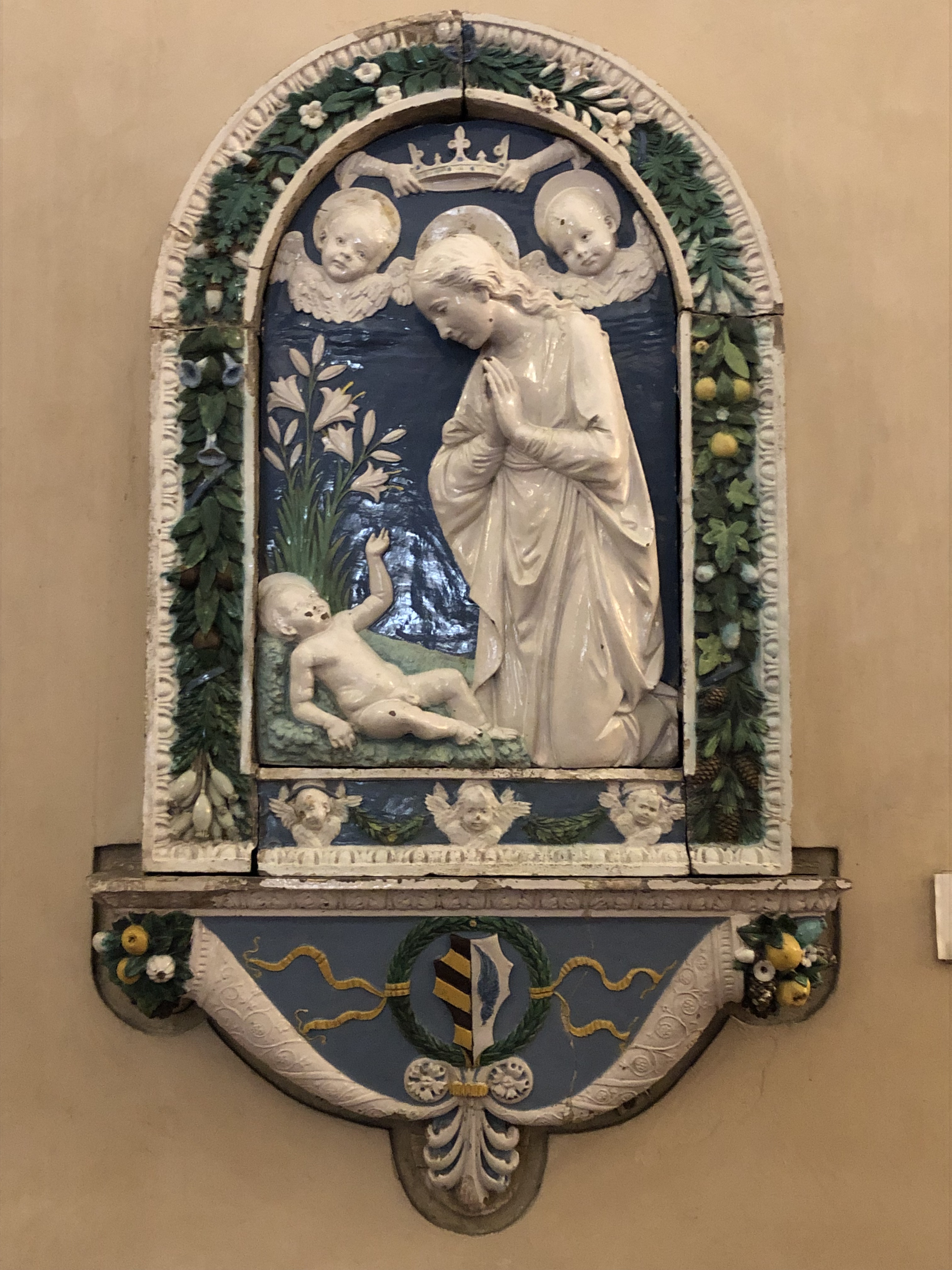
Andrea della Robbia, San Marco Convento, Florence. photo by MC
The alternative way to depict cherubs in Renaissance and Baroque art was to reduce them to floating faces with token wings on the side (sometimes in place of ears, sometimes below the ears), but no bodies at all. Was this a way to erase anything corporeal, not to mention bestial, from Christian symbols associated with heaven?
Fra Bartolomeo, detail, San Marco Convento, Florence. photo by William Carpenter
My heart was heavy three years ago when I wrote about this week’s Torah portion, Mishpatim (“Laws), and its injunctions to treat foreigners and resident aliens fairly. Mistreatment of refugees who cross into my country, the United States, was on the rise. So was intolerance of resident aliens already living and working here. A demagogue had got himself elected president of the U.S.A. by encouraging people to blame immigrants for their problems instead of asking for reform.
This year, although I still worry about the news from the United States, I am caught up in the experience of being a foreigner myself. I am not exactly a geir (גֵר) = foreigner, stranger, resident alien, sojourner, immigrant, non-citizen. I have my American passport, and eventually my husband and I will return to the country where we were born. In case of a serious emergency, we have travel insurance and the promise of help from a U.S. consul.
Nevertheless we are strangers, and in each new country where we rent an apartment for two weeks to two months, we have to figure out how things work. We find some people who speak enough English to answer some of our questions, but we pick up other rules for behavior by observation.
Laundry at the former Augobio Venetian palace inside Diocletian’s Roman palace, Split, Croatia
Our biggest challenge was our first country, Czechia. That’s where we learned how to arrange our lives around laundry. The European norm is to have a small washing machine in your apartment and hang up your clothes to dry. In Prague you drape clothes over a drying rack. Everywhere else we’ve been, you also have the option of pinning your wet clothing to a line strung outside a window (if you can reach the line and you know you won’t drop anything). Either way, laundry takes a long time to dry, and must be managed carefully so your supply of wet clothing does not back up.
Czechia is also where we learned not to smile all the time, the way Americans do. People respond better if you smile at them only when it is customary—and the customs are different in each country.
Food is also a challenge for us everywhere, thanks to the language barrier and the limitations in our diets. At grocery stores, we go by the pictures on the packages as much as we can. Asking our cell phones for translations of specific words can lead to humorous results. Asking other shoppers can lead to blank stares, and asking store employees is a gamble. One clerk might struggle through the language barrier to help us, and teach us how to pronounce a new word in the process. Another might glare and snap something incomprehensible to us.
In all four European countries where we’ve lived so far, you weigh your own produce and the machine spits out a sticker to put on your plastic bag. Sometimes. And when you go through the cashier’s line, you bag your own groceries. If you didn’t bring a bag, you buy one there.
As for restaurants, only those that cater to tourist traffic have menus with English translations. Timing also matters. In Croatia we learned that most folks eat their big meal of the day around 2:00 or 3:00 in the afternoon. We were the first customers at a fine restaurant that opened at 1:30, and not all the dishes on the menu were available yet.
Acting like a Croatian in Split
Before and after the big, late lunch, Croatians go to a café and sip coffee over a leisurely conversation, making one cup last an hour or more. Many coffee bars also sell alcoholic drinks, and bar food after dark, but the slow sipping is the same. As in Italy, you pay for your coffee or your meal when you are ready to leave, not when you order it, and you have to ask for the check.
Where do you buy a city bus ticket? Which types of business are open on Sundays? What is the procedure at a post office? Where do you put your trash? The answers to these questions have been different in each city where we’ve lived.
When I reread the post I wrote in 2017 on Mishpatim and two psalms, I smiled when I reached this sentence: “The overall theme of Psalm 119 is the longing to understand what God wants—which is like the longing of geirim to understand how things work in the strange country where they now live.”
Next week we will be in Jerusalem. Unlike most pilgrims from America, we will not be part of a guided tour, but on our own, living in an apartment for a month. We will be puzzling out words in modern Hebrew, which is spelled without vowel markings, so my knowledge of Biblical Hebrew will not be much help. I have heard that Israelis are outgoing and outspoken, but I do not know how things work in their country. Even though we are Jews, we will be geirim in Israel.
In this week’s Torah portion, Yitro, God descends on Mount Sinai in fire, smoke, earthquake, thunder, and the noise of horns, and proclaims the Ten Commandments, including the prohibition against having other gods.
Temple of Jupiter, Split, Croatia
This prohibition assumes that other gods do exist; God just wants exclusive worship. A few years ago I wrote an essay on this commandment and three Psalms that say all other gods are all inferior and subordinate to the God of Israel. You can read it here: Yitro & Psalms 29, 82, & 97: Greater Than Other Gods.
Other gods have been on my mind during our stay near the palace the Roman emperor Diocletian built in Split, Croatia. I walk past the Temple of Jupiter, built around 300 C.E. for Diocletian’s top god and metaphorical “father”, and converted in the 6th century into a Christian baptistery. I’ve seen Split’s cathedral, which was once the emperor’s mausoleum; the Catholic art here is less gory than in many cathedrals, but the man on the cross still strikes me as an “other god” who has nothing to do with the God of Jews.
Lamp, 4th century C.E., Archaeological Museum of Split
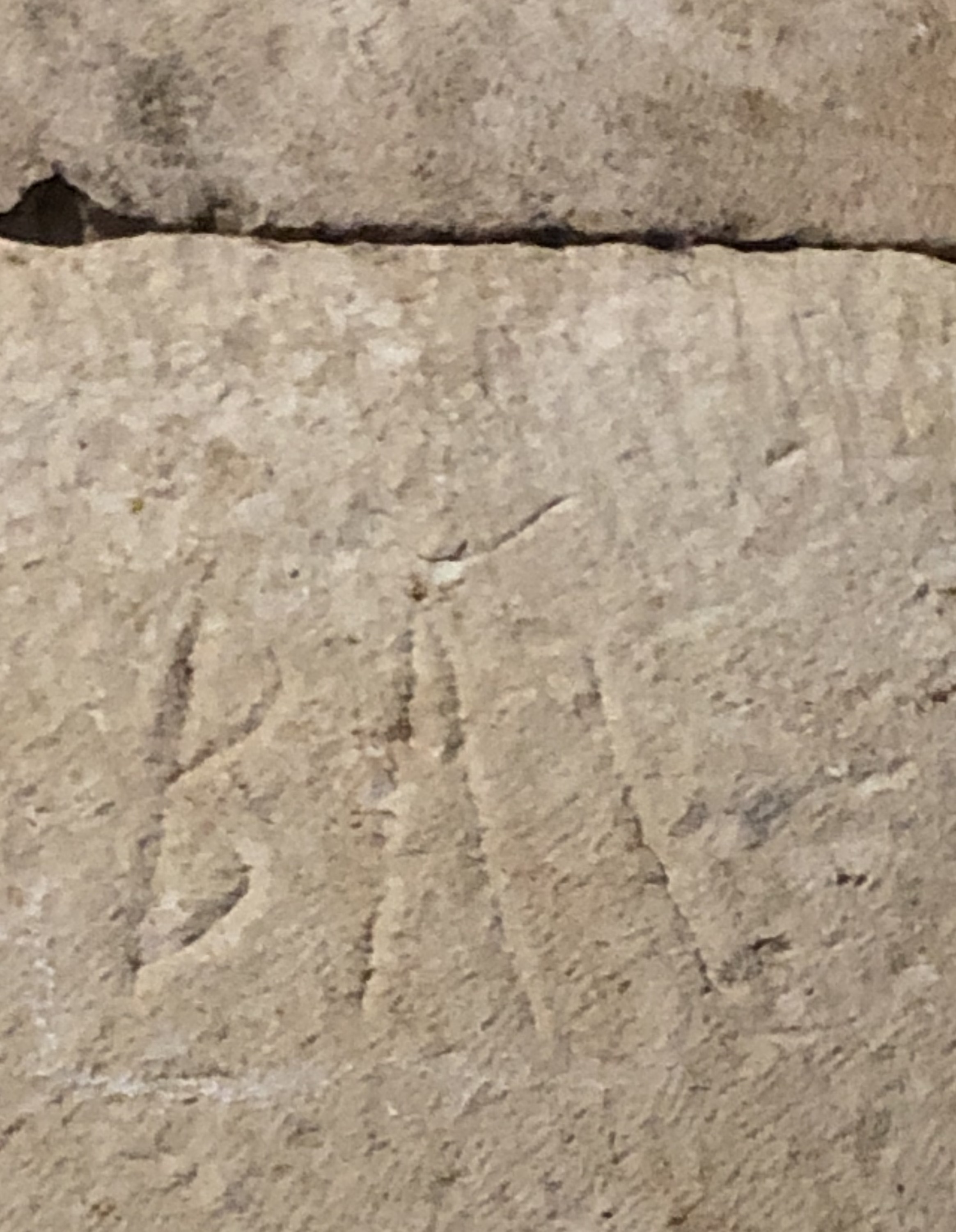
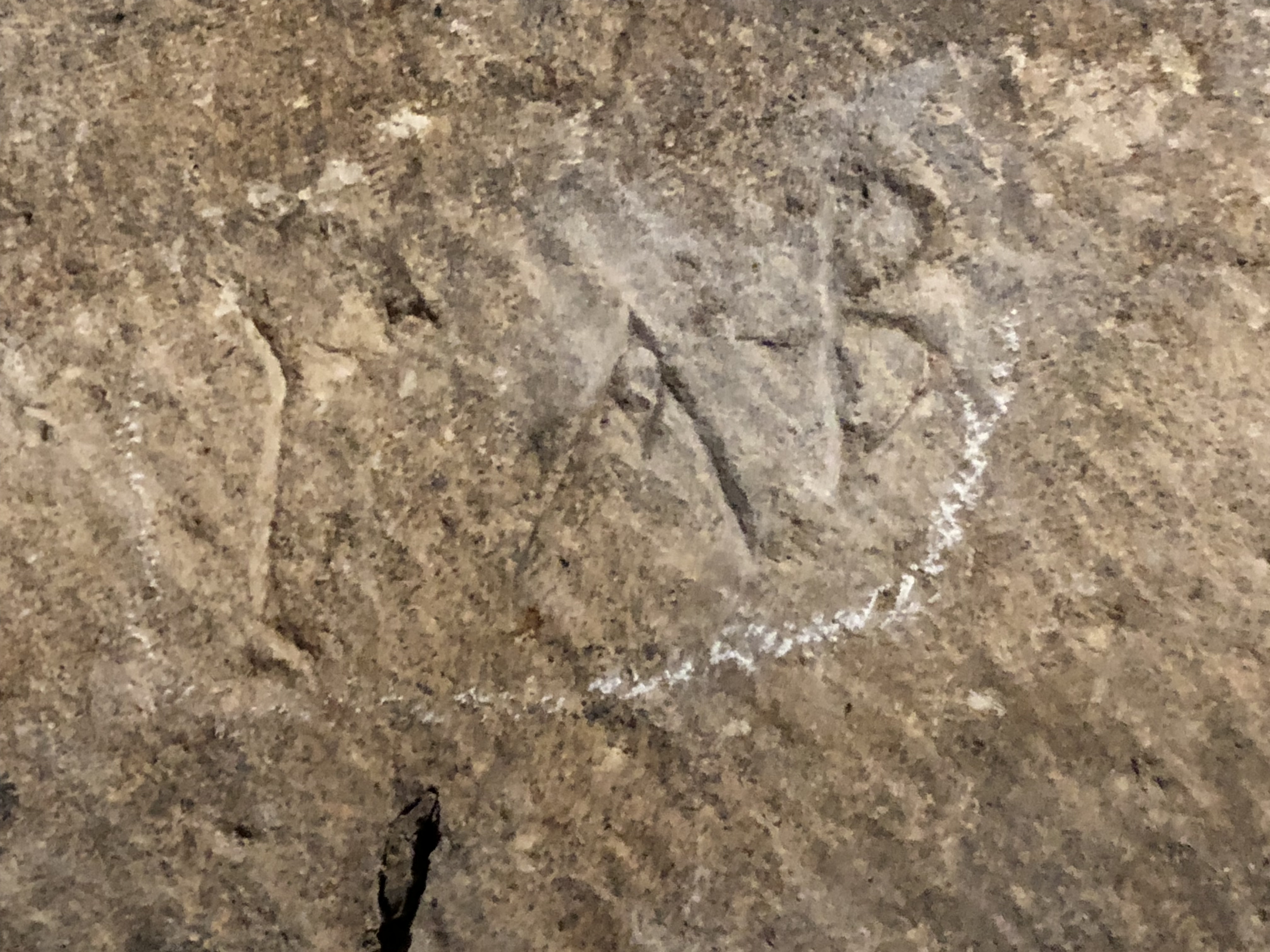
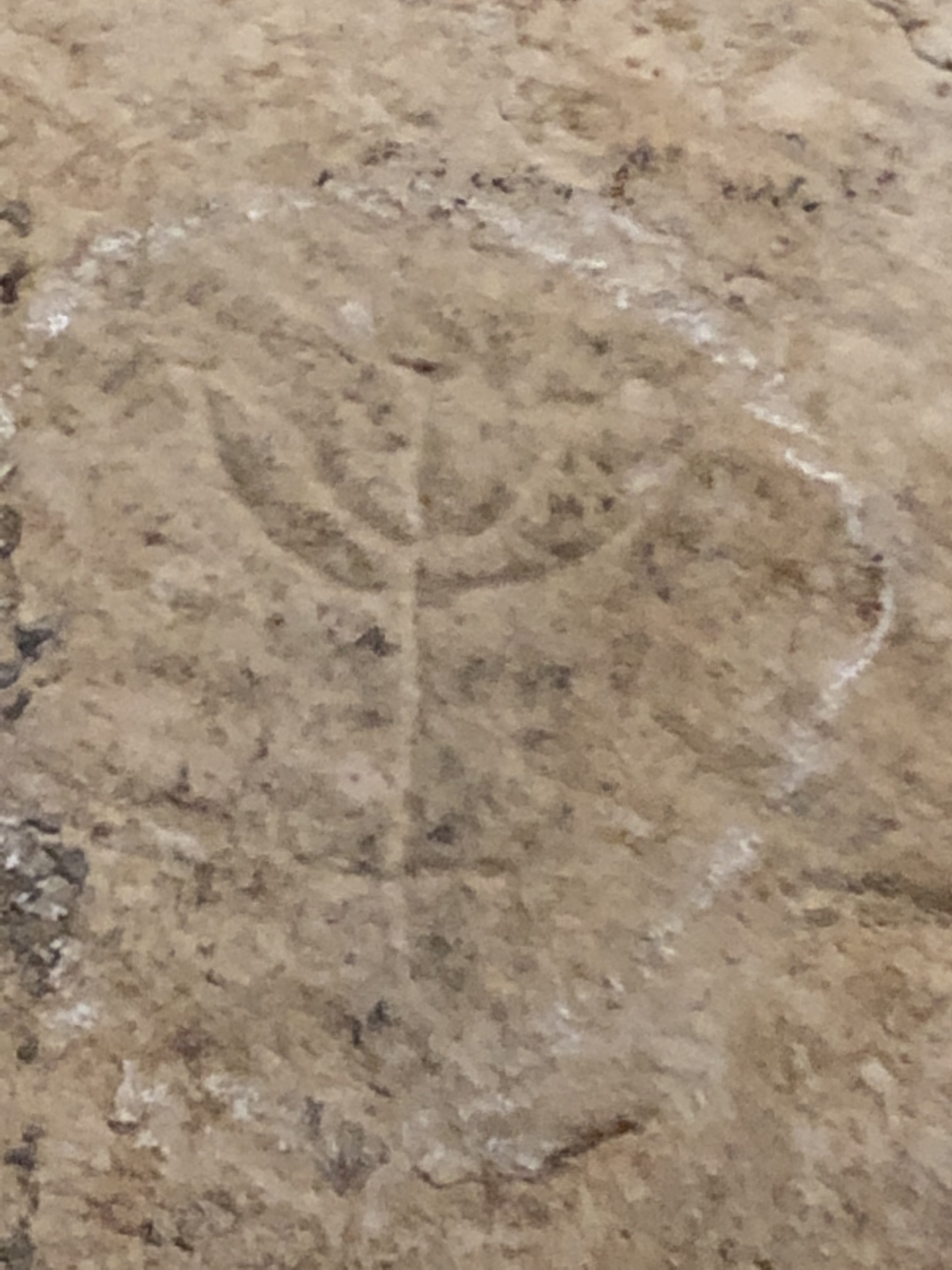
And in the eastern cellars of Diocletian’s Palace, I’ve seen both five-branched menorahs and the letters “BAL” carved into wall stones.
The menorah described in Exodus 25:32-28 has seven branches and seven lamps, like the one looted from the temple in Jerusalem and sculpted on the 1st-century Arch of Titus in Rome, and like the ones decorating 4th-century clay lamps from farther north on the Dalmatian coast.
But the four menorah carvings in Diocletian’s cellars have only five branches. Archaeologists have also found a relief of a five-branched menorah from a 4th-century sarcophagus in the Roman ruins of Salona nearby.
In Diocletian cellar 17e
The mystery about the number of branches is still unsolved, as well as the date and purpose of the menorahs scratched into the stones of two wide corridors in Diocletian’s cellars. One theory is that they date to the 7th century, when the city of Salona to the north was captured by Avars and Slavs. Both Jews and Christians fled and moved into the shell of Diocletian’s Palace, where they occupied the rooms that were still standing and also built stone houses of their own. Some of the cellars were used as warehouses, and the marks on the walls might have identified the owners of various sections of storage space.
Another theory is that some of the stone blocks in the eastern cellar walls came from Roman buildings erected on the shore before Diocletian started building his retirement palace in the 290’s. The site Diocletian chose for his palace complex sloped down to the sea, so he built the cellars under the south end to create a level ground floor for the entirety of the fortification (and to raise his own living quarters well above water level). Other remnants of earlier Roman structures have been found in the cellars. Could the menorahs have been scratched into the wall stones of a previous building to indicate ownership by Roman Jews?
Also in cellar 17e
Either way, it disconcerts me to see the menorah carvings interspersed with the carved Roman letters “BAL” in the same cellar hall.1
In Hebrew, baal(בַּעַל) = owner, lord, husband. Local gods were called the baal of ____, with the blank filled in by a place name. For example, in the book of Bemidbar/Numbers, the Israelites go to feasts for Baal Pe-or.2 Occasionally the Torah calls God baal, as in poetic passages comparing the Israelites to a bride and God to a husband. But usually a baal is a foreign god, the kind that the Israelites are forbidden to serve.
The Hebrew Bible reports widespread worship of two foreign gods in the northern kingdom of Israel in the 7th century B.C.E.: Baal and Asherah.3 Were there Roman Jews five or six centuries later who still worshiped both the God of Israel and Baal? Did the same people carve both symbols into the stones?
Probably not. Although Jews living with Romans might well have learned the Roman alphabet, they would have used Hebrew letters for anything related to their own community. Even if they wanted to add words to their menorah carvings, and chose the word baal to confirm that they were the baalim, the owners, of that hall, they had no reason to use an alien alphabet.
Furthermore, the letters BAL are carved more deeply into the stone than the menorahs, implying a different carver or a different technique. And why does one BAL have its letters reversed? Why is there another motif, a circle within a circle, in several of the eastern cellars?
So far I have been unable to find out anything about the “BAL” carvings. Maybe Bal was merely the name of a family that lived and worked beside the people who carved menorahs.
I still hope to find out why the menorahs in Diocletian’s cellars have five branches. A similar five-branch menorah carving was discovered in in Jerusalem during an excavation of an ancient drainage ditch in 2011. Maybe by now the stone will be in a museum, and I can see it and read more about it than I could find on-line. We fly to Israel only two weeks from now.
—
The corridor labeled 17E by archaeologists.
Numbers 25:1-3.
1 Kings 18:18-21, in which Elijah challenges the worship of two gods that Queen Jezebel imported from Phoenicia. The worship of either Baal or Asherah is also mentioned elsewhere in the Bible.
The Israelites Leave Egypt, The Golden Haggadah, 14th century Spain
The Israelites march out of Egypt beyad ramah, “with a high hand”, in this week’s Torah portion, Beshelach. (To read my 2013 essay on that rare phrase in the Torah, you can click here: Beshalach: High-Handed.)
Beyad ramah, like the English idiom “high-handed”, means arrogantly doing something without consulting or collaborating with others. In this week’s Torah portion, the Israelite slaves march out of Egypt fearlessly, even arrogantly, taking their Egyptian neighbors’ jewelry with them.
Three days later at the Reed Sea, they see the Egyptian army behind them and they feel powerless once more. Forty years later in Canaan, they kill, plunder, and conquer the native population in a way that could be considered high-handed. After that a few Jewish kings act arrogantly in the Torah, but the Israelites as a people rarely have the opportunity. Both Israelite kingdoms are small and eventually swallowed up by their powerful neighbors.
For almost two millennia, from the destruction of the second temple in 70 C.E. to the founding of the nation-state of Israel in 1948, Jerusalem and its surrounding province were subservient to the government of one larger empire after another. Jews who emigrated to other countries were only rarely considered peers of the majority group; discrimination ranged from being charged an extra tax to being murdered by mobs. An individual Jew could be high-handed in his own sphere, but a group of Jews could not pull it off until the twentieth century.
When I started working on volunteer committees I learned that if I just did something without consulting everyone who might be involved, I was being high-handed. I remembered how I had hated being treated unfairly and without respect when I was younger, and I learned how to collaborate better.
Can whole groups of people live together with mutual respect?
Sometimes, in some places, Jews have been one respected group living in harmony with other groups. Over the last two millennia, this was often the case in Split, Croatia, the city where I am living this winter.
A Short Illustrated History of Jews in Split
(all photos by Melissa Carpenter)
In the first century B.C.E. the Romans acquired both Syria (which included Jerusalem) and Dalmatia (which included Split). Julius Caesar set an example by granting Jews an exemption from Roman religious practices and permission to follow their own customs. In Jerusalem and the district of Judea, Jews protested in 66 C.E. against Roman taxes and soldiers, and the Roman governor responded by plundering the treasury of the temple. During the war that ensued, the Romans razed the temple.
Menorah from Salona, 4th century C.E., Split Archaeological Museum
Meanwhile in Dalmatia, Jews came with the Romans and settled along the coast. Jewish artifacts from as early as the third century C.E. have been found in both Split and the Roman city of Solana across the bay.
Emperor Diocletian, who built his retirement palace in Split around 300 C.E., persecuted and executed local Christians, but left Jews free to observe their own religion.
5-branch menorah carved on wall stone in cellar 17E, Diocletian’s Palace, Split
The Roman Empire was collapsing when Slavs and Avars invaded Dalmatia in the 6th century and seized the city of Salona north of Split. Both Jews and Christians fled across the bay and built stone houses inside the shell of Diocletian’s palace. Archaeologists have yet to determine whether the menorahs carved into buildings stones in the cellars of the palace date from this time or an earlier century.
In the 1490’s Spain and Portugal expelled their Jews. Some ports on the Adriatic Sea refused to accept these refugees, but Split made room for them, and these Sefardic Jews settled in the northwest quarter of Diocletian’s former palace. Eventually that became the Jewish neighborhood of Split.
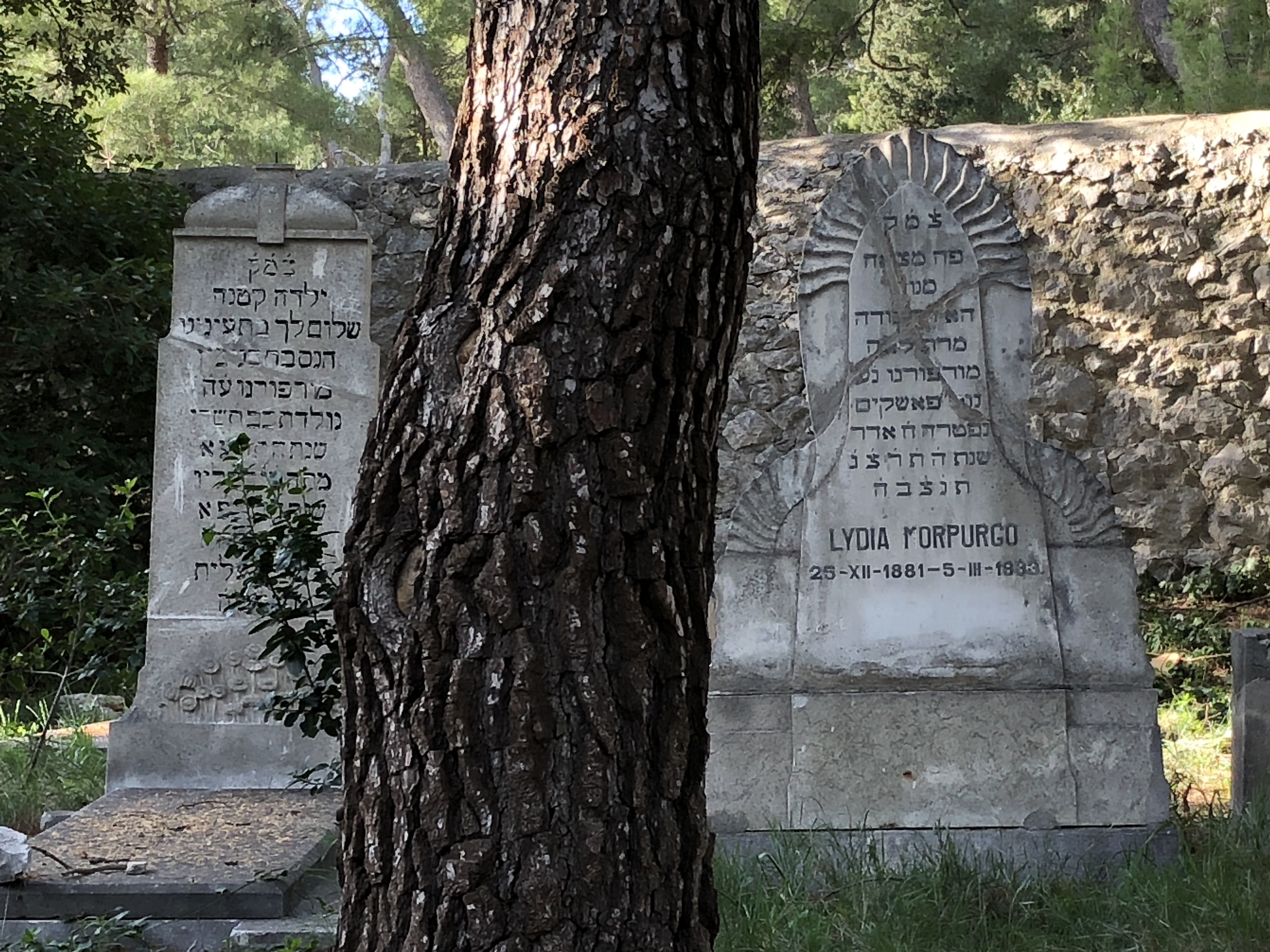
Jewish Cemetery on Marjan Hill
Split and the rest of the Dalmatian coast north of Dubrovnik were part of the Venetian Republic from 1420 to 1796. In the 16th century one of the Jewish immigrants from Portugal, Daniel Rodriga, persuaded the Venetian government to turn Split into a major port by adding a lazaretto with warehouses and a quarantine building. The doge in Venice agreed and put Rodriga in charge of building the lazaretto in 1572. Rodriga got permission from local authorities to establish a Jewish cemetery on the slope of nearby Marjan Hill in 1573.
“Jewish Tower”
Split boomed thanks to Rodriga’s lazaretto, and in the 17th century the Venetians built a defensive wall with bastions to protect their valuable port from the Ottomans, who had captured the other side of the bay. When Ottomans attacked Split in 1657, the Venetian wall was still under construction. The local Jews were trusted with the defense of Diocletian’s northwest tower. The Ottomans were unable to penetrate the city center inside the palace, and townspeople started calling that tower Zidovska Kula, “Jewish Tower”.
At first the Venetian ruling class was remarkably tolerant of Jews compared to the Christians in other countries, and the Jews of Split were free to follow any trades they chose. The only restriction imposed on them was that they could not own property; they had to rent, but they could buy long-term leases. And although Venice itself established a ghetto in 1516, Jews in Split could lease houses wherever they wanted. Most, but not all, chose to live in the old Jewish neighborhood.
This harmony between Christians and Jews lasted until the 18th century. Then in 1738 the Venetian rulers of Split started requiring Jews to wear special hats. In 1778 they ruled that Jews could no longer employ Christians, and created a Jewish ghetto by putting gates in seven of the stone archways over the narrow streets of Diocletian’s old palace. The gates were placed so the ghetto included the buildings where most of the Jews already lived. Jews had to be inside the gates from midnight to sunrise.
When Napoleon captured Split in 1806, all restrictions on Jews were eliminated. But then the Dalmatian coast fell to the Austro-Hungarian Empire, which did not grant Jews complete equality and freedom until 1867.
At the end of World War I, Dalmatia became part of the new kingdom of Yugoslavia, which was conquered by the Axis powers during World War II. In 1941 Germany installed a puppet government for inland Croatia called the Ustase, which shared the Nazi attitude toward Jews. Meanwhile Italy annexed most of the Dalmatian coast, and the people of Split organized armed resistance against the Italian fascist occupiers. The Jews of Split arranged for Jewish refugees from inland to escape through the port.
Although Italy refused to deport or murder Jews, in 1942 a mob including Italian soldiers attacked the Split synagogue and the people inside, and looted 60 Jewish homes. The following year Italy surrendered to the Allies, and Germany took over, assigning the Dalmatian coast to inland Croatia’s Ustase government. Dedicated to exterminating Croatian Jews and Muslim Serbs, the Ustase created their own concentration camps.
Fort Gripe, Split (now a maritime museum)
In Split the Ustase found a new use for the barracks at Fort Gripe, which had been built by the Austrians on the north side of a Venetian fort, and occupied by Mussolini’s soldiers for two years. In 1943 the barracks were converted into a prison for the remaining Jews of Split. Two Split doctors, Andrija Poklepovic and Mihovil Silobrcic, managed to rescue some of those Jews by transferring them to a hospital and then claiming they were quarantined because of disease.
The rest of the Jews imprisoned in Split were deported to two Ustase camps, Sajmiste and Jasenovac, where they were all murdered. About 150 of the 284 Jews living in Split in 1940 survived until liberation in 1945.
Croatia and its Dalmatian coastline were part of Tito’s Socialist Federal Republic of Yugoslavia from the end of the war to 1991, and due to the country’s official atheism, no rabbis were allowed. The first president of the independent nation of Croatia, Franjo Tudman, was known for his anti-Semitic slurs, and appointed former members of the Ustase to government posts.
Under the new Croatian constitution following Tudman’s departure from office, Jews are one of twelve “autonomous national minorities”, and elect a special representative to the Croatian parliament. The only anti-Semitic incidents I could uncover in the 21st century were the chanting of Ustase slogans, particularly at soccer matches, and the carving of a swastika into the turf of the soccer field in Split in 2015, which resulted in a 100,000 euro fine.
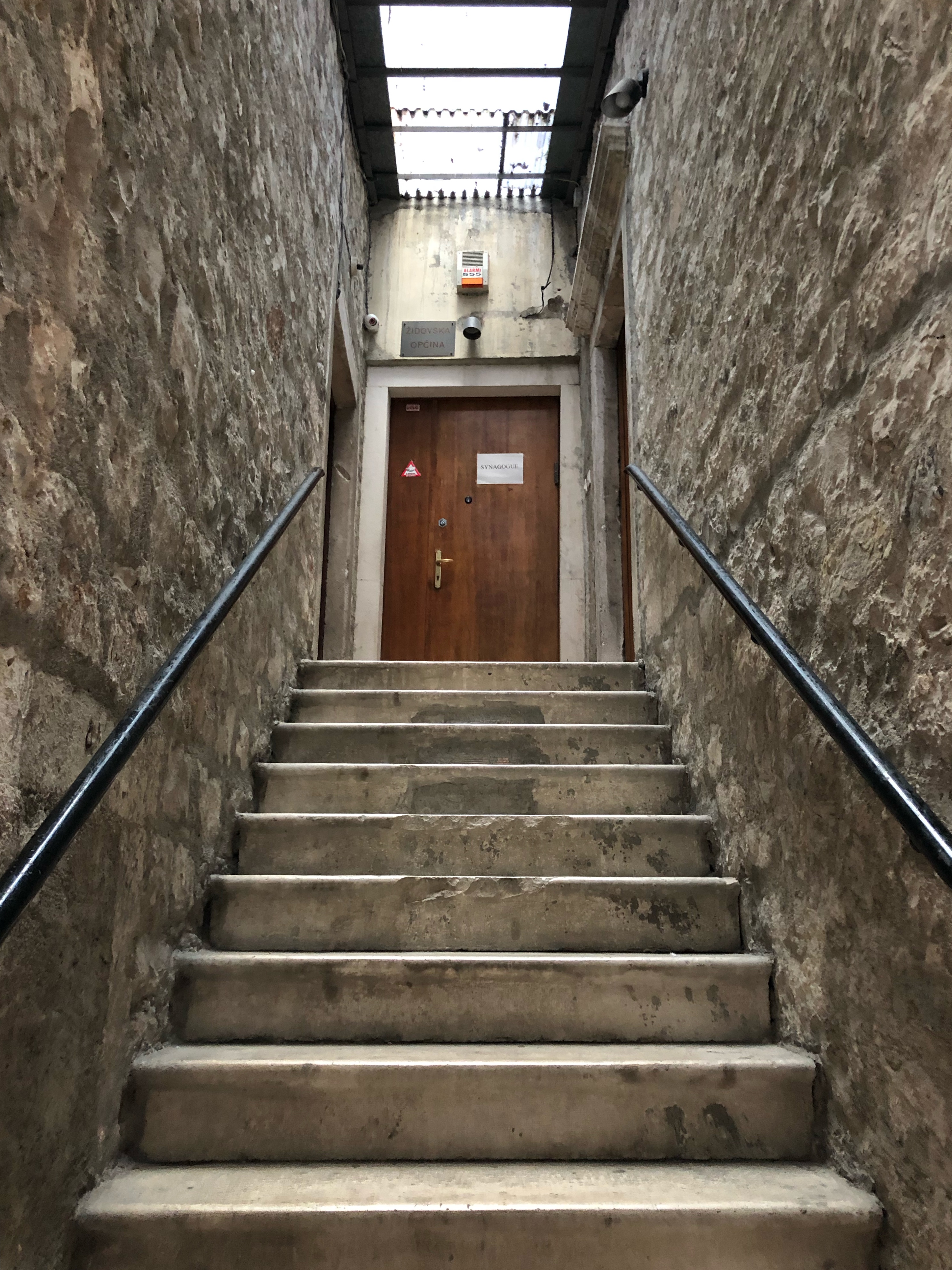
Today the Jewish population of Split is small; about 100 families belong to the Jewish community, which restored the old 16th-century synagogue in 1996 and meets there regularly.
So does Split count as a place where the Jews are respected and live in harmony with other groups? Not always, but more often than most places over the last 2,000 years.
(My thanks to Ivica Profaca, to “Albert” at the synagogue, and to the world’s biggest library, the Internet.)
Well, it may be the devil or it may be the Lord But you’re gonna have to serve somebody. (Bob Dylan)
The pharaoh of Egypt is an absolute ruler in the book of Exodus/Shemot. His word is law, and everyone in the country must serve him almost as if he were a god. There is no conflict between serving the pharaoh and serving Egyptian gods. But the God of Israel is a “jealous” god, who requires exclusive service.1 One cannot serve both God and Pharaoh.
When Moses and Aaron first speak to the pharaoh, they only request a leave of absence for the Israelites so they can make a three-day journey into the wilderness to offer animal sacrifices to God, Y-H-V-H.2 The implication is that then they will return to the corvée labor the pharaoh has imposed on them. But the ruler of Egypt refuses, sensing that there is a deeper issue.
And Pharaoh said: “Who is Y-H-V-H that I should listen to his voice [saying] to send out Israel? I do not know Y-H-V-H, and neither will I send out Israel.” (Exodus/Shemot 5:2)
He increases the workload of the Israelites instead. A demonstration miracle turning a staff into a snake does not change his mind.3 Following God’s order, Moses now warns the pharaoh about the first “plague” or miraculous disaster, which will turn the Nile into blood, and tells him that God said:
“Send out my people so yavduni in the wilderness!” (Exodus 6:16)4
yavduni(יַבְדֻנִי) = they will serve me. (A form of the root verb avad, עָבַד = work for someone, serve as a slave, employee, or attendant.)
Plague of Frogs, Golden Hagaddah, 1320-1330 CE
The pharaoh does not change his mind. After the second plague, frogs, the pharaoh says he will let the Israelites go, then hardens his heart and refuses as soon as God has ended the disaster. After the fourth plague, mixed vermin, the pharaoh offers to let the Israelites sacrifice to their god inside the land of Egypt, but Moses insists on the three-day journey into the wilderness.5 Again, the pharaoh agrees at first, but then refuses as soon as God removes the vermin.
During the seventh plague, hail, the pharaoh actually admits to Moses and Aaron that he is morally inferior to their god, Y-H-W-H:
“I am guilty this time. Y-H-W-H is the righteous one, and I and my people are the wicked ones. Pray to Y-H-W-H and enough from being thunder and hail, and I will send you out, and you will not continue to stand [against me].” (Exodus 9:28)
Moses agrees to do so, though he adds:
“But you and your avadim, I know that you still do not fear Y-H-V-H, God.” (Exodus 9:30)
avadim (עַבָדִים) = servants, courtiers, slaves. (Plural of the noun eved, עֶבֶד, from the root verb avad.)
Moses is right; once the hail and thunder have ceased, the pharaoh hardens his heart again and refuses to let the Israelites go.
This week’s Torah portion, Bo (“Come!”) begins when Moses announces the eighth plague, locusts.
And Moses came, and Aaron, to the pharaoh, and they said to him: “Thus says Y-H-V-H, the god of the Hebrews: How long will you refuse to humble yourself before me? Send out my people, so yavduni!”
In effect, Moses and Aaron admit that the contest is about who is superior, God or the pharaoh.
And the avadim of the pharaoh said to him: “How long will this be a stumbling block for us? Send out the people and ya-avdu Y-H-V-H, their god! Don’t you know yet that Egypt is destroyed?” (Exodus 10:7)
ya-avdu (יַעַבדוּ) = they will serve. (Another form of the verb avad.)
The pharaoh calls back Moses and Aaron and says:
“Go, ivdu Y-H-V-H, your god! Who and who are going?”
ivdu (עִבְדוּ) = serve! (An imperative of the verb avad.)
Plague of Darkness, Spanish, 1490 CE
Moses says all the people will go, including the children and even the flocks and herds. The pharaoh replies that only the men may go. So the plague proceeds. After every green plant in Egypt has been consumed by the locust swarms, the pharaoh admits his guilt. Yet his heart is unmoved when Moses describes the ninth plague, darkness, in which blindness strikes everyone in Egypt except the Israelites.
After three days of darkness the pharaoh offers to let even the children go, as long as the Israelites leave their livestock behind. Moses refuses, saying they need their flocks and herds to serve God.
“Because we will take from them la-avod Y-H-V-H, our god, and we will not know with what na-avod Y-H-V-H until we arrive there.” (Exodus 10:26)
la-avod (לַעֲבֹד) = to serve.
na-avod (נַעֲבֹד) = we will serve.
Moses knows that God intends to take the Israelites out of Egypt and give them a new land. Is he making up an excuse so that when the people leave for good they can take their animals with them? Does the pharaoh ask them to leave their livestock behind because that it just what he suspects? The pharaoh threatens to kill Moses if he ever sees his face again.
Then Moses gets angry, and tells the pharaoh about the tenth and final plague, the death of the firstborn.5 When it comes, the pharaoh and all the Egyptians practically push the Israelites out of the country. But the pharaoh, accustomed to hardening his heart, changes his mind after they have left. He sends an army to capture them.
Plague of the Firstborn, Spanish, 1490 CE
In next week’s Torah portion, Beshalach, the Israelites believe they are trapped between the Egyptian army and the Reed Sea.
And they said to Moses: “Is it because there are no graves in Egypt that you take us to die in the wilderness? What is this you have done to us by bringing us out of Egypt? Isn’t this the thing that we spoke to you [about] in Egypt, saying: Leave us, vena-avdah the Egyptians, because it is better for us avod the Egyptians than dying in the wilderness!” (Exodus 14:11-12)
vena-avdah (וְנַעֲבְדָה) = and we will serve.
avod (עֲבֹד) = serving.
The Israelites would rather serve the reality they know, however grim, than serve the invisible source of the ten miraculous disasters. God is an intangible idea that they are unable to trust.
I do not blame them. Human beings are naturally suspicious of change and skeptical about new ideas. We might experiment in small ways, but laying one’s life on the line is heroic and unusual—unless the boss orders it and everyone else is doing it, as in a war. Given a choice between certain slavery and risking death, many of us would choose slavery and hope that things would improve in the future even if we take no action.
Yet when we read a story like the one in the book of Exodus, most of us root for the Israelites to stop serving the pharaoh and throw in their lot with God. After all, serving God does not usually mean dying. Only once in a while.
You’re gonna have to serve somebody. What if the choice is between going along with an immoral status quo or rebelling against it? What do you choose?
This jealousy appears even in the Ten Commandments, Exodus 20:2-6.
Moses never says “Let my people go!” in the book of Exodus without adding “to serve God” or “to slaughter offerings for God”. Sometimes he adds more qualifiers. Throughout this week’s Torah portion, which covers the first seven plagues, Moses’ demand is that the pharaoh give the Israelites a short leave of absence from their forced labor so they can travel for three days into the wilderness the midbar (מִּדְבָּר), and serve their god there with animal sacrifices.
Back in 2013 it seemed obvious to me that prayer in a midbar is different from prayer in inhabited places. I have done very little wilderness hiking, but even a walk through the woods or on a beach beyond the houses and other people has let me pray more deeply. And midbar means not only wilderness, but also includes any land that is uninhabited or uncultivated.
But this year, writing in our apartment in Split, Croatia, the idea of encountering God in the midbar seems intriguing but out of reach.
Maisel Synagogue in Prague; built 1592, rebuilt 1905
Since we left our home in Oregon four months ago, we have visited old synagogues in five European cities during the past four months, but we only managed to go to one service, at the Maisel Synagogue in Prague. We pick which European spots we visit, whether for a day trip or for a month-long stay, based on their history, art, and architecture. We happily spend our days in cities that were already urban centers centuries ago, and are still packed with people. I sing Jewish prayers inside our lodgings, and sometimes while I walk outside. But my praying is neither communal nor in a midbar.
We are heading for Jerusalem at the end of February. Until then, when we push our aging bodies into taking long walks, we pick routes with old buildings, museums, and an occasional café where we can rest and warm up. In Oregon we had breathtaking midbar of all kinds: seashores, forests, waterfalls, deserts, mountains … Why waste time going to those kinds of places in Europe when we can get the same or better at home?
Peacock and fallen oranges in a front yard, Split, Croatia
Now my memories of praying alone in the woods seem faded, as if it happened long ago. Yet every day I sing my morning prayers when I get up, and it still reminds me of God, still triggers gratitude for my life. And when I see something that amazes and delights me, natural or man-made, I am moved to murmur another prayer of gratitude in Hebrew.
I daresay both communal prayer and wilderness prayer will both come back to me, maybe in Israel, certainly when we return to the United States. Meanwhile, I savor not only my personal practice, but also continuing to study and write about the Torah.
Entrance to synagogue in Split, Croatia (photo by M.C.)
The people we now call Jews have had many names over the past four millennia. The names they chose for themselves changed as they evolved from a cluster of Canaanite tribes, to an ethnic group with their own religion and country, to the scattered adherents of a religion and ancestry, to the varied people we know as Jews today. So did the names other people called them.
Click on this link: Shemot: Hebrews versus Children of Israel for an improved version of the essay I wrote in 2013 on two ancient names for the people we call “Jews” today: Hebrews and Israelites. In the Ancient Near East, the word corresponding to “Hebrews” (ivrim) meant outsiders, while the words corresponding to “Israelites” (benei Yisraeil) meant the children of an active engagement with God.
Both names appear in the Torah portion Jews are reading all over the world this week, Shemot (“Names”). It is the first portion in the book of Exodus, also called Shemot in Hebrew.
At least Jews who follow the cycle of Torah readings are opening the book of Exodus again. But what about Jews who pay little attention to the religion, yet stand firm in their ethnic identities?
A few of my friends in the United States fit that description. And so do most of the one hundred Jews in Split, Croatia, according to a Jewish man I met in Split’s only surviving synagogue. The survivors of World War II dismissed their parents’ religion.
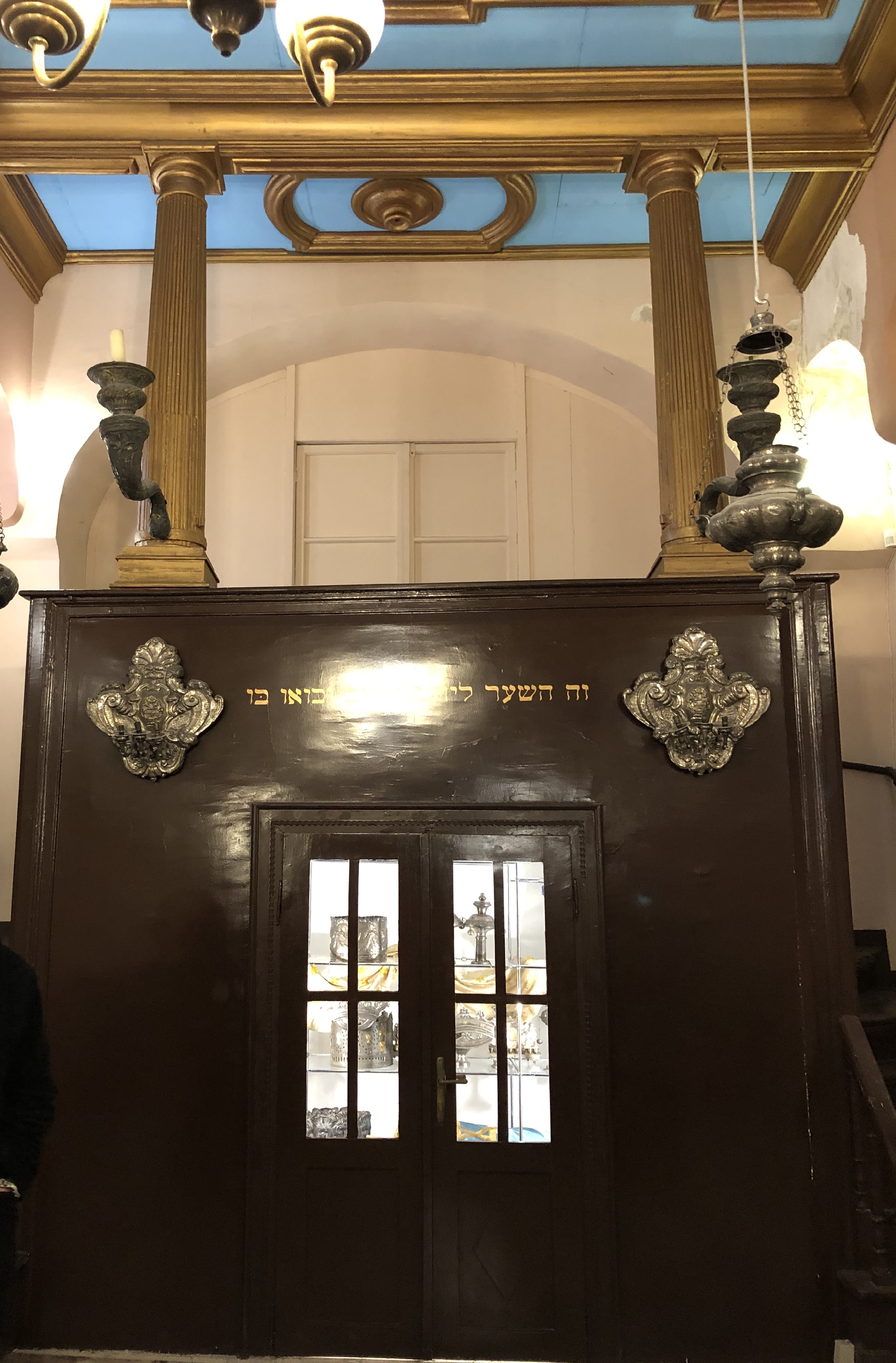
West end of sanctuary, Split
“We gather mostly to eat dinner together,” said the man who called himself Albert to English speakers like me. His eyes twinkled. “We eat kosher lobster! We get it straight from the fisherman, and he tells us which lobster is kosher.”
The Jewish community also dedicates itself to maintaining the synagogue, which was created in the 16th century out of the upper floors of two older stone houses inside the wall of Diocletian’s Palace. The interior of the sanctuary was remodeled in 1728, and has been maintained that way.
During the past year, a rabbi has been coming down from Zagreb about once a month to lead a service. The first service he led lasted three hours, Albert said. “We were thinking 45 minutes. People started to get up and leave. Afterward I told him he could come back, but we had to have a shorter service. He asked how long, and I said: 35 minutes. He said he couldn’t lead a service in only 35 minutes. I said okay, you can pray as long as you as you want to, but after 35 minutes we’ll go downstairs and have dinner. He got the idea.”
*
I converted to Judaism 33 years ago, but I am still aware of the difference between being an ethnic Jew and being a Jew for the religion. I can never have a Yiddish-speaking grandmother. I will never acquire the Ashkenazi taste for herring, either pickled or in sour cream. (I do not know what the traditional Jewish foods were for Croatians. Not lobster!) I will never know what it is like to grow up Jewish; I can only guess based on reports from my Jewish friends and memories of how as a child I was excluded and teased for other reasons.
I cannot be described as a “religious Jew” either, because in some ways I am not very observant, and my beliefs are idiosyncratic. Yet I remain passionately engaged with the religion. The longer I am away from the two Jewish communities I belong to in Oregon, the more I notice that I am a Jew and I can never be comfortable with any other religion.
When we visit old synagogues in Europe, I always take time to decipher the phrases written in Hebrew letters over the ark or on the wall. (For my own Torah study I use the Masoretic text, which includes vowel markings (nikudim). But the words on the walls are always painted or carved without vowels, like the writing in a Torah scroll, and like modern Hebrew in Israel. I hope to get better at reading unvoweled Hebrew when we spend a month in Israel at the end of this winter.)
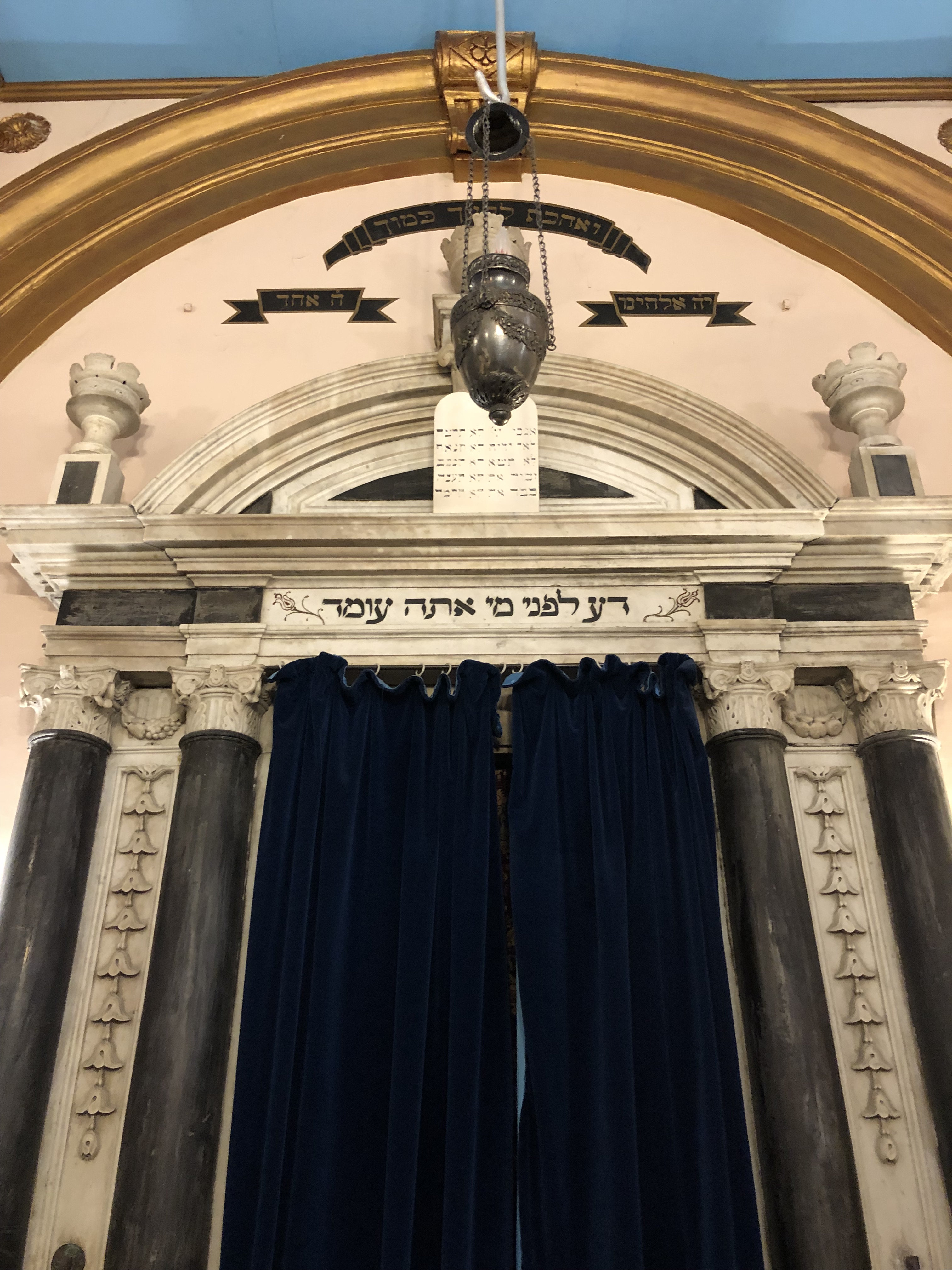
Ark on the east wall, Split
Each time I pronounce a phrase in Hebrew and then translate it to myself, my heart lifts, and I feel a surge of homecoming.
The Hebrew over the ark on the east wall of the only synagogue in Split is in Aramaic, but I managed to read it.
Du lifney mi atem omdim, “Know before whom you stand.” (Talmud Bavli, Berakhot 28b)
It’s a tall order. But as a Jew, as an adopted member of the children of Israel, I will keep striving to do so.
The last Torah portion in the book of Numbers/Bemidbar begins:
These are the masey the Israelites when they departed from the land of Egypt in their troops by the power of Moses and Aaron. Moses wrote down their departures for maseyhem at the word of God. And these were the maseyhem for their departures: (Numbers/Bemidbar 33:1-2)
masey (מַסְעֵי) = stages of the journey of. (A form of the noun massa (מַסַּע) = breaking camp, travelling on, journeying, stage of a journey. Derived from the root verb nasa(נָסַע) = pulled out, started out, uprooted.)
maseyhem (מַסְעֵיהֶם) = their stages of travel, their journeys. (Another form of the noun massa.)
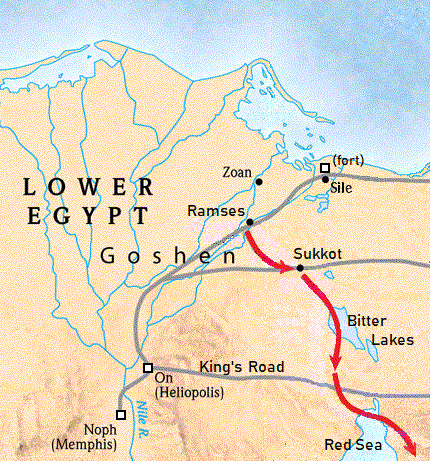
The Torah then lists 42 locations, from Ramses, the city where the Israelites assembled to leave Egypt, to the bank of the Jordan River, where the book of Numbers ends. In the list are a few geographical notes to help locate the campsites, and three references to events that occurred on the way.
Which three events?
At Rameses
Vayisu from Ramses on the first month, on the fifteenth day of the first month. On the day after Passover the Israelites departed with a high hand, before the eyes of all the Egyptians. The Egyptians were burying those that God had struck down, every firstborn; and against their gods God had done justice. (Numbers 33:3-4)
vayisu (וַיִּסְעוּ) = and they pulled out. (A form of the verb nasa.)
The extra information about the first location, the Egyptian city of Ramses, is that the Israelites left the morning after the night of the tenth and final plague God inflicted on the Egyptians, the death of their firstborn;1 that the Egyptians no longer tried to stop them; and that their God was stronger than the Gods of the Egyptians. Therefore the Israelites left proudly and openly, confident that God was on their side.
At Refidim
Vayisu from Alush and they camped at Refidim, and there was no water for the people to drink. (Numbers 33:14)
This sentence refers to a story in the book of Exodus/Shemot that begins:
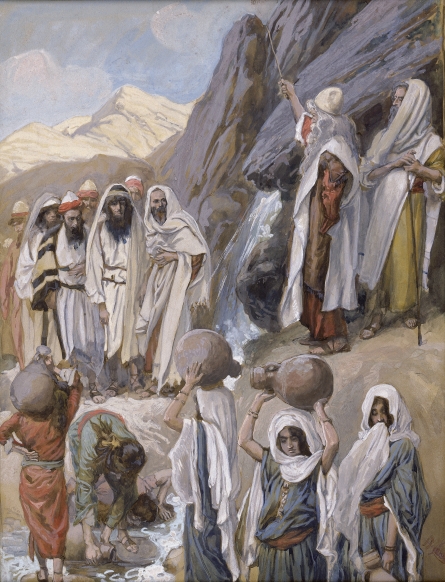
Moses Strikes the Rock, by James Tissot
Vayisu, the whole community of Israelites, from the wilderness of Sin for maseyhem at the word of God. And they camped at Refidim and there was no water for the people to drink. And they argued with Moses, and they said: “Give us water so we can drink!” And Moses said to them: “Why do you argue with me? Why do you test God?” (Exodus 17:1-2)
At the end of the story, the Torah reports that the Israelites said:
“Is God among us or not?” (Exodus 17:7)
Eleven times during their travels from Egypt to the Jordan River the Israelites complain about the conditions and reveal their lack of trust in God, Moses, or both.2 But this week’s Torah portion picks out only the time at Refidim, when God tells Moses to address the problem by striking a rock with his staff, and water comes out.
Why pick this complaint over any of the other ten times3 the Israelites test the leadership of either God or Moses? Why not include the time when Moses strikes the rock but fails to give God credit for the water?4 Or the confrontation at the Reed Sea?5 Or the complaint about food that led to God sending daily manna?6 Or the demand for the golden calf?7 Or the refusal to cross into Canaan at its southern border, which led to another 38 years in the wilderness?8
At Hor
Vayisu from Kadeish and they camped at Hor the Mountain, at the edge of the land of Edom. And Aaron the priest went up to Hor the Mountain at the word of God, and he died there in the 40th year of the exodus of the Israelites from the land of Egypt, on the fifth month, on the first of the month. And Aaron was 123 years old when he died at Hor the Mountain. And the Canaanite, the king of Arad who lived in the Negev in the land of Canaan, heard of the coming of the Israelites. (Numbers 33:37-40)
Both of Moses’ siblings, Miriam and Aaron, die on the journey. Both are leaders of the people, but only Aaron’s death is mentioned in the list. It might be sexism, or it might be because his death establishes the succession of high priests. Aaron’s oldest surviving son, Elazar, climbs the mountain with his father and Moses, and Aaron dies after Moses has removed his vestments and dressed Elazar in them.9
But why does the Torah portion Masey also mention the king of Arad? In a brief story earlier in Numbers, this king hears of the approaching Israelites, attacks them, and takes some captives.
Then the Israelites vowed a vow to God and said: “If you actually give this people into our hands, then we will dedicate their towns to destruction.” And God listened to the voice of the Israelites and gave [them] the Canaanites … (Numbers 21:2-3)
They were testing God again, but not complaining. In the Torah, dedicating something captured in battle to destruction means dedicating the whole battle to God instead of keeping some booty for personal benefit. Perhaps the Torah mentions the king of Arad here to show that the Israelites are not always rebellious; once in a while they dedicate everything to God.
Not at Mount Sinai
Why does the Torah pick these three events, and no others—not even what happened at Mount Sinai? The Torah portion merely says:
Vayisu from Refidim and they camped in the wilderness of Sinai. Vayisu from the wilderness of Sinai and they camped at Kivrot Hata-avah. (Numbers 33:15-16)
Yet at Mount Sinai the Israelites experience the presence of God in a revelation full of smoke, fire, thunder, and earthquake.10 God gives them the Ten Commandments, first in a voice only Moses can bear to hear, then engraved on pair of stone tablets, twice.11 At Mount Sinai the Israelites believe Moses will never return from the mountaintop, and worship Golden Calf.12 At Mount Sinai the Israelites make covenants with God, verbal and sacrificial, and their elders see God’s feet.13 At Mount Sinai they craft a portable tent-sanctuary so God will dwell among them.14
During their year in the wilderness at Mount Sinai, the attitude of the Israelites toward God swings between terror and total devotion, with a side-trip into ecstatic idol-worship.
The three events mentioned in this week’s list, however, focus on the attitude of the Israelites toward God when they are on their journey, not pausing in ecstasy. At Ramses the Israelites who leave with Moses are confident that God can and will protect them. At Refidim they doubt that God is with them. At Hor they accept their high priest’s successor (a sign that they will also accept Moses’ successor), and they rededicate themselves to God.
No Itinerary
Vayisu from the hills of the Avarim and they camped in the deserts of Moab, by the Jordan at Jericho. (Numbers 33:48)
The list ends where the Israelites are waiting to cross the river into Canaan, their “promised land”.
An itinerary is a planned route for a journey, listing locations and transportation between them in the order one has determined. But Moses’ list in Masey covers only the locations the Israelites have already camped at. It follows their route in the past, not the future. The added comments on three events mark their attitudes toward God in the past, but do not predict their attitudes toward God in the future.
When the Israelites travel, they cannot even predict where their next campsite will be. For each stage of their journey, they follow the God’s pillar of cloud and fire to their next stopping place.15
*
I am preparing now to go on a journey through Europe to Israel, crossing two seas to get to the same land the Israelites in the Torah reached by crossing the Jordan River. My husband and I have been longing to take this trip since the turn of the century, and now we can finally do it.
We have made an itinerary. We are paying for our reservations for the first three months, and making tentative plans in case we can extend our trip to nine months. But even when you have pre-paid for airfare and lodging, things happen along the way; you do not really know where you will find yourself. The definitive list is the one you make at the end of your travels.
***
What will happen to this blog while we are moving our things into storage, then moving ourselves from country to country?
This is the last new blog post I will have time to write for months. Knowing that makes me wistful. But every week I plan to look at the posts I have written on that week’s Torah portion over the last eight years, and choose one of my favorites.
Then I will e-mail the link to you, my readers. From time to time I will add my photos of old synagogues and other relevant sites in Europe and Israel. I will keep you posted on the masey of Melissa and Will Carpenter!
—
Exodus 12:1-32. Exodus 12:37 begins: Vayisu, the Israelites, from Ramses …
I am not counting the times in the book of Numbers when only a small subset of Israelites complained: Miriam and Aaron in Numbers 12:1-2, 250 Levites in 16:1-11, two Reuvenites in 16:12-5, and Moses and Aaron in Numbers 20:10-12.
The other ten times are Exodus 14:10, Exodus 15:23-24, Exodus 16:2-3, Exodus 32:1-10, Numbers 11:1-2, Numbers 11:4-20, Numbers 14:1-4, Numbers 17:6-15, Numbers 20:2-5, and Numbers 21:4-7.
Numbers 20:2-13.
Exodus 14:10-12.
Exodus 16:1-4.
Exodus 32:1-10.
Numbers 14:1-4.
Numbers 20:22-29.
Exodus 19:16-20, 20:15-18.
Exodus 20:1-18, 31:18, 32:15-19, 34:1-4, and 34:27-28.
The wise one, the wicked one, the simple one, and the one who does not know how to ask.
These are the “Four Sons” in the haggadah (הַגָּדָה = The Telling), the guide to the Passover/Pesach seder. Even haggadot that leave out many traditional sections still include the Four Sons (or in modern versions, Four Children) and label them that way. If you go to a Pesach seder this Friday evening, you will encounter them.
pesach (פֶּסַח) = the animal sacrifice for Passover, the festival of Passover. Plural: pesachim(פְּסָחִים).
Neither the four types of children, nor what we should tell them, come from the story of the exodus from Egypt in the Torah–even though telling that story is what Pesach is all about.
The Torah does prescribe what a father should say to a son on Pesach four times. Three of these instructions are preceded by a hypothetical question from a child. But the answers in the Haggadah are different from the answers in the Torah. By about 200 CE the Jewish community in Babylon had labeled the sons in the four passages and changed the answers to be given by their fathers.
“The Four Sons” Pesachtradition is first reported in the Mekhilta di Rabbi Yishmael.1 Who knows, maybe even Rabbi Yishmael ben Elisha was the one who invented this section in the second century CE, and it became popular after his students recorded it. The passage begins:
Four Sons in French haggadah, 1880’s
There are four sons: a wise son, a wicked son, a simple son, and one who does not know how to ask. (Mekhilta di Rabbi Yishmael, 13:14)2
A parental answer follows for each type of son.
Is it possible to combine the four explanations to children in the Torah with the Four Sons found in the Mekhilta and all traditional haggadot? Here is my attempt.
The “Wise” One
The question of the first child comes from the book of Deuteronomy/Devarim:
If your son asks you in the future, saying: “What are the terms and the decrees and the regulations that God, our God, has commanded you?” Then you shall say to your son: “We were slaves to Pharaoh in Egypt, and God brought us out from Egypt with a strong hand … And then God commanded us to do all these decrees, to be in awe of God, our God, for our own good always, to keep us alive as on this day.” (Deuteronomy 6:20-21, 6:24)
For about 1,800 years the haggadah has applied the child’s question to the rules of the Pesach seder:
Breaking off the afikoman
What does the wise son say? “What are the testimonies and the statutes and the judgments that God, our God, commanded us?” You, likewise, open to him with the Pesach rule: “Nothing should be eaten after the Pesach afikoman.”2
Later haggadot say the parent should tell the child all the rules of Pesach, including the one that nothing must be eaten after the afikoman. Although in the Torah this child says “commanded you”, the Mekhilta rewrites his question as “commanded us” in order to make the boy look better.
Answering the child’s question in the context of Deuteronomy 6:20-25 would be a bootless enterprise. If you responded with every rule in the Torah and how it is applied, both you and the child would fall asleep long before you could finish the task. You could limit your list to the rules of the Pesach seder, including the afikoman; but why not bring up each rule when you actually apply it during the evening?
I recommend saying: “We were slaves to Pharaoh in Egypt, and God brought us out from Egypt with a strong hand. So if we are wise we obey God’s rules, in awe and gratitude, and for our own good. Because here we are, alive today!” (Deuteronomy 6:21-24)
The “Wicked” One
The question of the second child comes from the book of Exodus/Shemot:
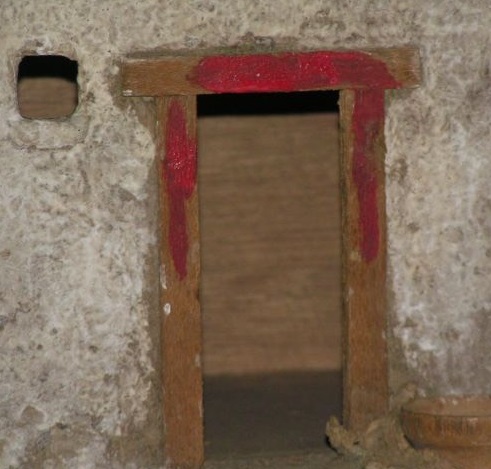
Take for yourselves an animal from the flock for your families and slaughter the pasach. And you shall take a bunch of hyssop and dip it in the blood that is in the basin, and daub it on the lintel and the two doorposts … And God will pass through to strike the Egyptians, and will see the blood on the lintel and the two doorposts, and God will pasach over the entrance … And when your children say to you: “What is this service to you?” Then you shall say: “It is a pasach slaughter for God, who pasach the houses of the Israelites in Egypt when [God] struck the Egyptians, but preserved our households.” (Exodus/Shemot 12:21-23, 12:26-27)
pasach (פָּסַח) = (verb) limped, skipped; (noun) an alternate spelling of pesach (פֶּסַח).
In context, the children are asking about the service of daubing blood on the outside frame of the front door, to commemorate the action in the book of Exodus. (Although pesach animals were slaughtered annually at the temple in Jerusalem until the second temple was destroyed in 70 CE, there is no evidence to date other than this passage in Exodus that the daubing of blood around doors was ever re-enacted.)
But the Mekhilta completely changes the meaning of the children’s question:
What does the wicked son say? “What is this service to you?”—to you, and not to him. Because he disassociated himself from the congregation and denied the foundation, you, likewise, blunt his teeth and tell him: “Because of this [that] God did for me when I went out of Egypt.” For me and not for you. Had you been there, you would not have been redeemed.
The father’s reply here sounds to me as if the questioner is not “the wicked son”, but “the son whose father hates him”.
The father makes the “wicked son” look bad by correctly quoting “What is this service to you?” and leaping to the conclusion that “to you” means the boy is disassociating himself from his parents and from other Jews.
This is a prejudiced assumption. Perhaps the child is merely expressing curiosity about a particular Pesach service and its meaning to an adult. The service in question is what the Israelites did in Egypt the night before they were freed: slaughtering a sheep or goat and daubing its blood on the lintel and doorposts of the front door.
I recommend answering: “Thanks to that service, God “skipped over the houses of the Israelites in Egypt when [God] struck the Egyptians, but preserved our houses.(Exodus 12:27) And that is why we call this week Passover; the Hebrew name, Pesach, means skipped over.”
The “Simple” One
The third child’s question appears in Exodus after the instructions to sacrifice every firstborn male animal in the herd and flock to God, in commemoration of the tenth and final plague in Egypt. A firstborn donkey is redeemed with a sheep sacrificed in its place. The firstborn son of each human mother is also dedicated to God.
Death of the Firstborn, haggadah by Judah Pinḥas, Germany, 1747
But every firstborn human among your sons you shall redeem. And when your son asks you in the future, saying: “What is this?” Then you shall say to him: “By strength of hand God brought us out from Egypt, from the house of slavery. And when Pharaoh hardened against sending us out, then God killed every firstborn in the land of Egypt, from the firstborn of humans to the firstborn of livestock. Therefore I am slaughtering for God every male womb-opener, but every firstborn of my sons I must redeem.” (Exodus 13:14-15)
The Mekhilta takes the question out of context and shortens the answer:
What does the simple son say? “What is this?” And you shall tell him: “With a mighty hand did God take us out of Egypt from the house of bondage.”
The best answer depends on what the simple child cannot find the words to describe. If “this” is the Pesach seder, it suffices to answer: “This is the way we tell the story of how God rescued us from slavery in Egypt.”
But what if the child has qualms about God’s tenth plague in Egypt, the death of the firstborn? I recommend reassuring your child (or your inner child) by explaining: “That was a miracle in the story. Moses told our ancestors to commemorate it by sacrificing the firstborn of each cow, sheep, or goat at the altar, but to redeem every firstborn son by giving something different to God instead. (Exodus 13:15) Today we give money in honor of the firstborn.”
The Speechless One
Exodus tells the father what to say to his son about the festival of matzah without including any prompting question.
Seven days you shall eat matzah, and on the seventh day will be a festival for God. Matzah shall be eaten for seven days, and nothing leavened shall be seen with you, and no sourdough shall be seen with you, throughout all your territory. And you shall tell your son on that day, saying: “For the sake of what God did for me in taking me out from Egypt.” (Exodus 13:6-8)
Modern biblical scholars suspect that there was already a festival of matzah in the spring, before the first grain harvest, and the Torah absorbed the pre-existing festival into the Pesach observance.4
Nevertheless, the Torah instructs us to explain the presence of matzah and the absence of leavened food during the week of Pesach in terms of the exodus. And you shall tell your son on that day, saying: “For the sake of what God did for me in taking me out from Egypt.” So does the Mekhilta:
And he who does not know how to ask, you open for him, as it is written: “And you shall tell your son on that day, etc.”
Like the answers for the “wicked” child and the “simple” child, the invented “son who does not know how to ask” gets an answer that ignores the point of the corresponding passage in the Torah—in this case instructions for the festival of matzah.
I recommend telling the speechless child: “For seven days we eat matzah, and avoid any baked goods with leavening. Why do we do this? For the sake of what God did for me in taking me out from Egypt. (Exodus 13:6-8) That’s what it says in the Torah, but what do you think it means?” In this way you may encourage your child to ask questions and generate possible answers.
*
Pesach is when we must tell the story of the exodus from Egypt in a way that engages our children and the “children” inside us. In order to do that, we can combine the traditions with our own creativity. The Babylonian Talmud tractate Pesachim gives examples of spur-of-the moment alternatives to traditional sections.5 But if you would like to plan some alternatives in advance, you are welcome to use this blog post as a starting point.
—
The Mekhilta di Rabbi Yishmael collection of commentary on the books of Exodus through Deuteronomy written during the first through fourth centuries CE and by Rabbi Yishmael ben Elisha, his students, and subsequent commentators and redactors. The rules and customs of Passover in the Mekhilta were probably written in the early third century CE, about the same time as Rabbi Yehudah Ha Nasi collected the mishnah of the Talmud. The fours sons in the Mekhilta are alluded to in the Jerusalem Talmud, but not in the Babylonian Talmud.
The afikomen is the final course or dessert of the Passover meal, consisting of half a piece of matzah separated and hidden early in the ritual.
The only reason given in Exodus for observing the festival of matzah during Pesach is the sentence: “And they baked the dough that they had taken out of Egypt, flat rounds of matzah, because it had not leavened, because they were driven out from Egypt and they could not delay. They did not even make provisions for themselves.” (Exodus 12:39) But the Israelites have two week’s notice, and their only leaven is sourdough starter, which never runs out as long as a little is saved from each batch of bread.
For example, Babylonian Talmud, Pesachim 115b: “Abaye was sitting before Rabba when he was still a child. He saw that they were removing the table before him, and he said to those removing it: “We have not yet eaten, and you are taking the table away from us?” Rabba said to him: “You have exempted us from reciting the questions of ‘Why is this night different’, as you have already asked what is special about the seder night.” (Translation from www.sefaria.or/Pesachim 115b.)

















 Questioning Torah