Yitro: Moses as Middle Manager

(This is my eighth post in a series about the conversations between Moses and God, and how their relationship evolves in the book of Exodus/Shemot. If you would like to read one of my posts about this week’s Torah portion, Ki Tisa, you might try: Ki Tisa: Making an Idol Out of Fear.)


The Israelites reach Mount Sinai three months after they leave Egypt, and perhaps a couple of years after God recruited Moses on that same mountain to serve as their prophet and leader.

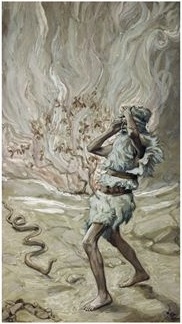
The ultimate goal of the Israelites’ journey is Canaan, which God has promised to give them as their own land (after dispossessing the people who already live there). But Moses knows that Mount Sinai, also called Mount Choreiv or simply “the mountain of God”, is a necessary stop on the way. Back when God first spoke to Moses, out of the fire in the bush that burned but was not consumed, God said:

“When you [singular] have brought the people out of Egypt, you [plural] will serve God at this mountain.” (Exodus 3:12)

Moses does not know that this is the spot where God will stage an impressive revelation, and make a covenant with the Israelites. But after all his leadership training in Egypt and on the road, he is ready for whatever God has in mind. (See my posts Shemot to Bo: Moses Finds His Voice and Beshallach: Moses Graduates.)

Up and down the mountain

… and Israel camped there, opposite the mountain. And Moses went up to God, and God called to him from the mountain, saying: … (Exodus 19:2-3)

Moses takes the initiative and starts climbing up the mountain before God calls to him. According to the 18th-century commentary Or HaChayim,

“Moses felt that if he waited until he would be asked to ascend, this would demonstrate both lethargy on his part and perhaps even unwillingness. … As soon as God noticed that Moses was ascending, God called out to him. You have to remember that it is in the nature of sanctity, not to make the first move towards a person until that person has made active preparations to welcome such sanctity.”1

God Appears to Moses, anonymous English woodcut, 1539

Yet in Egypt, when Moses first initiated a conversation with God, he did not go to any special place first.2 Moses and God have had conversations in Egypt, at the Reed Sea, and at several spots on the road to Mount Sinai, all without special preparations.

I think Moses follows a different procedure when the Israelites reach Mount Sinai because he knows that something significant will happen there, even though he does not know what. Now that they have arrived, Moses does not wait for God to make the first move. He has learned how to think like a leader. So he decides to show the Israelites that this mountain is God’s place, where something important will happen. So he decides to show the Israelites that this mountain is God’s place by climbing up while everyone watches. Does Moses walk to the spot where he first heard God’s voice? Or does he climb to the summit, closer to the “heavens”? The book of Exodus does not say.

Then God calls to him and says:

“Thus you shall say to the house of Jacob, and you will tell to the children of Israel:3 ‘You yourselves have seen what I did to Egypt, and how I carried you on wings of eagles and I brought you to me. And now, if you really listen to my voice and observe my covenant, you will become to me a segulah out of all the peoples—for all the earth is mine.” (Exodus 19:3-5)

segulah (סְגֻלָּה) = personal treasure, cherished possession.

This is the first time the Torah says God has a segulah. Three later references in the Hebrew Bible say both that the Israelites are God’s segulah and that God “chose” them.4 A standard idea in the Ancient Near East was that each god had his or her own chosen people. The God character in Exodus claims power over all the peoples on earth, but makes the offer of becoming God’s segulah only to the Israelites.

Here God may be using the word segulah to introduce the idea of a covenant or treaty. Being God’s personal treasured possession is conditional upon the people’s behavior: they must earn that status by paying attention to God’s instructions and keeping God’s yet-to-be-revealed covenant with them.

The God character in the Torah definitely plays favorites. Just as God did favors for Abraham, Isaac, Jacob, and Joseph in the book of Genesis, God does favors for Moses in the book of Exodus. So far in this book, God has been patient not only with Moses, but also with the Israelites—even though they keep wanting to go back to Egypt.5

God finishes by saying:

“‘And you, tiheyu to me a kingdom of priests, and a holy nation!’ These are the words that you must speak to the Children of Israel.” (Exodus 19:6)

tiheyu (תִּהְיוּ) = you (plural) will be, will become, would become, should become, must become.

In Exodus 28:1-2, during Moses’ first 40-day stint on top of Mount Sinai, God tells him that Aaron and his sons will be the priests of the new Israelite religion. It is unlikely that God first plans a religion in which everyone (or at least every man) is a priest, and then switches to the hereditary priesthood plan in less than two months. During that period, all the Israelites agree to the covenant with God three times, and do not disobey any of God’s laws.

On the last day of Moses’ 40-day stint, the Israelites commit a major violation by demanding an idol to follow. But Aaron is the one who makes them a golden calf. So God would have no reason to install Aaron and his sons as the priests instead of letting every Israelite be a priest.

Perhaps ‘And you, tiheyu to me a kingdom of priests, and a holy nation!’ is a goal for the distant future, rather than an immediate divine plan. The sentence could be translated: “And you, you should become to me a kingdom of priests, and a holy nation.”

Rabbi Lord Jonathan Sacks wrote that God’s pronouncement means:

“The Israelites were called on to be a nation of servant-leaders. They were the people called on, by virtue of the covenant, to accept responsibility not only for themselves and their families, but for the moral-spiritual state of the nation as a whole.”6

One of the duties of the priests, we learn in Leviticus 10:10-11, is to teach the people about God’s rules. In a kingdom of priests, presumably, everyone would remind everyone else about the right thing to do.

Up and down again

And Moses came and summoned the elders of the people, and he set before them all these words that God had commanded him. And all the people answered as one, and they said: “Everything that God has spoken, we will do!” Then Moses brought the words of the people back to God.  (Exodus 19:7-8)

The implication is that Moses climbed back to the top of the mountain to give God the people’s reply. Rashi repeated a common objection in the classic commentary when he wrote:

“But was it really necessary for Moses to deliver the reply to God? God is Omniscient! — But the explanation is that Scripture intends to teach you good manners from the example of Moses …”7

Although later theologians decided that God is omniscient, the God character in the Torah does not know ahead of time what human beings will do.8 This God also loses track of what the Israelites are doing; they suffer because of forced corvée labor for many years before God hears their moaning and recruits Moses to lead them out of Egypt.9 Moses knows how long it took for God to notice the cries of the Israelites. Perhaps now he reports the Israelites’ reply in case God missed it in a moment of distraction.

Moses might also think that climbing Mount Sinai again is more likely to get God’s attention than standing at the bottom and silently praying.

When Moses reaches the top of the mountain again, God speaks first.

The Cloud of Smoke over Mount Sinai, by James Tissot, circa 1900

And God said to Moses: “Hey, I myself am coming to you in a dark cloud, so that the people will listen when I speak with you, and also they will trust you forever.” Then Moses told the words of the people to God. (Exodus 19:9)

Rabbi Rami Shapiro explained:

“God isn’t saying that He will speak directly to the people that they may know He is God, He is saying that He wants the people to see that He is speaking to Moses so that they will believe that when Moses says such and such is the word of God, they will trust him. There is no reason to think that the people will even overhear what God is saying to Moses; all they will hear is that something is being spoken. Which is exactly what happens …”10

After Moses has reported how the people promised to do everything God said, God gives Moses orders to prepare the Israelites for a revelation (including a dark cloud) in three days. God tells him to make the people holy (without describing the method), to have everyone wash their clothes, to set a boundary around the mountain, and to warn the people that anyone who crosses that line, or even touches it, will be put to death.

Then Moses went down from the mountain to the people, and he made the people holy, and they washed their clothes. And he said to the people: “Be ready for the third day. Don’t go near a woman!” (Exodus 19:14-15)

Once again, Moses is taking initiative. Why does he add this injunction?

According to Leviticus 15:16-18, an emission of semen makes a man ritually impure, and anything it touches also becomes impure. If a man and a woman have sex, they must both bathe and wait until evening before they are ritually pure and able to participate in religious rites. Someone can be ritually pure without being holy, i.e. set aside for God, but a person cannot be holy without being ritually pure.

In a patriarchal society, Moses is addressing only the (heterosexual) men. He orders them to go without sex for two days before the day of God’s revelation. The classic commentators assumed that Moses somehow already knew the laws about ritual purity that God gave later, in Leviticus, and they explained that Moses thought a man’s semen might stay alive inside his wife for three days.11

This seems far-fetched. I prefer Rabbi Steinsaltz’s explanation that Moses was telling the men: “Refrain from sexual relations during these three days in order to focus your minds and prepare for the encounter.”12


At Mount Sinai, God is the boss, and Moses is the middle manager who relays God’s words to the people and the people’s words to God. But God is not a micro-manager, and welcomes it when Moses takes the initiative—as he does when he climbs the mountain to speak with God, and when he adds the order to refrain from sexual intercourse for three days.

And it happened on the third day, when it became morning. And there were thunder-sounds and lightning-flashes, and a heavy cloud on the mountain, and a very loud sound of a shofar [ram’s horn], and all the people who were in the camp trembled. (Exodus 19:16)

The revelation of God has begun.

To be continued …


  1. Or HaChayim, by Chayim ibn Attar, translation in www.sefaria.org.
  2. In Exodus 5:22-23, after his first audience with the new pharaoh, when the Israelites were given more labor instead of the holiday that Moses and Aaron had requested. See my post: Shemot to Bo: Moses Finds His Voice.
  3. The ethnic group known to the Egyptians in the book of Exodus as Hebrews is usually called the “children of Israel” (i.e. Israelites) in the Hebrew Bible, but occasionally called the “house of Jacob”.  Exodus 1:1-6 explains that these people are the descendants of Jacob in the book of Genesis, to whom God gave a second name, Israel.
  4. Deuteronomy 7:6 and 14:2, and Psalm 135:4, announce both that the Israelites are God’s segulah and that God chose them, using the verb bahar (בָהַר) = “chose” or “chosen”.
  5. So far, they complain about leaving Egypt and/or say they want to return there in Exodus 14:11-12, 16:3, and 17:3. Their backsliding will continue.
  6. Rabbi Lord Jonathan Sacks, Covenant & Conversation, “A Nation of Leaders: Yitro 5781”, 2022.
  7. Rashi (11th century Rabbi Shlomo ben Yitzchak), translation in www.sefaria.org.
  8. But God does predict what the pharaoh in Exodus will do, and hardens the pharaoh’s heart at key points to make sure it happens.
  9. Exodus 2:23-25.
  10. Rabbi Rami Shapiro, teaching@topica.email-publisher.com,  May 25, 2004, Shavuot.
  11. E.g. Avot deRabbi Natan, Talmud Bavli Niddah 42a and Shabbat 86a, Rashi.
  12. Rabbi Adin Even-Israel Steinsaltz, The Steinsaltz Tanakh, Koren Publishers, Jerusalem, 2019, quoted in www.sefaria.org.

Beshalach: Moses Graduates

(This is my seventh post in a series about the conversations between Moses and God, and how their relationship evolves in the book of Exodus/Shemot. If you would like to read one of my posts about this week’s Torah portion, Tetzaveh, you might try: Tetzaveh: Flower on the Forehead.)


The first time Moses and God have a conversation on Mount Sinai, God tells Moses to return to Egypt, ask the pharaoh to let the Israelites leave, and persuade the Israelites to follow him out of the country. Moses keeps making excuses to get out of this terrifying mission, certain that he cannot persuade anyone of anything. But God gives him one reassurance after another, finally promising to deploy Moses’ long-lost brother, Aaron, as his spokesman (or perhaps interpreter; see my post: Shemot: Not a Man of Words). Then Moses finally, reluctantly, heads back to Egypt.

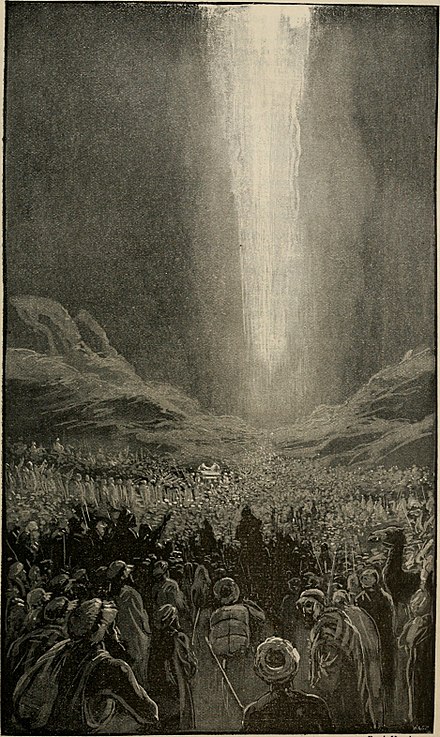
Pillar of Fire, by Paul Hardy, 1896

When he leaves Egypt a year or two later, 600,000 Israelites and supporters follow him into the wilderness.1 Although leadership comes more naturally to extraverts, introverts like Moses can become effective leaders with sufficient preparation and self-confidence. As God backs him up in his negotiations with the pharaoh, Moses earns respect from the pharaoh and his court, and his self-confidence increases exponentially.2 His standing also improves with the Israelites; by the time they leave Egypt, the people view both Moses and God (as manifested in a column of cloud and fire) as their leaders.

And God was going before them, by day in a column of cloud to lead them on the way, and by night in a column of fire to give light to them for walking day and night.  (Exodus 13:21)

A junior leader when the sea splits

The pharaoh has another change of heart, thanks to some heart-hardening from God, and he pursues the Israelites with a squadron of charioteers. God tells Moses to make the Israelites turn around and camp on the shore of the Reed Sea3 so they will appear to be trapped between the Egyptian army and the water. Moses does, even though God neglects to explain the next part of the divine scheme.

And Pharaoh approached, and the Israelites raised their eyes, and hey! Egyptians were setting out after them! They were very afraid. And the Israelites cried out to God. And they said to Moses: “Is it because there are no graves in Egypt, that you took us out to die in the wilderness? What is this you have done to us, to bring us out from Egypt?” (Exodus 14:10-11)

Out of their two leaders, the Israelites address God first, but they blame Moses. The 14th-century commentary Tur HaArokh explained: “When they noted that their prayer had not helped, they became heretical in their attitude, making above-mentioned sarcastic comments to Moses, blaming him for their present predicament.”4

They declare that they were better off being enslaved in Egypt. Moses replies, on his own initiative, that God will do battle for them. But then God tells Moses to order the Israelites to march forward into the sea, adding:

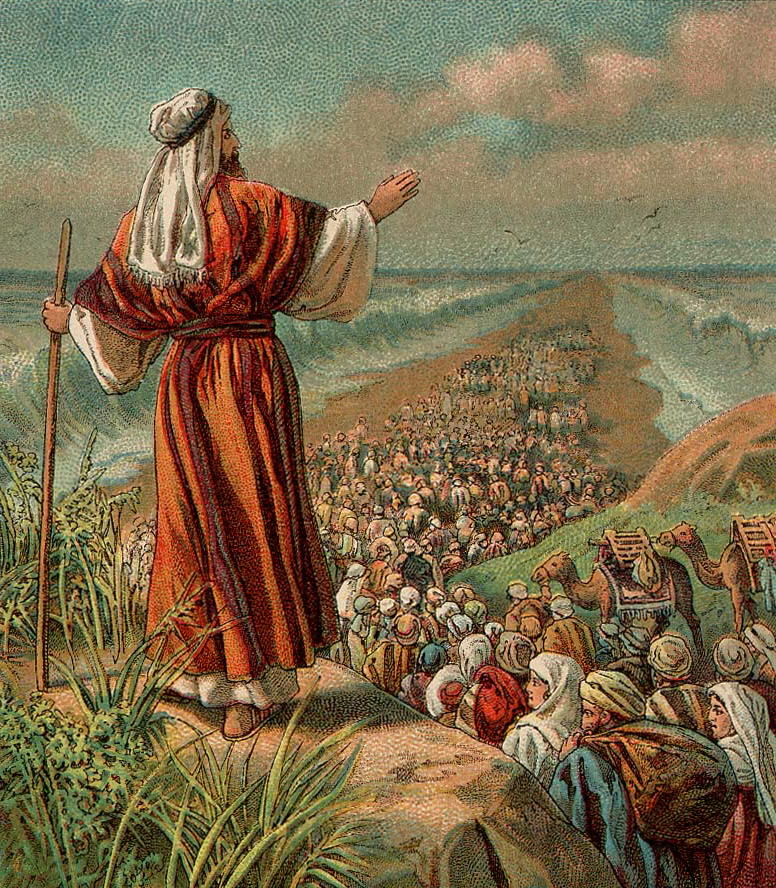
Moses and the Parting of the Red Sea, Providence Lithograph Co., 1907

“And you, raise your staff and stretch out your hand over the sea and split it! And the Israelites will come into the middle of the sea on the dry land. And I, I will be here strengthening the Egyptians’ heart, and they will come in after them. Then ikavdah by Pharaoh and by all Pharaoh’s army, by his charioteers and by his horsemen. Then Egypt will know that I am Y-H-V-H …” (Exodus14:16-18)

ikavdah (אִכָּבְדָה) = I will be considered impressive, I will be honored, I will be respected. (From the same root as koved, כֱֺבֶד = weight.)

It is important to God to acquire an impressive reputation in Egypt. But it is also important for the Israelites to respect Moses, so God has him initiate the miracle of the parting of the Reed Sea with a dramatic gesture.

The Egyptian charioteers urge the horses onto the dry sea-bed, still chasing the Israelites. But as soon as all the people and their livestock have reached the other side, God lets the water rush back and drown the Egyptians.

And Israel saw the great hand [power] that Y-H-V-H had used against the Egyptians, and the people feared Y-H-V-H, and they had faith in Y-H-V-H and in [God’s] servant Moses. (Exodus 14:31)

In their first conversation on Mount Sinai, God was like a patient parent reassuring an anxious young child. (See my post: Shemot: Moses Gives Up.) In Egypt, God is like a reliable parent to an adolescent uneasy with his place in the world. (See my post: Shemot to Bo: Moses Finds His Voice.) But as the Israelites journey from Egypt to Mount Sinai, God is like a mentor who takes time to make sure a young adult protégé comes to be viewed as a leader And Moses responds by turning to God when he needs advice.

A moment of panic

At Refidim, the Israelites’ last stop on the Sinai Peninsula before Mount Sinai, there is no water. The people are probably carrying some water from the last campsite, but they are anxious—or inclined to grumble.

And the people complained against Moses, and they said: “Give us water, so we may drink!” And Moses said to them: “Why do you complain against me? Why do you test God?” (Exodus 17:2)

Moses has identified so completely with his role as God’s agent that he now considers any quarrel with him a quarrel with God. After all, God makes the decisions; he merely carries them out.

But the people were thirsty for water there, and the people grumbled against Moses, and said: “Why this? To bring us up from Egypt [only] to bring death to me and my children and my livestock by thirst?” And Moses cried out to God, saying: “What can I do to this people? A little more and they will stone me!” (Exodus 17:3-4)

Moses is still insecure about his new role, afraid that at any time the people will turn angry enough to kill him.

And God said to Moses: “Pass before the people, and take with you some of Israel’s elders, and take the staff with which you struck the Nile in your hand, and go.” (Exodus 17:5)

Robert Alter noted: “… passing before the enraged people would be rather like running the gauntlet, and it is this that God compels him to do as the prelude to the demonstration of divine saving power.”6

In this way God nudges Moses to do something courageous. When he does pass in front of the people, they see that he is going somewhere (with witnesses) to find water, and trust him enough to wait for his return.

Moses Striking Water from the Rock, by Jacopo Tintoretto, 1577

Calmly God tells Moses the next step:

“Here, I will be standing before you there on the rock at Choreiv. And you must hit the rock, and water with come out of it, and the people will drink.” And Moses did thus, before the eyes of the elders of Israel. (Exodus 17:6)

Choreiv (חֺרֵב) = the alternate name for Mount Sinai, the name used for the “Mountain of God” in the passage about Moses seeing the bush that burned but was not consumed.7 (Ironically, from the root verb charav, חָרַב = dried up, made desolate.)

The Torah does not say that anyone actually sees God standing on a rock at the mountain. Perhaps Moses has developed a sense for the direction from which God’s instructions reach him. The 14th-century commentary Tur HaArokh suggested that Moses saw a vision of an angel on the rock.

And why does God create the miracle at Choreiv instead of at their camp at Refidim? Hirsch speculated in the 19th century that God had planned for water to gush from a rock when they arrived at the mountain, but the Israelites complained about thirst prematurely, before their portable supplies had run out. “The only effect of their untimely murmuring was that even now, while they were in Refidim, God provided them with water from Chorev. The words … seem to indicate that the water flowed from Chorev to the people’s camp in Refidim.”8

A staff initiative

Moses demonstrates his new ability as a leader in one more event before the Israelites pitch camp at the foot of Mount Sinai/Choreiv.

Then Amaleik came and would do battle with Israel at Refidim. And Moses said to Joshua: “Choose men for us and go out, wage battle against Amaleik! Tomorrow I will station myself on the top of the hill, and the staff of God will be in my hand.” (Exodus 17:8-9)

Nobody expects Moses to be a war leader. He is God’s prophet and deputy; when a warlike band of Amalekites appears, Moses appoints Joshua as the military general. Moses also decides to spend the day of the battle on top of a low hill where the Israelite troops can see him holding the staff. God does not need to instruct Moses this time; he has already taken charge.

Malbim, another 19th-century commentator, wrote “Moshe’s special abilities lay in the realm of the supernatural. … On this occasion, by contrast, God hid His face so that they were required to do battle in a natural manner. Therefore Moshe delegated command to Yehoshua, who had been chosen by God to lead the conquest of Canaan, which was to be accomplished through natural wars accompanied by hidden miracles.”9

Moses climbs to the top of the nearby hill with his brother Aaron and another trusted assistant, Chur.

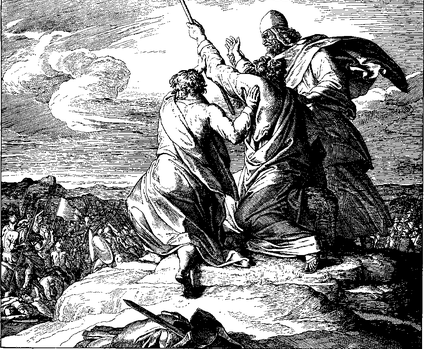
Battle with the Amalekites, by Julius Schnorr von Carolsfeld, 1860

And it happened that when Moses raised his hand, Israel prevailed. And when he rested his hand, Amaleik prevailed. Then Moses’ hands were keveidim. So they took a stone and placed it under him, and he sat down on it, and Aaron and Chur supported his hands, one on this side and one on the other side. And his hands were steadfast until the sun came in [went down].” (Exodus 17:12)

keveidim (כְּבֵדִים) = heavy. (From the same root as ikavdah,אִכָּבְדָה,in Exodus 14:18 above = I will be considered impressive, I will be honored, I will be respected.)

According to the 13th-century commentary Chizkuni, Moses’ motivation was “to be able to follow the course of the battle while personally watching, and even more, so that the Israelite fighters could see their leader and be encouraged by this visual contact … Moses’ staff in this instance served as a flag for the Israelites fighting Amalek.”10

And Joshua disabled Amaleik and his people with the edge of the sword. (Exodus 17:13)

Enough Amalekites are killed or wounded so that they give up and run away. The immediate cause of the Israelites’ victory is that they keep swinging at the Amalekites with swords (which they must have taken from Egyptians, along with the gold, silver, and clothing). But they have the confidence to attack instead of retreat only when they see Moses holding up the staff of God.

Moses has had enough mentoring by God, and enough practice being the leader of thousands, that this time he acts on his own initiative and does exactly the right thing to save his people. He has become a worthy co-leader with God.

To be continued …


  1. Exodus 12:37 says: The Israelites journeyed from Ramses to Sukkot, about 600,000 fighting men on foot, apart from non-walkers. This would mean the total number of Israelites was more than a million, which would take more miracles than the book of Exodus reports to keep alive in the arid wilderness. The next verse, Exodus 12:38, says: And also riffraff went up with them
  2. On Moses’ increasing self-confidence, see my post: Shemot to Bo: Moses Finds His Voice. On the courtiers, see Exodus 11:3: The man Moses was very great in the land of Egypt, in the eyes of Pharaoh’s courtiers and in the eyes of the people. The pharaoh reveals his growing respect for Moses in more subtle ways. The first time Moses and Aaron speak to him, he rejects their request out of hand (Exodus 5:1-9). After the second plague, the pharaoh summons Moses and Aaron and says if they will plead with God to remove the frogs, he will let the people go (Exodus 8:4). He keeps making these deals, then backing out on them, but at least he views Moses as someone who has God’s ear and must be negotiated with. When the pharaoh and Moses make another deal after the fourth plague, Moses adds: “Only may Pharaoh not deceive us again …” (Exodus 8:25)—and the pharaoh swallows the insult. During the final plague, death of the firstborn, the pharaoh begs Moses and Aaron not only to take the Israelites out of Egypt with no conditions, but also to bring a blessing upon him (Exodus 12:31-32).
  3. The Hebrew word for this body of water is yam suf (יַם־סוּף), which means “Sea of Reeds”. It is commonly translated as the Red Sea, since the northern tip of the Red Sea is one possibility for the Israelites’ crossing point.
  4. Tur HaArokh, by Rabbi Jacob ben Asher, written circa 1280–1340 C.E., translation in www.sefaria.org.
  5. See Exodus 14:4.
  6. Robert Alter, The Five Books of Moses: A Translation with Commentary, W.W. Norton & Co., New York, 2004, p. 412.
  7. Exodus 3:1.
  8. Rabbi Samson Raphael Hirsch, The Hirsch Chumash: Sefer Shemos, translation by Daniel Haberman, Feldheim Publishers, Jerusalem, 2005, p. 293.
  9. Malbim (19th-century rabbi Meir Leibush Weisser), translation in www.sefaria.org; I substituted “God” for “Hashem” for clarity.
  10. Chizkuni, by Chizkiah ben Manoach, 13th century, translation in www.sefaria.org.

Shemot to Bo: Moses Finds his Voice

(This is my sixth post in a series about the interactions between Moses and God on Mount Sinai, and how their relationship evolves. If you would like to read one of my posts about this week’s Torah portion, Terumah, you might try: Terumah: Insecurity.)


Moses hears God speak to him for the first time out of the fire in the thornbush on Mount Sinai. (See my post: Shemot: A Close Look at the Burning Bush.) God has already decided to use devastating miracles to liberate the Israelites in Egypt, but needs a human agent to persuade the Israelites to leave for Canaan and the pharaoh to let the Israelites go.

For this job, God picks an Israelite by birth who was raised by Egyptian royalty, and is now herding sheep in Midian. Moses’ assets are that he is curious and open to new ideas, he empathizes with the underdog, he is humble, and he is sufficiently awed to hide his face when he hears a divine voice speaking out of the fire. (See my post: Shemot: Empathy, Fear, and Humility.)

But he does not want to go. He knows he is not an adept speaker. (See my post: Shemot: Not a Man of Words.) And he longs to continue his safe and peaceful life in Midian. So he tries five times to excuse himself from the mission. (See my post: Shemot: Names and Miracles.)

In this first conversation on Mount Sinai, Moses sounds like an anxious child, and God sounds like a patient parent. It takes God a long time to reassure Moses enough so he will cooperate with God’s plan. Finally God promises that Moses’ brother Aaron will be his spokesman in Egypt, and Moses stops trying to get out of the job. (See my post: Shemot: Moses Gives Up.) After a brief stop at his father-in-law’s camp, he heads back to Egypt.

A year or two passes before Moses meets God on Mount Sinai again. During that time, God continues to give Moses instructions, and occasionally Moses asks God a question. These conversations are silent, inside Moses’ mind.

Does Moses change during this period in Egypt? Does his relationship with God change?

Shemot: Moses wins and loses the people’s trust

Aaron meets Moses on the road as he heads across the Sinai Peninsula toward Egypt.

And Moses told Aaron all the words with which [God] had sent him, and all the signs [God] had instructed him in. Then Moses and Aaron went, and they gathered all the elders of the Israelites. And Aaron spoke all the words that God had spoken to Moses, and he did the signs before the eyes of the people. And the people trusted … (Exodus 4:28-31)

The text does not say whether the Israelites trust Moses, whom they do not know, or only Aaron, one of their own elders. Either way, they believe they are hearing the words of their own god.

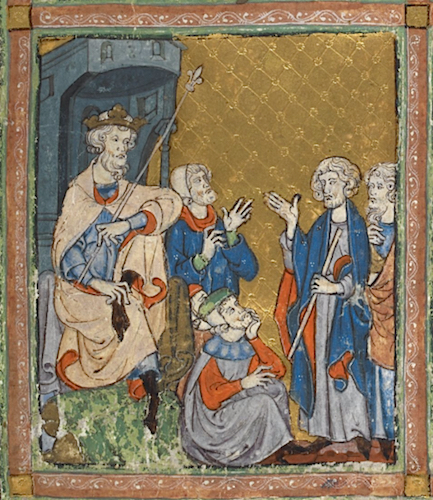
Moses and Aaron Come Before Pharaoh, Golden Haggadah, 14th century

And afterward Moses and Aaron came and said to Pharaoh: “Thus says Y-H-V-H, the god of Israel: ‘Let my people go, and they will observe a festival for me in the wilderness!’” (Exodus 5:1)

The text does not say which brother is doing the actual speaking. The pharaoh says no, and Moses and Aaron clarify their request:

“Please let us go a distance of three days into the wilderness, and we will make slaughter-offerings to Y-H-V-H, our God …” (Exodus 5:3)

Instead, the pharaoh increases the workload of the Israelites, and they turn against Moses and Aaron.1

Then Moses returned to Y-H-V-H and said: “My lord, why have you done harm to this people? Why did you send me? Since I came to Pharaoh to speak in your name, he has done harm to this people. And you certainly have not rescued your people!” (Exodus 5:22-23)

Until now, Moses has only responded after God spoke to him. This is the first time Moses initiates a conversation with God.2

On Mount Sinai, God warned Moses that the pharaoh would not let the Israelites go until after God had inflicted some devastating miracles on Egypt.3 Has Moses forgotten? Or is he making a different point with his questions?

Eleventh-century rabbi Chananel viewed Moses’ question “Why have you done harm to this people?” as an enquiry about the problem of evil. “This is not to be understood as a complaint or insolence, but simply as a question. Moses wanted to know the use of the [divine] attribute which decrees sometimes afflictions on the just, and all kinds of advantages for the wicked …”4

In the 14th century Rabbeinu Bachya saw Moses’ first question as an acknowledgement that God does do harm to people God favors. “The Torah wanted to inform us that improvements or deteriorations in the fate of the Jewish nation are the result of God’s doing, not of someone else’s doing. By his very question, Moses wanted to make it clear that he understood this. After all, evil does originate with God, though in a more indirect manner than good.”5

Their explanations are theologically interesting, but Moses has not engaged in such abstract thinking yet in the storyline of Exodus, and his second question, “Why did you send me?”, shows he is taking the situation personally. Other commentators have offered a more likely explanation: that Moses thought God would move quickly once he has spoken to the pharaoh, and life would improve for the Israelites until the final miracle freed them altogether. Therefore he asks why God sent him before the divine deliverance was at hand.6

According to 16th-century rabbi Ovadiah Sforno, Moses’ second question means: “Why did You make me the one to be the immediate cause of [their suffering]?”7

Moses’ questions to God remind me of a child complaining, “It’s not fair!” To his credit, Moses points out that the unfairness to the Israelites (why have you done bad to this people?), as well as unfairness to himself (why did you send me?).

According 19th-century rabbi S.R. Hirsch, Moses is telling God: “You caused this new calamity. You did not just remain aloof when it happened; rather, You provoked it through my mission.” Then Hirsch explains: “His mission has been a complete failure. … Moshe, too, is doubting himself; indeed, who, if not Moshe, would now not have heightened misgivings about his own capability, would now not ask himself whether he had mishandled his mission?”8

He also goes so far as to accuse God by saying: “and you certainly have not rescued your people!”. It is human nature to assign the blame to someone else when you suspect you are partly responsible for a disaster.

Moses may feel as insecure as ever about speaking to other human beings, but he is much bolder now when he speaks to God. He treats God the way an adolescent might treat a reliable parent at a moment of crisis.

And God’s response is mild enough:

“Now you will see what I will do to Pharaoh.” (Exodus 6:1)

Va-eira: Moses trusts Godand himself

When God tells Moses to go speak to the pharaoh again, Moses replies:

“Here, the Israelites don’t listen to me. How will Pharaoh listen to me? And I have foreskin-covered lips!” Then God spoke Moses and to Aaron, and commanded them … (Exodus 6:12-13)

Moses may trust God to listen to him patiently, but he still does not trust himself to be a convincing speaker. He uses the biblical metaphor of the foreskin to indicate that his power to speak well is blocked.9

Perhaps God thinks that Moses’ ears are also foreskin-covered, since God switches back to addressing Moses and Aaron at the same time.

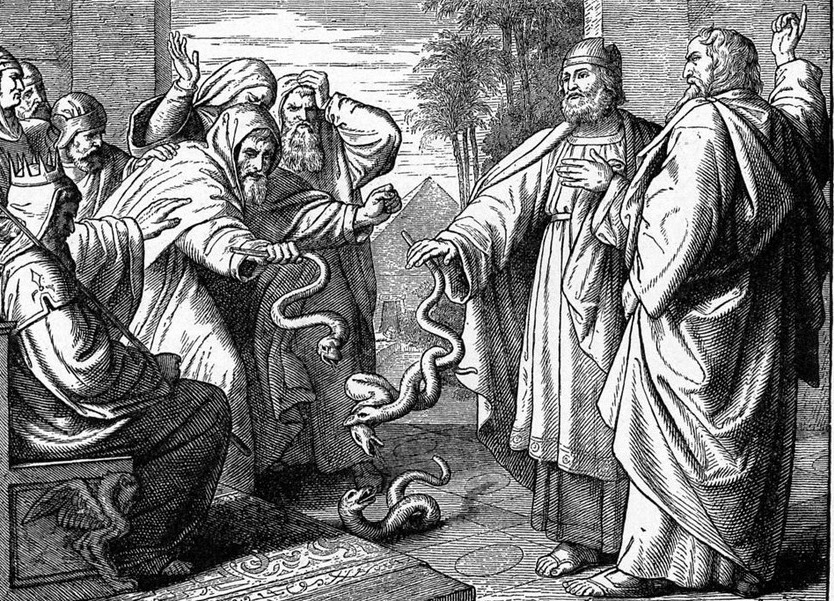
Aaron’s Rod Changed into a Serpent, by Julius Schnorr von Carolsfeld, Charles Foster Bible,1860

They obey God and return to the pharaoh to demonstrate the miraculous sign God gave Moses on Mount Sinai, in which his staff turned into a snake. This time Aaron is holding the staff.10

Then God dictates what Moses must say to the pharaoh the next morning at the Nile, and assigns Aaron to wield the staff to initiate the miracle of the water turning to blood.11 The miracles continue, with Moses repeating God’s words to the pharaoh, and Aaron making the gestures. Clearly Moses can speak upper-class Egyptian correctly. But if he is an insecure introvert, as I proposed in my post Shemot: Not a Man of Words, he needs to know ahead of time what to say, and God tells him.

Then Moses begins adding a few words of his own. After the miracle (or plague) of frogs, the pharaoh tells Moses and Aaron that if they beg God to remove the frogs, he will let the Israelites go make their offerings to God. Moses asks the pharaoh to choose the time for the divine frog extermination, “so that you will know there is none like Y-H-V-H, our God.” (Exodus 8:5-6)

He trusts God to back him up by killing the frogs on the day the pharaoh designates—and God does.

After the fourth plague (arov (עָרֺב) = swarms, mixtures of insects), the pharaoh tells Moses and Aaron that he will let the people make their offerings to God as long as they stay inside Egypt. Apparently on his own initiative, Moses replies:

“It would not be right to do thus, since we will slaughter for Y-H-V-H, our God, what is taboo for Egyptians. If we slaughtered what is taboo for Egyptians in front of their eyes, then wouldn’t they stone us? Let us go on a journey of three days into the wilderness …” (Exodus 8:22-23)

The pharaoh agrees this time, and Moses agrees to ask God to remove the swarms. But he adds:

“Only let Pharaoh not trifle with us again, by not letting the people go to make slaughter-offerings to Y-H-V-H!” (Exodus 8:25)

If Moses is an introvert, then he has probably spent days mulling over what he might say to the pharaoh in various situations. When one of those situations arises, he does not need to wait for either God or Aaron; he can simply deliver one of the replies he practiced. (This is how I have managed to speak up in difficult social situations despite my introversion.)

Moses is also getting used to being listened to. His trust in himself, as well as in God, is increasing.

Bo: Moses transcends himself

After the penultimate plague, three days of utter darkness for all the Egyptians, the pharaoh tells Moses that all the Israelites may go into the wilderness, even the women and children, as long as their livestock stays behind. Moses is now accustomed to the pharaoh bargaining in bad faith, and he has his answer ready.

And Moses said: “You, too, must give into our hand slaughter-offerings and burnt offerings, and we will make them for Y-H-V-H, our God. And also our own livestock will go with us; not a hoof will remain behind.  Because we will take from them to serve Y-H-V-H, our God, and we ourselves will not know what we will serve God [with] until we arrive there.” (Exodus 10:25-26)

The 18th-century commentary Or Hachayim noted: “At any rate, this answer of Moses to Pharaoh was obviously one that Moses invented and is not to be regarded as an instruction given to him by God.”10

The pharaoh loses his temper, possibly because Moses’ answer is obviously an excuse.

Then Pharaoh said to him: “Go away from me! Watch out against seeing my face again, because the moment you see my face you will die!” And Moses said: “You spoke the truth! I will not see your face again!” (Exodus 10:28-29)

Perhaps Moses forgets that God has saved one final plague to inflict upon Egypt. According to many commentators, God hurries to instruct Moses about it before he stalks  out of the pharaoh’s audience chamber.11

Moses then follows God’s new instructions by announcing that at midnight every Egyptian firstborn male, from the pharaoh’s oldest son to the firstborn of cattle, will die. Then he adds something God did not tell him to say.

“And then all these courtiers of yours will come down to me and prostrate themselves to me, saying: ‘Go! You and all the people who follow you!’ And after that I will go.” And he walked away from Pharaoh bahari af. (Exodus 11:8)

bahari af (בָּחֳרִי־אָף) = with the hot nose (an idiom for “in anger”).

Moses’ final words to the pharaoh do not sound like something an introvert rehearsed ahead of time. Carried away by his anger in the moment, Moses says the first thing that comes into his head.

It was standard procedure to prostrate oneself before a king in order to receive permission to speak; Moses and Aaron would have done it at every audience with the pharaoh. Now Moses says that the pharaoh’s courtiers will come to him and prostrate themselves, as if he were a king.12

Pharaoh and his Dead Son, by James Tissot, ca. 1900

It does not happen exactly the way Moses’ inflamed imagination pictures it. At midnight, when the firstborn Egyptians are dying and people are wailing in every Egyptian house, the pharaoh himself summons Moses and Aaron and commands the Israelites to leave Egypt and take their flocks and herds with them.

They march out of Egypt with everything they own, as well as some gold, silver, and clothing “borrowed” from Egyptians. They leave behind a country devastated by God’s ten miraculous plagues, a country in which everyone from pharaoh to commoner acknowledges that the God of Israel is the most powerful god.

The first stage of Moses’ mission, and God’s, has succeeded.

To be continued …


  1. Exodus 5:21.
  2. Rabbi Adin Even-Israel Steinsaltz, The Steinsaltz Tanakh, Koren Publishers, Jerusalem, 2019, quoted in www.sefaria.org.
  3. Exodus 3:19-20.
  4. Rabbeinu Chananel (Rabbi Chananel ben Chushiel), as quoted in other commentaries, translation in www.sefaria.org.
  5. Rabbeinu Bachya (Rabbi Bachya ben Asher, 1255–1340), translation in www.sefaria.org
  6. E.g. Rabbi Abraham ibn Ezra (12th century), Ramban (13th-century rabbi Moses ben Nachman), Chizkuni (a 13th-century compilation), Or Hachayim (by 18th-century Rabbi Chayim ben Moshe ibn Attar).
  7. Rabbi Ovadiah Sforno, translation in www.sefaria.org.
  8. Exodus 7:9-10.
  9. Leviticus 26:41 says that God will welcome the Israelites back “if their foreskin-covered heart humbles itself”. Jeremiah 6:10 says that the ears of the Judahites are “foreskin-covered, and they cannot listen”.
  10. Exodus 7:14-20.
  11. Or HaChayim, by Rabbi Chayim ben Moshe ibn Attar, translation in www.sefaria.org.
  12. E.g. Or HaChayim, ibid.
  13. Or HaChayim, ibid.

Shemot: Moses Gives Up

(This is my fifth post in a series about the interactions between Moses and God on Mount Sinai, a.k.a. Choreiv, and how their relationship evolves. If you would like to read one of my posts about this week’s Torah portion, Mishpatim, you might try: Mishpatim: The Immigrant.)


The first conversation between God and Moses on Mount Sinai leads to frustration on both sides. God keeps ordering Moses to go back to Egypt and lead the Israelites out; Moses keeps trying to excuse himself from the mission.

First he protests that he is unworthy of the job. Then he asks what he can tell the Israelites when they demand the name of the god who sent him. His third excuse is that the Israelites will not trust him, and his fourth is that he does not speak well.1

The first words Moses hears God speak out of the fire in the bush that burns but is not consumed are “Moses! Moses!” Moses manages to answer: “Here I am.” (Exodus 3:4)

Burning Bush, by Sebastien Bourdon, 17th c, detail

And [God] said: “Don’t come closer! Take off your sandals from upon your feet, because the place that you are standing on, it is holy ground!” And [God] said: “I am the God of your father; the God of Abraham, the God of Isaac, and the God of Jacob.” And Moses hid his face, because he was afraid of looking at God. (Exodus 3:5-6)

Two other prophets in the Hebrew Bible, Isaiah and Jonah, try to get out of the job when God first calls them.2 But Moses is the only one who hides his face in fear.

Moses also seems to be afraid to tell God no. He can suggest reasons why he is not the right person to be God’s agent, but a flat refusal is more than he wants to risk. And a large part of the reason Moses is so reluctant to return to Egypt is fear. This fear is not irrational. After Moses killed an Egyptian overseer for beating an Israelite laborer, a pair of Israelites taunted him about what he had thought was compassionate act, the pharaoh charged him with murder, and he fled the country.3 Even though a new pharaoh is now the king of Egypt,4 Moses is naturally nervous about returning there.

His overriding emotion, fear, is accompanied by a conviction of his own unworthiness for God’s mission. If Moses is an introvert, as I argued in my post Shemot: Not a Man of Words, he would find the prospect of persuading the Israelites in Egypt that he is really God’s agent, and persuading the new pharaoh to change his domestic policy regarding Israelites, a challenge too terrifying to face. Naturally he longs to continue his safe and peaceful life as a trusted son-in-law, husband, father, and shepherd who never has to speak to strangers.

But God answers Moses’ first four objections with reassurances—which fail to reassure him. Finally he resorts to begging God to send someone else.

Anyone but me

And he said: “Please excuse me, my lord! Send, please, by the hand [of whomever] you will send!” (Exodus 4:13)

He is still too afraid of God to say baldly: “I will not go, send someone else!” But that is his underlying message. Twentieth-century commentator Nehama Leibowitz called Moses’ fifth objection a “blank refusal, a final almost desperate rebuttal, as if all his arguments had been silenced and he was left with a barren, bewildered no.”5

Yet many commentators view Moses’ final objection as an expression of his humility. Ramban (13th-century Rabbi Moshe ben Nachman, also called Nachmanides) wrote that what Moses means is: “for there is not a person in the world who is not more fit for the mission than I.”6

Nineteenth-century rabbi Samson Raphael Hirsch elaborated Moses’ reasoning: “Ultimately the mission will be accomplished; but if undertaken by me, it will initially falter, and You will then have to send ((NP)) someone who is better, more efficient than I am. Rather, send this other one even now.”7

Considering how God responds patiently to Moses’ first four objections, he might expect God to be patient with his clumsy “Send, please, by the hand you will send” and infer that Moses is overwhelmed by his own incompetence. Or HaChayim, written by Chayim ben Moshe ibn Attar in the 18th century, argued: “Moses felt that God had given him leeway and would reply to any reservations he had about accepting such a mission. God wanted that when Moses would finally accept the mission he should do so because he wanted to and not because he had been forced to do so.”8

But according to Midrash Tanchuma, a collection of commentary dating as early as the 8th century C.E., God interprets Moses’ refusal as sheer obstinacy. “The Holy One, blessed be He, rebuked him, saying: Do you believe that your feet are under your control? Thereupon, Moses went to Pharaoh against his will.”9 And the next verse in Exodus reports God’s anger (using the biblical idiom of a burning nose).

A human assistant

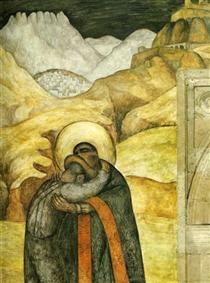
The Embrace, by Diego Rivera, 1923

Then God’s nose burned against Moses, and [God] said: “Isn’t your brother Aaron, the Levite? I know that he can certainly speak, and also, hey! he is going out to meet you. And he will see you, and he will rejoice in his heart. And you will speak to him, and put the words in his mouth. And I, I will be with your mouth and with his mouth, and I will teach you both what you must do.” (Exodus 4:14-15)

Even though God loses patience with Moses, God remains determined to send him to Egypt, and does not punish him. The God character in the Torah is anthropomorphic and does not know ahead of time what humans will do. Although later in the book of Exodus the God character sometimes explodes with anger and kills thousands with sudden diseases, here God remains calm and quickly thinks of a solution.

By this time, God must have noticed that Moses is terrified of speaking to either the Israelites or the pharaoh. But God still wants to use Moses to accomplish the rescue of the Israelites from Egypt. The solution is to recruit a fluent speaker as an intermediary between Moses and the people he is afraid to face. An obvious recruit would be an Israelite elder, a man who is already respected in the community that must be persuaded to follow Moses out of Egypt, as well as knowledgeable about how the Egyptian government operates. The best elder, God decides, is Moses’ older brother Aaron, even though the two brothers have not seen one another for decades. I think God is gambling that the family relationship will make Moses feel safer with Aaron, and Aaron feel more inclined to help Moses.

But why does God mention that Aaron is a Levite, when Moses comes from the same Levite family? According to Ibn Ezra,10 it is merely a way to distinguish Moses’ brother from other Israelites named Aaron (Aharon, אַהֲרֺן, in Hebrew). Yet God has already distinguished this Aaron from any others by saying “your brother”.

The separation of the tribe of Levi into two categories, Levites and Kohanim (priests who supervise Levites) comes later in the Torah,11 but that did not stop some classic commentators from bringing it in here. Many classic commentators wrote that calling Aaron “the Levite” is a subtle way for God to indicate that in the future Moses and Aaron will change positions. They wrote that God decides to make Aaron, not Moses, the future high priest when Moses begs God to send someone else.12

Classic commentators also argued that Moses objected five times to serving as God’s agent not because he was reluctant to do the job, but only because he somehow knew God’s alternative agent would be Aaron, and he did not want his big brother to feel slighted.13 (After all, the tradition in the Torah is that the firstborn son holds a higher position than any of his younger brothers, in terms of both inheritance and service as the priest of the extended family.)

According to this argument, God adds that when Aaron sees Moses, “he will rejoice in his heart”, to reassure Moses that he need not object to becoming God’s agent on Aaron’s account.

However, hearing “he will rejoice in his heart” could also reassure Moses that Aaron will be easy to work with. Aaron the friendly extravert will be patient while Moses speaks to him hesitantly, and faithful to Moses’ messages when he transmits them to the Israelites or to Pharaoh.

Moses does not reply to God’s statement that Aaron will speak for him. God proceeds to explain how the process will work:

“And he will speak for you to the people, and it is he [who] will be a mouth for you; and you, you will be as a god for him. And you will take in your hand this staff, with which you will do the signs.” (Exodus 4:16-17)

Moses still does not reply to God. He sees no alternative but to do what God wants. At least God has rearranged the assignment to make it easier for him. He may or may not know that now God is angry with him.

And Moses went and returned to Yitro, his father-in-law, and said to him: “Let me go, please, and I will return to my kinsmen who are in Egypt, and I will see: Are they still alive?” And Yitro said to Moses: “Go with peace.” (Exodus 4:18)

Two characterizations

What is Moses like when he has his first conversation with God?

Above all, he is anxious and fearful. He hides his face when God speaks out of the fire; after God orders him to persuade the Israelites to leave Egypt he asks “What should I say to them?” (Exodus 3:13), objects “But they, they will not trust me, and they will not pay attention to my voice” (Exodus 4:1), and pleads “I am not a man of words.” (Exodus 4:10) In my opinion, Moses is an introvert who knows he cannot put together words fast enough for a conversation with strangers. He is both afraid of facing the Israelite elders, and certain that he will fail to persuade them.

Moses also asks God: “Who am I that I should go to Pharaoh and that I should bring out the Israelites from Egypt?” (Exodus 3:11) Even though he grew up in an Egyptian palace and was the adopted son of the previous pharaoh’s daughter, he is not merely humble, but meek and unassertive. He is familiar with court procedures, but he does not expect the pharaoh or his advisers to respect him. Perhaps his lack of an illustrious Egyptian father affected how he was treated when he was growing up.

Moses’ final attempt to excuse himself from being God’s agent is a cry of desperation: “Send, please, by the hand [of whomever] you will send!” (Exodus 4:13) Then he gives up.

What is God like during this first conversation?

The God who speaks out of the fire in the thornbush is like a kind parent trying to reassure an unnecessarily anxious child. When Moses asks “Who am I to go to Pharaoh?”, God says soothingly: “But I will be with you.” (Exodus 3:12) When Moses asks what name of God he should give the Israelites, God’s first answer is too abstract; he tells Moses to say: Ehyeh sent me to you.” (Exodus 3:14). Ehyeh could mean I will be, I will become, I have not finished being, or I have not finished becoming. Then God remembers that Moses needs a simpler answer, and orders him to tell the Israelites that the god of their forefathers Abraham, Isaac, and Jacob sent him. When Moses objects that the Israelites will not trust him, God gives him three miraculous signs he can demonstrate to them.

When Moses tries to excuse himself a fourth time, by saying he is not a man of words, God tries to reassure him by saying “I myself will be with your mouth, and I will instruct you regarding what you will speak.” (Exodus 4:12) Even that reassurance does not calm Moses’ anxiety, and he resorts to asking God to send someone else, anyone but him.

Momentarily God feels a flare of anger—as all parents do when their best efforts fail to make their little ones calm down and cooperate. But then God thinks of a work-around using Moses’ long-lost brother, Aaron. From the God character’s point of view, Moses’ silence might seem sullen. But at least Moses stops resisting and sets off for Egypt.

To be continued …


  1. See the last three posts in this series: Shemot: Empathy, Fear, and Humility, Shemot: Names and Miracles, and Shemot: Not a Man of Words. (My first post in the series, about when God initiates the conversation by calling to Moses from the fire in the thorn-bush, is: Shemot: A Close Look at the Burning Bush.)
  2. Isaiah 6:1-8; Jonah 1:1-3 and 4:1-2.
  3. Exodus 2:12-15.
  4. Exodus 2:23.
  5. Nehama Leibowitz, Studies in Shemot (Exodus), Part 1, translated by Aryeh Newman, The Joint Authority of Jewish Zionist Education, Jerusalem, 1996, p. 66-67.
  6. Ramban, translation in www.sefaria.org.
  7. Rabbi Samson Raphael Hirsch, The Hirsch Chumash: Sefer Shemos, translation by Daniel Haberman, Feldheim Publishers, Jerusalem, 2005, p. 54-55.
  8. Or HaChayim, translation in www.sefaria.org.
  9. Midrash Tanchuma, translation in www.sefaria.org.
  10. 12th-century rabbi Abraham ben Meir ibn Ezra.
  11. The first priests are Aaron and his sons. The first indication that they give directions to the Levites is in Exodus 28:21, but their duties are formally distinguished from those of the priests in the book of Numbers.
  12. E.g. Shemot Rabbah 3:17, Talmud Bavli Zevachim 102a, Rabbeinu Bachya.
  13. E.g. Midrash Tanchuma, Shemot Rabbah, Rashi, Da’at Zekinim.

Shemot: Not a Man of Words

(This is the fourth post in a series about the conversations between Moses and Gold on Mount Sinai (a.k.a. Choreiv), and how their relationship evolves. If you would like to read one of my posts about this week’s Torah portion, Yitro, you might try: Yitro: Rejected Wife.)


Speaking out of the fire in the thornbush, God tells Moses the plan for bringing the Israelites out of Egypt and into Canaan, and concludes:

“And now, come! And I will send you to Pharaoh, and you will bring out my people, the Israelites, from Egypt.” (Exodus 3:10)

Moses immediately begins trying to excuse himself from the mission. But God has an answer to each of his first three objections. God even equips Moses with two miraculous signs he can demonstrate to the Israelites so they will believe their god sent him. (See my posts: Shemot: Empathy, Fear, and Humility and Shemot: Names and Miracles.)

The Call of Moses, Providence Lithograph Co., 1900

But Moses makes a fourth objection: he can hardly speak at all. His implication is that someone who cannot make himself understood to either the Israelites or Pharaoh would be a poor agent for God.

And Moses said to Y-H-V-H: “Please excuse me, my lord; I am not a man of words, neither in the past, nor the day before yesterday, nor at the time when you speak to your servant [now]—because I am heavy of mouth and heavy of tongue.” (Exodus 4:10)

(The Hebrew word for “heavy”, kavod, כָּבוֹד, can also mean impressive, magnificent, or glorious, but only the primary meaning, “heavy”, fits this verse. Less literal English translations of Exodus 4:10 change the metaphor from “heavy” to “slow”.)

What does Moses mean when he says he is heavy of mouth and tongue, and therefore not a man of words? One opinion is that Moses has a speech defect, while another line of commentary says he has no trouble with pronunciation, but he cannot find the right words.

Defective pronunciation?

The speech defect camp includes Rashi (11th-century rabbi Shlomoh Yitzchaki), who wrote that Moses is a stammerer; and 12th-century rabbi Abraham ibn Ezra, who argued that Moses could not pronounce any of the labials (consonants pronounced with the lips, such as בּ (b) and פּ (p)), and also had trouble with some of the linguals (consonants pronounced with the tongue, such as ד (d), and ל (l)).

Moses and Pharaoh’s Crown, Weltchronik, Regenburg, Germany, ca. 1360

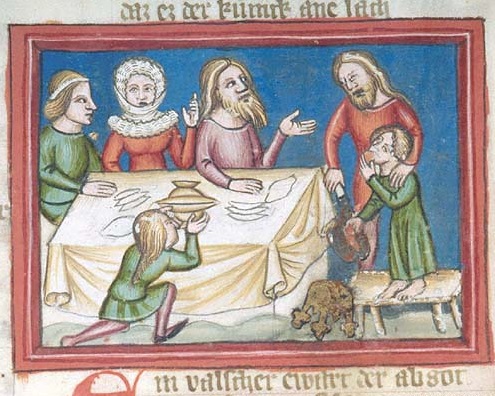
The classic midrash invented an episode in Moses’ childhood to account for a speech defect. When Moses was weaned, he was adopted as a son by the pharaoh’s  daughter.1 In one version of the midrash, “Pharaoh would kiss him and hug him, and he would take Pharaoh’s crown and place it on his head, as he was destined to do when he grew older. … The magicians of Egypt were sitting there, and said: ‘We are afraid of this one who takes your crown and places it on his head, lest he be the one regarding whom we said that he is destined to wrest your kingdom from you.’ Some of them said to behead him, some said to burn him.” (Shemot Rabbah)2  

In another version, “While growing up in Pharaoh’s palace Moses once took the king’s crown and threw it on the ground. The king wanted to execute him on account of this misdemeanor.” (Rabbeinu Bachya’s paraphrase of Pesikta Zutrata)3

In both versions of the midrash, little Moses was presented with a bowl containing a lump of gold and a burning coal. The court agrees that if he reached for the gold, he was smart enough to depose the pharaoh when he grew up, and he would be executed. But if he reached for the coal, he would be allowed to live.

“Immediately, they brought it before him and he extended his hand to take the gold. [The angel] Gabriel came and pushed his hand. He seized the coal and placed his hand with the coal into his mouth, and his tongue was burned.” (Shemot Rabbah)4

And God said to him: “Who placed a mouth in the human being? Or who makes [someone] mute or deaf or clear-sighted or blind? Is it not I, God? So now go! And I myself will be with your mouth, and I will instruct you regarding what you will speak.” (Exodus 4:11-12)

The first part of God’s rebuttal supports the speech defect theory; it implies that God is responsible for all the physical characteristics a person is born with, including birth defects. But then why does God promise to “instruct” Moses regarding what to say?

Ibn Ezra wrote: “God told Moses that He would teach him to speak with words that do not contain letters that he had difficulty enunciating.”5 Other commentators wrote that whenever Moses was speaking as God’s agent, God would intervene so that Moses’ lips and tongue would operate perfectly.

According to the 14th-century commentary Tur HaArokh, God “simply told him to go and fulfill his mission, and that He would come to his aid whenever required. Whatever he would be saying to Pharaoh would come out of his mouth clear …”6

19th-century Rabbi S.R. Hirsch added: “In fact, a stammerer is he most fitting one to carry out this mission. Every word that he will utter will itself be a sign. If a man who ordinarily stammers is able to speak fluently when he speaks at God’s command, his every word bears the stamp of credibility.”7

Why doesn’t God eliminate Moses’ speech defect altogether? Because Moses does not ask him to, according to the commentators who favor the speech defect theory. And why doesn’t Moses pray to God to remove his speech defect?

“Seeing that Moses, basically, did not wish to assume the burden of leadership at all, he did not pray to God to heal his speech defect. He contented himself with saying that someone with a blemish such as he suffered from was not likely to be the most suitable candidate for the task proposed by God. God, for His part, did not want to heal his speech defect precisely because he had not prayed to Him to do this.” (Tur HaArokh) 8

At a loss for words?

Other commentary rejects the theory that Moses has a speech defect, and interprets his statement that he is “not a man of words” as an argument that he is not a persuasive speaker. Being “heavy of mouth and heavy of tongue” is then a metaphor for a general delay in finding the right words to say.  A 2nd-century C.E. commentary simply states that Moses is not eloquent.9

A millennium later, Rashbam and Chizkuni10 claimed that Moses fled from Egypt before he had completed his education, and has not spoken the Egyptian language since, so therefore he is not fluent in the language spoken by the Egyptian aristocracy.11

Yet Moses grew up with an Egyptian princess as his adoptive mother; he must have been exposed to upper-class Egyptian for years. I suspect Moses is more likely to worry that he will be unable to speak in Hebrew to the Israelites living in Egypt. After all, when he was weaned (at around age three in that culture) the pharaoh’s daughter adopted him, and he left his Israelite birth parents. Only when Moses became an adult did he go to see the people of his birth.

… and Moses grew up. And he went out to his kinsmen, and he saw their forced labor. And he saw an Egyptian man striking a Hebrew man, one of his kinsmen. And he turned this way and that way, and he saw that there was no man, and he struck down the Egyptian and buried him in the sand.  (Exodus 2:11-12)

If Moses had not led a sheltered and insulated life in the palace, he would know that the Israelites doing forced labor on the pharaoh’s building projects were often beaten12—and he would know that killing one overseer would not rescue any Israelite from future beatings.

Instead, Moses might well think he can rescue the victim and eliminate the oppressor himself,  as long as he kills the overseer in secret.13 But his secret is revealed, and the pharaoh, Moses’ adoptive grandfather, orders him killed. Apparently the society Moses has grown up in has no qualms about summary executions.

Tammi J. Schneider noted in a 2025 article: “Moses does not, however, have a conversation with the Egyptian about his actions before he kills him. Moses is a bit of a hothead. The next day, when Moses finds two Hebrews fighting, he does speak briefly with the offender. The text is silent as to what language they speak, but there is no suggestion that Moses has difficulty doing so … The interaction leads Moses to flee, again with no suggestion that he discussed his plan or actions with anyone; he just acts on his own impulses …

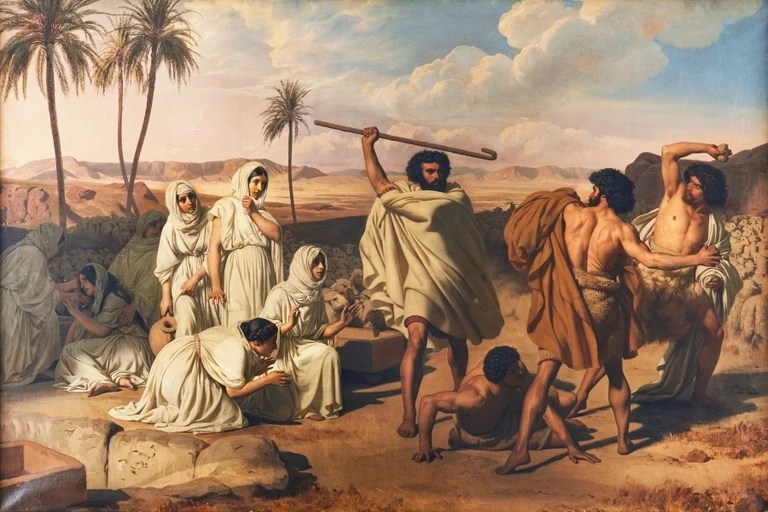
Moses Defending the Daughters of Jethro at the Well, by Eugene Roger, 1837

In Midian, he impulsively, without any conversation, drives off the shepherds who are preventing the seven daughters of Reuel from watering their flocks … This pattern suggests that Moses’ problem is not a speech impediment, but an impulse to act before speaking.”14 Perhaps when Moses is speaking to God on Mount Sinai, he says he is “not a man of words” because he knows he is an impulsive hothead. But there is another possible reason why he does not stop to speak before he acts.

No time for an introvert

While extraverts can think while they speak, introverts need time to figure out what they will say before they start speaking. I am an introvert, and I often want to contribute to a conversation among several people, but by the time I have composed my comment, the conversation has already moved on to another topic. Introverts can only speak well spontaneously about our own areas of expertise. The other situation in which we can speak quickly is when we happen to have rehearsed a remark ahead of time just in case the topic came up.

Many introverts do not trust themselves to come up with the right words before someone else jumps in (with either speech or action). What if Moses is an introvert, but he feels compelled to do something about the abusive overseer before any witness arrives at the scene?

He acts without speaking then. When he goes out to the worksite again the next day, he says to an Israelite who hits another Israelite: “Why do you hit your fellow?” (Exodus 2:13)

(His question is only three words long in Hebrew: “Lamah takeh rei-ekha?” (לָמָּה תַכֶּה רֵעֶךָ).)

Because the stakes are lower, Moses is willing to risk blurting something with no time to think. The guilty Israelite (an obvious extravert) taunts him by saying: “Who made you the man who is an officer and a judge over us? Are you saying you’ll kill me like you killed the Egyptian?” (Exodus 2:14) Moses turns away in silence, unable to formulate a quick rejoinder.

One advantage introverts have over extraverts is that we can happily spend long periods of time alone. When Moses flees Egypt, he does not take any servants with him, but walks alone across the wilderness of the Sinai Peninsula and into Midianite territory.

When he stops at a well there, seven sisters arrive and begin to water their flock, and then some male shepherds show up and rudely drive them away from the well. I think Moses wants to stop the men immediately, but he cannot think of what to say. So he just jumps up and drives them away. The father of the young women takes in Moses and gives him one of his daughters in marriage.

And Moses the introvert is content to shepherd his Midianite father-in-law’s flock alone in the wilderness. Once he takes the flock all the way to Mount Sinai, and God speaks to him out of a fire in a bush.

Naturally Moses is reluctant to abandon his peaceful life and afraid to return to Egypt—especially on a mission that will require him to speak to a lot of strangers about critical matters. So he tries to convince God that he is not the right man for the job. But he does not dare keep God waiting while he formulates excuses.

No wonder the four objections Moses the introvert makes are disorganized and indirect.

First Moses asks: “Who am I that I should go to Pharaoh and that I should bring out the Israelites from Egypt?” (Exodus 3:11) He pauses, perhaps searching for more words, and God promises to be with him so he will succeed.

Moses asks a second question: “And they say to me: ‘What is his name?’ What should I say to them?” (Exodus 3:13) He probably means that he does not even know the name the Israelites in Egypt use for their god. But God dips into theology and gives him two divine names related to the verb “to be” or “to become”. Then Moses manages to give the reason why he asked for a name: “But they will not trust me, and they will not pay attention to my voice.” (Exodus 4:1) In response, God patiently gives Moses two minor miracles he can perform again in Egypt.

But Moses is still afraid of returning to Egypt, and afraid that he will not be able to handle the job. So he grasps at a fourth excuse, reminding God that he is not a man of words.

If Moses had had enough time to plan his speech to God, he could have made a more coherent and convincing argument. He might have said (without pausing to let God interrupt): “But if I went, nobody would believe me! The Israelites wouldn’t believe me and follow me because I don’t speak Hebrew! And the new pharaoh wouldn’t believe me and let the Israelites go because the old pharaoh laid a murder charge on me and I ran away! So please send someone else!”

However, even if God had given Moses lots of time to figure out what to say, and he had then presented God with the argument above, it would not have let him off the hook. God would still have promised him success, still have given him two small miracles to induce the Israelites to believe him, and still have promised to feed him the right words.

And Moses, still not reassured, would still have resorted to begging God to send someone else.

To be continued …


  1. Exodus 2:1-10.
  2. Shemot Rabbah 1:26, translation in www.sefaria.org.
  3. 14th-century rabbi Bachya ben Asher (“Rabbeinu Bachya”) paraphrasing 11th-century Tobias ben Eliezer’s Pesikta Zutrata; translation of Bachya in www.sefaria.org.
  4. Shemot Rabbah, ibid.
  5. Abraham ben Meir ibn Ezra, translation in www.sefaria.org.
  6. Tur HaArokh, by Rabbi Jacob ben Asher (c. 1269 – c. 1343), translation in www.sefaria.org.
  7. Rabbi Samson Raphael Hirsch, The Hirsch Chumash: Sefer Shemos, translation by Daniel Haberman, Feldheim Publishers, Jerusalem, 2005, p. 53.
  8. Tur HaArokh, ibid.
  9. Seder Olam Rabbah 5:2, 2nd century C.E.
  10. Rashbam (12th-century rabbi Shmuel ben Meir) and Chizkuni (a 13th century collection of commentary).
  11. Da-at Zekinim, a 12th-13th century collection of commentary, upped the ante by claiming that the pharaoh and his advisors spoke 70 languages, and would ridicule Moses if he could not answer them in the same tongues.
  12. Exodus 1:11-14, 3:7-9.
  13. In Exodus 2:12, Moses glances around first, then kills the Egyptian without a witness, then buries the body in the sand.

Shemot: Names and Miracles

(This is the third post in a series about the interactions between Moses and God on Mount Sinai, a.k.a. Choreiv, and how their relationship evolves. If you would like to read one of my posts about this week’s Torah portion, Beshallach, you might try: Beshallach: See, Fear, Trust, Sing.)


Moses Before the Burning Bush, by Domenico Feti, 1614

Moses is shepherding the flock of his Midianite father-in-law when he approaches the “mountain of God”, called Choreiv or Sinai, and turns aside to examine a fire in a thornbush that does not burn the branches. God speaks out of the fire, ordering him to lead the Israelites from Egypt to the land of Canaan. But although Moses feels empathy for the oppressed Israelites, he does not want the job. Either fear or deep humility drives him to find one objection after another.

Who am I?

His first excuse for not going to Egypt, which I discussed in last week’s post, Shemot: Empathy, Fear, and Humility, is: “Who am I that I should go to Pharaoh and that I should bring out the Israelites from Egypt?” (Exodus 3:11)

And God replies: “But I will be with you.” (Exodus 3:12) Moses is not encouraged, but he does not argue with God. He moves on to his next question.

Who are you?

Then Moses said to the elohim: “Hey, I come to the Israelites and I say to them: ‘The elohim of your father sent me to you.’ And they say to me: ‘What is his name?’ What should I say to them?” (Exodus 3:13)

elohim (אֱלֺהִים) = god, gods, God. (A general term, not a name of God.)

Many commentators have offered insights about Moses’ request for God’s name, insights based on the assumption that Moses already knows all the names of God that have already been mentioned in the book of Genesis, and so do the Israelites in Egypt.1 But why should we make this assumption? Moses grew up in an Egyptian household. He did not even go out to look at the Israelite men doing forced labor until he was an adult, and he fled to Midian shortly after that. There is no reason to think he learned any names of God from the Israelites—or that the book of Genesis had been written yet.

The only name of God that Moses might know is God’s four-letter personal name, Y-H-V-H. Some modern commentators theorize that Y-H-V-H was originally the name of a Midianite god.2 If so, the author(s) of this story in Exodus could have drawn from a tradition that Moses’ father-in-law, a Midianite priest, taught him the God-name Y-H-V-H.

But even so, Moses would not expect that a Midianite god-name could help him gain the trust of the Israelites in Egypt.

Moses’ request for a name of God to tell the Israelites seems more like an extension of Moses’ first objection: he is not qualified for the job in Egypt, he is out of his depth. He knows the names of a number of Egyptian gods, but he does not know the name of the God speaking to him now from out of the fire in the bush. How can he be the prophet of a God he does not even know?

Another reason for Moses’ request for a name is that he is afraid the Israelites will not believe he is the agent of their God. What could he possibly say or do that would make them trust him?

But Moses, who has already hidden his face from God out of fear, hides his real question behind a more polite one: Suppose he goes to Egypt and the Israelites ask for God’s name. What should he say?

An unhelpful reply

And Elohim said to Moses: “Ehyeh what ehyeh.” And [God] said: “Thus you must say to the Israelites: Ehyeh sent me to you.” (Exodus 3:14)

ehyeh (אֶהְיֶה) = I will be, I will become, I have not finished being, I have not finished becoming. (The root verb hayah, הָיָה = was, became. The prefix e-, אֶ indicates both the first person singular and the imperfect form of the verb. Biblical Hebrew often uses the imperfect as a future tense, but it can also mean the action has not been completed.)

Commentators have a field day with this verse. But its theological implications do nothing for Moses’ dilemma. I can imagine him shuddering at the thought of what would happen to a stranger who showed up in Egypt and tried to explain Ehyeh what ehyeh to the Israelites.

Perhaps God hopes Moses will ponder Ehyeh what ehyeh in the future and learn something about the nature of God. But clearly he needs a different answer to his question about what name to give if the Israelites ask him to identify the God who sent him.

Then Elohim said further to Moses: “Thus you will say to the Israelites: ‘Y-H-V-H, the elohim of your fathers, the elohim of Abraham, the elohim of Isaac, and the elohim of Jacob, sent me to you.’ This is my name forever, and this is how I will be remembered from generation to generation.” (Exodus 3:15)

Y-H-V-H (י־ה־ו־ה) = the four-letter personal name of God (also called the tetragrammaton), spelled without hyphens in the Hebrew bible and Jewish prayers. For less sacred uses, Jews insert typographic marks such as hyphens, or replace the tetragrammaton with a synonym. (For possible etymologies of Y-H-V-H,see my post: Beshallakh & Shemot: Knowing the Name.)

The book of Exodus does not say whether the name Y-H-V-H was passed down among the Israelites during the 200 or more years they live in Egypt. Nor does it say whether the Israelites still tell stories about Abraham, Isaac, and/or Jacob. But even if they were familiar with the tetragrammaton and the three patriarchs, would knowing these names help Moses with his mission?

The God speaking out of the fire in the bush seems to think so, because God continues:

“Go and gather the elders of Israel, and you must say to them: “Y-H-V-H, the God of your fathers, appeared—the God of Abraham, Isaac, and Jacob—saying: ‘I have definitely noticed you and what is being done to you in Egypt. And I said I will bring you up from the misery of Egypt to the land of the Canaanites …’ And they will listen to your voice. Then you will come, you and the elders of Israel, to the king of Egypt … and you will say to him: ‘Y-H-V-H, the God of the Hebrews, has met us. So now please let us go on a journey of three days into the wilderness, and we will make slaughter-sacrifices to Y-H-V-H, our elohim.’” (Exodus 3:16-18)

Then God predicts that the pharaoh will not let the Israelites leave until after God has stricken Egypt with “wonders”, and that when they do leave, the Egyptian people will send them off with silver, gold, and clothing.

Moses is not convinced. He is too fearful, and maybe also too humble, to believe God will make everything come out all right.

Trust in miracles

And Moses replied, and he said: “But they, ya-aminu not in me, and they will not pay attention to my voice. Indeed, they will say: ‘Y-H-V-H has not appeared to you!’” (Exodus 4:1)

ya-aminu (יַאֲמִינוּ) =they will trust, they will believe.

Perhaps Moses does not expect any sympathy from the Israelites because he remembers when he returned to the scene of his sole crime (the murder of an Egyptian man who was beating an Israelite), and saw two Israelite men fighting. He asked one Israelite why he was striking the other, and the Israelite replied:

“Who appointed you as an officer and judge over us? Are you going to kill me, as you killed the Egyptian?” (Exodus 2:14)

How can Moses protest that the Israelites will not believe him when God has just said “And they will listen to your voice”? Listening implies a willingness to believe what is said. The 16th-century commentator Sforno wrote that Moses was not referring to his first speech to the Israelites, but to later events.

“Once the people will see that Pharaoh will refuse to let them go, they will lose faith in me and will not listen to my promises … for they know that when God says something it will be so. They will not be able to account for my failure except by claiming that I am an impostor.” (Sforno)3

The God character in this story is patient, and responds with a new approach. According to 14th-century commentary by Rabbeinu Bachya: “This is why God had to equip Moses with the ability to perform certain miracles to help convince the people that he was no charlatan.”4

Moses’ Rod Is Turned into a Serpent, by James Tissot, ca. 1900

Then Y-H-V-H said to him: “What is this in your hand?” He said: “A staff.” And [God] said: “Throw it to the ground!” And he threw it to the ground, and it became a snake. And Moses fled from its face. Then Y-H-V-H said to Moses: “Reach out your hand and grasp it by its tail!” And he reached out his hand and got a firm hold on it, and it became a staff in his fist. [God said] “So that ya-aminu that Y-H-V-H, the elohim of their fathers, the elohim of Abraham, the elohim of Isaac, and the elohim of Jacob, appeared to you.” (Exodus 4:2-5)

Here God gives Moses exactly what he asked for. Demonstrating this miracle is indeed likely to make the Israelites trust him and believe that their own god sent him.

And Moses, who has been consistently fearful from God’s first words to him until he flees from the snake that used to be his own staff, now summons his courage and grabs the snake firmly. At that moment, at least, he trusts God to protect him.

Why does God pick this particular miracle? 12th-century commentator Abraham ibn Ezra wrote that God started with Moses’ staff for practical reasons. “God gave Moses a sign via an object that was always with him, the staff, Moses’ walking stick, as is the custom with elders. Moses would not appear as a shepherd before Pharaoh.”5

Why does God make the staff turn into a snake? 19th-century rabbi Samson Raphael Hirsch wrote that the transformation of staff to snake and snake to staff will demonstrate to the Israelites that God has the power to overturn both human authority and hostile forces (two different descriptions of the pharaoh).

“You have been sent by the one sole God Who, if He so desires, can cause the very thing on which man relies for support, and which serves him as an instrument of his authority, to turn against him. Conversely, if He so desires, God can take a hostile force that is feared and shunned by man and place it into his hand as an accommodating support and tractable tool.” (Hirsch)6

Another line of commentary claimed that both the staff-snake miracle and the following miracle demonstrate that God is in charge of life and death.

And Y-H-V-H said further to him: “Please place your hand in your bosom!” And he placed his hand in his bosom [the front fold of his robe], and he took it out, and hey! His hand had tzara-at like snow! Then [God] said: “Return your hand to your bosom!” And he returned his hand to his bosom. Then he took it out of his bosom, and hey! It was restored as his flesh. (Exodus 4:6-7)

tzara-at (צָרַעַת) = a skin disease characterized by dead-white patches of skin.

16th-century rabbi Ovadiah Sforno, following 14th-century Rabbeinu Bachya, explained both miracles this way: “Here is a staff which is an inert object, and the hand which is something very much alive. I will demonstrate that I can kill that which is alive and bring to life that which is dead. I will make your hand useless and your staff will suddenly come alive.”7

Commentators have also pointed out that the second miracle points at Moses’ inappropriate speech even more than the first, since the Talmud considered tzara-at a divine punishment for evil speech.8

And Hirsch added: “For it demonstrates that not only the staff, but also the hand that holds and guides the staff, is subject to God’s control. … even if man seeks to withdraw into himself and rely only on himself, he cannot be sure of himself. If God wishes, He can plant discord even within man’s inner self.”9

After providing Moses with these two miracles for demonstration purposes, God says that if the Israelites do not believe him after the first sign, they will believe him after the second. But if even that does not work,

… and they do not listen to your voice, then you must take some water of the Nile, and you must pour it out on the dry land, and the water that you take from the Nile will become blood on the dry land. (Exodus 4:9)

Moses does not ask for a fourth miracle to demonstrate his bona fides. Instead he moves on to another excuse to stay home in Midian, another reason why he is not the right person for God’s mission.

To be continued …


  1. For example, Ramban (Nachmanides), Or HaChayim, and Samson Raphael Hirsch wrote that Moses was really asking which attribute of God would rescue the Israelites from Egypt, because that would be important information for the Israelites.
  2. E.g. Israel Knohl, https://www.thetorah.com/article/yhwh-the-original-arabic-meaning-of-the-name.
  3. Rabbi Ovadiah Sforno, translated in www.sefaria.org.
  4. Rabbeinu Bachya (Rabbi Bachya ben Asher), translated in www.sefaria.org.
  5. Abraham ben Meir ibn Ezra, translated in www.sefaria.org.
  6. Rabbi Samson Raphael Hirsch, The Hirsch Chumash: Sefer Shemos, translation by Daniel Haberman, Feldheim Publishers, Jerusalem, 2005, p. 50.
  7. Sforno, ibid.
  8. E.g. Rashi and 14th-century rabbi Jacob ben Asher in Tur HaArokh.
  9. Hirsch, p. 51.

Shemot: Empathy, Fear, and Humility

(This is the second post in a series about the interactions between Moses and God on Mount Sinai, a.k.a. Choreiv, and how their relationship evolves. If you would like to read one of my posts about this week’s Torah portion, Bo, you might try: Bo: Pride and Ethics.)


The pharaoh of Egypt dies, and the murder charge against Moses expires. But Moses continues to live in the wilderness east of Egypt with Yitro, a priest of Midian. He marries one of Yitro’s daughters, they have two sons.

Back in Egypt, there is a new pharaoh, but he is still subjecting the Israelites to forced labor.

And the Israelites moaned from the servitude, and they cried out, and their cry went up to God, from the servitude. And God paid attention to their groaning, and God remembered [God’s] covenant with Abraham, with Isaac, and with Jacob. (Exodus 2:23-24)

Divine miracles are necessary, but not sufficient, to bring the Israelites out of Egypt. A human intermediary is also needed: a prophet and leader to speak to Pharaoh and to lead the Israelites from Egypt to Canaan. For this job, God picks Moses.

Why does God choose Moses?

Moses at the Burning Bush, detail, by Rembrandt, 17th century

By the time God calls Moses’ name on Mount Sinai, Moses has already exhibited some character traits that make him a good choice. For one thing, he is curious about why the fire in the thorn-bush does not burn it up, and takes a closer look. (See last week’s post, Shemot: A Close Look at the Burning Bush.) A prophet must be open to hearing from God, and a leader must notice and investigate anything out of the ordinary.

Another of Moses’ helpful character traits is empathy for the underdog. When Moses sees an Egyptian man beating a Israelite, he first checks to see if there is anyone else around (to help, or to witness). Seeing no one, he strikes down the Egyptian and buries him in the sand. Although Moses is an adopted son of an Egyptian princess, he does not try to command the Egyptian overseer to cease. Either he is afraid that the Egyptian will strike him next, despite his apparent status, or he is so humble he does not believe he has any authority over an Egyptian overseer (perhaps because he carries no authority with anyone related to the pharaoh by birth rather than adoption).

When Moses goes back the next day, he sees two Israelite men fighting. He is not afraid to speak up to them, and he asks one Israelite why he is striking the other.

And [the Israelite] said: “Who appointed you as an officer and judge over us? Are you going to kill me, as you killed the Egyptian?” Then Moses was frightened, and said [to himself]: “Surely the matter is known!” (Exodus 2:14)

Pharaoh condemns Moses to death for the murder of the Egyptian, and Moses is too humble—or frightened—to fight the charge. He immediately flees into the wilderness. After several days he stops at a well where seven female shepherds are beginning to water their flock. When a group of male shepherds arrive and shove them away from the well, Moses fights them off, then helps the women draw water. They take him home to their father, who adopts him into the family. Out of either fear or humility, Moses never mentions that he used to live like a prince in Egypt, nor that he is wanted for murder.

Moses’ empathy for the underdog results in his flight to Midian. His curiosity draws him to the “mountain of God”, and then to God’s manifestation in a divine fire. Another character trait needed for God’s mission is humility, but so far Moses seems to be more motivated by fear of authority. When he kills the abusive Egyptian he is afraid that the pharaoh will find out, and when the pharaoh orders his execution he is afraid he will be found. Naturally he is nervous about the God on the mountain, too. In last week’s post, we saw how God gradually leads Moses up to the point where he can hear God call his name. Once Moses has responded to God’s second call by saying “Here I am”, God lets him know which god is calling.

Moses hides his face

The Call of Moses, by Providence Lithograph Co., 1900

And [God] said: “I am the God of avikha; the God of Abraham, the God of Isaac, and the God of Jacob.” And Moses hid his face, because yarei of looking at God. (Exodus 3:6)

avikha (אָבִיךָ) = your father, your forefather. (The plural would be avoteykha,אֲבוֹתֶיךָ, “your fathers”.)

yarei (יָרֵא) = he was afraid, he was in awe.

Why does God start off by saying “I am the God of your father” in the singular? The classic midrash1 assumed that God meant Moses’ biological father, Amram.

“The Holy One, blessed be He, said: ‘If I appear to him in loud voice, I will terrify him; in soft voice, he will take prophecy lightly.’ What did He do? He appeared to him with the voice of his father. Moses said: ‘Here I am; what does Abba want?’ The Holy One, blessed be He, said: ‘I am not your father, but rather the God of your father. … The God of Abraham, the God of Isaac, and the God of Jacob’. Moses was joyful and said: ‘Abba is enumerated with the patriarchs. Moreover, he is greater, as he was mentioned first.’” (Shemot Rabbah 3:1)2

But the book of Exodus itself does not depict Moses as so naïve and childlike. Furthermore, Moses might not even remember his father’s voice, since the pharaoh’s daughter took him into her palace when he was about three years old, after Moses’ mother had weaned him. And he would be unlikely to refer to Amram as “Abba”, the equivalent of “Dad”. So I prefer the commentary that says God refers to the collective “forefather” of the Israelites, then elaborates by citing the three patriarchs who are the forefathers of the Israelites: Abraham, Isaac, and Jacob.3

Why does Moses hide his face in fear (or awe) only when he hears that the God who is addressing him is the God of the Israelites? Perhaps he is not afraid of looking at other gods; he must have done it all the time when he lived with royalty in Egypt. But he takes the God of the Israelites, the God of Abraham, Isaac, and Jacob, more seriously.

Maybe he is frightened because he believes the God of his birth family has more power over him than any other god would. Maybe he is overwhelmed by awe because he is humble, and knows he is unworthy of being addressed by any God.

Or maybe he is frightened because he intuits that God would not speak to him except to ask him to do something terribly dangerous.

Moses’ first attempt to get out of the mission

Although Moses has hidden his face, God goes on speaking to him, filling in some backstory:

“I have definitely seen the suffering of my people who are in Egypt, and I have heard their outcry in the face of their oppressors, for I am acquainted with their pain. And I have come down to rescue them from the hand of Egypt and to bring them up from that land to a good and spacious land, a land flowing with milk and honey,4 to the place of the Canaanites, the Hittites, the Amorites, the Perizzites, the Hivites, and the Jebusites. … And now, go! And I will send you to Pharaoh, and you will bring out my people, the Israelites, from Egypt.” (Exodus 3:7-8, 10)

Despite God’s careful attempt to bring Moses to the right balance of fear and courage to receive the divine message, Moses does not respond with the equivalent of “Yes, sir!” Instead he starts making excuses why he should not go.

But Moses said to God: “Who am I that I should go to Pharaoh and that I should bring out the Israelites from Egypt?” (Exodus 3:11)

Is this humility, or is it the first excuse that comes to Moses’ mind to get out of what sounds like a difficult and dangerous job?

Some of each, according to Tze-enah Ure-enah: “That is, Moses said: I am lowly and I should speak with a king? Perhaps he will kill me?”5

But S.R. Hirsch saw Moses’ first excuse as humility without any thought of self-preservation: “Was he not entitled to doubt whether he had the imposing, overpowering strength of personality required to transform a nation of slaves into a people of God?”6

Joanathan Sacks offered a different argument why Moses would be reluctant to give up his life in Midian for the sake of the Israelites in Egypt: “He may have been Jewish by birth, but he had not suffered the fate of his people. He had not grown up as a Jew. He had not lived among Jews. He had good reason to doubt that the Israelites would even recognise him as one of them. … why should he even think of becoming their leader? Their fate was not his. He was not part of it. He was not responsible for it. He did not suffer from it. He was not implicated in it.”7

Nevertheless, Sacks pointed out, after he has given God several reasons why he should not be the one to go to Egypt, Moses finally submits and accepts the job, for the same reason he struck down the Egyptian man beating the Israelite laborer. When he sees people suffering, he cannot walk away. His empathy for the underdog is a more important qualification for God’s mission than personal courage.

Moses gets an answer

Then [God] said: “But I will be with you, and this is your sign that I myself sent you. When you bring out the people from Egypt, you will serve God on this mountain.” (Exodus 3:12)

Why does God answer “But I will be with you”? One explanation is that God intends to reassure Moses that he will not have to face the pharaoh alone, or the Israelites (who taunted him when he returned to the scene of his crime).

“One says “I will be with you” only to someone who is afraid.” (Shemot Rabbah)8

Adin Steinsaltz explained that God means: “I am not asking you to act on your own strength; you are merely a messenger.”9

On the other hand, “God was with him” is a biblical idiom for success. For example:

And God was with Joseph, and he was a successful man, and he was in the house of his Egyptian master. And his master saw that God was with him and everything that he did God made successful in his hand.” (Genesis 39:2-3)

So when God tells Moses “I will be with you”, God might be promising him that his mission will succeed. And Moses’ very success would be a sign to the Egyptians and the Israelites that God sent him on the mission.10

Hirsch wrote that God’s “I will be with you” means that God knows Moses is unable to succeed on his own—and this is the very the reason why God chooses him for the mission. He imagined God explaining:

“I need someone who is the wisest and at the same time the humblest of all men. Your marked inadequacy will stamp the work I intend to accomplish through you with a ‘sign’ for all time to come that what you achieved could have been achieved only at My command and by My power. Your very inadequacy will attest to the Divine character of your mission. Without this proof, Israel’s deliverance would be regarded as no different from other events in world history that glorify the power of men.”11

So Moses is the most qualified person to be God’s prophet because he is the least qualified person to face the pharaoh and lead the Israelites.


Moses does not argue with God about God’s reply “I will be with you”. But he does generate another question, as he flounders for a convincing reason why God should not send him to Egypt after all.

To be continued …


  1. Midrash is a type of commentary that makes additions to the text in order to flesh out the story or to connect it with a mystical tradition.
  2. Shemot Rabbah, 10th-12th centuries, translation in www.sefaria.org.
  3. E.g. Ibn Ezra, 12th century; Ramban, 13th century; Rabbeinu Bachya, 14th century.
  4. See my post: Ki Tavo: Milk and Honey.
  5. 17th-century commentary Tze-enah Ure-enah, translation from Yiddish in www.sefaria.org.
  6. 19th-century rabbi Samson Raphael Hirsch, The Hirsch Chumash: Sefer Shemos, translation by Daniel Haberman, Feldheim Publishers, Jerusalem, 2005, p. 35.
  7. Rabbi Lord Jonathan Sacks, Covenant & Conversation, “Who Am I? Shemot”, reposted Jan. 16, 2025.
  8. Shemot Rabbah.
  9. Rabbi Adin Even-Israel Steinsaltz, The Steinsaltz Tanakh, Koren Publishers, Jerusalem, 2019, quoted in www.sefaria.org.
  10. This is the opinion of Rashi (11th-century rabbi Shlomoh Yitzchaki), and 16th-century rabbi Ovadiah Sforno. (The Torah is ambiguous about whether the sign proving God sent Moses will be Moses’ success in liberating the Israelites from Egypt, or what will happen when they serve God on Mount Sinai, a.k.a. Choreiv.)
  11. Hirsch, p. 36.

Shemot: A Close Look at the Burning Bush

(I intended to post this last week, since it examines part of the first Torah portion in the book of Exodus, Shemot, but I didn’t finish it in time because I was sick. Now I am making it the first of a series of posts about how God and Moses interact on Mount Sinai, a.k.a. Choreiv. Meanwhile, if you would like to read one of my posts on this week’s Torah portion, Va-eira, try this one: Va-eira: Taking a Stand at the Nile.)


Moses is born under the general death sentence that the pharaoh has issued against all male newborns of the Hebrews. His mother hides him, one of the pharaoh’s daughters finds him, and his sister arranges for this Egyptian princess to adopt him. Moses grows up in the safety of the royal palace.

But he knows he is a Hebrew by birth. The narrative of the first Torah portion in the book of Exodus, Shemot (Exodus 1:1-6:1), confirms this by saying that when Moses had grown up,

Moses Kills an Egyptian, by Watson Heston, 1892

… he went to his kinsmen and he saw their forced labor. And he saw an Egyptian man beat a Hebrew man, one of his kinsmen. (Exodus 2:11)

Moses looks around, then kills the Egyptian. The pharaoh finds out, and once again Moses is under a death sentence. He flees the murder charge, walking alone all the way across the Sinai Peninsula to the land of Midian. A Midianite priest gives Moses shelter and marries him to one of his daughters.

Once again, Moses has been adopted and lives in safety—as long as he never goes back to Egypt.

Then God calls and orders him to do just that.

This is the first time Moses hears from God. If the divine call is not impressive enough, he might ignore it. If it is too overwhelming, he might go insane, or at least decide he is seriously ill, and fail to answer. What kind of approach will make Moses at least listen and respond to God’s order to return to Egypt and ask the new pharaoh to let the Hebrews go?

To answer that question, we need to examine the words the Torah uses in the description of Moses’ call to prophecy.

The place

And Moses was a shepherd of the flock of his father-in-law Yitro, a priest of Midian. And he led the flock ahar the midbar, and he came to the mountain of ha-elohim, to Choreiv. (Exodus 3:1)

ahar (אַחַר) = behind, afterward.

midbar (מִדְבָּר) = wilderness, i.e. any area that is neither farmed nor near a permanent settlement.

ha-elohim (הָאֱלֺהִים) = the gods, God.

Choreiv (חֺרֵב) = the mountain on the Sinai Peninsula called “Sinai” in other strands of the story.1 (From the root verb charav, חָרַב = dried up, made desolate.)

First God waits until Moses has traveled far from his home. Although many English translations skip the word ahar and just say Moses led his flock into the wilderness, Moses’ home (in his father-in-law’s encampment) is probably already in the midbar. The Midianites were nomadic tribes living along the eastern shore of the Gulf of Aqaba and also closer to the Sinai Peninsula, in the hills north of the Egyptian port of Eilat. Moses would have avoided any Midianite campsites near that port. So he lives in the midbar of Midian.

Now Moses leaves his home in the wilderness and leads the flock even farther away from civilization, “behind” the wilderness, to the mountain of God. Why does he go there?

16th-century rabbi Ovadiah Sforno, like many classic commentators, wrote: “He wanted to pray and meditate there in complete isolation and concentration.”2

Since Moses might see another shepherd in the wilderness, he takes the flock behind the wilderness, to the foot of Mount Choreiv: a mountain so dry nothing grows on it except thornbushes. But there is no previous indication in the Torah portion that Moses is a prayerful or meditative man. If anything, he is impulsive, quick to attack in order to rescue the underdog.

An alternate explanation is that Moses is looking for a new grazing site, and accidentally wanders to a place that is poor for grazing, but significant for other reasons.

“Apparently, Moses has never been to this mountain before—it must have been in a somewhat remote area. That is why the passage starts off by explaining the special circumstances that led him to this mountain at this time: he had led his flock ‘beyond the wilderness,’ some greater distance than usual, presumably in search of a good grazing site.” (Kugel)3

A third possibility is that Moses’s father-in-law, Yitro, has told him about this mountain associated with a god. As a Midianite priest, Yitro would know of any numinous sites in the region. Later in the book of Exodus, Yitro says:

“Now I know that Y-H-V-H is greater than all the gods.” (Exodus 18:10)

This implies that he already knew about the God whose personal name is the Tetragrammaton, Y-H-V-H; he simply had not known that this particular god was the most powerful. Moses is a curious man; just as he left the comfort of the palace to observe the forced labor of the Hebrews, he might now decide to check out the mountain of the god (ha-elohim), who turns out to be the God (ha-elohim), Y-H-V-H.

Later God will speak directly to Moses’ mind without preliminaries, wherever Moses happens to be. But for the first contact, God waits until Moses arrives at Mount Choreiv. If Moses already associates this mountain with a god, he will be more inclined to listen when God does speak to him.

The fire

The first thing God does when Moses arrives is to make something appear in a thornbush.

And a malakh of Y-H-V-H appeared to him belabat fire in the middle of the sneh. And he looked, and hey! the sneh was burning in the fire, but the sneh was not consumed. (Exodus 3:2)  

malakh (מַלְאַךְ) = messenger. (When a human sends a malakh, it’s another human. When God sends a malakh, it looks like a man but turns out to be God, or it sounds like a human voice but turns out to be God’s voice. Some English translations call a malakh of God an angel.)4

belabat (בְּלַבַּת) = in a flame of; in the heart of. (Some commentators derive the word from labah (לַבָּה) = flame, flame-shaped spear-head. Others derive the word from leiv (לֵב) = heart, mind, consciousness; courage; interior, middle.)5

sneh (סְנֶה) = thornbush. (This is the accepted translation; it may be the cassia senna shrub, called sene in Arabic. In the entire Hebrew Bible, this word appears only in Exodus 3:2-4 and Deuteronomy 33:16—which is a reference to Exodus 3:2-4. Commentators have suggested that the other name for Mount Choreiv, Mount Sinai, may be derived from sneh—or the other way around!)

What does Moses see in the fire? Is it an image of a man, like many a divine malakh? Or is it the image of a flame in the fire?6

19th-century rabbi Hirsch insisted Moses saw the image of a man, i.e. an angel:

“The angel appeared in the center of the fire, and the fire was in the center of the thorn bush. The thorn bush was not enveloped by flames, and the impression it made was not that of a thorn bush engulfed in flames without being consumed. … Rather, the fire was within the bush and the angel was within the flames.”7

Moses and the Burning Bush, by James Tissot, ca. 1900

Another 19th-century commentator, Shadal, elaborated:

“Now the bush was on fire, but it was not really burning, but was surrounded by flames like a burning object, since the fire was flashing between the thorns, but did not take to them, and thus at first Moses saw the fire amid the bush, and the bush flashing with fire, and then he saw that it was not burnt, and he said: ‘Let me turn aside to see’ why this bush is not burning.”8

On the other hand, even if belabat means “in the heart of”, it can be interpreted not as “in the middle of”, but rather in terms of the human heart as the seat of passion. In the mid-20th-century Menachem Mendel Kasher wrote:

“The bush resembles the heart. It too can burn without being consumed.”9

And at the end of the 20th century Avivah Gottlieb Zornberg added:

“For the angel appears by means of the heart’s fire; he cannot exist without it.”10

What is the purpose of all these special effects in the thornbush? Shemot Rabbah, a collection of midrash on the book of Exodus from circa 1200 C.E., plays on the meaning of leiv as “courage” when it explains:

 “In a flame (belabat) of fire” – to give him courage (lelabevo), so that when he arrives at Sinai and sees those fires, he will not fear them.”11

According to Chizkuni in the 13th-century:

“God wanted Moses to get used to such a phenomenon so that when the time came for the revelation at Mount Sinai, he would not become frightened by either it or the lightning.”12

Why does the messenger appear to him in a sneh? Tur HaAroch gave a simple answer in the 14th century, pointing out that the area around the thornbush would be uncontaminated by feces, since no animal would risk being jabbed by the thorns. God forbid that God should appear in a contaminated (tamei) place!

Da-at Zekenim, a compilation of Torah commentary from the 12th-13th centuries, says:

“The reason that God chose this bush to reveal Himself in was that one could not construct a deity or symbol of a deity out of the bush.”13

Even though other religions in the Ancient Near East elevated certain trees to divine status, Moses is not about to start worshiping a thornbush. Another message God might be communicating, according to two medieval commentaries, is that there is no place vacant of the divine presence, not even a thornbush.14

Passing the test

And Moses said: “Indeed, I will turn aside, and I will look at this great sight; why doesn’t the sneh burn up?” And Y-H-V-H saw that he had turned aside to look, and Elohim called to him from the middle of the sneh: “Moses! Moses!” And he said: “Here I am.” (Exodus 3:3-4)

elohim (אֱלֺהִים) = god, gods, God.

Some commentary suggests that God’s whole set-up is a test of Moses’ patience, curiosity, and power of observation. After all, another shepherd might merely think “Oh, a fire. Better herd the sheep away from it.” This practical but automatic thinking is not suitable for a prophet and leader of people, who must figure out the underlying causes of problems. Only after Moses turns aside to examine the bush does God call to him.

On the other hand, piquing Moses’ curiosity might be just the first step in leading him to accept that he is facing God. Rabbeinu Bachya wrote in the 14th century that the story shows Moses going through three levels of understanding. First he sees the fire with his physical eyes and goes to investigate. “If he had realized it was a heavenly fire, he would not have approached. Once he saw this fire he became stronger through seeing the angel … This means that first he saw the flame, and only after did he see the angel within the fire. Once he became stronger through seeing the angel, he saw the Divine Presence in a prophetic vision. … Because this was the beginning of Moshe’s prophecy, God wanted to orient him little by little and lift him up from one (spiritual) level to the next until his mind would be strong enough.”15

Why does God call Moses’ name twice? There are only three other places in the Hebrew Bible where God calls someone and repeats his name. In Genesis 22:11, God calls “Abraham, Abraham” because does not pay attention the first time. In Genesis 46:2, God calls “Jacob, Jacob” because Jacob is hesitant about going down to Egypt. And in 1 Samuel 3:10, God calls “Samuel, Samuel” because the first three times God called his name, the boy assumed it was the priest, Eli, calling for him, and he got up and ran to Eli before God could tell him a prophecy.

At the mountain of God, Moses is open to learning something new about the burning bush, but he does not expect to hear God calling his name. Probably the first time he hears it, Moses is flabbergasted. Only when he hears his name the second time is he able to respond. Or as Rabbeinu Bachya explained it:

“Seeing that a prophet would become frightened when he heard his name called for the first time, and as a result of his confusion he would misunderstand the divine message which was to follow, his name is called a second time in order to give him time to collect his thoughts. After the second mention of his name he would receive the message God wanted him to receive.”16

Moses’ reply “Here I am” could mean “I am at Your disposal.”17 Or it could mean he was ready to listen to God.18 Or he might have said “Here I am” even though he did not know who was calling to him.19

Holy ground

And he [God] said: “Don’t come closer! Take off your sandals from upon your feet, because the place that you are standing on, it is holy ground!” (Exodus 3:5)

Moses and the Burning Bush, by Gerard Hoet, 1648-1733

Why does God wait until this moment, when Moses has already stepped on holy ground with his sandals on? Maybe the situation at the burning bush has been sufficiently mysterious and daunting up to this point, but now Moses needs an extra boost of alarm. According to Rabbeinu Bachya,

“This was to serve as a warning not to be disrespectful, i.e. nonchalant, when he would be addressed by the Shekhinah, “God’s Presence”.20

Telling Moses to stand barefoot on holy ground could also give him a more subtle message. Bachya wrote:

“He was warned to strip off what the shoe represented, i.e. material concerns. The act of removing his shoes was a mental preparation to ready him to become God’s vessel, His prophet. The lesson was that just as a man can take off his shoe at will, so he can divest himself of material concerns and concentrate on spiritual concerns.”21

On the other hand, maybe the important thing about going barefoot is feeling the ground under one’s feet. According to the Chassidic text Itture Torah, “Only when one is barefoot can one feel the little stones underfoot. Moses was to lead his people in such a way that he could feel their smallest sorrows.”22


After Moses has responded to each step of God’s gradual introduction, from noticing that the bush is not burning up to hearing God call his name, God decides Moses is ready to receive his marching orders. But is he?

To be continued …


  1. Source scholarship of the 20th century concluded that the mountain on the Sinai Peninsula where God appears is called “Choreiv” in sources E and D, and “Sinai” in sources J and P. However, 21st-century scholars are questioning the J-E-P-D classification, while continuing to identify different strands in the Torah written by different sources.
  2. Rabbi Ovadiah Sforno, 16th century, translation in www.sefaria.org.
  3. James Kugel, How to Read the Bible, Free Press, Simon & Schuster, New York, 2007, p. 210.
  4. See my post: Vayeira: On Speaking Terms.
  5. Later in Exodus, God leads the Israelites from Egypt to Mount Sinai by means of a pillar of cloud by day and fire by night, and this pillar is sometimes called a malakh. See Exodus 14:19-20 and 14:24 at the Red Sea.
  6. See Rashi (11th century) and Ibn Ezra (12th century) for a detailed analysis of both positions.
  7. Samson Raphael Hirsch, The Hirsch Chumash: Sefer Shemos, translation by Daniel Haberman, Feldheim Publishers, Jerusalem, p. 30-31.
  8. Shadal is the acronym of 19th-century commentator Samuel David Luzzatto. Translation in www.sefaria.org.
  9. Menachem Mendel Kasher, Torah Shelemah, vol. 8, p. 123, cited in The Torah: A Modern Commentary, edited by W. Gunther Plaut, Union of American Hebrew Congregations, New York, 1981, p. 407.
  10. Avivah Gottlieb Zornberg, The Particulars of Rapture: Reflections on Exodus, Doubleday, New York, 2001, p. 338.
  11. Shemot Rabbah 2:5, translation in www.sefaria.org.
  12. Chizkuni is the name of a compilation by Chizkiah ben Manoach, mid-13th century. Translation in www.sefaria.org.
  13. Da-at Zekenim, a compilation 12th-13th century French and German commentary,  translation in www.sefaria.org.
  14. Shemot Rabbah 2:5 attributes this bit of wisdom to Rabbi Yehoshua ben Korcha, while Mekhilta DeRabbi Shimon Ben Yochai 3:1 attributes it to Rabban Gamaliel.
  15. Rabbeinu Bachya (Rabbi Bachya ben Asher, 1255-1340), translation in www.sefaria.org.
  16. Ibid.
  17. Da’at Zekenim, ibid.
  18. Malbim is the scronym of 19th-century rabbi Meir Leibush ben Yehiel Michel Wisser.
  19. Rabbi Adin Even-Israel Steinsaltz, The Steinsaltz Tanakh, Koren Publishers, Jerusalem, 2019, quoted in www.sefaria.org.
  20. Rabbeinu Bachya, ibid.
  21. Ibid.

Va-etchanan: Only One

The first definite statement of monotheism—that there are no other gods—appears in this week’s Torah portion, Va-etchanan (3:23-7:11), in the book of Deuteronomy (Devarim).

Our god is better than your god

Although the Hebrew Bible repeatedly forbids Israelites from worshiping any other gods, the texts of Genesis and Exodus assume that other, lesser gods exist.1 On the sixth day of creation, God says:

“Let us make humankind in our image, like our likeness.” (Genesis 1:26)

Neither kings nor God use the royal “we” in the Hebrew Bible. God uses the first person plural only four times in the entire canon.2 In Isaiah 6:8, God’s “we” includes the serafim, six-winged angels hovering in attendance on God. But the first three times, all in Genesis, God’s first person plural can only be addressing lesser gods who assist God in acts of creation. The second time, after the two humans have eaten fruit from the Tree of the Knowledge of Good and Evil, God says:

“Humankind is becoming like one of us, knowing good and evil!  And now, lest it stretch out its hand and take also from the Tree of Life and eat and live forever—!” (Genesis 3:22)

And the third time, after humans build the tower of Babel, God says:

The Confusion of Tongues,
by Gustave Dore, 19th century

“Come, let us go down there and let us make their language fail, so that a man cannot understand the language of his neighbor.” (Genesis 11:6-7)

The book of Exodus also assumes the existence of other gods. For example, God tells Moses and Aaron:

“I will pass over the land of Egypt on that night, and I will strike down every first-born in the land of Egypt, from human to beast; and against all ha-elohim of Egypt I will execute judgments. I am Y-H-V-H.” (Exodus 12:12)

ha-elohim (הָאֱלֺהִים) = the gods; God.

How could God punish the gods of Egypt if they do not exist?

After Moses and the Israelites have crossed the Red Sea, they sing to God:

“Who is like you ba-eilim, Y-H-V-H?
Who is like you, majestic among the holy,
Awesome of praises, doer of wonders?” (Exodus 15:11)

ba-eilim (בָּאֵלִם) = among the gods. B- (בּ) = among, in, through + -a- (ָ ) = the + eilim (אְלִם) = gods. (Unlike elohim, eilim is never used to refer to the God of Israel.)

Here the God of Israel, addressed by God’s sacred personal name, Y-H-V-H, is compared with multiple other, less awesome gods. This verse (“Mi khamokha”) is chanted or sung at every evening and morning Jewish service to this day. Some prayerbooks translate the first line as “Who is like you among the mighty?”—perhaps so that people who cannot read the Hebrew will not ask embarrassing questions!

Our god is the only god

Providence Lithograph Co., 1907

The book of Deuteronomy was expanded and reframed as Moses’ final speech to the Israelites in the 5th century B.C.E. after the Persians had conquered Babylon and given the exiled Israelites permission to return to Jerusalem. Second Isaiah, which also includes clear statements of monotheism, was written during the same period.3

The first monotheistic declaration in the Torah appears in this week’s Torah portion, Va-etchanan. Moses reminds the Israelites that their God created the universe, made miracles to rescue them from Egypt, and spoke to them out of the fire on Mount Sinai. He concludes:

You yourself have been shown in order to know that Y-H-V-H is ha-elohim; eyn od milvado. (Deuteronomy4:35)

ha-elohim (הָאֱלֺהִים) = the gods; God. Elohim (אֱלֹהִים) is the plural of eloha ((אֱלוֹהַּ = a god (in early Hebrew), and literally means “gods”. But elohim can also mean “God”—perhaps because the God of Israel had the powers of all the gods that other people worship.

eyn od (אֵין עוֹד) = there is no other, there is nothing else. (Eyn (אֵין) = there is no, there is not, none, nothing. Od (עוֹד) = other, else.)

milvado (מִלְּבַדּוֹ) = alone, by itself.

Technically, the Israelites whom Moses is addressing are not the ones who saw the miracles in Egypt and heard God’s voice from the fire 40 years before, when all but two4 of Moses’ present audience were either children or not yet born. Yet Moses speaks as if everyone in front of him was an eye-witness.

He elaborates on God’s deeds on behalf of the Israelites, then reiterates:

And you know today, and you must [continually] put back into to your consciousness, that Y-H-V-H is ha-elohim, in the heavens above and on the earth below; eyn od.(Deuteronomy 4:39)

But does this generation of Israelites really know that their God is the only god? After they pitched camp by the Jordan in the book of Numbers, many Israelite men joined the local women in ritual animal sacrifices to their god, Baal Peor.5

And the people ate and they bowed down to their elohim. And Israel attached itself to Baal Peor, and Y-H-V-H’s nose burned against Israel. (Numbers 25:3)

The God of Israel calls for impalements, but also sends a plague that kills 24,000 people. Moses mentions this recent episode in this week’s Torah portion:

“Your eyes saw what Y-H-V-H did regarding Baal Peor: that Y-H-V-H, your Elohim, wiped out every man from your midst who went after Baal Peor. But you who stuck to Y-H-V-H, your Elohim, all of you are alive today.” (Deuteronomy 4:3-4) Perhaps the surviving Israelites do know that there is only one god, Y-H-V-H. Or perhaps they think Baal Peor is a real god, but they know their own God is “a jealous god”6, so they avoid  worshiping any other gods.

Hear this: God is one

Mezuzah

Later in the portion Va-etchanan, Moses pronounces what has become a key Jewish prayer, recited twice a day since the first century C.E., and written on the scroll inside the mezuzah attached to a Jew’s doorpost.

Shema, Israel! Y-H-V-H is Eloheinu; Y-H-V-H is echad. (Deuteronomy 6:4)

shema (שְׁמַע) = Listen! Pay attention! Hear this!

Eloheinu (אֱלֺהֵנוּ) = our elohim: our gods, our God.

echad (אֶחָד) = one as the first of a series, one as singular, unique.

This verse certainly says that Y-H-V-H is the God of the Israelites. But is it also a statement of monotheism?

Some modern commentators have held that echad here merely means “first”, or, as Daniel Zucker expressed it, “the top god”.7 If  Moses’ declaration appeared in the book of Exodus, I might agree. But since it is in the later book of Deuteronomy, in the same Torah portion that says of God eyn od (there is no other), I favor a different kind of “one”.

The word echad could also mean “unique”, i.e. that God is the only one of its kind. In the 14th century, Rabbeinu Bachya explained: “He is unique in the universe, there is no other God deserving the title. He has no partners, is not an amalgamation of different powers working in tandem.”8

18th century rabbi Chayim ben Moshe ibn Attar put it more bluntly: “Furthermore, we express our conviction that He is indeed the only God, there is no other independent power in the universe.”9

Whatever the Shema meant when Deuteronomy was rewritten in the 5th century B.C.E., Jews have long considered it a declaration of monotheism. During the First Crusade, in 1096 C.E., Christians massacred Jews in the Rhine valley as well as Muslims in the “Holy Land”. Some Jews killed themselves before the Christians reached them.

“Over and over, their rallying cry at death is the single verse of the Sh’ma. Like their Sefardic counterparts, and medieval Muslims, Ashkenazi Jews understood the Christian concept of the divine Trinity as a case of polytheism; thus their insistence on God’s unity is a vehement repudiation of Christian doctrine.” (Susan Einbinder)10


In this week’s Torah portion, Moses tells the next generation of Israelites that they know there is only one God because 40 years ago they saw God’s miracles in Egypt and heard God’s voice in the fire on Mount Sinai. Only God could make those things happen. So according to Moses, they had direct evidence that the God of Israel is the only god; there is no other.

Moses does not mention that he is speaking to the next generation of Israelites, who were either children or not even born at the time. They have to go by what their parents told them, or by what Moses is telling them now.

Anyone who reads the book of Deuteronomy is in the same position. Why should we believe that there is one and only one god?

Some people believe it because their parents or teachers told them. And some believe it because it says so in the Torah. Others have their own mystical experiences, which they interpret as manifestations of a single, universal god. And some people believe it because they find one of the philosophical arguments for the existence of one God sufficiently compelling.

But many people are atheists, unable to believe God is real according to any of the usual definitions of God. When I examine the standard medieval theologian’s definition of God as an omnipotent, omniscient, omni-benevolent, and personal being, I always conclude that such a god is impossible. According to that definition of God, I am an atheist.

I have been fumbling toward my own definition of what I mean by “God” for decades, and I might never reach it. Although some scholars claim that the name Y-H-V-H comes from an older god-name and has nothing to do with the various conjugations of the Hebrew verb “to be” or “to become” (which are made up of those four letters in Hebrew), something about God as becoming speaks to me. But I cannot turn it into a tidy definition.

Yet I can recite the Shema with conviction. I am a Jew, and Y-H-V-H is our God, and God is one.


  1. The books of Leviticus and Numbers warn the Israelites against worshiping other gods without saying whether other gods exist.
  2. See my post: Bereishit: How Many Gods?
  3. The portion Va-etchanan also promises that God is compassionate and will ultimately rescue the Israelites (Deuteronomy 4:29-31), which is a constant refrain in Second Isaiah.
  4. Caleb and Joshua, the two out of ten scouts who trusted God to help them conquer Canaan. See my post: Shelakh-Lekha: Mutual Distrust.
  5. See my post: Pinchas & Balak: Calming Zeal.
  6. You must not have other elohim in front of me … You must not bow down to them and you must not serve them, because I, Y-H-V-H, your Elohim, am a jealous god … (Deuteronomy 5:9 and Exodus 20:3-5)
  7. Rabbi Daniel M. Zucker, “Shema Yisrael: In What Way is ‘YHWH One’?”, https://www.thetorah.com/article/shema-yisrael-in-what-way-is-yhwh-one.
  8. Rabbi Bachya ben Asher, a.k.a. Rabbeinu Bachya, translated in www.sefaria.org.
  9. Chayim ben Moshe ibn Attar, Or HaChayim, translated in www.sefaria.org.
  10. Susan L. Einbinder, My People’s Prayer Book, Vol. 1: The Sh’ma and its Blessings, Jewish Lights Publishing, Woodstock, VT, p. 90.

Beha-alotkha & Ki Tisa: Calf Replacement

When the Israelites arrive at Mount Sinai in the book of Exodus, they are led by God’s pillar of cloud by day and fire by night, as well as by God’s prophet Moses. When they leave in the book of Numbers, they are led by God’s cloud and fire, and Moses, and the ark.

It sounds like a net gain. But it was nearly a total loss.

Descent in Exodus

The Israelites, who spent their whole lives under Egyptian rule, are deeply insecure when they head into the wilderness. They cannot believe God will rescue them—from the Egyptian chariot army, from thirst, from hunger. After they reach Mount Sinai, God puts on an impressive revelation including fire, smoke, lightning, thunder, and shofar-blasts. The people tremble as violently as the mountain,1 and they unanimously pledge to do everything God commands.2

But all they really learn is that God is powerful, not that they can trust God to get them to Canaan and help them conquer it, as promised.

Vesuvius in Eruption, by J.M.W. Turner, 1817

When Moses climbs Mount Sinai for his first forty-day stint, the presence of God at the summit looks like a cloud to him. But it looks like a “consuming fire” to the Israelites.3 How could anyone, even a prophet of Moses’ stature, come back out of that fire alive?

The Israelites below fall into despair in the Torah portion Ki Tisa (Exodus 30:11-34:36), just as God finishes giving instructions to Moses and inscribes some words on a pair of stone tablets.

Then the people saw that Moses was delayed in coming down from the mountain, and the people assembled against Aaron and said to him: “Get up! Make us a god that will go in front of us, because this man Moses who brought us up from the land of Egypt, we do not know what has become of him!” (Exodus 32:1)

The Israelites are afraid to go any farther in the wilderness without Moses. Furthermore, God’s pillar of cloud and fire, which led the way to Mount Sinai,4 seems to have disappeared when they arrived.5 (Perhaps the divine pillar changed shape and relocated to the top of the mountain?) So, grasping at straws, they ask Aaron, Moses’ brother, to make them an idol “to go in front of us”. They would not expect a statue to walk, but they must hope that God would inhabit the idol, as the Egyptian gods inhabited statues in Egypt. Then if the idol were carried on a cart in front of them, God would, in a sense, be leading them. (See my posts Ki Tisa: Golden Calf, Stone Commandments and Ki Tisa: Making an Idol Out of Fear.)

Since the people “assembled against Aaron”, I suspect Aaron was telling them to wait a little longer for Moses to return. But now he caves in, and asks them to bring him gold earrings.

Golden calf figurine from temple of Baalat, Byblos

And he took [the gold] from their hands and he shaped it in a mold, and he made it into a statue of a calf. And they said: “This is your God, Israel, who brought you up from the land of Egypt!” And Aaron saw, and he built an altar in front of it. And Aaron called out and said: “A festival for Y-H-V-H tomorrow!”  (Exodus 32:4-5)

The Israelites worship the golden calf as if the God of Israel, whose personal name is Y-H-V-H, were inhabiting it. Nobody mentions that God has already prohibited making or worshiping any statue.

On the mountaintop above, God tells Moses what is happening, and threatens to wipe out all the Israelites and make a nation out of Moses’ descendants instead. Moses talks God out of it. Then he carries the stone tablets down to the camp below—and smashes them. The Levites kill 3,000 calf-worshipers at Moses’ command. And God kills additional people with a plague.

After that, God tells Moses that the Israelites should still go north and conquer Canaan.

“And I will send a malakh in front of you, and I will drive out the Canaanites …. But I will not go up in your midst, lest I destroy you on the way, because you are a stiff-necked people.” (Exodus 33:1,3)

malakh (מַלְאָךְ) = messenger. (In most English translations, a malakh from God is called an angel. A divine malakh can look like a man, or look like fire, or be a disembodied voice.)

And [when] the people heard this bad news, they mourned, and not one man put on his ornaments. (Exodus 33:4)

Their human leader is with them again, but the people want their divine leader as well. How will they know that God is with them, and they are going the right way, unless God’s pillar of cloud and fire is in front of them?

Moses knows a malakh would not be enough to reassure the Israelites, so he tells God:

“If your presence is not going, don’t you make us go up from this [mountain]!” (Exodus 33:15)

And God agrees to go with the Israelites for Moses’ sake. Only then does Moses pass on to the people the instructions God gave him for building a tent-sanctuary so God can dwell among them. The people eagerly donate materials and labor. They spend a year making everything, from the courtyard enclosure to the gold-plated ark inside the Holy of Holies. Then Moses assembles the sanctuary.

And Moses finished the work. And the cloud covered the Tent of Meeting, and the glory of Y-H-V-H filled the mishkan. (Exodus 40:33-34)

mishkan (מִשְׁכָּן) = Literally: dwelling-place (from the root verb shakhan, שָׁכַן = settle, stay, inhabit, dwell). In practice throughout the five books of the Torah: God’s dwelling-place, God’s sanctuary.

So God is willing to inhabit the tent-sanctuary, but not a gold statue. The book of Exodus ends:

For a cloud was over the mishkan by day, and fire was in it by night, in the sight of all the House of Israel on all their journeys. (Exodus 40:38)

Ascent in Numbers

The Israelites finally resume their journey to Canaan in this week’s Torah portion, Beha-alotkha (Numbers 8:1-12:16). Just before this Torah portion begins, the Torah indicates that unlike the golden calf, the two gold statues of keruvim (hybrid winged creatures) rising from the gold cover of the ark are not idols.

And when Moses came into the Tent of Meeting to speak with [God], then he heard the voice speaking to him from above the cover that was on the Ark of the Testimony, from between the two keruvim. (Numbers 7:89)

In other words, God speaks to Moses from the empty space between the two gold statues.

When the Israelites are finally ready to set out for Canaan, the Torah refers back to the end of Exodus.

The Tabernacle in the Camp, Collectie Nederland

And on the day the mishkan was erected, the cloud covered the mishkan for the Tent of the Testimony; and in the evening it was over the mishkan as an appearance of fire, until morning. Thus it was always: the cloud covered it, and appeared as fire at night. And according to when the cloud was lifted up from over the tent, after that the Israelites set out; and at the place where the cloud settled, there the Israelites camped. (Numbers 9:15-17)

The cloud by day and fire by night is not described as a pillar here; its shape is not mentioned at all. But it serves at least one of the purposes of the pillar of cloud and fire that led the Israelites from Egypt to Mount Sinai.

Whether for days or a month or a long time, when the cloud lingered over the mishkan, staying over it, the Israelites were camped, and they did not set out. But when it was lifted, they set out. (Numbers 9:22)

The other purpose of the pillar of cloud and fire was to indicate the direction of travel. This purpose is implied later in this week’s Torah portion:

And they set out from the mountain of God on a journey of three days, and the ark of the Covenant of God  traveled in front of them a journey of three days to seek out a resting place for them. (Numbers 10:33)

The ark, as we learned earlier in the book of Numbers, is covered by a curtain, a sheet of leather, a blue cloth, a crimson cloth, and another sheet of leather when the people travel6—both to honor it and to make sure nobody sees it. Levites from the clan of Geirshon carry it by the wood poles extending from the bottom of the ark.

The portion Beha-alokha contains two different descriptions of the location of the ark when the Israelites are traveling. First it describes the tribes of Judah, Yissachar, and Zevulun setting out, followed by Levites carrying the ark and other pieces of the mishkan.7  Then it says “the ark of the Covenant of God  traveled in front of them”. Either way, the ark goes wherever the Levites gripping the poles take it, so how can it “seek out a resting place”?

And the cloud of God was above them by day, when they set out from the camp. (Numbers 10:34)

If the divine cloud hovers over the marching Israelites all day, then it could indicate the direction of travel by veering off. The Israelites would respond with a course correction—just as they did when the pillar of cloud by day and fire by night led them from Egypt to Mount Sinai.

And the cloud can still take the shape of a pillar. When God orders Moses, Miriam, and Aaron rto report to the entrance of the mishkan,

Then God came down in a pillar of cloud and stood at the entrance of the tent, and called: “Aaron and Miriam!” And the two of them went forward. (Numbers 12:5)

Thus God addresses the anxious insecurity of the Israelites by traveling with them in person, so to speak, in the form of the cloud above them. They also have Moses, the man who arranged their liberation from Egypt and who communicates regularly with God. And they have the ark as a symbol of God’s presence among them even when the mishkan is disassembled and God is not currently speaking to Moses from above the ark.


I have friends who want to believe God is leading them. None of them see pillars of cloud by day and fire by night, as far as I know. But they often notice signs and omens (what I would call coincidences) that reassure them God is in charge and they are being led in the right direction.

I don’t blame them, any more than I blame the Israelites marching toward the unknown dangers of the land of Canaan. The wilderness of this world is frightening.


  1. Exodus 19:16-18, 20:15-16.
  2. Exodus 24:3, 24:7.
  3. Exodus 24:15-18.
  4. Exodus 13:21-22.
  5. So many commentators conclude, since throughout their stay at Mount Sinai no pillar is mentioned until they have finished building the sanctuary. Then God’s cloud by day and fire by night settles on the sanctuary tent, and lifts to signal that it is time for them to travel on (Exodus 40:33-34-38).
  6. Numbers 4:5-8. See my post: Bemidbar: Covering the Sacred.
  7. Numbers 10:13-17.