Beshalach: Moses Graduates

(This is my seventh post in a series about the conversations between Moses and God, and how their relationship evolves in the book of Exodus/Shemot. If you would like to read one of my posts about this week’s Torah portion, Tetzaveh, you might try: Tetzaveh: Flower on the Forehead.)


The first time Moses and God have a conversation on Mount Sinai, God tells Moses to return to Egypt, ask the pharaoh to let the Israelites leave, and persuade the Israelites to follow him out of the country. Moses keeps making excuses to get out of this terrifying mission, certain that he cannot persuade anyone of anything. But God gives him one reassurance after another, finally promising to deploy Moses’ long-lost brother, Aaron, as his spokesman (or perhaps interpreter; see my post: Shemot: Not a Man of Words). Then Moses finally, reluctantly, heads back to Egypt.

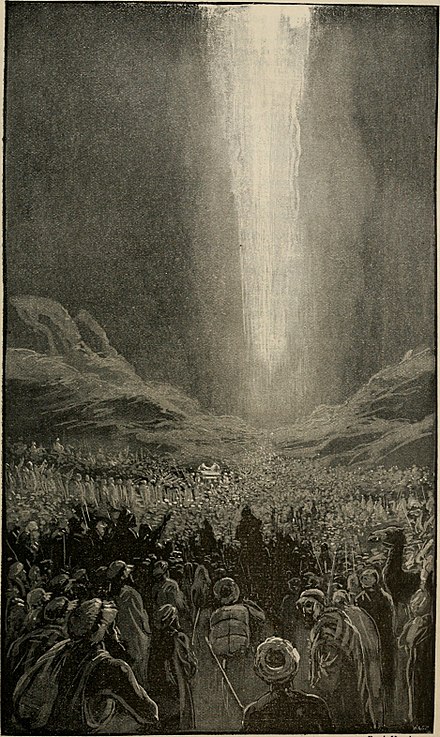
Pillar of Fire, by Paul Hardy, 1896

When he leaves Egypt a year or two later, 600,000 Israelites and supporters follow him into the wilderness.1 Although leadership comes more naturally to extraverts, introverts like Moses can become effective leaders with sufficient preparation and self-confidence. As God backs him up in his negotiations with the pharaoh, Moses earns respect from the pharaoh and his court, and his self-confidence increases exponentially.2 His standing also improves with the Israelites; by the time they leave Egypt, the people view both Moses and God (as manifested in a column of cloud and fire) as their leaders.

And God was going before them, by day in a column of cloud to lead them on the way, and by night in a column of fire to give light to them for walking day and night.  (Exodus 13:21)

A junior leader when the sea splits

The pharaoh has another change of heart, thanks to some heart-hardening from God, and he pursues the Israelites with a squadron of charioteers. God tells Moses to make the Israelites turn around and camp on the shore of the Reed Sea3 so they will appear to be trapped between the Egyptian army and the water. Moses does, even though God neglects to explain the next part of the divine scheme.

And Pharaoh approached, and the Israelites raised their eyes, and hey! Egyptians were setting out after them! They were very afraid. And the Israelites cried out to God. And they said to Moses: “Is it because there are no graves in Egypt, that you took us out to die in the wilderness? What is this you have done to us, to bring us out from Egypt?” (Exodus 14:10-11)

Out of their two leaders, the Israelites address God first, but they blame Moses. The 14th-century commentary Tur HaArokh explained: “When they noted that their prayer had not helped, they became heretical in their attitude, making above-mentioned sarcastic comments to Moses, blaming him for their present predicament.”4

They declare that they were better off being enslaved in Egypt. Moses replies, on his own initiative, that God will do battle for them. But then God tells Moses to order the Israelites to march forward into the sea, adding:

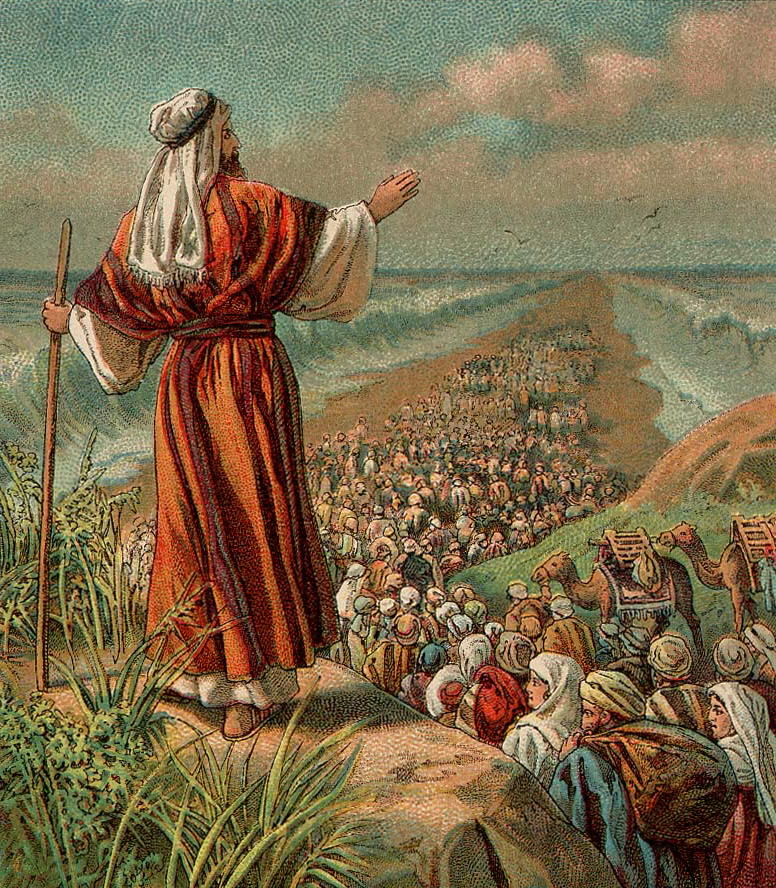
Moses and the Parting of the Red Sea, Providence Lithograph Co., 1907

“And you, raise your staff and stretch out your hand over the sea and split it! And the Israelites will come into the middle of the sea on the dry land. And I, I will be here strengthening the Egyptians’ heart, and they will come in after them. Then ikavdah by Pharaoh and by all Pharaoh’s army, by his charioteers and by his horsemen. Then Egypt will know that I am Y-H-V-H …” (Exodus14:16-18)

ikavdah (אִכָּבְדָה) = I will be considered impressive, I will be honored, I will be respected. (From the same root as koved, כֱֺבֶד = weight.)

It is important to God to acquire an impressive reputation in Egypt. But it is also important for the Israelites to respect Moses, so God has him initiate the miracle of the parting of the Reed Sea with a dramatic gesture.

The Egyptian charioteers urge the horses onto the dry sea-bed, still chasing the Israelites. But as soon as all the people and their livestock have reached the other side, God lets the water rush back and drown the Egyptians.

And Israel saw the great hand [power] that Y-H-V-H had used against the Egyptians, and the people feared Y-H-V-H, and they had faith in Y-H-V-H and in [God’s] servant Moses. (Exodus 14:31)

In their first conversation on Mount Sinai, God was like a patient parent reassuring an anxious young child. (See my post: Shemot: Moses Gives Up.) In Egypt, God is like a reliable parent to an adolescent uneasy with his place in the world. (See my post: Shemot to Bo: Moses Finds His Voice.) But as the Israelites journey from Egypt to Mount Sinai, God is like a mentor who takes time to make sure a young adult protégé comes to be viewed as a leader And Moses responds by turning to God when he needs advice.

A moment of panic

At Refidim, the Israelites’ last stop on the Sinai Peninsula before Mount Sinai, there is no water. The people are probably carrying some water from the last campsite, but they are anxious—or inclined to grumble.

And the people complained against Moses, and they said: “Give us water, so we may drink!” And Moses said to them: “Why do you complain against me? Why do you test God?” (Exodus 17:2)

Moses has identified so completely with his role as God’s agent that he now considers any quarrel with him a quarrel with God. After all, God makes the decisions; he merely carries them out.

But the people were thirsty for water there, and the people grumbled against Moses, and said: “Why this? To bring us up from Egypt [only] to bring death to me and my children and my livestock by thirst?” And Moses cried out to God, saying: “What can I do to this people? A little more and they will stone me!” (Exodus 17:3-4)

Moses is still insecure about his new role, afraid that at any time the people will turn angry enough to kill him.

And God said to Moses: “Pass before the people, and take with you some of Israel’s elders, and take the staff with which you struck the Nile in your hand, and go.” (Exodus 17:5)

Robert Alter noted: “… passing before the enraged people would be rather like running the gauntlet, and it is this that God compels him to do as the prelude to the demonstration of divine saving power.”6

In this way God nudges Moses to do something courageous. When he does pass in front of the people, they see that he is going somewhere (with witnesses) to find water, and trust him enough to wait for his return.

Moses Striking Water from the Rock, by Jacopo Tintoretto, 1577

Calmly God tells Moses the next step:

“Here, I will be standing before you there on the rock at Choreiv. And you must hit the rock, and water with come out of it, and the people will drink.” And Moses did thus, before the eyes of the elders of Israel. (Exodus 17:6)

Choreiv (חֺרֵב) = the alternate name for Mount Sinai, the name used for the “Mountain of God” in the passage about Moses seeing the bush that burned but was not consumed.7 (Ironically, from the root verb charav, חָרַב = dried up, made desolate.)

The Torah does not say that anyone actually sees God standing on a rock at the mountain. Perhaps Moses has developed a sense for the direction from which God’s instructions reach him. The 14th-century commentary Tur HaArokh suggested that Moses saw a vision of an angel on the rock.

And why does God create the miracle at Choreiv instead of at their camp at Refidim? Hirsch speculated in the 19th century that God had planned for water to gush from a rock when they arrived at the mountain, but the Israelites complained about thirst prematurely, before their portable supplies had run out. “The only effect of their untimely murmuring was that even now, while they were in Refidim, God provided them with water from Chorev. The words … seem to indicate that the water flowed from Chorev to the people’s camp in Refidim.”8

A staff initiative

Moses demonstrates his new ability as a leader in one more event before the Israelites pitch camp at the foot of Mount Sinai/Choreiv.

Then Amaleik came and would do battle with Israel at Refidim. And Moses said to Joshua: “Choose men for us and go out, wage battle against Amaleik! Tomorrow I will station myself on the top of the hill, and the staff of God will be in my hand.” (Exodus 17:8-9)

Nobody expects Moses to be a war leader. He is God’s prophet and deputy; when a warlike band of Amalekites appears, Moses appoints Joshua as the military general. Moses also decides to spend the day of the battle on top of a low hill where the Israelite troops can see him holding the staff. God does not need to instruct Moses this time; he has already taken charge.

Malbim, another 19th-century commentator, wrote “Moshe’s special abilities lay in the realm of the supernatural. … On this occasion, by contrast, God hid His face so that they were required to do battle in a natural manner. Therefore Moshe delegated command to Yehoshua, who had been chosen by God to lead the conquest of Canaan, which was to be accomplished through natural wars accompanied by hidden miracles.”9

Moses climbs to the top of the nearby hill with his brother Aaron and another trusted assistant, Chur.

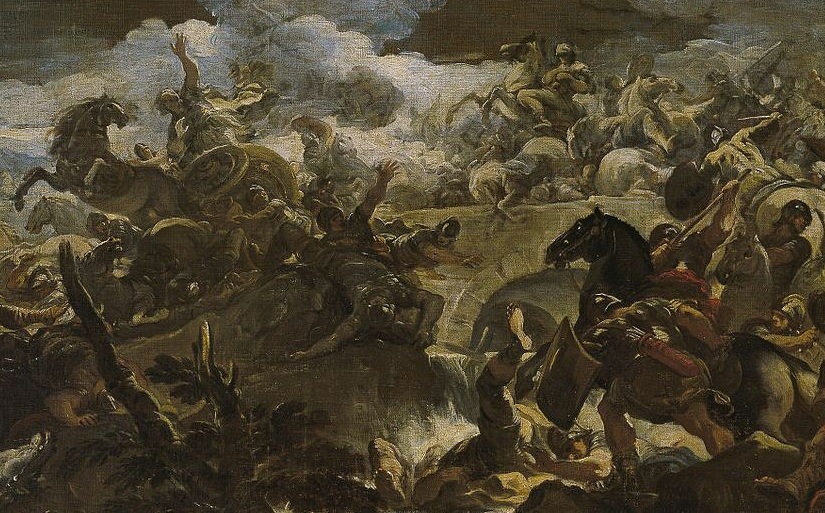
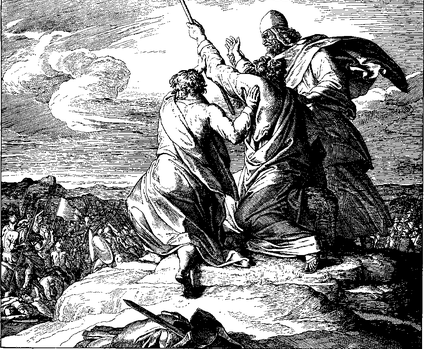
Battle with the Amalekites, by Julius Schnorr von Carolsfeld, 1860

And it happened that when Moses raised his hand, Israel prevailed. And when he rested his hand, Amaleik prevailed. Then Moses’ hands were keveidim. So they took a stone and placed it under him, and he sat down on it, and Aaron and Chur supported his hands, one on this side and one on the other side. And his hands were steadfast until the sun came in [went down].” (Exodus 17:12)

keveidim (כְּבֵדִים) = heavy. (From the same root as ikavdah,אִכָּבְדָה,in Exodus 14:18 above = I will be considered impressive, I will be honored, I will be respected.)

According to the 13th-century commentary Chizkuni, Moses’ motivation was “to be able to follow the course of the battle while personally watching, and even more, so that the Israelite fighters could see their leader and be encouraged by this visual contact … Moses’ staff in this instance served as a flag for the Israelites fighting Amalek.”10

And Joshua disabled Amaleik and his people with the edge of the sword. (Exodus 17:13)

Enough Amalekites are killed or wounded so that they give up and run away. The immediate cause of the Israelites’ victory is that they keep swinging at the Amalekites with swords (which they must have taken from Egyptians, along with the gold, silver, and clothing). But they have the confidence to attack instead of retreat only when they see Moses holding up the staff of God.

Moses has had enough mentoring by God, and enough practice being the leader of thousands, that this time he acts on his own initiative and does exactly the right thing to save his people. He has become a worthy co-leader with God.

To be continued …


  1. Exodus 12:37 says: The Israelites journeyed from Ramses to Sukkot, about 600,000 fighting men on foot, apart from non-walkers. This would mean the total number of Israelites was more than a million, which would take more miracles than the book of Exodus reports to keep alive in the arid wilderness. The next verse, Exodus 12:38, says: And also riffraff went up with them
  2. On Moses’ increasing self-confidence, see my post: Shemot to Bo: Moses Finds His Voice. On the courtiers, see Exodus 11:3: The man Moses was very great in the land of Egypt, in the eyes of Pharaoh’s courtiers and in the eyes of the people. The pharaoh reveals his growing respect for Moses in more subtle ways. The first time Moses and Aaron speak to him, he rejects their request out of hand (Exodus 5:1-9). After the second plague, the pharaoh summons Moses and Aaron and says if they will plead with God to remove the frogs, he will let the people go (Exodus 8:4). He keeps making these deals, then backing out on them, but at least he views Moses as someone who has God’s ear and must be negotiated with. When the pharaoh and Moses make another deal after the fourth plague, Moses adds: “Only may Pharaoh not deceive us again …” (Exodus 8:25)—and the pharaoh swallows the insult. During the final plague, death of the firstborn, the pharaoh begs Moses and Aaron not only to take the Israelites out of Egypt with no conditions, but also to bring a blessing upon him (Exodus 12:31-32).
  3. The Hebrew word for this body of water is yam suf (יַם־סוּף), which means “Sea of Reeds”. It is commonly translated as the Red Sea, since the northern tip of the Red Sea is one possibility for the Israelites’ crossing point.
  4. Tur HaArokh, by Rabbi Jacob ben Asher, written circa 1280–1340 C.E., translation in www.sefaria.org.
  5. See Exodus 14:4.
  6. Robert Alter, The Five Books of Moses: A Translation with Commentary, W.W. Norton & Co., New York, 2004, p. 412.
  7. Exodus 3:1.
  8. Rabbi Samson Raphael Hirsch, The Hirsch Chumash: Sefer Shemos, translation by Daniel Haberman, Feldheim Publishers, Jerusalem, 2005, p. 293.
  9. Malbim (19th-century rabbi Meir Leibush Weisser), translation in www.sefaria.org; I substituted “God” for “Hashem” for clarity.
  10. Chizkuni, by Chizkiah ben Manoach, 13th century, translation in www.sefaria.org.

Va-etchanan: Only One

The first definite statement of monotheism—that there are no other gods—appears in this week’s Torah portion, Va-etchanan (3:23-7:11), in the book of Deuteronomy (Devarim).

Our god is better than your god

Although the Hebrew Bible repeatedly forbids Israelites from worshiping any other gods, the texts of Genesis and Exodus assume that other, lesser gods exist.1 On the sixth day of creation, God says:

“Let us make humankind in our image, like our likeness.” (Genesis 1:26)

Neither kings nor God use the royal “we” in the Hebrew Bible. God uses the first person plural only four times in the entire canon.2 In Isaiah 6:8, God’s “we” includes the serafim, six-winged angels hovering in attendance on God. But the first three times, all in Genesis, God’s first person plural can only be addressing lesser gods who assist God in acts of creation. The second time, after the two humans have eaten fruit from the Tree of the Knowledge of Good and Evil, God says:

“Humankind is becoming like one of us, knowing good and evil!  And now, lest it stretch out its hand and take also from the Tree of Life and eat and live forever—!” (Genesis 3:22)

And the third time, after humans build the tower of Babel, God says:

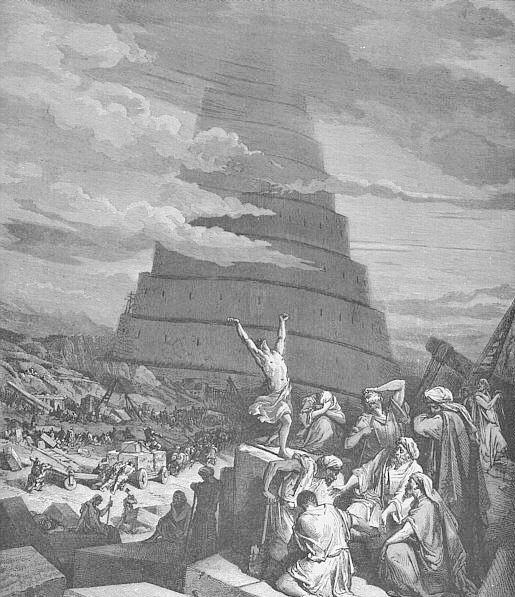
The Confusion of Tongues,
by Gustave Dore, 19th century

“Come, let us go down there and let us make their language fail, so that a man cannot understand the language of his neighbor.” (Genesis 11:6-7)

The book of Exodus also assumes the existence of other gods. For example, God tells Moses and Aaron:

“I will pass over the land of Egypt on that night, and I will strike down every first-born in the land of Egypt, from human to beast; and against all ha-elohim of Egypt I will execute judgments. I am Y-H-V-H.” (Exodus 12:12)

ha-elohim (הָאֱלֺהִים) = the gods; God.

How could God punish the gods of Egypt if they do not exist?

After Moses and the Israelites have crossed the Red Sea, they sing to God:

“Who is like you ba-eilim, Y-H-V-H?
Who is like you, majestic among the holy,
Awesome of praises, doer of wonders?” (Exodus 15:11)

ba-eilim (בָּאֵלִם) = among the gods. B- (בּ) = among, in, through + -a- (ָ ) = the + eilim (אְלִם) = gods. (Unlike elohim, eilim is never used to refer to the God of Israel.)

Here the God of Israel, addressed by God’s sacred personal name, Y-H-V-H, is compared with multiple other, less awesome gods. This verse (“Mi khamokha”) is chanted or sung at every evening and morning Jewish service to this day. Some prayerbooks translate the first line as “Who is like you among the mighty?”—perhaps so that people who cannot read the Hebrew will not ask embarrassing questions!

Our god is the only god

Providence Lithograph Co., 1907

The book of Deuteronomy was expanded and reframed as Moses’ final speech to the Israelites in the 5th century B.C.E. after the Persians had conquered Babylon and given the exiled Israelites permission to return to Jerusalem. Second Isaiah, which also includes clear statements of monotheism, was written during the same period.3

The first monotheistic declaration in the Torah appears in this week’s Torah portion, Va-etchanan. Moses reminds the Israelites that their God created the universe, made miracles to rescue them from Egypt, and spoke to them out of the fire on Mount Sinai. He concludes:

You yourself have been shown in order to know that Y-H-V-H is ha-elohim; eyn od milvado. (Deuteronomy4:35)

ha-elohim (הָאֱלֺהִים) = the gods; God. Elohim (אֱלֹהִים) is the plural of eloha ((אֱלוֹהַּ = a god (in early Hebrew), and literally means “gods”. But elohim can also mean “God”—perhaps because the God of Israel had the powers of all the gods that other people worship.

eyn od (אֵין עוֹד) = there is no other, there is nothing else. (Eyn (אֵין) = there is no, there is not, none, nothing. Od (עוֹד) = other, else.)

milvado (מִלְּבַדּוֹ) = alone, by itself.

Technically, the Israelites whom Moses is addressing are not the ones who saw the miracles in Egypt and heard God’s voice from the fire 40 years before, when all but two4 of Moses’ present audience were either children or not yet born. Yet Moses speaks as if everyone in front of him was an eye-witness.

He elaborates on God’s deeds on behalf of the Israelites, then reiterates:

And you know today, and you must [continually] put back into to your consciousness, that Y-H-V-H is ha-elohim, in the heavens above and on the earth below; eyn od.(Deuteronomy 4:39)

But does this generation of Israelites really know that their God is the only god? After they pitched camp by the Jordan in the book of Numbers, many Israelite men joined the local women in ritual animal sacrifices to their god, Baal Peor.5

And the people ate and they bowed down to their elohim. And Israel attached itself to Baal Peor, and Y-H-V-H’s nose burned against Israel. (Numbers 25:3)

The God of Israel calls for impalements, but also sends a plague that kills 24,000 people. Moses mentions this recent episode in this week’s Torah portion:

“Your eyes saw what Y-H-V-H did regarding Baal Peor: that Y-H-V-H, your Elohim, wiped out every man from your midst who went after Baal Peor. But you who stuck to Y-H-V-H, your Elohim, all of you are alive today.” (Deuteronomy 4:3-4) Perhaps the surviving Israelites do know that there is only one god, Y-H-V-H. Or perhaps they think Baal Peor is a real god, but they know their own God is “a jealous god”6, so they avoid  worshiping any other gods.

Hear this: God is one

Mezuzah

Later in the portion Va-etchanan, Moses pronounces what has become a key Jewish prayer, recited twice a day since the first century C.E., and written on the scroll inside the mezuzah attached to a Jew’s doorpost.

Shema, Israel! Y-H-V-H is Eloheinu; Y-H-V-H is echad. (Deuteronomy 6:4)

shema (שְׁמַע) = Listen! Pay attention! Hear this!

Eloheinu (אֱלֺהֵנוּ) = our elohim: our gods, our God.

echad (אֶחָד) = one as the first of a series, one as singular, unique.

This verse certainly says that Y-H-V-H is the God of the Israelites. But is it also a statement of monotheism?

Some modern commentators have held that echad here merely means “first”, or, as Daniel Zucker expressed it, “the top god”.7 If  Moses’ declaration appeared in the book of Exodus, I might agree. But since it is in the later book of Deuteronomy, in the same Torah portion that says of God eyn od (there is no other), I favor a different kind of “one”.

The word echad could also mean “unique”, i.e. that God is the only one of its kind. In the 14th century, Rabbeinu Bachya explained: “He is unique in the universe, there is no other God deserving the title. He has no partners, is not an amalgamation of different powers working in tandem.”8

18th century rabbi Chayim ben Moshe ibn Attar put it more bluntly: “Furthermore, we express our conviction that He is indeed the only God, there is no other independent power in the universe.”9

Whatever the Shema meant when Deuteronomy was rewritten in the 5th century B.C.E., Jews have long considered it a declaration of monotheism. During the First Crusade, in 1096 C.E., Christians massacred Jews in the Rhine valley as well as Muslims in the “Holy Land”. Some Jews killed themselves before the Christians reached them.

“Over and over, their rallying cry at death is the single verse of the Sh’ma. Like their Sefardic counterparts, and medieval Muslims, Ashkenazi Jews understood the Christian concept of the divine Trinity as a case of polytheism; thus their insistence on God’s unity is a vehement repudiation of Christian doctrine.” (Susan Einbinder)10


In this week’s Torah portion, Moses tells the next generation of Israelites that they know there is only one God because 40 years ago they saw God’s miracles in Egypt and heard God’s voice in the fire on Mount Sinai. Only God could make those things happen. So according to Moses, they had direct evidence that the God of Israel is the only god; there is no other.

Moses does not mention that he is speaking to the next generation of Israelites, who were either children or not even born at the time. They have to go by what their parents told them, or by what Moses is telling them now.

Anyone who reads the book of Deuteronomy is in the same position. Why should we believe that there is one and only one god?

Some people believe it because their parents or teachers told them. And some believe it because it says so in the Torah. Others have their own mystical experiences, which they interpret as manifestations of a single, universal god. And some people believe it because they find one of the philosophical arguments for the existence of one God sufficiently compelling.

But many people are atheists, unable to believe God is real according to any of the usual definitions of God. When I examine the standard medieval theologian’s definition of God as an omnipotent, omniscient, omni-benevolent, and personal being, I always conclude that such a god is impossible. According to that definition of God, I am an atheist.

I have been fumbling toward my own definition of what I mean by “God” for decades, and I might never reach it. Although some scholars claim that the name Y-H-V-H comes from an older god-name and has nothing to do with the various conjugations of the Hebrew verb “to be” or “to become” (which are made up of those four letters in Hebrew), something about God as becoming speaks to me. But I cannot turn it into a tidy definition.

Yet I can recite the Shema with conviction. I am a Jew, and Y-H-V-H is our God, and God is one.


  1. The books of Leviticus and Numbers warn the Israelites against worshiping other gods without saying whether other gods exist.
  2. See my post: Bereishit: How Many Gods?
  3. The portion Va-etchanan also promises that God is compassionate and will ultimately rescue the Israelites (Deuteronomy 4:29-31), which is a constant refrain in Second Isaiah.
  4. Caleb and Joshua, the two out of ten scouts who trusted God to help them conquer Canaan. See my post: Shelakh-Lekha: Mutual Distrust.
  5. See my post: Pinchas & Balak: Calming Zeal.
  6. You must not have other elohim in front of me … You must not bow down to them and you must not serve them, because I, Y-H-V-H, your Elohim, am a jealous god … (Deuteronomy 5:9 and Exodus 20:3-5)
  7. Rabbi Daniel M. Zucker, “Shema Yisrael: In What Way is ‘YHWH One’?”, https://www.thetorah.com/article/shema-yisrael-in-what-way-is-yhwh-one.
  8. Rabbi Bachya ben Asher, a.k.a. Rabbeinu Bachya, translated in www.sefaria.org.
  9. Chayim ben Moshe ibn Attar, Or HaChayim, translated in www.sefaria.org.
  10. Susan L. Einbinder, My People’s Prayer Book, Vol. 1: The Sh’ma and its Blessings, Jewish Lights Publishing, Woodstock, VT, p. 90.

Beshalach: Who Is Like You?

Pharaoh thinks his army of charioteers has trapped the Israelites on the shore of the Reed Sea. The Israelites think they are going to die. Then God splits the water long enough for them cross over on dry ground, and for the Egyptians to follow them onto the sea bed. At that point in this week’s Torah portion, Beshalach (Exodus 13:17-17:16), the water rushes back, and all the Egyptians drown.

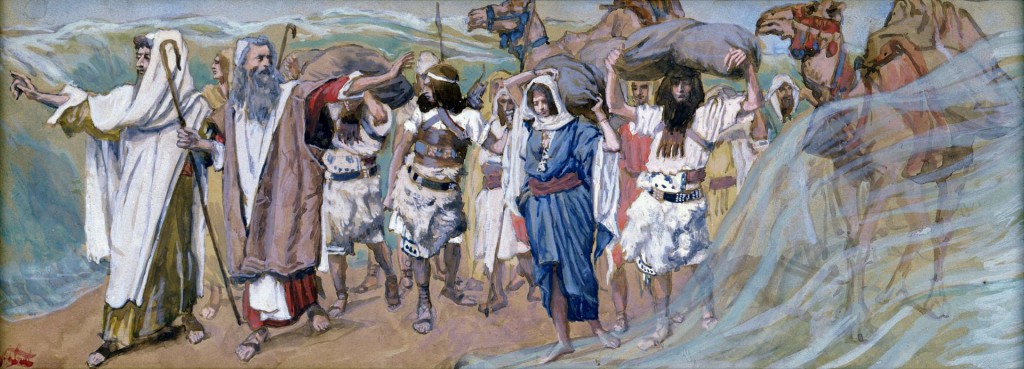
The Waters Are Divided, by James Tissot, circa 1900

The Israelites saw the Egyptians dead on the shore of the sea. And the Israelites saw the great power that God had used against the Egyptians, and the people feared God … and they trusted in God and in God’s servant, Moses. That was when Moses and the Israelites sang this song to God. (Exodus 14:30-15:1)

The 18-verse “Song of the Sea” that follows may be the oldest text in the bible; Hebrew scholars date it to roughly 1100 B.C.E. (The rest of the book of Exodus, judging by the language, was written well after 900 B.C.E.) The song differs from the prose account leading up to it, but it does include descriptions of God drowning an army of Egyptian chariots.

This is the first time anyone sings in the bible, as well as the first time a human character addresses God with words of praise (instead of pleading or questions).

In the first part of the “Song of the Sea”, verses 4-10 describe God drowning the Egyptian charioteers (with no mention of Moses). In the second part, verses 14-16 describe the fear of the surrounding kingdoms when they hear about it (a theme that is premature at this point in the Exodus story). In between these two themes, there is a verse that Jews still sing at every morning and evening service:

Mi khamokhah ba-eilim, Adonai!
Mi kamokhah, nedar bakodesh,
Nora tehilot, oseh feleh!

  Who is like you among the eilim, Y-H-V-H!
  Who is like you, majestic in holiness,
  Too nora for praises, doing wonders! (Exodus 15:11)

eilim (אֵלִם) = Plural of eil (אֵל) = a god; the name of the father god in Canaanite mythology; a title of the God of Israel.

nora (נוֹרָא) = feared, fearsome, awesome. (A form of the verb yareh, יָרֵא = fear, be afraid.)

The verse beginning “Mi khamokhah” (often transliterated as mi chamocha) certainly counts as praising God. But what kind of praise is this, comparing God to other gods? Or saying that God is too fearsome to praise? In the book of Exodus, the Israelites who travel from Egypt to Canaan believe that there were many gods, all inhuman and frightening, and the best they could hope for was that their own God was the most powerful, and would help them—if not for their own sake, for the sake of God’s reputation. The straightforward translations of eilim as “gods” and nora as “feared” or “fearsome” match their point of view.

Nobody is like you

The Song of the Sea is not the only biblical text that contain references to other gods—usually serving under the God of Israel, who is the supreme creator and judge. The idea appears in the books of Genesis, Exodus, Psalms, and Job. (See my posts Yitro & Psalms 29, 82, & 97: Greater Than Other Gods and Bereishit: How Many Gods?)

However, two biblical books, Deuteronomy and Isaiah, present clear statements of monotheism.1  For example, God says:

And there are no gods [elohim] except for Me.  (Isaiah 44:6)

Because I am Eil, and there is no other.  (Isaiah 45:22)

Jewish theology was almost exclusively monotheistic by the first century C.E., when Philo of Alexandria, a Jewish Platonist, analyzed the Hebrew Bible and rabbinic laws in terms of Greek philosophical categories. Philo dealt with archaic ideas in the bible, such as an anthropomorphic god and references to other gods, by explaining that they were allegorical.

But Talmudic and medieval commentators were more attached to taking the bible literally. They strained to find alternate interpretations for the scattered references to other gods, including the comparison between God and the eilim in the Song of the Sea.

One ploy was to treat the word eilim (אֵלִם) as if it were a misspelling of the Hebrew word ilam (אִלָּם) = mute, unable to speak. This was a legitimate move, since the Hebrew in the bible was written without the diacritical marks commonly called vowel pointing until the Masoretic text was fixed in the 7th-10th centuries C.E. Theoretically, the Masoretes could have misinterpreted a word spelled simply אלם in the Torah scroll.

So the Talmud, extant around 500 C.E., reports:

“The school of Rabbi Yishmael taught that the verse: “Who is like You, O Lord, among the gods” (Exodus 15:11), should be read as: ‘Who is like You among the mute’, for You conduct Yourself like a mute and remain silent in the face of Your blasphemers.” (Talmud Bavli, Gittin 56b)2

Rashi, 16th century woodcut

Rashi (11th-century Rabbi Shlomoh Yitzchaki) went farther afield when he suggested reading eilim (אֵלִם) as its homophone eilim (אֵילִים), which is the plural of ayil (אַיִל) = ram; metaphorically, a powerful man or a mighty tree.

 “באלם means ‘amongst the mighty’, just as (Ezekiel 17:13) ‘and the mighty of (אילי) the land he took away’.” (Rashi)2

Other rabbis chose to consider the eilim angels, i.e. celestial beings who have no existence apart from God. Ramban (13th-century Rabbi Moshe ben Nachman) wrote that “among the eilim” means “among those who serve before Thee in heaven”.2

An 18th-century commentator explained the events at the Sea of Reeds as a battle between the God of Israel and the guardian angel of Egypt:

“Israel describes that they had seen the guardian angel of Egypt die; hence they could say that absolutely no celestial force compares to the Lord our God.” (Or HaChayim)3

But in the 19th century, Rabbi Samson Raphel Hirsch identified the eilim as powerful natural forces:

“True, there are אֵלִם, active and effective forces in nature; but though men may worship them as gods, they are subject and bound by powerful bonds to the order You have ordained for them. You alone are free; You are not bound by the was of nature, the work of Your own hands.”4

The “Mi Khamokha” verse in modern prayerbooks is often translated so as not to raise questions about monotheism. Rashi’s proposal, “Who is like you among the mighty?” is a common translation. The traditional Artscroll Siddur goes with: “Who is like You among the heavenly powers?”

I like the approach in Rabbi David Zaslow’s prayerbook, Ivdu Et Hashem B’Simcha, which retains the literal definition of eilim as “gods” but adds a explanatory phrase: “Who is like you among the gods that are worshipped?”5

Too fearsome to praise

After the difficult question “Who is like you among the eilim?”, the rest of the verse extols God by saying:

Who is like you, majestic in holiness,

Too fearsome for praises, doing wonders! (Exodus 15:11)

A strictly literal translation of the phrase Nora tehillot” would be “fearsome praises”, but the oldest Biblical Hebrew omits many of the connecting words we rely on in English. The consensus of translators is that the sense of the phrase is “too nora for praises”. But does the word nora (a past participle used as an adjective) carry its primary meaning of “feared” or “fearsome”? Or its secondary meaning of “treated with awe” or “awesome”?

Many medieval rabbis analyzed the phrase Nora tehillot” in terms of being afraid of God.According to Rashi in the 11th century:

“Thou art an object of dread, so that people do not recount thy praises, fearing lest these may be enumerated less then they really are, just as it is written (Psalms 65:2) ‘To Thee, silence is praise’.”2

12th-century Rabbi Abraham ben Meir ibn Ezra added:

“However, they are obligated to praise Him because He alone does wonders.”2

In the 13th century, Ramban had another explanation for the use of the word nora:

“In my opinion, nora t’hilot means: “fearful with praises, for He does fearful things and He is praised for them, as when He wreaks vengeance on those who transgress His will, and thereby helps those who serve Him. Thus He is [both] feared and highly praised.” (Ramban)2

But in the 16th century, Rabbi Obadiah Sforno (who lived in Italy during the Renaissance) commented on the verse in terms of awe rather than fear.

“Anyone aware of the marvelous attributes of His cannot fail but recite these praises in awe, not because he is afraid of being punished but because the very nature of God inspires awe and reverence.”2

Yet in the 19th century, S.R. Hirsch wrote sternly:

“Songs of praise to God that do not lead to the fear of God, or that are even intended as substitutes for the fear of God, are nothing but a profanation of God’s Name.”6

Most modern prayerbooks translate nora (נוֹרָא) as “awesome”, rather than “feared” or “fearsome”, probably so as not to make God sound harsh and unloving.


I believe that literal translations of the Hebrew Bible reflect the viewpoint of the original authors, and are appropriate for everyone except readers who do not grasp concepts such as allegory or cultural history, and insist on taking every word in an English translation of the bible as a simple directive from God.

But in a Jewish prayerbook, literal translations of quotes from the bible are more problematic. Some readers are comfortable with the evolution of the religion, and can mentally adapt the ancient words—even while singing them—so that the prayer becomes worthy vehicle for their heartfelt feelings. For other readers, this approach seems unnatural, difficult, or contrary. Why should one sing or recite a prayer one does not believe in literally?

For these people, it might be better to adjust the translations of Hebrew words in prayers so as to avoid raising objections about whether there is only one God, or whether God is kind rather than frightening. Then they, too, might be able to use prayer to express gratitude for the wonders of creation.


  1. Deuteronomy 4:35, 10:14, and 32:39; Isaiah 37:16, 37:20, 41:4, 43:10-11, 44:6, 44:8, 45:5-6, 45:21-22, and 48:12. (Isaiah from chapter 40 on is called second Isaiah or Deutero-Isaiah, and was written in the 6th century C.E.)
  2. Translations from www.sefaria.org.
  3. Or HaChayim, by Rabbi Chayim ben Moshe ibn Attar, translation in www.sefaria.org.
  4. Samson Raphael Hirsch, The Hirsch Chumash: Sefer Shemot, translated by Daniel Haberman, Feldheim Publishers, Jerusalem, 2003, p. 247.
  5. Ivdu Et Hashem B’Simcha, compiled and edited by Rabbi David Zaslow, The Wisdom Exchange, 2010, pp. 81 and 82.
  6. Hirsch, ibid., p. 248.

Beshalach & Ki Tisa: Dancing

How do you thank—or appease—the God of Israel? Burning offerings on an altar is the primary method in the Hebrew Bible. But for women, another way is to grab your tambourine and do a chain dance.

Celebrating the right way in Beshalach

As soon as the Israelites walk out of Egypt, Pharaoh pursues them with chariots in the Torah portion Beshalach (Exodus 13:17-17:16). Then a wind from God dries out a path across the Reed Sea. After the Israelites cross over, God makes the waters return and drown the Egyptian army.

Miriam, by Anselm Feuerbach, 1862

Then Miriam the prophetess, Aaron’s sister, took the tambourine in her hand, and all the women went out after her with tambourines and with mecholot. And Miriam sang call-and-response to them: “Sing to Y-H-V-H, for [God] is definitely superior! Horse and its rider [God] threw into the sea!” (Exodus 15:20-21)

mecholot (מְחֺלוֹת) = plural of mecholah (מְחֺלָה) or mechol (מְחוֹל) = chain dance or circle dance. (From the root verb chol, חול = go around in succession; do a circle dance or chain dance.)

In a mecholah, dancers form a line behind a leader, with each dancer using one hand to touch the next. The line moves in a circle, a spiral, or some other curving pattern s the dancers copy the steps of the leader.

In this first example of mecholot in the Torah, each woman on the shore of the Reed Sea is carrying her tambourine, but her other hand is free to touch the shoulder of the woman in front of her. Percussion and singing are integral to the dancing.

This first chain dance is a heartfelt celebration of a divine miracle that saved the Israelites from being killed. Even the words the women sing are a tribute to God.

Celebrating the wrong way in Ki Tisa

The Israelites also think they are celebrating God’s presence with the second mecholot in the Torah,which occur in this week’s Torah portion, Ki Tisa (Exodus 30:11-34:35). But they are deluding themselves.

A pillar of cloud and fire from God led the Israelites our of Egypt, across the Reed Sea, and all the way to Mount Sinai. But there the pillar disappeared, and God manifested as terrifying noises and volcanic fires. At least the people still had Moses as an intermediary—until after the revelation and covenants at Sinai, when Moses disappeared. From Moses’ point of view, God invited him into the cloud on top of the mountain for forty days and nights of divine instruction. But the Israelites below see only fire at the top of the mountain.2 When Moses has not returned after 40 days, they give up on ever seeing him again. How can they continue traveling to Canaan without either the pillar of cloud and fire or the prophet Moses to lead them?

And the people saw that Moses was shamefully late coming down from the mountain, and the people assembled against Aaron, and they said to him: “Get up! Make us a god that will go in front of us, since this man Moses who brought us up from the land of Egypt—we do not know what happened to him!” (Exodus 32:1)

What the Israelites are asking for is an idol: a statue that a god will magically inhabit. After all, other religions in the Ancient Near East depend on idols inhabited by gods to grant good fortune to their worshipers.

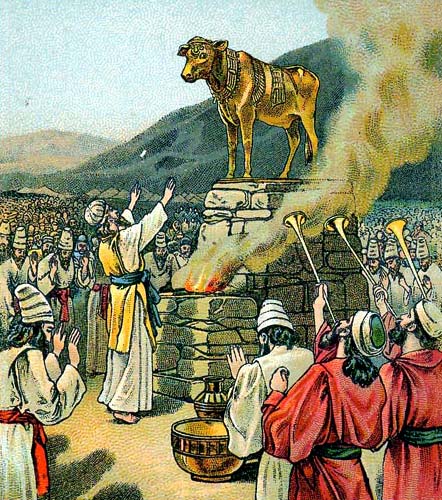
Worshipping the Golden Calf, Providence Lithograph Co. Bible card, 1901

Aaron melts down the gold earrings that the Israelites took from the Egyptians on their way out, and makes a golden calf.

… and they said: “This is your god, Israel, who brought you up from the land of Egypt!” And Aaron saw, and he built an altar in front of it, and he called out and said: “A festival for Y-H-V-H tomorrow!” And they rose early the next day, and they offered up burnt offerings and brought wholeness offerings. Then the people sat down to eat, and they drank, and they got up letzacheik. (Exodus 32:4-6)

letzacheik (לְצַחֵק) = to make merry, to have fun, to mock, to laugh, to play around.

Aaron should have known better. Yes, using the four-letter personal name of the God of Israel would at least remind the people which God brought them out of Egypt. And Aaron cannot be held accountable for knowing the second of the Ten Commandments, which forbids idols, since this list of commands is inserted into the Torah portion Yitro (Exodus 18:1-20:23) in the middle of the story of God’s frightening volcanic revelation.3

Nevertheless, right after the revelation God tells Moses:

“Thus you must say to the Israelites: You yourselves saw that I spoke to you from the heavens. With me, you must not make gods of silver or gods of gold …” (Exodus 20:19-20)

A long list of additional rules follows.

Then Moses came and reported to the people all the words of Y-H-V-H and all the laws. And all the people answered with one voice, and they said: “All the things that Y-H-V0H spoke we will do!” And Moses wrote down all the words of Y-H-V-H. (Exodus 24:3-4)

So by the time Moses disappears for forty days, everyone, including Aaron, knows that God absolutely rejects gold idols. And they make one anyway.

In this week’s Torah portion, when Moses finally hikes back down Mount Sinai carrying the two stone tablets, he hears raucous singing.4

And he came close to the camp, and he saw the calf and mecholot. And Moses’ anger burned, and he threw the tablets from his hands and shattered them at the bottom of the mountain. (Exodus 32:19)

Naturally Moses would be angry at the sight of the golden calf, which was exactly the kind of idol God prohibited. But why was he upset by the sight of chain dancing?

Rashi5 proposed that the Israelites were dancing lewdly. He cited the first description of the Israelites’ revelry in front of the golden calf, which says “they got up letzacheik (to play; see Exodus 32:6, above). The word letzachek, Rashi pointed out, has a sexual connotation in the book of Genesis, when Potifar’s wife accuses Joseph of attempted rape. She says: “… he came into our house letzachek with me!” (Genesis 39:17).

Yet the dances reported in this week’s Torah portion are mecholot, in which the only physical contact is between one person’s hand and the back of the next person’s shoulder. It is not even partner dancing. I think Moses is enraged to see the dancing simply because the people are celebrating the manufacture and worship of an idol, when they ought to feel ashamed of disobeying God.

Thousands of the dancers die in Ki Tisa6 because they convince themselves that they are celebrating the return of their God with perfectly acceptable acts of worship: burnt offerings, feasting, drinking, and innocent mecholot. They cannot bring themselves to believe what Moses told them: that their God, the God who brought them out of Egypt, is not the normal kind of god that inhabits idols.


Denial—pretending that a reality does not exist—is human nature. We often long for something we cannot have, and postpone doing what we must to make the best of it. Sometimes we get away with it for a while, and when we feel stronger we grapple with our problem again.

But some forms of denial are too extreme to get away with, even in a world without a Moses or a God to inflict direct punishment. Today we may die if we neglect clear warnings about our health. Our hopes and plans may die if we fail to face reality in our relationships, our jobs, our finances, our habits.

Before we join a dance of celebration, may we consider whether we are celebrating something real.


Next week: more dancing

I hope my Jewish readers had a happy Purim!


  1. See my blog post: Bo & Beshalach: Winds.
  2. Exodus 24:16-17.
  3. From the viewpoint of source criticism, the Ten Commandments were clearly inserted by a later editor. But even if the biblical narrative were a continuous whole with one author, there is no indication that anyone except Moses heard the Ten Commandments at that time.
  4. Exodus 32:18.
  5. Rashi is the acronym for 11th-century rabbi Shlomoh Yitzchaki.
  6. Three thousand are slain by Levites in Exodus 32:26-29, and an additional number are killed by a plague from God in Exodus 32:35.

Bo & Beshalach: Winds

A plague of locusts descended on Egypt in last week’s Torah portion, Bo (Exodus 10:1-13:16). A swarm of Egyptian charioteers pursues the Israelites in this week’s Torah portion, Beshalach (Exodus 13:17-17:16). Both the locusts and the charioteers are frightening in their numbers and  destructiveness—and the God character controls both hordes with winds, to spectacular effect.

Locust winds

The eighth of the ten plagues the God character creates in Egypt is a plague of locusts that eat all the vegetation remaining after the previous plagues.

And Moses held out his staff over the land of Egypt, and God guided a ruach kadim through the land all that day and all the night. And in the morning the ruach hakadim carried in the locust swarms. And the locusts went up over the whole land of Egypt and settled down very heavily throughout the territory of Egypt. There were no locust swarms just like it before, and there will be none after. (Exodus 10:13-14)

ruach (רוּחַ) = wind; spirit, disposition, mood.

ruach kadim (רוּחַ קָדִים), ruach hakadim (רוּחַ הַקָּדִים) = wind from the east; dry east wind.

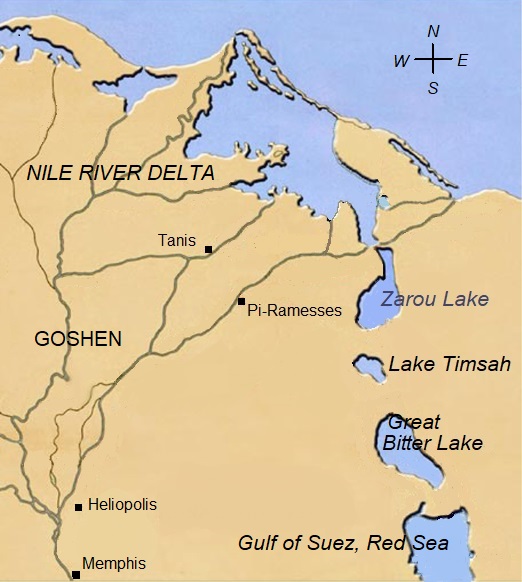
Actual desert locusts in northern Africa and southwestern Asia (Schistocera gregaria) breed in areas where there has been sufficient rainfall (to moisten the ground for egg-laying) and vegetation (for the larvae to eat). The breeding grounds in the early spring, when the locust plague in Exodus occurs (see map above) are different from the breeding grounds in summer. Adult locusts congregate into swarms when there is enough vegetation. They can fly short distances, but for long distances they take advantage of winds, catching a ride only on warm, relatively humid winds. Locust swarms from winter and spring breeding grounds around the Red Sea would need to catch a warm wind from the south to southeast to reach Egypt to the north.1

So why does the Torah say the wind that carries the locusts into Egypt is a ruach kadim, a dry east wind? One theory is that the Israelite wrote down this story was thinking in terms of winds in Canaan or Judah. When a wind brings disaster there, it is a dry wind from the eastern desert.

The God character ends the plague of locusts by changing the direction of the wind.

And God turned around a very strong ruach yam, and it lifted the locusts and blew them toward the Yam Suf. Not one locust remained in all the territory of Egypt. (Exodus 10:19)

yam (יָם) = sea, Mediterranean Sea; west.

ruach yam (רוּחַ יָם) = wind from the sea; wind from the west.

suf (סוּף) = reed, reeds, water plants.

Yam Suf (יָם סוּף) = Sea of Reeds; Red Sea.

If the God character reverses the wind from the southeast, it becomes a wind from the northwest. A strong wind coming down from the Mediterranean northwest of Egypt would indeed blow locust swarms in Egypt back toward the Red Sea or the Sea of Reeds.

The important point in the book of Exodus is that God controls the locust plague, bringing the devouring swarms into Egypt with one wind, and removing them with another.

The Hebrew Bible also uses the word for wind, ruach, to refer to someone’s mental spirit, ranging from calm wisdom  to insane jealousy or rage. And in the land of Canaan, dry desert winds were dangerous because they stripped crops, dried up ponds, and made people sick. Moist winds from the Mediterranean left dew in the morning that helped keep plants alive during the summer.

So a ruach kadim could be someone’s bad attitude or a dangerous mood—which plagues any people nearby like a swarm of locusts. A ruach yam could represent someone’s pleasant and kindly spirit, which gives others comfort and relief.

Chariot winds

Pharaoh lets the Israelites leave Egypt after God’s final plague, the death of the firstborn.2 On the second day of their exodus from Egypt, just when they thought they were free, the God character makes Pharaoh change his mind. God tells Moses:

“I will strengthen Pharaoh’s heart, and he will chase after them. Then I will be honored by Pharaoh and by all his forces, and the Egyptians will know that I am God.” (Exodus 14:5)

The God character in this part of Exodus cannot resist staging one more dramatic miracle to drive the point home that the God of Israel is more powerful than any other.3

And the Egyptians chased after them and caught up with them [when they were] encamped on the yam, all of Pharaoh’s chariot horses and riders and his army … (Exodus 14:9)

The Israelites panic when they see charioteers approaching, but God halts the action for the night.  The supernatural pillar of cloud and fire that has led the Israelites to the shore of the Sea of Reeds circles around their camp and stands between them and the Egyptians, so they cannot get any closer.4

Then Moses held out his hand over the yam, and God made the yam go with a strong  ruach kadim all night, and [God] made the yam dry up, and the waters split. Then the Israelites came through the middle of the yam on dry ground (Exodus 14:21-22)

When a strong east wind blows into Egypt or Israel, the air is so dry that ponds can evaporate and shallow lakes can shrink in an afternoon. Blowing sand increases the effect. Was the biblical Yam Suf shallow enough so a strong east wind could expose part of its bed–enough for people and livestock to walk across on the mud?

Yes, if two or more of the lakes between the Sinai peninsula and Egypt proper were connected during Egypt’s Nineteenth Dynasty, as some scholars claim. No, if it was the Gulf of Suez on the Red Sea, as other scholars believe.

If Yam Suf refers to the Red Sea, the water would be too deep for an east wind to dry out a path across it. But the narrative gives two different accounts of the depth of the yam before God parted it. First it describes an east wind drying up the sea. Then the narrator says:

Then the Israelites came through the middle of the yam on dry ground, and the waters were a wall for them on their right and on their left. (Exodus 14:22)

Many of us picture walls of water rising almost vertically from the dry sea bed, as in this illustration:

The Waters Are Divided, by James J.J. Tissot, 1896-1902

An east wind drying up part of a shallow lake does not make walls of water. But after the Egyptian army has drowned, the Israelites on the other side rejoice by singing an ancient song or poem. (We know Exodus 15:1-18 dates to a much earlier time than the narrative because the Hebrew is older.) In this poem, the wind comes not from the east, but from God’s nose. And instead of exposed mud at the bottom of a shallow sea, the deep waters congeal or freeze solid.

And by a ruach from your nostrils the waters piled up;

            The watercourses stood up like a dam.

            The deeps congealed in the heart of the yam. (Exodus 15:8)

Nevertheless, whoever wrote the narrative that precedes this poem knew about harsh, dry east winds, and therefore could easily imagine walking across dry ground in the middle of a sea.

If the “Sea of Reeds” is a shallow salt lake, the miracle would lie in the inability of the Egyptians to follow the Israelites an hour or two later.

This week’s Torah portion says that the Egyptian charioteers followed the Israelites as far as the middle of the sea—on dry ground that was probably still muddy—and then were drowned by the sudden return of the water.

Then God made the wheels of their chariots fall off, and they moved laboriously. And the Egyptians said: “Let me flee from before Israel, because God is fighting for them against Egypt!” Then God said to Moses: “Hold out your hand over the yam, and the waters will come back over the Egyptians, over their chariots and over their riders!” And Moses held out his hand over the yam, and the yam came back to its normal position. And the Egyptians were fleeing from meeting it, but God shook the Egyptians off (their chariots) in the middle of the yam. The waters returned and covered the chariots and the riders and all Pharaoh’s soldiers coming in after them into the yam; not one of them remained. (Exodus 14:25-28)

The Egyptians Are Destroyed, by James J.J. Tissot, 1896-1902

The narrative does not say how God made the waters return to their normal level so quickly. But the poem that follows it says:

You blew with your ruach; the yam covered them;

            They sank like lead in the majestic waters. (Exodus 15:10)

The ancient poem tells us the wind from God’s nostrils opens a path through the sea and closes it again. The later narrative says God summons an east wind to expose the sea bed, and then makes the waters return through some unknown means.

Either way, the Yam Suf opens or closes according to God’s whim. And the word ruach can mean mood or spirit as well as wind. In the Torah portion Beshalach, the God character rescues the Israelites and drowns the Egyptians in a spirit of pride and determination to demonstrate superior power.


In the story of the plague of locusts, the God character dooms all the innocent people who stay in Egypt to a year of famine. In the story of crossing the Sea of Reeds, God dooms the army unit that pursues the Israelites to instant death.

But the God character’s objectives are achieved. The Israelites are free to march on to Canaan, and both the Egyptians and the Israelites know God is supreme.

And Israel saw the great power that God used against Egypt, and the people feared God and had faith in God and in [God’s] servant Moses. (Exodus 14:31)

Imagine you were an anthropological god and you wanted to rescue a downtrodden ethnic group from one country, motivate it to travel to another country, and make it the ruling class there. Could you formulate a proposal that killed fewer innocent people than the divine plan in Exodus?


  1. World Meteorological Organization, “Weather and Desert Locusts”, https://library.wmo.int/doc_num.php?explnum_id=3213#:~:text. In the book of Exodus, the last four plagues take place in the early spring.
  2. Exodus 12:29-32.
  3. See my post: Va-eira: Pride and Ethics.
  4. See my post: Beshalach: Pillar of Cloud and Fire.

Shelach-Lekha: Deceptions and Sore Spots

How do you persuade someone to do what you want—even when you can’t make a reasonable case for it?

Two of the stories people tell in this week’s Torah portion, Shelach-Lekha, are implausible when you examine them. But nevertheless the speakers succeed in getting the reaction they desire.

1) Fabrication by the Ten Scouts

The Two Reports of the Spies, 1907 bible card by Providence Lithograph Co.

Moses sends twelve men north from the wilderness of Paran to scout out the land of Canaan—the land God has promised to give to the Israelites—and report back. He also tells them to bring back some fruit from the land. They return forty days later with pomegranates, figs, and a single cluster of grapes so heavy that two of them have to bear it on a carrying frame.

All twelve scouts agree that the land is fertile and good, and “flows with milk and honey”1. Ten of them, however, are alarmed by the “strong people” and “large fortified cities” they saw—phrases that make the assembled Israelites nervous.

Caleb, one of the other two scouts, urges:

“Let us definitely go up! And we will take possession of [the land], since yakhol nukhal it!” (Numbers 13:30)

yakhol (יָכוֹל) = being capable of, having power to. (Infinitive absolute form of yakhol, יָכֺל = was capable of, had power to; held onto, won.)

nukhal (נוּכַל) = we are capable of, we have the power to do. (Imperfect form of yakhol.)

yakhol nukhal (יָכוֹל נוּכַל) = Literally: being capable we are capable of. Idiomatically: we are certainly capable of. (In Biblical Hebrew, an infinitive absolute preceding another verb from the same root indicates emphasis, such as “certainly”, “definitely”, or in older English “surely”.)

The ten scouts who are afraid to march on Canaan do not want the Israelites to believe Caleb’s assurance. So they add some new details to their story.

But the men who had gone up with him said: “Lo nukhal to go up to the people, because they are stronger than we are!” And they put forth to the Israelites a slanderous report of the land that they had scouted, saying: “The land that we traversed to scout out is a land devouring its inhabitants! And all the people who we saw in it were people of [great] size. And there we saw the Nefilim2, Anakites from the Nefilim! And in our eyes we were like grasshoppers, and so we were in their eyes.”

Lo nukhal (לֺא נוּכַל) = we are not capable, we do not have the power. (Lo, לֺא ֹ= not.)

The ten scouts simply do not believe that their people could succeed in conquering the land, with or without God’s help. Since the presence of large fortified cities is not enough to persuade the Israelites to stay put in Paran, the ten scouts invent a “slanderous report” that is clearly false—if you examine it rationally.

How could a land that produces such abundant food be “devouring its inhabitants”? Could wild animals be killing off the people? No, the land is full of large cities, and these cities are still populated. We know this because in their first account, the scouts said that there were Anakites; Amalekites living in the Negev; Hittites, Jebusites, and Amorites living in the hill country; and Canaanites living along the seacoast to the west and the Jordan River to the east.3

Furthermore, in the first report Anakites were only one of the groups living in Canaan. In their new story, they ten scouts say that all the people are giants—giants so big that they felt like grasshoppers in comparison.

Despite the holes in their story, the ten scouts succeed in panicking the Israelites, who weep all night and tell each other: “Give us a leader and we will return to Egypt!” (Numbers 14:4)

In the morning the twelfth scout, Joshua, stands with Caleb and both men argue that the Israelites can conquer Canaan because God is with them. But their argument comes too late. The people have already been persuaded by the tale the other ten scouts fabricated.

The Israelites do not see through the deception because their habit, whenever they encounter a problem, is to doubt God and beg to go back to Egypt, where they were enslaved but (they now believe) safe.

In the book of Exodus the Israelite slaves believe Moses the first time he tells them that God will rescue them.4 Then Pharaoh doubles their labor, and when Moses tells them that God will not only free them, but also give them the land of Canaan, they do not listen.5 Five of the ten plagues affect the Israelites as much as the Egyptians, which is not a promising sign. After they march out of Egypt, Pharaoh pursues the Israelites with an army of charioteers, and they are so frightened they do not believe God will rescue them.6

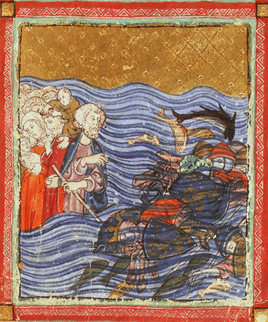
Escape over the Red Sea, Golden Haggadah, c. 1320, Spain

Their faith in God returns after the Egyptian army drowns in the Reed Sea.7 But in the wilderness the Isaelites think they are going to die when they run out of food or water, and they long for Egypt instead of trusting God to provide for them.8

The majority of Israelites are easily deceived in this week’s Torah portion because the fabrication of the ten scouts triggers their ongoing anxiety about God.

2) Fabrication by Moses

In the morning the Israelites threaten to stone Caleb and Joshua for telling them what they do not want to hear. Then the glory of God (probably the divine cloud that has led them from Egypt to the southern edge of Canaan) appears on the Tent of Meeting.9 God threatens to disown the Israelites, kill them, and make a nation out of Moses instead.

Moses does not try to reason with God. Instead he reminds God that if God kills all the Israelites, the Egyptians will hear about it and spread the news. Since God chose the Israelites to rescue and accompany, Moses says,

“… then the nations that heard of your reputation would say: Except God was not yekholet to bring this people to the land that [God] promised them, so [God] slaughtered them in the wilderness!” (Numbers 14:15)

yekholet (יְכֺלֶת) = capable enough, powerful enough. (Also from the root verb yakhol.)

Moses then asks God to pardon the people instead. God grants a limited pardon, requiring the Israelites to stay in the wilderness for forty years before they get another chance to enter Canaan.

Would the natives of Egypt and other nations really conclude that God killed the Israelites because God was not powerful enough to give them the land?  In an actual war between the Israelites and the natives of Canaan, people might assume that the conqueror’s god was stronger. But would people think that the reason God killed the Israelites before they even entered Canaan would was because God was weak?

Throughout the Ancient Near East, gods were considered mercurial and easily angered. The gods in polytheistic religions quarreled with each other, with disastrous consequences to human beings. They also lashed out at humans if they felt they were insufficiently propitiated.

If news spread that the Israelites had all died at the border, the people of other nations probably would conclude that the God of Israel was responsible. But they would attribute God’s deed to annoyance, revenge, or a change of mind, not to a lack of power.

Apparently God does not think of this. After hearing Moses’ deceptive claim, God commutes the Israelites’ sentence. Why is the God-character in Shelach-Lekha so easily persuaded?

Israelites Leave Egypt, the Golden Haggadah

Four times in the book of Exodus God says that the purpose of creating ten plagues in a row (and hardening Pharaoh’s heart whenever it wavers) is so that all the Egyptians, as well as the Israelites, will realize how powerful God is.10 Finally God lets Pharaoh beg the Israelites to leave Egypt, and they march out into the wilderness. Then God tells Moses:

“And I will strengthen Pharaoh’s heart and he will chase after you. Then I will be honored through Pharaoh and through all his army, and Egypt will know that I am God.” (Exodus 14:4)

The honor11 that God has in mind is drowning the Egyptian army in the Reed Sea. For the God-character portrayed in Exodus and Numbers, it is not enough to be the most powerful god in the world.12 All human beings must know that the God of Israel is the most powerful god. The God-character in Exodus and Numbers frets over “his” reputation.

Moses is able to mislead this God-character because he knows what the deity is touchy about.


Few people today believe in an anthropomorphic God that is hypersensitive and does not see through human misdirection. But all of we humans can be tricked into knee-jerk reactions by those who know our weak spots.

In these times I am angry when immoral politicians use slogans that push people’s buttons and thereby get popular support for agendas that will result in the opposite of what their voter base really wants. I am also angry when activists whose agendas I favor unskillfully use slogans that set off negative knee-jerk reactions among people who would otherwise be able to listen to a reasonable argument.

Alas, the portion Sehlach-Lekha illustrates that when a speaker fabricates a story that triggers an ingrained fear or sore spot, the listeners are highly unlikely to stop and think.

May all human beings be blessed with longer fuses, and the strength to put our feelings on hold long enough to question what we read or hear.


  1. Numbers 13:27. See my post Ki Tavo: Milk and Honey.
  2. Nefilim (נְפִילִים) = a race of demi-gods and heroes before the Flood. (Genesis 6:4)
  3. Numbers 13:29.
  4. Exodus 4:30-31.
  5. Exodus 6:6-9.
  6. Exodus (Beshallach)14:10-12.
  7. Exodus (Beshallach) 14:31.
  8. Exodus (Beshallach) 16:2-3, 17:1-4.
  9. Numbers 14:10.
  10. Exodus 7:3-5, 9:15-16, 10:1-2, 11:9.
  11. Honor or importance. The Hebrew word in Exodus (Beshallach) 14:4 is ikavdah (אִכָּבְדָה) = I will be honored, I will show my glory, I will be respected, I will be recognized as important. God repeats this sentiment in Exodus 14:17 and 14:18.
  12. Monotheism appears in the Hebrew Bible only in the first chapter of Genesis and the books of Deuteronomy and Isaiah.

Vayakheil+4: Not on Shabbat

“Hurry up and wait” describes a lot of life. Two weeks ago I was frantically getting ready to move my mother into assisted living. Now my effort to fulfill the Fifth Commandment and honor my mother is on hold until I get a moving date from the center—and wouldn’t you know it, she had another fall while she was alone in her house …

Talmud Readers, by Adolf Behrman, 1876-1943. What could be more absorbing?

I wish this period of waiting instead of doing labor were like the day of shabbat, the sabbath day of rest, but these days my soul is too heavy to rise to either refreshment or holiness. So this week I took my mind off my troubles by researching the commandment about shabbat. Here is a new post for this week’s Torah portion, Vayakheil—and four other portions in the book of Exodus, Beshallach, Yitro, Mishpatim, and Ki Tisa, that include variations on the command to desist from labor on the seventh day.

*

The first three of the Ten Commandments order us not to underestimate God.1 The last six are ethical precepts for human relations with other humans.2 In between, the fourth commandment combines holiness and ethics. It opens:

Remember the day of the shabbat, to treat it as holy. (Exodus 20:8) 3

shabbat (שַׁבַּת) = sabbath, day of rest. (From the same root as shavat, שָׁבַת = cease, stop, desist; stop working.)

This command is followed by explanatory notes in the Torah portion Yitro. More details are added every time the observance of shabbat is commanded in the book of Exodus—from the first time, in the portion Beshallach, when the Israelites are collecting manna, to the sixth time, in this week’s portion, Vayakheil, after God has given Moses a second set of tablets with the Ten Commandments carved in stone.

1) Don’t move

Manna Raining from Heaven, Maciejowski Bible, c. 1250 C.E.

Moses first mentions shabbat in the Torah portion Beshallach, when God provides manna for the hungry Israelites to gather up from the ground six, and only six, days a week. Moses says:

“See that God has given you the shabbat. Therefore on the sixth day [God] is giving you food for two days. Everyone in his place! No one go out from his spot on the seventh day!” (Exodus 16:29—Beshallach)

This introduces shabbat as a day of rest, at least in terms of going out and gathering food.

2) Holy break

The next order regarding shabbat is the one in the Ten Commandments in Yitro. The full fourth commandment states:

The Creation, by Lucas Cranach, 1534, Luther Bible

Remember the day of the shabbat, to make it holy. Six days you may work and you may do all your labor. But the seventh day is a shabbat for God, your God; you must not do any labor, you or your son or your daughter, your male slave or your female slave or your livestock or your immigrant within your gates. Because in six days God made the heavens and the earth and the sea and everything that is in them, and [God] took a break on the seventh day. Therefore God blessed the day of the shabbat and made it holy. (Exodus 20:8-11)

The emphasis in this commandment is on the holiness of shabbat. Since the day itself is holy, it must be set aside from mundane labor by all humans and animals in an Israelite’s household, and even by God.

3) Ethical refreshment

The third injunction about shabbat is in the portion Mishpatim:

Six days you may do your doings, but on the seventh day tishbot so that your ox and your donkey can take a break, veyinafeish, your slave and the immigrant. (Exodus 23:12)

tishbot (תּשְׁבֺּת) = you must cease, stop, stop working. (A form of the verb shavat.)

veyinafeish (וְיִנָּפֵשׁ) = and he can refresh himself, reanimate himself, catch his breath. (From the same root as nefesh, נֶפֶשׁ = throat, breath, appetite, mood, animating soul.)

This time Moses, speaking for God, gives a reason why even slaves, immigrants, and beasts must be given a day off from work on shabbat: so that draft animals can rest their muscles, and human laborers can rest their souls, becoming refreshed and revitalized.

Providing a day of rest is an ethical mandate; the moral principle of kindness calls for helping others to have a better life, and the moral principle of fairness supports giving everyone a day off when the landowner has a day off. Shabbat is the opposite of Pharaoh’s unethical subjection of the Israelite slaves to unremitting labor.4

4) Be holy or die

The fourth command about shabbat appears in the Torah portion Ki Tisa, after God finishes telling Moses what the Israelites must make to set up the sanctuary and the priests of their new religion. God warns that all of this construction must pause on the day of shabbat.

Nevertheless, you must observe shabtotai, because it is a sign between me and you for your generations, for knowledge that I, God, have made you holy. And you must observe the shabbat because it is holy for you. Whoever profanes it must definitely be put to death, because whoever does labor on it, his life will be cut off from among his people. (Exodus 31:12-14)

shabtotai (שַׁבְּתֺתַי) = my shabbats.

This order not only reiterates that shabbat is holy, but adds that observing it is a reminder that the Israelite people themselves are holy, i.e. set aside for God.

In addition, profaning shabbat by doing labor on that day is such a serious transgression that God assigns it the death penalty.

This rule about observing shabbat is the source text for the Talmud’s list of 39 categories of labor forbidden on the seventh day. The rabbis assume that since God warns that the work of building the sanctuary and fabricating the priests’ clothing must cease on shabbat, the labors involved in doing those tasks are the labors forbidden on shabbat from then on.5

This injunction in Ki Tisa continues:

The Israelites must observe the shabbat, doing the shabbat throughout their generations as a covenant forever. Between me and the Israelites it will be a sign forever, because for six days God make the heavens and the earth, and on the seventh day [God] shavat vayinafash. (Exodus 31:16-17)

vayinafash (וַיִּנָּפַשׁ) = and he refreshed himself, reanimated himself, caught his breath.   (A variant of veyinafeish.)

Since the divine life of the universe pauses every seven “days” for refreshment and redirection, so must our own souls. (See my earlier post,  Mishpatim, Ki Tisa, & 2 Samuel: Soul Recovery.)

5) No farming

Shabbat comes up again later in the portion Ki Tisa when God gives Moses additional instructions for the Israelites.

Six days you may work, but on the seventh day tishbot; at plowing and at grain-cutting tishbot. (Exodus 34:21)

The book of Exodus gives no reason why agricultural labor in particular is prohibited on shabbat. One possibility is that this sentence refers to the ethical law about shabbat in Mishpatim, since landowners used draft animals (oxen and donkeys) to plow, and teams of underlings including slaves and immigrants to scythe down ripe grain.

Sheaves of grain

On the other hand, the list in the Talmud of activities prohibited on shabbat includes farming chores that eventually lead to the bread that must be displayed on the gold-plated table in the sanctuary.6 The first eleven of the 39 prohibited labors in the Talmud are sowing grain, plowing, reaping, gathering sheaves, threshing, winnowing, selecting the edible kernels, grinding them into flour, sifting the flour, kneading dough, and baking bread. By this interpretation, the ban on plowing and reaping on shabbat might mean the holiness of the day surpasses the holiness of the sanctuary.

6) Light no fires

The sixth and final shabbat instruction in the book of Exodus occurs in this week’s Torah portion, Vayakheil. Again the seventh day is called holy, and doing labor on that day is punishable by death.

Six days you may do labor, but the seventh day must be holy for you, a shabbat shabbaton for God. Anyone who does labor on it must be put to death. You must not kindle a fire in any of your settlements on the day of shabbat. (Exodus 35:2-3)

shabbaton (שַׁבָּתוֹן) = most solemn shabbat, feast day of shabbat, day of absolute stopping.

Here Moses repeats God’s commands that the day of shabbat must be treated as holy and that anyone who does not desist from labor on that day must be executed.

The new information in Vayakheil is that lighting a fire is prohibited on shabbat. Before this, the only specific examples of labor forbidden on shabbat are agricultural: gathering manna, using draft animals, sowing and reaping . Now, in Vayakheil, Moses gives another example of labor: lighting a fire.

The purpose of this prohibition cannot be ethical, since lighting a fire is not in itself a heavy labor, and it benefits other humans by giving them heat, light, and a way to cook food.

Since the previous verse reminds us that the seventh day must be holy, refraining from kindling a fire must be another religious rule associated with holiness.

Kindling a fire is number 37 in the Talmud’s list of 39 labors banned on shabbat, right after extinguishing a fire. It may allude to the fire on the altar. Although burnt offerings continue during shabbat according to the Torah, the fire is not rekindled. In fact, it must never go out.7 The altar fire is holy because it is dedicated to God, and because God kindled it.8

*

Thus the book of Exodus presents the law against working on shabbat as a religious rule (guarding what is holy) three to five times.9 It presents the law as an ethical rule (promoting kindness and fairness) only twice.10

Yet when we observe the day of shabbat we can remember that it is not solely a religious requirement reminding us of holiness. We will not be put to death for doing forbidden work on shabbat, since that part of the order in this week’s Torah portion is no longer followed. But when we try to set aside mundane concerns in order to elevate our souls on the seventh day, we can also remember the ethical values in the last six commandments, which address kindness, fairness, and respect for other human beings.

And I can pray that soon I will be able to obey the fifth commandment, and treat my mother with kindness and respect by moving her into a safe place.

  1. See my upcoming post, Pekudei, Yitro, & Ki Tisa: Not Like Other Gods.
  2. See my posts Yitro, Mishpatin, & Va-etchanan: Relative or Relevant? Part 1, Part 2, and Part 3 on the last six commandments.
  3. This is the opening in Exodus. When Moses repeats the Ten Commandments in Deuteronomy, the fourth commandment opens: Observe the day of the shabbat and treat it as holy. (Deuteronomy 5:12)
  4. Exodus 5:1-9, 6:9.
  5. Talmud Bavli, Shabbat 73a, Mishna.
  6. Exodus 25:23-30.
  7. Leviticus 6:5-6.
  8. Leviticus 9:24 for the portable sanctuary in the wilderness.
  9. Exodus 16:29, 20:8 and 11, 31:12-13 at a minimum. According to the Talmud Exodus 34:21 and 35:2-3 are also rules for religious purposes.
  10. Exodus 20:9-10, 23:12.

Haftarat Beshalach—Judges: A Humble Commander

Red Sea in Golden Haggadah, c. 1320, Spain

Pharaoh lets the Israelites leave without conditions in last week’s Torah portion, Bo. But God hardens Pharaoh’s heart one last time in this week’s Torah portion, Beshalach, in order to have an excuse to create another miracle.1 When the Israelites are trapped between Pharaoh’s charioteers and the Reed Sea, they complain that Moses rescued them from servitude in Egypt only to so they would die in the wilderness.2 Moses raises his staff, God splits the Reed Sea, the Israelites cross over, and the water surges back and drowns the Egyptian army.

Moses, as usual, is the mediator between God and the Israelites. For the rest of his life he doggedly continues speaking to both sides and doing whatever it takes to keep the people moving toward Canaan.

He never wanted this role. Four times at the burning bush Moses tried to persuade God to send someone else.3 Finally God talked him into it—or perhaps the deciding factor was Moses’ compassion for the oppressed, which had already moved him to kill an Egyptian beating a Hebrew man, and defend seven shepherdesses from a gang of men who drove them away from a well.4

I admire Moses’ humility, as well as his courage and cleverness when he talks God out of killing all the Israelites after the golden calf fiasco.5 Most of all, I admire his unselfish dedication to others. He makes a few ethical mistakes, but overall he consistently labors for the welfare of the Israelites in his charge, ignoring his own interests.

*

This week’s haftarah reading from the book of Judges includes three admirable characters. Devorah and Ya-eil both act with courage and intelligence, like the women at the beginning of the book of Exodus: the two chief midwives, Shifrah and Puah,6 Moses’ mother, Yocheved,7 and Pharaoh’s daughter, who adopts the infant Moses and hires Yocheved to nurse him.8

But the character I admire most in this week’s haftarah is a man.

Just before the haftarah, the book of Judges says that the Israelites are once again oppressed, this time by a Canaanite king who has a large chariot regiment. God let it happen because the Israelites were straying after other gods again.

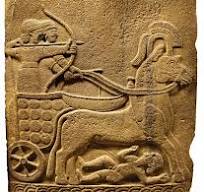
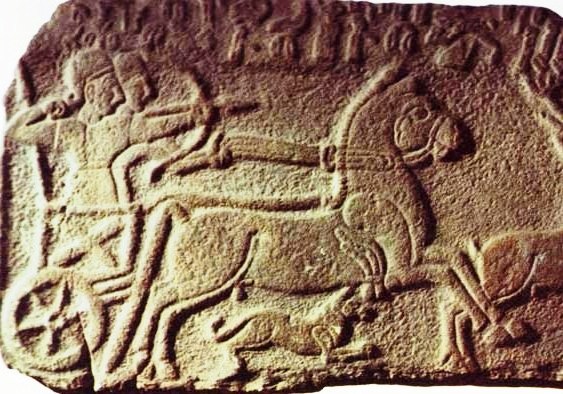
Assyrian war chariot

Then God handed them over into the power of Yavin, a king of Canaan who reigned in Chatzor. And the commander of his army was Sisera, who headquartered at Charoshet Hagoyim. And the Israelites cried out to God, because he had nine hundred iron chariots, and he had oppressed the Israelites violently for twenty years. (Judges/Shoftim 4:2-3)

The Israelite tribes have only foot soldiers, and no king to unite them. But they do have a prophetess named Devorah.

Devorah was a prophet-woman, wife of Lapidot. She was the judge of Israel at that time … and the Israelites went to her for legal decisions. (Judges 4:4-5)

This woman has the same role as Samuel in the first book of Samuel: she both interprets the word of God and makes rulings in disputes, including disputes between tribes. Devorah has the most authority among the Israelites, as Samuel did later, before the first Israelite king.

And she sent and summoned Barak, son of Avinoam, from Kedesh of Naftali, and she said to him: “Is it not [that] God, the God of Israel, commanded: Go umashakhta on Mount Tabor! And you shall take with you ten thousand men from Naftali and from Zevulun. Umashakhti toward you the stream of Kishon; Sisera, the commander of the army of Yavin; and his chariots and his force. And I will put them in your power.” (Judges 4:6-7)

umashakhta (וּמָשַׁכְתָּ) = and you shall pull together, draw to yourself, rally.

umashakhti (וּמָשַׁכְתִּי) = and I will pull, draw.

When Barak hears this command from God, he is hesitant. He does not doubt God’s power, but he doubts his own. Maybe he wonders if he could muster enough fighting men, or maybe he wonders if the men would obey his orders. He knows Devorah has the real authority.

And Barak said to her: “If you go with me then I will go, but if you do not go with me I will not go.” And she said: “I will certainly go with you. Only honor will not be yours on the road that you are following, because through the power of a woman God will hand over Sisera.” And Devorah got up and went with Barak to Kedesh. And Barak mustered Zevulun and Naftali at Kedesh, and ten thousand men went up on his heels, and Devorah went up with him. (Judges 4:8-10)

I admire Barak for his humility. He is more interested in freeing the Israelites from the oppressive rule of King Yavin than he is in his own honor. He accepts his loss of status if the men see him taking orders from a woman.

Barak and Devorah lead the Israelite troops to the top of Mount Tavor. Sisera orders all his chariots and troops to move to the almost dry Kishon River. Then Devorah tells Barak:

“Get up! Because this is the day when God will give Sisera into your power. Is it not God who goes before you?” (Judges 4:14)

Barak leads his foot soldiers in a charge down the slope of Mount Tavor.

And God threw into confusion Sisera and every chariot and every warrior [so they fell] to the edge of the sword before Barak. And Sisera descended from his chariot and fled on foot. And Barak pursued the chariots and the warriors as far as Charoshet Hagoyim, and every warrior of Sisera fell to the edge of the sword; not one remained. (Judges 4:15-16)

The poem following the narrative of Sisera’s defeat explains that God turns the Kishon into a raging torrent that sweeps away Sisera’s army9.

Barak rallies the troops, but in Devorah’s name. He leads the charge, but only when Devorah says it was time. Then God drowns Sisera’s army at the Kidron, just as God drowned Pharaoh’s army at the Reed Sea.10

Sisera, the commander of King Yavin’s army, flees on foot to the nearby campsite of Chever the Kenite. He assumes he can find shelter there, because that Chever’s family is one of King Yavin’s allies. Chever’s wife, Ya-eil (Jael), is alone inside her tent when Sisera arrives. Maybe Sisera chooses her tent because everyone else is gone, or maybe it is the first tent he reaches.

Study of Jael, by Carlo Maratta ca. 1700

When he asks Ya-eil for water she gives him milk. When he falls asleep she hammers a tent pin through his head.11

Ya-eil, like Devorah, is both courageous and clever. But is she ethical? The book of Judges does not say why Ya-eil kills Sisera. Does she empathize with the Israelite tribes? Is she feuding with her husband or her husband’s family, Sisera’s allies? Or does she have some private reason that did not make it into the book? Without knowing her motive for killing Sisera, we cannot judge Ya-eil’s moral character.

And hey! Barak was pursuing Sisera, and Ya-eil went out to greet him. And she said to him: “Come, and I will show you the man whom you are seeking.” (Judges 4:22)

Barak is prepared to kill Sisera, but he finds out that a woman beat him to it. Devorah’s prophecy that “through the power of a woman God will hand over Sisera” is fulfilled twice: Sisera’s army is defeated with the help of Devorah, and Sisera himself is killed by Ya-eil.

*

Yes, the two women are admirable for their courage, their quick thinking, and their refusal to play the role of submissive wife. But I think Barak is even more admirable. He does not lack courage; after all, he leads the charge down to the enemy forces with their dangerous iron chariots, and then he pursues Sisera single-handedly. But like Moses, Barak is also humble. Her publicly admits that Devorah, a woman, is more powerful and respected than he.

And Barak follows Devorah’s directions for an ethical reason: to rescue the Israelites from oppression.

  1. Exodus 14:4, 14:8-9.
  2. And they said to Moses: “Was it because there are no graves in Egypt that you took us out to die in the wilderness?” (Exodus 14:11)
  3. Exodus 3:10-12, 4:1, 4:10-13.
  4. Exodus 2:11-17.
  5. Exodus 32:7-14.
  6. Exodus 1:15-22. See my post Shemot: Disobedient Midwives.
  7. Exodus 2:1-4. See my post Shemot & Psalm 137: Cry Like a Baby.
  8. Exodus 2:5-10.
  9. Judges 5:20-21. The poem also adds troops from three other Israelite tribes (Efrayim, Benyamin, and Issachar) to Barak’s army. (Judges 5:14-15).
  10. Exodus 14:10-30.
  11. Judges 4:17-21.

Beshalach & Vayeishev: By Hand

by Theodore Gericault, 1824

Hands are powerful.  Hands are personal.

Both modern English and biblical Hebrew use the word for “hand” (yad, יָד) in many idioms.  And sometimes an idiom in an English translation of the Hebrew bible was adopted into English just because the “Old Testament” had so many English-speaking readers.

Beshalach: a high hand

The Israelites leave Egypt “with a high hand” in this week’s Torah portion, Beshalach.  Here is the King James translation:

And the Lord hardened the heart of Pharaoh king of Egypt, and he pursued after the children of Israel: and the children of Israel went out with an high hand. (Exodus 14:8)

In English we say people are “high-handed” when they act as if they have the authority to accomplish something by themselves, without consulting anyone or considering anyone else’s concerns.  When the Israelites march out of Egypt, they feel arrogant for a change.  The pharaoh who oppressed them has begged them to go, they are taking everything Pharaoh wanted them to leave behind, and they have just commandeered  gold and other valuables from their Egyptian neighbors.  They act as if they are invincible–until the Egyptian army catches up with them. (See my 2013 post: Beshalach: High Handed.)

In English we say “He was caught red-handed,” because a man at a murder scene with blood on his hands is probably the murderer.  The idiom applies to anyone caught committing a violation in front of witnesses or with obvious, incontrovertible evidence.

But if you arrange for someone to die while you are elsewhere and there is no evidence that “your hand was in it”, you might never be implicated.  Biblical Hebrew would phrase that idiom as “your hand was with” the obvious perpetrator.  For example, King David asks a woman with an imaginary story about two sons “Is the hand of Joab with you in all this?” to find out if Joab’s hand is in her ploy to make him change his mind about his son Absalom (2 Samuel 14:19).

Vayeishev: don’t lay a hand on

This week I am writing the part of my book on Genesis about when Joseph’s brothers sell him as a slave to caravan bound for Egypt in the Torah portion Vayeishev.  Initially, most of Joseph’s ten older brothers want to kill him, then throw his body into one of the dry cisterns in the vicinity.  Reuben, the oldest brother, persuades them not to get blood on their own hands.

And Reuben said to them: “Don’t shed blood!  Throw them into this pit that is in the wilderness, but don’t extend a hand (yad) on him,” in order to rescue him from their hand (yad) and return him to his father.  (Genesis 33:22)

In colloquial English Reuben is saying: “Don’t lay a hand on him.”   All the brothers cooperate by seizing Joseph, stripping off his fancy tunic, and throwing him into the cistern alive.  Then Reuben wanders off while the rest of Joseph’s brothers sit down for a meal and Joseph pleads for his life from the bottom of the cistern.  An Ishmaelite caravan headed for Egypt approaches, and one of the brothers, Judah, says:

What profit if we murder our brother and cover up his blood?  Let’s go and sell him to the Ishmaelites, and our hand (yad) won’t be on him; for he is our brother, our flesh.”  (Genesis 33:26-27)

What Judah does not say is that a slave sold in Egypt would probably have a short life-span.

Thus the Torah provides an example of how humans excuse their own behavior when they put someone in harm’s way or incite someone to commit a crime.  If I didn’t do it with my own hands, they think, I’m not really guilty.

In Genesis, Joseph’s brothers realize that they are guilty after all, and that guilt haunts them the rest of their lives.

Repost: Beshalach & the History of Split

The Israelites Leave Egypt, The Golden Haggadah, 14th century Spain

The Israelites march out of Egypt beyad ramah, “with a high hand”, in this week’s Torah portion, Beshelach.  (To read my 2013 essay on that rare phrase in the Torah, you can click here: Beshalach: High-Handed.)

Beyad ramah, like the English idiom “high-handed”, means arrogantly doing something without consulting or collaborating with others.  In this week’s Torah portion, the Israelite slaves march out of Egypt fearlessly, even arrogantly, taking their Egyptian neighbors’ jewelry with them.

Three days later at the Reed Sea, they see the Egyptian army behind them and they feel powerless once more.  Forty years later in Canaan, they kill, plunder, and conquer the native population in a way that could be considered high-handed.  After that a few Jewish kings act arrogantly in the Torah, but the Israelites as a people rarely have the opportunity.  Both Israelite kingdoms are small and eventually swallowed up by their powerful neighbors.

For almost two millennia, from the destruction of the second temple in 70 C.E. to the founding of the nation-state of Israel in 1948, Jerusalem and its surrounding province were subservient to the government of one larger empire after another.  Jews who emigrated to other countries were only rarely considered peers of the majority group; discrimination ranged from being charged an extra tax to being murdered by mobs.  An individual Jew could be high-handed in his own sphere, but a group of Jews could not pull it off until the twentieth century.

When I started working on volunteer committees I learned that if I just did something without consulting everyone who might be involved, I was being high-handed.  I remembered how I had hated being treated unfairly and without respect when I was younger, and I learned how to collaborate better.

Can whole groups of people live together with mutual respect?

Sometimes, in some places, Jews have been one respected group living in harmony with other groups.  Over the last two millennia, this was often the case in Split, Croatia, the city where I am living this winter.

A Short Illustrated History of Jews in Split

(all photos by Melissa Carpenter)

In the first century B.C.E. the Romans acquired both Syria (which included Jerusalem) and Dalmatia (which included Split).  Julius Caesar set an example by granting Jews an exemption from Roman religious practices and permission to follow their own customs.  In Jerusalem and the district of Judea, Jews protested in 66 C.E. against Roman taxes and soldiers, and the Roman governor responded by plundering the treasury of the temple.  During the war that ensued, the Romans razed the temple.

Menorah from Salona, 4th century C.E.,  Split Archaeological Museum

Meanwhile in Dalmatia, Jews came with the Romans and settled along the coast.  Jewish artifacts from as early as the third century C.E. have been found in both Split and the Roman city of Solana across the bay.

Emperor Diocletian, who built his retirement palace in Split around 300 C.E., persecuted and executed local Christians, but left Jews free to observe their own religion.

5-branch menorah carved on wall stone in cellar 17E, Diocletian’s Palace, Split

The Roman Empire was collapsing when Slavs and Avars invaded Dalmatia in the 6th century and seized the city of Salona north of Split.  Both Jews and Christians fled across the bay and built stone houses inside the shell of Diocletian’s palace.  Archaeologists have yet to determine whether the menorahs carved into buildings stones in the cellars of the palace date from this time or an earlier century.

In the 1490’s Spain and Portugal expelled their Jews.  Some ports on the Adriatic Sea refused to accept these refugees, but Split made room for them, and these Sefardic Jews settled in the northwest quarter of Diocletian’s former palace.  Eventually that became the Jewish neighborhood of Split.

Jewish Cemetery on Marjan Hill

Split and the rest of the Dalmatian coast north of Dubrovnik were part of the Venetian Republic from 1420 to 1796.  In the 16th century one of the Jewish immigrants from Portugal, Daniel Rodriga, persuaded the Venetian government to turn Split into a major port by adding a lazaretto with warehouses and a quarantine building.  The doge in Venice agreed and put Rodriga in charge of building the lazaretto in 1572.  Rodriga got permission from local authorities to establish a Jewish cemetery on the slope of nearby Marjan Hill in 1573.

“Jewish Tower”

Split boomed thanks to Rodriga’s lazaretto, and in the 17th century the Venetians built a defensive wall with bastions to protect their valuable port from the Ottomans, who had captured the other side of the bay. When Ottomans attacked Split in 1657, the Venetian wall was still under construction.  The local Jews were trusted with the defense of Diocletian’s northwest tower.  The Ottomans were unable to penetrate the city center inside the palace, and townspeople started calling that tower Zidovska Kula, “Jewish Tower”.

At first the Venetian ruling class was remarkably tolerant of Jews compared to the Christians in other countries, and the Jews of Split were free to follow any trades they chose.  The only restriction imposed on them was that they could not own property; they had to rent, but they could buy long-term leases.  And although Venice itself established a ghetto in 1516, Jews in Split could lease houses wherever they wanted.  Most, but not all, chose to live in the old Jewish neighborhood.

This harmony between Christians and Jews lasted until the 18th century.  Then in 1738 the Venetian rulers of Split started requiring Jews to wear special hats.  In 1778 they ruled that Jews could no longer employ Christians, and created a Jewish ghetto by putting gates in seven of the stone archways over the narrow streets of Diocletian’s old palace.  The gates were placed so the ghetto included the buildings where most of the Jews already lived.  Jews had to be inside the gates from midnight to sunrise.

When Napoleon captured Split in 1806, all restrictions on Jews were eliminated.  But then the Dalmatian coast fell to the Austro-Hungarian Empire, which did not grant Jews complete equality and freedom until 1867.

At the end of World War I,  Dalmatia became part of the new kingdom of Yugoslavia, which was conquered by the Axis powers during World War II.  In 1941 Germany installed a puppet government for inland Croatia called the Ustase, which shared the Nazi attitude toward Jews.  Meanwhile Italy annexed most of the Dalmatian coast, and the people of Split organized armed resistance against the Italian fascist occupiers.  The Jews of Split arranged for Jewish refugees from inland to escape through the port.

Although Italy refused to deport or murder Jews, in 1942 a mob including Italian soldiers attacked the Split synagogue and the people inside, and looted 60 Jewish homes. The following year Italy surrendered to the Allies, and Germany took over, assigning the Dalmatian coast to inland Croatia’s Ustase government.  Dedicated to exterminating Croatian Jews and Muslim Serbs, the Ustase created their own concentration camps.

Fort Gripe, Split (now a maritime museum)

In Split the Ustase found a new use for the barracks at Fort Gripe, which had been built by the Austrians on the north side of a Venetian fort, and occupied by Mussolini’s soldiers for two years.  In 1943 the barracks were converted into a prison for the remaining Jews of Split.  Two Split doctors, Andrija Poklepovic and Mihovil Silobrcic, managed to rescue some of those Jews by transferring them to a hospital and then claiming they were quarantined because of disease.

The rest of the Jews imprisoned in Split were deported to two Ustase camps, Sajmiste and Jasenovac, where they were all murdered.  About 150 of the 284 Jews living in Split in 1940 survived until liberation in 1945.

Croatia and its Dalmatian coastline were part of Tito’s Socialist Federal Republic of Yugoslavia from the end of the war to 1991, and due to the country’s official atheism, no rabbis were allowed.  The first president of the independent nation of Croatia, Franjo Tudman, was known for his anti-Semitic slurs, and appointed former members of the Ustase to government posts.

Under the new Croatian constitution following Tudman’s departure from office, Jews are one of twelve “autonomous national minorities”, and elect a special representative to the Croatian parliament.  The only anti-Semitic incidents I could uncover in the 21st century were the chanting of Ustase slogans, particularly at soccer matches, and the carving of a swastika into the turf of the soccer field in Split in 2015, which resulted in a 100,000 euro fine.

Today the Jewish population of Split is small; about 100 families belong to the Jewish community, which restored the old 16th-century synagogue in 1996 and meets there regularly.

So does Split count as a place where the Jews are respected and live in harmony with other groups?  Not always, but more often than most places over the last 2,000 years.

(My thanks to Ivica Profaca, to “Albert” at the synagogue, and to the world’s biggest library, the Internet.)