Shoftim: To Do Justice

Tzedek, tzedek you must pursue. (Deuteronomy/Devarim 16:20)

tzedek (צֶדֶק) = right behavior; ethical standards; justice.

The pursuit of justice and/or ethical behavior is an obligation incumbent upon all of us.  But in this week’s Torah portion, Shoftim (“Judges”), the pursuit of tzedek is an instruction to judges.  The portion begins:

Shoftim and officers you shall appoint in all your gates [of towns] that God is giving to you according to your tribes; veshaftu the people [with] rulings of tzedek.  (Deuteronomy 16:18)

shoftim (שֺׁפְטִים) = judges; those who decide cases; those who deliver justice.

veshaftu (וְשָׁפְטוּ) = and they shall judge, make settlements among, deliver justice to.

Samson, also a judge

The shoftim in this week’s portion are not the kind of shoftim we see in the book of Judges/Shoftim.  There, most shoftim were chieftains or war leaders during a time of frequent conflicts among small states.  They deliver justice to the people by leading an army that frees them from their latest conquerors.  Afterward they usually serve as chieftains who are also judges.1

City gate at Megiddo

The shoftim in this week’s Torah portion also differ from the town elders who serve as judges in biblical passages referring to the time before Israel and Judah had kings. During that period, an individual with a claim to press, or two household heads seeking arbitration, would go to the town gate or the village threshing floor at daybreak and call ten of the settlement’s elders (respected male heads of households) to come over and adjudicate.2  A decision required the consensus of all ten men.3

Although the book of Deuteronomy is set on the bank of the Jordan at the end of Moses’ life, it was written for the citizens of the kingdom of Judah, and refers to their legal system.4  The shoftim in this week’s portion are appointed judges, not the first ten respected elders to pass by.

These appointed shoftim must judge the people with “rulings of tzedek” as follows:

You may not skew a ruling; you may not recognize a face; and you may not take a bribe, since a bribe blinds the eyes of the wise and distorts the words of the tzaddikimTzedek, tzedek you must pursue, so you may live and take possession of the land that God, your God, is giving to you.  (Deuteronomy 16:19-20)

tzaddikim (צַדִּיקִם) = the innocent; the righteous, the ethically good, the just.  (From the same root as tzedek.)

To “recognize a face” means to show favoritism, not just in the decision but also in how the parties are treated during the hearing.5

Why would pursuing justice enable the Israelites to live and conquer more and more of the land of Canaan?  Deuteronomy predicts that they will only win battle victories with God’s help.  (See my post Re-eih: Ownership.)  Therefore it pays to do what God wants.

Moses frequently restates what God wants from the Israelites, which includes just decisions about legal claims.  It also includes avoiding the worship of other deities (the first of the Ten Commandments).  If local appointed judges hear that someone has been worshiping other gods, they must investigate thoroughly.  If the rumor proves true,
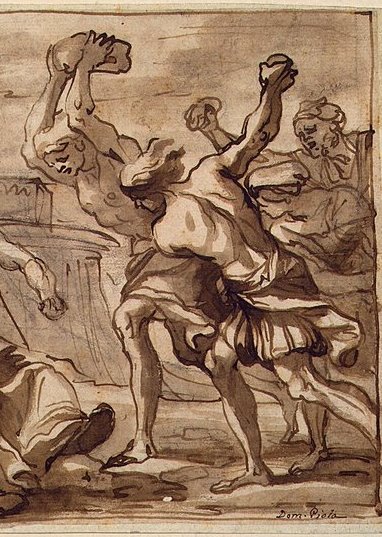
Stoning, from Piola Domenico, 17th century

Then you shall bring out to your gates that man or that woman who did the wicked thing, and stone them with stones so they will die.  On the word of two or three witnesses they shall definitely be executed, [but] they shall not be put to death on the word of one.  (Deuteronomy 17:5-6)

At least two eye-witnesses must agree that they saw the accused bow down to, or otherwise serve, an alien god before the judges can declare the accused guilty.  One or zero witnesses are insufficient for a guilty verdict, no matter what the circumstantial evidence.6

The Torah portion Shoftim also addresses what local judges should do when it is hard to connect a legal case with the appropriate law or ruling.

If a matter of law is too difficult for you, … then you shall get up and go up to the place God, your God, chooses.  And you shall come to the priests of the Levites, or to the judge who is [serving] at that time, and you shall inquire; and he shall tell you the matter of the law.  (Deuteronomy 17:8-9)

The next few verses say that the local judges must carry out the ruling from Jerusalem (the place God chooses) exactly as instructed.  This passage parallels the scene in Exodus/Shemot where Yitro tells his son-in-law Moses to appoint judges to settle minor disputes, and ask them to bring the major cases to him.7  Yitro explains that the major cases should go to Moses not because he is the central authority, but because God talks to him and gives him the laws.  Perhaps difficult cases must be referred to the priests and judges in Jerusalem not because they are the central authority, but because they are more experienced in interpreting God’s laws.

*

Just as “Tzedek, tzedek you must pursue” should be a goal for every human being in some sphere of life, we can take to heart other instructions to the shoftim in this week’s portion.  How do you judge the actions of another person?

Do you act like the chieftains and war leaders in the book of Judges, convinced that your own cause is just and therefore you have the right to dictate to everyone else?  Or do you act like the elders in the gate, taking action against someone only if your sense of what is right matches the opinions of other respected people in your community?

Do you “recognize a face” or show favoritism, making excuses for someone you like while judging someone you dislike harshly?  Do you feel obligated to refrain from correcting someone who has given you a gift, such as a job or status?

If one person tells you about the terrible thing a third person did, do you believe it?  Or do you wait until two eye-witnesses confirm it?  Do you draw conclusions about someone from circumstantial evidence?

If you cannot make up your mind about whether another person is guilty of wrongdoing, or whether you need to do anything about it, to whom do you take the case?  Who can you trust?

It is not so easy to pursue justice.

  1. Judges 2:16-19. Specific war-leaders whom the book of Judges cites as shoftim administering justice are Otniel (3:9), Jepthah/Yiftach (12:7), and Samson/Shimshon. (15:20, 16:31).  The shoftim named in Judges who appear to be chieftains who also judge cases are Tola (10:1-2), Ya-ir (10:3), Ivtzan (12:8-9), Eilon (12:11), and Avdon (12:13-14).  One woman, Devorah, takes a dual role.  She is introduced as “a prophetess, a woman of Lapidot, [who] administered justice in Israel at that time … and Israelites went up to her for rulings” (Judges 4:4-5), but then she calls for war and accompanies a general into battle.
  2. Ruth 4:1-11, Proverbs 31:23, and Lamentations 5:14. Also see Victor H. Matthews & Don C. Benjamin, Social World of Ancient Israel 1250-587 BCE, Hendrickson Publishers, Peabody, MA, 1993, pp. 122-124.  Deuteronomy 25:7 calls for the elders at the gate to rule on the case of a new husband who accuses his bride of not being a virgin; perhaps the older system of town elders survived, modified by later laws and rulings imposed by the kingdom’s priests and other higher-ranking judges (see Deuteronomy 17:8-13).
  3. Matthews & Benjamin, p. 124.
  4. Most modern critical scholars date the composition of Deuteronomy chapters 12-25 to the reign of King Josiah of Judah in the 7th century B.C.E., with some editing later.
  5. Rashi (11th-century rabbi Shlomoh Yitzchaki) on Deuteronomy 16:19.
  6. Talmud Bavli, Sanhedrin 37b.
  7. Exodus 18:22.

Shoftim: No Goddesses Allowed

In beginning, elohim created the heavens and the earth. (Genesis/Bereishit 1:1)

elohim (אֱלֺהִים) = gods (plural); one of the names of the God of Israel. (Other common names include the tetragrammaton, El, El Elyon, and El Shaddai.)

How many gods does it take to create the universe? For most of ancient Canaan and Mesopotamia, in the beginning there were two: a father god and a mother goddess, who proceeded to beget additional gods. The universe was dualistic from the start.

But the book of Genesis clarifies that only one God created the universe, without any sexual partner.  God makes all the separations and distinctions, including gender, during the course of this creation. And unlike the gods of other peoples in the Ancient Near East, the God of the Torah demands exclusive loyalty. Anyone who worships God is forbidden to worship any additional gods or goddesses.

God first reveals this at Mount Sinai, with the commandment:

You shall not make for yourself an idol or any image of what is in the heavens above or what is in the earth below on what is in the water below the earth. You shall not bow down to them and you shall not serve them. Because I, God, your elohim, am a jealous eil. (Exodus/Shemot 20:4-5)

eil, El (אֵל) = a god; the father god of Canaanite religion; the God of Israel.

Matzeivah at Gezer

Worshiping an idol is equated in the Bible with worshiping the god that the idol represents. In this week’s Torah portion, Shoftim (“Judges”), Moses orders the Israelites:

You must not plant for yourself an asherah of any wood next to the altar of God, your elohim, that you shall make for yourself. And you must not erect for yourself a matzeivah which God, your elohim, hates. (Deuteronomy/Devarim 16:21-22)

asherah (אֲשֵׁרָה) = the mother goddess of Canaanite and Phoenician religions (called Ishtar in Akkadian and Inanna in Sumerian); a carved wooden post representing this goddess. (Plural: asherim, אֲשֵׁרִים.)

matzeivah (מַצֵבָה) = a standing stone used as a marker, or as an image representing a god. (Plural: matzeivot, מַצֵּבֺת.)

Clay figurines from Judah

Although very few wooden artifacts have survived the millennia in Israel, archaeologists have unearthed numerous small clay figurines in ancient Judah that may have been modeled after large wood asherim.1

All asherim are forbidden in the Bible, but not every matzeivah is. Standing stones that mark graves, boundaries, covenants, or great events are acceptable.2 So are the standing stones Jacob erects for God and anoints with oil.3 The matzeivot that God hates are the standing stones that people bowed to and anointed in order to worship a different god.

Asherim and matzeivot are mentioned together in eleven biblical passages.4 These wood and stone vertical idols were erected at the shrines of other gods—and even, at times, inside the temple of the God of Israel in Jerusalem.5 Thus when people came to a shrine or, during the reigns of more permissive kings, to a temple of God, they also acknowledged the divine power of the gods represented by the asherah and the matzeivah.

Who were the gods behind these two ubiquitous types of idols?

Asherah from Ugarit

The religion of Canaan (later known as Phoenicia) had a founding pair of gods who mated and produced 70 more gods. The father god was named El. In a long poem from Ugarit in northern Canaan6, El is associated with the bull, and holds court in a field at the source of two rivers. The mother goddess was named Asherah or Atirat, and was associated with the seashore, stars, fertility, and trees.

El and Asherah’s most important son was Baal, the weather god. In the Ugaritic poem, Baal asks Asherah to ask El for permission to build a palace on Mount Tzafon and hold court there. Both parents give permission, thus making Baal the ruler over all his sibling gods and goddesses. In other Canaanite stories, Asherah and her son Baal are a sexual pair.

Baal from Ugarit

An asherah represented the mother goddess Asherah. A matzeivah probably represented her son and lover Baal, since Canaanite rituals focused on the pairing of Asherah and Baal, not Asherah and El.7 Most biblical references to matzeivot do not specify the god; the only exceptions are Jacob’s matzeivot for God in the book of Genesis, and two matzeivot of Baal in the second book of Kings.8

The first time the Israelites are told to destroy asherim and matzeivot is in the book of Exodus:

For their altars you shall tear down and their matzeivot you shall shatter and their asherim you shall cut down (34:13); because you must not bow down to another eil, because God is jealous of “his” name; a jealous eil is “he”. (Exodus 34:14)

The Torah consistently uses masculine pronouns and conjugations to refer to its asexual God. Hebrew is a gendered language, in which even inanimate objects and abstract concepts are assigned genders, so the masculine gender is often arbitrary. But it may not be so arbitrary in the case of God.

In the Torah the head of a household is a man, who is entitled to complete obedience from his wife and adult children as well as his slaves. God is often described in the first five books of the Bible as a demanding father, and in the books of the Prophets as the husband of the Israelites, who collectively take the role of God’s unfaithful wife.

Canaanite and Mesopotamian religions had both priestesses and priests; the Israelites had only priests. In other Canaanite and Mesopotamian cultures, women could also own land, make contracts, and initiate divorce. The Israelites reserved these privileges for men.

Is the biblical condemnation of goddesses, including both Asherah and the later goddess Ashtoret, “Queen of the Heavens”9, a result of this discrimination against women?

Or is it merely part of the condemnation of all gods other than the one God, a condemnation that includes the worship of matzeivot as well as asherim?

Complete dedication to a single god does have an advantage. If you begin with two gods, male and female, you can certainly understand our universe of separations and distinctions. But it might be hard to grasp that everything is part of a whole.  Beginning with a single god who creates all the separations and distinctions makes it easier to transcend dualism and get an inkling of the underlying unity of everything.

For me, as for many human beings, it is hard to keep remembering that we are interconnected parts of the whole, and that the whole means more than the sum of its parts.  It is hard to keep returning to any sort of God-consciousness.

So I agree with the Torah portion Shoftim that we should not plant any goddess-posts or god-stones. What we need is a new pronoun and some new metaphors for God.

  1. See Aaron Greener’s essay What Are Clay Female Figurines Doing in Judah during the Biblical Period?, published on thetorah.com.
  2. Jacob marks Rachel’s grave (Genesis 35:20) and his boundary pact with Lavan (Genesis 31:45-52) with matzeivot. Moses erects twelve matzeivot for the twelve tribes around an altar for a ceremonial covenant between the Israelites and God (Exodus 24:4). Joshua erects twelve standing stones in a circle at Gilgal to commemorate the crossing of the Jordan River (Joshua 4:1-9, 4:19-24).
  3. Genesis 8:18, 28:22, 31:13, and 35:14.
  4. Exodus 34:13; Deuteronomy 7:5, 12:13, and 16:21-22; 1 Kings 4:23; 2 Kings 17:10, 18:4, and 23:13-14; Micah 5:12; 2 Chronicles 14:2 and 31:1.
  5. King Hezekiah shatters matzeivot in the Jerusalem Temple in 2 Kings 18:4. King Menashe erects an asherah in the Temple in 2 Kings 21:7. King Josiah removes all the objects made for Asherah and Baal from the Temple and burns them in 2 Kings 23:4-6.
  6. Translated by H.L. Ginsberg in The Ancient Near East, Vol. 1, edited by James B. Pritchard, Princeton University Press, 1958.
  7. Similarly, in the annual fertility rituals of Mesopotamia to the east, a high priestess embodying Asherah (called Inana or Ishtar in that region) has sexual intercourse with the city’s king, who embodies Asherah’s son Baal (called Tammuz or Dumuzi there).
  8. 2 Kings 3:2 and 10:26-27.
  9. Ashtoret, originally one of the daughters of Asherah and El, replaced Asherah as the primary goddess in the region of Canaan during the 6th century B.C.E. The worship of Ashtoret is denounced in Judges 2:13 and 10:6, 1 Samuel 7:4 and 12:10, 1 Kings 11:5, and 2 Kings 23:13. Israelite women worship the “Queen of the Heavens”, one of the titles of Ashtoret, in Jeremiah 7:18 and 44:15-18.
  10. 1 Samuel 28:3-20.


Haftarat Shoftim—Isaiah: A New Name

Every week of the year has its own Torah portion (a reading from the first five books of the Bible) and its own haftarah (an accompanying reading from the books of the prophets). This week the Torah portion is Shoftim (Deuteronomy 16:18-21:9) and the haftarah is Isaiah 51:12-52:12).

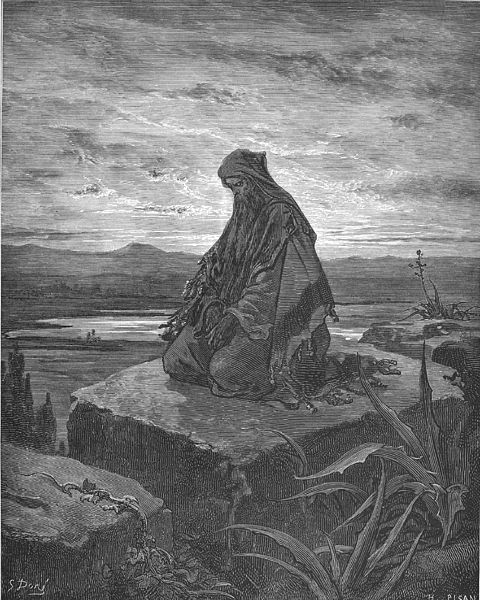
Isaiah, by Gustave Dore, 1866

The second “book” of Isaiah (written in the sixth century B.C.E. around the end of the Babylonian exile, two centuries after the first half of Isaiah) opens:

            Nachamu, nachamu My people!” (Isaiah 40:1)

nachamu (נַחֲמוּ) = Comfort them! (From the same root as nicham (נִחָם) = having a change of heart; regretting, or being comforted.)

This week’s haftarah from second Isaiah begins:

             I, I am He who menacheim you. (Isaiah 51:12)

menacheim (מְנַחֵם) = is comforting.

At this point, many of the exiles in Babylon have given up on their old god and abandoned all hope of returning to Jerusalem. So second Isaiah repeatedly tries to reassure them and change their hearts; he or she uses a form of the root verb nicham eleven times.

In the Jewish calendar, this is the time of year when we, too, need comfort leading to a change of heart. So for the seven weeks between Tisha B’Av (the day of mourning for the fall of the temple in Jerusalem) and Rosh Hashanah (the celebration of the new year) we read seven haftarot of “consolation”, all from second Isaiah.

This year I notice that each of these seven haftarot not only urges the exiles to stick to their own religion and prepare to return to Jerusalem; it also coaxes them to consider different views of God.

The first week—

—in Haftarah for Ve-etchannan—Isaiah: Who Is Calling? we learned that once God desires to communicate comfort, the transmission of instructions to human prophets goes through divine “voices”, aspects of a God Who contains a variety ideas and purposes. When we feel persecuted, it may comfort us to remember that God is not single-mindedly out to get us, but is looking at a bigger picture.

The second week—

—in Haftarah for Eikev—Isaiah: Abandonment or Yearning? second Isaiah encourages the reluctant Jews in Babylon to think of Jerusalem as a mother missing her children, and of God as a rejected father. Instead of being told that God has compassion on us, we feel compassion for an anthropomorphic God. Feeling compassion for someone else can cause a change of heart in someone who is sunk in despair.

The third week—

—in Haftarah Re-eih—Isaiah: Song of the Abuser, we took a new look at what God would be like if God really were anthropomorphic. Like a slap in the face, this realization could radically change someone’s theological attitude.

The fourth week, this week—

—God not only declares Itself the one who comforts the exiled Israelites, but also announces a new divine name.

In Biblical Hebrew, as in English, “name” can also mean “reputation”. In this week’s haftarah, God mentions two earlier occasions when Israelites, the people God promised to protect, were nevertheless enslaved: when they were sojourning in Egypt, and when Assyria conquered the northern kingdom of Israel/Samaria. Both occasions gave God a bad reputation—a bad name. And the Torah portrays a God who is very concerned about “his” reputation. For example, when God threatens to kill all the Israelites for worshiping a golden calf, Moses talks God out of it by asking:

What would the Egyptians say? “He was bad; He brought them out to kill them in the mountains and to remove them from the face of the earth.” (Exodus/Shemot 32:12)

Now, God says, the Babylonians are the oppressors. They captured Jerusalem, razed God’s temple, deported all the leading families of Judah, and still refuse to let them leave Babylon.

            Their oppressors mock them—declares God—

            And constantly, all day, shemi is reviled. (Isaiah 52:5)

shemi (שְׁמִי) = my name.

The Babylonians are giving the God of Israel a bad name.

            Therefore My people shall know shemi,

            Therefore, on that day;

            Because I myself am the one, hamedabeir. Here I am! (Isaiah 52:5-6)

hamedabeir (הַמְדַבֵּר) = the one who is speaking, the one who speaks, the speaker. (From the root verb diber (דִּבֶּר) = speak)

Since God’s old name has been reviled, God promises that the Israelites will know God by a new name. Then God identifies Itself not merely as the speaker of this verse, but as “the one, The Speaker”, adding extra emphasis with “Here I am!”

The concept of God as Hamedabeir appears elsewhere in the Bible. In the first chapter of the book of Genesis/Bereishit (a chapter that modern scholars suspect was written during the Babylonian exile), God speaks the world into being. Whatever God says, happens.

Second Isaiah not only refers to God as the creator of everything, but emphasizes that what God speaks into being is permanent.

            Grass withers, flowers fall

            But the davar of our God stands forever! (Isaiah 40:8)

davar  (דָּבָר) = word, speech, thing, event. (Also from the root verb diber (דִּבֶּר) = speak.)

What is the davar of God regarding the exiles in Babylon? In this week’s haftarah second Isaiah says:

            Be untroubled! Sing out together

            Ruins of Jerusalem!

            For God nicham His people;

            He will redeem Jerusalem. (Isaiah 52:9)

nicham (ִנִחַם) = had a change of heart about; comforted.

God let the Babylonians punish the Israelites because they were unjust and because they worshiped other gods. But now God has had a change of heart and wants to end the punishment and rescue the Israelites from Babylon. Since God’s name was reviled, some of the exiles do not believe God has the power to carry out this desire. So God names Itself Hamedabeir and then declares:

            Thus it is: My davar that issues from My mouth

            Does not return to me empty-handed,

            But performs my pleasure

            And succeeds in what I send it to do.

            For in celebration you shall leave,

            And in security you shall be led. (Isaiah 55:11-12)

The speech of Hamedabeir achieves exactly what God wants it to. In this case, God wants the Israelites in Babylon to return joyfully and safely to Jerusalem. If the exiles believe this information, their hearts will change and they will be filled with new hope.

*

It is easy to give up on God when life looks bleak, and you blame an anthropomorphic god for making it that way. No wonder many Israelite exiles in the sixth century B.C.E. adopted the Babylonian religion. No wonder many people today adopt the religion of atheism.

But there is an alternative: redefine God. Discover a name for God that changes your view of reality, and therefore changes your heart.

Thinking of God as Hamedabeir, The Speaker, takes me in a different direction from second Isaiah. Not being a physicist, I take it on faith that one reality consists of the movement of sub-atomic particles. But another reality is the world we perceive directly with our senses, the world of the davar—the thing and the event. We human beings cannot help dividing our world into things and events. We are also designed to label everything we experience. What we cannot name does not clearly exist for us. In our own way, we too are speakers.

What if God is the ur-speech that creates things out of the dance of sub-atomic particles—for us and creatures like us?

What if God, The Speaker, is the source of meaning? Maybe God is what speaks to all human beings, a transcendent inner voice which we seldom hear. When we do hear The Speaker say something new, we often misinterpret it. Yet sometimes inspiration shines through.

I am comforted by the idea of a Speaker who makes meaning, even if I do not understand it.


Shoftim: Abominable

by Melissa Carpenter, Maggidah

lamb 2

You shall not slaughter for God, your god, an ox or a lamb or kid that has a defect in it, any bad thing, because it is toeivah to God, your god.  (Deuteronomy/Devarim 17:1)

to-eivah (תּוֹעֵבָה) = repugnant, causing visceral disgust; taboo; an abomination, a foreign perversion, a custom in one culture that is prohibited in another culture.

This is only the first of five times the word to-eivah appears in this week’s Torah portion, Shoftim (“Judges”). This emotionally loaded word appears as a noun or adjective 117 times in the Hebrew Bible, and its verb form (תעב) appears 23 times. An object or action can be to-eivah to a class of human beings, or to God.  The first three times the word to-eivah appears in the Bible, it describes what disgusts Egyptians.

To-eivah to Egyptians

The book of Genesis/Bereishit says that Egyptians find eating at the same table with Hebrews to-eivah (Genesis 43:32).  We do not know whether Egyptians considered the manners or the diet of the Hebrews abominable.

Next Joseph tells his brothers that shepherds are to-eivah to Egyptians (Genesis 46:34), meaning that Egyptians shun that occupation.  Then in the book of Exodus/Shemot, Moses tells the Pharaoh that the Hebrews must travel some distance to make sacrifices to God because their animal offerings are to-eivah to Egyptians (Exodus 8:22).

To-eivah to God

The first thing considered to-eivah to God, rather than to a group of humans, is in the book of Leviticus:

With a male you shall not lie down as one lies down with a woman; it is to-eivah. (Leviticus/Vayikra 18:22)

This infamous line (misused by fundamentalists to claim that all homosexuality is an “abomination”) occurs in the middle of a list of sexual prohibitions God tells Moses to issue to the Israelites.  Since God is the speaker in this verse, the implication is that God considers that particular type of intercourse (whatever it might actually be)1 to be to-eivah.

Attributing visceral disgust to God is an anthropomorphization.  God, unlike Egyptians or other humans, has no viscera. But the Hebrew Bible often ascribes human emotions to God, including anger and disgust.

The God of Israel finds five more kinds of sexual pairings to-eivah in the book of Leviticus. The Torah assumes they are practiced by Canaanites, and forbids them to Israelites.2

Nothing is labeled to-eivah in the book of Numbers, but Moses uses that word sixteen times in Deuteronomy–six of them in this week’s Torah portion. The first verse in the portion Shoftim to use that word specifies that offering an animal with a defect is to-eivah to God.3

Immediately after warning that God is revolted by offerings with physical defects, this week’s Torah portion says that for Israelites to worship other gods is to-eivah.

And hey, [if] it is truly established the thing was done, this to-eivah, in Israel, then you must bring out that man or that woman who did the evil thing to your gates. And you must stone the man or the woman with stones so they die. (Deuteronomy 17:4-5)

To-eivah magic

To-eivah deeds in this week’s Torah portion include not only offering defective animals and worshiping other gods, but also practicing magic:

When you come into the land that God, your god, is giving to you, you must not learn to do as the to-avot of those nations. There must not be found among you one who makes his son or his daughter pass through the fire, a caster of cast lots, a cloud-reader, or a snake-diviner, or a sorcerer, or one who casts spells with a familiar, or a woman who inquires of the dead, or a man who consults ghosts, or a medium for the dead.  Because everyone who does these things is to-avot, and on account of these to-eivot, God, your god, is dispossessing them [the Canaanite nations] before you.  (Deuteronomy 18:9-12)

To-avot, to-eivot  (תּוֹעֵבֹת, תּוֹעֲוֹת) = plurals of to-eivah.

To-eivah temptation

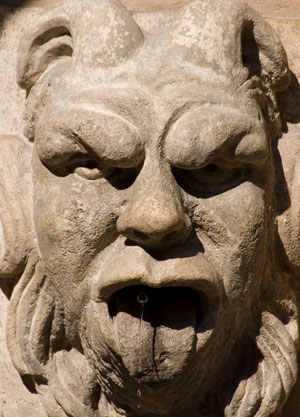
disgust 1

The word to-eivah appears one more time in this week’s Torah portion.  Moses tells the Israelites that when they conquer any Canaanite town in the land designated for Israel, they must kill all the inhabitants, men, women, and children.

Only from the towns of these people, [the towns] that God, your God, is giving to you as a possession, you must not let any soul live … so that they will not teach you to do like any of their to-avot that they do for their gods; then you would do wrong for God, your god. (Deuteronomy 20:16,18)

Here Moses appears to assume that since the Israelites are so easily tempted, they are not responsible for their own actions.  He orders them to murder all of the potential tempters, as if genocide were a mere peccadillo compared to conversion to a different religion.

Which comes first, visceral disgust or the decision to commit genocide?

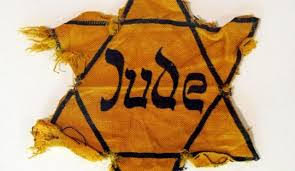
The most famous example of modern genocide is the Nazi round-up and slaughter of Jews and members of smaller minorities, including homosexual men, Gypsies, Jehovah’s Witnesses, and blacks.

When Hitler came to power, Germany was suffering from a long economic depression.  Hitler wanted to make Germany great again.  His government intensified pre-existing prejudices, and used the perception of minorities as “inferior races” or abominations as an excuse to confiscate Jewish wealth, which funded 3-5% of the national budget and perhaps a third of the German war effort.

Required identification

Then the Nazi government doomed Jewish men, women, and children, as well as members of smaller minorities, to slavery and death in concentration camps.

Increasing visceral disgust for Jews enabled the government to improve the German economy, and treating the Jews as to-eivah led to and justified genocide.

In the book of Deuteronomy, Moses wants to inspire the Israelites to conquer Canaan and secure it as an Israelite land, without any future assimilation or retaliation.  The most certain way to accomplish this would be to murder every Canaanite in every captured village or town.

Is the purpose of the proposed genocide to ensure Israelite ownership of the land?  Or to eliminate religious freedom and enforce the worship of one God?  Either way, labeling the Canaanites as to-eivah justifies Moses’ call for genocide.


When we feel repugnance, our impulse is to get rid of whatever is disgusting us.  Personally, I find okra disgusting.  I believe that no moral issue is involved if someone gives me a bowl of gumbo with okra and I quietly dispose of it.

But what if we find a class of human beings disgusting and believe that they are even to-eivah to God?  Can we just get rid of them?  No.  Genocide is never justified.

Moses underestimates the need for human responsibility in this week’s Torah portion.  He should be preaching that we are responsible for our own  religious worship—and that we must avoid doing abominable deeds in the name of God.


  1. Modern commentary is divided over whether the Torah is calling any homosexual act to-eivah, or whether the Torah is telling men not to ask other men to be submissive, as women were required to be in that era.
  2. Leviticus 18:26, 18:27, 18:29, 18:30, 20:23.
  3. See Deuteronomy 17:1 above.

Shoftim: Saving Trees

When you besiege a town for many days, to make war against it, to capture it, lo tashchit its trees by swinging an axe against them; for you will eat from them, so you shall not cut them down; for is a tree of the field ha-adam, to come in front of you in the siege? (Deuteronomy/Devarim 20:19)Peaches_clip_art_hight

lo tashchit (לֹא־תַשְׁחִית) =  you shall not destroy, ruin, corrupt.

ha-adam (הָאָדָם) = human (as an adjective); the human, humankind (as a noun).

The above verse from this week’s Torah portion, Shoftim (“judges”), assumes that it is acceptable to make war in order to capture a town belonging to a different tribe or nation. If humans from the town get in your way, you may kill them. Everyone does it.

However, the verse does challenge the idea that it is acceptable to cut down your enemy’s orchards and groves. This practice ensured that even if the siege failed, the town would still suffer in the long term, deprived of both fruit and a means of livelihood. (For example, olive oil was a major export in the part of Canaan that the Israelites conquered.  Cutting down olive trees would mean the town had no more olive oil for themselves or for trade.)

The Talmud generalizes the prohibition against cutting down fruit trees in a siege to prohibit any wasteful destruction, including tearing fabric when you are not in mourning (Kiddushin 32a), or scattering your money in anger (Shabbat 105b).

Rambam (the 12th-century commentator Moses Maimonides) wrote that the verse in this week’s Torah portion applies to any injury to a fruit tree. However, he said, the tree may be removed if it is damaging other trees, or even if its wood can be sold at a high price. The important thing is to avoid any needless destruction. He extended this idea to cover ruining edible food or demolishing a usable building.

The prohibition against waste and useless destruction came to be called bal tashchit. (Bal, like lo, means “not”.)

Many societies have rules against destroying a fellow citizen’s property. What stands out about the Jewish principle of bal taschchit is that it prohibits useless destruction of both enemy property, and your own personal property.

According to the 13th-century book Sefer Ha-Chinukh, the purpose of bal taschchit is to train us to avoid acting on evil impulses. Wicked people revel in destruction and corruption. By following the rule to eschew waste and preserve everything useful, we gradually reduce our impulses to destroy something, and develop a better attitude.

Imagine if everyone followed the rule of bal taschchit today!

Who knows, maybe the modern ethic of “reduce, re-use, recycle” is training us to disapprove of wasting the earth’s resources. Maybe the people of the world are almost ready to rally to a new call to save the world from the pollution that leads to “global climate change”—which really means ruin and hardship all over the world.

May it be so!