Ki Teitzei: Crossing Gender Lines

by Melissa Carpenter, Maggidah

Joan of Arc 15th century CE
Joan of Arc, 15th century CE: Toeivah?

The equipment of a gever shall not be upon a woman, and a gever shall not wear the outer garment of a woman; for toeivah of God, your god, are all those who do these things.  (Deuteronomy/Devarim 22:5)

gever (גֶּבֶר) = an adult man; a man in a position of power; a warrior or soldier.

toeivah (תּוֹעֵבָה) = abhorrent, repugnant, causing visceral disgust; an “abomination”.

A hasty reading of the above verse in this week’s Torah portion, Ki Teitzei (“When you go out”) leads some people to think that God finds all cross-dressing abominable.

Last week, in Shoftim: Abominable, I wrote about how attributing toeivah to God is an anthropomorphization.  Whoever wrote down this verse in Ki Teitzei1 probably found everyone found everyone who did “these things” disgusting, and wanted to reinforce a social norm by attributing that disgust to God.

But does the verse actually prohibit cross-dressing?

The Babylonian Talmud (Nazir 59a) states that the purpose of the verse cannot be to teach that men should not dress like women, and vice versa, because mere cross-dressing is not an abomination.  It suggests two other reasons for the verse.  The first is that someone should not cross-dress in order to sneak into a single-sex group in order to seduce someone.  (According to the Talmud, unauthorized sex is abominable.)

Assyrian bronze sickle sword

This first interpretation fails to account for specific words in the verse in Deuteronomy, which prohibits a woman from wearing the equipment of a man (kli), not his clothing.  Furthermore, the text uses the word gever, which implies a warrior or a ruler, rather than ish, the common term for any man.  In the Torah, the equipment of a warrior is his sword or his bow and arrows; the equipment of the ruler of a clan or tribe is his staff.
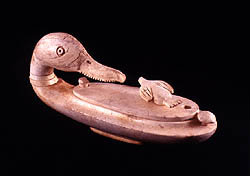
Ivory cosmetics box from Sidon

The second Talmudic interpretation, attributed to Rabbi Eliezer ben Yaakov, fits the verse better: women should not go to war bearing weapons, and men should not use cosmetics to beautify themselves.2

In today’s terms, it would be acceptable for a woman to wear pants, but not for her to carry a gun (a common weapon today).  A man could wear a skirt (for comfort, not to show off his legs), but he should not wear make-up.

The underlying assumption is that weapons and war are part of a man’s nature, and  personal beautification is part of a woman’s nature.  This assumption was rarely questioned until the 20th century C.E.

As late as the 19th century, Rabbi Samson Raphael Hirsch wrote that Deuteronomy 22:5 “forbids each sex that which is specifically suited to the nature of the opposite sex.  A man shall not attend to his external physical appearance in the way appropriate to a woman’s nature, and a woman shall not appear in a vocation suited to a man’s nature…”  He added that a woman’s place was in the home—i.e. that motherhood was the calling of all women, and any other vocation was for men only.

I suspect it did not occur to Hirsch, any more than it occurred to my mother and many other women born in the 1920’s and 1930’s, that women who made beauty and sex appeal their top priority were planning to be dependent on men for financial support.  From Biblical times until my own “baby boomer” generation, most cultures assumed that war and jobs requiring either muscle or authority were for men, while housework and child care were for women.

This view of the “natures” of men and women is countered by two stories in the Hebrew Bible: one about a primping man, and one about two warrior women.

The Primping Man

The Torah does not say that Joseph primps or applies cosmetics.  But the book of Genesis/Bereishit does say that Jacob spoils his son Joseph by giving him a fancy coat or tunic.  When Joseph becomes a slave to Potifar, and Potifar’s wife tries to seduce him, the Torah says:

“The Glory of Joseph” by James Tissot

And Joseph was beautiful of shape and beautiful of appearance.  (Genesis/Bereishit 39:6)

Rashi, following Midrash Tamchuma, commented: “As soon as he saw that he was ruler (in the house) he began to eat and drink and curl his hair.  The Holy One, blessed be He, said to him, “Your father is mourning and you curl your hair!  I will let a bear loose against you.”Other classic commentary implies that Joseph not only curled his hair, but put kohl around his eyes and wore elevated heels.

Yet Joseph eventually became a viceroy of Egypt, and Jacob’s deathbed blessing praises Joseph’s power with a manly weapon:

And his bow was continually taut, and his arms and hands were agile… (Genesis 49:24)

Thus Joseph has a reputation as both beautifying himself like a woman, and being a gever with both weapons and the power to rule.

The Warrior Women

A story in the book of Judges features two women who engage in acts of war.  The prophetess Devorah serves openly as the general of an army recruited from some of the tribes of Israel, though she wears no weapon and her male lieutenant, Barak, leads the soldiers into battle.  When the Israelites win, the enemy general, Sisera, flees to a tent where he believes he will be safe.  (Sisera’s king is friends with the owner of the tent, Chever the Kenite.)  Cheve, the owner of the tent, is not at home, so his wife Jael welcomes Sisera inside and gives him a drink of milk.
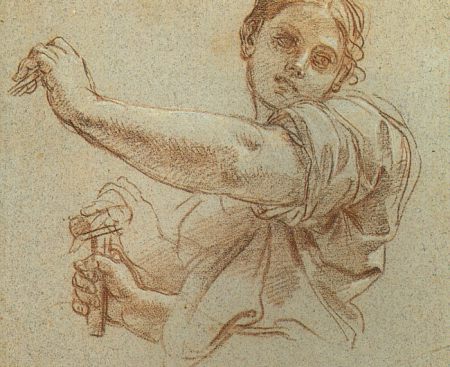
"Study of Jael in Red Chalk" by Carlo Maratta
“Study of Jael in Red Chalk”
by Carlo Maratta

Sisera naturally assumes all women are subservient to their men, so he swallows the milk and relaxes.  Then she kills him.

The Bible gives two accounts of the murder.  In the first one, Jael waits until Sisera falls asleep, then kills him by hammering a tent peg through his skull.  Next comes an ancient poem describing the same incident, but implying that Jael crushes Sisera’s head with a hammer while he is still awake and upright.  Either way, Jael does not have access to men’s equipment, so she improvises her own weapon.

Far from censuring her for using a weapon and taking the authority to make an independent decision, the book of Judges praises Jael—as a woman.

Most blessed of women is Jael, the wife of Chever the Kenite; most blessed is she in the tent.  (Judges/Shoftim 5:24)

Thus  a man who is beautiful (and perhaps enhances his beauty as if it were the “outer garment of a woman”), and a woman who improvises the equipment of a gever, are both praised for taking on the roles of two genders at once.

Adopting roles previously associated with the opposite gender is commonplace in advanced societies today.  Some men are tender parents of infants and young children, and some men devote themselves to looking sexy.  Some women succeed in vocations previously reserved for men, and some women are soldiers.

Perhaps we are moving away from the society preferred in this week’s Torah portion, and toward a society in which both men and women are complete people, like Joseph and Jael.

  1. According to current scholarship the book of Deuteronomy was written, or at least recorded in written form, in 7th-century B.C.E. Judah.
  2. This is also the interpretation of Targum Onkelos, the first century C.E. translation of the Torah from Hebrew into Aramaic, which says that men should not beautify their bodies in the manner of women.
  3. Genesis Rabbah 86:3, edited in the 4th to 5th centuries C.E.
  4. Rashi (11th-century Rabbi Shlomo Yitzchaki), following Midrash Tanchuma, Vayeshev 8, translation by http://www.sefaria.org.


Ki Teitzei: Forgetting to Be Selfish

Last week’s Torah portion, Shoftim, told us not to cut down fruit trees when we are besieging a city. By Talmudic times, this injunction had been expanded into the principle of bal taschchit, do not destroy anything useful. (See my post Shoftim: Saving Trees.)

Some of the rules in this week’s Torah portion, Ki Teitzei (“When you go out”), have been similarly expanded. Here is one, nicknamed “The Forgotten Sheaf”:

If you harvest your harvest in your field, and you forget an omer in the field, you shall not turn back to take it. It shall be for the stranger, for the orphan, and for the widow, so that God, your god, will bless you in everything your hands do. (Deuteronomy/Devarium 24:19)

omer (עֹמֶר) = a dry measure, roughly 2 quarts or 2 liters, used in the Torah for both manna and cut ears of grain.

The word omer is sometimes translated as “sheaf”, but the omer of manna discussed in the book of Exodus/Shemot consists of tiny white spheres the size of coriander seed.  Manna could hardly be gathered into a sheaf! Elsewhere in the Hebrew Bible, the word omer refers to grain, and can easily be translated as a quantity of grain heads. (The sheaves in Joseph’s dream in Genesis/Bereishit are called alumim (אֲלֻמִּים), an entirely different word.)

Commentators over the centuries have agreed that the purpose of the rule about the so-called “Forgotten Sheaf” could not be to provide for the poor (epitomized by three types of people unlikely to own land or to be supported by wealthy men: resident aliens, orphans, and widows). One omer of grain might feed one person for one day. Landowners and their employees would have to be extraordinarily forgetful to accidentally leave enough grain to feed all the poor in their area.

detail from R.F. Babcock, "Ruth Gleaning"
detail from R.F. Babcock, “Ruth Gleaning”

Moreover, the Torah already requires landowners to deliberately leave behind grain, grapes, and other produce for the poor to glean.

When you harvest the harvest of your land, you shall not finish harvesting to the edge of your field, nor gather up the gleanings of your harvest.  And you shall not glean your vines nor gather up your fallen grapes in your vineyard; to the poor and to the stranger you shall leave them. (Leviticus/Vayikra 19:9-10)

The Torah portion for this week in Deuteronomy adds orchards to the fields and vineyards.

When you beat out your olive tree, you shall not strip the branches behind you; they shall be for the stranger, for the orphan, and for the widow. (Deuteronomy 24:20)

If landowners are already required to leave food in their fields, vineyards, and orchards for the poor to glean, why does the Torah tell them not to go back and gather an omer they forgot about?

The 13th-century book Sefer Ha-Chinukh answers that the purpose of this commandment is to help people develop the habit of generosity. Even if you are giving to the poor as required by gleaning laws, tithes, or taxes, as you work to increase your own wealth you must still cultivate the belief that sharing wealth is more important than maximizing your own profit.

Philo of Alexandria’s commentary, written in the first century C.E., criticizes people who devote themselves exclusively to increasing their own wealth, and never notice that their gains would be impossible without the natural world God gives us.  (I would add that the gains of the money-hungry also require the labor of other people.) And in the 19th century, Rabbi Samson Raphael Hirsch wrote that the commandment not to go back for the forgotten omer is intended to clear possessiveness and greed from your thoughts.

Besides breaking the habits of possessiveness and greed, leaving the forgotten omer behind might also help someone to overcome the habits of worrying about being cheated, or thinking of everything in terms of private property.

What if a farmer left grain in the field, and nobody came by to pick it up?  Would this violate the principle of bal tashchit, “do not waste”?

This was not an issue in ancient Israel, where there were always people without land of their own  who gleaned to feed themselves.

Gleaning projects are being revived today in the United States, collecting food that would otherwise be wasted.  But we can also update the principle of the forgotten omer.  What if you are fumbling with your purse or billfold, and you accidentally drop money on the sidewalk?  If you leave it behind, the money will not go to waste; someone will pick it up. What if you forget to collect your change at the counter, or discover you left too large a tip?  Going back for your money would shrink your soul.  Leaving it for someone else gives you practice in keeping your priorities straight.

When you have forgotten to do a good deed, go back.  But when you have forgotten to be selfish, go on, and be grateful for your forgetfulness.

Ki Teitzei: Captive Soul

detail of Rachel weeping in Massacre of the Innocents, by Francois-Joseph Navez, 1824

When you go out to battle against your enemies, and God, your god, gives [one of them] into your hand, and you capture captives from him; and you see among the captives a woman who is yefat to-ar, and you desire her, then you may take her for a wife. (Deuteronomy 21:10-11)

yefat to-ar = beautiful of form, shapely, attractive.

yefat (יְפַת) = beautiful of.

to-ar (תֺּא) = form, shape.

This week’s Torah portion, Ki Teitzei (“When you go out”), opens with a standard situation in war: the men on the winning side of a battle take all the losers’ possessions, including their women.  In other Torah portions, the enemy’s women are merely listed as part of the booty; their fate is not addressed until the portion Ki Teitzei.

The implication in the passage above is that the Israelite soldiers will restrain themselves from raping most captive women, but a woman who has a beautiful shape is a special case.

The Hebrew bible describes three people besides the captive woman as yefat to-ar (feminine) or yefeh to-ar (masculine): Rachel, Jacob, and Esther.  Rachel’s beauty in the book of Genesis/Bereishit makes Jacob fall in love at first sight and labor for 14 years in order to marry her.  When her son Joseph is serving as Potifar’s steward in Egypt, his beauty makes his master’s wife lust after him so much that she grabs his clothing to pull him down.  Esther’s beauty in the book of Esther makes the king of Persia fall for her and crown her as his queen.

Clearly if you are yefat to-ar, your body is bound to inspire someone with extreme desire. Perhaps that is why this week’s Torah portion does not ask Israelite soldiers to refrain altogether from sex with the enemy’s women. But it does raise the bar for a man who desires a shapely captive. Instead of (or according to some commentators, in addition to) raping her in the field, he must bring her home.

You shall bring her into the midst of your household, and she shall shave her head, and she shall do her nails. And she shall remove the cloak of her captivity from herself, and she shall sit in your house, and she shall weep for her father and her mother for a month of days. After this, you may come into her and become her husband, and she will be your wife. But it happens that you do not want her [any more], then you shall send her out as her own nefesh. You shall certainly not sell her for silver, nor shall you take advantage of her, inasmuch as you violated her. (Deuteronomy 21:12-14)

nefesh = soul, person, individual; appetite. (In post-Biblical Jewish writings, the nefesh is the level of soul that animates the body.)

By bringing the captive woman into his household, and exchanging her captive’s cloak for ordinary clothes, the man publicly changes her status from war booty to prospective wife.  Next, she gets a full month to mourn for her old home and family, by shaving her head (a common mourning practice in the Hebrew bible), trimming her nails, and weeping.  During this month, the man is forbidden to molest her.  The month of mourning grants the woman a measure of human dignity.

At the end of the month, the man chooses whether to espouse her or to send her away free.  Being a woman, the former captive does not have the right to negotiate her own marriage.  Nevertheless, she now has as much status as an Israelite woman with no father; she is either married or free, not a slave.

On a literal level, the law of the captive woman teaches men to restrain their sexual desires and reserve sex for responsible and committed relationships.  It also teaches men to choose their partners after a period of consideration, rather than in the first heat of physical passion.

But the Chassidic rabbis of the 17th-19th centuries found other levels of meaning in the passage about the captive woman. The one that speaks to me this year comes from 18th-century Rabbi Schnuer Zalman of Liadi (with some interpretation by Rabbi Zalman Schacter-Sholomi).  Schnuer Zalman saw the Israelite soldier as the conscious ego, and the captive woman as the nefesh, the level of soul that animates our bodies.  He called this the “animal soul” because it is the seat of physical desires.

The nefesh is held captive not by the body itself, but by the limited perspective of our physical desires and aversions, and by the compulsions of our bad habits.  The nefesh is a “woman of beautiful form” because, despite its captivity, it expresses some of the beauty of the neshamah, the divine level of soul that transcends the physical world.

When your conscious self longs to connect with the beauty of the divine, you have to free your nefesh from its captivity, so it can become a clear vessel for your divine neshamah.  According to Schnuer Zalman, the way to do this is to shave its head and cut its nails—that is, to renounce physical desires for the sake of spiritual desires.

This year, my rational mind knows my body would benefit from a weight-loss diet.  Another part of me craves comfort food. Now I wonder if my craving for comfort food is a bad habit that grew because of the limited perspective of my “animal soul”.  My nefesh is short-sighted enough to prefer feeling better right now over restraining myself for the sake of a distant future benefit.  Now the bad habit holds my nefesh captive.  According to Rabbi Schneur Zalman, I should renounce my physical desires in order to elevate my nefesh.

But I do not want to renounce ALL of my physical desires.  After all, some of them are good for my body, nefesh, and neshamah.  For example, sometimes I feel the urge to stretch, take a walk, kiss my husband, or eat green beans and mint from my garden.  These are good desires, since acting on them results in joy and gratitude for the gifts of the universe.

Can I renounce only one physical desire: the craving for comfort food?

I have never been able to stick to a diet I undertake for the sake of my body.  But what if I dieted for the sake of my soul?

My heartfelt impulse is to give the captive woman in this week’s Torah portion a safe home and a position of dignity, respect, and freedom.  Maybe I can see my own nefesh as a captive who is being enslaved by my bad habit.  If I intervene, will God give me the strength to rescue my soul and give it a good home?

Ki Teitzei: Too Many Vows

When did you last make a vow or swear an oath?  In our society, we often sign contracts and promise to do things; but a solemn, witnessed vow is usually reserved for a wedding, an oath of office, or (in some religions) an initiation into a religious order.  Nevertheless, when we violate solemn promises we have made to ourselves, we find ourselves in the same position as ancient Israelites who failed to fulfill their vows.

One warning about vows appears in this week’s Torah portion, Ki Teitzei (“when you go out”):

When you vow a vow to God, your god, you shall not delay in fulfilling it, because God, your god, will certainly call you to account, and there will be guilt in you. But if you refrain from vowing, there will not be guilt in you. You must guard what comes out of your lips; and you must make any voluntary gift that you spoke with your mouth, as you have vowed to God, your god. (Deuteronomy/Devarim 23:22-24)

The majority of vows mentioned in the Hebrew bible are vows to give something to God. People vow to offer an animal at the altar, or to give money to the Temple treasury, just because they want to do something extra for their religion. Both this week’s Torah portion and a similar passage in Ecclesiastes/Kohelet state that when you vow to make a gift to God, you must fulfill it with minimum delay, or you will be guilty of wrongdoing. Someone today would be guilty of similar wrongdoing if they promised to donate extra money to their congregation, but then took years to get around to it.

Another type of vow is the vow of self-denial. The most common vow of self-denial in the Torah is the vow to be a nazir, someone who abstains from haircuts and from wine (or anything else made with grapes) for a fixed period of time. (See my post Naso: Distanced by Hair.)

But like us, Israelites and Jews thousands of years ago made individual vows of self-denial, which are mentioned in the Hebrew bible and discussed in detail in the Talmud tractate Nedarim (“Vows”).  In modern American one common individual vow of self-denial is to abstain from certain foods.  Two thousand years ago this was also a possible vow, but vows to refrain from sex with your spouse get more coverage in the Talmud.

Carrying out your vow without delay is also a requirement for vows of of self-denial. The book of Numbers/Bemidbar says: If someone vows a vow to God or swears an oath to abstain an abstention for himself, he shall not desecrate his word; according to anything that goes out of his mouth he must do. (Numbers 30:3)

Making a vow before God seems to be a common human impulse.  Yet both Deuteronomy and Ecclesiastes, as well as the Talmud, emphasize that it is better to simply do what you intend without making a vow.

What is so bad about making vows? The Torah and the Talmud discourage vowing because the consequences are terrible if you do not fulfill your vow. All too often, people make vows and then fail to live up to them because of circumstances they did not anticipate.  Some people are simply stymied by bad luck. But others are carried away by their emotions at the time of the vow, and rashly promise more than they can realistically deliver. Some people make vows they regret the next morning.

Traditional commentary points out that people tend to find excuses to justify their failure to deliver on a vow, and comfort themselves with the thought that at least they meant well. This is a form of self-delusion that leads some people to substitute making vows for actually doing the right thing. Thus people who makes rash vows end up behaving less ethically.  They also suffer because other people stop believing what they say.

I have also noticed another reaction to the failure to fulfill a rash vow. I know people who made solemn promises to themselves to increase their Jewish religious observance–not just by adding one daily blessing or one small restriction, but by taking on a full day of orthodox Shabbat observance every week, or by switching from a diet of bacon cheeseburgers to keeping kosher so strictly that they can no longer eat out. And when they failed to fulfill their rash vows, they did not excuse themselves on the grounds of good intentions.  Instead, they gave up on their religion–an easy thing to do, in our modern society. And that, too, can be bad for the soul.

I agree with the Torah and Talmud that it is better to guard your lips and stop yourself from making vows. But if you need to make a vow, consider it carefully, over a period of time, to make sure it is something reasonable that you can fulfill.

But what if you have made a vow you cannot, or no longer want to, fulfill?  In Talmudic times, people called upon rabbis to annul their ill-considered vows of self-denial. Jews today have Yom Kippur, the annual Day of Atonement.  If we break our vows to other people, we can only make things right by going through a process of atonement with those individuals. But if we have failed to carry out our vows to ourselves, or to God, then we can atone in our communal prayers on Yom Kippur.

The holy day begins with the singing of “Kol Nidrei”, which means “All vows” in Aramaic. The Kol Nidrei prayer may have begun as a way to absolve Jews from vows of conversion to another religion, since so many Jews had to pretend to convert to Christianity in order to save their lives. Now it serves as a heartfelt introduction to the day when we can release ourselves from guilt over the personal vows before God that we now wish we had not made.

This week is the second week of Elul, the month leading up to Rosh Hashannah and Yom Kippur. The Jewish tradition is to spend this month examining ourselves, apologizing and atoning for the wrongs we have done to other people, and recognizing where we have failed the God inside each of us.

This month of Elul, may we all catch up on the good deeds we promised to do but never got around to; may we find ways to clear ourselves and start fresh with every person we have wronged; may we recognize and accept our failures to fulfill our personal vows; and may we figure out ways to improve ourselves gently, without making any rash vows.

Ki Teitzei: Work Like an Animal

You shall not plow with an ox and a donkey together.  (Deuteronomy/Devarim 22:10)

You shall not muzzle an ox while it is threshing.  (Deuteronomy/Devarim 25:4)

These two lines from this week’s Torah portion, Ki Teitzei (“When you go forth”), are often cited as examples of  biblical injunctions to minimize the suffering of animals.  If two animals of unequal strength are yoked together, the weaker animal is likely to stumble or strain itself to exhaustion.  If an ox is muzzled while it is trampling grain to thresh it, the ox is tormented by the sight of food it cannot eat.

The Talmud (in Bava Metzia 90b) explains that both prohibitions also apply more generally.  Two different kinds of animals must not be made to work together at any task, whether they are yoked or not, even if they are merely driven by a shout.  Similarly, an ox must not be restrained even by a shout from eating as much grain as it wants while it works.

Ki Teitzei is also the Torah portion that insists an employer may not delay paying an employee’s wages.

You shall not oppress a poor or destitute hired laborer, from among your brothers or from among your stranger who is in your land, within your gates.  Each day you shall give him his hire and the sun shall not set on him, because he is poor and it is supporting his life …  (Deuteronomy/Devarim 24:14-15)

Thus the general principle of acting with consideration toward the animals who work for you also applies to the human beings who work for you.  We should be considerate toward human laborers by paying them promptly.

I believe we should also treat them at least as well as our laboring animals.

That means we should not ask two people with different strengths to do the same job, any more than we should ask an ox and a donkey to do the same job.  And we should not make people slave away without any breaks to refresh their spirits, any more than we should make an ox trample grain without taking any grain for its own refreshment.

And, following the Talmud, we should not shout at anyone who works for us: employees, students, or family members.  Nor should we insult them.


In an even larger sense, the laboring animal and the human master are two parts of a person’s psyche.  Sometimes I browbeat myself into finishing a project even when my body is sore or my brain is tired.  This is cruelty to my animal aspect.

After studying this week’s Torah portion, I have three new rules for myself.  I shall not expect to do the same job as someone else, or even the same job that I did on another day.  I shall not put my nose to the grindstone, but instead snatch what spiritual nourishment I can from every job.  And I shall reward myself at regular intervals for my own hard work.

These are not easy rules for a conscientious perfectionist to follow.  But I need my inner ox.  I must not muzzle it!