Ki Tavo: Making It Clear

by Melissa Carpenter, Maggidah

Moses commands the Israelites to paint orders from God on standing stones in this week’s Torah portion, Ki Tavo (“When you enter”).  They are supposed to erect the stones on Mount Eyval, beside the town of Shechem.

And it shall be when you cross over the Jordan, you shall erect these stones, as I command you this day, on Mount Eyval; and you shall paint them with limewash. (Deuteronomy/Devarim 27:4)

Fragments of 8th-century B.C.E. Bilam story on limewash at Deir Alla, Jordan
Fragments of an 8th-century B.C.E. Bilam story on limewash at Deir Alla, Jordan

When limewash is painted on a surface in multiple layers, the coating hardens into a thin shell of white limestone, which could last for millennia in dry conditions. (See my post Ki Tavo: Writing in Stone.) Remnants of one ancient text painted in ink on a limewashed wall still survive after 29 centuries!

And you shall write on the stones all the words of this torah, be-eir thoroughly. (Deuteronomy 27:8)

torah (תוֹרָה) = teaching. (The word torah also refers to the first five books of the Bible, to the whole Hebrew Bible, and to any teaching of Jewish law or religion.)

be-eir (בְּאֵר) = (verb) explaining, making clear, making plain.  (The noun be-eir = well, watering place.)

A simple interpretation of this line is that the letters on the limewash must be plain and easy to read. But the Talmud (Sotah 36a) asserts that the teaching was made plain by being inscribed in 70 languages, so anyone who came by could read it.  The purpose of the stones, according to the Talmud, was to teach the laws of the Torah to the native Canaanites.  This would give them a chance to renounce their own gods and adopt the laws of Israel, and thus be spared from death at the hands of the Israelite invaders.

I like the Talmud’s attempt to find a safe path for Canaanites. But it is a stretch to imagine that all the different tribes inhabiting Canaan would immediately send scribes to read and copy the writing on the stones.

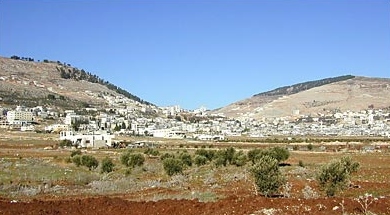
Mt. Gerezim (left) before deforestation, Mount Eyval (right)

What other purpose is there for the limewashed stones?  In this week’s Torah portion, Moses gives orders for a ritual at the city of Shechem (now Nablus).  Just east of the old town of Shechem stand two hills with a narrow valley between them. Until modern times, Mount Gezerim to the south was wooded, and Mount Eyval to the north was barren. (See my earlier blog, Vayishlakh: Mr. Shoulders.)  Moses wants the standing stones erected on Mount Eyval.  Then his ritual calls for the men of half of the twelve tribes to stand on one mountain, and half on the other.

And Moses commanded the people on that day, saying:  These will stand for blessing the people upon Mount Gerizim, when you have crossed the Jordan: Simon and Levi and Judah and Issachar and Joseph and Benjamin .  And these will stand for the cursing on Mount Eyval: Reuben, Gad, and Asher, and Zebulun, Dan, and Naphtali. And the Levites shall sing out, and they shall say to all the men of Israel, in an uplifted voice… (Deuteronomy 27:11-14)

The Levites are to pronounce twelve curses, and at the end of each curse all the Israelites are to say “amen”. The curses are conditional; each one begins with the formula “Accursed is the one who…” and then states a prohibition in the Torah.  The prohibitions include making an idol, treating a parent with contempt, moving a boundary marker, leading the blind astray, doing injustice to the poor, three kinds of incest, lying with a beast, two kinds of murder, and failing to perform “the words of this torah”, i.e. the more complete text on the standing stones.

The Israelites are to confirm their acceptance of the torah by saying “amen”.

Although both of the twin hills are part of the ritual, Moses calls for stones with the written torah only on Mount Eyval—the same hill where half the tribes are to stand to represent the curses.  My guess is that Mount Eyval was chosen for both purposes because it was bare, while Mount Gerizim was wooded.  A bare hill implies infertile land, which would be a curse in Biblical times.  And on the bare summit of Eyval, the white stones would be visible from a distance.

They would also be clearly visible to the men of Israel standing on both hills and saying “amen”.  Rabbi David Kasher, in his blog at parshanut.com, points out that the Israelites would internalize their commitment to the laws of the Torah more deeply by looking at the giant stones. “Words and ideas, I guess, even though they are the essence of the Torah, are somewhat elusive.  We human beings relate to reality in physical space, because that’s where we experience ourselves existing.  So objects help us concretize ideas, to bring them into reality.”
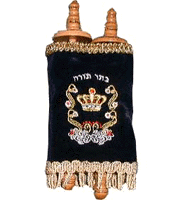
Torah scroll, dressed

A similar function is served by the Torah scroll in Jewish services today.  Reading the Torah portion out loud is the purpose of the ritual.  But the reader uses a particular chant to sing out the text, because a melody reaches deeper into the heart.  The reader chants not from a book, but from a Torah scroll, written by a scribe with a quill on parchment.  And we have rituals for taking the Torah scroll out of the ark, unwrapping and unrolling it, holding it up afterward for everyone to see the writing, then rolling, dressing, and returning it to its ark.  All of these rituals make the text itself more real, more important, and more holy to us.

And you shall write on the stones all the words of this torah, be-eir thoroughly. (Deuteronomy 27:8)

be-eir (בְּאֵר) = (verb) explaining, making clear, making plain.  (The noun be-eir = well, watering place.)

Yes, the writing on the standing stones must be clear and easy to read.  But the other meaning of the verb be-eir can also be applied to Moses’ directions.  The ritual of the Levites singing out twelve prohibitions from the Torah, while the men of Israel stand on top of the two hills saying “Amen”, clarifies the purpose of the writing on the stones.  The teachings must be taken as mandatory God-given instructions for behavior.  Anyone who does not follow them is cursed; his life will go badly.

In a way, the noun be-eir also applies to part of the Torah portion.  A deep teaching is like a well, a watering-place in the desert.  If you travel through life with no guidance, acting merely according to your intuitions and feelings in the moment, your life will go badly—as if you were cursed. Human beings need instructions, words of wisdom to hold onto.  But it is easy to forget a piece of torah when you need it.  How do you internalize a teaching?  How do you drink it in?

Saying the words out loud helps.  Chanting or singing them works even better.  Conducting a whole ritual around them impresses your subconscious with their importance.

Then when we come to a decision point, the words of the torah emerge from the depths of our minds.  We still have to figure out the best way to apply them to our current situation, but at least we have something to work with.

May we all internalize the best torah to guide our decisions in our own lives!
Ki Tavo: Carved in Stone

Carve something on a stone, and set it upright as a memorial or a boundary marker.  People have been doing this all over the world for millennia.  Americans today still erect gravestones and mark historic sites with upright stones bearing text.

Anyone can read the inscribed stone or stele and learn something—about the battle that took place at that spot, or the boundary it marks, or the person who is buried there.

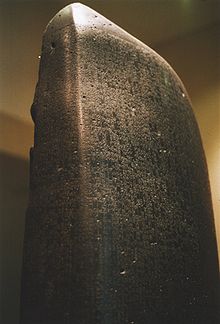
Code of Hammurabi, 1750 B.C.E.

In the ancient Middle East, most steles recorded victories in battle. But the oldest stele discovered so far from that region is a stone seven and a half feet high, with the Code of Hammurabi carved into it during the 18th century B.C.E.  The 282 laws of the reigning Babylonian king are written in Akkadian.

Standing stones without any words carved into them are even older. Only oral tradition can tell subsequent generations what the stones commemorated. A stranger from another place or a later time who sees a blank monument, or a circle of tall stones, knows only that they are significant, not what they signify.

The first standing stones in the Torah are uncarved.  In the book of Genesis/Bereishit, Jacob erects four different matzeivot or standing stones, marking the sites of his dream of angels, the boundary  between his area of influence and his father-in-law Lavan’s, and his wife Rachel’s grave.

Moses erects twelve standing stones at the foot of Mount Sinai in the book of Exodus/Shemot, to represent the twelve tribes of Israel in their covenant with God.  But the only engraved stones in Exodus are the two small tablets bearing the ten commandments, and they are so sacred that they are carried inside the ark, which must never be touched or opened.

At Mount Sinai and in the wilderness, the blank stones that depend on mutable oral tradition are out in public.  But the immutable, fixed written words are hidden in a sacred place.

Moses does not call for standing stones with writing on them until this week’s Torah portion, Ki Tavo (“When you enter”), in the book of Deuteromy/Devarim.

Moses and the elders of Israel commanded the people, saying:  Observe the entire commandment that I command you this day.  And it shall be, on the day that you cross over the Jordan into the land that God, your god, is giving to you, you shall erect for yourself great stones, vesadeta them with the siyd. And you shall write on them all the words of this torah when you cross over, so that you may come into the land that God, your god, is giving to you, a land flowing with milk and honey, as God, the god of your forefathers, has spoken to you. (Deuteronomy 27:1-3)

vesadeta (וְשַׂדְתָּ) = and you shall limewash (coat them with a paint-like mixture of lime and water).

siyd (שִׂיד) = lime, quicklime, limewash.

torah (תוֹרָה) = teaching. (The word torah also refers to the first five books of the Bible, to the whole Hebrew Bible, and to any teaching of Jewish law or religion.)

The people of the ancient Middle East made quicklime (calcium oxide powder) by burning bones. Adding enough water to slake the lime turns it into calcium hydroxide, which can be mixed with additional water to make limewash.  Limewash is still used to coat surfaces in order to make them smooth and white; the coating hardens into a thin shell of limestone, which may last for millennia in dry conditions. Remnants survive of a text painted in ink on a white limewashed wall in the 8th century B.C.E.

Fragments of 8th-century B.C.E. Balaam story on limewash at Deir Alla, Jordan

Thus the text on Moses’ limewashed stones could have been readable for many centuries. The Hebrew Bible does not specify which torah Moses wants on the stones, but it must include some or all of the laws from the written Torah we have today—the first five books of the Bible, as copied and recopied on parchment and paper. According to 12th-century rabbi Abraham Ibn Ezra, Moses means the 613 commandments that the Talmud (Makkot 23b) says are in the five books. Other commentary speculates that Moses is calling for the code of laws in the book of Deuteronomy (chapters 13-26), or for the whole book of Deuteronomy (which would fit on two stones the size of the one used for the Code of Hammurabi).

Until this point in the Torah, Moses passes down God’s laws by announcing them verbally to the assembly of Israelites. Only in this week’s Torah portion does Moses call for laws to be “carved in stone”—or at least painted on limestone—and set out in a public place: the top of Mount Eyval, next to the ancient town of Shekhem.

And it shall be when you cross over the Jordan, you shall erect these stones, as I command you this day, on Mount Eyval; vesadeta them with the siyd. And you shall build there an altar for God, your god … (Deuteronomy 27:4-5)

Moses continues with orders for offerings at the altar, followed by a ritual of blessings and curses to indicate acceptance of God’s law.  (See my earlier post, Ki Tavo: Cursing Yourself.)

On the bare summit of Mount Eyval, the stones would be visible from a distance, as shining white pillars against the sky.

Perhaps the author of this section of Deuteronomy imagined that the steles on Mount Eyval would be like the Code of Hammurabi, which many scribes over the centuries copied onto clay tablets. In the Talmud (Sotah 35b), Rabbi Yehudah imagines scribes from different Canaanite tribes visiting the stones on Mount Eyval and bringing home copies of their text.

Yet ancient scribes, including those who copied the Hebrew Bible, not only made copying errors, but also felt free to insert additional material. The steles on Mount Eyval would stand as a permanent record of the original laws of Moses, whatever amendments people made later.

From the viewpoint of the storyline within the book of Deuteronomy, Moses’ desire for a permanent, immutable, and public record of the laws is understandable. He is about to die, and he believes the Israelites, with their history of backsliding, will eventually abandon God’s laws and convert to Canaanite religions. Moses’ last hope of preserving his religion is to write it down.

He writes multiple copies of “this torah” in Deuteronomy 31:9, and a book of “this torah” to be placed inside the ark in Deuteronomy 31:24-26. All of these writings appear to be on parchment scrolls. But he also wants a more permanent record, so he orders the limewashed standing stones.

From the viewpoint of modern scholarship, Deuteronomy was written much later than Numbers, probably after the fall of the Northern Kingdom of Israel.  King Josiah of Judah, the southern kingdom, wanted public support for conquering the old northern territory and reinstating the old religion the two kingdoms shared. The description of a permanent monument bearing the laws of Moses might make King Josiah’s people feel that the religion of the God of Israel should persist.

From the viewpoint of a practicing Jew today, I would say the religion could not have survived this long without additions and reinterpretations. Of the 613 mitzvot or commandments in the five books of the Torah, as compiled by Rambam (12th-century rabbi Moses Maimonides), only 271 can be observed at all today. (Many of the old laws were about sacrifices at the temple, a method of worship that ended about 2,000 years ago with the fall of the second temple in Jerusalem.)

And some of the commandments are clearly inferior to ethical customs that Jews adopted later in their history. For example, although the Torah includes highly ethical commandments (such as not to insult, embarrass, or slander people), it also contains commandments such as the requirement that a rapist must marry his victim if she is single (Deuteronomy 22:29). There was a reason for that law in Judah 2,700 years ago, but 21st-century American society has better ways of handling the situation.

If archaeologists ever discover limewashed stones with some laws of Moses written on them, I pray that we may view the laws as artifacts, not immutable rules to follow forever. Reinterpretations of both oral traditions and traditional writings are what keep a religion alive, and let it walk farther on the path of virtue.

Haftarah for Ki Tavo–Isaiah: Rise and Shine

I was an alto before I was a Jew. I first sang Handel’s “Messiah” in my high school choir. Now, 27 years after my conversion, I still enjoy Handel’s music, and I still do not take the words seriously. But when you sing words, you remember them.

This week I read the Torah portion, Ki Tavo, and then turned to the haftarah, the passage from the Prophets/Neviyim that is traditionally chanted after the Torah portion at the morning Shabbat service. I glanced at the first line in Hebrew, and I immediately sang:

handel-1

Arise, shine, for thy light has come! (Isaiah 60:1)

This King James Bible translation accurately captures one possible meaning of the Hebrew. But the “Messiah” uses the line for an entirely different purpose than the book of Isaiah. Handel’s friend Charles Jennens, who provided the libretto for the oratorio, was a devout Anglican who wanted to tell a story of Jesus’ life in terms of direct divine intervention in human affairs. So he cut and pasted verses from all over the King James Bible and the Common Book of Prayer to make his point.

Jennens took many lines out of context from the book of Isaiah. At the beginning of the “Messiah”, after setting the scene, he put in a line from the King James version of Isaiah: Behold, a virgin shall conceive and bear a son, and shall call His name Emmanuel: God with us.

This line is now notorious as a bad Hebrew translation. A more accurate translation would be: Behold (or Hey!), the young woman is pregnant and is giving birth to a son; may she call his name Immanu-El (with us God). (Isaiah 7:14)

There is no virgin birth in the original Hebrew, and the young woman is already pregnant. There is no indication here or in the rest of Isaiah that this line has anything to do with the birth of someone called Jesus about 700 years later.

But by using this quote from the King James Bible, Jennens established that the “Messiah” was going to be about Jesus. He proceeded with another out-of-context quote from Isaiah: O thou that tellest good tidings to Zion …say unto the cities of Judah, behold your god! (Isaiah 40:9)

Then Jennens goes directly to the verse at the beginning of this week’s haftarah. The King James translation is: Arise, shine, for thy light is come, and the glory of the Lord is risen upon thee.

Here is my own translation:

Arise! Shine! For your light ba,

And the kavod of God dawns over you. (Isaiah 60:1)

ba = come, has come, is coming

kavod = glory, honor, dazzling splendor, awesome presence

In the “Messiah”, Jennens uncharacteristically chose to follow up Isaiah 60:1 with the next two verses, Isaiah 60:2-3. A solo bass sings the King James version: For behold, darkness shall cover the earth, and gross darkness the people; but the Lord shall arise upon thee, and His glory shall be seen upon thee. And the Gentiles shall come to thy light, and kings to the brightness of thy rising.

Here is my translation from the Hebrew:

For hey! the darkness will cover the earth

And the gloom the peoples;

But God will dawn upon you

And Its kavod will appear over you.

And the nations will walk to your light

And kings to a gleam of your dawn. (Isaiah 60:2-3)

What is the light that either came or is coming? And who is “you”?

These three verses connect “light” with God’s glory. In the previous two chapters of Isaiah, the Israelites who live in exile in Babylonia have been groping in the darkness of ignorance, wondering how to find their god. So “light” may mean both enlightenment and God’s close approach.

The “you” (and all the verbs) in the verses above are in the feminine singular, but no female human is mentioned. “The people” and “God” (and “Jesus”!) would all take the masculine form. However, most place-names in the Torah are feminine. The subject whose light will attract the tribute of many nations is finally named in 60:14: And they will call you City of God, Zion of the Holy One of Israel.

Zion (pronounced Tziyon in Hebrew) is a synonym for Jerusalem. Scholars date the second half of the book of Isaiah (chapters 40-66) to about 550-515 B.C.E., around the time when the Persian king Cyrus  gave the Jews in exile permission to return to Jerusalem and rebuild their temple. The poet in Isaiah chapter 60 apparently rejoiced that Zion’s people and religion were rising again, and hoped that the religion would spread as more and more nations “saw the light”.

So in the 6th century B.C.E., the book of Isaiah saw the rebuilding of Jerusalem as the dawn of an era in which belief in the god of Israel would become universal. In the 18th century C.E., the librettist of Handel’s “Messiah” connected the dawning of God’s light with the birth of Jesus, heralding the new religion of Christianity. Meanwhile, for the last 2,000 years or so, Isaiah 60:1-22 has been the “sixth haftarah of consolation” of Jews; we read it during the sixth week after Tisha B’Av, the day of mourning for the fall of the first and second temples in Jerusalem.

Can this haftarah from Isaiah, which is so hopeful about the rebuilding of the temple, still console us for the fall of both temples in Jerusalem? Personally, I am glad that for the last 2,000 years we have been seeking God through prayer instead of through animal offerings at a temple.  But I am still waiting for enlightenment to dawn over Zion.

Meanwhile, I can use a message of hope during this introspective month of Elul, when Jews are asked to prepare for Yom Kippur by reviewing the past year and acknowledging their misdeeds. As Rabbi Shoshana Dworsky pointed out, it is easy for a woman to take the first few verses of this haftarah personally, since all the language is in the feminine singular! What if the poem is addressing me, as I wonder how I will ever outgrow the shortcomings in my character that I am pondering this month?

Maybe my light is coming, and soon I will arise and shine.

Ki Tavo: Cursing Yourself

Today Mount Gezerim and Mount Eyval stand over the city of Nablus.  In the Hebrew Bible, the same two hills frame the ancient Canaanite city of Shekhem.  Although Moses has never been to Canaan, in the book of Deuteronomy/Devarim he knows about Gezerim and Eyval.

Mt. Gezerim (left), Nablus, Mt. Eyval (right)

Moses knows how the slopes that face one another curve to form a natural amphitheater, so anyone who stood in the middle of the valley and shouted could be heard by people standing on both slopes.  He gives the following order in this week’s Torah portion, Ki Tavo (“When you enter”):

These shall stand for blessing the people upon Mount Gerizim, when you have crossed the Jordan: Simon and Levi and Judah and Issachar and Joseph and Benjamin.  And these shall stand for the cursing on Mount Eyval: Reuben, Gad, and Asher, and Zebulun, Dan, and Naphtali.  And the Levites shall testify, and they shall say to every man of Israel in a loud voice: “Arur is the craftsman who makes a carved idol or a cast idol, an abomination to God, or the one who sets it up in a hiding-place.”  And all the people shall answer and say: “Amen.” (27:12-15)

arur (אָרוּר) = accursed; isolated and ruined.

amen (אָמֵן) = Supported!  Confirmed!  (A formula indicating acceptance of a curse, oath, message, deal, or religious tenet.)

The ritual continues with eleven more curses:

  • demeaning one’s father or mother
  • moving another’s boundary marker
  • making a blind person go astray
  • skewing justice concerning a stranger, orphan, or widow
  • having sex with one’s father’s wife
  • having sex with any animal
  • having sex with one’s sister or half-sister
  • having sex with one’s mother-in-law
  • hitting a person in private
  • taking payment to murder someone
  • not upholding the words of the Torah.

Commentators have pointed out that these curses deal with acts done secretly or privately, acts that society is not likely to discover and punish.  Ten of these acts concern treating other human beings badly, even when no one else knows.  The other two are about cheating on one’s religion.

Of course, more secret vices could be added to the list, but since the Israelites had twelve tribes, these twelve secret sins serve as examples.

By saying amen to the curses, the Israelites are internalizing an aversion to, or fear of, transgressing God’s ethical and religious rules.

The ritual Moses prescribes would have a major psychological impact on people just entering their new homeland.  Instead of proudly celebrating their military victories, they must dedicate themselves to being considerate with other humans and honest with God.

Why two mountains?

Mount Gerizim, which represents blessings, was thickly wooded in the biblical era.  Mount Eyval, which represents curses, was bare and stony.  Doing the right thing, therefore, would mean choosing the blessing of abundant life.  Doing the wrong thing would mean choosing an accursed life, a life of emptiness and spiritual death.

By saying “Amen” after the Levites recite each curse, the people affirm that this is the choice they must make.


Twelve Blessings

The twelve blessings are not listed in this week’s Torah portion, but according to the Talmud they are simple inverses of the curses, e.g. not making and secretly setting up an idol, etc.

However, it is easy to extrapolate active behaviors that lead to being blessed: worshiping only God; honoring one’s parents; respecting others’ property; guiding the blind; being just to people who are at a disadvantage in society; having sex only with appropriate partners; refraining from violence even when you could get away with it; putting life ahead of profit; and promoting the  rules in the Torah.

*

The blessings and curses still apply to us today.  Every time an individual faces a decision between doing something they know is wrong, and doing the right thing instead, that individual stands  between Mount Eyval and Mount Gerizim.

Thanks to our inner Levites, we know that if we do something wrong in secret,  we will still be accursed: we will suffer from guilt, we will feel degraded, and we will isolate ourselves.  If we do something good in secret, we will still be blessed: we will feel full of life, right with the world and right with our souls.

(This blog was first posted on August 23, 2010.)