Ki Tavo: The Curse of Frustration

What are the worst curses you can imagine?

A slew of curses that will result if the people do not obey God appear in this week’s Torah portion, Ki Tavo (Deuteronomy 26:1-29:8). This section begins:

But it will be, if you do not heed the voice of God, your God, by observing and doing all [God’s] commands and decrees which I command you today, then all these curses will come upon you and overtake you. (Deuteronomy 28:15)

The first curses in this section of the Torah portion use general language, such as:

Cursed will you be in your comings, and cursed will you be in your goings. (Deuteronomy 28:19)

But then the Torah moves to curses about specific areas of life, including the curse of failure in whatever you try to accomplish.

God will send against you the malediction, the vexation, and the reproach, against every undertaking of your hand that you do, until you are annihilated and you perish quickly because of your evil deeds when you abandoned me.  (Deuteronomy 28:20)

This sentence ends in the first person, with God reacting personally to being disobeyed, feeling abandoned.

But it opens in the third person, stating that God will reproach the disobedient Israelites by thwarting every effort they make to thrive. 19th-century rabbi Hirsch explained: “Consequent to the sin, inner serenity disappears and is replaced by inner disquiet, and by a constant feeling of reproach, self-reproach, the consciousness that one deserves God’s censure. … Inner disquiet and a constant mood of self-reproach will prevent the success of your labors.”1

This is an apt psychological explanation for why some people cannot bring their undertakings to completion. But what about the threat of being annihilated and perishing quickly? Many people live with guilt and self-reproach for decades, depressed but not annihilated.

Next the Torah describes how the disobedient Israelites will be cursed by diseases, drought, and defeat in battle—all potentially deadly. Then we return to the failure of people’s enterprises.

The Scream, by Edvard Munch, 1893

And God will strike you with shiga-on and with blindness and with confusion of mind. And you will grope around at midday the way the blind grope around in their [own] darkness, and your ways will not prosper; and indeed you will be exploited and robbed all the time, and there will be no rescuer. (Deuteronomy 28:28-29)

shiga-on (שִׁהָּעוֹן) = madness, insanity. (From the root verb shaga, שָׁגַע = acted insane.)

Since blindness is listed between insanity and confusion, it probably means the inability to foresee or understand anything, rather than a literal lack of vision.

Hirsch explained: “You will not have a clear perception of things and of the circumstances; hence, nothing that you do will achieve the desired end. Others, first and foremost the neighboring nations, will take advantage of your perplexity so as to rob you of your rights.”2

Three milestones
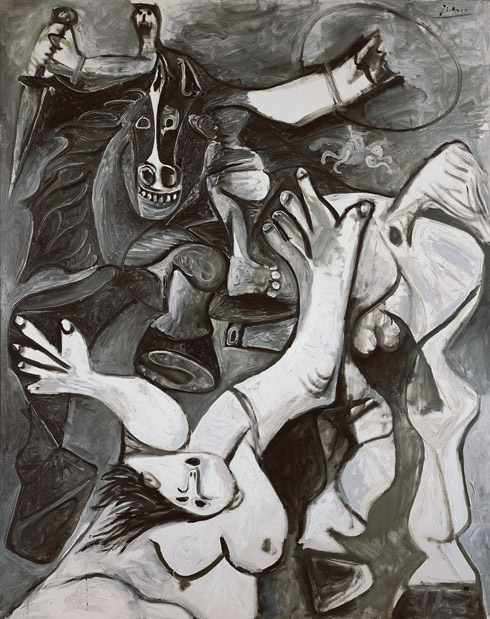
Rape of the Sabines, by Pablo Picasso,1962

The portion Ki Tavo then lists three deeds that require a major investment of a man’s time and money in order to reap a deeply satisfying reward. For all three, the disobedient Israelites will never get the reward.  

A woman you will betroth, and another man will use her for sex. A house you will build, and you will not live in it. A vineyard you will plant, and you will not use it. (Deuteronomy 28:30)

Arranging a marriage in the Torah included negotiations with the woman’s family and the payment of a bride-price; the reward was not only a sex partner, but a companion, a worker, and a  mother of one’s children. Building a house was also a big enterprise with a long-term reward. And grape vines, like fruit trees, had to be cultivated for three years without a harvest; only in the fourth year could they be picked for food, wine, and profitable trade.

The Torah portion Shoftim, earlier in Deuteronomy, treats the same three things as milestones in a man’s life. Officials who are recruiting troops are supposed to say:

“Who is the man that has built a new house and has not dedicated it? Let him go and return to his house, lest he die in the battle, and another man dedicate it. And who is the man that has planted a vineyard and has not used it? Let him go and return to his house, lest he die in the battle, and another man harvest it. And who is the man that has betrothed a woman and has not taken her [in marriage]? Let him go and return to his house, lest he die in the battle, and another man take her.” (Deuteronomy 20:5-7)3

No man wants to die before marrying, moving into his own house, and harvesting from his own grapevines (or fruit trees). If the Israelites are behaving well, following God’s directions, men can be excused from military service in order to enjoy reaching these milestones. Other men can go off to invade towns outside Israel’s borders, and God will give them success in battle.4

But if Israelites are behaving badly, flouting God’s directions, then they will be invaded by outsiders who seize their fiancées, their houses, and their vineyards.

Last week’s Torah portion, Ki Teitzei, expands on one of these military exemptions:

When a man takes a new wife, he must not go out with the troops, and he must not cross over to them for any matter. He will be exempt for his household one year and give joy to his wife whom he has taken. (Deuteronomy 24:5)

We can imagine the recruits crossing the town square to stand on one side, while the men who are staying home remain on the other side. This verse also informs us that the exemption from military service lasts for a year, and that a man must “give joy” to his new wife.

A wife in ancient Israel was not just a baby-making, bread-kneading, thread-spinning machine. She was supposed to be able to enjoy sex with her husband, and to be content with her new life in his household.

The Talmud adds that the exemptions for a new house and a newly mature vineyard also last for a full year.

“Since the wife needs twelve months, also all of them need twelve months.” (Talmud Yerushalmi, Sotah 8:8:2)5

“Those who are exempt for these reasons do not even provide water and food to the soldiers, and they do not repair the roads.” (Talmud Bavli, Sotah 43a)5

Thwarted by enemies

But when the Israelites disobey God, no one will get a year off for settling into a new marriage, a new house, or a new addition to their livelihood. Instead, God will let outsiders invade Israel and win. This week’s Torah portion continues:

Your ox will be slaughtered in front of your eyes, and you will not eat from it. Your donkey will be stolen in front of you, and it will not return to you. Your flock will be given to your enemies, and there will be no rescuer for you. Your sons and your daughters will be given to another people, and your eyes will be seeing and longing over them every day, but there will be no strength in your hand. The fruit of your land, and everything you toiled for, will be consumed by a people you do not know, and you will only be exploited and crushed all the time.  (Deuteronomy 28:31-33)

The laws laid down by God through Moses mandate returning stray animals to their owners,6 provide redemption for children sold as slaves, and even make the sale of land temporary.7 But invaders from other countries would disregard the local laws, and act only for their own benefit. Ironically, God will let the invaders succeed because the Israelites have been disregarding laws and acting only for their own benefit!

The curses that result from invasion by enemies are communal punishments, occurring when the people as a whole disobey God’s laws. Ethical and law-abiding individuals or families do not get special treatment when enemies invade.

Insanity

And you will be meshuga from the sight that you see with your eyes. (Deuteronomy 28:34)

The Sleep of Reason Produces Monsters, by Francisco de Goya, circa 1797

meshuga (מְשֻׁגָּ֑ע) = insane, crazy, raving. (Also from the root verb shaga, שָׁגַע, otherwise used only in the hitpael form: hishtaga-a, הִשְׁתַּגַּעַ = behaved like an insane person, or mishtaga-a, מִשְׁתַּגַּעַ = was behaving like an insane person.)

Ha-Emek Davar, a collection of 12th and 13th-century commentary, explained: “You will be amazed that you have become like this. That a few bandits have done so much damage, and your strength cannot save you, even though really it should have been strong enough against them. From this you will become insane and go out of your minds.”8

If the conquerors were merely a group of bandits, the Israelites might be driven mad by an inability to understand why they had not been able to defeat them. Only a few Israelites would attribute their unlikely failure to defend their land to a divine curse. If the conquerors were a large army, more Israelites might realize that God was no longer on their side, and remember that they needed God’s help. Either way, the Israelites could only explain their defeat if they acknowledged that they had done wrong and disobeyed their God.


It is human nature to cling to the belief that you are right and righteous, and to resist admitting that your actions have been unethical.

In a world-view with a God who administers rewards and punishments for collective behavior, the only responses to the total frustration of our plans and dreams are to admit our own bad behavior, to blame only the people around us, or to plunge into the mental blindness of believing that everything you are suffering is all for the best.

Without a God-centered world-view, there is a fourth option: to believe that tragedies sometimes happen when no one is at fault. This belief is easy to maintain when inexplicable tragedies are happening to people you don’t know. But it could lead to a mental breakdown when tragedies happen to you.

No wonder we feel cursed when undertakings we have nurtured for years are suddenly annihilated. Admitting collective guilt, blaming others, believing it’s all for the best, shrugging it off as bad luck, and going a little crazy are all possible responses. If, God forbid, it happened to you, what would your response be?


  1. Samson Raphael Hirsch, The Hirsch Chumash: Sefer Devarim, translated from German by Daniel Haberman, Feldheim Publishers, Jerusalem, 2009, p. 667.
  2. Ibid., p. 670.
  3. See my post Shoftim: More Important than War, Part 1.
  4. Deuteronomy 20:1.
  5. Translations of both Talmud Yerushalmi and Talmud Bavli are from www.sefaria.org.
  6. Deuteronomy 22:1-3.
  7. Deuteronomy 25:25-46.
  8. Ha-Emek Davar, commentary by the 12th to 13th-century Tosafists, translated in www.sefaria.org.
Ki Tavo & 2 Isaiah: Enlightenment

Enlightenment is a theme in both this week’s Torah portion, Ki Tavo (Deuteronomy 26:1-29:8) and this week’s haftarah reading (Isaiah 60:1-22). At any other time of year, this synchrony would be no accident. When the rabbis of the second century C.E. paired haftarah readings from the prophets with the weekly readings from the Torah proper (Genesis through Deuteronomy), they picked haftarot that had related themes—at least most of the year.

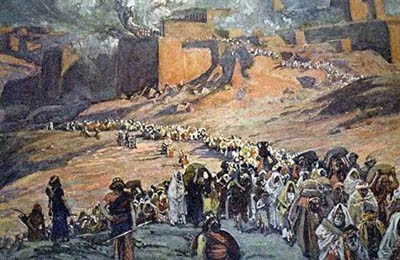
But during seven weeks in late summer, between Tisha B’Av1 and Rosh Hashanah2, the Torah readings continue working through the book of Deuteronomy, while the haftarot all explore the same theme in second Isaiah—an unknown prophet recorded in chapters 40-66 of the book of Isaiah. Second Isaiah addresses the Israelites who were deported to Babylon when King Nebuchadnezzar captured and razed Jerusalem.3

March of the Prisoners from Jerusalem, by James Tissot, 1896

The prophet promises the exiles that if they return, God will forgive them for their past disobediences, and their ruined city will become glorious. This week we read the Sixth Haftarah of Consolation, which describes how God will make Jerusalem shine like a beacon to other nations.

Ki Tavo: Enlightenment

At Mount Sinai, when Moses led the Israelites through a formal covenant ritual with God (including splashing blood on the altar and the people),

Moses came and recounted to the people all God’s words and the laws, and all the people answered with one voice, and they said: “All the things that God has spoken, we will do!” (Exodus 24:3)

In this week’s Torah portion, Moses gives instructions for conducting another covenant ritual once the Israelites have entered Canaan.4 But first he declares:

Today you have affirmed God to be your god, and to walk on [God’s] paths, and to keep [God’s] decrees and commands and laws, and to pay attention to [God’s] voice. (Deuteronomy 26:17)

The Israelites do not shout out their agreement in the book of Deuteronomy, the way they did in the book of Exodus, but neither do they grumble. Moses continues as if everyone agrees.

And God has affirmed to you today that you are [God’s] treasured people, as [God] spoke to you, and keeping all [God’s] commands. And [God will] set you high above all the nations that [God] made, in praise and in reputation and in splendor. And you will become a holy people to God, as [God] spoke. 5 (Deuteronomy 26:18-19)

Moses is describing a covenant, originating at Sinai and affirmed on the east bank of Jordan River where the people can see Canaan. The Israelites as a people promise to single out God as their only god, and to obey God. God promises to single out the Israelites as God’s unique treasure, and to elevate them relative to other nations.

Including the phrase and keeping all [God’s] commands” makes the statement of God’s side of the covenant awkward reading. Probably it means that God promises to give the Israelites special treatment only if they keep their promise to obey all of God’s commands. But the commentary includes alternate interpretations. One is that God gives all the rules to the people Israel, and only some of them to the other, lesser nations.6 Another is that God will act to help the Israelites achieve the difficult task of keeping all God’s laws and decrees.7

Next Moses recites the blessings God will give those who obey God’s rules, and the curses God will inflict on those who disobey. Then he says:

You have seen all that God did before your eyes in the land of Egypt, to Pharaoh and to all his attendants and to all his land—the great trials that your eyes saw, the great signs and marvels. Yet God has not given you a leiv for da-at, or eyes for seeing, or ears for listening, until this day. (Deuteronomy 29:1-3)

leiv (לֵב) or leivav (לֵבָב) = the heart; the seat of both thinking and feeling, therefore the conscious mind.

da-at (דַעַת) = knowledge; intimate acquaintance, insight, understanding. (From the root verb yada, יָדַע = notice, find out, recognize, become acquainted, know, understand.)

In Egypt, the Israelite slaves witnessed the trials of Pharaoh and his advisors when God afflicted Egypt with ten miraculous plagues. Forty years later, the next generation of Israelites includes many who were children in Egypt and can vouch for God’s miracles.

But during the Israelites’ long journey through the wilderness, they often complained about God and said they were better off as slaves in Egypt. In the last of the forty years, many of the men went to Moabite feasts and worshiped Ba-al Pe-or, disobeying their own God’s repeated command that they must not worship other gods.8

They heard, but did not have “ears for listening” to God’s words as transmitted by Moses. They saw more divine miracles on their journey, but did not have “eyes for seeing” that God was still taking care of them, leading the way with the pillar of cloud and fire, and providing water to drink and manna to eat. They did not use their leiv to think about the evidence of their senses, and so they did not reach any understanding about God’s long-term plan. They did not find any enlightenment.

The Torah switches briefly to God’s point of view9:

And I brought you up, all of you, for forty years in the wilderness. Your cloak did not wear out from upon you, and your sandal did not wear out from on your foot. You did not eat bread or drink wine or liquor—in order that teide-u that I am God, your God. (Deuteronomy 29:4-5)

teide-u (תֵּדְעוּ) = you would know, you would understand. (Also from the root verb yada.)

But God’s demonstration did not result in any enlightenment. As Moses has just said, “Yet God has not given you a leiv for da-at, or eyes for seeing, or ears for listening, until this day.”

What has changed now that the Israelites are about to cross the Jordan into Canaan? The answer in this week’s Torah portion is not that Moses’ long oration has enlightened them. Moses hints at a different answer when he concludes:

And you came up to this place. And Sichon, king of Cheshbon, and Og, king of the Bashan, went out to meet us in battle, but we struck them down. And we took their land and gave it as hereditary property to the Reubenites and to the Gadites and to half of the tribe of Menashe. So you must keep the words of this covenant and you must do them, in order that taskilu everything that you do. (Deuteronomy 29:6-8)

taskilu (תַּשְׂכִּילוּ) = you (plural) will succeed; understand; act with religious insight. (A form of the verb sakhal, שָׂכַל; its meaning overlaps but does not coincide with yada.)

In this context, taskilu means “you will succeed”. Yet the success depends on the understanding and religious insight that would motivate the Israelites to keep the covenant and obey God.

When the Israelites defeat the armies of kings Sichon and Og and take their lands, they learn in the most direct way that God’s pledge to give them the much larger land of Canaan is not an empty promise. They could actually do it!—with God’s help. There is nothing like an exciting experience to change your thinking. Now, at last, they see the light.

And for a while, at least through the whole book of Joshua, they enthusiastically obey God’s rules.

Second Isaiah: Illumination

In the chapter of Isaiah before the sixth haftarah of consolation, the prophet repeats his or her message that the people of Judah were defeated and exiled because they disobeyed God; but now God will forgive and redeem all of them who repent and head back to Jerusalem.10

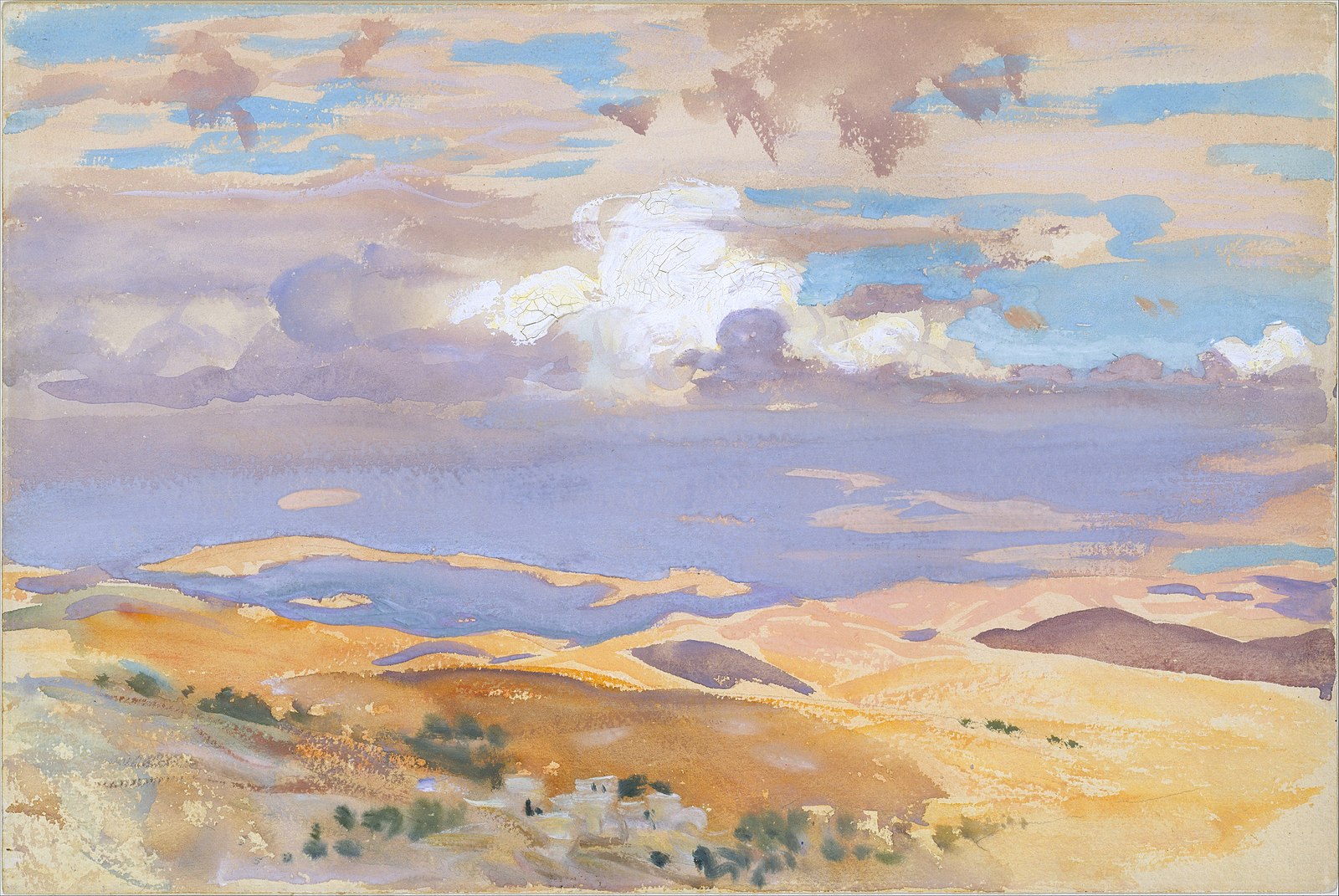
From Jerusalem, by John Singer Sargent, 1905-6

This week’s haftarah then opens with imagery of light:

Arise! Brighten! For your light is coming,

And the glory of God shines on you.

Because hey! The darkness will cover the land,

And thick fog, the peoples.

But upon you God will shine

            And  [God’s] glory will be seen upon you. (Isaiah 60:1-2)

We can see sources of light, such as stars, and every material thing that light shines on. But without light, we are blind. No wonder cultures around the world associate light with knowledge. No wonder the English language calls understanding “enlightenment”.

Many cultures also associate light with good behavior, and darkness with bad behavior. The book of Proverbs says:

The route of the righteous is like radiant light,

            Going on and brightening until the day is established.

The path of the wicked is like darkness;

            They do not know what they stumble on. (Proverbs 4:18-19)

The wicked—which in the bible means not only those who wrong their fellow humans, but all those who disobey God—stumble and fall in the darkness. But the righteous, who can see everything in front of them, know how to avoid tripping.

Furthermore, when the righteous settle in Jerusalem, God will shine light on the city, and the people of other nations will notice it. Second Isaiah continues:

And nations will walk by your light,

And kings, by the radiance of your shining. (Isaiah 60:3)

Ibn Ezra commented: “He who is in darkness usually sees those that are dwelling in light.”11 Naturally they are drawn to the clarity and well-being that light provides.

According to second Isaiah, peace and prosperity will govern Jerusalem, and riches will flow into the city from places as far away as Sheba and Tarshish.

Because God will be your light forever,

            And your days of mourning will be done.

And your people, all of them righteous,

            Will possess the land forever. (Isaiah 60:20-21)

According to Ibn Ezra, “The mourner sits, as it were, in darkness.” Death is associated with darkness, and a good life with light.


This week’s Torah portion, Ki Tavo, points out that despite all of God’s efforts at enlightening the Israelites in the wilderness, they do not fully throw in their lot with God until they win a couple of battles and camp across the Jordan River from Canaan. Only then do they understand God’s plan; only then do their minds open to illumination. Only then do they settle into obeying God. On the other hand, this week’s haftarah, Isaiah chapter 60, declares that the reward of obeying God’s commands is illumination.

Today we no longer receive signs from the God-character in the bible. We must make do with telling coincidences and unforeseen results that are enlightening in retrospect. Individuals stumble along in the darkness, making mistake after mistake. Nations are governed by politicians who cannot agree on, or even see, a path to peace and prosperity. And world-wide climate change is accelerating because we humans have fouled our own nest and failed to cooperate enough to clean it.

What would a Moses or a second Isaiah say to us? What would make us stop and reconsider? How do get enough illumination to see the right path and redeem ourselves?


  1. Tisha B-Av is the annual day of mourning for the destruction of the temple in Jerusalem. See my post: Lamentations: Seeking Comfort.
  2. Rosh Hashanah is the first day of the Jewish year. See my post: Rosh Hashanah: Remembering.
  3. The Babylonian campaign to eliminate rebellion in their vassal state of Judah included deporting all of its leading citizens to Babylon in two waves, after each of Nebuchadnezzar’s successful sieges of Jerusalem in 597 and 587 B.C.E.
  4. On two hills in front of the Canaanite town of Shekhem. See my posts: Ki Tavo: Making It Clear, and Ki Tavo: Cursing Yourself.
  5. Moses is alluding to God’s statement at Mount Sinai: And now, if you really pay attention to my voice and keep my covenant, then you will be my treasure among all the peoples. For all the earth is mine, but you will be my kingdom of priests and a holy nation. (Exodus 19:5-6)
  6. See Ovadiah Sforno (16th century) on Deuteronomy 26:18.
  7. See Or HaChayim (18th century) on Deuteronomy 26:18
  8. Numbers 25:1-9.
  9. Probably because of an error in editing when a 6th-century BCE redactor revised an older text to frame it as part of Moses’ oration.
  10. Isaiah 59:9-21.
  11. 12th century rabbi Abraham ben Meir ibn Ezra, translation in www.sefaria.org.
Mishpatim, Ki Tavo, & Joshua: Writing and Reading

After Moses tells the Israelites God’s “Ten Commandments”, he goes back up Mount Sinai and listens to God proclaiming 48 or more additional rules (depending on how you count them)—four in last week’s Torah portion, Yitro, and at least 44 in this week’s Torah portion, Mishpatim (Exodus 21:1-24:18). The lengthy list includes religious observances, civil and criminal laws, and ethical guidelines.

Then Moses came and he reported to the people all the words of God and all the laws. And all the people answered with one voice, and they said: “The things that God has spoken, we will do!” (Exodus 24:3)

Apparently Moses has a phenomenal memory. And the Israelites are eager to obey all the orders he has passed on orally. But how will they remember these rules?

Moses speaks, writes, then reads

Then Moses wrote down all the words of God. And he got up early in the morning and he built an altar beneath the mountain, and twelve standing stones for the twelve tribes of Israel. (Exodus 24:4)

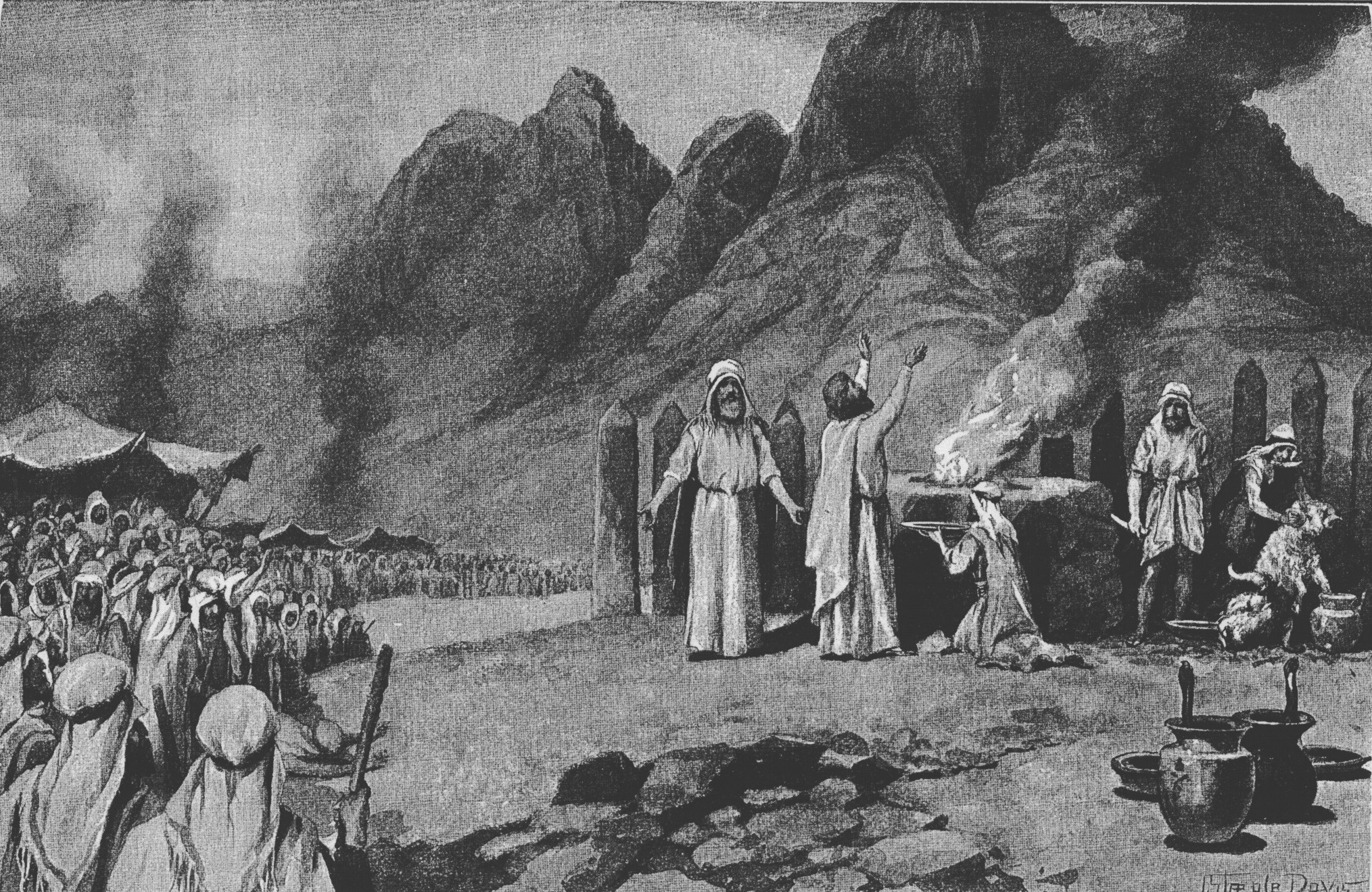
The Covenant Confirmed, by John Steeple Davis, 1844-1917

What are “all the words of God” that Moses writes down at that point? The Torah does not say. I think the most reasonable inference is that Moses writes down the Ten Commandments and the 48 or so rules God has just given him. But according to Rashi,1 Moses wrote down the book of Genesis and the book of Exodus up to, but not including, the account of the revelation at Mount Sinai. Apparently he brought some parchment and ink with him from Egypt.

Then he took the seifer of the covenant and he read it out loud in the ears of the people. And they said: “Everything that God has spoken we will do and we will listen!” (Exodus 24:7)

seifer (סֵפֶר) = book (in scroll form), scroll, written document.

This time the Israelites respond with even more fervor, promising not only to obey God’s rules, but to listen to them, pay attention to them. Moses prepares a burnt offering on the altar, and splashes some of the blood on the people to seal their covenant with God.

After this, Moses follows another instruction from God, taking Aaron, two of Aaron’s sons, and seventy elders halfway up Mount Sinai. They get far enough to see God’s feet on a sapphire brickwork. (See my post Mishpatim: After the Vision, Eat Something.)

Then Y-H-V-H said to Moses: “Come up to me on the mountain and be there, and I will give you the stone tablets and the torah and the commandment that I have inscribed to instruct them.” (Exodus 24:12)

torah (תּוֹרָה) = teaching, instruction; law as a whole. (The word torah later came to mean the first five books of the bible.)

Moses and Joshua Climb Mt. Sinai, by James Tissot

Even God wants to create a written record for future reference.

And Moses took Joshua, his attendant, and Moses went up the mountain of God. And to the elders he said: “Wait for us here until we return to you …” (Exodus 24:13)

Moses takes Joshua with him. But the Torah reports only Moses entering the cloud at the top of Mount Sinai and staying inside it for forty days and forty nights.2 There God gives him lengthy instructions for building a sanctuary and ordaining priests. When Moses finally hikes back down with the two stone tablets, in the portion Ki Tisa, Joshua pops into the picture again.

And the tablets were God’s doing, and the writing was written by God, engraved on the tablets. Then Joshua heard the sound of the people shouting, and he said to Moses: “A sound of war in the camp!” (Exodus 32:16-17) The Torah never says what Joshua was doing during those forty days, or exactly where he was on the mountain. God’s instructions in the cloud are addressed exclusively to Moses.

Joshua copies, then reads

Joshua remains Moses’ attendant until the end of the book of Deuteronomy, when Moses lays hands on him to make him the new leader of the Israelites, the one who will take them across the Jordan River into Canaan. Then God tells Moses:

“Here, the time draws near for [your] death. Call Joshua, and present yourselves in the Tent of Meeting, and I will give him orders.” (Deuteronomy 31:14)

There God speaks at length to Moses about the future of the Israelites, and teaches him a poem. Then God speaks to Joshua the first time:

And [God] commanded Joshua son of Nun, and said: “Be strong and resolute, because you yourself will bring the Israelites to the land that I promised to them, and I will be with you.” (Deuteronomy 31:23)

After Joshua hears this brief encouragement, Moses has more writing to do.

And Moses finished writing the words of this torah in the seifer until it was complete. (Deuteronomy 31: 24)

In the book of Joshua, God repeatedly gives Joshua instructions for the next step on his conquest of Canaan. But God does not tell him any new rules. Joshua faithfully carries out all the instructions he has received from both God and Moses.

Altar on Mt. Eyval, photo by Raymond Hawkins

When he reaches the two hills in front of Shekhem in Canaan, Eyval and Gerizim, he follows a set of orders Moses gave in the Torah portion Ki Tavo: writing on standing stones, then making offerings on an altar, then assembling the tribes on the two hills to say “Amen” after each curse or blessing the Levites call out.3 Moses started with the order to write on stones:

“Once you cross the Jordan to the land that Y-H-V-H, your God, is giving you, then you must erect large stones for yourselves and coat them with limewash. And you must write on the stones all the words of this torah …. You must erect these stones that I am commanding you about today on Mount Eyval …” (Deuteronomy 27:2-4)

All the words of which torah? The implication is that the Israelites should write down rules that Moses has passed down from God in the book of Deuteronomy—either all of them, or a subset. One logical selection would be the twelve curses that Moses then says the Levites should proclaim.

These curses are actually rules.  Each one begins “Cursed be anyone who—” and then states a deed that God forbids, such as making idols or accepting bribes. Eleven of the curses repeat rules that Moses has previously delivered. The twelfth is:

Cursed be one who does not uphold the words of this torah, to do them. And all the people shall say: Amen. (Deuteronomy 27:26)

Is “this torah” the instruction of the twelve curses, or what is written on the twelve stones?

When Joshua leads the Israelites to Mount Eyval, the priests are carrying the ark, which now contains the whole seifer Moses wrote. At first it sounds as if Joshua has the whole scroll copied onto the stones.

And [Joshua] wrote there, on the stones, a copy of the torah of Moses, that [Moses] had written in front of the Israelites. (Joshua 8:32)

But after Joshua conducts the ritual of curses and blessings, he reads out loud from Moses’ scroll.

And after that, he read aloud all the words of the torah, the blessing and the curse, out of all the writing in the seifer of the torah. There was not a word out of all that Moses commanded that Joshua did not read opposite the whole assembly of Israel, including the women and the little ones and the foreigners who went among them. (Joshua 8:34-35)

These two verses are difficult to interpret. At first it sounds as if Joshua is reading out the torah or teaching about the blessing and curse ritual they have just performed. But then it sounds as if Joshua reads the entire “seifer of the torah”, the record that Moses wrote at the foot of Mount Sinai in this week’s Torah portion, Mishpatim, and subsequent additions. That scroll might take all day to read out loud.

The tradition of public readings of scrolls continued. In 2 Kings 22:8, the priests find a “seifer of the torah” when they are repairing the temple in Jerusalem. King Josiah summons all the people of Judah to listen to him read it out loud. Then he swears that his people will observe all of the commandments and laws in it. They do not respond with “Everything that God has spoken we will do and we will listen!” the way the people did at Mount Sinai. Nor do they say “Amen” then way the people did at Mount Eyval. Their response is positive, but muted:

And all the people stood up for the covenant. (2 Kings 23:3)

For more than two thousand years, Jews have been reading out loud from a seifer torah hand-lettered on a parchment scroll. Everyone who comes to services watches the scroll being unrolled, and hears someone chant all or part of that week’s portion in Hebrew. In the course of a year, the seifer torah is chanted from the beginning of Genesis to the end of Deuteronomy.4 And those who do not know Hebrew can follow along by reading a translation.


For Moses and Joshua, the advantage of a written record is that it can be read out loud later. The assumption is that people will learn God’s rules better if they hear them—repeatedly.

I know that today some people absorb information better by listening, while others absorb it better by reading it. I hope someday to accompany my blog posts with podcasts in which I read my own writing aloud. But I am no Moses, so this project will have to wait until I finish rewriting my book on ethics in Genesis.

There are other texts that everyone should be familiar with. For example, the United States still uses an amended version of its original constitution. Many Americans refer to the authority of the constitution without knowing what it actually says. It is easy to find a written copy of this document, but I believe it should be taught in schools again, article by article, amendment by amendment, along with some of the various interpretations. And maybe we should even read it out loud in public once a year, just so everyone will know the source text that inflames such passions today.


  1. 11th-century rabbi Shlomo Yitzchaki, the most quoted classic Jewish commentator.
  2. Exodus 24:15-18.
  3. See my blog post Ki Tavo: Making It Clear.
  4. But some Jewish communities follow a tradition of reading a third of each Torah portion each week, so the five-books of the Torah are completed over the course of three years.

Haftarat Ki Tavo—Isaiah: The Place

For seven weeks after Tisha Be-Av (the fast day to mourn the destruction of both temples in Jerusalem), Jews read a “haftarah of consolation” from second Isaiah. This week, the sixth haftarah of consolation does not even mention consolation or comforting. Only once does it refer to mourning:

Fourth Day of Creation, Nuremberg Chronicle, 1493

Your sun will not set again

            And the moon will not be taken away.

For God will be your everlasting light,

And the days of your mourning will be done. (Isaiah 60:20)


The mourning will be over because all of Jerusalem’s people will return to their city-state, and all the other nations of the world will honor them, serve them, and bring them fabulous wealth.

The consolation in the sixth week’s haftarah, then, is the promise that all the suffering of the Israelites under the thumb of the Babylonians will end, and the people (or at least their descendants) will live happily ever after.

Will this happen after a certain number of years or centuries, or after a certain condition has been met? In other chapters, second Isaiah1 reminds the Israelites that they must return to God before God will return Jerusalem to them. In Isaiah 60, the prophet does not worry about any conditions.

Instead of a time frame, this prophesy is attached to a place: Jerusalem. Furthermore, Jerusalem’s future triumph is the triumph of the God of Israel, not just of the Israelites who live in God’s city.2 God elaborates:

Your gates will always be open;

            Day and night, they will not shut—

To let the wealth of nations come into her [Jerusalem],

            And their kings will be leading the processions. (Isaiah 60:11)

The Caravan, by Charles Theodore Frere, 1888

The magnificence of the Lebanon will come to you:

            Juniper, fir, and cypress together,

To beautify the makom of my holy sanctuary,

            And I will honor the makom of my feet. (Isaiah 60:13)

makom (מָקוֹם) = place, location.

God’s “footstool” is either the temple in Jerusalem, or the city itself, according to Psalms 99:5 and 132:7, Lamentations 2:1, and 1 Chronicles 28:2.3

Since the second destruction of the temple in Jerusalem in 70 C.E., the city of Jerusalem has been rebuilt, and a mosque has been erected where the temple once stood. But the prophecy by second Isaiah in the sixth haftarah of consolation has never come true. For a small minority of Jews, it remains an aspiration. For others, it is a potent symbol. For almost two thousand years, Jews have ended celebrations of Passover and Yom Kippur by shouting: “Next year in Jerusalem!”

It is a joyful shout. The idea of Jerusalem gives many people comfort.


My husband and I finally went to Jerusalem in 2020. We stayed there for three weeks, until the Covid pandemic forced us to choose between taking one of the last airplanes to the United States, or making aliyah and applying for permanent residency in Israel. We flew home.

This week I am in need of comfort and consolation for a personal reason: my mother died recently, a few days after we celebrated her 93rd birthday with her. She was in hospice, so her death was neither a surprise nor a tragedy. But I am aware of the void in my life, and my own fragility.

How could I write a new blog post the week after my mother died? According to Jewish tradition, I should stay home for seven days of mourning (shiva)3 and refrain from “labor”4 (including writing) and from reading the five books of Torah or the Prophets.5 During this time, my Jewish community should visit me so I can say a prayer called the Mourner’s Kaddish, which requires ten witnesses. But I have no Jewish community where I live now, a two-hour drive away from my Jewish friends in Portland. My mother requested cremation rather than a funeral, so the first time I recited the Mourner’s Kaddish for her, I had to do it during a service on Zoom. My greatest comfort these days is the patient help and support of my husband. But I am also comforting myself by doing what I love most: reading and writing about Torah. Yes, I need to keep remembering my mother, who she was when I was growing up and who she was in old age. But I also need to keep remembering who I am.


If I were “sitting shiva” during these seven days, my Jewish friends would come to my home and recite the traditional condolence to a mourner:

Hamakom yenachem etchem betokh she-ar aveilei tziyon viyerushalayim.

May hamakom comfort you among the rest of the mourners of Zion and Jerusalem.

hamakom (הַמָּקוֹמ) = the place.

This expression reminds mourners that they are not alone; the death of relatives and friends is part of life—even in Jerusalem, where those walking on the Temple Mount during the time of the second temple greeted mourners with the words “May the one who dwells in this house comfort you.”6

The temple was considered the dwelling-place of God. Thus God is the true source of comfort. An earlier Talmud tractate records the blessing: Blessed is the comforter of mourners.7

Thus in the words of condolence spoken during the past millennia, hamakom is as a name for God, a name that does not appear in the bible.

The idea of Jerusalem does not comfort me. But the idea of God as a makom of consolation does. Somewhere in each soul is a place of connection to the  reality before words.


  1. Chapters 1-39 of the book of Isaiah were written in the 8th century B.C.E. Chapters 40-66, sometimes called “second Isaiah” or “deuteron-Isaiah” were written after the Babylonian conquest in 587 B.C.E.
  2. The books of Exodus through Deuteronomy forecast a single nation of Israel consisting of the descendants of Jacob, a.k.a. Israel. The two books of Samuel describe the unification of much of Canaan under kings David and Solomon. In 1 Kings, the united kingdom of Israel splits into two kingdoms after Solomon’s death in the 10th century B.C.E. The northern kingdom is called Israel or Samaria, and its capital is Samaria; the southern kingdom is called Judah, and its capital is Jerusalem. When the Assyrians conquered Samaria in 722 B.C.E., many of its people fled to Judah. Biblical books written during the Babylonian Exile in the 6th century B.C.E. refer to Jerusalem as the once and future capital of the people who are again called Israelites.
  3. See my post Haftarat Ki Tavo—Isaiah: A Place for Feet. Also see Psalm 26:8, which refers to “the makom of the dwelling-place of your glory”.
  4. The seven days of formal mourning, called “sitting shiva”, begin immediately after the burial. The end of the burial is also when Jewish mourners begin saying the prayer called the  Mourner’s Kaddish, which requires ten witnesses.
  5. Semachot 5. Semachot, originally called Evel Rabati, is a late (eighth-century C.E.) Talmudic tractate.
  6. Semachot 6.
  7. Semachot 6.


Ki Tavo & Vayigash: Tithes and Taxes

How does a theocracy support itself?

Governments today, both democratic and autocratic, levy taxes to pay for government programs that range from making war to feeding children.  But a few thousand years ago in the Ancient Near East, most countries were theocracies; gods were considered the ultimate rulers, and their deputies were anointed kings and priests.

Both Egypt and the two kingdoms of Israel conscripted soldiers for war and laborers for major building projects.1  But how did they fund the programs that kept at least some of their people from starving?

The book of Genesis credits Joseph, the pharaoh’s viceroy, with refinancing the government of Egypt.  The next four books of the bible state what Israelites must contribute when they have their own nation, their own king, and their own clergy.

Joseph, Overseer of Pharaoh’s Granaries, by Lawrence Alma-Tadema, 1874

Egypt in Genesis

Joseph stockpiles grain in Egypt during the seven years of plenty in the Torah portion Vayigash.  Then in the first year of the seven-year drought, he sells it (to Egyptians as well as Canaanites) for silver.  In the second year, he sells grain to Egyptians in exchange for their livestock.  The third year, when the pharaoh owns all of Egypt’s silver and livestock, the  farmers offer:

“Acquire us and our farmland for the food, and we ourselves will be Pharaoh’s slaves, and our land.” (Genesis 47:19)

Joseph agrees.  All the farmland of Egypt, except what belongs to the priests, becomes the property of the government, and the farmers become serfs.  Joseph gives them grain for planting and eating.  And from then on, the farmers have to give one-fifth of their produce to Pharaoh as rent.

Joseph does not create any means for them to buy back their former land.  In fact, he moves whole villages to other parts of the country.  This underscores the claim in the story that the pharaoh now owns all the land and the farmers are mere serfs.

Israel in Numbers and Deuteronomy

Moses, speaking for God, decrees a different plan for the Israelites to follow after they have conquered their own country.  God is the true owner of all the land, but God has assigned a landholding to every Israelite in every tribe.  Plots of land can be sold, but only for temporary ownership; all lands return to the original clans every fifty years.2

King Solomon, French 13th century

Kings throughout the Ancient Near East appointed tax collectors to make sure landowners paid taxes, mostly in the form of foodstuffs.  In the bible, King Solomon divides the united kingdom of Israel into twelve districts, each supervised by an official who had to provide food for the king and court one month out of the year.3

Landowners are also responsible in the Torah for supporting the kingdom’s two most important social programs: the state religion, and care for the poor.  While the priests and their households receive portions from individual offerings at the altar,4 and wealthier Israelites are obligated to extend loans to their poorer neighbors and kin,5 the primary method for supporting people without their own land is mandatory tithing.

The Talmud distinguishes three kinds of tithes in the Hebrew Bible.  The first tithe is brought to the temple for the resident priests and their households.  The second tithe is also brought to Jerusalem, but consumed on the spot in a feast for the landowner’s family, slaves, and employees; Levites and landless immigrants are also invited to feast.6  Every third year, the second tithe is replaced with a “poor tithe” stored in the towns and doled out to the local Levites, immigrants, widows, and orphans.

This week’s Torah portion, Ki Tavo (“when you come”), requires landowners to accompany their tithes both in Jerusalem and in their home towns with declarations that they owe their livelihood to God and they are tithing to obey God’s orders.  First Moses addresses the annual contribution of the best of the first fruits:

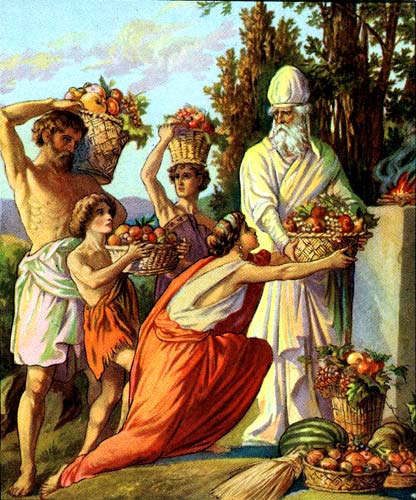
First Fruits, bible card by Providence Lithograph Co. ca. 1900

You shall take some of the first of every fruit of the earth that you bring in from your land, which God, your God, is giving to you, and put it in a basket.  And you shall go to the place where God, your God, chooses to let [God’s] name dwell.  And you shall go to whoever the priest is at that time, and you shall say to him: “I announce today to God, our God, that I have come into the land that God vowed to our fathers to give to us.”  (Deuteronomy/Devarim 26:2-3)

The farmer then recites a brief history from Jacob’s descent to Egypt through his descendants’ arrival in Canaan.7  He concludes:

“And [God] brought us to this place and gave us this land, a land flowing with milk and honey.  And now, hey!  I bring the first fruits of the earth that you gave to me, God!”  And you shall leave [the basket] in front of God, your God, and you shall bow down in front of God, your God.  (Deuteronomy 26:9-10)

The baskets of first fruits are presented to God, then eaten by the resident priests and their households.

Then you shall rejoice in all the good things that God, your God, gave to you and your household—you and the Levite and the immigrant who is in your midst.  (Deuteronomy 26:11)

The summer pilgrimage festival in Jerusalem, Shavuot, is identified as the “Day of First Fruits” in Numbers 28:26.  But the Israelites must continue to bring the first fruits of each of seven species8 as they ripen through the summer, until the fall pilgrimage festival, Sukkot.  The Israelites are obligated to bring the first-born animals from their herds and flocks to the temple for the spring pilgrimage festival, Pesach or Passover.9

For all three pilgrimage festivals, as well as for other offerings at the temple, landowners are obligated to invite the Levites and immigrants from their own neighborhoods to accompany them to Jerusalem and join in the feast.10  Perhaps the participation of Levites and immigrants is why the Talmud calls this the “second tithe”.

barley

But a feast every few months is not enough to sustain life.  So every third year, landowners must bring the “poor tithe” to a central location in the nearest town.  This tithe includes foods that have a longer shelf life (grain, wine, and olive oil), and it is also accompanied by a declaration in this week’s Torah portion.

When you have finished laseir every maseir of your produce in the third year, the year of the maseir, and you give it to the Levite, to the immigrant, to the fatherless child, and to the widow, then they will eat inside your gates and they will be satisfied.  Then you shall say in the presence  of God, your God: “I cleared out the sacred [portion] from the house, and also I gave it to the Levite and to the immigrant, to the fatherless child and to the widow, as in your commands that you commanded me.  I did not bypass your commands, and I did not forget.”  (Deuteronomy 26:12-13)

laseir (לַעְשֵׂר) = tithing, assembling a tithe, collection one-tenth.  (From eser, עֶשֶׂר = ten.)

maseir (מַעְשֵׂר) = tithe.  (Also from eser.)

The Levites serve at the temple on a rotating schedule as administrators, guards, assistants, and musicians, and by God’s decree cannot own farmland of their own.  The third tithe also provides sustenance for immigrants who have not been able to buy land, and for two other categories of people who were often impoverished in ancient Israel: widows and children who have lost their fathers.

The grain and other foods set aside for the third-year tithe are considered sacred because they are prohibited for mundane use; they cannot be either sold or eaten by the owner’s household.  This tithe is also sacred because it serves God; giving food to those who do not have the means to feed themselves is a sacred obligation.

*

Today the citizens of most nations are required to pay taxes.  Portions of our taxes go to the military, though sometimes we also conscript soldiers.  In modern nations, no one is conscripted to provide labor for government building projects; they are supported by taxes (including roads and other infrastructure).  Our taxes are also spent on education, on health care, and on supporting those who do not have the means to support themselves—the elderly and disabled, minor children whose parents cannot take care of them, recent victims of disasters.

I believe we should treat the taxes we pay for these social programs as a sacred obligation.

  1. Corvée labor, called mas (מַס) in Hebrew, is imposed by both pharaohs in Exodus on the Israelites to build brick storehouses (Exodus 1:11-13. 5:6-9) and by the Israelite tribes on Canaanites (Josiah 16:10, 17:13; Judges 1:27-35). A list of King David’s top officials includes an officer in charge of mas (2 Samuel 20:23-26); so does the list of King Solomon’s top officials (1 Kings 4:6).  King Solomon imposes mas on 30,000 Israelites who spent every third month in Lebanon cutting wood and quarrying stone (1 Kings 5:27).  Then he imposes mas on resident Canaanites to build the temple, his own palace, a citadel, and city walls around Jerusalem, Chazor, Megido, and Gazer.
  2. Leviticus 25:10-24.
  3. 1 Kings 4:7-19, 5:7-8.
  4. Numbers 18:8-19.
  5. Leviticus 25:35-37.
  6. Except in Numbers 18:21-29, which describes an earlier system of tithing. In that system, the first tithe is given to the Levites, who then give one-tenth of what they receive to the priests.
  7. See my post Ki Tavo: A Perishing Aramean.
  8. Deuteronomy 8:8-9 calls Israel “a land of wheat and barley, of grapevines and figs and pomegranates, a land of olive trees and honey/date syrup; a land where you need not stint on eating food …”  Mishnah Bikkurim 1:3 states that only these seven species are brought to the temple, and they are not brought before Shavuot.
  9. Exodus 13:11-13 and 22:28-29; Numbers 18:13-18. God assigns the first fruits of Pesach and the meat of the firstborn animals to the Levites (including the priests), as well as a contribution of five shekels for each firstborn son.
  10. In front of God, your God, you shall eat them, in the place that God, your God, choosesyou and your sons and your daughters and your male slaves and your female slaves and the Levites who [live] within your gates. And you will rejoice in front of God, your God, in everything you put your hand to. Guard yourself lest you abandon the Levite on any of your days on the earth.  (Deuteronomy 12:18-19)

Ki Tavo: Milk and Honey

Moses describes three rituals the Israelites must perform after they have crossed the Jordan and taken the land of Canaan in this week’s Torah portion, Ki Tavo (“When you come”).  For all three, Moses reminds the people that they will be living in “a land flowing with milk and honey”.

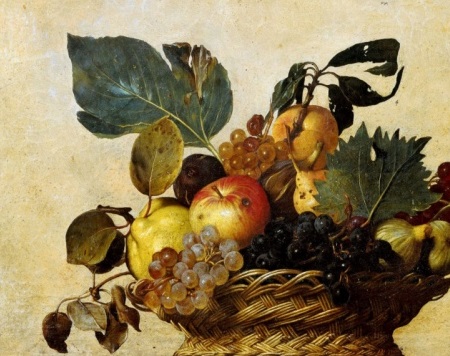
Still Life, Caravaggio ca. 1595, detail

First he prescribes Shavuot, the annual pilgrimage to bring the first fruits of the year to the priests at the temple.  Each farmer must bring a basket of fruits, give the basket to a priest, and recite a short history of the Israelites from the arrival in Egypt to the arrival in Canaan.  (See my post Ki Tavo: A Perishing Aramean.)  The recitation ends:

“And [God] brought us to this place and gave to us this land, a land zavat chalav udevash.  And now behold!  I bring the first fruits of the soil that you have given to me, God.”  (Deuteronomy/Devarim 26:9-10)

zavat (זָבַת) = flowing, oozing.

chalav (חָלָב) = milk, drinkable yogurt.

udevash (וּדְבָשׁ) = and honey, fruit syrup.

Through this formula, each donor expresses appreciation to God for the bountiful land.

Payment of the Tithes, by Pieter Brueghel the Younger, 1617

The second ritual takes place every three years, when all farmers must set aside a tenth of their harvest and give it to the people in their towns who have no farms to feed them.  When they have done so, they must recite this declaration to God:

I have rooted out from the house what is to be consecrated, and also I have given it to the Levite and to the resident alien, to the orphan and to the widow, as in all the commands that you commanded me.  I did not transgress your commands and I did not forget.  … Look down from your holy home, from the heavens, and bless Your people Israel and the soil that you have given to us as you swore to our forefathers, a land of zavat chalav udevash. (Deuteronomy 26:13-15)

The second recitation alludes to the reason why God “gave” the Israelites in a land of milk and honey: because they obeyed God’s commands.  (God’s gift consists of helping the Israelites attack the inhabitants of Canaan, win a series of battles, and kill or subjugate the people.  See my post Re-eih: Ownership.)

Altar on Mt. Eyval, photo by Raymond A. Hawkins

The third ritual that Moses prescribes takes place neither at the temple nor in the towns, but at twin hills near the town of Shekhem.  As soon as they have crossed the Jordan, the Israelites must erect large stones on Mount Eyval and coat them with limewash, which hardens into a smooth white surface.  (See my post Ki Tavo: Carved in Stone.)  Then they must build an altar, make an offering, and write on the standing stones.

And you shall write on them all the words of this teaching when you cross over in order to come into the land the God, your God, is giving you, a land zavat chalav udevash, as God, God of your forefathers, spoke to you.  (Deuteronomy 27:3)

Because God “gives” them such a bountiful land, the Israelites must record God’s teaching (torah) on the hilltop.

Next Moses describes the ritual.  Half of the tribes must stand for the blessing on nearby Mount Gezerim, and the other half must stand for the curse on Mount Eyval.  Then the Levites shout out the prescribed curses for disobeying God, and after each one all the people must say “Amen”. (See my post Ki Tavo: Cursing Yourself.)

What does it mean to say that a land is flowing with milk and honey?  And why does Moses keep bringing it up?

What does it mean?

Oozing fig

The most literal explanation of zavat chalav udevash was offered in the Talmud, Ketubot 111b, where several rabbis describe seeing nanny goats dripping milk as they grazed under fig trees oozing syrup.  Later commentary explained the idiom as referring to a land that is good for both raising livestock (which produce milk) and growing fruits (which produce syrup).  An alternative explanation was that valleys are farmed everywhere, but in Canaan even the uncultivated hills provide food, because their vegetation produces herbage for wild goats (making milk) and flowers for wild bees (making honey).1

At least in years with enough rain.  Earlier in the book of Deuteronomy, Moses (speaking for God) tells the Israelites:

And observe all the commands that I command you today, so that you will be strong and enter and possess the land that you are crossing into to possess.  And so that your days will be long on the soil that God swore to your forefathers to give to them and to their descendants, a land zavat chalav udevash.  For the land that you are entering to possess is not like the land of Egypt that you left, where you sowed seeds and your watered them by foot, like a vegetable garden.  But the land that you are crossing into to possess is a land of hills and valleys, [a land that] drinks water from rain of the heavens.  … And it will be, if you really listen to my commands that I command you today, to love God, your God, and to serve [God] with all your heart and with all your soul, then I will give rain to your land …  (Deuteronomy 11:8-11, 11:13-14)

Canaan will be a land “flowing with milk and honey” as long as its new occupants, the Israelites, love and serve God, so that God provides rain to make the vegetation grow and bloom.

It occurred to me that milk also indicates fertility, and honey or syrup is a luxury, one of the choice products of Canaan that Jacob sends as a gift to Egypt.2  The basket of first fruits that a person bring to the priests may also contain the delicacy of fruit syrups.

Why does Moses keep bringing it up?

The phrase zavat chalav udevash, “flowing with milk and honey”, appears fifteen times in Exodus through Deuteronomy.  The first occurrence is when Moses stands at the burning bush on Mount Sinai.  God tells him:

“And I have come down to rescue [my people] from the hand of the Egyptians and to bring them up from that land to a good and spacious land, to a land zavat chalav udevash, to the place of the Canaanites and the Hittites and the Amorites and the Perizzites and the Chivites and the Jebusites.”  (Exodus/Shemot 3:8)

The good news is that the land flows with good things to eat.  The bad news is that the land is already inhabited by six other peoples.  The next two references in Exodus mention the current inhabitants first, then sweeten the picture by calling the land “zavat chalav udevash”.3

This promise does not keep the Israelites from complaining about the uncertain food and water supply on the journey from Egypt to the border of Canaan, and suggesting that they give up and return to Egypt.4  Since the carrot is not enough, Moses adds a stick, handing down warnings that the Israelites must obey God if they want God to help them move into the land zavat chalav udevash.5

Eventually the next generation of Israelites does cross the Jordan, and conquers much of Canaan under the leadership of Joshua and, presumably, with the help of God.  Thus the rituals Moses lays out in this week’s Torah portion include gratitude for possession of a land zavat chalav udevash.


Today we, too, must obey the rules in order to have land that is “flowing with milk and honey”.  We have imperiled our whole planet through air pollution, and the global climate change that has already begun threatens to scorch areas that we used until now to produce food for our immense world population.  We must obey the rules inherent in nature, starting now.

Already in our lifetimes the flow of milk and honey will diminish.  The milk of fertility will dry up, and the honey of luxury will become scarce.  We will have to develop new lands to recover at least part of the abundance that came to us as a gift—for we have not loved nor served our earth.


  1. Nogah Hareuveni, Ecology in the Bible, Neot Kedumim, 1974, p. 11, cited in The Torah: A Modern Commentary, ed. W. Gunther Plaut, Union of American Hebrew Congregations, New York, 1981.
  2. Genesis 43:11.
  3. Exodus 3:17, 13:5.
  4. The Israelites complain about the journey at least five times in Exodus 14:11-12, 15:22-24, 16:2-3, 17:1-4, and 32:1. Each time they are afraid they will die without reaching the land God promised, so they would have been better off staying in Egypt. They complain about the food and water on journey to Canaan at least six times in Numbers 11:1, 11:4-6, 13:31-14:4, 16:12-14, 20:1-5, and 21:4-5.
  5. Numbers 13:27-14:10 and 14:22-35; Deuteronomy 6:3 and 11:8-9.

Repost: Ki Tavo

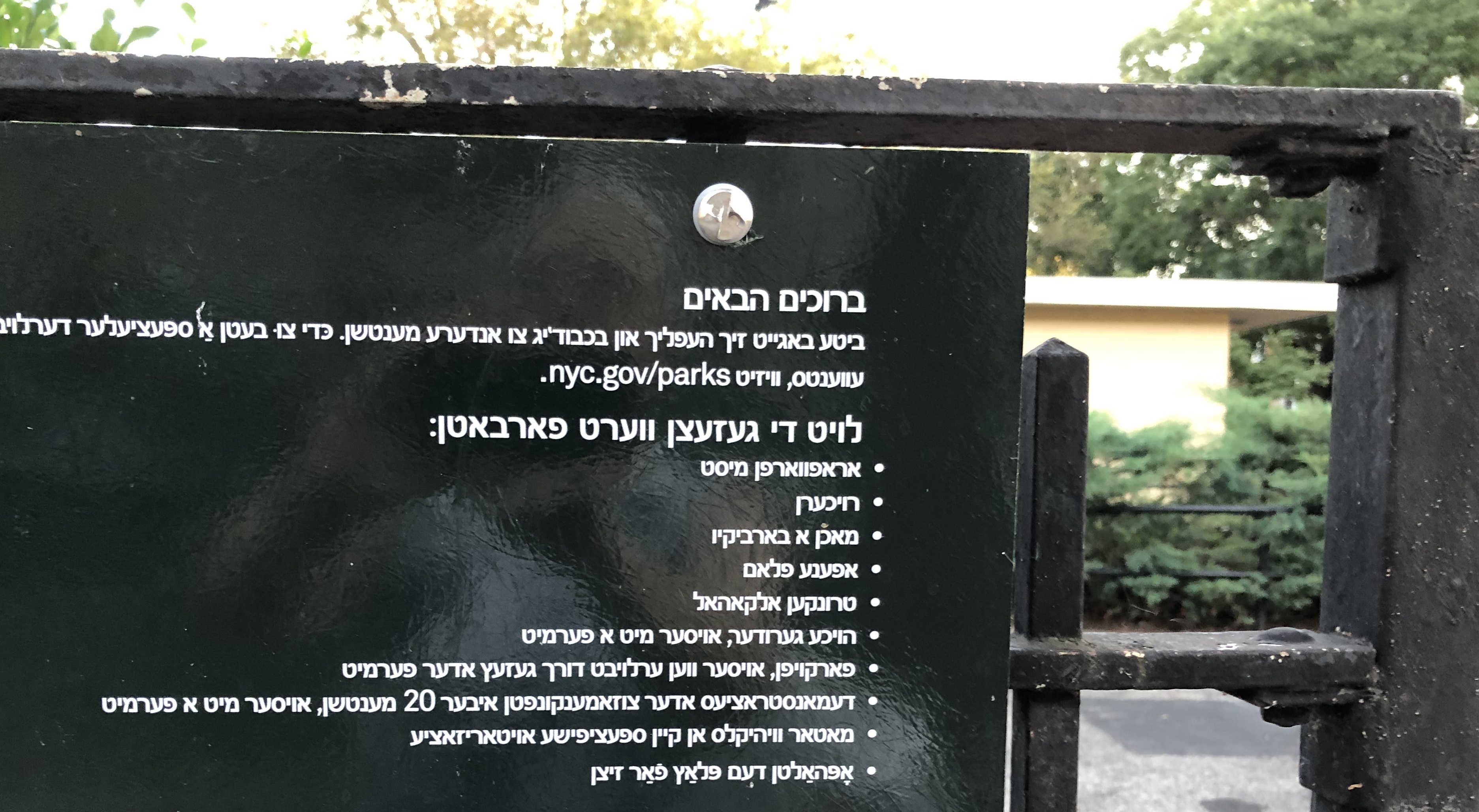
Bruchim Habayim (“Blessed are those who come”, i.e. “Welcome”)

Are we there yet?  Is this sign in Israel?

No, it’s part of a bilingual sign welcoming people to Saratoga Park in Brooklyn.  We are renting an apartment across the street, for a week, before we continue our journey east.

Between Portland, Oregon and New York, New York my husband and I spent a good weekend at my sister’s house in the New England woods.

Both my sister and I are called to write.  (To find my sister’s writing, see sarabacker.com.)  We both have a passion for ethics, and a commitment to thinking things through.

For me, ethics is not a list of God-given rules, but rather a method for treating other human beings (and the whole world of living things) with respect and consideration.

So this week I polished up an essay I wrote nine years ago on Moses’ ritual for dedicating oneself to good behavior.  Here’s the link:  Ki Tavo: Cursing Yourself.

Ki Tavo: A Perishing Aramean

Still life by Caravaggio, 1605

Do we own land, prosper in business, or put food on the table entirely because of our own efforts?  The book of Deuteronomy/Devarim says no.  Moses tells the Israelites that they will conquer Canaan only with God’s help.  (See my post Re-eih: Ownership.)  Then they will acquire cities, houses, and farms that other people built.  (See my post Eikev, Va-etchannan, & Noach: Who Built It?)  After that they will build more houses, and all their enterprises will prosper, making their wealth increase.  Moses predicts they will then forget God, and think:

“My ability and the power of my hand made me this wealth.”  Then you must remember God, your God, who gives you the ability to make wealth …”  (Deuteronomy 8:11, 17-18)

Furthermore, the Israelites must not confuse taking possession of land, or inheriting it from their fathers, with actual ownership.1

Hey!  The heavens and the heavens of the heavens, the land and everything in it, belongs to God, your God.  (Deuteronomy 10:14)

*

In this week’s Torah portion, Ki Tavo (“When you come”), Moses prescribes an annual ritual to thank God for the land we pretend we own, and for the harvest we pretend comes exclusively from our own labors.

Bible card by Providence Lithograph Co., ca. 1900

You shall take some of the first of every fruit of the earth that you bring in from your land that God, your god, is giving to you.  And you shall place them in a basket and go to the place that God, your God, will choose to let [God’s] name dwell.  (Deuteronomy/Devarim 26:2)

The place that “God will choose” is Jerusalem.2  The head of each household brings the basket to the temple. and affirms that the land on which his family grew the fruits is a gift from God.

And you shall come to whoever is the priest in those days, and you shall say to him: “I declare today to God, your God, that I came to the land that God swore to our forefathers to give to us.”  (Deuteronomy 26:3)

The priest sets the basket in front of the altar.

And you shall respond, and you shall say in front of God, your God: “Arami oveid avi.  And he went down to Egypt and he sojourned there with few men, but he became there a nation great and powerful and populous.”  (Deuteronomy 12:4-5)

Arami (אֲרַמִּי) = a male Aramean, a man from the country of Aram (roughly corresponding to present-day Syria).

oveid (אֺבֵד) = wandering lost; being ruined; perishing.  (Oveid is the kal participle of the verb avad, אָבַד, and implies that the subject is lost, ruined, or perishing.)3

avi (אָבִי) = my father, my forefather.

Who is the Arami?  The book of Genesis/Bereishit tells us that Abraham lives in the Aramean city of Charan (also called Paddan-Aram) before God tells him to go to Canaan.  Later in Genesis, Abraham’s grandson Jacob flees to Charan and lives there with his uncle Lavan for 20 years before returning to Canaan.  So we have three candidates for the Aramean in this declaration: Abraham, Lavan, or Jacob.  And only two of those, Abraham and his grandson Jacob, qualify as a forefather of the Israelites.

Rashi4 identified the Arami as Lavan and the avi as Jacob.  His interpretation, “Lavan sought to uproot everyone [all Jews] as he chased after Jacob,” requires translating Arami oveid avi as “An Aramean was ruining my forefather.”  But oveid cannot mean “ruining”, only “being ruined”.(see 3)  Furthermore, Biblical Hebrew grammar allows for an implied verb “to be” anywhere in the phrase Arami oveid avi, but not for the Arami to be the subject doing something to avi as a direct object.5  So Arami and avi must be the same person.

Rashbam6 recognized this, and identified the person as Abraham.  He associated oveid with wandering when one is exiled from one’s own land, and rephrased Arami oveid avi as “My father Abraham, an Arami was he, oveid and exiled from the land of Aram.”  Then he cited Genesis 12:1, where God tells Abraham: “Go forth from your land and from your relatives and from your father’s house to the land that I will show you.”  If Aram is Abraham’s own land, Rashbam must have reasoned, then in Canaan he is an exile.

Calling Abraham an exile seems like a stretch to me.  Abraham hears God and decides to leave.  He brings along his wife, his nephew, the people who work for them, and the wealth he has accumulated in livestock and goods.  It sounds like a comfortable emigration.

Rashbam’s explanation also fails to account for the sentence immediately following Arami oveid avi in Deuteronomy 12:5 above.  Abraham and his household do visit Egypt, but the same group returns to Canaan after a very short sojourn there.  They may pick up a few Egyptian slaves, but Abraham’s returning household is far from being “a nation great and powerful and populous”.

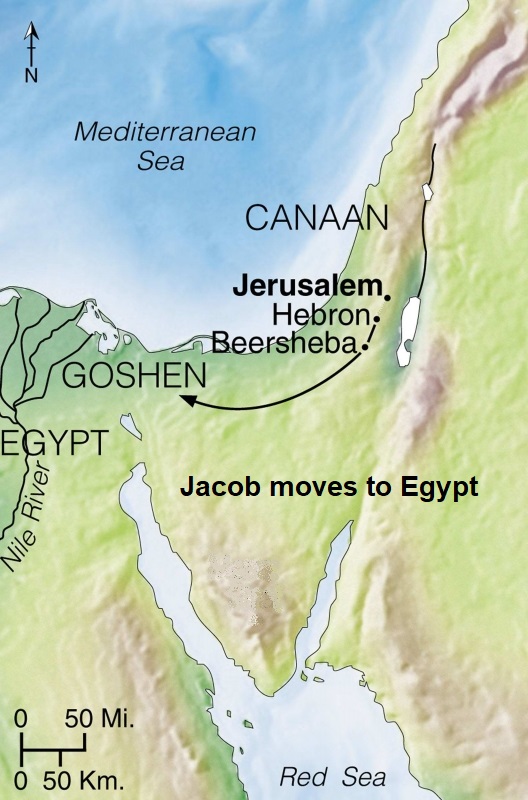
That leaves Abraham’s grandson Jacob as the Arami who is the speaker’s forefather.  Jacob, a.k.a. “Israel”, moves to Egypt to join his son Joseph and brings along 66 of his descendants, not counting the wives of the adult men.7  These “children of Israel” stay in Egypt for 430 years.8  When they leave in the book of Exodus, there are “about 600,000 men on foot” along with their families and fellow travelers9—enough to count as a nation in the Ancient Near East.  The sentence following Arami oveid avi fits only Jacob.

If Jacob is the Aramean and “my forefather”, why is he called oveid?  The translation of oveid that best describes Jacob’s life at the time he emigrates to Egypt is “perishing”, since he and his extended family are suffering through a second year of famine in Canaan.  Therefore, Arami oveid avi should be translated: “A perishing Aramean was my forefather”.

A man bringing his first fruits to the temple does identify himself as an Israelite with these three words, but it would be simpler to say “Jacob is my forefather” or “Israel is my forefather”.  The clause Arami oveid avi acknowledges two other things: that his ancestors had not always lived in Canaan/Judah, and that at a critical time they were perishing in a famine.  Remembering these things, the farmer is more likely to feel grateful that God gave the Israelites land, and that the God who makes famines has provided him with agricultural abundance.

*

The recitation and ritual actions continue in this week’s Torah portion without mentioning that they are part of Shavuot, one of the three annual pilgrimages to Jerusalem dictated in the Torah.  In Exodus 34:22 Shavuot is described as a celebration the first fruits of the wheat harvest, and in Numbers 28:26 Shavuot is identified as the “Day of First Fruits” (Yom Habikkurim).

But the recitation beginning Arami oveid avi has also become part of Passover/PesachIn 220 C.E., when Judah HaNasi recorded the Mishnah (the core of the Talmud), the farmer’s declaration before the priest was already included in the seder (the Passover service at home around the table).10  It still is.

Arami oveid avi is a humbling opening line.  If God could let Jacob, one of God’s favorite people, come close to perishing of hunger, any of us might be ruined.  And every human being will eventually perish from this earth.

Yes, while we are alive we must cultivate our crops.  Our own efforts are necessary, but not sufficient, for prosperity; other necessary factors are out of our hands.  The good life is a fragile and temporary blessing.

May we notice the first fruit of every blessing in our lives, and express our gratitude.

(An earlier version of this essay was published in September 2011.)

  1. The real owner of the land is also revealed in Leviticus 25:23, when God declares: “But the land must not be sold to forfeit reacquisition, because the land is Mind; for you are resident aliens with Me.” (See my post Behar: Owning Land.)
  2. Modern critical scholars agree that the earliest form of book of Deuteronomy was written no earlier than the 7th century B.C.E., after the northern kingdom of Israel had been wiped out by the Assyrians, and the only remaining Israelite kingdom was Judah, with its capital and temple at Jerusalem.
  3. The piel participle, me-abeid (מְאַבֵּד = giving up as lost, ruining, letting perish) implies that the subject is abandoning, ruining, or destroying someone else.)
  4. Rashi is the acronym for 11th-century rabbi Shlomoh Yitzchaki.
  5. In Biblical Hebrew, if avi were a definite direct object instead of a subject, it would be preceded by the word et (אֶת).
  6. Rashbam is the acronym for Rashi’s grandson, the 12th-century rabbi Shmuel ben Meir.
  7. Genesis 46:26.
  8. Exodus 12:40. (In Genesis 15:13 God predicts it will be 400 years.)
  9. Exodus 1:7, 12:37-38.
  10. Talmud Bavli, Pesachim 116a, Mishnah.

Ki Tavo & Ki Teitzei: You Are What You Wear, Part 2

A person’s inner state and outer garment should match, according to the Torah.

And God said to Moses: Go to the people and consecrate them, today and tomorrow, and they shall wash their semalot. Then they shall be ready for the third day, for on the third day God is coming down before the eyes of all the people on Mount Sinai. (Exodus/Shemot 19:10-11)

semalot (שְׂמָלוֹת) = plural of simlah (שִׂמְלַה) = a long, loose outer garment resembling a caftan or cloak. (A variant spelling is salmah (שַׂלְמָה), plural salmot (שַׂלְמֹת).)

If you are consecrated, made holy enough to behold God, then your simlah must also be purified. Although men remove their semalot to do physical labor, stripping down to a less bulky garment underneath, the Israelites in the Bible wear their semalot for public appearances, as well as for protection from wind, sun, and rain. At night one’s simlah serves as a blanket.

Three of the laws in last week’s Torah portion, Ki Teitzei, assume every individual has the right to a simlah. Even an impoverished debtor and a captive of war must be allowed to sleep in their semalot. Depriving someone of a simlah would not only expose them to the elements, but deprive them of human dignity. (See my post Ki Teitzei: You Are What You Wear, Part 1.)

Two other laws in the portion Ki Teitzei (4 and 5 below) show how a simlah can reveal something about the essential nature of the person who wears it. And this week’s Torah portion, Ki Tavo (“When you enter”), ends with miraculous semalot that reveal the nature of humankind.

  1. Abominable or godly?

One of the laws about the simlah in Ki Teitzei has become notorious:

The equipment of a man shall not be on a woman, and a man shall not put on the simlah of a woman, because anyone doing this is to-eivah to God, your God. (Deuteronomy/Devarim 22:5)

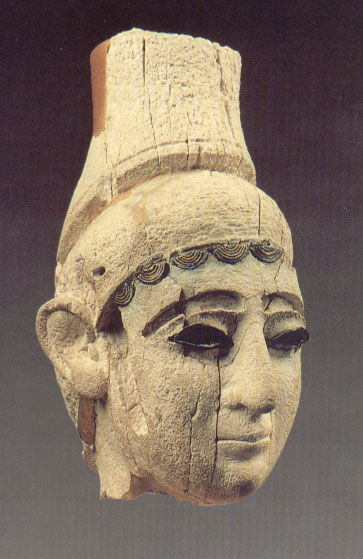
Head of a prince or princess from Ugarit, 13th century B.C.E.

to-eivah (תוֹעֲבַה) = abhorrent, abominable, anathema.

The first clause in this verse may be a reaction against a Canaanite myth (discovered in the ruins of Ugarit) about Paghat, a young woman who wears weapons under her female clothing and sets out to avenge her brother’s murder.1 The Bible frequently denounces Canaanite religions, and the Talmud (Nazir 59a) agrees that the “equipment of a man” consists of weapons of war.

The second clause in the verse may be a reaction against a Canaanite practice in which male temple functionaries cross-dressed and offered themselves as surrogates for gods in homosexual religious acts. According to the Bible, this happened even at the Temple in Jerusalem until King Josiah put an end to it.2

A man wearing a woman’s simlah may be to-eivah because the only men who appeared that way in public were those paid for sexual rituals from another religion—a practice God clearly abhors according to a later law in Ki Teitzei:

No daughter of Israel shall be a female religious prostitute, and no son of Israel shall be a male religious prostitute. You shall not bring into the house of God, your God, the fee of a harlot [female prostitute] or the price of a dog [male prostitute] for any vowed offering, because both of them are to-eivah to God, your God. (Deuteronomy 23:18-19)

Nevertheless, for more than two millennia people have used the law in Ki Teitzei about cross-dressing to promote the traditional gender roles in their own societies. (See my post Ki Teitzei: Crossing Gender Lines.)

Today many people reject the idea that every individual must squeeze into one of two gender roles defined by a particular society. Some individuals in the 21st century C.E. choose apparel that blurs gender lines in order to reveal their own nuanced identities.

In the 7th century B.C.E. kingdom of Judah, a man who wore the simlah of a woman also revealed an essential part of his identity: he was dedicated to gods other than the God of Israel, and he served these gods by providing ritual sex for worshipers.

  1. Fraud or honesty?

The remaining law in Ki Teitzei that mentions a simlah is about the virginity of a bride. It begins:

If a man takes a wife and he comes into her, and then he hates her, and he brings charges against her and gives her a bad name, and he says: “I took this woman, and I approached her, but I did not find evidence of virginity in her!”— (Deuteronomy 22:13-14)

Detail of “Hymen” by Marc Chagall

This was a serious charge in ancient Judah. A marriage was a contracted alliance between two households. The legal contract included the dowry paid to the groom’s household, and the bride-price paid to the bride’s household. When the bride and groom had intercourse, the marriage was completed. The bride (but not the groom) was expected to be a virgin (unless the contract stipulated otherwise).

So if a man claimed, after the wedding, that his bride was not a virgin, he was not only defaming her and her parents, but also suing her family for contract fraud. If the village elders ruled in his favor, he got a divorce, the bride (if she was permitted to live4) became unmarriageable, and the bride’s father had to return the bride-price to the groom. The grooms’ household, on the other hand, got to keep the dowry, the bride price, and the family’s good name.3

What if a groom tells a lie in order to get a divorce with a lucrative financial settlement? Then, according to Ki Teitzei, the bride’s parents should bring “evidence of the girl’s virginity” to the elders sitting as judges, and the bride’s father should say:

“But this is evidence of the virginity of my daughter!” And they shall spread the simlah before the elders of the town. (Deuteronomy 22:17)

The evidence is the simlah the bride wore on her wedding night. When the couple goes to bed, she lies on top of her own simlah—and leaves a bloodstain if her hymen breaks.

In much of the ancient Near East, a bride’s parents collected her wedding simlah the morning after—just in case they would need to display it.

The law in Ki Teitzei affirms that a bloodstained simlah is evidence of virginity, and punishes the lying husband. He is flogged; he pays 100 shekels of silver to the bride’s father (to compensate for impugning his honor); and he may never divorce the bride.

The good name of the bride’s family is restored. The bride herself at least has the consolation of a salvaged reputation and a guaranteed home (even if she might prefer to be the property of a different man).

Thus the condition of the bride’s simlah proves something about her character: she was honest when she affirmed she was a virgin.

  1. Natural or miraculous?

At the end of this week’s Torah portion, Ki Tavo, Moses quotes God:

“And I led you forty years through the wilderness. Your salmot did not wear out upon you, and your sandal did not wear out upon your foot. Bread you did not eat, and wine or alcohol you did not drink, so that you would know that I, God, am your God.” (Deuteronomy 29:4-5)

During their 40 years in the wilderness, the Israelites did not need to grow grain and grind it into flour; manna miraculously appeared every morning. They did not need to cultivate grapes and make wine; God provided fresh drinking water in the desert. They did not need to make leather for sandals, or weave cloth for semalot; God continuously renewed their clothing.5

Instead, the Israelite women wove cloth to make God’s sanctuary. All the weavers were generous volunteers.6  And God generously volunteered the small miracles that kept the people clothed and fed. All God wanted was acknowledgement “he” was their god.

The Israelites in the books of Exodus and Numbers did praise God for saving them at the Reed Sea and for giving them victories in battles. But in ordinary daily life, they complained about the food, were impatient when they ran out of water, and did not even notice the condition of their semalot.

Moses introduces God’s words at the end of Ki Tavo by saying:

But God did not give you a mind to know, or eyes to see, or ears to hear, until this day. (Deuteronomy 29:3)

Only at the end of 40 years in the wilderness to the people notice God’s daily generosity.

The portrayal of God’s character must be taken with a grain of salt. The Torah sometimes portrays God as a patient parent, sometimes as an angry mass murderer. This is the result of trying to explain everything in terms of an anthropomorphic god.

Yet the passage at the end of Ki Tavo does offer insight into the character of human beings. Human nature takes good situations for granted—until we are deprived of them, or until we grow wise enough to see how fragile our lives are. To find that wisdom—a mind to know, eyes to see, ears to hear—might take 40 years. And we cannot force ourselves to become wise.  It comes as a gift.

  1. She emerges, dons a youth’s raiment, puts a k[nife] in her sheath. A sword she puts in her scabbard, and over all dons woman’s garb. (“The Tale of Aqhat”, The Ancient Near East, Vol. 1, by James B. Pritchard, Princeton Univ. Press, 1958, p. 132)
  2. And he smashed the houses of the male religious prostitutes that were inside the house of God, where the women wove fabrics for Asherah. (2 Kings 23:7).  The book of Deuteronomy was probably written during the reign of King Josiah (640-609 B.C.E.), and encouraged his campaign to wipe out the practice of other religions in Judah.
  3. Victor H. Matthews & Don C. Benjamin, Social world of Ancient Israel 1250-587 BCE, Hendrickson Publishers, Peabody, Mass., 1993, p. 127-128.
  4. But if this charge is true, evidence of the girl’s virginity was not found, then they shall bring the girl out to the entrance of her father’s house, and the men of the town shall stone her with stones. And she will die because she did a serious offense in Israel, fornicating in the house of her father. (Deuteronomy 22:20-21)
  5. Deuteronomy 8:2-6 and Nehemiah 9:20-21 report similar miracles. (See my post Eikev: Not by Bread Alone.)
  6. Exodus 35:20-29.

Haftarat Ki Tavo—Isaiah: A Place for Feet

Every week of the year has its own Torah portion (a reading from the first five books of the Bible) and its own haftarah (an accompanying reading from the books of the prophets). This week the Torah portion is Ki Tavo (Deuteronomy 26:1-29:8) and the haftarah is Isaiah 60:1-22.
by Michelangelo
Sistine Chapel ceiling, by Michelangelo

A popular image of God is of an old man with a beard, floating in the sky and stretching out his hand like the God that Michelangelo painted in the Sistine Chapel. But the Hebrew Bible never mentions a beard in connection with God. 

“By the hand of God” appears all over the Bible, but it is simply an idiom for “through the agency of God”.  Sometimes a deed is accomplished by the hand of a human being, sometimes by the hand of God.

In the Bible, the most common anthropomorphic image of God is of someone enveloped in robes, sitting on a throne. The face is too bright to be seen, and the hands are not mentioned. But sometimes the feet are.

Divine feet

The feet of God appear in this week’s haftarah, where second Isaiah encourages the exiles in Babylon to return to Judah and rebuild Jerusalem.  God tells Jerusalem that someday the other nations, from Sheba to the Phoenician cities of Lebanon, will bring tribute to her.

            The magnificence of the Lebanon will come to you,

            All its juniper, fir, and cypress,

            To beautify the place of My holy site;

            And the place of My raglayim I will honor.  (Isaiah 60:13)

raglayim (רַגְלַיִם) = pair of feet. (From regel, רֶגֶל = foot. Regalim, רְגָלִים = feet (more than two); times, occasions.)

The Babylonian army had burned the First Temple to the ground when it captured Jerusalem and deported its leading families to Babylon in 589-587 B.C.E.  But in 535 B.C.E., the Persian king Cyrus captured Babylon and decreed that all of its foreign populations were free to return to their former homes and worship their own gods. Some of the exiled Israelites were skeptical about going.  So in this week’s haftarah, God promises that once the Israelites build a new temple in Jerusalem, God will honor it as the place of the divine presence. Second Isaiah refers to God’s presence in terms of both God’s light and God’s raglayim.

The most stunning appearance of God’s feet is in the book of Exodus/Shemot, when 74 people climb halfway up Mount Sinai.

Then they went up, Moses and Aaron, Nadav and Avihu, and 70 of the elders of Israel.  And they saw the God of Israel, and beneath his raglayim it was like a making of bricks of sapir and like an image of the sky for purity.  (Exodus/Shemot 24:9-10)

sapir (סַפִּיר) = a blue precious stone. (From the same root as safar (סָפַר) = counted up, and seifer (סֵפֶר) = scroll, document, book.)

Do the 74 Israelites actually see human-shaped feet against the bright blue sky?  Is it a shared vision in a dream state?  Or do they see something indescribable, which Exodus tries to capture with the metaphors of feet (suggestive of footsteps), sapir (suggestive of writing) and sky (which is also the word for heavens)?

Baal Preparing Thunder & Lightning
Baal Preparing
Thunder and Lightning

Four other references to God’s feet are based on descriptions of Baal the storm-god in other Canaanite religions. For example:

            And He bent down the sky and descended,

            And a thick fog was beneath his raglayim(Psalm 18:10)

Did the original poets who invented these descriptions believe that Baal actually had feet and stood on the clouds, or were they simply writing poetry?  What about the poets who applied those descriptions to the God of Israel?

The Bible does use raglayim for several idioms involving human beings. When a man’s foot slips or stumbles, it means he is straying from the path of righteousness. Raglayim also appears as a euphemism for genitals, and even urination. In another biblical idiom, when person A bows at the raglayim of person B, it means that A submits to B’s authority.  An example occurs in this week’s haftarah immediately after the verse about God’s feet.

            And they will walk to you bowing,

            The children of your oppressors.

            And they will bow down at the soles of your raglayim,

            Everyone who used to scorn you.

            And they will call you City of God,

            Zion, Holy of Israel.  (Isaiah 60:14)

Here the prophet pictures people from foreign countries coming to Jerusalem and bowing at the feet of the city personified, or her people.

Pharaoh Tutankhamun's throne and footstool
Pharaoh Tutankhamun’s throne and footstool

Bowing to a footstool

People bow down to the ground to honor God throughout the Hebrew Bible, but they never bow to God’s feet. They do, however, bow down to God’s footstool in the Psalms.

            Let us enter His sanctuary.

            Let us bow down to His hadom-raglayim.

            Arise, God, to your resting-place,

            You and the ark of Your power!  (Psalm 132:7-8)

hadom-raglayim (הֲדֺם־רַגְלַיִם) = the stool for a pair of feet; footstool. (Used in the Bible five times in reference to God, and once in Psalm 110:1 in reference to King David.)

In Psalm 132:7 God’s footstool is the ark inside the sanctuary. In Psalm 99:5 and 1 Chronicles 28:2 it seems to be the whole sanctuary. In Lamentations 2:1 God’s footstool is Zion or Israel in general. In second Isaiah, the idea of God’s footstool expands along with the idea of God:

Thus said Hashem:

            The heavens are My throne

            And the earth is My hadom-raglayim.

            Where is this house that you will build for Me?

            Where is this place, my resting-place?

            All these were made by My hand,

            So all these came into being

                        —declares God.  (Isaiah 66:1-2)

Becoming a footstool

This week’s haftarah is the sixth of seven readings from second Isaiah called the seven haftarot of consolation. Each one gives us a different view of God, either by shaking up one of the traditional beliefs about a local, anthropomorphic God or by expanding on the concept of a single abstract God for the whole universe.

How can we interpret the line “And the place of My raglayim I will honor” in this haftarah?

God is addressing Jerusalem—but not the ruined houses and broken stones of the old city in the hills of Judah.  God is really addressing the people of Jerusalem, the exiles who feel ruined and broken in Babylon. Now they have a chance to go home and rebuild. Now the people can make themselves into a holy footstool, a hadom-raglayim, for God.

Then will they see God’s feet over their heads?  No. In the rest of this week’s haftarah second Isaiah describes God’s presence in terms of light, not body parts.  The haftarah begins:  Arise, shine, for your light has come.  (See my earlier post, Haftarah for Ki Tavo—Isaiah: Rise and Shine.)

After God promises to honor the temple as if God’s feet rested there, the haftarah says:

            God will be for you an everlasting light;

            And your God will be your splendor.  (Isaiah 60:19)

The presence of God is more like light than like a robed figure with feet.  And if you make yourselves a holy community, the light of God will shine through you.