Eikev: Not by Bread Alone

by Melissa Carpenter, Maggidah

“Man does not live by bread alone” is an old-fashioned aphorism in English, indicating that human beings also have essential spiritual needs. Christian English-speakers trace it to Matthew 4:4, where Jesus quotes it to Satan. But the original source is in this week’s Torah portion, Eikev (“on the heels of”), when Moses warns the Israelites that when they take over Canaan, they must remember what they learned in the wilderness.

bagel

And you shall remember the entire way that God, your god, made you walk these 40 years in the wilderness in order to anotekha, to test you, to know what was in your heart: Would you observe [God’s] commandments or not? So [God] anotekha and let you go hungry and fed you the manna, which you did not know and your fathers did not know, in order to let you know—that not by bread alone does the human live; rather, the human lives on everything that comes out of the mouth of God. (Deuteronomy/Devarim 8:2-3)

anotekha (עַנֹּתְךָ) = humble(d) you, humiliate(d) you, impoverish you, deprive(d) you of all independence.

This is a new reason for keeping the Israelites in the wilderness for 40 years.  In the book of Numbers/Bemidbar, the wilderness time was prolonged from two years to forty when the people first reached the southern border of Canaan and refused to cross it.  (See my post on the story of the scouts: Shelach-Lekha: Mutual Distrust.)

God decided then that the people would spend an additional 38 extra years in the wilderness, until the generation that refused to cross into the “promised land” had died out.  Now, in Deuteronomy, Moses reveals another reason for the extra 38 years: so that the new generation would be tested.

Testing: Shabbat

Back in the book of Exodus/Shemot, the people journeyed for a month and a half after leaving Egypt without running out of food. Then halfway between the oasis of Eylim and Mount Sinai they complained of a famine.

This seems like an odd complaint for people who are traveling with large herds of milk-producing animals. Did their cows, ewes, and nannies all dry up at once?  Was there an unrecorded rule that they could not slaughter any of their livestock for food until after God gave them the rules for animal offerings? God must have done something to the Israelites’ walking food supply, since this week’s Torah portion says God let you go hungry and fed you the manna”.

from Maciejowski Bible, circa 1250 C.E.
Manna, Maciejowski Bible,
circa 1250 C.E.

In Exodus,

God said to Moses: Here I am, raining down for you bread from the heavens. And the people shall go out and gather up the day’s worth on its day, so that I can test them: Will they go by my teaching or not? (Exodus/Shemot 16:4)

Manna began appearing on the ground every sunrise, looking like tiny white seeds. Unlike any other food the Israelites had known, manna melted in the sun, and rotted when people tried to keep it overnight in their tents. They could cook and eat only one day’s portion for each person—except on the sixth day of the week. On that day only, they were able to cook or bake a double portion of manna, and follow God’s commandment to rest on the seventh day, Shabbat.

The first phase of the test was whether people would go out to gather manna on Shabbat. Some people did, hoping to hoard their extra one-day portion of cooked or baked manna. But the ground was bare on Shabbat, and they had to eat the manna they had saved.  They could never get ahead.

Testing: Dependence

The manna continued the rest of the time the Israelites lived in the wilderness, but the test changed. If the first phase was to train people to observe Shabbat, the second phase focused on the people’s dependence on a food that they were powerless over.

In this week’s Torah portion, Moses says twice that God anotekha: humbled you or humiliated you. Moses is addressing the adult children of slaves, who were never as independent as the free and wealthy. But at least the slaves had procured their own food. Now all the adults were as dependent on manna as an infant is on its mother’s milk.

From one point of view (particularly among men used to ruling their own households) this was a form of humiliation. From another point of view, it was a reminder of humankind’s dependence on God’s gifts. The manna tested which point of view each person would take—so they would know what was in their heart.

God humbled—or humiliated—the Israelites by making them dependent on manna, Moses says, …in order to let you know that not by bread alone does ha-adam live; rather, on everything that comes out of the mouth of God ha-adam  lives. (Deuteronomy 8:3)

In context, this statement means:

1) Humans cannot live on what we make for ourselves (such as bread); we can live only because of everything God gives us (which may include the grains, rains, and brains required to make bread—or may include some other food).

2) Humans depend on God not only for food, but also for everything else God calls into being to sustain us. In the book of Genesis, this “everything” includes companionship (It is not good for the human to be alone (Genesis 2:18), language (and whatever the human called each living creature, that was its name (Genesis 2:19), and the ability to learn from tests.

For 40 years in the wilderness, God trained the Israelites to accept their utter dependence on God for everything in life. At the same time, God insisted that the Israelites follow all the rules Moses put into words, and punished the most egregious violations with death.

This training seems designed to make people passive and submissive.  Yet when the Israelites finally did cross the Jordan and conquer Canaan, they would need to act independently, first in war and then in agriculture and commerce. Why wasn’t God training these children of slaves to take initiative and manage their own physical needs?

I would answer that all the rebellions against God and Moses indicate that the people were neither passive nor submissive by nature. Left to their own devices, they would act, not just wait for something to happen.  In fact, when they were left to their own devices while Moses spent 40 days on Mount Sinai, they took the initiative and made the Golden Calf.

The lessons the Israelites really needed, both in the wilderness and in Canaan, were that no matter what they did on their own, their very lives depended on God (or nature); and that the only route to a good life was obeying God’s rules. They had to be trained to accept whatever God gave them, so that they could love and fear (or be in awe of) their god.


We face the same test today. As adults, most of us want to take care of ourselves and avoid being dependent on other people. We may not have spent 40 years in a wilderness, but when we were children, our dependence frustrated us, and we learned that humans we depended on could suddenly be absent when we needed them.

Yet we also know that we cannot do everything on our own; we are not gods.  We will always be at least partly dependent on other people. We will always be dependent on “nature”, which we can alter somewhat for better or worse, but cannot create in the first place. And even though we can often improve our lives by taking the right actions, there will always be surprises: both bad and good things will happen that we have no control over. In a sense, we are always at the mercy of God.

Not by bread alone does a human live; rather, a human lives on everything that comes from God.

The choice we can make in our hearts is whether to feel humble or humiliated; to feel grateful for what we are given, or resentful over what we are deprived of.

After I converted to Judaism 29 years ago, I discovered that I could use prayer in order to cultivate humbleness and gratitude. Life is better that way! May each one of us find a practice that will help us to accept every test and every portion of manna that comes our way.

 

Eikev: Reward and Punishment

The oldest section of Jewish prayer services consists of the Shema and the three excerpts from the Torah that follow it. This “Shema section” became a regular part of morning and evening services about 2,000 years ago.  The Shema itself is a single sentence: Listen, Israel: God is our god, God is one. (Deuteronomy/Devarim 6:4)

The prayer service continues with Deuteronomy 6:5-9, in a paragraph sometimes called “the ve-ahavta” because it begins with the word ve-ahavta (וְאָהַבְתָּ) = And you shall love. (See my post: Va-etchannan: Extreme Love.) This first paragraph after the Shema urges individuals to remember to love God at all times.

The second paragraph, Deuteronomy 11:13-21, which comes from this week’s Torah portion, Eikev (“On the heels of”), offers reasons why the whole community must follow God’s rules. The third paragraph, Numbers/Bemidbar 14:37-41, calls for tassels (tzitzit) as a reminder to keep our attention on God. (See my post Shelach-Lekha: Glimpses of Blue.)

The second paragraph after the Shema is the most problematic of the three, because its reasons for obeying God’s rules consist of two if-then statements that are obviously untrue. It begins:

And it will be, if you [plural] truly heed My commandments that I am commanding to you today, to love God, your god, and to serve [God] with your whole levav and your whole being— (Deuteronomy/Devarim 11:13)

levav (לֵבָב) = mind, (literally “heart”), the seat of conscious thoughts and feelings.

Are the commandments in the “if” clause the whole body of law in the Torah, or just to love God and serve God with your whole mind and body? For classic commentators, it does not matter, because the way to love and serve God is to follow all of God’s commandments in the Torah. 

Hiroshige, detail
Rain by Hiroshige, detail

The next two verses promise a reward:

—then I will give rain to your land at the right time, autumn-rain and spring-rain, and you will gather your grain and your wine and your olive oil. And I will put grasses in your field for your livestock, and you will eat and you will be sated. (Deuteronomy 11:14-15)

It is a nice promise, but we all know that obeying God’s commandments does not, in actual practice, result in beneficial weather–even in Israel. For Jews outside Israel, obeying God’s commandments does not guarantee the results of beneficial weather: a full stomach and being able to live where you are.

One explanation is that we humans are so fallible, we never manage to obey all of the pertinent commandments properly; and God will not reward us if we miss the mark on even one of them. But even the God-character in the Torah, who wipes out the innocent with the guilty, is not that unreasonable.

The if-then promise is followed by an if-then threat:

Be on guard against yourselves, because if your mind yifteh, and you turn away and serve other gods and bow down to them—then the heat of God’s anger will be against you, and it will shut up the heavens, and rain will not happen, and the land will not give its produce, and you will quickly perish from the good land that God is giving to you. (Deuteronomy 11:16-11:17)

yifteh (יִפְתֶּה) = will fool itself, will be tempted, will be naïve.

However, we know that when someone succumbs to the temptation to serve other gods—either literal or figurative—drought, death, or exile do not necessarily follow.

Some commentary points out that although the ve-ahavta paragraph of the Shema addresses “you” in the singular, this second paragraph uses “you” in the plural.  God’s covenant is with all the Israelites, collectively. The more conscientious members of the community are charged elsewhere in in the Torah with preventing idolatry and improving the behavior of the slackers.

Yet bad things still happen to whole groups of good people.

And whole groups of people who fool themselves into idolatry (such as the belief that getting rich is more important than loving your fellow as yourself) still have plenty to eat.

Jews who want to believe the promise and threat in the passage from this week’s Torah portion continue to find rationalizations. Sixty years ago some religious Jews blamed their own people’s lack of perfection for the Holocaust.

Environmentalists, extending the if-then statements in this week’s Torah portion to the whole human race, have pointed out that our wanton degradation of the world’s air, water, soil, flora, and fauna result in poisoned food, sickness, and  rising sea levels, all of which can result in starvation, death, and exile. We can certainly argue that if society as a whole does not put the welfare of our planet first, then disasters will follow. And perhaps taking care of the earth is one way to love and serve God.

But it is not the only way. What about all the commandments in the Torah? What about all the other acts of kindness and right behavior we should be doing?

I believe that the two if-then statements in this excerpt from the Torah portion Eikev do not reflect literal reality, and can only be considered poetic exaggerations. Yet I also believe that loving and serving the divine does have good consequences, and letting ourselves be fooled into worshiping harmful ideologies does have bad consequences.

So I am struck by the last sentence in the excerpt from Eikev that is used as the second paragraph of the Shema. After repeating the reminders in the first paragraph to always keep “these words” in mind, the second paragraph ends:

So that your days yirbu, and the days of your children, upon the land that God vowed to your forefathers, to give to them as the days of the heavens over the earth. (Deuteronomy 11:21)

yirbu (יִרְבּוּ) = will be many, will become numerous, will increase.

“Your” and “you” in this sentence are plural.  So on a simple level, the sentence might mean “So that your people will live a long time in the land (Canaan) God promised to give your ancestors—as long as the sky is above the earth”. In other words, every individual must die, but as long as you all obey God, your people can live in Israel forever.

Maybe this promise was motivating when Deuteronomy was written (probably in the 7th century B.C.E.). But today, many Jews who choose not to emigrate to Israel need a different kind of promise.

In the 19th century, Rabbi Samson Raphael Hirsch wrote that “as the days of the heavens” means that days on earth would be like days of heaven. Following his lead, I would retranslate the sentence at the end of the excerpt this way:

“So that your days will increase in fullness and value, and so will the days of your children; and the potentials of your ancestors will be realized in you and your children; and every day on earth will be full of the divine.”

Not only is this a good reward for good behavior, but it actually works. If you keep your attention on loving and serving God—the inner divine voice, or the spirit of life, or all humanity—then your days really do improve. They may even become heavenly.

Eikev: 40 Days and 40 Nights

Moses spends most of the book of Deuteronomy/Devarim reminding the Israelites that for 40 years they have been rebelling against God and provoking God to anger. For 40 years Moses has been urging the people to change their ways and urging God not to wipe them out. After Moses dies and the people enter the Promised Land, he warns, he can no longer intercede for them.

In the middle of another harangue in this week’s Torah portion, Eikev (“on the heels of”), Moses is seized by a visceral memory from 40 years before.

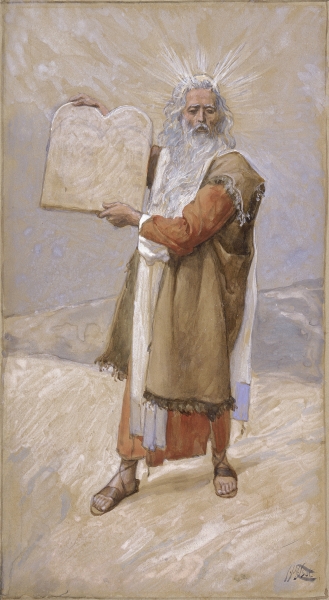
Moses and the Ten Commandments, by James J.J. Tissot, 1896

In Choreiv you provoked God, and God became furious enough to exterminate you. When I went up to the mountain to take the stone tablets of the covenant that God had cut with you, and I stayed on the mountain 40 days and 40 nights—bread  I did not eat and water I did not drink. Then God gave me the two stone tablets written by the finger of God, and on them were all the words that God had spoken with you on the mountain from the midst of the fire on the day of the assembly. And it happened at the end of 40 days and 40 nights, God gave me the two stone tablets, the tablets of the covenant. (Deuteronomy/Devarim 9:8-11)

Choreiv = dryness, drought; an alternate name for Sinai.

Moses does not mention the reams of information God gave him during those 40 days, according to the book of Exodus/Shemot: hundreds of laws, and instructions for making a portable sanctuary. What sticks in his memory—so much that he says it twice—is receiving the stone tablets after spending 40 days and 40 nights on the mountaintop with God.

The Torah often uses “40 days” or “40 years” to mean “a long time”. But the phrase “40 days and 40 nights” appears in only four stories: Noah and the flood in Genesis; Moses’ two long stints on Mount Sinai in Exodus; Moses’ recollection of that time in this week’s Torah portion in Deuteronomy; and the prophet Elijah’s stay in a cave on Mount Choreiv in Kings I.

In all of these passages, if something happens for 40 days and 40 nights, it is removed from the ordinary world.

On the last night of Moses’ first 40 days and nights on the mountaintop, God gives him the tablets. Then God tells him to hurry back down, because the Israelites have made themselves a cast-metal idol, a golden calf. In both the book of Exodus and Moses’ recollection 40 years later, God offers to wipe out those no-good Israelites and choose Moses’ descendants instead.

And God said to me: “I have seen this people, and look, it is a stiff-necked people. Leave me alone, and I will exterminate them and wipe out their name from under the heavens and make you into a greater and mightier nation than they.” (Deuteronomy 9:13-14)

In the Exodus account, Moses picks up on God’s hint and does not leave God alone. Instead, he argues that it would give God a bad reputation if God now killed the people God had personally brought out of Egypt. Only after God relents does Moses go down the mountain.

But 40 years later, Moses does not remember arguing with God. He merely says:

And I turned and came down from the mountain, and the mountain was burning with fire, and the two tablets of the covenant were in my two hands. (Deuteronomy 9:15)

His sensory impressions—the fire on the mountain, the stone tablets in his hands—come back to Moses so vividly that he misses an opportunity to remind the Israelites that he intervened for them again. He only remembers and patches it into his story later.

As Moses tells the story in this week’s Torah portion, he saw the people carousing in front of the golden calf, smashed the stone tablets, then went back up the mountain for another 40-day fast in order to appease God.

I grasped the two tablets and threw them from my two hands and shattered them before your eyes. Then I fell down before God, like the first time, 40 days and 40 nights—bread  I did not eat and water I did not drink—because of all your offense that you committed, doing what was bad in God’s eyes, angering God. (Deuteronomy 9:17-18)

Moses backtracks briefly, remembering that he ground the calf into gold dust. But he does not mention all the other things he did according to Exodus before climbing the mountain again, including ordering the Levites to kill about 3,000 men who worshiped the golden calf, and asking God to either bear with the offending Israelites or erase Moses from God’s book.

What matters to Moses is that he spent another 40 days and 40 nights with God on the mountaintop.

According to Exodus, during that that time Moses saw God’s back, hear God describe Itself, bargained some more, and received more laws. Then God told him to write the words of the Ten Commandments on the stone tablets, which Moses did.

In Deuteronomy, Moses does not mention any of this, not even seeing God’s back! But he repeats three times that he stayed before God on the mountain a second time for 40 days and 40 nights. And in Moses’ memory, he made an ark for the tablets, but God carved the words into the stone.

And God wrote on the tablets, like the first inscription, the Ten Commandments that God spoke to you on the mountain from the midst of the fire on the day of the assembly, and God gave them to me. Then I turned and came down from the mountain, and I put the tablets in the ark that I had made, and they were there, as God had commanded me. (Deuteronomy 10:4-5)

Moses brings up the 40 days and 40 nights one more time before he returns to preaching.

And I, I stood on the mountain, as on the first days, 40 days and 40 nights, and God listened to me this time as well, and God did not want to exterminate you. God said to me: Get up, go on the journey in front of the people… (Deuteronomy 10:10-11)

Moses’ overriding memories of “40 days and 40 nights” and “two stone tablets could be considered a distraction from his point that the Israelites rebelled against God even at Mount Sinai/Choreiv, and Moses kept on interceding for them. Maybe now that he is 120 years old, Moses’ mind is wandering.

Or maybe these are the two most important things in the story after all:

1) The basic rules for human behavior are written in stone. Even if you shatter them, they will return.

2) When you spend 40 days and 40 nights above the world, like Noah in his ark or Moses on the mountain, you may be so high you forget to eat and drink. But God will bring you back down to deal with life on the ground, life with other people.

Eikev: Covered Heart, Stiff Neck

Some common Biblical Hebrew metaphors seem straightforward to English-speakers, some need only a little explanation, and others seem bizarre. The name of this week’s Torah portion, Eikev, is an easy metaphor. The word means “on the heels of”, and this makes sense to English-speakers in a fairly literal translation of the first sentence of the portion:

It will happen, eikev your listening to these laws, that if you keep and perform them, then God, your god, will keep for you the covenant and the kindness that He swore to your forefathers. (Deuteronomy/Devarim 7:12)

eikev (עֵקֶב) = on the heels of, as a consequence of.

Later in this Torah portion, we get the following sentence:

You must circumcise the foreskin of your leivav, and you must not stiffen your oref again. Because God, He is your god, the god of gods ... (Deuteronomy 10:16-17)

leivav (לֵבָב) = heart, thoughts and feelings, seat of consciousness, mind.

oref (עֺרֶף) = nape, neck, back of the neck

Most English speakers think that stiff-necked means stubborn, and that is certainly part of its meaning in Biblical Hebrew. But in the Torah kasheh-oref (“stiff of neck”) and related phrases have a more specific meaning.

The first time the Torah refers to a stiff neck is right after God has given Moses the two tablets of commandments on Mount Sinai.  God tells Moses that the people below have made and bowed down to a golden calf, and calls them stiff-necked— meaning that they are stubbornly reverting to the old-time religion of Egypt.

Necks are called stiff or hard 19 times in the Torah, and 18 of those references either accuse or warn descendants of the children of Israel regarding their attitude toward God.  Being stiff-necked is associated with deliberately disobeying God— by worshiping other Gods, or by refusing to listen to God, or by refusing to follow God’s laws.

The Torah also has nine references to turning one’s neck to someone. Since the word oref really means the back of the neck, it is not surprising that this Hebrew metaphor covers two English metaphors: turning your back on someone, and turning tail to flee. Perhaps stiff-necked people are those who stubbornly turn their backs on God.

The only time the Torah uses the concept of a stiff neck a different way is in Proverbs 29:1:  Reprimands make a man stiff-necked; suddenly he cracks, and there is no healing.  (If only Moses had known that, it might have been easier for him to lead the Israelites across the wilderness.)

In this week’s Torah portion, when Moses tells the people not to stiffen their necks again, he means that they must not  deliberately turn away from their own religion again.  But what does he mean when he says “You must circumcise the foreskin of your heart“?

The Hebrew word levav does mean the organ that pumps blood, but this literal meaning leaves us with a horrific image of open-heart surgery. In the Torah and Talmud, the heart is also the seat of our stream of consciousness, all our thoughts and feelings. In many Torah passages, a more accurate translation of levav would be “mind”. I usually prefer to keep the original metaphors in my translations from the Torah, but if I retranslate Deuteronomy 10:16 with the words levav (heart) and oref (back of the neck) changed into their implied meanings, here is what we get:

You must circumcise the foreskin of your mind, and you must not stubbornly reject [God] again. 

Then what does it mean to circumcise the foreskin of your mind? The 15th-century rabbi Ovadiah Sforno wrote that the Torah is asking us to remove the covering over our intelligence, by examining our thinking for errors that lead to false beliefs. Eliminating these errors of thought will remove the barrier between our minds and God.

The 19th-century rabbi Samson Raphael Hirsch proposed a harsher interpretation: our thoughts and desires are unruly, so we must gain mastery over them. Once we subordinate our hearts/minds to our real selves, we become able to subordinate ourselves to God.

Circumcision is certainly removing a covering (though what remains is rarely associated with intelligence, today). When Moses describes himself at the burning bush as someone with uncircumcised lips, he implies that an insensitive covering, literal or metaphorical, prevents him from speaking well.

I suppose circumcision can also be seen as a form of discipline; the ancient Israelites did view uncircumcised Greeks and Romans as licentious. But in the Torah, literal circumcision is primarily a sign of the covenant between the Israelites and God, the covenant first ratified by Abraham. Thus circumcisizing your heart is also a metaphor for making a covenant with God–not just with your actions, but with your inner mind.

It is hard enough to obey the rules laid down by your religion (particularly if you are an orthodox Jew facing a list of 613 commandments).  But is it even possible to cut away anything unholy from your innermost thoughts and feelings?

All too often, when we examine our own minds and judge the contents, we reprimand ourselves harshly.  Then we react to our own harshness either by rebelling against our superegos and stiffening our necks (perhaps like the man in the verse from Proverbs above); or by wrapping ourselves in suffocating layers of blame and depression, and sometimes covering that over with denial. It is as if, having peeled back the foreskin over our minds and peeked inside, we then add layer upon layer of extra skin, so we will not see our true inner minds again.

How can we uncover our hidden feelings and beliefs, and leave our minds open and able to grow? I think we need to relax our necks first. We need to be flexible, willing to turn around, to reconsider. Then, if we approach our inner selves either dispassionately or with kindness, instead of with reprimand and blame, we can choose to turn toward the good and the holy. Once we are turning toward God, instead of stubbornly turning our backs on God, then the coverings that have kept us out of a covenant with the divine might not even need to be cut. The barriers might softly fall away.

Or maybe that’s a woman’s point of view, and men need to tame their testosterone drive with a metaphorical circumcision of their hearts!  What do you think?

Va-etchanan: Extreme Love

Ve-ahavta God, your God, with all your heart and with all your soul and with all your uttermost. (Deuteronomy/Devarim 6:5)

ve-ahavta (וְאָהַוְתָּ) = And you shall love.

The verse commanding us to love God, which appears in this week’s Torah portion, Va-etchanan (“And I implored”), is also a key moment in every evening and morning Jewish prayer. For Jews serious about prayer, it can be a daunting commandment.

What does it mean to love God?  And how can we do it?

Loyalty

When the book of Deuteronomy was written down, perhaps in the 7th century B.C.E., the word ahavah, “love”, often meant loyalty. When treaties called for vassals to love their overlords with all their heart, they meant that the vassals must be totally loyal.

This definition of love answers the question “How can love be commanded?” Our emotions may not be under our own control, but we can freely choose, over and over again, to act with loyalty. Similarly, we can choose to be committed to someone, even when our desires pull us in another direction.

The concept of love as commitment and loyalty continued in the Talmud, which tells the story of Rabbi Akiva’s execution by the Roman government, after his conviction for teaching Torah. Akiva interpreted nafshekha as “your life”, and said at his execution that he was fulfilling the commandment to love God with all his life.

Today it is still possible to be loyal and committed to your religion, and in one sense this counts as loving God.

Obsession

Ideas about the meaning of the word  ahavah, “love”,  changed over the centuries, and Torah commentary on this verse changed accordingly. Medieval thinkers saw love as an overwhelming state of mind. In the 11th century, Bachya ibn Pakuda wrote in Duties of the Heart:

“What does the love of God consist of? The soul’s complete surrender of its own accord to the Creator in order to cleave to His supernal light…”

In this state of mind, there would be

“no place for any other thought, sending forth not even one of the limbs of its body on any other service but that drawn to be His will; loosening the tongue but to make mention of Him and praise Him out of love of Him and longing for Him.”

This kind of obsessive passion sometimes happens to a lover who is falling in love, or to a mother who is enraptured by her baby.  The condition is temporary, and does not require any deliberate choice. Can obsessive passion for God be commanded? Can we choose to enter into that state?

In the 12th century, Moshe ben Maimon, known as Maimonides or Rambam, wrote that passion for God can be prompted by deliberately paying attention to the wonders of God’s creation:

“When man contemplates His works and His wonderful, great creatures and fathoms through them His inestimable and boundless wisdom, he will immediately love, and praise, and exalt, and will be seized by a keen longing passion to know Him …” (Yesodei ha-Torah).

Judging by another of his books, Maimonides thought contemplation would lead to passionate obsession: 

“What is suitable love? To love God with an exceedingly great and very intense love until one’s soul is knit with the love of God and one is constantly obsessed by it. As in a state of love-sickness, in which the mind cannot be diverted from the beloved, the love is constantly obsessed by his love, lying down or rising up, eating or drinking.” (Teshuva).

Longing

The Chassidic movement among eastern European Jews in the 18th century also placed a high value on passionate attachment to God, but its rabbis emphasized the feeling of longing for union with God. The holy Chassids are described as desiring God with an intensity like the sexual desire of a young adult who has fallen in love–hard. Yet the yearning for God seems to be enough, even if the lover of God occasionally gets distracted, and even if the lover never feels as if the union with God is consummated.

Building on the Chassidic tradition, Rabbi Yehudah Leib Alter of Ger wrote in his 1808 work Sfaat Emet (as translated by Arthur Green):

“This means one should want nothing but God. ‘With all your soul’—‘with every single soul-breath that God has created in you.’ And the meaning of ‘be-khol levavekha’ is not ‘with all your heart,’ as most people interpret it. But rather, we need to become aware that each feeling we have is only the life force that comes from God. … Even if it is hard for us to imagine fulfilling ‘with all your heart,’ we should still have that willful longing to reach it at all times. For it is through this longing that gates open in the human heart.”

Unselfishness

Later in the 19th century, the rationalist Rabbi Samson Raphael Hirsch explained the verse this way:

“All your thoughts and emotions, all your wishes and aspirations, and all your possessions shall be regarded by you only as means for attaining closeness to God, for bringing God near to you; this shall be their sole value to you.”

Selfish desires, he continued, should be sacrificed for the sake of the relationship with God.

Although self-sacrifice acquired a bad reputation in the 1960’s, today many people believe that marriages are successful when both partners are willing to sacrifice selfish desires for the sake of the marriage. Can this view of love as being unselfish and giving the other person priority be applied to God?


When I say or read the commandment to love God with all my heart/mind and all my desire/life and all my uttermost means, my immediate thought is always that it’s too hard.  I just don’t have the inner means to do it–whether I define love as loyalty and commitment, as passionate obsession, as extreme longing, or as self-sacrifice.

Yet I have loved a few human beings in all of those ways. Perhaps if I believed in an anthropomorphic god, I would be able to follow the commandment to love God.  Since I do not, I am hoping that partial love of God is better than none at all.  So instead of loving God as I love a human being, I am committed to Torah and a moral life. I have established a habit of remembering to contemplate the wonders of the universe, as Maimonides recommends, and a habit of moving my feeling-soul by singing prayers.

I keep longing and seeking to go farther on this journey. I am taking better care of my real needs, but I am prepared to sacrifice any apparent needs to serve a greater good. That is my all my uttermost, all I can do to love God.

Eikev: With Heart and Throat

What does God want from us?  Moses asks and answers that question, as old as human history, in this week’s Torah portion, Eikev (“following on the heels of”).  And the answer still means something, even for those of us who define God as a state of being rather than as the omnipotent ruler of the universe.

And now, Israel, what does God, your god, request from you?  Nothing but to be in awe of God, your god; to walk in all God’s paths; and to love God; and to serve God, your god, with all your levav and all your nefesh; to observe the commands and decrees of God that I am commanding you today for your own good.  (Deuteronomy/Devarim 10:12-13)

levav = heart; seat of thoughts and feelings and understanding; inner self, consciousness

nefesh = throat; appetite; the soul that animates the body; life force

Long-time readers of this blog are already acquainted with the Hebrew words levav and nefesh.  Both words refer to parts of human anatomy that are metaphors for aspects of being human.  But why does God require service with all our “heart” AND all our “throat”—both in last week’s Torah portion (check out Deuteronomy 6:5), and again this week?

In modern terms, we might translate the phrase as “with all your mind and all your body”.  So the two verses translated above mean we must direct all our conscious feelings toward both awe and love of God, and make all our conscious decisions so they follow God’s paths.  Furthermore, our conscious feelings and decisions must become so habitual that our bodies instinctively react that way.  And it takes both our minds and our bodies to keep on observing (paying attention to, guarding) the rules Moses laid out for going God’s way.

If you define God as the omnipotent ruler of the universe, obviously doing all this is “for your own good”.  We get more rewards and fewer punishments when we go along with human authorities, so it seems reasonable that the same would be true for going along with a divine authority.  When we provide what the boss wants from us, we get more of what we want from the boss.

Do you define God as the omnipotent ruler of the universe?  That definition is certainly implied in the book of Deuteronomy.  And the Talmud, commenting on the passage above, claims that God rules everything except our own feelings.  “Everything is in the hands of Heaven, except the awe/fear of Heaven.”  (Talmud, Berakhot 33b)

Jewish liturgy applies this definition of God in its repeated use of the phrase “melech ha-olam”, literally “king of the world/universe/eternity”, in formal blessings and prayers.  And many people today, in several different religions, view God as the omnipotent ruler of the universe.

I do not.  Maybe it’s because I grew up in a family of athiests, but the only rulers I know of are human decision-makers.  I don’t even view “nature” as the ruler of the universe, since “nature” doesn’t make decisions; it just is.

Yet the two verses I translate above still speak to me, even though in my own “heart” I use the slippery word “God” to name a mystery that my rational mind can describe as a state of being, and my intuitive mind identifies as the source and goal of my yearning.

I encourage and cultivate my yearning for “God” in ways that Jews have cultivated their awe and love of “God” ever since the fall of the second temple, almost 2,000 years ago:  through Torah study, through prayer, and through noticing the wonders of this world (from the bug crawling on a leaf to my husband smiling at me).  All three practices lead to feeling awe, love, and gratitude for … what?  Why not call it “God”, in English or Hebrew?

Okay, so I’m working on two of God’s requests in this week’s Torah portion:  feeling awe and feeling love.  What about walking in all God’s paths, and serving God with all my levav and all my nefesh, and following all the rules passed on by Moses?

I can’t prove it, but I believe all this studying, praying, and noticing I’m doing does lead to making better decisions (in my levav) and creating better habits (in my nefesh), so I walk more often on the right paths, and better serve the spirit of God within me.  I don’t follow exactly the same set of rules Moses gives in the Torah (though I do pay attention to them, and think about them, when I study Torah).  But I work on following, as best I can, an informal set of rules for behavior that my own branch of Judaism agrees upon.  And I like myself more, so perhaps all these practices are indeed for my own good.

What God wants from me is, apparently, the same as what I want from my orientation toward God.

Am I just being self-centered?  I don’t know, but I take comfort in the double name of God that first appears in the book of Deuteronomy.  In the verses above I translate the double name as “God, your god”, but the Hebrew actually uses two different words for “God”.  The first one is the four-letter name of God, spelled with the Hebrew equivalents of Y-H-V-H and related to the verb “to be”.  Jews refer to it as Hashem, “The Name”, and treat it as sacred.

The second word appears sometimes in Deuteronomy as Eloheynu, “our god”, sometimes as Eloheykhem, “your god” (the god of all of you being addressed), and sometimes, including the verses above, as  Eloheykha, “your god” (the god of you, one person in particular).  The implication is that the God of all be-ing is also a god that we, you, and I have a relationship with.

What does God want from you?  Relationship, connection, direction.  You can deduce it from the verses quoted above.  What do you want from God?  Relationship, connection, direction?