1 Samuel: Sacred Kings

(If you want to read one of my earlier posts on this week’s Torah portion, Ki Teitzei (Deuteronomy 21:10-25:19) you might try: Ki Teitzei: Virtues of a Parapet. Below is the fifth post in my series on why David is God’s favorite king—whether he acts ethically or not.)


The first king of the Israelites is Saul, who was anointed by the prophet Samuel at God’s command. But Saul turns out to be an unsatisfactory king, from Samuel and God’s point of view; he is more concerned about keeping his troops happy than about following God’s rules.1 So God tells Samuel to secretly anoint David as the next king.

And Samuel took a horn of oil and anointed him in the midst of his brothers. And the ruach of God rushed through David from that day and onward. Then Samuel got up and went [back] to Ramah. Then the ruach of God turned away from Saul, and a malignant ruach from God terrified him. (1 Samuel 16:13-14)

ruach (רוּחַ) = wind; spirit, disposition.

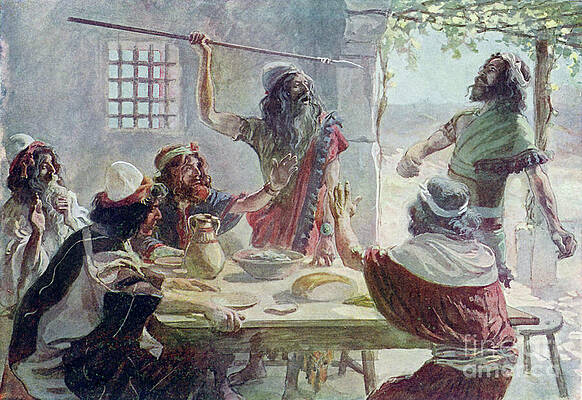
Saul Casts a Javelin at Jonathan, by James Tissot, ca. 1900

The malignant ruach afflicts King Saul with bouts of paranoia, in which he is terrified that David, his loyal army commander, will kill him and seize his throne. While he is in the grip of this spirit, he throws a spear or javelin at David twice. Later, when Saul’s own son and heir, Jonathan, questions his plan to kill David, Saul throws a spear at him, too. The king even orders a whole town of Israelite priests and their families massacred because the high priest helped David to escape.2

David becomes the leader of an outlaw band moving from place to place as King Saul tries to hunt them down. Yet there is no revolution, and no coup. David does not become the king until many years later, after Saul has died in a battle with the Philistines. Why does David wait?

The king’s robe

On one expedition Saul takes 3,000 men to En-Gedi, where he has heard that David and his 600 outlaws are hiding. Saul steps into a cave to defecate in private. He has no idea that the cave is large enough to hide hundreds of men, who are sitting in the recesses of the cave behind him.

Then David’s men said to him: “Here is the day about which God said to you: ‘Hey, I myself give your enemy into your hand!’ And you can do whatever seems good in your eyes to him!” And David got up and stealthily cut off the corner of Saul’s me-il. (1 Samuel 24:5)

me-il (מְעִיל) = a robe worn over the tunic by members of the royal family, high priests, and Samuel (who was a priest before becoming a prophet and judge).

Nowhere in the first book of Samuel does God promise to give an enemy into David’s hand. But David’s men are hoping to motivate him to kill Saul, without saying so directly.

They fail. Instead of stabbing Saul from behind, David merely collects evidence that he could have done so if he had chosen.

And he said to his men: “Far be it from me, by God, if I should do this thing to my lord, to God’s anointed, to stretch out my hand against him! For he is God’s anointed!” (1 Samuel 24:7)

This is an interesting statement by someone who is also God’s anointed. Perhaps David is so awed by his own anointment that he is also awed by Saul’s status. Or perhaps he is planning ahead, setting an example so that when he himself is the king, his subjects will treat his life as sacred, too.

When Saul stands up and walks out, David restrains his men. Then he steps out of the cave and calls after the king. Saul turns around, and David prostrates himself at a distance. He  immediately starts talking, probably so that Saul will listen to him instead of calling his soldiers. Partway through his oration, David points out that he could have killed Saul while the king was squatting in the cave.

“But I had compassion on you, and I said: ‘I will not stretch out my hand against my lord, for he is God’s anointed.’ And see too, my father: see the corner of your me-il in my hand! For when I cut off the corner of your me-il I did not kill you! Know and see that there is no evil or rebellion in my hand, and I did not do wrong against you. Yet you are lying in wait to take my life!” (1 Samuel 24:9-12)

By saying he had compassion on Saul, David puts the idea of compassion into Saul’s mind. By prostrating himself to Saul and calling him “my father” (which acknowledges Saul’s position as both his king and his father-in-law3), he subtly invites the king to be solicitous toward his inferior.

Although David promises that he will never make a move against Saul, he implies that God will:

“Let God judge between me and you, and let God take vengeance for me upon you, but my hand will not be against you!” (1 Samuel 24:13)

If David is hinting to God, God does not respond. David elaborates on his theme until Saul finally answers.

“Is this your voice, my son David?” And Saul lifted up his voice and wept. And he said to David: “You are more righteous than I am, because you have repaid me with goodness, and I have repaid you with evil.” (1 Samuel 24:17-18)

David has succeeded in touching Saul’s good (and rational) ruach. His gamble pays off. Instead of ordering his troops to attack the cave, Saul goes home. The king does not go as far as inviting David to resume his old position in court, and David knows better than to ask.

Before long, Saul’s paranoid ruach overcomes his good ruach again, and he sets off with another troop of soldiers to hunt down David in the wilderness.

Since he knows how changeable Saul is, why does David cut off the corner of the royal robe, then step out to speak to Saul? He could have just stayed in hiding.

My guess is that David puts on a show to satisfy his men. Since he is unwilling to kill Saul, he stages a piece of theater for them that makes him look bold and noble.

The king’s spear

When David and his outlaws are in the wilderness of Zif, some locals report it to King Saul, who collects 3,000 men and sets out again. At night David looks down at the king’s campsite from a hilltop. Saul and his general, Abner, are asleep in the middle of the camp, surrounded by their sleeping troops. Near Saul’s head is a water jug, and the king’s spear, thrust into the ground. David’s nephew Avishai says:

“Today God has delivered up your enemy into your hand! And now, please let me strike him into the ground with the spear, one time! I will not [need to do it] twice to him!” (1 Samuel 26:8)

Avishai is bragging that he can kill Saul with one blow, so nobody in the camp will hear a cry. He is confident that he is a better spear thrower than the king, who missed David twice and Jonathan once.

But David said to Avishai: “You must not destroy him! Because who stretches out his hand against God’s anointed and is exempt from punishment?” (1 Samuel 26:9)

David’s disappointed nephew is silent. David says:

“… God will smite him instead. Either his day will come and he will die, or he will go down in battle and be snatched away. Far be it from me, by God, to stretch out my hand against God’s anointed! And now, please take the spear that is at his head, and the jug of water, and we will go on our way.” (1 Samuel 26:10)

Once again, David emphasizes the importance of doing no harm to God’s anointed king. Taking a symbol of kingship is different, however, whether it is the king’s spear or a corner of his robe.

Then David steals down and takes the spear and water jug himself, perhaps concerned that his young nephew might kill Saul despite his orders. This is when God enters the picture and demonstrates approval of David’s restraint.

And there was no one who saw, and no one who knew, and no one who was rousing, because all of them were sleeping—because the deep slumber of God had fallen upon them. (1 Samuel 26:12)

When David is safely back on the hilltop, he shouts and wakes up everyone below. He accuses General Abner and his men of failing at their job.

“… You did not keep watch over your lord, over God’s anointed! And now, see: Where are the king’s spear, and the jug of water that was at his head?” (1 Samuel 26:16)

Once again, David refers to “God’s anointed”. This way of describing a king reflects his own attitude toward kingship, but it is also a good seed to plant in the minds of the soldiers for the day when David reveals he, too, is God’s anointed.

And Saul recognized David’s voice, and said: “Is this your voice, my son David?” And David said: “My voice, my lord king.” (1 Samuel 26:17)

This time Saul begs David to come back, and promises that he will never do anything bad to David again. But David merely orders someone to return the king’s spear. His last words to Saul are:

“Today God gave you into my hand, but I was not willing to stretch out my hand against God’s anointed.  And hey! As your life has been important today in my eyes, so may my life be important in God’s eyes, and may [God] rescue me from every distress!” (1 Samuel 26:23-24)

Here David is really addressing God. Robert Alter wrote that David “hopes that God will note his own proper conduct and therefore protect him.”5

The king’s death

Tired of being hunted by King Saul, David takes his whole band of outlaws across the border into Philistine territory. While David and his men are in the Philistine village of Ziklag, there is a major battle between the Philistines and the Israelites in the Jezreel Valley in Israelite territory. The Philistines win and occupy the Jezreel, the Israelites who are not killed flee, and Saul and three of his sons, including Jonathan, die on the battlefield. Saul, wounded by arrows, asks his weapons-bearer to finish him off, but the man is feel so awed and fearful that he refuses. David is not the only Israelite who believes a king anointed by God is sacrosanct! So Saul dies by falling on his own sword.6

The second book of Samuel opens with a young man running from the battlefield all the way to Ziklag. He prostrates himself to David, then tells him what happened. His story of how King Saul died is different:

“… he turned around and he saw me and he called out to me, and I said: ‘Here I am’. And he said to me: ‘Who are you?’ And I said to him: ‘I am an Amalekite”. And he said to me: ‘Stand over me, please, and give me the death-blow, because weakness has seized me, though life is still in me.’ Then I stood over him and I gave him the death-blow, since I knew that he could not live long after having fallen. Then I took the circlet that was on his head and the bracelet that was on his arm, and I brought them to my lord here.” (2 Samuel 1:7-10)

According to Robert Alter: “A more likely scenario is that the Amalekite came onto the battlefield immediately after the fighting as a scavenger, found Saul’s corpse before the Philistines did, and removed the regalia. … he sees a great opportunity for himself: he will bring Saul’s regalia to David, claim personally to have finished off the man known to be David’s archenemy and rival, and thereby overcome his marginality as a resident alien … by receiving a benefaction from the new king …”7

But the Amalekite does not know that an anointed king is sacrosanct in David’s eyes. David rips a tear in his clothes in mourning, and demands:

“How were you not afraid to stretch out your hand to destroy God’s anointed!” (2 Samuel 1:14)

Then he has the Amalekite executed.


David could have interpreted his anointment by a prophet in the name of God as permission to supersede the previously anointed king as soon as possible. Instead, he takes the position that anyone who is “God’s anointed” is sacrosanct, and any attempt to kill that person is a crime against God.

During the period when David is an outlaw, he bends a few rules. But he also consults God through oracular devices and does what God says;8 and he maintains that the life of anyone whom God has had anointed is sacred. His attitude toward God keeps him in God’s favor. So God helps him by casting a deep sleep over Saul’s camp while David steals the king’s spear.

Can this warm relationship between David and the God character continue even when David goes to work for the Philistine king who is the chief the enemy of Israel? We shall see in next week’s post, 1 Samuel: David and the King of Gat.


  1. 1 Samuel 10:19-22, 15:9-11. See my first post in this series: 1 Samuel: Anointment.
  2. Saul throws spears at David in 1 Samuel 18:9-12, 19:9-11, and at Jonathan in 1 Samuel 20:30-33. (See my third post in this series: 1 Samuel: David the Beloved.) Saul has everyone in the town of Nov massacred in 1 Samuel 22:16-19. (See my fourth post in this series: 1 Samuel: David the Devious.)
  3. David is married to Saul’s second daughter, Mikhal. She helped him to escape their house when Saul’s men came to kill him, but David never tried to arrange for her to leave and join the outlaws. See my post: 1 Samuel: David the Beloved.
  4. 1 Samuel 24:20-21.
  5. Robert Alter, Ancient Israel: The Former Prophets, W.W. Norton &Co., New York, 2013, p. 399.
  6. 1 Samuel 31:1-7.
  7. Alter, pp. 426-427.
  8. See my post: 1 Samuel: David the Devious.

1 Samuel: David the Devious

(If you want to read one of my earlier posts on this week’s Torah portion, Shoftim (Deuteronomy 16:18-21:9) you might try: Shoftim: More Important Than War: Part 2. Below is the third post in my series on why David is God’s favorite king—whether he acts ethically or not.)


David first comes to King Saul’s court to play the lyre, which calms the king when a fit of irrational terror seizes him. While he is working for Saul, advancing from musician to army commander, David attracts love and loyalty from everyone—Jonathan, the king’s oldest son and heir; Mikhal, the king’s daughter who becomes David’s wife; the king’s troops; and the women in every Israelite city, who celebrate David’s military successes. Why not? He is young, handsome, daring, quick-witted, and eloquent. He quickly learns the arts of war and leadership. He has natural charisma, and God’s blessing. (See my revised version of last week’s post: 1 Samuel: David the Beloved.)

But King Saul becomes jealous of David’s popularity. Even though he does not know that the prophet Samuel, at God’s command, secretly anointed the adolescent David as the next king, Saul comes to suspect that David is scheming to seize his throne.

In fact, David is happy to wait for the throne. But after King Saul makes several attempts to kill him, he flees from the king’s court. For his new life on the run, David adjusts his ethical standards. Although he still worships the God of the Israelites, he lies to a priest, violates a religious rule, and runs a protection racket.

Violating a religious rule

David’s first stop after he parts from Jonathan in the field outside the king’s settlement is Nov, a town of Israelite priests.

And David came to Nov, to Achimelekh the Priest. And Achimelekh trembled to meet David, and said to him: “Why are you alone, and there is no one with you?” (1 Samuel 21:2)

As the king’s top commander and brother-in-law, David would normally travel with an entourage. But why does the high priest tremble? According to Pamela Tamarkin Reis,1 Achimelekh’s fear is due to the presence of a third person.

And a man was there that day from the servants of Saul. He was detained in front of God, and his name was Doeig the Edomite, chief of Saul’s shepherds. (1 Samuel 21:8)

Whatever business Doeig has at the sanctuary, he lingers after David arrives. Both Achimelekh and David would notice him hanging around. Whether the high priest knows that David has fled from King Saul or not, he would be anxious about the presence of someone who might report David’s unusual visit to the jealous and irrational king.   

Instead of telling the truth, David says:

“The king commanded me [about] a matter, and he said to me: ‘Not a man must know anything about the matter on which I am sending you and on which I commanded you!’ So I let the young men know about such-and-such a place [to meet me]. And now, what is there at hand? Give five loaves of bread to my hand, or whatever can be found.” (1 Samuel 21:3-4)

David speaks to Achimelekh as if he were still an important official, and invents a tale about a secret mission. Either he is lying to mislead the priest, or, according to Reis, he is lying to mislead Doeig.

The Priest answered David and said: “There is no ordinary bread under my hand. Rather, there is only sacred bread. If the young men kept themselves away, surely, from women …” (1 Samuel 21:5)

The high priest is suggesting violating a religious rule. Inside the sanctuary, in the room that only priests may enter, is a gold-plated bread table displaying twelve flat, round loaves of bread, along with frankincense. The high priest must lay out new bread every week.

Every sabbath day, perpetually, he must arrange them before the presence of God, from the Israelites as a covenant forever. And they will be for Aaron and his sons [i.e. the hereditary priests], and they will eat them in a holy place; because they are the holiest for him out of the fire-offerings of God. A decree forever. (Leviticus 24:8-9)

According to this law, after the twelve loaves are replaced with fresh bread on Shabbat, the priests must eat the old bread. But Achimelekh is so eager to help David, the national hero, that he offers to break the rule and let David and his young men eat last week’s sacred bread. He mollifies his conscience by stipulating that they must at least be ritually pure when they eat the bread, and asks discreetly if they have avoided an emission of semen.

David assures him that he and the (fictional) young men have kept away from women for the last two days, and all their gear was purified before they set out.

Then the Priest gave him sacred [bread], since there was no bread there except for the Bread of the Presence that had been removed from the presence of God in order to set out warm bread on the day it was taken away. (1 Samuel 21:7)

Thus both Achimelekh and David bend the rules. After that, David asks:

“Don’t you have on hand here a spear or a sword? Because my sword and my gear I also did not take along in my hand, since it was an urgent matter of the king!” (1 Samuel 21:9)

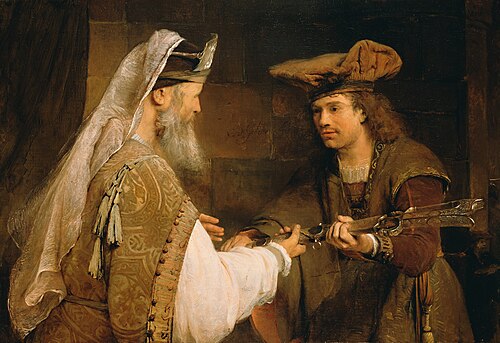
Achimelekh Giving the Sword to David,
by Aert de Gelder, ca. 1700

The high priest replies that the only weapon around is the sword of Goliath, whom David killed with his slingshot. He hands the trophy over to David. Supplied with food and a sword, David leaves and heads for the Philistine border.

The God character does not punish David for this transgression. But God does nothing to help Achimelekh, David’s partner in rule-bending, when Doeig tells King Saul what happened. Saul summons the high priest and all the lesser priests for questioning, and demands:

“Why did you band together against me, you and the son of Jesse, by your giving him bread and a sword … to rise up against me as an ambusher, as it is this day?” (1 Samuel 22:13)

Achimelekh replies:

“But who among all your servants is like David, trustworthy and the king’s son-in-law and commander of your bodyguard and honored in your house?” (1 Samuel 22:14)

Then he pleads innocence on the grounds of ignorance. King Saul orders the palace guard to execute all the priests, but they refuse. So Saul tells Doeg to do it, and he kills all the priests, then massacres the whole population of Nov, man, woman, and child, and all the livestock. Only one person escapes: Ahimelekh’s son Evyatar.

And the God character stands by and lets it happen. Throughout the Hebrew Bible, God delivers collective punishment without distinguishing between innocent and guilty individuals. In the first book of Samuel, it is enough that David, God’s favorite, escapes—along with a priest whom David can consult in the future.

Leading an outlaw band

David crosses the border into Philistine territory, where he is recognized by the servants of the Philistine king of Gat. He escapes by feigning madness, and crosses back into Israelite territory, but only as far as the Cave of Adulam, between Gat and Bethlehem. David’s seven older brothers in Bethlehem hear that he is there, and join him. So does the priest Evyatar, who is also hiding from Saul.

And they gathered to him, every man in distress, and every man who had a creditor, and every man whose soul was bitter. And he became commander over them, and with him were about 400 men. (1 Samuel 22:2)

David’s band of outlaws has grown to about 600 men when he hears that Philistines are attacking the Israelite town of Ke-ilah, south of Adulam. He asks God whether he should rescue the town. (In the Hebrew Bible, God speaks directly only to selected prophets. Everyone else hears from God in dreams, or gets answers from God through divining devices such as casting lots or consulting the priest’s eifod (אֶפוֹד), a ritual tabard worn on the chest. Evyatar brings an eifod when he joins David.)

Although God answers yes, he should rescue Ke-ilah, David’s men are afraid to go. So David asks God again, even though fighting Philistines is no longer his job. Maybe he is still a hero at heart. Or maybe he wants to win allies in the south of Judah for the sake of his future plans.

And once again David inquired of God, and God answered him, and said: “Arise, go down to Ke-ilah, because I am giving the Philistines into your hand!” (1 Samuel 23:4)

The God character, who no doubt likes being consulted, helps David win a victory. When King Saul hears that David and his men are now inside the walls of Ke-ilah, he prepares to besiege the town. David asks the priest Evyatar to use his eifod and addresses two more questions to God:

“Will Saul come down, as your servant has heard? … Will the citizens of Ke-ilah deliver me and my men into his hands?” (1 Samuel 23:11-12)

Through the eifod God answers yes to both questions. Apparently God is aware of the fears of the people of Ke-ilah. They are grateful to David for rescuing them from the Philistines, but they are too afraid of King Saul to defend their rescuers. After all, Saul has recently massacred all the Israelites in the town of Nov. Turning over David and his men to the king would be the townspeople’s best hope of escaping the same fate.

David pays attention to God’s answers, and he and his men leave town before Saul sends an army to beseige it—thus saving both themselves and the townspeople. The outlaw band keeps moving from one location to another in Israelite territory.

And Saul sought him all the days, but God did not give him [David] into his hand. (1 Samuel 22:14)

The God character is still planning for David to replace Saul as the king someday. If God did nothing, Saul would presumably track down a band of 600 men roaming around his kingdom. But God prevents that from happening. Apparently God likes a hero who takes initiative, but also respects and consults God—even if he bends the rules about sacred bread.

Running a protection racket

David seems both noble and pious in the story about rescuing the town of Ke-ilah. But he also uses his outlaw band for a dubious enterprise.

When an exceedingly wealthy man named Nabal is having his 3,000 sheep sheared at Carmel, David sends ten young men to Nabal to wish him well and say:

“And now, I have heard that you have shearers. Now, the shepherds that belong to you were with us. We did not humiliate them, and they did not find anything missing the whole time we were in Carmel. Ask your boys, and they will tell you. And may [my] boys find favor in your eyes, since we have come on a good day. Please give whatever you can find in your hand to your servant, to your ‘son’ David!” (1 Samuel 25:7-8)

In other words, David’s men, without being asked, protected Nabal’s shepherds and flock from thieves and raiders, and did not take any sheep themselves. Now David requests a gift in return, hinting that it is “a good day”, since a sheep shearing was normally celebrated with feasting. His message is polite and deferential. He refers to himself as Nabal’s inferior twice, by calling himself “servant” and “son”.

Then Nabal answered David’s servants, and he said: “Who is David? Who is the son of Jesse? Today there are many slaves who are breaking away, each one from his master! And I should take my bread and my water and my butchered meat that I butchered for my shearers, and I should give it to men who are from I don’t know where?” (1 Samuel 25:10-11)

Comparing someone with a private army of 600 men to a runaway slave is not a smart move. Neither is refusing to give him any food supplies. David’s ten young men report back.

Then David said to his men: “Each man gird on his sword!” And each man girded on his sword, and David also girded on his sword, and they went up behind David, about 400 men. And 200 stayed with the gear. (1 Samuel 25:13)

As they head toward Nabal’s house in Maon, the next town south of Carmel, David says to himself:

“Surely in vain did I guard everything that belongs to this one in the wilderness, and nothing was missing that belongs to him. And he returned evil to me instead of good! Thus may God do to the enemies of David, and thus may [God] add, if by morning I leave alive out of all that belongs to him [even one] pisser against the wall!” (1 Samuel 25:21-22)

Meanwhile Nabal’s wife Abigail, who is described as “intelligent and beautiful”, finds out what happened, and hurriedly loads a train of donkeys with 200 loaves of bread, five butchered sheep, and some wine, grain, raisin cakes, and dried figs. She intercepts David and his 400 men, drops down from her own donkey, and prostrates herself in front of David.

Abigail does not hesitate to denounce her husband and give David all the food. She explains her interception as God’s way of preventing David from becoming guilty of murder.

“… God restrained you from coming to shed blood, and rescued you from avenging yourself by your own hand … for my lord battles the battles of God, and may no evil be found in all your days!”  (1 Samuel 25:26, 25:28)

When God makes David king, she adds, it would be a problem if he had a reputation for spilling blood for no good cause. And David, his cool intelligence restored, thanks her:

“Blessed is God, the God of Israel, who sent you this day to meet me! And blessed is your judgement, and blessed are you, who prevented me this day from shedding blood, and rescued me from avenging myself by my own hand!” (1 Samuel 25:32-33)

David returns to his camp, and Abigail goes home to find her husband getting drunk. She waits until morning, when he has a hangover, to tell him what she did. Nabal has a stroke.

And it happened in about ten days: God struck Nabal, and he died. (1 Samuel 25:38)

David immediately sends a marriage proposal to Abigail, and she accepts.2

David may be guilty of implicit extortion. But since the outlaws cannot farm or engage in trade, they have to get food some other way. They refrain from either stealing sheep or, thanks to Abigail, from killing any Israelites. So God avenges David by killing Nabal.


Although David intends to kill innocent Israelite men in Nabal’s household, he changes his mind. His actual transgressions during his time as an outlaw are peccadilloes, excusable on the grounds that he has to eat sacred bread, dissemble, and run a protection racket simply in order to survive. And David still honors God and follows God’s instruction to rescue an Israelite village from Philistines. So the God character excuses him, and continues to provide a little help now and then as David makes his own way on the road to kingship.

This is the kind of personal God anyone would hope for. But in the first book of Samuel, only David wins God’s forgiveness.


  1. Pamela Tamarkin Reis, Reading the Lines: A Fresh Look at the Hebrew Bible, Hendrickson Publishers, Peabody, Mass., 2002, pp. 136-142.
  2. In ancient Israel, a man could have multiple wives, but a woman could have only one husband.

1 Samuel: David the Beloved

(If you want to read one of my earlier posts on this week’s Torah portion, Re-eih (Deuteronomy 11:26-16:17), you might try: Re-eih: Ownership. Below is the second post in my new series on why David is God’s favorite king.)


David’s name (דָוִד) means “beloved”. He is already God’s beloved when God tells the prophet Samuel to anoint him as the future king of Israel.1 King Saul also loves young David at first, and employs him as his lyre-player and weapons bearer.2 After David kills Goliath with his slingshot, everyone else seems to fall in love with him, including two of the king’s children, the king’s troops, and the women in every Israelite city.

Jonathan

Right after David kills Goliath he returns to King Saul.

And it was as he finished speaking to Saul, then the nefesh of Jonathan became bound up with the nefesh of David. And Jonathan loved him like his own nefesh. (1 Samuel 18:1)

nefesh (נֶפֶשׁ) = self, personality; throat; what makes a body alive.

Jonathan is Saul’s oldest son. Shortly after Saul was acclaimed king, he put Jonathan in charge of one-third of the Israelite troops.3 An able commander, Jonathan won two battles against the Philistines before Saul hired David to play the lyre.

Why does young David captivate Jonathan? Perhaps he sees in David a younger but grander version of himself. Jonathan had led a daring raid against all odds on a Philistine garrison;4 David volunteered to face Goliath with nothing but his slingshot. Both of them had more practical intelligence than Saul, both attracted people’s loyalty, and both spoke piously about God.

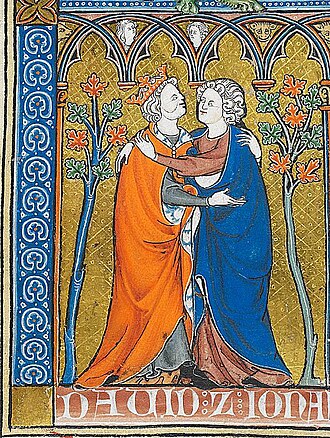
Jonathan and David, “La Somme le Roi”, French illuminated ms., 1290

And Jonathan and David, he cut a covenant because of his love for him like his own nefesh. (1 Samuel 18:2-3)

Although the subject is plural, the pronoun and verb following it are third person plural. The usual biblical covenant is “cut” (a biblical idiom) between two parties.5 But the covenant between Jonathan and David is one-sided. Jonathan cuts the covenant, promising something; David merely accepts Jonathan’s promise. The next verse indicates what the lopsided covenant is about.

And Jonathan stripped himself of the me-il that was on him and he gave it to David, and his [military] garb, and even his sword, and even his bow, and even his belt. (1 Samuel 18:4)

me-il (מְעִיל) = robe worn over the tunic by members of the royal family, high priests, and Samuel (who was a priest before becoming a prophet and judge).

Jonathan is symbolically replacing himself with David, either consciously or unconsciously. The robe signifies that David is now the heir to the throne. The armor and weapons hint that David will replace Jonathan as the king’s chief commander. (King Saul loaned David his armor to fight Goliath, and David politely rejected it.6 But Jonathan’s armor and weapons are not a loan for a particular battle; they seem to be a gift.)

Classic and modern commentators have disagreed about whether Jonathan’s love for David is sexual. Pirkei Avot declares:

“All love that is dependent on something, when the thing ceases, the love ceases. But [love] that is not dependent on something never ceases. Which is love that is dependent on something? This is the love of Amnon for Tamar.7 And which is the love that is not dependent on something? This is the love of David and Jonathan.”8

Whether Jonathan’s love for David has a sexual element or not, it does seem to be unconditional. Yet this does not fully explain Jonathan’s covenant. Turning over one’s whole identity to another person is an unusual act of love.

Soldiers and women

And David went out [with the troops], and everywhere Saul sent him, he was successful. And Saul placed him over men of war, and it was good in the eyes of all the people, and also in the eyes of Saul’s servants. And it was when they came back, when David returned from striking down the Philistine, women went out from all the towns for singing and dancing, to meet King Saul with timbrels, with rejoicing, and with triangles. And the women who were playing chanted, and they said: “Saul struck down his thousands, and David his tens of thousands!” (1 Samuel 18:5-7)

Everybody loves success—except for a jealous competitor. Jonathan does not protest when the chanting women do not even mention him. But Saul smolders with anger, thinking:

“They give to David tens of thousands, and to me the thousands. There remains for him only the kingdom!” (1 Samuel 18:8)

The next day Saul has one of his fits of madness, and as usual David plays the lyre to calm him down. But this time Saul throws a spear at David, twice. David dodges the spear both times.

And Saul was afraid in the face of David, because God was with him, and had turned away from Saul. (1 Samuel 18:12)

King Saul’s diagnosis is correct. David is now God’s beloved, not Saul.

Then Saul removed him from his side, and appointed him commander of a thousand. And he went out and came back before the people. (1 Samuel 18:13)

Going out and coming back is a biblical idiom for leading a military action. David now has Jonathan’s old job. Perhaps, during a rational period, Saul realizes that his own support from the people depends on continued success in the war with the Philistines, and for that he needs David as his chief military leader. But if David continued to serve as his personal musician between campaigns, Saul might try to kill him again in his next fit of madness. So Saul removes David from court to prevent it.

And David was prospering in all his ways, and God was with him. And Saul saw that he was prospering very much and was afraid of his presence. And all Israel and Judah were loving David, since he was going out and coming back before them. (1 Samuel 18:14-16)

Mikhal

Suddenly Saul invites David to marry his older daughter, Meirav. Some commentators speculate that Saul is trying to put David in a position where he has no choice but to continue fighting Philistines for the king. But I wonder if David reminded Saul about the reward he promised to the man who killed Goliath, a reward that included wealth and the king’s daughter.9

David gives a politely humble reply to the proposed marriage. When it is time for the wedding, the mercurial king marries Meirav to another man.

But Mikhal, daughter of Saul, had fallen in love with David. And it was told to Saul, and the matter was agreeable in his eyes. Saul said [to himself]: “I will give her to him, and she will become a trap to him, and the Philisitines’ hand will be against him.” Then Saul said to David: “With the second one you will become a son-in-law to me today!” (1 Samuel 18:20-21)

Again David answers humbly. He sends this message through the king’s servants:

“I am a poor man, and lightly esteemed.” (1 Samuel 18:23)

Perhaps David is suggesting that King Saul still owes him the reward of “great wealth”. If he received that wealth, he could afford to pay a bride-price worthy of a king’s daughter. But Saul has a different idea about the bride-price. He has his servants tell David:

“There is no pleasure for the king in a bride-price—except for a hundred Philistine foreskins, for vengeance on the king’s enemies.” And Saul planned to cause David’s fall at the hand of the Philistines. (1 Samuel 18:25)

But David is God’s beloved, and he has no trouble slaying 200 Philistine men. He gives their foreskins to King Saul, who then gives David his daughter Mikhal.

Two rescuers

And Saul spoke to his son Jonathan, and to all his servants, to put David to death. But Saul’s son Jonathan delighted in David very much. (1 Samuel 19:1)

Jonathan manages to change his father’s mind, and Saul lets David return to the royal house whenever he is not fighting Philistines. But once again a malign spirit overcomes the king, David plays the lyre for him, and Saul hurls a spear at him. David flees to his own house.

And Saul sent messengers to David’s house, to keep watch and to kill him in the morning. And Mikhal, his wife, told David, saying: “If you don’t escape with your life tonight, tomorrow you will be put to death!” And she let David down through the window, and he went, and he hurried away, and he escaped. (1 Samuel 19:12)

Then Mikhal tucks a statue into the bed, puts a tangle of goat’s hair at its head, and pulls up the covers. When Saul’s messengers demand to see David, she says he is sick. When they insist, she shows them the bed. But they uncover the truth. Her father scolds her for deceiving him and letting his “enemy” escape. Mikhal lies and pretends that David threatened to kill her if she did not help him. Like Jonathan, she loves David more than she loves her father. There is no indication of whether David loves her.

David flees to Ramah, the prophet Samuel’s home base. Saul sends messengers to Ramah three times, and each time the spirit of God overcomes them and they babble in ecstasy; God is still looking after David. After the third time, David leaves Ramah and finds Jonathan, asking him:

“What have I done? What is my crime, and what is my offense before your father, so that he seeks my life?” (1 Samuel 20:1)

When Jonathan says he had no idea that his father was trying to kill David, David replies:

“You father surely knows that I have found favor in your eyes. So he said [to himself]:‘Don’t let Jonathan know about this, lest he be pained.’ However, by the life of God and the life of yourself, it is indeed like one step between me and death!” (1 Samuel 20:3)

Jonathan believes him, and promises to do whatever David says. David’s plan is to hide in the countryside while Jonathan tests his father’s intentions. Calling himself “your servant” (since Jonathan still has higher rank, as the king’s heir), David says:

“And you should act with loyal-kindness toward your servant, because you brought your servant into a covenant of God with you …” (1 Samuel 20:8)

Robert Alter noted: “David’s formulation of the arrangement is pointed and quite accurate: it was Jonathan who initiated the pledge of mutual fealty out of his love for David, and who drew David into the commitment.”10

Jonathan swears that he will let David know if King Saul is plotting against him. He adds:

“And may YHWH be with you, as he was with my father!” (1 Samuel 20:13)

Here Jonathan believes that David will be the next king, and privately waives his own claim to the throne. But he asks for reassurance that David will try to keep him and his family alive.

“… Will you not act toward me with the loyal-kindness of God, so I will not die? And you must not cut off your loyal-kindness to my house, ever …” (1 Samuel 20:14-15)

David does not say a word. We can hope he at least nods.

Jonathan attends the king’s New Moon dinner, and makes an excuse for David’s absence. Saul explodes, calling his son-in-law David by the disrespectful appellation “son of Jesse”, and his own son by more insulting names. He accuses Jonathan of the truth:

“Don’t I know that you yourself are choosing the son of Jesse, to your shame? … All the days that the son of Jesse is alive on earth, you will not be secure, you or your kingdom! And now send and fetch him to me, because he is a dead man!” And Jonathan answered his father Saul and said: “Why should he be put to death? What has he done?” (1 Samuel 20:30-32)

In fact, all David has done is to succeed as a warrior and military commander, defending Saul’s kingdom from the Philistines and winning public adulation. But the question tips Saul into madness again, and he throws his spear at his own son and heir. Jonathan leaves the table without eating, and the next morning he gives David their pre-arranged signal in the field. When the two men are alone, David throws himself on his face in prostration to Jonathan.

And he prostrated himself three times, and each man kissed his friend, and each man wept with his friend, until David had made it [the weeping] greater. (1 Samuel 20:41)

People in the Hebrew Bible usually prostrate themselves to God, or to humans who are much higher-ranking than themselves. But in the book of Genesis, Jacob prostrates himself to his brother Esau seven times as part of his effort to mollify his Esau, who had threatened to kill him 20 years before after Jacob had cheated him. Esau then embraces and kisses Jacob, and both of them weep.11  

Why does David prostrate himself to Jonathan in a scene reminiscent of Jacob’s reunion with Esau? David knows, thanks to his secret anointment by Samuel, that he, not Jonathan, is the future king of Israel. Perhaps he is moved by Jonathan’s loyalty and love, and knows that he cannot equal it.

According to Alter, “It is noteworthy that throughout this narrative David is repeatedly the object but never the subject of the verb ‘to love’…”12

Both men weep, though David weeps longer. His tears might be a parting gift to his devoted friend, or they might simply reflect David’s inner turmoil as he faces an unknown future in exile.

Final parting

David and Jonathan meet one more time, when David has become the leader of a large band of outlaws moving from hideout to hideout to evade capture by King Saul. Although Saul never tracks them down, Jonathan obviously has inside information; he visits David at his camp in a forest, and says:

“Don’t be afraid, for the hand of my father Saul will not find you. And you yourself will become king over Israel, and I myself will be your second. And even my father Saul knows this.” (1 Samuel 23:17)

Jonathan’s love for David no longer obliterates his sense of self. Now he asks David to appoint him as viceroy once his beloved becomes king. David’s response is not reported.

The two men reaffirm their covenant, and Jonathan goes home. But he never becomes David’s viceroy; Jonathan dies in the same battle as Saul, and David mourns for both of them as he is proclaimed king.


“What have I done now?” David asked when his oldest brother scolded him for running to the front lines facing Goliath and the Philistines.13 The question comes up again when David asks Jonathan:

“What have I done? What is my crime, and what is my offense before your father, so that he seeks my life?” (1 Samuel 20:1)

And Jonathan answered his father Saul and said: “Why should he be put to death? What has he done?” (1 Samuel 20:32)

What has David done? One answer is that he is young and handsome, bold and confident. He thinks on his feet and speaks eloquently. He quickly learns the crafts of war and military leadership. He is clever, but not deceitful. No wonder David is beloved by every sane person in the kingdom of Israel.

Last week I gave David credit for taking initiative, setting his own goals, and working resolutely to achieve them. Before he was anointed, he made himself an expert at the lyre and slingshot. After he is anointed, he dedicates himself to becoming a hero and next in line for king.

These goals would be ridiculous if David were not naturally talented—and if he did not know that God had chosen him as the next king. But being chosen by God does not necessarily mean succeeding. After all, God originally chose Saul as king. But Saul lacked confidence, vacillated, and did not think things through. No wonder God withdrew support from Saul and promised it to David.

It is not enough to be chosen. One must develop the right character traits, and hold oneself to the necessary standards. Only then will one continue to be beloved—by an individual, by the general public, or by God.

I know that I certainly do not have what it takes to be a hero. But I am grateful that I have the right character traits and standards of behavior to be a worthy spouse.


  1. See my post: 1 Samuel: Anointment.
  2. See my post: 1 Samuel: Lyre and Slingshot.
  3. 1 Samuel 13:1-3.
  4. 1 Samuel 14:1-15.
  5. The key exception is when God makes a unilateral covenant with Noah and every living creature not to drown the world again (Genesis 9:8-12). More normal covenants between humans occur in Genesis 21:22-33, 26:23-33, and 31:44-54, and Joshua 9:3-15.
  6. See my post: 1 Samuel: Lyre and Slingshot.
  7. Amnon feels sexual desire for half-sister Tamar, which disappears after he rapes her (2 Samuel 13:1-15).
  8. Pirkei Avot 5, c.190–c.230 C.E.
  9. See my post: 1 Samuel: Lyre and Slingshot.
  10. Robert Alter, Ancient Israel: The Former Prophets: Joshua, Judges, Samuel, and Kings, W.W. Norton & Co., New York, 2013, p. 358.
  11. Genesis 33:3-4.
  12. Alter, p. 347.
  13. 1 Samuel 17:29.

1 Samuel: Lyre and Slingshot

(If you want to read one of my earlier posts on this week’s Torah portion, Eikev (Deuteronomy 7:12-11:25), you might try: Eikev: Not by Bread Alone. Below is the second post in my new series on why David is God’s favorite king.)


When the prophet Samuel secretly anoints David as the future king of Israel,1 all we know about David is:

  • He is the eighth and youngest son of Jesse (Yishai) the Bethlehemite, and his job is to shepherd his father’s flock. (1 Samuel 16:11)
  • He is “ruddy, with beautiful eyes, and good-looking” (1 Samuel 16:12), but not exceptionally tall.
  • God chooses him not because of his appearance, but because of his leivav (לֵבָב) = heart, seat of thoughts and feelings; mind, character, understanding. (1 Samuel 16:7)
  • His name is David (דָוִד) = beloved.(1 Samuel 16:13)

In the next two stories in the first book of Samuel, David exhibits some of the mental qualities that make him God’s beloved. And God demoralizes Saul, while encouraging David.

David the musician

When Samuel anointed Saul, no one witnessed it. The prophet told him that later that day he would briefly join a band of ecstatics2 led by people playing “lyre and timbrel, flute and harp” and this ecstatic experience would change him “into another man”. When it happened, Saul’s neighbors observed him babbling in ecstasy.3

David’s secret anointment, unlike Saul’s, is witnessed by his immediate family.

And Samuel took a horn of oil and anointed him in the midst of his brothers. And the ruach of God rushed through David from that day and onward. Then Samuel got up and went [back] to Ramah. Then the ruach of God turned away from Saul, and a malignant ruach from God terrified him. (1 Samuel 16:13-14)

ruach (רוּחַ) = wind; spirit, disposition.

Instead of a single ecstatic experience, David is supported continuously by a more subtle ruach of God. Perhaps God changes Saul’s ruach on purpose in order to pave to way for David.

And Saul’s servants said to him: “Hey, please! A malignant ruach of God is terrifying you. May our lord please say [the word], and your courtiers in front of you will look for a man who knows how to play the lyre. And it will be, whenever the malignant ruach of God happens to you, he will play with his hand, and it will be better for you.” (1 Samuel 16:15-16)

King Saul’s courtiers probably know about Saul’s ecstatic experience that included the music of the lyre.

And Saul said to his servants: “Please look for me a man who is good at playing, and bring him to me!” And one of the ne-arim answered and said: “Hey, I have seen a son of Jesse the Bethlehemite who knows how to play—a strong man of ability, and a warrior, and one discerning with words, and a handsome man, and God is with him!” (1 Samuel 16:16-18)

ne-arim (נְעָרִים) = male adolescents, young unmarried men; young male servants. (Singular: na-ar, נַעַר.)

The young servant, probably a few years younger than David, is so star-struck that he calls David a man and a warrior—even though David has never been in a battle. Rabbi Steinsaltz explained: “The young man sought to stress that David was not merely a talented musician, but also one who would be suitable to accompany the king for his other qualities.”4

King Saul sends a message to Jesse, and Jesse sends his youngest son with gifts for the king.

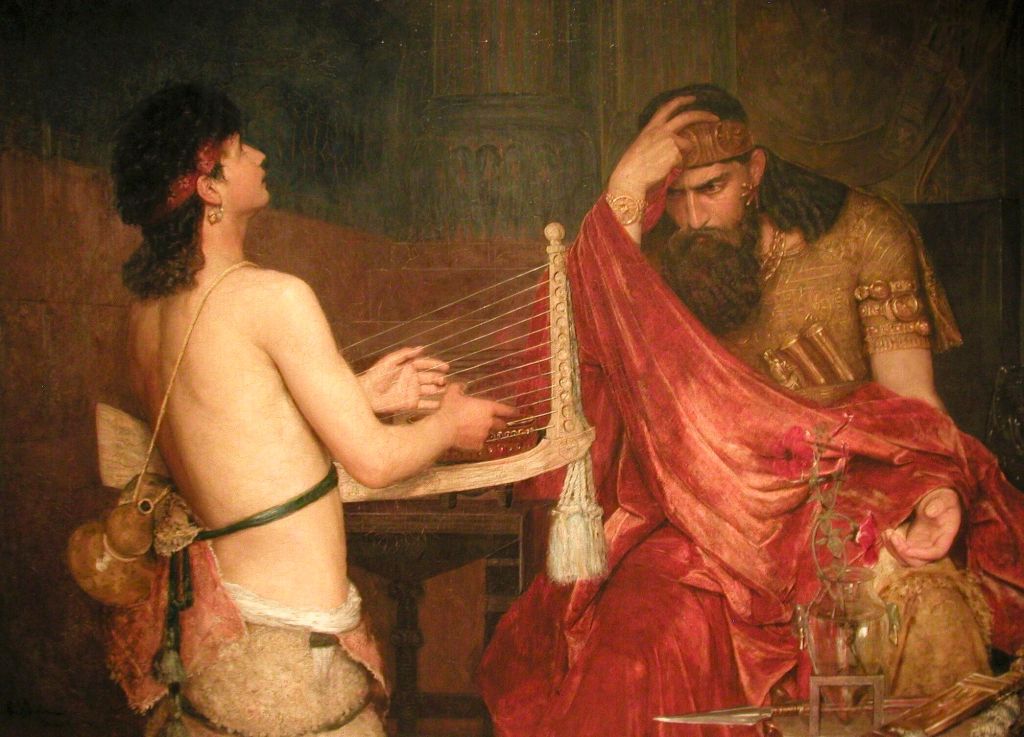
David and Saul, by Ernst Josephson, 1878

And David came and stood before Saul. And Saul loved him very much, and he became his weapons bearer. And Saul sent to Jesse, saying: “Please let David stand [in attendance] before me, because he has found favor in my eyes.” And it was when the ruach of God happened to Saul, then David took his lyre and played it with his hand, and Saul found respite, and it was better for him, and the malignant ruach turned away and went up from him. (1 Samuel 16:21-23)

Even King Saul loves David—at first.

David the marksman

In the next story, a Philistine army and an Israelite army face one another across a ravine in the valley of Elah, about 25 miles (40 km) from Bethlehem. A Philistine champion comes forward—a giant of a man with a scimitar and a spear, wearing heavy bronze armor.5 His name is Goliath (Galyat, גׇּלְיַת = revealer; exiler).

Goliath crosses the ravine and challenges the Israelites to send their own champion down to meet him in single combat. His terms are that the loser’s people will become slaves to the winner’s.

And Saul and all Israel heard these words of the Philistine, and they were dismayed and very afraid. (1 Samuel 17:11)

At least King Saul now has something to be terrified about. Although he himself is a tall warrior, he does not volunteer to fight Goliath. Nor do any of Jesse’s three oldest sons, who are in the army on the Israelite side of the ravine.

And David was going and returning from [waiting] on Saul, to shepherd his father’s flock in Bethlehem. And the Philistine approached and presented himself, in the early morning and in the evening, for forty days. (1 Samuel 17:15-16)

Jesse sends David to the Israelite camp with bread for his three older brothers and cheese for their commander, and asks him to return with news of how his brothers are faring. This reminds me of how Jacob sends Joseph to check up on his older brothers and report back to him.6 Joseph’s jealous older brothers seize him and sell him into slavery; but David’s older brothers are fond of him.

When young David arrives at the army camp, he leaves the gifts of food with a watchman and runs to the front lines.

And a man of Israel said: “Do you see this man [Goliath] who comes up? Indeed, he comes up to taunt Israel! And it will be [that] the man who strikes him down, the king will enrich with great wealth, and will give him his daughter, and will make his father’s household free [of taxes] in Israel!” (1 Samuel 17:25)

David gives no sign that he hears this. Instead, he speaks for the first time in the story, asking the men near him:

“What will be done for the man who strikes down the Philistine yonder and removes the disgrace from upon Israel? For who is this uncircumcised Philistine that he should taunt the battle lines of the living God?” (1 Samuel 17:26)

According to Robert Alter, “His first words express his wanting to know what will be gained—implicitly, in political terms—by the man who defeats Goliath. The inquiry about personal profit is then immediately balanced (or covered up) by the patriotic pronouncement … David has, of course, just heard one of the troops stipulate the reward for vanquishing the Philistine, but he wants to be perfectly sure before he makes his move, and so he asks for the details to be repeated.”7

David’s patriotic speech also honors God, who just might be listening. But why would a thoughtful, even calculating, adolescent with no battle experience consider fighting the armed and armored giant? Has he grown up so beloved by his own family and everyone who meets him that he assumes he can do anything? Does he think that nothing can kill him until his anointment has been realized and he has been acclaimed king? Or is he feeling the ruach of God inside him?

David’s oldest brother, Eliav, accuses him of sneaking into the front lines just to see the battle.

And David said: “What have I done now? Wasn’t it only words?” (1 Samuel 17:29)

David’s “What have I done now?” says a lot. Eliav, and probably David’s other brothers, see him as a headstrong scamp, exasperating but lovable.

David then checks with other soldiers about the king’s promised reward. Someone reports his questions to Saul, who has David fetched.

And David said to Saul: “Don’t let the leiv of a human fall on him! Your servant will go and do battle with this Philistine!” (1 Samuel 17:32)

leiv (לֵב) = heart, seat of thoughts and feelings; mind, character, understanding. (Alternate spelling of leivav.)

Perhaps David omits a courtly introduction to his speech because he is young and excited—and he is already familiar with the king, having played the lyre for him. Yet he is polite enough to refer to the feelings of “a human” falling, instead of the feelings of Saul.

But Saul said to David: “You cannot prevail in going against this Philistine to do battle with him, because you are a na-ar, and he has been a man of battle since he was a na-ar!” (1 Samuel 17:33)

David retorts that when lions and bears carried off lambs from his father’s flock, he went after them and killed them.

“And I held onto its beard and struck it down and put it to death! Even the lion, even the bear, your servant struck down. And this uncircumcised Philistine will be like one of them, since he has taunted the battle lines of the living God!” (1 Samuel 17:35-36)

Perhaps the God character, like a fond grandfather, loves David for his courage as well as for his quick wit. David exhibited his courage before God decided he should be anointed. And David knows God loves him.

And David said: “God, who rescued me from the hand of the lion and the hand of the bear, he himself will rescue me from the hand of this Philistine!” Then Saul said to David: “Go, and may God be with you!” And Saul dressed David in his own garb, and put a bronze helmet on his head, and dressed him in armor. Then David strapped his sword over his garb and he tried to walk, but he was not trained. Then David said to Saul: “I am unable to walk in these, since I am not trained.” And David removed them from upon himself. (1 Samuel 17:37-39)

If King Saul were not so desperate to get rid of the threat of Goliath, he might have second thoughts about sending out a young musician who does not even know how to walk in armor. But he merely stands by while David takes only his staff and his slingshot, and heads for the ravine. He picks up five smooth stones on the way and tucks them into his shepherd’s pouch.

David walks toward Goliath alone, but Goliath is preceded by his shield-bearer. Goliath jeers at David, and David asserts that God will be the victor.

And David said to the Philistine: “You come to me with sword and spear and scimitar, but I come to you with the name of the God of Armies, the God of the battle lines of Israel, whom you have taunted! Today God will deliver you to my hand, and I will strike you down and remove your head … And all this assembly will know that not with a sword or a spear does God grant victory; for the battle is God’s, and he will give all of you into our hand!” (1 Samuel 17:45-47)

How could the God character resist this speech?

David only needs one of his five stones to kill Goliath. He slings it, and hits Goliath smack on the forehead.

And the stone sank into his forehead, and he fell on his face to the ground. (1 Samuel 17:49)

Commentators have wondered why Goliath did not fall backward. Rashi wrote that God arranged it that way “in order that David should not be troubled to walk [the extra distance] and cut off his head”.8

The term “fell on his face” often occurs in the Torah to describe a deliberate prostration toward God or toward a superior. Goliath is, in a sense, prostrating himself to either David or David’s God in defeat.

Robert Alter noted: “David speaks almost as though he expects to prevail through a miracle of divine intervention … but in fact his victory depends on his resourcefulness in exploiting an unconventional weapon, one which he would have learned to use skillfully as a shepherd.”9

In case Goliath is unconscious but not dead, David runs up to the body.

David Beheads Goliath, by Michelangelo, Sistine Chapel, 1509

…and there was no sword in David’s hand. And David ran and stood over the Philistine, and he took his [Goliath’s] sword and drew it from its sheath and killed him; he cut off his head. And the Philistines saw that their champion was dead, and they fled. (1 Samuel 17:50-51)

The Philistines do not become slaves of the Israelites, as Goliath had promised. But the Israelites do pursue them and kill some of their soldiers before they reach the gate of the fortified Philistine city of Ekron.


As the youngest of eight sons, David could have been as spoiled as Joseph is in the book of Genesis. But all Joseph does, before he becomes a slave in Egypt, is tell his prophetic dreams and rat on his brothers. David grows up in a more reasonable family, and he is a self-starter. Before his surprise anointment, he takes the time to practice with both the lyre and the slingshot. His musicianship becomes good enough for the king to hire him, and he is so good a marksman that he slays Goliath with a single stone.

Probably the God character loves David for his courage, his cleverness, and his habit of praising God. But what I admire most about David as a youth is that he takes initiative, sets goals for himself, and keeps working until he achieves them.

Next week we will see how David becomes the beloved of Jonathan, Michal, the troops, and the women of Israel—everyone except King Saul—without risking the loss of God’s affection. He knows how to be successful. But does he know how to return anyone’s love?


  1. See last week’s post, 1 Samuel: Anointment.
  2. The Hebrew word navi (נָבִיא) is used for both rational prophets like Samuel who hear God speaking to them, and irrational “prophets” who experience God’s presence with fits of ecstasy that include singing and dancing.
  3. 1 Samuel 10:5-11.
  4. Adin Even-Israel Steinsaltz, Introductions to Tanakh, I Samuel, as quoted in www.sefaria.org.
  5. Robert Alter translates the measurements in the story, explaining that Goliath is over 8 feet tall, and his armor weighs about 125 pounds. (Robert Alter, Ancient Israel: The Former Prophets: Joshua, Judges, Samuel, and Kings, W.W. Norton & Co., New York, 2013, pp.  334-335.
  6. Genesis 7:17-23.
  7. Alter, p. 338.
  8. Rashi (11th-century Rabbi Shlomoh Yitzchaki), translated in www.sefaria.org.
  9. Alter, p. 341.

1 Samuel: Anointment

(This week’s Torah portion is Va-etchanan, Deuteronomy 3:23-7:11. If you want to read one of my earlier posts on this portion, you might try: Va-etchanan: Fire, Not Idols. Below is the first in a new series of posts on why David is God’s favorite king, which I am offering in place of the rest of Deuteronomy.)


When a prophet anoints a man as king, it is only the first step on the road to rulership. The prophet Samuel anoints the first two kings of Israel, Saul and David. But they both have to wait for popular acceptance before they can begin to govern.

The anointing of Saul

Samuel Anoints Saul, Maciejowski Bible, ca. 1250

Samuel is not only a prophet, but also a circuit judge for four towns in the hills between Shiloh and Jerusalem: Bethel, Gilgal, Mitzpah, and Ramah.1 When Samuel grows old, the elders of the area ask him to appoint a king to govern them. (See my post: Haftarat Korach—1 Samuel: No Kings?) He warns them that a king would seize their property and their children, and treat them like slaves. But the people are undeterred, and God tells Samuel:

“About this time tomorrow I will send to you a man from the land of Benjamin, and you will anoint him as a ruler over my people Israel. He will deliver my people from the hand of the Philistines. For I have seen my people, since their cry of distress has come to me.” (1 Samuel 9:16)

The next day, Samuel arrives at the next town on his circuit at the same time as Saul2, a young man who is a head taller than anyone else. After he has been searching for three days for his father’s lost donkeys, his servant suggests that he ask the seer in the nearby town. When Saul says he has nothing to pay the seer, his servant gives him a piece of silver. Compared to his servant, Saul seems be clueless and not to be trusted with money.

At the town gate, God tells Samuel:

“Hey! It’s the man about whom I said to you: This one will restrain my people!” (1 Samuel 9:17)

Saul asks Samuel how to get to the seer’s house, and Samuel replies that he is the seer. Then before Saul can ask about his father’s donkeys, the prophet tells him they have been found, and invites him to a feast at the local sanctuary. At dawn, Samuel accompanies Saul back to the town gate and tells Saul’s servant to go on ahead.

Then Samuel took a flask of oil and poured it on his head, and he kissed him, and he said: “Is it not so that God meshachakha as a ruler over [God’s] inheritance?” (1 Samuel 10:1)

meshachakha (מְשָׁכהֲךָ) = has anointed you. (From the same root as moshiach, מָשִׁיחַ = annointed one. In the Hebrew Bible, a moshiach is a king or a priest. This word was translated into English as “messiah”.)

The “inheritance” Samuel refers to is the Israelites.

Saul says nothing—either because he is dumbfounded, or because Samuel keeps on talking. He tells Saul what will happen to him the rest of the day—including an encounter with a band of ecstatic prophets playing lyres, timbrels, flutes, and harps.

“Then the spirit of God will rush over you, and you will speak in ecstasy with them, and you will be changed into another man.” (1 Samuel 10:6)

Somehow this experience of an altered state will change Saul so he will become capable of assuming command. Samuel concludes by ordering Saul to meet him in seven days at Gilgal.

A note on anointments

The first anointment in the Hebrew Bible is of a stone. Jacob wakes up from his dream of the ladder or stairway between heaven and earth. He takes the stone he was using as head-rest, sets it upright as a pillar, and pours oil on top of it, thus dedicating it as a sacred spot.3

The book of Exodus calls for the anointment of the first five priests of the new centralized religion, as well as all the sanctuary furnishings, and the matzah wafers used in the consecration. God gives Moses the recipe for the anointing oil: three spices and olive oil.4 A public ritual of consecration by anointment finally occurs in Leviticus 8:10-12.

The first anointment of a human being who is not a priest is Samuel’s anointment of Saul. After that, five more men are anointed as kings of Israelites: David, Solomon, Jehu (in Samaria), Joash (in Judah), and Jehoahaz (in Judah).5 All of these kings are anointed with olive oil poured on their heads, but no spices are mentioned.

Maimonides explained: “A son who succeeds his father as king is not anointed unless he assumes his position amid a dispute over the inheritance or during a civil war. Under these circumstances, he should be anointed in order to remove all disagreement. Therefore, they anointed Solomon because of the claim of Adoniyahu; Joash, because of the usurpation of Atalyah; and Jehoahaz, because of the claim of his brother, Jehoyakim.” (Mishneh Torah, Kings and Wars)6

Saul, David, and Jehu are anointed by prophets. But Solomon and Joash are anointed by priests,7 and Jehoahaz is anointed by “the people of the land”.7

After Saul’s anointment

The secret anointment of Saul is only the first step toward making him the king of the Israelites. The prophet Samuel assembles the people seven days later at Ha-Mitzpah, “the watchtower”, perhaps a landmark near Gilgal. He addresses them and casts lots to determine who will be their king. The lot falls on Saul, but nobody can find him. Then God tells Samuel that Saul is hiding in the baggage.8 When the young man is fetched and brought in front of the people, everyone sees that he stands a head taller than anyone else.

And all the people shouted and said: “May the king live!” And Samuel spoke to the people the rules of kingship, and he wrote them in a scroll, and he set it in front of God. Then Samuel sent away the people, each to his own house, and Saul also went to his house in Give-ah. And with him went the able people whose hearts God had touched. (1 Samuel 10:24-26)

Others are skeptical. But when the king of Ammon threatens a town in Gilead, God inspires Saul to unite the tribes and defeat the Ammonite army. After the victory, Samuel assembles the Israelites again for a ceremony confirming Saul’s kingship. (See my post: Haftarat Korach—1 Samuel: No Kings?) Now all the Israelites are enthusiastic about King Saul—except for Samuel.

Saul recruits an army to fight the Philistines, and waits seven days for Samuel to arrive and make the offerings to God. Then, seeing his troops begin to scatter, Saul makes the offerings himself—just before the prophet shows up and scolds him for not waiting.9

The last straw for Samuel is when Saul follows his order to conquer the main town of the Amalekites, but then fails to carry out the rest of his directions: to renounce the spoils and devote all its people and livestock to destruction in God’s name.

And Saul and the troops spared Agag [king of Amalek] and the best of the flocks and cattle, the fat ones, the lambs, and all the good ones … And the word of God happened to Samuel, saying: “I have had a change of heart that I kinged Saul as king, because he has turned away from [following] after me, and my word has not been established!” (1 Samuel 15:9-11)

Samuel does not accept King Saul’s explanations and apologies. After Samuel kills King Agag himself and goes home to Ramah, God speaks to him again: “How long will you keep lamenting for Saul, when I have rejected him from reigning over Israel? Fill your horn with oil and go. I send you to Jesse the Bethlehemite,10 because I have seen among his sons a king for me.” (1 Samuel 16:1)

The anointing of David

Once again Samuel performs a secret anointment. He travels to Bethlehem, sacrifices a calf, and invites Jesse and his sons to eat the approved portions.

And it was when they came and [Samuel] saw Eliav, then he said [to himself]: Indeed, facing God is meshicho! But God said to Samuel: “Don’t pay attention to his appearance, or to the height of his stature, because I have rejected him. For it is not what the human sees. For the human sees [what is] for the eyes, but God sees the heart.” (1 Samuel 16:6-7)

meshicho (מְשִׁיחוֹ) = his anointed one. (A form of moshiach.)  

Jesse brings seven sons to Samuel, and God rejects each one. Then Samuel asks Jesse if he has any more sons, and Jesse replies that his youngest is still out shepherding the flock.

And he sent and had him brought in. And he was ruddy, with beautiful eyes, and good to see. And God said: “Arise, meshacheihu, because this is he!” And Samuel took a horn of oil vayimeshach him in the midst of his brothers. And the spirit of God rushed through David from that day and onward. Then Samuel got up and went [back] to Ramah. (1 Samuel 16:12-13)

meshacheihu (מְשָׁחֵהוּ) =anoint him!

vayimeshach (ואיִּמְשַׁח) = and he anointed.

David (דָּוִד) = beloved. (An alternative form of dod, דוֹד or דֺּד = beloved; uncle.)

Saul is acclaimed as king the same year that Samuel anointed him. But David has to wait for decades after his anointment, until King Saul dies in battle, before he becomes the king—first of Judah, then of all Israel.

When he is acclaimed king of all Israel, he is anointed again!

All the tribal leaders of Israel came to the king at Hebron,11 and the king, David, cut a covenant with them at Hebron in front of God, vayimshechu David as king over Israel. (2 Samuel 5:3-4)

 vayimshechu (וַיִּמְשְׁחוּ) =and they anointed him. At least during his long wait between anointments, David has the comfort of knowing that he is God’s chosen king. In fact, he is already God’s beloved.


How would you feel if you were secretly anointed to a high position? If you were like Saul, you might doubt that you could rise to the challenge. After all, a single ecstatic experience of the divine is not enough to change someone’s personality. And when the position came open, you might even hide in the baggage.

But if you were like David, you might take your anointment in stride, and immediately make your own plans to be in the right place at the right time. Maybe that quality is what God sees in David’s heart.

Next week we will start looking at look at David’s plans, why he is God’s beloved.


  1. For the convenience of readers unfamiliar with Hebrew, I am giving all the commonly-known proper names in their usual English formulation—with footnotes on their Hebrew pronunciations and meanings. Samuel is Shmuel, שְׁמוּאֵל = “his name/reputation is God”. Bethel is Beit-Eilבֵּית-אֵל = “House of God”.
  2. Saul is Sha-ul, שָׁאוּל = “asked for”.
  3. Genesis 28:17-18.
  4. Exodus 30:24
  5. In 1 Kings 19:15, God commands the prophet Elijah to anoint Chazaeil as king of Aram, Jehu as king of the northern kingdom of Israel, and Elisha as Elijah’s successor. Only one of these anointments is described in the bible, when Elisha has one of his student prophets anoint Jehu in 2 Kings 9:1-10. Jehu takes the throne from King Ahab. Jehu is Yeihu, (יֵהוּא), “God is he”. Joash is Yeho-ash (יְהוֹאָשׁ), “God is fire”, and Jehoahaz is Yeho-achaz (יְהוֹאָחָז), “God grasped”. (I use a transliteration system in which “ch” is a soft gutteral, as in the Scottish “loch” or German “ich”.
  6. Moses ben Maimon, a.k.a. Ramban or Maimonides (12th century), Mishneh Torah, Kings and Wars, 1:12, translated by Eliyahu Touger, Moznaim Publishing.
  7. 1 Kings 1:39, 2 Kings 11:12.
  8. 2 Kings 23:30.
  9. 1 Samuel 10:19-22.
  10. Jesse is Yishai (יִשַׁי), “my man”. Bethlehem is Beit-Lechem (בֵּית-לֶחֶם), “House of Bread”.
  11. Hebron is Chevron (חֶברוֹן), “alliance”.

Lamentations: Starvation

The Burning of Jerusalem by Nebuchadnezzar’s Army, studio of Juan de la Corte, 17th century

Jews observe a day of mourning every year on Tisha Be-Av, the ninth day of the month of Av. Starting at sunset this Saturday evening, we will once again mourn the destruction of Jerusalem in 587 B.C.E and its temple in 586 B.C.E. by the Babylonian army.

After the Romans destroyed the second temple in 70 C.E., Tisha Be-Av became the day to mourn both events. Over the millennia, the mourning on this day has expanded to include other wholesale catastrophes inflicted on Jews, such as the Crusades, the Spanish Inquisition and Expulsion, and the Nazi Holocaust.

Besides fasting and praying on Tisha Be-Av, the Jewish tradition calls for chanting the book of Lamentations: four poems mourning the Babylonian destruction of Jerusalem, and a poem of personal lamentation in the middle.

What I noticed when I reread Lamentation this year is the theme of death by starvation—the result of the 30-month siege before Jerusalem surrendered to the Babylonians in 587 B.C.E.

Chapter 1: Neglected city

The book of Lamentations is called Eykhah in Hebrew because it opens with that word:

Eykhah she sits in isolation?
The city [once] teeming with people?
She has become like a widow. (Lamentations 1:1)
Eykhah (אֵכָה) = How, where, alas; how can it be?1

After describing the desolation of the razed city, the deportation of some of its survivors, and the lack of allies to help the remaining survivors, the poem says:

All her people are moaning,
searching for bread.
They have given away their treasures for food
to restore their lives.
See, God! And notice
how I have become worthless. (Lamentations 1:11)

The last couplet in this verse switches to first person, from the viewpoint of Jerusalem herself. The city is worthless now. The victims of the siege would also feel worthless, not even worthy of being fed.

I called out to my lovers;
they had deceived me.
My priests and my elders perished in the city
as they searched for food for themselves
to restore their lives.
See, God, that I am in narrow straits!
Mei-ay are in turmoil.
My heart is turning over inside me,
for I have surely rebelled.
Outside, the sword bereaves;
in the house, it is like death. (Lamentations 1:19-20)

mei-ay (מֵעַי) = my bowels, my innards; my inner feelings.

“My lovers” refers to the kingdom of Judah’s erstwhile allies, who abandoned it when the Babylonian army began its conquest. “My priests and my elders” are the religious leaders and judges who were formerly sustained by public funding. “Bowels in a turmoil” could be a literal description of a symptom of malnutrition, or a reference to extreme anxiety.

“I have surely rebelled” is one of many lines in Lamentations which reflect the biblical assumption that the victims must have done something wrong, or God would not have let the devastation happen. (See my post: Isaiah & Lamentations: Any Hope?) In this first poem the city has surrendered and the siege is over, but the deaths continue. The last two lines refer to Jerusalemites being slain by enemy soldiers in the streets, while people inside their houses are still dying of the diseases caused by slow starvation.

Chapter 2: Starving children

The second poem in Lamentations points out the fate of children in Jerusalem.

My eyes are consumed with tears,
mei-ay are in turmoil.
Keveidi pours out on the ground,
over the shattering of my people.
Small child and nursing baby are fainting
in the plazas of the city. (Lamentations 2:11)

keveidi (כְּבֵדִי) = my liver (the heaviest organ in the body). From the same root as the adjective kaveid (כָּבֵד) =heavy, weighty, oppressive, impressive; and theverb kaveid (כָּבֵד) = was heavy, was honored.

The speaker’s liver is not literally pouring out on the ground. The person full of tears and inner turmoil either finds the situation either unbearably heavy and oppressive, or has lost any hope of being honorable.

The poem continues:

They say to their mothers:
“Where is grain and wine?”
While they faint like the fatally wounded
in the plazas of the city,
As their life pours out in their mothers’ bosoms. (Lamentations 2:12)

After a digression criticizing the enemies of the almost-conquered kingdom of Judah, the poet cries out to Jerusalem:

Get up! Sing out in the night
at the beginnings of the watches,
Pour out your heart like water
in front of our Lord!
Raise your palms to God
over the life of your small children,
Who faint with hunger
at every street corner! (Lamentations 2:19)

The poet even raises the threat that people might commit what the Hebrew Bible considers the most horrible kind of cannibalism: a mother eating her own child.

See, God, and notice
to whom you are ruthless!
If women eat their own fruit,
children [they once] fondled?
If priest and prophet are killed
in the holy place of God? (Lamentations 2:20)

But in the book of Lamentations, God never responds.

Chapter 4: Slow death

After the third poem in Lamentations, a first-person lament that does not mention Jerusalem, the fourth poem returns to stirring sympathy for the innocent children caught in the siege.

The tongue of the nursing baby sticks
to its palate in thirst.
Small children beg for bread;
there is no one to break it for them. (Lamentations 4:4)

Breaking bread is an idiom; we can assume at this point there are no loaves of bread available to break in the besieged city! The poet then describes how the survivors of the long siege have changed.

Her consecrated ones were cleaner than snow,
whiter than milk.
Their limbs were ruddier than coral,
gleaming like sapphire.
[Now] they appear darker than black;
they are not recognized in the streets.
Their skin is shriveled on their bones;
it has become dry as wood. (Lamentations 4:7-8)

Starvation and malnutrition turn people who were once gleaming with good health into black stick-figures. Their shriveled and discolored faces are no longer recognizable. Metaphorically, they are so sick and depleted that they have lost their individuality.

Better those slain by the sword
than slain by famine,
Since those pierced through gush blood
more than the crop of the field. (Lamentations 4:9)

In other words, it is better to die suddenly when one is in good health, losing blood in a rush, than to die gradually by drying up. The Talmud explained: “This one, who dies of famine, suffers greatly before departing from this world, but that one, who dies by the sword, does not suffer.”2

The metaphor of bleeding crops is obscure. Robert Alter suggested: “Run through by the sword, their bodies ooze blood more abundantly than the crop of the field runs with sap (alternately, more than the crop of the field flourishes).”3

The poet then turns to the horror already broached in the second poem:

The hands of compassionate women
cooked their own children!
They were for eating, for them,
during the shattering of my people. (Lamentations 4:10)

Neither reference to cannibalism in Lamentations accuses the mothers of killing their children. After all, children die of starvation much sooner than adults.4 The Talmud viewed a mother’s cannibalism as the most severe punishment from God for whatever sin the Jerusalemites might have committed.5

Chapter 5: Burning

The fifth and final poem in Lamentations sums up what happened, including the lack of food during and after the siege.

At the risk of our lives we gathered our bread
in the face of the sword of the wilderness.
Our skin was hot like a furnace
in the face of burning hunger. (Lamentations 5:9-10)

Rabbi Steinsaltz suggested two possible meanings: “In order to obtain food, we must put our lives at risk by traveling through the desert, which is frequented by robbers. Alternatively: In order to survive during the war we must bring food from faraway places, even from the wilderness.”6

And Robert Alter speculated that the verse about gathering bread referred to Jerusalemites who were fleeing into the desert after Jerusalem surrendered, and faced armed bandits.7 Regardless of the poet’s exact meaning, the two couplets refer to the same alternatives as in the fourth poem: death by the sword, or death by starvation. And the opportunistic diseases that accompany starvation give people high fevers.


War has not ended. There is always somewhere in the world where people are suffering due to destruction, death, and exile inflicted upon them by enemies. In 587 B.C.E., Jerusalem was one of those places. And since the city had been under siege for two and a half years, many of the deaths were due to starvation.

The book of Lamentations begs God for compassion. No one expected the Babylonians to exercise compassion. But whoever deprives innocent people, especially infants and children, of food tortures them to death, and deprives them of their humanity.

Today the Gaza strip has been under siege for almost two years. Hamas started the war, but the government of Israel has continued bombing the enclave. Residents are warned about each new offensive so they can move to another area of the Gaza strip while their homes are ruined. But the distribution of food, clean water, and medical supplies has been hampered rather than encouraged. More and more survivors of the bombs (today’s equivalent of swords) are dying of starvation. What was once true for Jews in Jerusalem is now true for Palestinians in Gaza:

All her people are moaning, searching for bread. (Lamentations 1:11)

Small child and nursing baby are fainting in the plazas of the city … their life pours out in their mothers’ bosoms. (Lamentations 2:11-12)

Eykhah! How can it be?


  1. For more on Eykhah and the incomprehension at how things could have reached this point, see my post: Devarim, Isaiah, & Lamentations: Desperation.
  2. Talmud Bavli, Bava Batra 8b.
  3. Robert Alter, The Hebrew Bible, Volume 3: A Translation with Commentary, W.W. Norton & Co., New York, 2019, p. 665 footnote 9.
  4. Growing children have higher nutritional needs than adults, and their immune systems are more susceptible to disease and infection. Infants die quickly in a famine because mothers who have not eaten cannot breastfeed them.
  5. Talmud Bavli, Sanhedrin 104b, translation in www.sefaria.org.
  6. Rabbi Adin Even-Israel Steinsaltz, Introductions to Tanakh: Lamentations, quoted in www.sefaria.org.
  7. Alter, p. 668 footnote 9.

Balak, Pinchas, & Matot: Midianites Revisited

Ten years ago I wrote a post called Balak, Pinchas, & Matot: How Moabites Became Midianites. I received some positive comments, but also some hate mail. I am leaving that post up to remind myself that my writing is not always interpreted the way I intended it.

This week Matot (Numbers 30:2-32:42) arrives again in the annual cycle of Jewish Torah portions, and I want to add another interpretation of the Israelites’ massacre of Midianite women. I also want to re-examine my conclusion in 2015, in which I compared my own unreflective discrimination against Republicans to Moses’ discrimination against Midianites.

Midianites in Moab

Moses first encounters Midianites in the area where archaeologists have confirmed that they actually lived: east of the Gulf of Aqaba (in present-day Saudi Arabia), and north up to and including Timna. In the book of Exodus, Moses is fleeing from a murder charge in Egypt, and a priest of Midian invites Moses to live with him and marry one of his daughters.1

Years later in the book of Numbers, Moses leads the Israelites all the way to the east bank of the Jordan River. When King Sichon will not let them pass through Cheshbon, they conquer his whole kingdom, and the kingdom of Bashan to the north. Then they go back and camp in the acacias on the “Plains of Moab”, so-called because the land of Cheshbon was once part of kingdom of Moab.

In the Torah portion Balak, King Balak of Moab is afraid of the horde of Israelites camped just north of his border.

And Moab said to the elders of Midian: “Now this assembly will lick up everything around us like the ox licks up the green plants of the field!” (Numbers 22:4, in the portion Balak)

Apparently there is no king of Midian, so King Balak sends his message to the elders of each town. And apparently the Midianites respond to his call for an ally, because when Balak sends a delegation to Bilam, a Mesopotamian “sorcerer”, the Torah says:

The elders of Moab and the elders of Midian went, and tools of divination were in their hand, and they came to Bilam and they spoke Balak’s words to him. (Numbers 22:7).

Balak’s message asks Bilam to come to Moab and curse the Israelites. Eventually the two men meet on a ridge at Moab’s northern border, overlooking the Israelite camp. But King Balak’s plan fails, because Bilam is actually a prophet, and God will not let him curse the Israelites.2

Then Bilam got up and went, and he returned to his place. And also Balak went on his way. And Israel stayed in the acacias, and the people began to whore with the women of Moab. They [the women] called the people for animal sacrifices of their gods, and the people ate, and they bowed down to their gods. And Israel yoked itself to the Ba-al of Peor, so God’s nose heated up against Israel. (Numbers 24:25-25:3)

As usual, the God character responds to “whoring” after other gods with a plague. Next, an Israelite man brings a foreign woman into the Tent of Meeting itself for sex. Aaron’s grandson Pinchas quickly thrusts a spear through both of them, and the plague halts.

One would expect the impaled woman to be a Moabite, since the Israelite men were seduced into worshiping Ba-al Peor by Moabite women. But the next Torah portion, Pinchas, identifies the foreign woman as the daughter of a Midianite elder.

Pinchas impales them, in Sacra Parallela, 9th century Byzantine manuscript

And the name of the Midianite woman who was struck down was Kozbi, daughter of Tzur, the head of the people of a paternal household from Midian. And God spoke to Moses, saying: “Be hostile toward the Midianites, and strike them down. Because they were hostile to you through their deceit, when they deceived you about the matter of Peor …” (Numbers 25:15-18)

Suddenly Moabite women have become Midianite women.

In this week’s Torah portion, Matot, God reminds Moses to attack the Midianites.

And God spoke to Moses, saying: “Take vengeance, the vengeance of the Israelites, from the Midianites; afterward you will be gathered to your people.” (Numbers 31:1-2)

Moses obediently musters an army.

And they arrayed against Midian, as God had commanded Moses, and they killed every male. And the kings of Midian they killed … five kings of Midian, and Bilam son of Beor, they killed by the sword. But the children of Israel took captive the women of Midian and their little ones… (Numbers 31:7-9)

In this passage, the Midianites are not ruled merely by elders, but by five kings. And Bilam, who goes home at the end of the portion Balak, mysteriously appears among the kings of Midian.

The Women of Midian Led Captive by the Hebrews, by James Tissot, ca. 1900

The story ends with the slaughter of the captive Midianite women. (See my post Matot: Killing the Innocent.)

And Moses said to them: “You left every female alive! Hey, they were the ones who, by the word of Bilam, led the Israelites to treachery against God in the matter of Peor, so there was a plague in God’s assembly. So now, kill every male among the little ones; and every woman who has known a man by lying with a male, kill!” (Numbers 31:15-17)

Has Moses forgotten that the Israelite men were seduced into worshiping Ba-al Peor by Moabite women? Or does he assume that God must be right, so the women whom he thought were Moabites must secretly be Midianites?

Another Explanation for Midianites in Moab

In my 2015 post, I review three kinds of attempts by commentators to reconcile the apparent conflation of Moabites and Midianites in this storyline: the “apologists”, who invented bizarre explanations for the inconsistencies; the “scientists”, modern scholars who assigned the scenes to two different sources and noted that the redactor left both Moab (the enemy in the J/E source) and Midian (the enemy in the P source) in the story; and the “psychologists”, who imagined that Moses, whose own wife is a Midianite, is flummoxed when God tells him that the Midianite women are all guilty.

Now I would add a fourth explanation. Angela Roskop Erisman3 dates the storyline about Midianites in Moab to the reign of Hezekiah, the king of Judah from circa 716 to 687 B.C.E. Before King Hezekiah rebelled against being a vassal of the Assyrian Empire, he lined up support from Egypt, but Egypt (ruled by Kushites at the time) was not much help. So, according to Erisman, he probably arranged an alliance with Midian instead. These two political alliances are reflected in the Torah, where Moses has a Midianite wife in the book of Exodus, but a Kushite wife in Numbers 12:1.

Jerusalem survived the Assyrian siege in 701 B.C.E. not because of any allies, but because King Hezekiah had built a new city wall and dug a tunnel between the city and the nearest water source, the Siloam Pool. No assistance from Midianites was recorded either in the Hebrew Bible or on the Assyrian stelae that have been excavated.

If the Midianites failed to come to the aid of Jerusalem, that would be reason enough to vilify them in one of the stories about Moses.

Floored by comments

Ten years ago, I wrote this conclusion to my post on Midianites in Moab:

“Just as Moses judges all Midianites in the five northern tribes as evil because of the actions of a few of their members, human beings throughout history have made judgements about undifferentiated groups.  It is so much easier than discriminating among individuals. From Biblical times to the present day, some people have judged all Jews as bad.

“Today, I catch myself ranting against Republicans, as if every person who voted Republican in the last election were responsible for the particular propaganda efforts and political actions that I deplore. A psychological look at the story of Moses and the Midianites near Moab reminds me that I need to be careful not to slander the innocent with the guilty.”

My intention was to sound a warning against treating all members of a group as if they were the same. It is obvious that “All Midianites are bad” is a false statement in the context of the whole Torah, since Moses’ father-in-law and wife are Midianites and do nothing but good deeds.

My next example was my own bad tendency to talk about “Republicans” as if all Republicans were bad. I thought I was being clear that there were people who voted for Republican candidates in the 2014 election for reasons that had nothing to do with the claims and policies that I, personally, objected to.

But I got a lot of comments that were vicious put-downs. I deleted them, since I did not want hate language in this blog. Now I wish I had saved them, so I would have examples of knee-jerk emotional reactions.

This year I received a milder negative comment on my 2015 post:

“You had me until you started the Republican rant…. Too bad TDS once again ruins scripture talk unnecessarily.”

I had to look up TDS. I found it that it stands for “Trump Derangement Syndrome”, and is a term that some supporters of Donald Trump use to criticize people whom they perceive as having knee-jerk emotional reactions against Trump that make them incapable of perceiving reality.

Who is making a rational analysis, and who is having a knee-jerk emotional reaction? It turns out to be a complicated question.

Should I have avoided any mention of politics in my 2015 blog post, and found a different example of my own tendency to discriminate against whole groups (instead of being discriminating about the differences among individual members of those groups)?

Maybe. But I find American politics more frightening now than I did ten years ago. When I wrote my 2015 post, I thought it was obvious that “All Jews are bad” is a false statement, like “All Midianites are bad”. But now anti-Semitism is increasing in the United States, and it comes from both ends of the political spectrum. I suspect that the increase on the right is part of today’s greater tolerance for hate speech, while the increase on the left is due to a false assumption that all Jews support the current government of Israel’s war on Gaza.

Will human beings ever overcome the black-and-white thinking that leads us to slander whole groups of people?


  1. Exodus 2:15-22.
  2. See my post Balak: Prophet and Donkey.
  3. Angela Roskop Erisman, “Moses is Modeled on Horus and Sargon, but His Story Is About King Hezekiah” and “Miriam Complains of Moses’ Cushite Wife: Hezekiah Married the Wrong Empire!” in www.thetorah.com, 2025.

Haftarat Pinchas—1 Kings: Despair

The prophet Elijah scores a stunning victory in his competition with Queen Jezebel for the religious allegiance of the Israelites. And then he falls into a deep depression in this week’s haftarah reading, 1 Kings 18:46-19:21.

The contest

Elijah and Queen Jezebel are both zealots for their gods.1 When Jezebel of Sidon marries Ahab, king of the northern kingdom of Israel, she brings 450 prophets of Ba-al and 400 prophets of Asherah with her to her new home. Ahab builds a temple for Ba-al and a post for Asherah in his capital, Samaria.

Then Ahab continued to act to provoke Y-H-V-H, the God of Israel, more than all the kings of Israel who were before him. (1 Kings 16:13)

Elijah declares a drought in the northern kingdom of Israel, and God cooperates by withholding rain.2 After three years of drought and famine, Elijah appears before Ahab and orders the king to set up a contest.

He tells King Ahab to assemble “all Israel” and the 450 prophets of Ba-al on top of Mount Carmel3, where there are two altars: one for Ba-al, and a ruined altar for Y-H-V-H. The king obeys, because he knows only Elijah can end the drought.

When everyone has assembled on top of Mount Carmel, Elijah calls out:

“How long will you hop between two opinions? If Y-H-V-H is God, follow him! And if it’s Ba-al, follow him!” (1 Kings 18:21)

Nobody answers. So Elijah announces the terms of the contest. Each altar will be stacked with firewood, and a bull will be cut up and laid out on top. Then the prophets will ask their gods to send fire to ignite the offering—450 prophets of Ba-al at one altar, and Elijah alone at the other.

Elijah and Ahab at Mount Carmel, Zurich Bible, 1531

The Israelites agree that whichever god sends down fire will be their god. So Jezebel’s 450 prophets spend all morning and most of the afternoon calling on Ba-al, dancing, and gashing themselves, but nothing happens. Then Elijah mends the ruined altar of Y-H-V-H, stacks the firewood and the slaughtered bull, and has water poured over the whole thing. He calls to God once, and fire falls down from the sky. The fire devours the cut-up bull, the wood, the stones, the dirt, and the water.

All the people prostrate themselves, and shout:

“Y-H-V-H is God! Y-H-V-H is God!” (1 Kings 18:39)

Victory? Not enough for Elijah. He tells the Israelites:

“You must seize the prophets of the Ba-al! Not one must escape you!” (1 Kings 18:40)

They do. Elijah takes all 450 of them down to the nearest gully and slaughters them like sacrificial animals. Then he announces to King Ahab that it is about to rain at last.

The flight

This week’s haftarah opens with Elijah’s triumphal run through the rain in front of the king’s chariot, all the way from Mount Carmel to the king’s house in the Yizreil Valley, about 18 miles (29 km). There King Ahab tells Queen Jezebel what happened at Mount Carmel. She sends Elijah a message saying that she will have him killed the next day.

And he saw, and he rose, and he went for [the sake of] his nefesh. And he came to Beersheba that belongs to Judah, and he left his young man there. (1 Kings 19:3)

nefesh (נֶפֶשׁ) = soul that animates the body, life force; throat, appetite, desire.

In another time and place, a man in Elijah’s position might start a revolution against the king and queen instead of fleeing. But popular revolutions were rare in the Ancient Near East. The only one recorded in the Hebrew Bible is led by Jereboam against King Reheboam, Solomon’s son and heir. When the northern Israelites secede from Reheboam’s kingdom, they proclaim Jereboam king of their new nation.4

But biblical prophets only try to motivate people, from kings to commoners, to stop worshiping other gods, to follow God’s rules (especially the ethical ones), to refrain from certain wars, and (after the Babylonian Exile) to return to Jerusalem.

Elijah succeeds in inducing the Israelites to choose God over Ba-al. But King Ahab does whatever his wife says, and Jezebel is furious at the death of the prophets she supported. Neither converts to worshiping Y-H-V-H. So Elijah concludes that he has failed.

He travels about 200 miles (320 km) south, to the southern edge of the kingdom of Judah. He does not stop at Jerusalem to ask for asylum from King Jehosephat, who worships Y-H-V-H. Maybe he is afraid of extradition, or of a paid assassin sneaking into Jehosephat’s palace.

Or maybe he imagines spending the rest of his life as a useless courtier, instead of as a powerful prophet fighting for Y-H-V-H, and he decides a life like that is not worthwhile.

He stops at the last town before the Negev Desert, where he thoughtfully leaves his only servant. He does not want the young man to die in the desert.

Elijah, however, is ready to die. At least he will die on his own terms, not Jezebel’s.

And he walked into the wilderness, a day’s journey, and he came and sat down under a lone broom bush, and he asked for his nefesh to die. And he said: “Too much! Now, Y-H-V-H, take my nefesh, since I am no better than my forefathers!” [1 Kings 19:4]

What does he mean by the reference to his forefathers? One interpretation is that “up until this point, he has harbored an ambition that with his unique methodology, he could surpass his ancestors … Where his ancestors failed, Eliyahu HaNavi [“the prophet”] thought his innovative and more aggressive approach would succeed.” (Jachter)5

He asks for death when he concludes that he, too, has failed to turn the Israelites away from worshiping other gods.

Answer to a prayer

Two other prophets in the Hebrew Bible, Moses and Jonah, beg God for death.

Moses is fed up when he has brought the Israelites within a day’s march of the border of Canaan, and they sit and wail that they miss the food in Egypt. He never wanted the job of leading them in the first place. He tells God:

“Where am I to get meat to give to all this people, when they cry on me saying: ‘Give us meat, so we may eat it!’ I am not able to carry all this people alone by myself, because they are too heavy for me! If this is what you do to me, definitely kill me, please!” (Numbers 11:13-15)

To me this seems like a cry of desperation, not an actual desire for death. And God does not kill Moses, but rather sends so many quail that many Israelites die when “the meat was still between their teeth” (Numbers 11:33).

Jonah, like Moses, does not want the job God assigns him. He is supposed to go to Nineveh, the capital of Israel’s enemy, and proclaim that in 40 days the city will be overthrown. But he is afraid that the Ninevites might actually repent, and then God will have mercy on them. Jonah tries to run away from God, to no avail. After he finally does his job, all the Ninevites do repent, even the king. And Jonah feels frustrated, because he wants the Ninevites to die.

And to Jonah this was very bad, and he burned with anger. And he prayed to Y-H-V-H, and said: “… And now, Y-H-V-H. please take my nefesh from me, because it would be better if I die than if I live!” (Jonah 4:1–3)

To me this seems more like an ill-considered expression of anger than an actual death-wish. And God does not kill Jonah, but instead gives him an object lesson on compassion.

Is Elijah cracking under stress, like Moses? Or angry, like Jonah? Perhaps, but I think he is also seriously depressed and really does want to die. He does not merely ask God to kill him, but walks into the desert all day, then sits down in a place with shade, but no water. He has made sure that if God does not take his life immediately, he will die of dehydration.

And God does not kill Elijah, either.

And he lay down and slept under a lone broom bush. And hey, this malakh was poking him! And it said to him: “Get up! Eat!”  

malakh (מַלְאָךְ) = messenger, human or divine. A messenger from God might appear human, but is not; in that case it is often translated as “angel”.

And he looked, and by his head was a cake baked on hot stones, and a jug of water. And he ate and he drank, and he went back and he lay down. (1 Kings 19:6)

Elijah merely obeys the angel, without pausing to think about what the divine rescue might mean. He does not want to do anything, ever again.

And the malakh of Y-H-V-H returned a second time and poked him, and it said: “Get up! Eat! Or the journey will be too much for you.” (1 Kings 19:7)

Since God will not leave him alone to die, Elijah eats and drinks again, then continues walking south, all the way to Mount Sinai. There God tells him he will go on living, but he must anoint Elisha, who will replace him as the kingdom of Israel’s chief prophet.6


I can empathize with Moses when he bursts out “If this is what you do to me, definitely kill me, please!” because I, too, feel frustrated when something I didn’t really want to do in the first place is not going well due to the behavior of the other people involved. But what I really want is to get out of that particular responsibility and enjoy life.

I also feel mildly depressed now and then, but I am grateful that I have never felt so depressed I wanted to die. Poor Elijah could not imagine life without his mission: to convert the whole kingdom of Israel to the worship of Y-H-V-H. My own mission is smaller: I just want to write about Torah.


  1. See my post Pesach: Who Is Elijah?
  2. 1 Kings 17:1.
  3. Mount Carmel is one of the hills just east of present-day Haifa.
  4. 1 Kings 12:1-20.
  5. Chaim Jachter, From David to Destruction, 2019, reprinted in www.sefaria.org.
  6. See my posts Haftarat Pinchas—1 Kings: The Sound of God and Haftarat Pinchas—1 Kings: Passing On the Mantle.

Balak: High Anxiety

Poor King Balak of Moab. His name, Balak (בָּלָק), means “he devastated”. But he never devastates any person or any land in the Torah; instead, Balak himself feels devastated.

The situation

Balak already rules a diminished country. During the reign of the previous king, the Amorites conquered the northern half of Moab.

… Sichon, king of the Amorites, himself had waged war against the former [king] of Moab, and had taken all his land from his hand, as far as the Arnon. (Numbers 21:26)

Next, a horde of Israelites march through the wilderness east of Moab at the end of last week’s Torah portion, Chukat, avoiding settled lands until they have crossed the Arnon River. Then they turn west, heading for the land of Canaan. Since they must pass through King Sichon’s city-state of Cheshbon to reach the Jordan River, they ask Sichon for permission to travel on the king’s highway, promising they will not use any well water or go off the road into fields or vineyards. But the king refuses and attacks the Israelites east of his border. They conquer his entire country. (See my post Chukat: Respect versus Belligerence.)

Encouraged by their victory, the Israelites begin conquering more Amorite land to the north, until the army of King Og of Bashan confronts them at Edre-ii.

(Route of the Israelites in red)

And they [the Israelites] struck him and his sons and all his people, until there was no survivor left to him, and they took possession of his land. Then the Israelites journeyed on, and camped on the Plains of Moab, across the Jordan from Jericho. (Numbers 21:35-22:1)

The Torah still calls the area where they camp, near Mount Nebo, “the Plains of Moab”, even though Moab has not owned the land since King Sichon captured it.

When this week’s Torah portion (Balak, Numbers 22:2-25:9) begins, the conquering Israelites have come south again, and are camping right across the Arnon River from the remaining kingdom of Moab. King Balak does not know that the Israelites’ next target for conquest is the land of Canaan. It would be just as easy for them to continue south and ford the Arnon River as it would be for them to turn east and cross the Jordan.

This week’s portion begins:

Balak son of Tzipor saw everything that Israel had done to the Amorites. And Moab1 felt very intimidated on account of the people, because there were so many; and Moab felt dread on account of the Israelites. (Numbers 22:2-3)

I think that King Balak, who never does devastate any person or place, feels devasted at the sight of the Israelites across the Arnon. (If their campsite is within view of Jericho, it would actually be almost 60 miles, or 100 km, from the Arnon, but the Torah is more interested in a good story than in geographic precision.)

A confident and thoughtful king might feel relieved that the Israelites had skirted his own country and conquered his enemy to the north instead.  He might make inquiries, and learn that the Israelites had asked permission to cross through the land of Cheshbon peacefully, since their real destination was Canaan.  He might realize that the Israelites are, in fact, no threat to the present kingdom of Moab.

But Balak is consumed by anxiety.  The Israelites are so numerous, and so successful in battle, how could they not be a threat?  Balak knows his own army could never defeat them unaided.

The search for help

A king of Moab looking for allies might consider the kingdom of Ammon to the northeast, or the kingdom of Edom on Moab’s southern border. Instead Balak calls on Midianites, who live mostly south of Edom, near the Gulf of Aqaba and the Sinai Peninsula. I will discuss this oddity in my post two weeks from now, about the Torah portion Matot.

And Moab said to the elders of Midian: “Now the assembly [of Israelites] will lick up everything around us, like an ox licks up the green plants of the field!” (Numbers 22:4)

Balak then decides that help from the Midianites will not be enough; what he really needs is magic.

“Israel’s mere presence and the wondrous victories they had already achieved had worked such a spell on his people that they had lost all confidence in the ordinary powers of nations … the spell had to be broken. It had to be countered with an equally mysterious power, one that acts secretly in the dark, before Balak could dare to lead his people into battle against Israel, or before he could even hope to succeed in doing so.” (Hirsch)2

So Balak sends dignitaries to Bilam (often spelled Balaam in English), a famous sorcerer who lives even farther away than the Midianites: by the Euphrates in Mesopotamia.  The dignitaries deliver their king’s message:

“Hey! A people went out from Egypt; hey! It covers the sight of the land!  And it is dwelling in front of me! And now go, please, and curse this people for me, because it is too numerous for me! Perhaps we will be able to strike them and drive them from the land. Because I know that whomever you bless is blessed, and whomever you curse is cursed.” (Numbers 22:5-6)

I think that Balak feels so powerless, he cannot believe that his army could drive back the Israelites even if Bilam blessed every Moabite. What he needs is a curse that will cripple the Israelites so they cannot fight in the first place.

The king’s dignitaries spend the night at Bilam’s house, while Bilam waits for God to speak to him. In the morning Bilam says:

“Go back to your land, because Y-H-V-H refuses to let me go with you.” (Numbers 22:13)

Bilam knows that he is a prophet, not a sorcerer, and his blessings and curses come true only because God puts the words in his mouth. His use of the same personal name for God as the Israelites indicates to readers that he is a real prophet.

When the dignitaries return to King Balak, they say:

“Bilam refused to go with us.” (Numbers 22:14)

“They suspected him of being a liar, accusing him of desiring more honor than what Balak had shown him thus far.” (Or HaChayim)3

Balak refuses to take no for an answer; he cannot bear to give up the idea of being rescued by magic.  So he sends a larger and more impressive delegation, with a pleading message that offers Bilam great honor—i.e., ample remuneration:

“Please don’t hold back from going to me! Because I really will honor you very much. And anything that you say to me, I will do. So please go and curse this people for me!” (Numbers 22:16-17)

The failure of magic

Bilam goes, hoping against hope that God will let him curse the Israelites and collect the reward. When he arrives in Moab, the king’s first words to him are not royal commands, but subservient whining:

“Didn’t I actually send for you, to invite you?  Why didn’t you go to me? Am I actually not able to honor you?” (Numbers 22:37)

Balak’s insecurity is showing.  Meanwhile, Bilam has had a harrowing experience involving an angel and a talking donkey (see my post Balak: Prophet and Donkey).  He answers with the truth:

“Hey! I’ve come to you now. Am I actually able to speak anything? I must speak the word that God puts in my mouth.”  (Numbers 22:38)

Bilam Prepares for Prophecy, by James Tissot, circa 1900

King Balak takes Bilam to three different spots overlooking the Israelite camp, and at each place, he builds altars and sacrifices animals according to Bilam’s instructions.  At each place, Bilam goes off by himself, then returns to King Balak and recites a poem extolling the Israelites. Bilam’s second poem includes the lines:  

“For there is no magic in Jacob,

and no divination in Israel.” (Numbers 23:23)

Unlike Balak, the people of Israel do not need magic, because they know God is blessing them.

After the third time Balak and Bilam go through their routine, the king of Moab finally gives up on magic.

Then Balak’s nose burned in anger toward Bilam, and he slapped his hands together. Balak said to Bilam: “I invited you to pronounce a curse on my enemies, and hey! You repeatedly blessed them these three times!  So now, run away back to your own place.  I said I would certainly honor you, but hey! God held you back from honor!” (Numbers 24:10-11)


Poor King Balak. Since he is ruled by fear, he never does find out that the Israelites have no intention of attacking Moab.

It is easy for us to see that Balak should have sent his dignitaries to the Israelites first, and learned their intentions. But things look different when anxiety unhinges you.

How can we face threats, real or apparent, with equanimity? How can we avoid being devastated? The clue in the Torah is that there is no magic in Israel; people who know they have God’s blessing do not seek magic. Our task is to focus on our blessings instead of our fears.

Balak could have thought about how the conquering Israelites had already passed up opportunities to attack his kingdom, and investigated why. I could think about all the ways my life is good right now, while preparing as best I can for a future in a world that seems more uncertain than ever. I know that magic is of no avail, but it helps to remember that I have led a worthwhile life.


  1. Elsewhere in the Hebrew Bible the name of a kingdom is also used as the name of its king; for example, in Numbers 20:18, the king of Edom is called “Edom”.
  2. Samson Raphael Hirsch, The Hirsch Chumash: Sefer Bemidbar, English translation by Daniel Haberman, Feldheim Publishers, Jerusalem, 2007.
  3. Chayim ibn Attar, Or Hachayim, 18th century, translation in www.sefaria.org.

Haftarat Chukat–Judges: Outlaws

The leader of a band of outlaws becomes a ruler by popular acclaim twice in the Hebrew Bible. It happens to Yiftach (“Jepthah” in English) in the book of Judges, and to David in the first book of Samuel. But the story of Yiftach’s ascent is a tragedy, while David rises to kingship with confidence and unlimited success. The biggest difference between them is their relationship with God.

Yiftach the outlaw

This week’s haftarah reading from the Prophets (Judges 11:1-33) begins:

Yiftach, by Hieronymus Francken, 17th century, cropped

Yiftach the Giladite was a mighty man of ability, and he was the son of a prostitute woman. And Gilad begot Yiftach. (Judges 11:1)

Gilad (often spelled “Gilead” in English) is both the name of Yiftach’s father, and the name of the Israelite territory east of the Jordan River.1 The name of Yiftach’s father implies that he is the most important man in Gilad. No one would believe a prostitute who identified someone important as the father of her child—unless she had given up her trade to live in that man’s house.

“The plain meaning of this statement is that Yiftah’s mother was a licentious woman who became Gilad’s concubine.” (Steinsaltz)2

And Gilad’s wife bore sons to him. But when the wife’s sons had grown up, they cast out Yiftach, and said to him: “You will not inherit in our father’s household, because you are the son of the other woman!” (Judges 11:2)

This is an illegal move in Israelite tradition. If Yiftach grew up in his father’s house, that means his father acknowledged him as a son. All of a man’s acknowledged sons split his property when he died, and the firstborn son inherited a double portion.3 The order in which the story reports the births of Gilad’s sons implies that Yiftach is the firstborn. His half-brothers may want larger shares of the inheritance, and they may also be jealous of Yiftach’s strength and prowess. So they kick him out of the house.

Vayivrach, Yiftach, from the presence of his brothers, and he settled in the land of Tov. And worthless men collected around Yiftach, and they went out with him. (Judges 11:3)

vayivrach (וַיִּבְרַח) = and he fled, went quickly.

They went out with him” means that Yiftach and his followers went out raiding farms and villages. For a man who had no property and no trade, the only alternatives to raiding (or stealing) were to find employment as a seasonal agricultural worker, or to sell oneself as a slave.

Worthless men—men without land or jobs—are attracted to Yiftach because he is a “mighty man of ability”, a natural leader for activities involving aggression. The text does not say who the men raid, but if Tov was close to the northern border of Gilad, as some scholars argue, then outlaws living in Tov could raid Aramean villages just over the border without making enemies in Gilad.

The Ammonite threat

The first three verses about Yiftach fill in the background for a situation that the bible describes immediately before this week’s haftarah reading:

The Ammonites mustered and camped inside Gilad. And the Israelites gathered and camped at Mitzpah.4 And the people, the leaders of Gilad, said, each to his fellow: “Who is the man who will begin to do battle against the Ammonites? He will be the head of all the inhabitants of Gilad!”  (Judges 10:17-18)

“They scarcely permit themselves to imagine victory but are prepared to proclaim as chief whoever will dare to fight the Ammonites.” (Alter)5

At this point, Yiftach and his band of outlaws have been raiding for some time from their base in Tov. Stories of daring raids have probably spread across Gilad. So the elders of Gilad travel to Tov.

And they said to Yiftach: “Go, and become a commander for us, and we will wage war against the Ammonites!” And Yiftach said to the elders of Gilad: “Aren’t you the ones who hate me, and drove me away from my father’s house? Then why have you come to me, now that you are in a tight place?” (Judges 11:6-7)

The answer is obvious: Yiftach is the only man they know who is capable of conducting a military campaign. But he cannot resist pointing out that the elders should have thought of that before they kicked him out.

Then the elders of Gilad said to Yiftach: “Just so. Now we have returned to you [so that] you will go with us and wage war against the Ammonites. And you will become our head, out of all the inhabitants of Gilad.” (Judges 11:8)

They need the man whom they cast out so much, they even offer to make him the governor of the region as well as their war general.

And Yiftach said to the elders of Gilad: “If you yourselves bring me back to wage war against the Ammonites, and God gives them to me, I myself will be your head.” (Judges 11:9)

Exum6 pointed out that Yiftach’s counter-offer specifies that he will be the head of the Giladites even after the military action is over. It also brings God into the picture.

The elders agree, and Yiftach goes with them to Mitzpah, where he repeats the agreement so everyone there can hear it, too. Then he exchanges messages with the Ammonite commander, who pays no attention to Yiftach’s explanation of why Gilad belongs to the Israelites.7 His explanation concludes:

“May God, the judge, judge today between the Israelites and the Ammonites!” (Judges 11:27)

Up to this point, God has been silent.

Then a spirit of God came over Yiftach, and he crossed over Gilead … to the Ammonites. (Judges 11:29)

In most biblical stories about ad-hoc war leaders, God’s spirit inspires them to volunteer. But Yiftach is recruited by human beings, and the spirit of God does not come over him until he has already negotiated the terms of his service with the elders, and attempted negotiation with the enemy. (See my post Haftarat Chukat—Judges: A Peculiar Vow.)

Yiftach has been talking as if he knows God is on his side, but he is actually unsure and insecure. Even feeling a divine spirit come over him and move him to lead the battle does not reassure him. Yiftach desperately wants to become the “head” or governor of the whole region, and he knows it will only happen if God grants him victory, no matter how good his strategy and leadership are. And if he loses the battle with the Ammonites, they will kill him.

So he utters a vow that could be considered a prayer—or a bribe.

Yiftach’s vow

Then Yiftach vowed a vow to God, and said: “If you definitely give the Ammonites into my hand, then it will be the one going out—whoever goes out the doors of my house to meet me when I return safely from the Ammonites—will be God’s; and I will offer up [that one] as a burnt offering.” (Judges 11:30-31)

Yiftach’s Sacrifice, Maciejowski Bible, ca. 1250

The battle is a rout, with total victory for the Israelites. When Yiftach returns, his daughter, who is his only child, comes dancing out of the house playing a drum in celebration. Yiftach is shocked, even though it is customary for women to greet returning warriors with dancing, singing, and drumming. (See my post Judges, Jeremiah, and 1 Samuel: More Dancing.) But he carries out his vow. (See my post Haftarat Balak—Micah: Bribing the Divine.)

Why would Yiftach utter a vow that leaves so much room for disaster? One theory is that Yiftach expected his daughter to emerge, and his vow to sacrifice her reflected extreme trust in God; he was waiting for God to stop him the way God stopped Abraham from sacrificing Isaac.8 But since God disapproves of Yiftach’s vow, God lets the sacrifice go forward.9

Another theory is that Yiftach suppressed the knowledge that his daughter was likely to come out the door.

“A psychological study of Jephthah might suggest that punishing himself was, if only unconsciously, the purpose of the vow.  The man who was considered to be unworthy because of his birth, and maybe in his heart of hearts accepted this, made sure, through the vow, that there would be no continuity beyond his own lifetime. To put it another way, the stain of his illegitimate birth would end with his death. Perhaps that is why he does not take a second wife and try again.” (Magonet)10

Since Yiftach’s own brothers cast him out, he believes God will eventually cast him out. And the God-character in this story silently collaborates with Yiftach to blight his success.

David the outlaw

The name of the other biblical leader of an outlaw band is David (דָּוִד), which comes from the noun dod (דּוֹד), meaning “beloved”. He is the beloved of God, as well as of King Saul’s son Jonathan.

I will explore King David’s relationship with God in greater detail in a series of blog posts in August. Here, I will point out that David’s history before he becomes the leader of an outlaw band is different from Yiftach’s.

David is an adolescent, the youngest of eight sons of Jesse, when God commands the prophet Samuel to secretly anoint him as the next king of Israel, after Saul.

And Samuel took the horn of oil and anointed him in the midst of his brothers. And the spirit of God made David prosper from that day on. (1 Samuel 16:13)

Samuel Anoints David, Dura Europos Synagogue, 3rd century CE

David’s brothers seem happy with his anointment. While Yiftach flees from his brothers, David flees from King Saul, who is insanely jealous of David’s military successes and keeps threatening to kill him. After a quick stop for provisions,

Then David stood up, vayivrach that day from the presence of Saul … (1 Samuel 21:11)

When David finds a hiding place in the cave of Adulam,

… his brothers and his father’s whole household heard, and they went down to him there. And they gathered themselves to him, every man in distress, and every man who had a creditor, and every man with bitter feelings. And he became a commander over them. And there were with him about 400 men. (1 Samuel 22:2)

David’s band of outlaws includes “worthless men”, like Yiftach’s. But it also includes all of David’s brothers and their families and servants.

The book of 1 Samuel provides two clues about how David and his outlaws support themselves. Instead of raiding villages like Yiftach’s band, they rescue the town of Keilah from Philistine raiders, with God’s approval—after leading away the Philistine’s livestock. Later, David appears to be running a protection racket. He and his men stand around in the field by Carmel where Naval’s 3,000 sheep are being sheared. Afterward, David sends ten of his young men to Naval to wish him peace, mention the shearing, and give him this message:

“Now, the shepherds that belong to you were with us. We did not humiliate them, and nothing was missed by them the whole time they were in Carmel. Ask your lads, and they will tell you … Please give whatever you can find in your hand to your servants [David’s men] and to your ‘son’ David!” (1 Samuel 25:7-8)

When Naval refuses to give anything to David for guarding his sheep, David and his men head toward Naval’s house armed with swords, intending to kill every male there. They refrain only because Naval’s wife intercepts them with a troop of donkeys loaded with provisions.

King Saul keeps hunting them down, so finally David offers his outlaws (600 now) as mercenaries to the Philistine king of Gath. He brings his employer booty from the villages they raid, claiming they are Israelite villages, when really they are places affiliated with neither Israelites nor Philistines.11

Finally, when all the Philistine kings unite to make war on the Israelites, David sends booty to the elders in more than two dozen towns in the territory of Judah. He is absent from the battle, but when he learns that King Saul was killed, he and his outlaws move to Judah.

And the men of Judah came, and they anointed David as king there over the House of Judah … (2 Samuel 2:4)

David has become the “head” or chief of Judah without making a single vow to God. He does not need to, because unlike Yiftach, he grew up confident about his family, and he has known that God is on his side ever since Samuel anointed him when he was a teenager.


  1. Numbers 32:33-42. This region is currently the northwestern corner of Jordan.
  2. Rabbi Adin Even-Israel Steinsaltz, Introductions to Tanakh: Judges, reprinted in www.sefaria.org.
  3. Genesis 25:31-34, Deuteronomy 21:17.
  4. The Hebrew Bible refers to at least two towns named Mitzpah (מִצְפָּה), one in Gilad and one in the territory of Benjamin, where Samuel assembles the Israelites to cast lots for a king in 1 Samuel 10:22.
  5. Robert Alter, Ancient Israel: The Former Prophets, W.W. Norton & Co., New York, 2013,p. 164.
  6. J. Cheryl Exum, Tragedy and Biblical Narrative, Cambridge University Press, Cambridge, 1992, p. 55.
  7. Judges 11:21, 23.
  8. Rabbi Yosef ibn Kaspi, Gevia Kesef, 14th century, citing Genesis 22:9-13.
  9. Jonathan Kirsch, The Harlot by the Side of the Road: Forbidden Tales of the Bible, Penguin Random House, 1998, p. 207.
  10. Jonathan Magonet, “Did Jephthah Actually Kill his Daughter?”, footnote 11, www.thetorah.com, 6/25/2015.
  11. 1 Samuel 27:1-12.