Moshe (“Moses” in English) is the protagonist in the story of Exodus through Deuteronomy—from his secret birth in Egypt, to his death on a peak overlooking Canaan. His brother Aharon (“Aaron” in English) is three years older, but the Torah does not even tell us that he exists until Moshe’s first time on Mount Sinai, when he is begging God to send someone else to free the Israelites from Egypt.1
Then God replies:
“Isn’t your brother Aharon, the Levite? I know that he can certainly speak, and also, hey! he is going out to meet you. And he will see you, and he will rejoice in his heart. And you will speak to him, and put the words in his mouth. And I, I will be with your mouth and with his mouth, and I will teach you both what you must do.” (Exodus 4:14-15)
The brother who assisted the prophet
When Aharon first hears from God, the Torah simply reports:
Then God said to Aharon: “Go to the wilderness to meet Moshe.” And he went, and he encountered him at the mountain of God, and he kissed him. (Exodus 4:27)
The two brothers walk back to Egypt, where Aharon assembles all the Israelites elders and tells them everything that Moshe has told him. This is the last time that Aharon does the talking for Moshe in the book of Exodus. (See my post Shemot to Bo: Moses Finds his Voice.) But he continues to serve as Moshe’s assistant through all ten of God’s miraculous plagues.
Throughout the book of Exodus, Moshe is the prophet, the leader, and the center of attention. When God does not tell him what to do, he decides on his own. Aharon does whatever his little brother tells him to do.
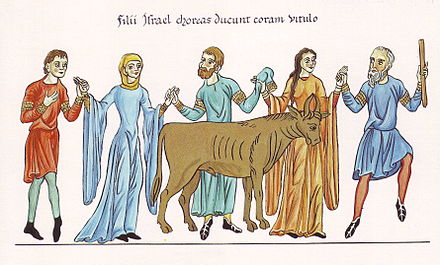
Aharon’s first independent act is making a golden calf in the Torah portion Ki Tisa (Exodus 30:11-34:35), a clear violation of God’s law. Despite his crime, he becomes the high priest of the Israelites in this week’s Torah portion, Shemini (Leviticus 9:1-11:47).
Ki Tisa: the brother who made a golden calf
When the Israelites reach Mount Sinai, Moshe is the one who listens to all of God’s rules and passes them on to the people. Then God summons Moshe to climb to the summit alone and receive the stone tablets. Before he hikes up, Moshe assigns Aharon and another leader named Chur to judge legal cases in his absence. His absence lasts for 40 days and 40 nights, as he listens to God’s instructions for setting up a centralized religion.
At the top of Mount Sinai, God tells Moshe that Aharon will be the first high priest, and his four sons will be priests under him. But at the foot of Mount Sinai, the Israelites abandon hope that their leader will ever return to them.
And the people saw that Moshe was shamefully late in coming down from the mountain, and they assembled against Aharon and said to him: “Get up, make us a god that will go before us! Because this Moshe, the man who brought us up from Egypt, we do not know what has become of him!” (Exodus 32:1)
Like the other Israelites, Aharon heard the second of the “Ten Commandments”: “You must not make an idol, or any likeness of what is in the heavens above, or what is on the earth underneath, or what is in the waters underneath the earth. You must not bow down to them and you must not serve them …” (Exodus 20:4-5)
And like the other Israelites, Aharon heard Moshe repeat God’s subsequent law: “With me, you must not make gods of silver or gods of gold. You must not make them!” (Exodus 20:20, 24:3-4)
As one of the two designated judges, Aharon is supposed to hand down the law. Yet when a group of Israelites order him make them a god, Aharon immediately asks the people for their gold earrings.
And he took [the gold] from their hand, and he shaped it with an engraving tool, and he made it into a cast eigel. And they said: “This is your god, Israel, who brought you up from the land of Egypt!” (Exodus 32:4)
eigel (עֵגֶל) = calf, bull-calf.
And Aharon saw, and he built an altar, and he proclaimed: “A festival for Y-H-V-H tomorrow!” (Exodus 32:5)
Has Aharon completely forgotten God’s prohibitions against gold idols? Or does he think that God will overlook his disobedience as long as he claims that the golden calf represents the right god, the God whose personal name is spelled Y-H-V-H?
Is he simply afraid to oppose the men who asked him to make an idol? (According to the midrash collection Vayikra Rabbah, the Israelites asked Chur for an idol first, and killed him when he refused to make one.)2 Later commentators added that Aharon’s fear made him stall for time, in the hope that Moshe would return before the festival.3
Or was Aharon an agreeable person who has never learned how to handle confrontation, because his little brother was always there to do it?
And they got up early the next day, and they raised fire-offerings and they offered wholeness-offerings, and the people sat down to eat and to drink. Then they got up to make merry. (Exodus 32:6)
Their happy relief is interrupted by Moshe striding into the camp and shattering the two stone tablets he received from God. Then he grinds the gold calf into dust.
And Moshe said to Aharon: “What did this people do to you, that you have brought upon them a great chatah?” (Exodus 32:21)
chatah (חֲטָאָה) = guilt, sin (in relation to God).
And Aharon said: “Don’t let my lord’s nose get hot [with anger]! You yourself know the people, that they are set on evil. They said to me: Make us a god that will go before us, because this Moshe, the man who brought us up from the land of Egypt, we do not know what has become of him! And I said to them: Who has gold? And they broke it off and gave it to me, and I threw it into the fire, and out came this eigel!” (Exodus 32:22-24)
At least Aharon does not invent an excuse for his behavior, although he does make it sound as if the calf emerged all by itself, without any shaping or casting on Aharon’s part.
I can imagine Moshe rolling his eyes. But instead of asking his brother a follow-up question, he turns his attention to the drunk Israelites who were making merry in front of the golden calf.
And Moshe saw that the people had lost control—because Aharon had let them lose control … Then Moshe stood in the gate of the camp and said: “Whoever is for Y-H-V-H, to me!” And all the sons of Levi gathered to him. (Exodus 32:25-26)
Moshe orders the Levite men to go through the camp killing all the idol-worshippers. Then God sends a plague to kill any who were overlooked.4
But neither Moshe nor God punishes Aharon.
Moshe hikes up to top of Mount Sinai for another forty days, then returns to the camp with God’s pardon and a second pair of stone tablets. At that point he announces God’s plans for the revised religion. The people enthusiastically donate materials and labor to make a new portable sanctuary and altar, and new vestments for the priests. Aharon is still slated to be the first high priest, and his sons are still slated to serve as his assistants.
Shemini: memories of the golden calf
In this week’s Torah portion, Shemini (“Eighth”), Aharon and his sons have completed seven days of sitting at the entrance of the new sanctuary, also called the Tent of Meeting. Their ordination as the only priests of the revised religion is almost finished.
And it was on the eighth day, Moshe called to Aharon, to his sons, and to the elders of Israel. (Leviticus 9:1)
Until now, Moshe has been offering the animal sacrifices to God. This will be Aharon’s first day to make offerings on the altar himself.
And he said to Aharon: “Take yourself an eigel, a son of the herd [male two-year-old], as a chatat, and an unblemished ram as a rising-offering, and bring them near in front of God.” (Leviticus 9:2)
chatat (חַטָּאת) = an offering to expiate guilt or atone for sin. (From the noun chatah.)
Later in the book of Leviticus, in the portion Acharei Mot, Aharon is instructed to offer a par, (פַּר = adult bull) annually on Yom Kippur, as a guilt offering for himself and his sons—just in case they remain guilty of any transgressions committed during the past year.5
R.S. Hirsch explained that Aharon’s first guilt offering is a two-year-old male calf because “It is fitting that the priest who is about to serve in the Sanctuary should represent himself with such an offering. Later, however, when he has already assumed the office … he represents himself as a par.”6
(The standard practice was that whoever brought a guilt offering to the altar would lay his hands on its head before it was slaughtered, thus indicating his identity with the animal and symbolically offering himself to God. Aharon must identify with a calf for his first guilt offering, and with a grown bull from then on.)
But the main line of commentary, from Sifra (ca. 300 C.E.) to Avivah Gottlieb Zornberg (2022)7 deduces that Aharon has not yet cleared his guilt for making the golden eigel that people used as an idol, so now he must make atonement with a live eigel.
Then, as the high priest, Aharon can effect atonement for the Israelites who worshiped the golden calf.
Shemini: still afraid
Moshe tells Aharon when it is time to slaughter his own bull-calf as a guilt offering, along with his own ram as a rising-offering, and a hairy goat as a guilt offering for all the Israelites, along with other animal offerings and a grain offering. He concludes:
“… today, Y-H-V-H will appear to you!” (Leviticus 9:4)
Moshe repeats that promise to the whole assembly of Israelites, who have been fashioning all the pieces of the new sanctuary and the priests’ vestments for months, perhaps even a full year. This is the critical moment when they all will find out whether their work has been in vain.
Moshe tells his brother to come close to the new copper altar. The next verse says merely:
And Aharon came close to the altar, and he slaughtered the eigel for the chatat that was his. (Leviticus 9:8)
But according to the commentary, he is afraid to approach the altar. Ramban wrote: “Some Rabbis say that Aaron saw the [horned] altar in the form of the bull, and he was frightened by it.”8
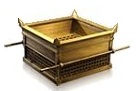
Altars throughout the Levant were square boxes with protrusions shaped like horns at the four top corners. And every calf, even if it were only one year old, would have horns.
Ramban explained: “The reason for this [apparition which Aaron saw in the altar] was that since Aaron was the holy one of the Eternal, having no sin on his soul except for the incident of the golden calf, therefore that sin was firmly fixed in his mind … It thus appeared to him as if the form of the calf was there [in the altar] preventing his [attaining] atonement.”9
Or, as Rabbi David Kasher put it in the 21st century: “You see, it wasn’t just the altar. Aaron saw bulls everywhere. They haunted him. Bulls, and cows, and calfs—bovine beasts of every shape and size—their horns pointed at him, their hooves marching towards him. They were coming to collect punishment for his great sin. … Aaron stands there and wonders how he will ever be able to do this job. How can he atone for others when he himself is so full of sin? And Moses tells him, you are right, my brother. You will only become the High Priest for these people once you have worked through your own issues. You must find peace inside yourself before you can find it for anyone else. So first offer your sacrifices, first atone for yourself.”10
Then the sons of Aharon brought the blood to him, and he dipped his finger into the blood, and he put it on horns of the altar, and he poured the [remaining] blood on the foundation of the altar. (Leviticus 9:9)
Aharon is back on track. He continues performing the tasks of a high priest until all the animals have been slaughtered and burned according to regulations, and their blood distributed appropriately.
Then Aharon raised his hand toward the people, and he blessed them. And he came down from making the chatat, the rising-offering, and the wholeness-offering. Then Moshe and Aharon entered the Tent of Meeting, and they came out and they blessed the people. And the glory of Y-H-V-H appeared to the entire people—and fire went out from in front of Y-H-V-H, and it consumed the rising-offering and the fat parts on the altar. And all the people saw, and they sang out joyfully, and they threw themselves down on their faces. (Leviticus 9:22-24)
What would it be like to believe you had done something so terrible you could never be forgiven?
What would it be like to see a miraculous fire rush out from the Holy of Holies to pardon you?
What would it be like to be Aharon?
- Exodus 4:10-13. See my post Shemot: Moses Gives Up.
- Vayikra Rabbah, midrash (an imaginative form of commentary) composed ca. 500 C.E.
- E.g. Or HaChayim, 18th century C.E.
- Exodus 32:35.
- Leviticus 16:6, 16:11-14.
- 19th century Rabbi Raphael Samson Hirsch, The Hirsch Chumash: Sefer Vayikra, Part 1, English translation by Daniel Haberman, Feldheim Publishers, Jerusalem, 2002, p. 278.
- Avivah Gottlieb Zornberg, The Hidden Order of Intimacy, Schocken Books, New York, 2022 p. 61. See also Midrash Tanchuma, 6th-8th centuries C.E.; Rashi, 11th century; Da-at Zekinim, 12th-13th centuries; Rabbeinu Bachya ben Asher, 14th century; and Or HaChayim by Chayim ibn Attar, 18th century.
- Ramban is the acronym of 13th-century Rabbi Moshe ben Nachman, a.k.a. Nachmanides. Translation in www.sefaria.org.
- Ramban, ibid.
- David Kasher, ParshaNut, Shemini: “Come Close”.

 Questioning Torah