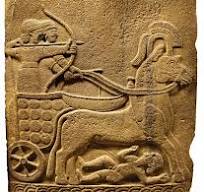
Prosperous kingdoms in the Ancient Near East had horse-drawn war chariots; before the reign of King Shlomoh (“Solomon” in English) the Israelites had only foot soldiers.1
In each enemy war chariot stood a driver and one or two archers, all armed with swords in case of close combat. On an open plain, a battalion of chariots could slaughter a large regiment of foot soldiers—unless the foot soldiers have a secret weapon.
And the Israelites do, as in both this week’s Torah portion, Beshallach (Exodus/Shemot 13:17-17:16), and the accompanying haftarah reading, Judges 4:4-5:31: a God who controls the weather.
At the Sea of Reeds
And God caused the people to turn onto the road in the wilderness of the Sea of Reeds. And the people went up armed from the land of Egypt. (Exodus 13:18)
Although God had ordered the Israelites to “borrow” silver and gold objects from their desperate Egyptian neighbors before they left,2 God said nothing about weapons. The fact that the Israelites “borrowed” swords as well only shows that they were already afraid of being attacked, not that they knew how to use their weapons.3
A pillar of cloud by day and fire by night leads the Israelites to the shore of an inlet or brackish lake called the Sea of Reeds. Meanwhile, God tells Moses:
“I will strengthen the heart of Paroh [“Pharaoh”], and he will pursue them. Then I will be glorified through Paroh and through all his army, and the Egyptians will know that I am God!” (Exodus 14:4)
On the theory that an act of God is an act of nature, it makes sense that after the pharaoh has made a habit of hardening his own heart after each plague God sent to Egypt, now his heart hardens naturally when he hears where the Israelites have gone.
And he harnessed his chariot, and he took his [fighting] people with him, and he took 600 choice chariots, and every [other] chariot in Egypt, every one with a team of three. (Exodus 14:6-7)
The pharaoh’s chariots catch up with the Israelites at the shore of the Sea of Reeds.
… and the Israelites raised their eyes, and hey! Egypt was setting out after them! And they were very afraid. And the Israelites cried out to God. (Exodus 14:10)
Many classic commentators questioned why the Israelites, with 600,000 men,4 would be afraid of an Egyptian force of 600 chariots.5 Even if every chariot held two archers and was pulled by two horses, how many men can 1200 archers and 1200 war horses strike down before they are overwhelmed by the remaining foot soldiers?
Chizkuni summarized the most common explanation: “Their fear was based on their slave mentality. Every slave is afraid of his master. These Israelites had not yet proven to themselves that they could fend for themselves.”6
After crying out to God, the people protest to Moshe (“Moses”in English), who tells them that God will fight the Egyptian chariot battalion, and they should all be quiet.
Then the messenger of God that was going in front of the machaneih of Israel pulled out and went around behind them; the pillar of cloud pulled out from in front of them and stood behind them. And it came between the machaneih of Egypt and the machaneih of Israel … (Exodus 14:19-20)
machaneih (מַחֲנֵה) = camp (as a place with temporary structures for spending the night); camp (as a faction or party of people).
Here, nobody is camping for the night. The sun sets, and the pillar of cloud between the two camps turns into a pillar of fire.
And Moshe stretched out his hand over the sea, and God made the sea go back with a strong east wind all night, and made the sea [bed] dry land; for the waters split. And the Israelites came through the middle of the sea on the dry land, and the waters were a wall for them on their right and on their left. (Exodus 14:21-22)
While the Israelites and their livestock are walking in the dark ahead of the pillar of fire, the Egyptians see the pillar of fire receding down a stretch of dry land.
Then the Egyptians pursued and came after them: all of Paroh’s horses and his chariots and his horsemen, into the middle of the sea. (Exodus 14:23)
The Israelites are climbing the bank of the far shore while the Egyptians are racing across the temporary road of dry land. Then, during the last watch of the night, God acts again.
And God looked down at the Egyptian camp from the pillar of fire and cloud, and yaham the Egyptian camp. (Exodus 14:24)
yaham (יָהָם) = he confused, confounded, panicked. (From the verb hamam, הָמַם = roused, brought into movement and confusion, caused pandemonium.)
And [God] loosened the wheels of his [the pharaoh’s] chariots and made them drive with heaviness. Then [the king of] Egypt said: “I must flee from the face of Israel, because God wages war for them against Egypt!” (Exodus 14: 25)
What is God doing to the Egyptian chariots?
Rashi suggested: “Through the power of the fire of the pillar of fire the wheels were burnt and the chariots were thus dragged along and those who were sitting in them were thrown about and their limbs were all put out of joint.”7
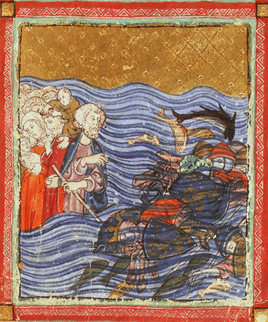
Others proposed that many of the panicked Egyptian chariot drivers tried to turn around, but then they crashed into the chariots behind them.8
But according to Robert Alter, “The simplest explanation is that as the water begins to seep back and before it becomes a flood that engulfs the Egyptians, it turns the dry ground into muck. The chariot wheels rapidly become stuck in the mud … and break off from the axles.”9
At sunrise, when all the Israelites are safe on the other side, God tells Moshe to turn around and stretch out his hand again. The water comes crashing back in.
And the waters returned, and they covered the chariots and the horsemen of all of Paroh’s army that was coming after them into the sea; not one of them remained. (Exodus 14:28)
Thanks to God, the entire enemy force is dead.
At the Wadi Kidron
When the haftarah reading in the book of Judges opens, the Israelites have been subjugated by a Canaanite king named Yavin, whose general is Sisera.
And the Israelites cried out to God, because he had 900 iron chariots, and he had been violently oppressing the Israelites for twenty years. (Judges 4:3)
But now the Israelites have a leader like Moses, who was both a prophet (spokesperson for God) and a judge (legal authority).
And Devorah was a woman, a prophetess, a woman of torches. She was judging Israel at that time. (Judges 4:4)
Israelites from several northern tribes routinely come to consult Devorah at her home in Efrayim territory. Now she summons Barak, who presumably has some experience leading soldiers, from his home in Naftali territory.
And she said to him: “Has not God, the God of Israel, commanded you: ‘Go! And you must form a line on Mount Tabor, and take with you 10,000 men from the Naftalites and the Zevulunites. And I will form a line against you at the Wadi Kishon: Sisera, commander of Yavin’s army, and his procession. And I will give him into your hand!’” (Judges 4:6-7)
Mount Tabor was forested, providing the Israelites with both cover and a view of the upper Jezreel Valley, including the streambed of the Kishon River. Devorah communicates God’s promise to bring the enemy to the bottom of the mountain and give victory to the Israelites. But Barak is understandably nervous about the whole enterprise.
And Barak said to her: “If you go with me, I will go. But if you do not go with me, I will not go!” (Judges 4:8)
She agrees, and he rounds up 10,000 men. When General Sisera learns that 10,000 foot soldiers have gathered on Mount Tabor, he takes his 900 chariot crews, along with all his other fighters, to the Wadi Kishon.
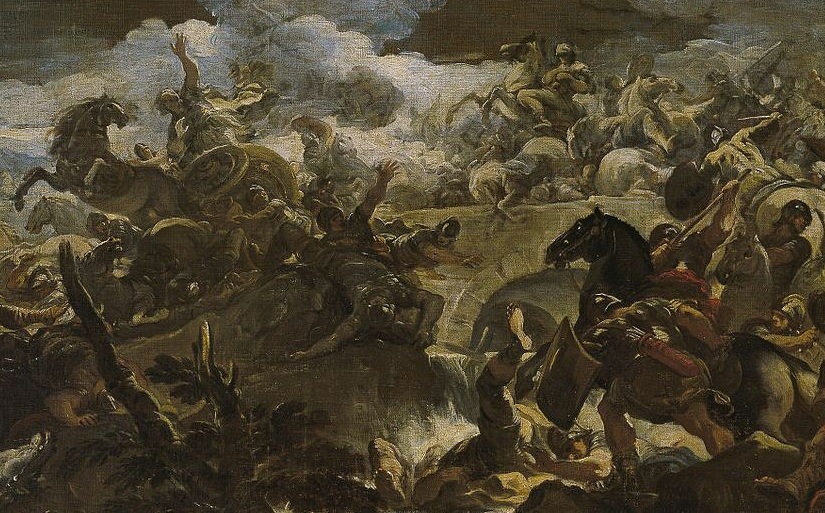
And Devorah said to Barak: “Arise, because this is the day that God is giving Sisera into your hand! Does not God go out before you?” And Barak came down from Mount Tabor, and 10,000 men were behind him. And God yaham Sisera and all the chariotry and all the camp toward the edge of the sword[s] in front of Barak. And Sisera got down from the chariot and fled on foot. And Barak was pursuing after the chariotry and after the machaneih … And the whole machaneih of Sisera fell by the edge of the sword. (Judges 4:13-16)
Only Sisera escapes, and he is then killed by a woman, Yael (“Jael” in English)—but that is a story for another post.
What does God do to the Canaanites and their chariots that causes panic and pandemonium? The story in the book of Judges holds no internal clues. But the poem following it does.
In both Exodus and Judges, the stories are followed by poems composed in a more ancient Hebrew than the rest of the Hebrew Bible. The poem that Devorah and Barak sing, known a the “Song of Devorah” (Judges 5:1-31), mentions more Israelite tribes, and describes Yael’s killing of Sisera differently. One line in the poem provides more information about the destruction of Sisera’s army:
The Wadi Kishon swept them away. (Judges 5:21) A wadi is a stream-bed that contains only a trickle during the dry season. A heavy rainstorm at the wadi’s source results in a rushing flood of water. Steinsaltz explained: “The Kishon Stream, which apparently overflowed its banks, swept them, some of the enemy soldiers, away. The ground turned muddy, making it impossible for the chariots to maneuver properly. Thus, the chariot riders became easy prey for the foot soldiers of Zebulun and Naphtali, who gained the advantage of speed.”10
In both the Torah portion and the haftarah, Israelites on foot face archers riding on chariots. And in both Exodus and Judges, God saves the Israelites by manipulating water so that the chariots will be stuck in the mud, and the enemy will die in the ensuing confusion and panic.
The Israelites are stuck in the role of victims until God strikes. In the portion Beshallach, they believe that they can never escape from the pharaoh. In the haftarah from Judges, they believe they will always be under the thumb of the Canaanite king.
Their enemies feel free to throw their weight around, until the situation reverses and they are the ones who are stuck. The chariot wheels that gave them such mobility are jammed by mud, immovable. And the Israelites are freed.
The English idiom ‘stick-in-the-mud” means someone who resists change, who does not adapt to new circumstances. Although the Israelites in both stories are afraid of the enemy who has long oppressed them, when their prophet—Moshe or Devorah—tells them in the name of God to do something new, they bravely go ahead and do it. The ex-slaves from Egypt walk in the dark between two walls of water, trusting that the ground will stay firm under their feet until they reach the other side. The oppressed Israelites in northern Canaan hurry down toward the chariot riders poised to shoot them.
But their enemies are stick-in-the-mud types even before the real mud arrives. The pharaoh keeps breaking his promises to let the Israelites go, hardening his heart because he cannot bear to give up the status quo. General Sisera is so used to success that he orders his troops into a wadi without thinking about the weather. When the Egyptian pharaoh and the Canaanite general encounter some unexpected mud, they are confused; they do not know how to handle it.
The road to freedom is courage. The road to destruction is the inability to change.
- Kings 10:26.
- Exodus 12:35-36.
- Rabbi Samson Raphael Hirsch, The Hirsch Chumash: Sefer Shemos, translated by Daniel Haberman, Feldheim Publishers, Jerusalem, p. 228.
- Exodus 12:37. Numbers in the Hebrew Bible are chosen for emotional impact, and are not meant to be historically accurate.
- E.g. Ibn Ezra, Chizkuni, Bachya ben Asher.
- Chizkuni, 13th-century compilation of midrash by Rabbi Hezekiah ben Manoah, translation in www.sefaria.org.
- Rashi, acronym of 11th-century Rabbi Shlomoh Yitzchaki, translation in www.sefaria.org. 14th-century rabbis Jacob ben Asher (Tur HaArokh) and Bachya ben Asher also expressed this opinion.
- E.g. Ibn Ezra, Midrash Tanchuma, Chizkuni, Rashbam
- Robert Alter, The Five Books of Moses, W.W. Norton & Co., New York, 2004, p. 395. Also proposed by Rabbi Obadiah Sforno in the 16th century.
- Rabbi Adin Steinsaltz, Introductions to Tanach: Judges, quoted on www.sefaria.org.

 Questioning Torah