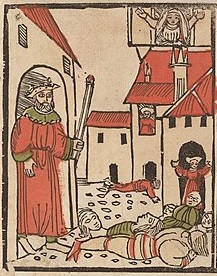
The midnight death of the firstborn is the last of the ten plagues that God inflicts upon Egypt before the pharaoh lets the Israelites go in this week’s Torah portion, Bo (Exodus/Shemot 10:1-13:16). First Moshe (“Moses” in English) warns Paroh (“Pharaoh” in English) that all the firstborn sons1 in Egypt will die—
“— from the firstborn son of Paroh who sits on his throne, to the firstborn son of the female slave who is behind the millstones, and the firstborn of every beast. Then there will be a loud cry throughout all the land of Egypt, the like of which has never been, and never will be again. But against all the Israelites, not a dog will sharpen its tongue …” (Exodus 11:5-7)
In other words, all the firstborn sons of Egyptians and their livestock will die, but the firstborn sons of Israelites and their livestock will be unharmed; not even a dog will snarl at them.
In order to make the Israelites exempt from this final plague, God orders a ritual.
Marking with blood
First, God tells Moshe that every Israelite household must acquire a lamb or a goat kid, an unblemished male yearling, on the tenth day of “this month”— Aviv, the first month of spring.2 If a household has too few members to eat an entire lamb in one night, it should combine with another small household. The household must keep watch over the animal for four days, then slaughter it on the fourteenth day of the month.
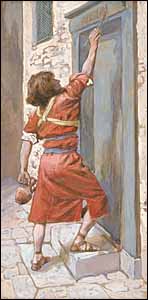
“Then they will take some of the blood and put it on the two door posts and on the lintel, on the houses where they will eat it.” (Exodus 12:7)
When Moshe passes on this instruction to the Israelite elders, he provides more details:
“Then you must take a bunch of oregano,3 and dip it in the blood that is in the basin, and apply some of the blood that is in the basin to the lintel and the two doorposts. And none of you should go out through the entrance of his house until morning!” (Exodus 12:22)
Any firstborn sons inside a house with bloodstains around the door will live through the night. But if any Israelite firstborn sons are wandering around outside, they will be subject to the death of the firstborn. Moshe gives the same explanation that God gave him:
“And God will pass through to strike down Egyptians, and will see the blood on the lintel and the two doorposts, and God ufasach the entrance, and will not give [release?] the destruction to enter your houses to strike.” (Exodus 12: 23)4
ufasach (וּפָסַח) = will skip, will hop, will limp. (From the same root verb as the name of the annual observance, Pesach (פֶּסַח). Pesach is called “Passover” in English instead of Skipover.)
Why do the Israelites have to paint or sprinkle blood around the entrance of every house where they gather to eat that night?
The simple answer implied by Moshe’s speech is that God could not identify which houses contained Israelites without a sign at the entrance—even though this same God has the ability to identify who is a firstborn son.
Classic Jewish commentators, offended by the idea that God would not already know which houses contained Israelites, offered other answers. Rashbam considered “the destruction”an agent that God releases upon Egypt; the bloodstains “insure that God’s angel killing the firstborn will bypass the houses with the sign of the blood on their door-frames.”5
Perhaps Chizkuni was thinking of an “angel” of destruction when he wrote: “The blood on the entrances of the homes of the Israelites should form the equivalent of the letter ח, in order to protect the entrance so that the destructive force which would kill the firstborn inside would not carry out that command. … the letter ח could be a symbol of חיים, life.”6
The two doorposts and the lintel across the top do make a shape like the Hebrew letter ח. But according to the Mekhilta DeRabbi Ishmael, it is not necessary to posit an angel; marking the doorframe with blood is simply a commandment, and “… in reward for your performance of the commandment, I reveal myself and have compassion on you.”7
Some commentators wrote that performing this particular commandment required courage and trust in God, because the Egyptians worshipped a ram god and would attack anyone who slaughtered a lamb and applied its blood to their doorframes. However, only two ancient Egyptian temples were dedicated to a ram god, both farther south than the Nile delta where the pharaoh and the Israelites live in the book of Exodus.8
Furthermore, at that point in the story the Egyptians are desperate to get the Israelites out of their country so that their God will stop afflicting them with plagues. Even the pharaoh is getting desperate. Just before God gives Moshe the instructions for the first Passover, God tells him that once the death of the firstborn has happened,
“… after that he will send you out from here. When he sends you, it is finished; he will absolutely drive you away from here.” (Exodus 11:1)
Then God says that the Israelites must ask their Egyptian neighbors to give them silver and gold objects. The Egyptians hand over their valuables, because—
“… God gave the people grace in the eyes of the Egyptians … (Exodus11:3)
It seems the Egyptians are more afraid of the Israelites than the Israelites are of the Egyptians.
Other commentators have considered the application of lamb’s blood around the doorframe a symbolic act. In the Jerusalem Talmud, “Rebbi Eliezer ben Jacob says, why at the door? Because by the door they went from servitude to freedom.”9
Maybe emerging through that bloodstained doorway the next morning is like a birth into a new state of being.
What to eat
After the Israelites paint or sprinkle lamb’s blood on their door frames, God tells Moshe,
“Then they must eat the meat on that night, roasted in fire, and matzot, and on bitter herbs they must eat it.” (Exodus 12:8)
matzot (מַצּוֹת) = plural of matzah (מַצָּה) = unleavened bread: flat sheets of flour and water, baked quickly without sourdough or any other leavening.
Why must the meat be roasted? In the 13th century, Chizkuni wrote that roasting was necessary “so that the fragrance of the meat will assail the noses of the Egyptians and they will reflect on what is happening to their [ram] deity.”11
But in the 20th century, Everett Fox wrote: “Not raw or boiled, since what seems to be meant is an imitation of standard sacrifices.”12 Similarly, matzah was the type of bread offered to God at the altar.13
Why must the Israelites eat matzah and bitter herbs with the roasted meat? The Talmud explains:
“The reason for matzah is because our forefathers were redeemed from Egypt, as it is stated: “And they baked the dough that they took out of Egypt as cakes of matzot, for it was not leavened, as they were thrust out of Egypt and could not tarry, neither had they prepared for themselves any victual” (Exodus 12:39). The reason for bitter herbs is because the Egyptians embittered our forefathers’ lives in Egypt, as it is stated: “And they embittered their lives with hard service, in mortar and in brick; in all manner of service in the field, all the service that they made them serve was with rigor” (Exodus 1:14).”14
Chizkuni wrote: “The bitter herbs symbolize the slavery, the unleavened bread symbolizes freedom, and the meat of the Passover symbolizes … being saved. At the time when the Passover lamb was being consumed the firstborn Egyptians were being killed.”15
But by the 18th century, some commentators offered less symbolic explanations. Chayim ibn Attar wrote: “The requirement to eat bitter herbs with it is natural; Egyptians used to eat roast meat with something pungent as this enhanced the taste of the meat and enabled the person who ate it to thoroughly enjoy his meal.”16
And maybe God, on a night when the Israelites must eat a large dinner and also prepare to leave their homes forever at daybreak, prescribes the fastest way to bake new bread: mix flour and water and slap it in the oven without taking time for kneading it or letting it rise.17
Ready to go
But God has not finished prescribing how the Israelites must eat their last meal in their Egyptian homes.
“And like this you must eat it: [with] your hips girded, your sandals on your feet, and your staffs in your hand. And you must eat it in trembling haste. It is a pesach for God.” (Exodus 12:11)
Here the word pesach refers to a type of offering, anticipating the annual pesach offerings at the temple.18
Why must the Israelites eat a large meal in discomfort, standing up with their robes hiked up and tied around their hips, and holding s staff in one hand? They do not need to hurry for fear of the Egyptians, because the Egyptians want them to leave. Nor do they need to leave in a hurry because the pharaoh might change his mind again, since God said that the death of the firstborn will be the final plague.
So I agree with 14th-century rabbi Bachya ben Asher, who wrote: “The symbolic meaning of “with girded loins and your shoes on your feet” (verse 11), was to depict people who are eager to be on their way to a new destination.” 19
The Israelites must act as if they are in a hurry as a display of eagerness to leave Egypt and head toward Canaan.
Future observance
After repeating that the Israelites should mark their houses with blood so that God will skip over them, God wraps up the instructions to Moshe by saying:
“And this day will be a reminder for you, and you will celebrate it as a festival for God throughout your generations. A decree forever; you must celebrate it!” (Exodus 12:15)
Then God decrees avoidance of leaven, consumption of matzah for seven days, and a holy convocation on the first and seventh day—but nothing about eating standing up. After the Israelites have left their Egyptian homes, God adds that future Pesach meals must be eaten inside the house, without breaking bones, and men may eat it only if they are circumcized.20
The Passover ritual in the Torah portion Bo adds drama to the story of the night before the Israelites leave Egypt. It also provides an opportunity for God to order future Passover rituals.
From the 10th century B.C.E. to the destruction of the first temple in 587 B.C.E., Pesach was a spring pilgrimage-festival in which citizens of the kingdom of Judah brought lambs to slaughter at the temple and eat there, not at home, with unleavened bread.21 This practice was reinstated during the time of the second temple, 537 B.C.E. to 70 C.E.22 The purpose of the festival was to give God offerings in gratitude for rescuing the Israelites from servitude in Egypt.
After the fall of the second temple, Jews began celebrating Passover through a long and elaborate evening ritual at home. The basics of the ritual Jews use today were set down in the Mishnah of the Talmud tractate Pesachim around 200 C.E., and involve symbolic foods, four cups of wine, prayers, quotes from the Torah, and more—including a retelling of the story from the beginning of the book of Exodus through this week’s Torah portion, Bo. Blood is not daubed on doorways, eating lamb is optional, and participants are told to recline, not stand up.
Yet the underlying purpose of the first Passover ritual, the festival in temple times, and the ritual since 200 C.E. is the same: to teach the importance of freedom.
In the portion Bo, the Israelites must pretend to tremble with eagerness for their release from servitude, and stepping through their bloodstained doorways is like being born. In the temple festival, the technology of animal sacrifice is used to thank God for freedom and independence. And the script (hagadah) for the Passover that Jews have been celebrating for almost two millennia, the key statement and theme is “We were slaves; now we are free”.
Of course Jews have not always been free during the course of history, but we can pray to be free again. And many Jews today enhance the Passover ritual with prayers and symbols of hope that other peoples will be freed from oppression.
I pray that it may be so, without bloodshed, and with trembling haste.
- Bekhor (בְּכוֹר) = firstborn male, son who was born first—no matter how old. In this case, the firstborn humans include both the first son of a man (such as the pharaoh) and the first son of a woman (such as the female slave).
- The lunar month of Aviv (“ripening grain”) was renamed Nisan in the 6th century B.C.E. It begins in March or April, when barley and wheat planted in the fall are forming ears of grain.
- See my post Pesach, Metzora, & Chukat: Blood and Oregano.
- In Exodus 12:13 God commands virtually the same thing, but says “and I will skip over you, and for you it will not be a blow to destruction (lemashchit) when I strike down the land of Egypt.”
- Rashbam, the acronym for 12th-century rabbi Shmuel ben Meir, translated in www.sefaria.org.
- Chizkuni, the acronym for 13th-century rabbi Chizkiah ben Manoach, translated in www.sefaria.org.
- Mekhilta DeRabbi Ishmael, 3rd century C.E., quoted by Nehama Leibowitz, New Studies in Shemot (Exodus), translated by Aryeh Newman in 1976, Maor Wallach Press, Jerusalem, 1996,p. 199.
- The ram god Heryshaf was worshipped at Henen-Nesut, renamed Heracleopolis. The ram god Khnum was worshipped at Elephantine Island, and in the 5th century B.C.E., the priests of Khnum wrecked the temple next door, which belonged to a Jewish colony, but the Elephantine papyrus in which a Jewish official recorded this does not say there was any loss of life.
- Jerusalem Talmud, Kiddushin 1:2:31, translated in www.sefaria.org.
- Chizkuni, ibid.
- Everett Fox, The Five Books of Moses, Schocken Books, New York, 1983, p. 315.
- See my post Pesach: Being Unleavened, Part 2.
- Talmud Bavli, Pesachim 116b, translated by Rabbi Adin Steinsaltz in the Koren “William Davidson Talmud”, www.sefaria.org.
- Chizkuni, ibid.
- 18th-century rabbi Chayim ibn Attar, Or HaChayim, translated in www.sefaria.org.
- Tractate Pischa 16:39, translated in www.sefaria.org.
- See my post Pesach: Being Unleavened, Part 2 for an alternate explanation.
- See Deuteronomy 16:2.
- Rabbeinu Bachya ben Asher, 14th century C.E. , translated in www.sefaria.org.
- Exodus 13:43-49.
- See Deuteronomy 16:1-8. When scribes wrote Deuteronomy, the “place that God will choose” meant the temple in Jerusalem.
- Ezra 6:19-22; Talmud Bavli, Pesachim.

 Questioning Torah