(Below is the seventh post in my series on why David is God’s favorite king—whether he acts ethically or not. If you want to read one of my posts on this week’s Torah portion in Deuteronomy, you might try Vayeilekh: Two Transitions. And since the Jewish new year, Rosh Hashanah, begins tonight, I wish you all a good year, shanah tovah, in this time of uncertainty!)
The first book of Samuel ends with a major battle in the Jezreel Valley between the Israelites and the Philistines. The Philistines win and take over the large valley. Both King Saul and his oldest son, Jonathan, die in battle. But David, who once was King Saul’s most famous commander, is absent. (See my post 1 Samuel: David and the King of Gat.)
The second book of Samuel opens with a man bringing David news about the Philistine victory and the deaths of King Saul and his oldest son, Jonathan. David mourns for his enemy, Saul, as well as for his ally, Jonathan.
And it was after this when David inquired of God, saying: “Should I go up into one of the towns of Judah?” (2 Samuel 2:1)
Inquiring of God

The phrase “inquired of God” does not mean asking God directly; in the Hebrew Bible, only the most advanced prophets can do that. Anyone else with a question for God goes to either a prophet, or a priest with a divining instrument called an eifod (אֵפוֹד).
One member of David’s outlaw band is Evyatar, the son of the high priest of Nov, who escaped with his father’s eifod when King Saul had every resident of Nov massacred. (See my post 1 Samuel: David the Devious.) David previously asked Evyatar to “inquire of God” before he ordered his band of 600 men to rescue the Israelite town of Ke-ilah from the Philistines, and before they left Ke-ilah because King Saul was bringing troops to capture him.1 He did it again when he and his men returned to Ziklag and found that Amalekite raiders had destroyed the village and taken all of their wives and children.2
All three times, David did what the eifod said God wanted, and the results were good (at least for David and his men).
Now that King Saul and his firstborn son are dead, David “inquires of God” to find out whether it is time to rally support in the territory of his own tribe, the tribe of Judah.
The answer is yes. When David asks which town in Judah he should “go up into”, i.e. make his headquarters, the priest uses his eifod again and comes up with the answer: Hebron. So David and his whole outlaw band move into Hebron and its surrounding villages.
And the men of Judah came, and there they anointed David as king over the house of Judah. (2 Samuel 2:4)
David, king of Judah
This is not David’s first anointment. When he was still a boy, the prophet Samuel secretly anointed him as the next king of all Israel. (See my post 1 Samuel: Anointment.) Now the leaders of Judah anoint him as the king of their tribe. A single tribe has never had its own king before, and never does again.3
While David is ruling as the king of Judah, Abner, who served as Saul’s general after David fled, is uniting all the other tribes to recognize Saul’s fourth son, Ishboshet, as the king of all Israel. (Saul’s three oldest sons died in the battle with the Philistines in Jezreel.) Once Abner has consolidated power under his puppet king, the two sides go to war.
And the war was long between the house of Saul and the house of David, and David was growing stronger and the house of Saul was growing weaker. (2 Samuel 3:1)
Eventually Abner meets with David in Hebron and offers to get all the other tribes of Israel to accept David as their king. David accepts the peace treaty. But after Abner leaves, Joab, David’s nephew and general, send a message to him. Abner returns, and Joab meets him at the city gate.
And Joab took him aside into the middle of the [double walls of the city] gate to speak with him privately. Then he struck him there in the belly, so he died in exchange for the blood of his brother Asaheil. (2 Samuel 3:27)
In an earlier battle Abner had killed Joab’s brother Asaheil with a blow to the belly,4 so it seems like a revenge killing. But I wonder if Joab has second motive; he would not want to be demoted in favor of General Abner when the kingdom of Israel is reunited.
David distances himself from the murder by cursing Joab and his descendants (without using God’s name to make the curse more effective) and by elaborately mourning for Abner. He even makes Joab and all the troops tear their clothes and lament at the funeral procession. After burying Abner, David praises the dead general and concludes:
“May God repay the doer of the evil according to his evil!” (2 Samuel 3:39)
But David does not fire his nephew Joab. Nor does he inquire of God about what to do with him.
Joab serves as the chief commander of the Israelites for the rest of King David’s life, with no interference from God. Even though Joab killed Abner for personal reasons rather than for the good of King David or Israel, David is still God’s beloved. As long as David wants to keep Joab, God looks the other way.
King Ishboshet is soon assassinated, and leaders from all the tribes of Israel come to Hebron to pledge their allegiance to David. They tell him:
And God said to you: “You yourself will shepherd my people Israel, and you yourself will be ruler over Israel.” (2 Samuel 5:2)
Of course they have no idea what God actually said to David. But according to Robert Alter, attributing those words to God provides “the divine declaration of David’s legitimacy as ruler”.5
And all the elders of Israel came to the king at Hebron, and King David cut a covenant with them in Hebron before God. And they anointed David king over Israel. David was 30 years old when he became king, and he ruled for 40 years. (2 Samuel 5:3-4)
Rabbi Steinsaltz explained: “This was a bilateral agreement. The people accepted David’s reign upon themselves, while he granted a general amnesty, committing to take no actions to settle old scores, as some of the people had not supported him in the past.”6
Fifteen to twenty years have past since the prophet Samuel secretly anointed young David at God’s behest.7 Now, at age 30, he is publicly anointed king by “all the elders of Israel”.
David, king of Israel
Without consulting God, David captures the Jebusite town of Jerusalem by sending his men through a water conduit in a surprise attack. He turns the town into the new capital of Israel.
And David settled in the fortress, and he called it the City of David. And David built all around, from the rampart inward. And David went on and on and became great; and God, the god of armies, was with him. (2 Samuel 5:9-10)
As soon as the Philistines hear that David is now the king of Israel, they send a united army to Jerusalem, and camp just west of the city. Although they could not conquer Israel during the reign of King Saul, they hope to win a battle with the new king.
Then David inquired of God, saying: “Should I go up against the Philistines? Will you give them into my hand?” (2 Samuel 5:19)
A major battle with the Philistine army is more perilous than a surprise attack on the town of the Jebusites. So David turns to divination to ask if God will help him. And God says yes. The Israelites win the battle, but the Philistines regroup, come back, and try again. Again David inquires of God whether he should go up against the Philistines. This time God answers no—he should lead his men around behind the Philistine army.
And let it be, when you hear the sound of marching in the tops of the balsam trees, that is when God will go out before you, to strike down the camp of the Philistines. And David did so, as God had commanded him. And he struck down the Philistines from Geva until you come to Gazer. (2 Samuel 5:24-25)
With God’s help, David wins such a decisive victory that the Philistines do not cross over the border into the kingdom of Israel again.
Next King David makes Jerusalem the religious, as well as political, capital of Israel. He brings the ark to Jerusalem and places it in a tent until he can build a temple for it. Then he consults the prophet Nathan, who has a dream in which God dictates a long message to David. Nathan recites the message to his king, telling him that God does not want him to build the temple, but one of David’s sons will be king after him and build it, and his descendants will be kings of Israel forever.8
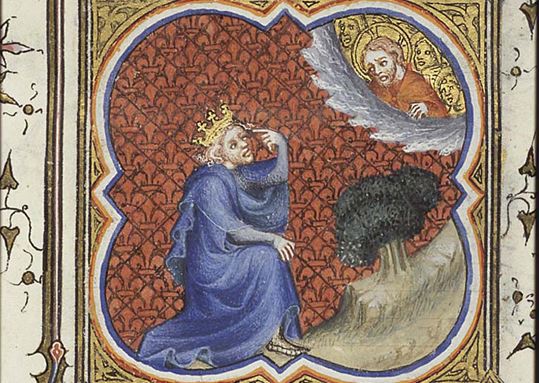
David sits in front of the ark inside the tent, tells God his gratitude for everything God has done, and concludes:
“And now, be pleased and bless the house of your servant to be forever in your presence, since you, my lord God, you have spoken. And through your blessing may the house of your servant be blessed forever!” (2 Samuel 7:29) So far, so good. But later, David gets a married woman pregnant, than arranges the death of one of his own soldiers to cover it up. That is too much; he loses God’s approval. After that, bad things start happening to David. (See my next blog post.)
Sometimes David inquires of God through his priest’s eifod or through his prophet. Asking God what he should do, and then doing what God says, is a way to ensure that God will back him up when he initiates a battle or makes a critical move.
The rest of the time, David acts on his own initiative, and—so far—it goes well. God does not intervene. The God character seems to have chosen David as a boy because of his pluck as well as his intelligence, and probably God remains happy to see his protégé exercising these traits as an adult.
Like David, when we are young we can often succeed through our own initiative, but it helps to have an authority figure to consult with for advice and the promise of back-up. When we grow old, we are the only authority figures. At least we can draw on more experience at 60 than at 30. But we are fooling ourselves if we think we can consult God through a divining device, or through someone’s dream. In our world, we always have to figure out the best course of action on our own.
- 1 Samuel 23:2-4 and 1 Samuel 23:11-12. See my post 1 Samuel: David the Devious.
- 1 Samuel 30:7-8. See my post 1 Samuel: David and the King of Gat.
- Even when the kingdom of Israel divides into two kingdoms in the first book of Kings, the land of the tribe of Benjamin is included in the kingdom named Judah.
- 2 Samuel 2:18-24.
- Robert Alter, Ancient Israel: The Former Prophets, W.W. Norton & Co., New York, 2013, p. 450.
- Adin Even-Israel Steinsaltz, Introductions to Tanakh, 2 Samuel, as quoted in www.sefaria.org.
- See my post 1 Samuel: Anointment.
- 2 Samuel 7:1-17.

 Questioning Torah
2 thoughts on “2 Samuel: David the King”