(If you want to read one of my earlier posts on this week’s Torah portion, Shoftim (Deuteronomy 16:18-21:9) you might try: Shoftim: More Important Than War: Part 2. Below is the third post in my series on why David is God’s favorite king—whether he acts ethically or not.)
David first comes to King Saul’s court to play the lyre, which calms the king when a fit of irrational terror seizes him. While he is working for Saul, advancing from musician to army commander, David attracts love and loyalty from everyone—Jonathan, the king’s oldest son and heir; Mikhal, the king’s daughter who becomes David’s wife; the king’s troops; and the women in every Israelite city, who celebrate David’s military successes. Why not? He is young, handsome, daring, quick-witted, and eloquent. He quickly learns the arts of war and leadership. He has natural charisma, and God’s blessing. (See my revised version of last week’s post: 1 Samuel: David the Beloved.)
But King Saul becomes jealous of David’s popularity. Even though he does not know that the prophet Samuel, at God’s command, secretly anointed the adolescent David as the next king, Saul comes to suspect that David is scheming to seize his throne.
In fact, David is happy to wait for the throne. But after King Saul makes several attempts to kill him, he flees from the king’s court. For his new life on the run, David adjusts his ethical standards. Although he still worships the God of the Israelites, he lies to a priest, violates a religious rule, and runs a protection racket.
Violating a religious rule
David’s first stop after he parts from Jonathan in the field outside the king’s settlement is Nov, a town of Israelite priests.
And David came to Nov, to Achimelekh the Priest. And Achimelekh trembled to meet David, and said to him: “Why are you alone, and there is no one with you?” (1 Samuel 21:2)
As the king’s top commander and brother-in-law, David would normally travel with an entourage. But why does the high priest tremble? According to Pamela Tamarkin Reis,1 Achimelekh’s fear is due to the presence of a third person.
And a man was there that day from the servants of Saul. He was detained in front of God, and his name was Doeig the Edomite, chief of Saul’s shepherds. (1 Samuel 21:8)
Whatever business Doeig has at the sanctuary, he lingers after David arrives. Both Achimelekh and David would notice him hanging around. Whether the high priest knows that David has fled from King Saul or not, he would be anxious about the presence of someone who might report David’s unusual visit to the jealous and irrational king.
Instead of telling the truth, David says:
“The king commanded me [about] a matter, and he said to me: ‘Not a man must know anything about the matter on which I am sending you and on which I commanded you!’ So I let the young men know about such-and-such a place [to meet me]. And now, what is there at hand? Give five loaves of bread to my hand, or whatever can be found.” (1 Samuel 21:3-4)
David speaks to Achimelekh as if he were still an important official, and invents a tale about a secret mission. Either he is lying to mislead the priest, or, according to Reis, he is lying to mislead Doeig.
The Priest answered David and said: “There is no ordinary bread under my hand. Rather, there is only sacred bread. If the young men kept themselves away, surely, from women …” (1 Samuel 21:5)
The high priest is suggesting violating a religious rule. Inside the sanctuary, in the room that only priests may enter, is a gold-plated bread table displaying twelve flat, round loaves of bread, along with frankincense. The high priest must lay out new bread every week.
Every sabbath day, perpetually, he must arrange them before the presence of God, from the Israelites as a covenant forever. And they will be for Aaron and his sons [i.e. the hereditary priests], and they will eat them in a holy place; because they are the holiest for him out of the fire-offerings of God. A decree forever. (Leviticus 24:8-9)
According to this law, after the twelve loaves are replaced with fresh bread on Shabbat, the priests must eat the old bread. But Achimelekh is so eager to help David, the national hero, that he offers to break the rule and let David and his young men eat last week’s sacred bread. He mollifies his conscience by stipulating that they must at least be ritually pure when they eat the bread, and asks discreetly if they have avoided an emission of semen.
David assures him that he and the (fictional) young men have kept away from women for the last two days, and all their gear was purified before they set out.
Then the Priest gave him sacred [bread], since there was no bread there except for the Bread of the Presence that had been removed from the presence of God in order to set out warm bread on the day it was taken away. (1 Samuel 21:7)
Thus both Achimelekh and David bend the rules. After that, David asks:
“Don’t you have on hand here a spear or a sword? Because my sword and my gear I also did not take along in my hand, since it was an urgent matter of the king!” (1 Samuel 21:9)
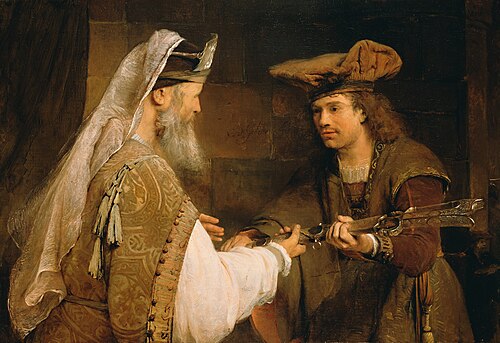
by Aert de Gelder, ca. 1700
The high priest replies that the only weapon around is the sword of Goliath, whom David killed with his slingshot. He hands the trophy over to David. Supplied with food and a sword, David leaves and heads for the Philistine border.
The God character does not punish David for this transgression. But God does nothing to help Achimelekh, David’s partner in rule-bending, when Doeig tells King Saul what happened. Saul summons the high priest and all the lesser priests for questioning, and demands:
“Why did you band together against me, you and the son of Jesse, by your giving him bread and a sword … to rise up against me as an ambusher, as it is this day?” (1 Samuel 22:13)
Achimelekh replies:
“But who among all your servants is like David, trustworthy and the king’s son-in-law and commander of your bodyguard and honored in your house?” (1 Samuel 22:14)
Then he pleads innocence on the grounds of ignorance. King Saul orders the palace guard to execute all the priests, but they refuse. So Saul tells Doeg to do it, and he kills all the priests, then massacres the whole population of Nov, man, woman, and child, and all the livestock. Only one person escapes: Ahimelekh’s son Evyatar.
And the God character stands by and lets it happen. Throughout the Hebrew Bible, God delivers collective punishment without distinguishing between innocent and guilty individuals. In the first book of Samuel, it is enough that David, God’s favorite, escapes—along with a priest whom David can consult in the future.
Leading an outlaw band
David crosses the border into Philistine territory, where he is recognized by the servants of the Philistine king of Gat. He escapes by feigning madness, and crosses back into Israelite territory, but only as far as the Cave of Adulam, between Gat and Bethlehem. David’s seven older brothers in Bethlehem hear that he is there, and join him. So does the priest Evyatar, who is also hiding from Saul.
And they gathered to him, every man in distress, and every man who had a creditor, and every man whose soul was bitter. And he became commander over them, and with him were about 400 men. (1 Samuel 22:2)
David’s band of outlaws has grown to about 600 men when he hears that Philistines are attacking the Israelite town of Ke-ilah, south of Adulam. He asks God whether he should rescue the town. (In the Hebrew Bible, God speaks directly only to selected prophets. Everyone else hears from God in dreams, or gets answers from God through divining devices such as casting lots or consulting the priest’s eifod (אֶפוֹד), a ritual tabard worn on the chest. Evyatar brings an eifod when he joins David.)
Although God answers yes, he should rescue Ke-ilah, David’s men are afraid to go. So David asks God again, even though fighting Philistines is no longer his job. Maybe he is still a hero at heart. Or maybe he wants to win allies in the south of Judah for the sake of his future plans.
And once again David inquired of God, and God answered him, and said: “Arise, go down to Ke-ilah, because I am giving the Philistines into your hand!” (1 Samuel 23:4)
The God character, who no doubt likes being consulted, helps David win a victory. When King Saul hears that David and his men are now inside the walls of Ke-ilah, he prepares to besiege the town. David asks the priest Evyatar to use his eifod and addresses two more questions to God:
“Will Saul come down, as your servant has heard? … Will the citizens of Ke-ilah deliver me and my men into his hands?” (1 Samuel 23:11-12)
Through the eifod God answers yes to both questions. Apparently God is aware of the fears of the people of Ke-ilah. They are grateful to David for rescuing them from the Philistines, but they are too afraid of King Saul to defend their rescuers. After all, Saul has recently massacred all the Israelites in the town of Nov. Turning over David and his men to the king would be the townspeople’s best hope of escaping the same fate.
David pays attention to God’s answers, and he and his men leave town before Saul sends an army to beseige it—thus saving both themselves and the townspeople. The outlaw band keeps moving from one location to another in Israelite territory.
And Saul sought him all the days, but God did not give him [David] into his hand. (1 Samuel 22:14)
The God character is still planning for David to replace Saul as the king someday. If God did nothing, Saul would presumably track down a band of 600 men roaming around his kingdom. But God prevents that from happening. Apparently God likes a hero who takes initiative, but also respects and consults God—even if he bends the rules about sacred bread.
Running a protection racket
David seems both noble and pious in the story about rescuing the town of Ke-ilah. But he also uses his outlaw band for a dubious enterprise.
When an exceedingly wealthy man named Nabal is having his 3,000 sheep sheared at Carmel, David sends ten young men to Nabal to wish him well and say:
“And now, I have heard that you have shearers. Now, the shepherds that belong to you were with us. We did not humiliate them, and they did not find anything missing the whole time we were in Carmel. Ask your boys, and they will tell you. And may [my] boys find favor in your eyes, since we have come on a good day. Please give whatever you can find in your hand to your servant, to your ‘son’ David!” (1 Samuel 25:7-8)
In other words, David’s men, without being asked, protected Nabal’s shepherds and flock from thieves and raiders, and did not take any sheep themselves. Now David requests a gift in return, hinting that it is “a good day”, since a sheep shearing was normally celebrated with feasting. His message is polite and deferential. He refers to himself as Nabal’s inferior twice, by calling himself “servant” and “son”.
Then Nabal answered David’s servants, and he said: “Who is David? Who is the son of Jesse? Today there are many slaves who are breaking away, each one from his master! And I should take my bread and my water and my butchered meat that I butchered for my shearers, and I should give it to men who are from I don’t know where?” (1 Samuel 25:10-11)
Comparing someone with a private army of 600 men to a runaway slave is not a smart move. Neither is refusing to give him any food supplies. David’s ten young men report back.
Then David said to his men: “Each man gird on his sword!” And each man girded on his sword, and David also girded on his sword, and they went up behind David, about 400 men. And 200 stayed with the gear. (1 Samuel 25:13)
As they head toward Nabal’s house in Maon, the next town south of Carmel, David says to himself:
“Surely in vain did I guard everything that belongs to this one in the wilderness, and nothing was missing that belongs to him. And he returned evil to me instead of good! Thus may God do to the enemies of David, and thus may [God] add, if by morning I leave alive out of all that belongs to him [even one] pisser against the wall!” (1 Samuel 25:21-22)
Meanwhile Nabal’s wife Abigail, who is described as “intelligent and beautiful”, finds out what happened, and hurriedly loads a train of donkeys with 200 loaves of bread, five butchered sheep, and some wine, grain, raisin cakes, and dried figs. She intercepts David and his 400 men, drops down from her own donkey, and prostrates herself in front of David.
Abigail does not hesitate to denounce her husband and give David all the food. She explains her interception as God’s way of preventing David from becoming guilty of murder.
“… God restrained you from coming to shed blood, and rescued you from avenging yourself by your own hand … for my lord battles the battles of God, and may no evil be found in all your days!” (1 Samuel 25:26, 25:28)
When God makes David king, she adds, it would be a problem if he had a reputation for spilling blood for no good cause. And David, his cool intelligence restored, thanks her:
“Blessed is God, the God of Israel, who sent you this day to meet me! And blessed is your judgement, and blessed are you, who prevented me this day from shedding blood, and rescued me from avenging myself by my own hand!” (1 Samuel 25:32-33)
David returns to his camp, and Abigail goes home to find her husband getting drunk. She waits until morning, when he has a hangover, to tell him what she did. Nabal has a stroke.
And it happened in about ten days: God struck Nabal, and he died. (1 Samuel 25:38)
David immediately sends a marriage proposal to Abigail, and she accepts.2
David may be guilty of implicit extortion. But since the outlaws cannot farm or engage in trade, they have to get food some other way. They refrain from either stealing sheep or, thanks to Abigail, from killing any Israelites. So God avenges David by killing Nabal.
Although David intends to kill innocent Israelite men in Nabal’s household, he changes his mind. His actual transgressions during his time as an outlaw are peccadilloes, excusable on the grounds that he has to eat sacred bread, dissemble, and run a protection racket simply in order to survive. And David still honors God and follows God’s instruction to rescue an Israelite village from Philistines. So the God character excuses him, and continues to provide a little help now and then as David makes his own way on the road to kingship.
This is the kind of personal God anyone would hope for. But in the first book of Samuel, only David wins God’s forgiveness.
- Pamela Tamarkin Reis, Reading the Lines: A Fresh Look at the Hebrew Bible, Hendrickson Publishers, Peabody, Mass., 2002, pp. 136-142.
- In ancient Israel, a man could have multiple wives, but a woman could have only one husband.

 Questioning Torah
4 thoughts on “1 Samuel: David the Devious”