(If you want to read one of my earlier posts on this week’s Torah portion, Re-eih (Deuteronomy 11:26-16:17), you might try: Re-eih: Ownership. Below is the second post in my new series on why David is God’s favorite king.)
David’s name (דָוִד) means “beloved”. He is already God’s beloved when God tells the prophet Samuel to anoint him as the future king of Israel.1 King Saul also loves young David at first, and employs him as his lyre-player and weapons bearer.2 After David kills Goliath with his slingshot, everyone else seems to fall in love with him, including two of the king’s children, the king’s troops, and the women in every Israelite city.
Jonathan
Right after David kills Goliath he returns to King Saul.
And it was as he finished speaking to Saul, then the nefesh of Jonathan became bound up with the nefesh of David. And Jonathan loved him like his own nefesh. (1 Samuel 18:1)
nefesh (נֶפֶשׁ) = self, personality; throat; what makes a body alive.
Jonathan is Saul’s oldest son. Shortly after Saul was acclaimed king, he put Jonathan in charge of one-third of the Israelite troops.3 An able commander, Jonathan won two battles against the Philistines before Saul hired David to play the lyre.
Why does young David captivate Jonathan? Perhaps he sees in David a younger but grander version of himself. Jonathan had led a daring raid against all odds on a Philistine garrison;4 David volunteered to face Goliath with nothing but his slingshot. Both of them had more practical intelligence than Saul, both attracted people’s loyalty, and both spoke piously about God.
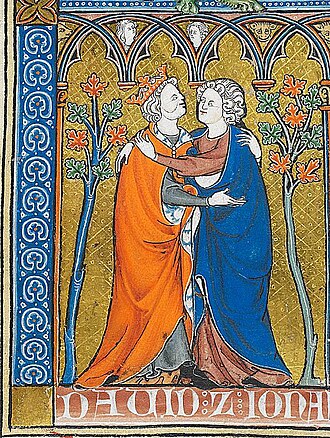
And Jonathan and David, he cut a covenant because of his love for him like his own nefesh. (1 Samuel 18:2-3)
Although the subject is plural, the pronoun and verb following it are third person plural. The usual biblical covenant is “cut” (a biblical idiom) between two parties.5 But the covenant between Jonathan and David is one-sided. Jonathan cuts the covenant, promising something; David merely accepts Jonathan’s promise. The next verse indicates what the lopsided covenant is about.
And Jonathan stripped himself of the me-il that was on him and he gave it to David, and his [military] garb, and even his sword, and even his bow, and even his belt. (1 Samuel 18:4)
me-il (מְעִיל) = robe worn over the tunic by members of the royal family, high priests, and Samuel (who was a priest before becoming a prophet and judge).
Jonathan is symbolically replacing himself with David, either consciously or unconsciously. The robe signifies that David is now the heir to the throne. The armor and weapons hint that David will replace Jonathan as the king’s chief commander. (King Saul loaned David his armor to fight Goliath, and David politely rejected it.6 But Jonathan’s armor and weapons are not a loan for a particular battle; they seem to be a gift.)
Classic and modern commentators have disagreed about whether Jonathan’s love for David is sexual. Pirkei Avot declares:
“All love that is dependent on something, when the thing ceases, the love ceases. But [love] that is not dependent on something never ceases. Which is love that is dependent on something? This is the love of Amnon for Tamar.7 And which is the love that is not dependent on something? This is the love of David and Jonathan.”8
Whether Jonathan’s love for David has a sexual element or not, it does seem to be unconditional. Yet this does not fully explain Jonathan’s covenant. Turning over one’s whole identity to another person is an unusual act of love.
Soldiers and women
And David went out [with the troops], and everywhere Saul sent him, he was successful. And Saul placed him over men of war, and it was good in the eyes of all the people, and also in the eyes of Saul’s servants. And it was when they came back, when David returned from striking down the Philistine, women went out from all the towns for singing and dancing, to meet King Saul with timbrels, with rejoicing, and with triangles. And the women who were playing chanted, and they said: “Saul struck down his thousands, and David his tens of thousands!” (1 Samuel 18:5-7)
Everybody loves success—except for a jealous competitor. Jonathan does not protest when the chanting women do not even mention him. But Saul smolders with anger, thinking:
“They give to David tens of thousands, and to me the thousands. There remains for him only the kingdom!” (1 Samuel 18:8)
The next day Saul has one of his fits of madness, and as usual David plays the lyre to calm him down. But this time Saul throws a spear at David, twice. David dodges the spear both times.
And Saul was afraid in the face of David, because God was with him, and had turned away from Saul. (1 Samuel 18:12)
King Saul’s diagnosis is correct. David is now God’s beloved, not Saul.
Then Saul removed him from his side, and appointed him commander of a thousand. And he went out and came back before the people. (1 Samuel 18:13)
Going out and coming back is a biblical idiom for leading a military action. David now has Jonathan’s old job. Perhaps, during a rational period, Saul realizes that his own support from the people depends on continued success in the war with the Philistines, and for that he needs David as his chief military leader. But if David continued to serve as his personal musician between campaigns, Saul might try to kill him again in his next fit of madness. So Saul removes David from court to prevent it.
And David was prospering in all his ways, and God was with him. And Saul saw that he was prospering very much and was afraid of his presence. And all Israel and Judah were loving David, since he was going out and coming back before them. (1 Samuel 18:14-16)
Mikhal
Suddenly Saul invites David to marry his older daughter, Meirav. Some commentators speculate that Saul is trying to put David in a position where he has no choice but to continue fighting Philistines for the king. But I wonder if David reminded Saul about the reward he promised to the man who killed Goliath, a reward that included wealth and the king’s daughter.9
David gives a politely humble reply to the proposed marriage. When it is time for the wedding, the mercurial king marries Meirav to another man.
But Mikhal, daughter of Saul, had fallen in love with David. And it was told to Saul, and the matter was agreeable in his eyes. Saul said [to himself]: “I will give her to him, and she will become a trap to him, and the Philisitines’ hand will be against him.” Then Saul said to David: “With the second one you will become a son-in-law to me today!” (1 Samuel 18:20-21)
Again David answers humbly. He sends this message through the king’s servants:
“I am a poor man, and lightly esteemed.” (1 Samuel 18:23)
Perhaps David is suggesting that King Saul still owes him the reward of “great wealth”. If he received that wealth, he could afford to pay a bride-price worthy of a king’s daughter. But Saul has a different idea about the bride-price. He has his servants tell David:
“There is no pleasure for the king in a bride-price—except for a hundred Philistine foreskins, for vengeance on the king’s enemies.” And Saul planned to cause David’s fall at the hand of the Philistines. (1 Samuel 18:25)
But David is God’s beloved, and he has no trouble slaying 200 Philistine men. He gives their foreskins to King Saul, who then gives David his daughter Mikhal.
Two rescuers
And Saul spoke to his son Jonathan, and to all his servants, to put David to death. But Saul’s son Jonathan delighted in David very much. (1 Samuel 19:1)
Jonathan manages to change his father’s mind, and Saul lets David return to the royal house whenever he is not fighting Philistines. But once again a malign spirit overcomes the king, David plays the lyre for him, and Saul hurls a spear at him. David flees to his own house.
And Saul sent messengers to David’s house, to keep watch and to kill him in the morning. And Mikhal, his wife, told David, saying: “If you don’t escape with your life tonight, tomorrow you will be put to death!” And she let David down through the window, and he went, and he hurried away, and he escaped. (1 Samuel 19:12)
Then Mikhal tucks a statue into the bed, puts a tangle of goat’s hair at its head, and pulls up the covers. When Saul’s messengers demand to see David, she says he is sick. When they insist, she shows them the bed. But they uncover the truth. Her father scolds her for deceiving him and letting his “enemy” escape. Mikhal lies and pretends that David threatened to kill her if she did not help him. Like Jonathan, she loves David more than she loves her father. There is no indication of whether David loves her.
David flees to Ramah, the prophet Samuel’s home base. Saul sends messengers to Ramah three times, and each time the spirit of God overcomes them and they babble in ecstasy; God is still looking after David. After the third time, David leaves Ramah and finds Jonathan, asking him:
“What have I done? What is my crime, and what is my offense before your father, so that he seeks my life?” (1 Samuel 20:1)
When Jonathan says he had no idea that his father was trying to kill David, David replies:
“You father surely knows that I have found favor in your eyes. So he said [to himself]:‘Don’t let Jonathan know about this, lest he be pained.’ However, by the life of God and the life of yourself, it is indeed like one step between me and death!” (1 Samuel 20:3)
Jonathan believes him, and promises to do whatever David says. David’s plan is to hide in the countryside while Jonathan tests his father’s intentions. Calling himself “your servant” (since Jonathan still has higher rank, as the king’s heir), David says:
“And you should act with loyal-kindness toward your servant, because you brought your servant into a covenant of God with you …” (1 Samuel 20:8)
Robert Alter noted: “David’s formulation of the arrangement is pointed and quite accurate: it was Jonathan who initiated the pledge of mutual fealty out of his love for David, and who drew David into the commitment.”10
Jonathan swears that he will let David know if King Saul is plotting against him. He adds:
“And may YHWH be with you, as he was with my father!” (1 Samuel 20:13)
Here Jonathan believes that David will be the next king, and privately waives his own claim to the throne. But he asks for reassurance that David will try to keep him and his family alive.
“… Will you not act toward me with the loyal-kindness of God, so I will not die? And you must not cut off your loyal-kindness to my house, ever …” (1 Samuel 20:14-15)
David does not say a word. We can hope he at least nods.
Jonathan attends the king’s New Moon dinner, and makes an excuse for David’s absence. Saul explodes, calling his son-in-law David by the disrespectful appellation “son of Jesse”, and his own son by more insulting names. He accuses Jonathan of the truth:
“Don’t I know that you yourself are choosing the son of Jesse, to your shame? … All the days that the son of Jesse is alive on earth, you will not be secure, you or your kingdom! And now send and fetch him to me, because he is a dead man!” And Jonathan answered his father Saul and said: “Why should he be put to death? What has he done?” (1 Samuel 20:30-32)
In fact, all David has done is to succeed as a warrior and military commander, defending Saul’s kingdom from the Philistines and winning public adulation. But the question tips Saul into madness again, and he throws his spear at his own son and heir. Jonathan leaves the table without eating, and the next morning he gives David their pre-arranged signal in the field. When the two men are alone, David throws himself on his face in prostration to Jonathan.
And he prostrated himself three times, and each man kissed his friend, and each man wept with his friend, until David had made it [the weeping] greater. (1 Samuel 20:41)
People in the Hebrew Bible usually prostrate themselves to God, or to humans who are much higher-ranking than themselves. But in the book of Genesis, Jacob prostrates himself to his brother Esau seven times as part of his effort to mollify his Esau, who had threatened to kill him 20 years before after Jacob had cheated him. Esau then embraces and kisses Jacob, and both of them weep.11
Why does David prostrate himself to Jonathan in a scene reminiscent of Jacob’s reunion with Esau? David knows, thanks to his secret anointment by Samuel, that he, not Jonathan, is the future king of Israel. Perhaps he is moved by Jonathan’s loyalty and love, and knows that he cannot equal it.
According to Alter, “It is noteworthy that throughout this narrative David is repeatedly the object but never the subject of the verb ‘to love’…”12
Both men weep, though David weeps longer. His tears might be a parting gift to his devoted friend, or they might simply reflect David’s inner turmoil as he faces an unknown future in exile.
Final parting
David and Jonathan meet one more time, when David has become the leader of a large band of outlaws moving from hideout to hideout to evade capture by King Saul. Although Saul never tracks them down, Jonathan obviously has inside information; he visits David at his camp in a forest, and says:
“Don’t be afraid, for the hand of my father Saul will not find you. And you yourself will become king over Israel, and I myself will be your second. And even my father Saul knows this.” (1 Samuel 23:17)
Jonathan’s love for David no longer obliterates his sense of self. Now he asks David to appoint him as viceroy once his beloved becomes king. David’s response is not reported.
The two men reaffirm their covenant, and Jonathan goes home. But he never becomes David’s viceroy; Jonathan dies in the same battle as Saul, and David mourns for both of them as he is proclaimed king.
“What have I done now?” David asked when his oldest brother scolded him for running to the front lines facing Goliath and the Philistines.13 The question comes up again when David asks Jonathan:
“What have I done? What is my crime, and what is my offense before your father, so that he seeks my life?” (1 Samuel 20:1)
And Jonathan answered his father Saul and said: “Why should he be put to death? What has he done?” (1 Samuel 20:32)
What has David done? One answer is that he is young and handsome, bold and confident. He thinks on his feet and speaks eloquently. He quickly learns the crafts of war and military leadership. He is clever, but not deceitful. No wonder David is beloved by every sane person in the kingdom of Israel.
Last week I gave David credit for taking initiative, setting his own goals, and working resolutely to achieve them. Before he was anointed, he made himself an expert at the lyre and slingshot. After he is anointed, he dedicates himself to becoming a hero and next in line for king.
These goals would be ridiculous if David were not naturally talented—and if he did not know that God had chosen him as the next king. But being chosen by God does not necessarily mean succeeding. After all, God originally chose Saul as king. But Saul lacked confidence, vacillated, and did not think things through. No wonder God withdrew support from Saul and promised it to David.
It is not enough to be chosen. One must develop the right character traits, and hold oneself to the necessary standards. Only then will one continue to be beloved—by an individual, by the general public, or by God.
I know that I certainly do not have what it takes to be a hero. But I am grateful that I have the right character traits and standards of behavior to be a worthy spouse.
- See my post: 1 Samuel: Anointment.
- See my post: 1 Samuel: Lyre and Slingshot.
- 1 Samuel 13:1-3.
- 1 Samuel 14:1-15.
- The key exception is when God makes a unilateral covenant with Noah and every living creature not to drown the world again (Genesis 9:8-12). More normal covenants between humans occur in Genesis 21:22-33, 26:23-33, and 31:44-54, and Joshua 9:3-15.
- See my post: 1 Samuel: Lyre and Slingshot.
- Amnon feels sexual desire for half-sister Tamar, which disappears after he rapes her (2 Samuel 13:1-15).
- Pirkei Avot 5, c.190–c.230 C.E.
- See my post: 1 Samuel: Lyre and Slingshot.
- Robert Alter, Ancient Israel: The Former Prophets: Joshua, Judges, Samuel, and Kings, W.W. Norton & Co., New York, 2013, p. 358.
- Genesis 33:3-4.
- Alter, p. 347.
- 1 Samuel 17:29.

 Questioning Torah
2 thoughts on “1 Samuel: David the Beloved”