(If you want to read one of my earlier posts on this week’s Torah portion, Eikev (Deuteronomy 7:12-11:25), you might try: Eikev: Not by Bread Alone. Below is the second post in my new series on why David is God’s favorite king.)
When the prophet Samuel secretly anoints David as the future king of Israel,1 all we know about David is:
- He is the eighth and youngest son of Jesse (Yishai) the Bethlehemite, and his job is to shepherd his father’s flock. (1 Samuel 16:11)
- He is “ruddy, with beautiful eyes, and good-looking” (1 Samuel 16:12), but not exceptionally tall.
- God chooses him not because of his appearance, but because of his leivav (לֵבָב) = heart, seat of thoughts and feelings; mind, character, understanding. (1 Samuel 16:7)
- His name is David (דָוִד) = beloved.(1 Samuel 16:13)
In the next two stories in the first book of Samuel, David exhibits some of the mental qualities that make him God’s beloved. And God demoralizes Saul, while encouraging David.
David the musician
When Samuel anointed Saul, no one witnessed it. The prophet told him that later that day he would briefly join a band of ecstatics2 led by people playing “lyre and timbrel, flute and harp” and this ecstatic experience would change him “into another man”. When it happened, Saul’s neighbors observed him babbling in ecstasy.3
David’s secret anointment, unlike Saul’s, is witnessed by his immediate family.
And Samuel took a horn of oil and anointed him in the midst of his brothers. And the ruach of God rushed through David from that day and onward. Then Samuel got up and went [back] to Ramah. Then the ruach of God turned away from Saul, and a malignant ruach from God terrified him. (1 Samuel 16:13-14)
ruach (רוּחַ) = wind; spirit, disposition.
Instead of a single ecstatic experience, David is supported continuously by a more subtle ruach of God. Perhaps God changes Saul’s ruach on purpose in order to pave to way for David.
And Saul’s servants said to him: “Hey, please! A malignant ruach of God is terrifying you. May our lord please say [the word], and your courtiers in front of you will look for a man who knows how to play the lyre. And it will be, whenever the malignant ruach of God happens to you, he will play with his hand, and it will be better for you.” (1 Samuel 16:15-16)
King Saul’s courtiers probably know about Saul’s ecstatic experience that included the music of the lyre.
And Saul said to his servants: “Please look for me a man who is good at playing, and bring him to me!” And one of the ne-arim answered and said: “Hey, I have seen a son of Jesse the Bethlehemite who knows how to play—a strong man of ability, and a warrior, and one discerning with words, and a handsome man, and God is with him!” (1 Samuel 16:16-18)
ne-arim (נְעָרִים) = male adolescents, young unmarried men; young male servants. (Singular: na-ar, נַעַר.)
The young servant, probably a few years younger than David, is so star-struck that he calls David a man and a warrior—even though David has never been in a battle. Rabbi Steinsaltz explained: “The young man sought to stress that David was not merely a talented musician, but also one who would be suitable to accompany the king for his other qualities.”4
King Saul sends a message to Jesse, and Jesse sends his youngest son with gifts for the king.
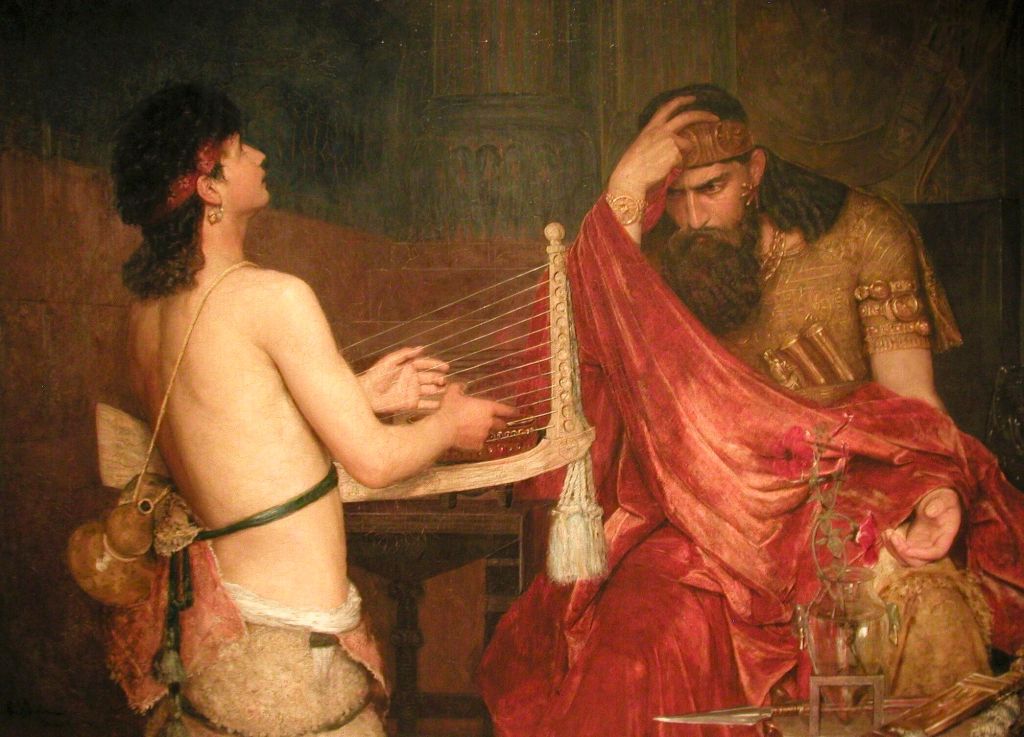
And David came and stood before Saul. And Saul loved him very much, and he became his weapons bearer. And Saul sent to Jesse, saying: “Please let David stand [in attendance] before me, because he has found favor in my eyes.” And it was when the ruach of God happened to Saul, then David took his lyre and played it with his hand, and Saul found respite, and it was better for him, and the malignant ruach turned away and went up from him. (1 Samuel 16:21-23)
Even King Saul loves David—at first.
David the marksman
In the next story, a Philistine army and an Israelite army face one another across a ravine in the valley of Elah, about 25 miles (40 km) from Bethlehem. A Philistine champion comes forward—a giant of a man with a scimitar and a spear, wearing heavy bronze armor.5 His name is Goliath (Galyat, גׇּלְיַת = revealer; exiler).
Goliath crosses the ravine and challenges the Israelites to send their own champion down to meet him in single combat. His terms are that the loser’s people will become slaves to the winner’s.
And Saul and all Israel heard these words of the Philistine, and they were dismayed and very afraid. (1 Samuel 17:11)
At least King Saul now has something to be terrified about. Although he himself is a tall warrior, he does not volunteer to fight Goliath. Nor do any of Jesse’s three oldest sons, who are in the army on the Israelite side of the ravine.
And David was going and returning from [waiting] on Saul, to shepherd his father’s flock in Bethlehem. And the Philistine approached and presented himself, in the early morning and in the evening, for forty days. (1 Samuel 17:15-16)
Jesse sends David to the Israelite camp with bread for his three older brothers and cheese for their commander, and asks him to return with news of how his brothers are faring. This reminds me of how Jacob sends Joseph to check up on his older brothers and report back to him.6 Joseph’s jealous older brothers seize him and sell him into slavery; but David’s older brothers are fond of him.
When young David arrives at the army camp, he leaves the gifts of food with a watchman and runs to the front lines.
And a man of Israel said: “Do you see this man [Goliath] who comes up? Indeed, he comes up to taunt Israel! And it will be [that] the man who strikes him down, the king will enrich with great wealth, and will give him his daughter, and will make his father’s household free [of taxes] in Israel!” (1 Samuel 17:25)
David gives no sign that he hears this. Instead, he speaks for the first time in the story, asking the men near him:
“What will be done for the man who strikes down the Philistine yonder and removes the disgrace from upon Israel? For who is this uncircumcised Philistine that he should taunt the battle lines of the living God?” (1 Samuel 17:26)
According to Robert Alter, “His first words express his wanting to know what will be gained—implicitly, in political terms—by the man who defeats Goliath. The inquiry about personal profit is then immediately balanced (or covered up) by the patriotic pronouncement … David has, of course, just heard one of the troops stipulate the reward for vanquishing the Philistine, but he wants to be perfectly sure before he makes his move, and so he asks for the details to be repeated.”7
David’s patriotic speech also honors God, who just might be listening. But why would a thoughtful, even calculating, adolescent with no battle experience consider fighting the armed and armored giant? Has he grown up so beloved by his own family and everyone who meets him that he assumes he can do anything? Does he think that nothing can kill him until his anointment has been realized and he has been acclaimed king? Or is he feeling the ruach of God inside him?
David’s oldest brother, Eliav, accuses him of sneaking into the front lines just to see the battle.
And David said: “What have I done now? Wasn’t it only words?” (1 Samuel 17:29)
David’s “What have I done now?” says a lot. Eliav, and probably David’s other brothers, see him as a headstrong scamp, exasperating but lovable.
David then checks with other soldiers about the king’s promised reward. Someone reports his questions to Saul, who has David fetched.
And David said to Saul: “Don’t let the leiv of a human fall on him! Your servant will go and do battle with this Philistine!” (1 Samuel 17:32)
leiv (לֵב) = heart, seat of thoughts and feelings; mind, character, understanding. (Alternate spelling of leivav.)
Perhaps David omits a courtly introduction to his speech because he is young and excited—and he is already familiar with the king, having played the lyre for him. Yet he is polite enough to refer to the feelings of “a human” falling, instead of the feelings of Saul.
But Saul said to David: “You cannot prevail in going against this Philistine to do battle with him, because you are a na-ar, and he has been a man of battle since he was a na-ar!” (1 Samuel 17:33)
David retorts that when lions and bears carried off lambs from his father’s flock, he went after them and killed them.
“And I held onto its beard and struck it down and put it to death! Even the lion, even the bear, your servant struck down. And this uncircumcised Philistine will be like one of them, since he has taunted the battle lines of the living God!” (1 Samuel 17:35-36)
Perhaps the God character, like a fond grandfather, loves David for his courage as well as for his quick wit. David exhibited his courage before God decided he should be anointed. And David knows God loves him.
And David said: “God, who rescued me from the hand of the lion and the hand of the bear, he himself will rescue me from the hand of this Philistine!” Then Saul said to David: “Go, and may God be with you!” And Saul dressed David in his own garb, and put a bronze helmet on his head, and dressed him in armor. Then David strapped his sword over his garb and he tried to walk, but he was not trained. Then David said to Saul: “I am unable to walk in these, since I am not trained.” And David removed them from upon himself. (1 Samuel 17:37-39)
If King Saul were not so desperate to get rid of the threat of Goliath, he might have second thoughts about sending out a young musician who does not even know how to walk in armor. But he merely stands by while David takes only his staff and his slingshot, and heads for the ravine. He picks up five smooth stones on the way and tucks them into his shepherd’s pouch.
David walks toward Goliath alone, but Goliath is preceded by his shield-bearer. Goliath jeers at David, and David asserts that God will be the victor.
And David said to the Philistine: “You come to me with sword and spear and scimitar, but I come to you with the name of the God of Armies, the God of the battle lines of Israel, whom you have taunted! Today God will deliver you to my hand, and I will strike you down and remove your head … And all this assembly will know that not with a sword or a spear does God grant victory; for the battle is God’s, and he will give all of you into our hand!” (1 Samuel 17:45-47)
How could the God character resist this speech?
David only needs one of his five stones to kill Goliath. He slings it, and hits Goliath smack on the forehead.
And the stone sank into his forehead, and he fell on his face to the ground. (1 Samuel 17:49)
Commentators have wondered why Goliath did not fall backward. Rashi wrote that God arranged it that way “in order that David should not be troubled to walk [the extra distance] and cut off his head”.8
The term “fell on his face” often occurs in the Torah to describe a deliberate prostration toward God or toward a superior. Goliath is, in a sense, prostrating himself to either David or David’s God in defeat.
Robert Alter noted: “David speaks almost as though he expects to prevail through a miracle of divine intervention … but in fact his victory depends on his resourcefulness in exploiting an unconventional weapon, one which he would have learned to use skillfully as a shepherd.”9
In case Goliath is unconscious but not dead, David runs up to the body.

…and there was no sword in David’s hand. And David ran and stood over the Philistine, and he took his [Goliath’s] sword and drew it from its sheath and killed him; he cut off his head. And the Philistines saw that their champion was dead, and they fled. (1 Samuel 17:50-51)
The Philistines do not become slaves of the Israelites, as Goliath had promised. But the Israelites do pursue them and kill some of their soldiers before they reach the gate of the fortified Philistine city of Ekron.
As the youngest of eight sons, David could have been as spoiled as Joseph is in the book of Genesis. But all Joseph does, before he becomes a slave in Egypt, is tell his prophetic dreams and rat on his brothers. David grows up in a more reasonable family, and he is a self-starter. Before his surprise anointment, he takes the time to practice with both the lyre and the slingshot. His musicianship becomes good enough for the king to hire him, and he is so good a marksman that he slays Goliath with a single stone.
Probably the God character loves David for his courage, his cleverness, and his habit of praising God. But what I admire most about David as a youth is that he takes initiative, sets goals for himself, and keeps working until he achieves them.
Next week we will see how David becomes the beloved of Jonathan, Michal, the troops, and the women of Israel—everyone except King Saul—without risking the loss of God’s affection. He knows how to be successful. But does he know how to return anyone’s love?
- See last week’s post, 1 Samuel: Anointment.
- The Hebrew word navi (נָבִיא) is used for both rational prophets like Samuel who hear God speaking to them, and irrational “prophets” who experience God’s presence with fits of ecstasy that include singing and dancing.
- 1 Samuel 10:5-11.
- Adin Even-Israel Steinsaltz, Introductions to Tanakh, I Samuel, as quoted in www.sefaria.org.
- Robert Alter translates the measurements in the story, explaining that Goliath is over 8 feet tall, and his armor weighs about 125 pounds. (Robert Alter, Ancient Israel: The Former Prophets: Joshua, Judges, Samuel, and Kings, W.W. Norton & Co., New York, 2013, pp. 334-335.
- Genesis 7:17-23.
- Alter, p. 338.
- Rashi (11th-century Rabbi Shlomoh Yitzchaki), translated in www.sefaria.org.
- Alter, p. 341.

 Questioning Torah
One thought on “1 Samuel: Lyre and Slingshot”