The leader of a band of outlaws becomes a ruler by popular acclaim twice in the Hebrew Bible. It happens to Yiftach (“Jepthah” in English) in the book of Judges, and to David in the first book of Samuel. But the story of Yiftach’s ascent is a tragedy, while David rises to kingship with confidence and unlimited success. The biggest difference between them is their relationship with God.
Yiftach the outlaw
This week’s haftarah reading from the Prophets (Judges 11:1-33) begins:
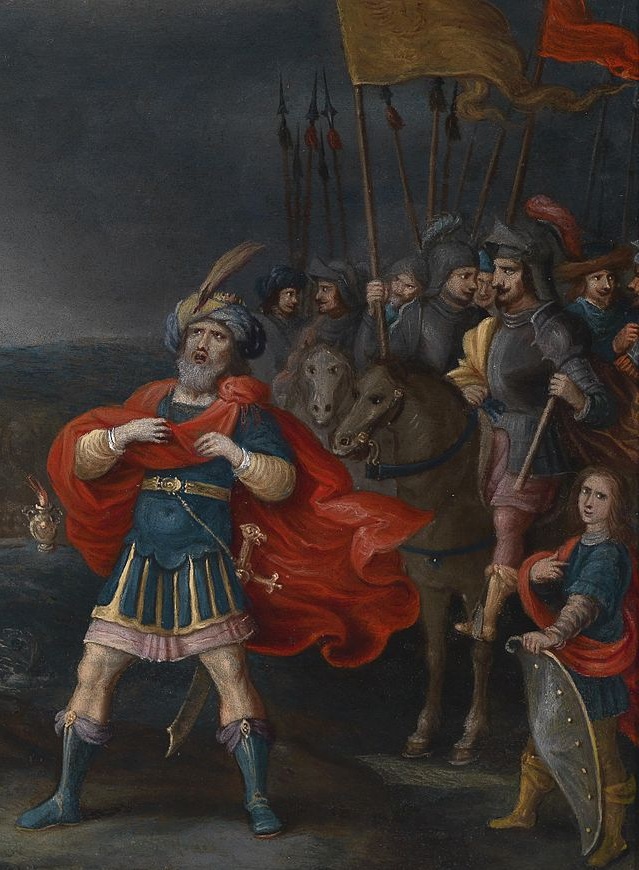
Yiftach the Giladite was a mighty man of ability, and he was the son of a prostitute woman. And Gilad begot Yiftach. (Judges 11:1)
Gilad (often spelled “Gilead” in English) is both the name of Yiftach’s father, and the name of the Israelite territory east of the Jordan River.1 The name of Yiftach’s father implies that he is the most important man in Gilad. No one would believe a prostitute who identified someone important as the father of her child—unless she had given up her trade to live in that man’s house.
“The plain meaning of this statement is that Yiftah’s mother was a licentious woman who became Gilad’s concubine.” (Steinsaltz)2
And Gilad’s wife bore sons to him. But when the wife’s sons had grown up, they cast out Yiftach, and said to him: “You will not inherit in our father’s household, because you are the son of the other woman!” (Judges 11:2)
This is an illegal move in Israelite tradition. If Yiftach grew up in his father’s house, that means his father acknowledged him as a son. All of a man’s acknowledged sons split his property when he died, and the firstborn son inherited a double portion.3 The order in which the story reports the births of Gilad’s sons implies that Yiftach is the firstborn. His half-brothers may want larger shares of the inheritance, and they may also be jealous of Yiftach’s strength and prowess. So they kick him out of the house.
Vayivrach, Yiftach, from the presence of his brothers, and he settled in the land of Tov. And worthless men collected around Yiftach, and they went out with him. (Judges 11:3)
vayivrach (וַיִּבְרַח) = and he fled, went quickly.
“They went out with him” means that Yiftach and his followers went out raiding farms and villages. For a man who had no property and no trade, the only alternatives to raiding (or stealing) were to find employment as a seasonal agricultural worker, or to sell oneself as a slave.
Worthless men—men without land or jobs—are attracted to Yiftach because he is a “mighty man of ability”, a natural leader for activities involving aggression. The text does not say who the men raid, but if Tov was close to the northern border of Gilad, as some scholars argue, then outlaws living in Tov could raid Aramean villages just over the border without making enemies in Gilad.
The Ammonite threat

The first three verses about Yiftach fill in the background for a situation that the bible describes immediately before this week’s haftarah reading:
The Ammonites mustered and camped inside Gilad. And the Israelites gathered and camped at Mitzpah.4 And the people, the leaders of Gilad, said, each to his fellow: “Who is the man who will begin to do battle against the Ammonites? He will be the head of all the inhabitants of Gilad!” (Judges 10:17-18)
“They scarcely permit themselves to imagine victory but are prepared to proclaim as chief whoever will dare to fight the Ammonites.” (Alter)5
At this point, Yiftach and his band of outlaws have been raiding for some time from their base in Tov. Stories of daring raids have probably spread across Gilad. So the elders of Gilad travel to Tov.
And they said to Yiftach: “Go, and become a commander for us, and we will wage war against the Ammonites!” And Yiftach said to the elders of Gilad: “Aren’t you the ones who hate me, and drove me away from my father’s house? Then why have you come to me, now that you are in a tight place?” (Judges 11:6-7)
The answer is obvious: Yiftach is the only man they know who is capable of conducting a military campaign. But he cannot resist pointing out that the elders should have thought of that before they kicked him out.
Then the elders of Gilad said to Yiftach: “Just so. Now we have returned to you [so that] you will go with us and wage war against the Ammonites. And you will become our head, out of all the inhabitants of Gilad.” (Judges 11:8)
They need the man whom they cast out so much, they even offer to make him the governor of the region as well as their war general.
And Yiftach said to the elders of Gilad: “If you yourselves bring me back to wage war against the Ammonites, and God gives them to me, I myself will be your head.” (Judges 11:9)
Exum6 pointed out that Yiftach’s counter-offer specifies that he will be the head of the Giladites even after the military action is over. It also brings God into the picture.
The elders agree, and Yiftach goes with them to Mitzpah, where he repeats the agreement so everyone there can hear it, too. Then he exchanges messages with the Ammonite commander, who pays no attention to Yiftach’s explanation of why Gilad belongs to the Israelites.7 His explanation concludes:
“May God, the judge, judge today between the Israelites and the Ammonites!” (Judges 11:27)
Up to this point, God has been silent.
Then a spirit of God came over Yiftach, and he crossed over Gilead … to the Ammonites. (Judges 11:29)
In most biblical stories about ad-hoc war leaders, God’s spirit inspires them to volunteer. But Yiftach is recruited by human beings, and the spirit of God does not come over him until he has already negotiated the terms of his service with the elders, and attempted negotiation with the enemy. (See my post Haftarat Chukat—Judges: A Peculiar Vow.)
Yiftach has been talking as if he knows God is on his side, but he is actually unsure and insecure. Even feeling a divine spirit come over him and move him to lead the battle does not reassure him. Yiftach desperately wants to become the “head” or governor of the whole region, and he knows it will only happen if God grants him victory, no matter how good his strategy and leadership are. And if he loses the battle with the Ammonites, they will kill him.
So he utters a vow that could be considered a prayer—or a bribe.
Yiftach’s vow
Then Yiftach vowed a vow to God, and said: “If you definitely give the Ammonites into my hand, then it will be the one going out—whoever goes out the doors of my house to meet me when I return safely from the Ammonites—will be God’s; and I will offer up [that one] as a burnt offering.” (Judges 11:30-31)
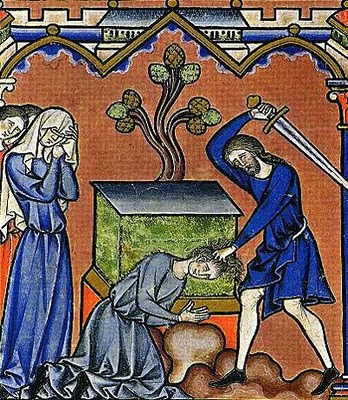
The battle is a rout, with total victory for the Israelites. When Yiftach returns, his daughter, who is his only child, comes dancing out of the house playing a drum in celebration. Yiftach is shocked, even though it is customary for women to greet returning warriors with dancing, singing, and drumming. (See my post Judges, Jeremiah, and 1 Samuel: More Dancing.) But he carries out his vow. (See my post Haftarat Balak—Micah: Bribing the Divine.)
Why would Yiftach utter a vow that leaves so much room for disaster? One theory is that Yiftach expected his daughter to emerge, and his vow to sacrifice her reflected extreme trust in God; he was waiting for God to stop him the way God stopped Abraham from sacrificing Isaac.8 But since God disapproves of Yiftach’s vow, God lets the sacrifice go forward.9
Another theory is that Yiftach suppressed the knowledge that his daughter was likely to come out the door.
“A psychological study of Jephthah might suggest that punishing himself was, if only unconsciously, the purpose of the vow. The man who was considered to be unworthy because of his birth, and maybe in his heart of hearts accepted this, made sure, through the vow, that there would be no continuity beyond his own lifetime. To put it another way, the stain of his illegitimate birth would end with his death. Perhaps that is why he does not take a second wife and try again.” (Magonet)10
Since Yiftach’s own brothers cast him out, he believes God will eventually cast him out. And the God-character in this story silently collaborates with Yiftach to blight his success.
David the outlaw
The name of the other biblical leader of an outlaw band is David (דָּוִד), which comes from the noun dod (דּוֹד), meaning “beloved”. He is the beloved of God, as well as of King Saul’s son Jonathan.
I will explore King David’s relationship with God in greater detail in a series of blog posts in August. Here, I will point out that David’s history before he becomes the leader of an outlaw band is different from Yiftach’s.
David is an adolescent, the youngest of eight sons of Jesse, when God commands the prophet Samuel to secretly anoint him as the next king of Israel, after Saul.
And Samuel took the horn of oil and anointed him in the midst of his brothers. And the spirit of God made David prosper from that day on. (1 Samuel 16:13)

David’s brothers seem happy with his anointment. While Yiftach flees from his brothers, David flees from King Saul, who is insanely jealous of David’s military successes and keeps threatening to kill him. After a quick stop for provisions,
Then David stood up, vayivrach that day from the presence of Saul … (1 Samuel 21:11)
When David finds a hiding place in the cave of Adulam,
… his brothers and his father’s whole household heard, and they went down to him there. And they gathered themselves to him, every man in distress, and every man who had a creditor, and every man with bitter feelings. And he became a commander over them. And there were with him about 400 men. (1 Samuel 22:2)
David’s band of outlaws includes “worthless men”, like Yiftach’s. But it also includes all of David’s brothers and their families and servants.
The book of 1 Samuel provides two clues about how David and his outlaws support themselves. Instead of raiding villages like Yiftach’s band, they rescue the town of Keilah from Philistine raiders, with God’s approval—after leading away the Philistine’s livestock. Later, David appears to be running a protection racket. He and his men stand around in the field by Carmel where Naval’s 3,000 sheep are being sheared. Afterward, David sends ten of his young men to Naval to wish him peace, mention the shearing, and give him this message:
“Now, the shepherds that belong to you were with us. We did not humiliate them, and nothing was missed by them the whole time they were in Carmel. Ask your lads, and they will tell you … Please give whatever you can find in your hand to your servants [David’s men] and to your ‘son’ David!” (1 Samuel 25:7-8)
When Naval refuses to give anything to David for guarding his sheep, David and his men head toward Naval’s house armed with swords, intending to kill every male there. They refrain only because Naval’s wife intercepts them with a troop of donkeys loaded with provisions.
King Saul keeps hunting them down, so finally David offers his outlaws (600 now) as mercenaries to the Philistine king of Gath. He brings his employer booty from the villages they raid, claiming they are Israelite villages, when really they are places affiliated with neither Israelites nor Philistines.11
Finally, when all the Philistine kings unite to make war on the Israelites, David sends booty to the elders in more than two dozen towns in the territory of Judah. He is absent from the battle, but when he learns that King Saul was killed, he and his outlaws move to Judah.
And the men of Judah came, and they anointed David as king there over the House of Judah … (2 Samuel 2:4)
David has become the “head” or chief of Judah without making a single vow to God. He does not need to, because unlike Yiftach, he grew up confident about his family, and he has known that God is on his side ever since Samuel anointed him when he was a teenager.
- Numbers 32:33-42. This region is currently the northwestern corner of Jordan.
- Rabbi Adin Even-Israel Steinsaltz, Introductions to Tanakh: Judges, reprinted in www.sefaria.org.
- Genesis 25:31-34, Deuteronomy 21:17.
- The Hebrew Bible refers to at least two towns named Mitzpah (מִצְפָּה), one in Gilad and one in the territory of Benjamin, where Samuel assembles the Israelites to cast lots for a king in 1 Samuel 10:22.
- Robert Alter, Ancient Israel: The Former Prophets, W.W. Norton & Co., New York, 2013,p. 164.
- J. Cheryl Exum, Tragedy and Biblical Narrative, Cambridge University Press, Cambridge, 1992, p. 55.
- Judges 11:21, 23.
- Rabbi Yosef ibn Kaspi, Gevia Kesef, 14th century, citing Genesis 22:9-13.
- Jonathan Kirsch, The Harlot by the Side of the Road: Forbidden Tales of the Bible, Penguin Random House, 1998, p. 207.
- Jonathan Magonet, “Did Jephthah Actually Kill his Daughter?”, footnote 11, www.thetorah.com, 6/25/2015.
- 1 Samuel 27:1-12.

 Questioning Torah