English makes a clear distinction between “loyalty” and “kindness”. Loyalty means a long-term, committed allegiance; a loyal person consistently supports a person or a social group no matter what happens. Kindness means acting with generosity, thoughtfulness, or consideration; you can do a kindness for a stranger you will never see again.
But in Biblical Hebrew, the word chessed (חֶסֶד) covers both loyalty and kindness. The translation depends on the context—but it also colors the interpretation.
For example, Abraham uses the word chessed when he is explaining to the king of Gerar why both he and Sarah said they were brother and sister, when in fact they are husband and wife. He claims that if strangers knew they were married, they would kill him to get her; but if a man who wants her (such as the king) believes Abraham is only Sarah’s brother, the man would pay him to take her as a concubine, and Abraham would live.1
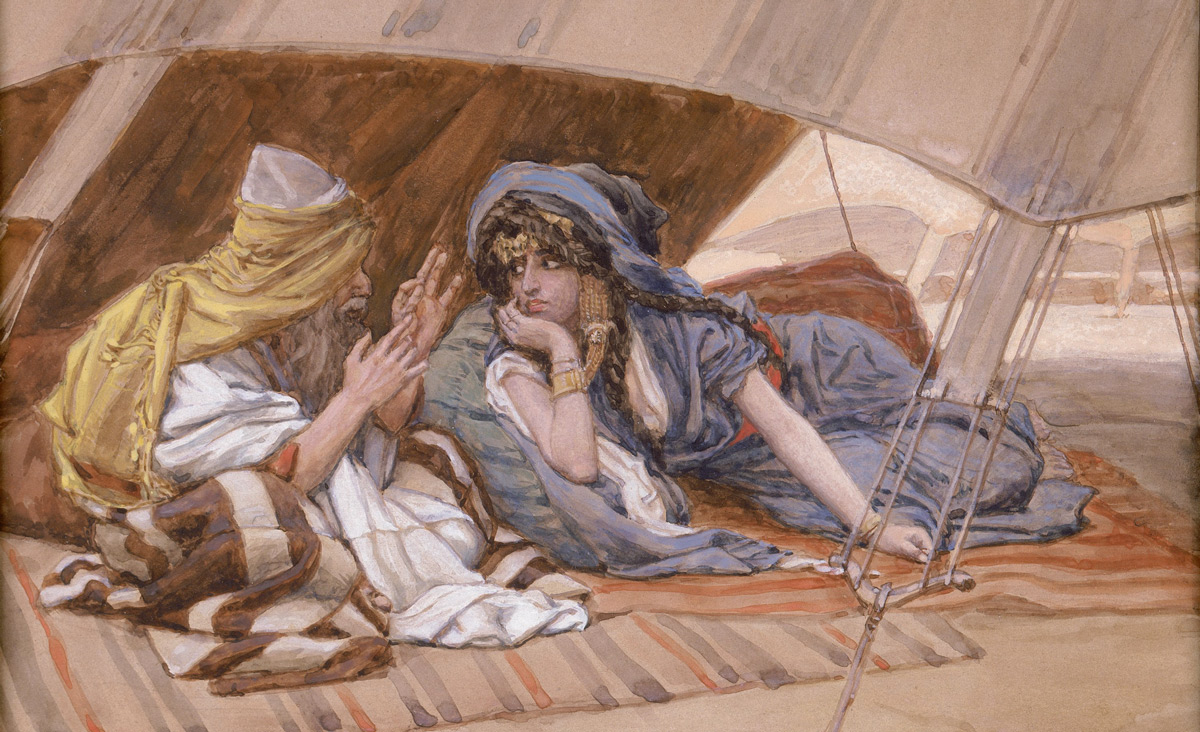
“When God made me wander from my father’s house, I said to her: ‘This is your chessed that you will do for me: At every place where we arrive, say of me: He is my brother.’” (Genesis 20:13)
If chessed is translated as “kindness” here, the implication is that Sarah lies about her marital status out of the goodness of her heart, as a favor to her husband. If chessed is translated as “loyalty”, the implication is that Sarah has an obligation to her husband: as a loyal wife, she must either obey him, or (if she believes Abraham’s claim about strangers) save his life by telling the lie.
The word chessed appears four times in this week’s haftarah reading, Joshua 2:1-24. (A haftarah is the passage from the Prophets that accompanies the weekly Torah portion. In this week’s Torah portion, Moses sends spies into Canaan almost 40 years before Joshua does it in the haftarah. See my post Shelakh-Lekha: Sticking Point.)
Disloyalty to king and country
In this week’s haftarah, the Israelites are camped on the east bank of the Jordan River, across from the city-state of Jericho. Moses has died, and the people are poised to begin the conquest of Canaan under their new leader, Joshua. Before he leads his troops around Jericho and the walls come tumbling down, Joshua sends two spies across the river. They slip through the city gates as evening approaches, and go to a prostitute’s house.
Someone in town sees the two strangers, assumes they must be spies from the horde of Israelites camped right across the river, and tells the king of Jericho. The king immediately sends a message to the prostitute, Rachav, saying:

“Bring out the men who came to you, who came into your house, because they have come to search out the whole land!” (Joshua 2:3)
Naturally the king of Jericho wants to interrogate the two spies, and then make sure they never report back to the Israelite camp.
Thinking fast, Rachav tells the king’s messengers:
“True, the men came to me, but I do not know where they were from. And it was, the gate was closing at dark, and the men went out. I do not know where the men went. Quick, chase after them, for you might overtake them!” (Joshua 2:4-5)
As a loyal subject and citizen, Rachav should have handed over the two Israelites—not only because her king ordered it, but also because they are enemies of her own city-state. But she has secretly decided to defect to the other side, so she lies to the king’s men. They believe her, and run off to look for the two spies at the fords along the Jordan River.
Allegiance to a deity
Rachav hides the two Israelites on her roof, under the stalks of flax she had spread out to dry.2
And before they lay down, she herself came up to them on the roof. And she said to the men: “I know that Y-H-V-H has given you the land, and that dread of you has fallen over us, and that all the land’s inhabitants are quivering before you. Because we heard that God dried up the waters of the Reed Sea before you when you went out of Egypt, and what you did to the two Amorite kings who were across the Jordan … 3 And we heard, and our hearts melted [in fear], and no spirit of life rose again in a man before you, because Y-H-V-H is your god. He is God in the heavens above and on the earth below!” (Joshua 2:8-11)
Once she has declared her faith in the God of Israel (a necessary step for defecting and joining the Israelites), and provided some valuable information about the morale of the people of Jericho, Rachav asks the two spies to repay her for saving them from the king of Jericho’s men.
Loyalty to family
“And now, please swear to me by Y-H-V-H, since I have done chessed for you, then you will also do chessed for my father’s household, and you will give me a sign of emet; and you will preserve the lives of my father and my mother and my brothers and my sisters, and all those who belong to them, and you will rescue our souls from death!” (Joshua 2:12-13)
emet (אֱמֶת) = reliability, faithfulness; truth.
Rachav asks the spies to save her whole family as well as herself. Yet in the Hebrew Bible, a prostitute supports herself by taking customers because she is not supported by her father, brother, or husband. Rachav’s father and brothers are still alive. Either they refused to let her live with them, or she is an unusually independent woman who chose to set up her own house and business, even though it would shame the whole family.
Despite this earlier rift, Rachav is now loyally doing chessed for her family by requesting that the spies save their lives as well.
Exchange of favors
But although Rachav is loyal to her family, she has not yet had an opportunity to join the Israelites and pledge her loyalty to them. So when she points out that she has done chessed for the two spies, she means she has done them a kindness or a favor.
When she asks the spies to swear that they will do chessed for her and her family, she is not asking for an act of kindness or an act of loyalty. She is asking for reciprocity, an exchange of favors.
Later in the story of the conquest of Canaan, the word chessed is employed that way when some Israelite scouts see a man leaving the town of Beit-El. They stop him and propose an exchange of favors:
“Please show us the way to enter the town, and we will do chessed for you.” And he showed them the way to enter the town, and they struck the town with the edge of the sword, but they sent free the man and his whole clan. (Judges 1:24-25)
Rachav’s proposal is more formal, calling for an oath and a reliable sign from the two men.
And the men said to her: “Our souls to die instead of yours—as long as you do not tell about this business of ours! And it will be, at Y-H-V-H’s giving the land to us, that we will do with you chessed and emet.” (Joshua 2:14)
The combination “chessed and emet” can be translated as “reliable loyalty” or “true kindness”, depending on the circumstances. Here, the men are not pledging to be kind, but to be loyal—loyal to the reciprocal arrangement that Rachav requested.
Thorough kindness
After dark, Rachav completes her initial act of kindness by helping the two spies leave the town unnoticed.
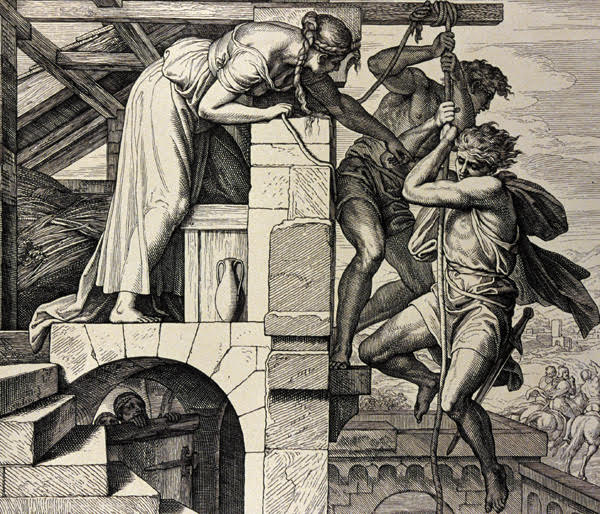
Then she let them down by a rope through the window—since her house was in a recess of the wall, and in the [city] wall she lived. (Joshua 2:15)
Fortified cities in the Ancient Near East were encircled by double (casemate) walls, with rooms between the two walls. At strategic points, these rooms were occupied by soldiers, but other stretches of wall were available to those who could not afford larger quarters.
And she said to them: “Go to the hills, lest the pursuers encounter you, and stay hidden there for three days, until the pursuers return. After that you may go on your way.” (Joshua 4:16)
Rachav tells the spies to hide in the hills to the west of the Jordan valley, the opposite direction from the river where the “pursuers”—the king’s men—will be guarding the fords.
Before they leave, the two spies designate the sign of emet that Rachav asked for.
“Hey, we will be coming into the land. Then you tie this cord of red string in the window through which you let us down; and you gather your father and mother and brothers and your father’s whole household to yourself in the house. And it will be: anyone who goes outside the doors of your house, his blood will be on his own head and we will be innocent. But anyone who is with you in the house, his blood will be on our head, if a hand is against him. But if you tell about this business of ours, then we will exempt from this oath of yours you had us swear.” (Joshua 4:18-20)
The spies make sure the terms of the arrangement are spelled out so they can avoid any mistakes or misunderstandings.
And she said: “As you have spoken, so be it!” And she sent them off, and they went. And she tied the red cord through the window. (Joshua 2:21)
The two spies follow Rachav’s directions, and after hiding in the hills for three days, they arrive safely back at the Israelite camp. When the Israelite troops come to Jericho, Joshua orders them to kill all the people in the city, except Rachav and everyone with her in her house.4 While the city wall is collapsing and the rest of the troops are running through killing people, the two spies fulfill their oath by bringing Rachav and her family out to safety.
And Rachav the prostitute, and her father’s household, and everyone who was hers, Joshua let live. And she settled in the midst of Israel, to this day, because she had hidden the messengers whom Joshua had sent to spy out Jericho. (Joshua 6:25)
Some people remain loyal to a person or a country no matter what. Others are loyal only as long as the person or government meets their ethical standards. And some people act loyal only when it is in their self-interest.
Rachav acts in her own self-interest when she becomes disloyal to her king, her city-state, and the god of Jericho. But her request that the Israelites save her family is an act of loyalty to her relatives. She hides the two Israelite spies as an act of kindness. When she realizes that this is her opportunity to defect to the Israelite side, she frames her kindness as a favor, and asks the men to return the favor. After they do, Rachav becomes a loyal citizen of Israel. For her, chessed encompasses impulsive kindness, the practical exchange of favors, and loyalty—both to the family she was born into, and to the people she chose.
- See my post Lekh-Lekha, Vayeira, & Toledot: The Wife-Sister Trick, Part 1.
- Joshua 2:6.
- The two Amorite kings are Sichon and Og; Israelite soldiers conquer their kingdoms, Chesbon and Bashan, in Numbers 21:21-35, once their families have camped above the Jordan River across from Jericho.
- Joshua 6:17.

 Questioning Torah
Really great to learn so much more about “chesed”.
After all, it’s part of the thirteen attributes of G-d’s essential nature (“abounding in chesed”, VeRav Chesed, ” וְרַב-חֶסֶד ” ).
And since we are created in G-d’s image, it is part of our essential nature, too.