(This is the second post in a series about the interactions between Moses and God on Mount Sinai, a.k.a. Choreiv, and how their relationship evolves. If you would like to read one of my posts about this week’s Torah portion, Bo, you might try: Bo: Pride and Ethics.)
The pharaoh of Egypt dies, and the murder charge against Moses expires. But Moses continues to live in the wilderness east of Egypt with Yitro, a priest of Midian. He marries one of Yitro’s daughters, they have two sons.
Back in Egypt, there is a new pharaoh, but he is still subjecting the Israelites to forced labor.
And the Israelites moaned from the servitude, and they cried out, and their cry went up to God, from the servitude. And God paid attention to their groaning, and God remembered [God’s] covenant with Abraham, with Isaac, and with Jacob. (Exodus 2:23-24)
Divine miracles are necessary, but not sufficient, to bring the Israelites out of Egypt. A human intermediary is also needed: a prophet and leader to speak to Pharaoh and to lead the Israelites from Egypt to Canaan. For this job, God picks Moses.
Why does God choose Moses?
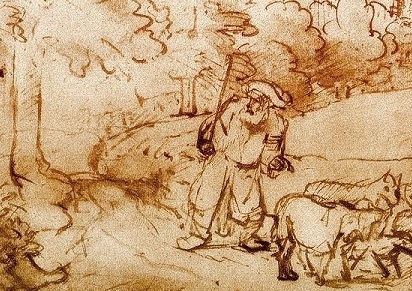
By the time God calls Moses’ name on Mount Sinai, Moses has already exhibited some character traits that make him a good choice. For one thing, he is curious about why the fire in the thorn-bush does not burn it up, and takes a closer look. (See last week’s post, Shemot: A Close Look at the Burning Bush.) A prophet must be open to hearing from God, and a leader must notice and investigate anything out of the ordinary.
Another of Moses’ helpful character traits is empathy for the underdog. When Moses sees an Egyptian man beating a Israelite, he first checks to see if there is anyone else around (to help, or to witness). Seeing no one, he strikes down the Egyptian and buries him in the sand. Although Moses is an adopted son of an Egyptian princess, he does not try to command the Egyptian overseer to cease. Either he is afraid that the Egyptian will strike him next, despite his apparent status, or he is so humble he does not believe he has any authority over an Egyptian overseer (perhaps because he carries no authority with anyone related to the pharaoh by birth rather than adoption).
When Moses goes back the next day, he sees two Israelite men fighting. He is not afraid to speak up to them, and he asks one Israelite why he is striking the other.
And [the Israelite] said: “Who appointed you as an officer and judge over us? Are you going to kill me, as you killed the Egyptian?” Then Moses was frightened, and said [to himself]: “Surely the matter is known!” (Exodus 2:14)
Pharaoh condemns Moses to death for the murder of the Egyptian, and Moses is too humble—or frightened—to fight the charge. He immediately flees into the wilderness. After several days he stops at a well where seven female shepherds are beginning to water their flock. When a group of male shepherds arrive and shove them away from the well, Moses fights them off, then helps the women draw water. They take him home to their father, who adopts him into the family. Out of either fear or humility, Moses never mentions that he used to live like a prince in Egypt, nor that he is wanted for murder.
Moses’ empathy for the underdog results in his flight to Midian. His curiosity draws him to the “mountain of God”, and then to God’s manifestation in a divine fire. Another character trait needed for God’s mission is humility, but so far Moses seems to be more motivated by fear of authority. When he kills the abusive Egyptian he is afraid that the pharaoh will find out, and when the pharaoh orders his execution he is afraid he will be found. Naturally he is nervous about the God on the mountain, too. In last week’s post, we saw how God gradually leads Moses up to the point where he can hear God call his name. Once Moses has responded to God’s second call by saying “Here I am”, God lets him know which god is calling.
Moses hides his face

And [God] said: “I am the God of avikha; the God of Abraham, the God of Isaac, and the God of Jacob.” And Moses hid his face, because yarei of looking at God. (Exodus 3:6)
avikha (אָבִיךָ) = your father, your forefather. (The plural would be avoteykha,אֲבוֹתֶיךָ, “your fathers”.)
yarei (יָרֵא) = he was afraid, he was in awe.
Why does God start off by saying “I am the God of your father” in the singular? The classic midrash1 assumed that God meant Moses’ biological father, Amram.
“The Holy One, blessed be He, said: ‘If I appear to him in loud voice, I will terrify him; in soft voice, he will take prophecy lightly.’ What did He do? He appeared to him with the voice of his father. Moses said: ‘Here I am; what does Abba want?’ The Holy One, blessed be He, said: ‘I am not your father, but rather the God of your father. … The God of Abraham, the God of Isaac, and the God of Jacob’. Moses was joyful and said: ‘Abba is enumerated with the patriarchs. Moreover, he is greater, as he was mentioned first.’” (Shemot Rabbah 3:1)2
But the book of Exodus itself does not depict Moses as so naïve and childlike. Furthermore, Moses might not even remember his father’s voice, since the pharaoh’s daughter took him into her palace when he was about three years old, after Moses’ mother had weaned him. And he would be unlikely to refer to Amram as “Abba”, the equivalent of “Dad”. So I prefer the commentary that says God refers to the collective “forefather” of the Israelites, then elaborates by citing the three patriarchs who are the forefathers of the Israelites: Abraham, Isaac, and Jacob.3
Why does Moses hide his face in fear (or awe) only when he hears that the God who is addressing him is the God of the Israelites? Perhaps he is not afraid of looking at other gods; he must have done it all the time when he lived with royalty in Egypt. But he takes the God of the Israelites, the God of Abraham, Isaac, and Jacob, more seriously.
Maybe he is frightened because he believes the God of his birth family has more power over him than any other god would. Maybe he is overwhelmed by awe because he is humble, and knows he is unworthy of being addressed by any God.
Or maybe he is frightened because he intuits that God would not speak to him except to ask him to do something terribly dangerous.
Moses’ first attempt to get out of the mission
Although Moses has hidden his face, God goes on speaking to him, filling in some backstory:
“I have definitely seen the suffering of my people who are in Egypt, and I have heard their outcry in the face of their oppressors, for I am acquainted with their pain. And I have come down to rescue them from the hand of Egypt and to bring them up from that land to a good and spacious land, a land flowing with milk and honey,4 to the place of the Canaanites, the Hittites, the Amorites, the Perizzites, the Hivites, and the Jebusites. … And now, go! And I will send you to Pharaoh, and you will bring out my people, the Israelites, from Egypt.” (Exodus 3:7-8, 10)
Despite God’s careful attempt to bring Moses to the right balance of fear and courage to receive the divine message, Moses does not respond with the equivalent of “Yes, sir!” Instead he starts making excuses why he should not go.
But Moses said to God: “Who am I that I should go to Pharaoh and that I should bring out the Israelites from Egypt?” (Exodus 3:11)
Is this humility, or is it the first excuse that comes to Moses’ mind to get out of what sounds like a difficult and dangerous job?
Some of each, according to Tze-enah Ure-enah: “That is, Moses said: I am lowly and I should speak with a king? Perhaps he will kill me?”5
But S.R. Hirsch saw Moses’ first excuse as humility without any thought of self-preservation: “Was he not entitled to doubt whether he had the imposing, overpowering strength of personality required to transform a nation of slaves into a people of God?”6
Joanathan Sacks offered a different argument why Moses would be reluctant to give up his life in Midian for the sake of the Israelites in Egypt: “He may have been Jewish by birth, but he had not suffered the fate of his people. He had not grown up as a Jew. He had not lived among Jews. He had good reason to doubt that the Israelites would even recognise him as one of them. … why should he even think of becoming their leader? Their fate was not his. He was not part of it. He was not responsible for it. He did not suffer from it. He was not implicated in it.”7
Nevertheless, Sacks pointed out, after he has given God several reasons why he should not be the one to go to Egypt, Moses finally submits and accepts the job, for the same reason he struck down the Egyptian man beating the Israelite laborer. When he sees people suffering, he cannot walk away. His empathy for the underdog is a more important qualification for God’s mission than personal courage.
Moses gets an answer
Then [God] said: “But I will be with you, and this is your sign that I myself sent you. When you bring out the people from Egypt, you will serve God on this mountain.” (Exodus 3:12)
Why does God answer “But I will be with you”? One explanation is that God intends to reassure Moses that he will not have to face the pharaoh alone, or the Israelites (who taunted him when he returned to the scene of his crime).
“One says “I will be with you” only to someone who is afraid.” (Shemot Rabbah)8
Adin Steinsaltz explained that God means: “I am not asking you to act on your own strength; you are merely a messenger.”9
On the other hand, “God was with him” is a biblical idiom for success. For example:
And God was with Joseph, and he was a successful man, and he was in the house of his Egyptian master. And his master saw that God was with him and everything that he did God made successful in his hand.” (Genesis 39:2-3)
So when God tells Moses “I will be with you”, God might be promising him that his mission will succeed. And Moses’ very success would be a sign to the Egyptians and the Israelites that God sent him on the mission.10
Hirsch wrote that God’s “I will be with you” means that God knows Moses is unable to succeed on his own—and this is the very the reason why God chooses him for the mission. He imagined God explaining:
“I need someone who is the wisest and at the same time the humblest of all men. Your marked inadequacy will stamp the work I intend to accomplish through you with a ‘sign’ for all time to come that what you achieved could have been achieved only at My command and by My power. Your very inadequacy will attest to the Divine character of your mission. Without this proof, Israel’s deliverance would be regarded as no different from other events in world history that glorify the power of men.”11
So Moses is the most qualified person to be God’s prophet because he is the least qualified person to face the pharaoh and lead the Israelites.
Moses does not argue with God about God’s reply “I will be with you”. But he does generate another question, as he flounders for a convincing reason why God should not send him to Egypt after all.
To be continued …
- Midrash is a type of commentary that makes additions to the text in order to flesh out the story or to connect it with a mystical tradition.
- Shemot Rabbah, 10th-12th centuries, translation in www.sefaria.org.
- E.g. Ibn Ezra, 12th century; Ramban, 13th century; Rabbeinu Bachya, 14th century.
- See my post: Ki Tavo: Milk and Honey.
- 17th-century commentary Tze-enah Ure-enah, translation from Yiddish in www.sefaria.org.
- 19th-century rabbi Samson Raphael Hirsch, The Hirsch Chumash: Sefer Shemos, translation by Daniel Haberman, Feldheim Publishers, Jerusalem, 2005, p. 35.
- Rabbi Lord Jonathan Sacks, Covenant & Conversation, “Who Am I? Shemot”, reposted Jan. 16, 2025.
- Shemot Rabbah.
- Rabbi Adin Even-Israel Steinsaltz, The Steinsaltz Tanakh, Koren Publishers, Jerusalem, 2019, quoted in www.sefaria.org.
- This is the opinion of Rashi (11th-century rabbi Shlomoh Yitzchaki), and 16th-century rabbi Ovadiah Sforno. (The Torah is ambiguous about whether the sign proving God sent Moses will be Moses’ success in liberating the Israelites from Egypt, or what will happen when they serve God on Mount Sinai, a.k.a. Choreiv.)
- Hirsch, p. 36.

 Questioning Torah
6 thoughts on “Shemot: Empathy, Fear, and Humility”