(I intended to post this last week, since it examines part of the first Torah portion in the book of Exodus, Shemot, but I didn’t finish it in time because I was sick. Now I am making it the first of a series of posts about how God and Moses interact on Mount Sinai, a.k.a. Choreiv. Meanwhile, if you would like to read one of my posts on this week’s Torah portion, Va-eira, try this one: Va-eira: Taking a Stand at the Nile.)
Moses is born under the general death sentence that the pharaoh has issued against all male newborns of the Hebrews. His mother hides him, one of the pharaoh’s daughters finds him, and his sister arranges for this Egyptian princess to adopt him. Moses grows up in the safety of the royal palace.
But he knows he is a Hebrew by birth. The narrative of the first Torah portion in the book of Exodus, Shemot (Exodus 1:1-6:1), confirms this by saying that when Moses had grown up,

… he went to his kinsmen and he saw their forced labor. And he saw an Egyptian man beat a Hebrew man, one of his kinsmen. (Exodus 2:11)
Moses looks around, then kills the Egyptian. The pharaoh finds out, and once again Moses is under a death sentence. He flees the murder charge, walking alone all the way across the Sinai Peninsula to the land of Midian. A Midianite priest gives Moses shelter and marries him to one of his daughters.
Once again, Moses has been adopted and lives in safety—as long as he never goes back to Egypt.
Then God calls and orders him to do just that.
This is the first time Moses hears from God. If the divine call is not impressive enough, he might ignore it. If it is too overwhelming, he might go insane, or at least decide he is seriously ill, and fail to answer. What kind of approach will make Moses at least listen and respond to God’s order to return to Egypt and ask the new pharaoh to let the Hebrews go?
To answer that question, we need to examine the words the Torah uses in the description of Moses’ call to prophecy.
The place
And Moses was a shepherd of the flock of his father-in-law Yitro, a priest of Midian. And he led the flock ahar the midbar, and he came to the mountain of ha-elohim, to Choreiv. (Exodus 3:1)
ahar (אַחַר) = behind, afterward.
midbar (מִדְבָּר) = wilderness, i.e. any area that is neither farmed nor near a permanent settlement.
ha-elohim (הָאֱלֺהִים) = the gods, God.
Choreiv (חֺרֵב) = the mountain on the Sinai Peninsula called “Sinai” in other strands of the story.1 (From the root verb charav, חָרַב = dried up, made desolate.)
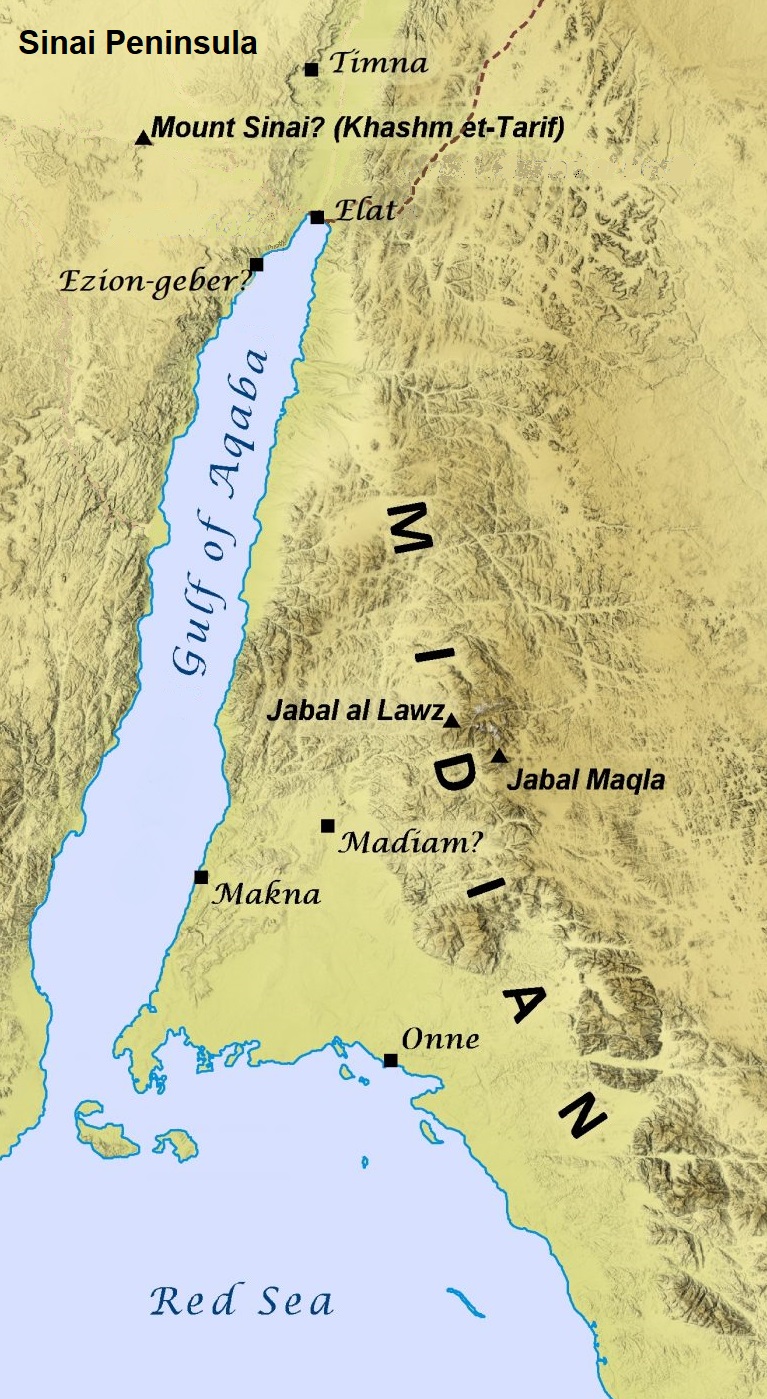
First God waits until Moses has traveled far from his home. Although many English translations skip the word ahar and just say Moses led his flock into the wilderness, Moses’ home (in his father-in-law’s encampment) is probably already in the midbar. The Midianites were nomadic tribes living along the eastern shore of the Gulf of Aqaba and also closer to the Sinai Peninsula, in the hills north of the Egyptian port of Eilat. Moses would have avoided any Midianite campsites near that port. So he lives in the midbar of Midian.
Now Moses leaves his home in the wilderness and leads the flock even farther away from civilization, “behind” the wilderness, to the mountain of God. Why does he go there?
16th-century rabbi Ovadiah Sforno, like many classic commentators, wrote: “He wanted to pray and meditate there in complete isolation and concentration.”2
Since Moses might see another shepherd in the wilderness, he takes the flock behind the wilderness, to the foot of Mount Choreiv: a mountain so dry nothing grows on it except thornbushes. But there is no previous indication in the Torah portion that Moses is a prayerful or meditative man. If anything, he is impulsive, quick to attack in order to rescue the underdog.
An alternate explanation is that Moses is looking for a new grazing site, and accidentally wanders to a place that is poor for grazing, but significant for other reasons.
“Apparently, Moses has never been to this mountain before—it must have been in a somewhat remote area. That is why the passage starts off by explaining the special circumstances that led him to this mountain at this time: he had led his flock ‘beyond the wilderness,’ some greater distance than usual, presumably in search of a good grazing site.” (Kugel)3
A third possibility is that Moses’s father-in-law, Yitro, has told him about this mountain associated with a god. As a Midianite priest, Yitro would know of any numinous sites in the region. Later in the book of Exodus, Yitro says:
“Now I know that Y-H-V-H is greater than all the gods.” (Exodus 18:10)
This implies that he already knew about the God whose personal name is the Tetragrammaton, Y-H-V-H; he simply had not known that this particular god was the most powerful. Moses is a curious man; just as he left the comfort of the palace to observe the forced labor of the Hebrews, he might now decide to check out the mountain of the god (ha-elohim), who turns out to be the God (ha-elohim), Y-H-V-H.
Later God will speak directly to Moses’ mind without preliminaries, wherever Moses happens to be. But for the first contact, God waits until Moses arrives at Mount Choreiv. If Moses already associates this mountain with a god, he will be more inclined to listen when God does speak to him.
The fire
The first thing God does when Moses arrives is to make something appear in a thornbush.
And a malakh of Y-H-V-H appeared to him belabat fire in the middle of the sneh. And he looked, and hey! the sneh was burning in the fire, but the sneh was not consumed. (Exodus 3:2)
malakh (מַלְאַךְ) = messenger. (When a human sends a malakh, it’s another human. When God sends a malakh, it looks like a man but turns out to be God, or it sounds like a human voice but turns out to be God’s voice. Some English translations call a malakh of God an angel.)4
belabat (בְּלַבַּת) = in a flame of; in the heart of. (Some commentators derive the word from labah (לַבָּה) = flame, flame-shaped spear-head. Others derive the word from leiv (לֵב) = heart, mind, consciousness; courage; interior, middle.)5
sneh (סְנֶה) = thornbush. (This is the accepted translation; it may be the cassia senna shrub, called sene in Arabic. In the entire Hebrew Bible, this word appears only in Exodus 3:2-4 and Deuteronomy 33:16—which is a reference to Exodus 3:2-4. Commentators have suggested that the other name for Mount Choreiv, Mount Sinai, may be derived from sneh—or the other way around!)
What does Moses see in the fire? Is it an image of a man, like many a divine malakh? Or is it the image of a flame in the fire?6
19th-century rabbi Hirsch insisted Moses saw the image of a man, i.e. an angel:
“The angel appeared in the center of the fire, and the fire was in the center of the thorn bush. The thorn bush was not enveloped by flames, and the impression it made was not that of a thorn bush engulfed in flames without being consumed. … Rather, the fire was within the bush and the angel was within the flames.”7

Another 19th-century commentator, Shadal, elaborated:
“Now the bush was on fire, but it was not really burning, but was surrounded by flames like a burning object, since the fire was flashing between the thorns, but did not take to them, and thus at first Moses saw the fire amid the bush, and the bush flashing with fire, and then he saw that it was not burnt, and he said: ‘Let me turn aside to see’ why this bush is not burning.”8
On the other hand, even if belabat means “in the heart of”, it can be interpreted not as “in the middle of”, but rather in terms of the human heart as the seat of passion. In the mid-20th-century Menachem Mendel Kasher wrote:
“The bush resembles the heart. It too can burn without being consumed.”9
And at the end of the 20th century Avivah Gottlieb Zornberg added:
“For the angel appears by means of the heart’s fire; he cannot exist without it.”10
What is the purpose of all these special effects in the thornbush? Shemot Rabbah, a collection of midrash on the book of Exodus from circa 1200 C.E., plays on the meaning of leiv as “courage” when it explains:
“In a flame (belabat) of fire” – to give him courage (lelabevo), so that when he arrives at Sinai and sees those fires, he will not fear them.”11
According to Chizkuni in the 13th-century:
“God wanted Moses to get used to such a phenomenon so that when the time came for the revelation at Mount Sinai, he would not become frightened by either it or the lightning.”12
Why does the messenger appear to him in a sneh? Tur HaAroch gave a simple answer in the 14th century, pointing out that the area around the thornbush would be uncontaminated by feces, since no animal would risk being jabbed by the thorns. God forbid that God should appear in a contaminated (tamei) place!
Da-at Zekenim, a compilation of Torah commentary from the 12th-13th centuries, says:
“The reason that God chose this bush to reveal Himself in was that one could not construct a deity or symbol of a deity out of the bush.”13
Even though other religions in the Ancient Near East elevated certain trees to divine status, Moses is not about to start worshiping a thornbush. Another message God might be communicating, according to two medieval commentaries, is that there is no place vacant of the divine presence, not even a thornbush.14
Passing the test
And Moses said: “Indeed, I will turn aside, and I will look at this great sight; why doesn’t the sneh burn up?” And Y-H-V-H saw that he had turned aside to look, and Elohim called to him from the middle of the sneh: “Moses! Moses!” And he said: “Here I am.” (Exodus 3:3-4)
elohim (אֱלֺהִים) = god, gods, God.
Some commentary suggests that God’s whole set-up is a test of Moses’ patience, curiosity, and power of observation. After all, another shepherd might merely think “Oh, a fire. Better herd the sheep away from it.” This practical but automatic thinking is not suitable for a prophet and leader of people, who must figure out the underlying causes of problems. Only after Moses turns aside to examine the bush does God call to him.
On the other hand, piquing Moses’ curiosity might be just the first step in leading him to accept that he is facing God. Rabbeinu Bachya wrote in the 14th century that the story shows Moses going through three levels of understanding. First he sees the fire with his physical eyes and goes to investigate. “If he had realized it was a heavenly fire, he would not have approached. Once he saw this fire he became stronger through seeing the angel … This means that first he saw the flame, and only after did he see the angel within the fire. Once he became stronger through seeing the angel, he saw the Divine Presence in a prophetic vision. … Because this was the beginning of Moshe’s prophecy, God wanted to orient him little by little and lift him up from one (spiritual) level to the next until his mind would be strong enough.”15
Why does God call Moses’ name twice? There are only three other places in the Hebrew Bible where God calls someone and repeats his name. In Genesis 22:11, God calls “Abraham, Abraham” because does not pay attention the first time. In Genesis 46:2, God calls “Jacob, Jacob” because Jacob is hesitant about going down to Egypt. And in 1 Samuel 3:10, God calls “Samuel, Samuel” because the first three times God called his name, the boy assumed it was the priest, Eli, calling for him, and he got up and ran to Eli before God could tell him a prophecy.
At the mountain of God, Moses is open to learning something new about the burning bush, but he does not expect to hear God calling his name. Probably the first time he hears it, Moses is flabbergasted. Only when he hears his name the second time is he able to respond. Or as Rabbeinu Bachya explained it:
“Seeing that a prophet would become frightened when he heard his name called for the first time, and as a result of his confusion he would misunderstand the divine message which was to follow, his name is called a second time in order to give him time to collect his thoughts. After the second mention of his name he would receive the message God wanted him to receive.”16
Moses’ reply “Here I am” could mean “I am at Your disposal.”17 Or it could mean he was ready to listen to God.18 Or he might have said “Here I am” even though he did not know who was calling to him.19
Holy ground
And he [God] said: “Don’t come closer! Take off your sandals from upon your feet, because the place that you are standing on, it is holy ground!” (Exodus 3:5)
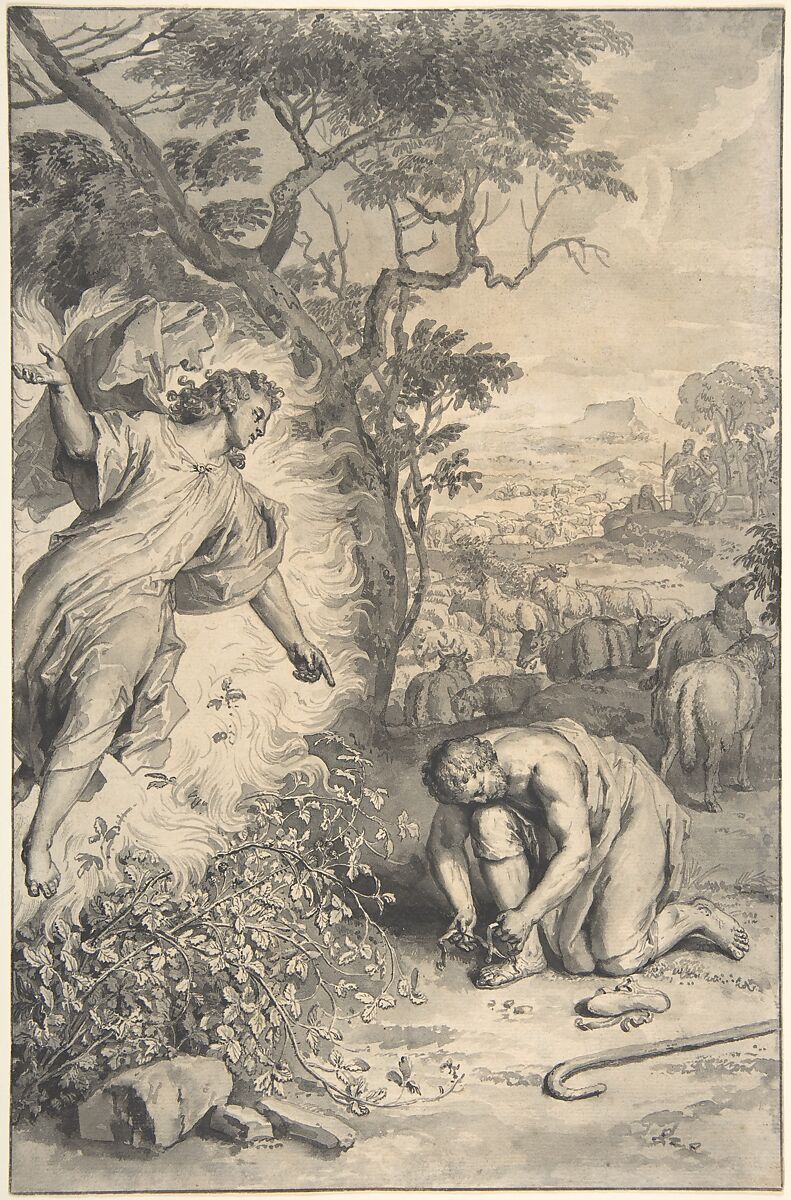
Why does God wait until this moment, when Moses has already stepped on holy ground with his sandals on? Maybe the situation at the burning bush has been sufficiently mysterious and daunting up to this point, but now Moses needs an extra boost of alarm. According to Rabbeinu Bachya,
“This was to serve as a warning not to be disrespectful, i.e. nonchalant, when he would be addressed by the Shekhinah, “God’s Presence”.20
Telling Moses to stand barefoot on holy ground could also give him a more subtle message. Bachya wrote:
“He was warned to strip off what the shoe represented, i.e. material concerns. The act of removing his shoes was a mental preparation to ready him to become God’s vessel, His prophet. The lesson was that just as a man can take off his shoe at will, so he can divest himself of material concerns and concentrate on spiritual concerns.”21
On the other hand, maybe the important thing about going barefoot is feeling the ground under one’s feet. According to the Chassidic text Itture Torah, “Only when one is barefoot can one feel the little stones underfoot. Moses was to lead his people in such a way that he could feel their smallest sorrows.”22
After Moses has responded to each step of God’s gradual introduction, from noticing that the bush is not burning up to hearing God call his name, God decides Moses is ready to receive his marching orders. But is he?
To be continued …
- Source scholarship of the 20th century concluded that the mountain on the Sinai Peninsula where God appears is called “Choreiv” in sources E and D, and “Sinai” in sources J and P. However, 21st-century scholars are questioning the J-E-P-D classification, while continuing to identify different strands in the Torah written by different sources.
- Rabbi Ovadiah Sforno, 16th century, translation in www.sefaria.org.
- James Kugel, How to Read the Bible, Free Press, Simon & Schuster, New York, 2007, p. 210.
- See my post: Vayeira: On Speaking Terms.
- Later in Exodus, God leads the Israelites from Egypt to Mount Sinai by means of a pillar of cloud by day and fire by night, and this pillar is sometimes called a malakh. See Exodus 14:19-20 and 14:24 at the Red Sea.
- See Rashi (11th century) and Ibn Ezra (12th century) for a detailed analysis of both positions.
- Samson Raphael Hirsch, The Hirsch Chumash: Sefer Shemos, translation by Daniel Haberman, Feldheim Publishers, Jerusalem, p. 30-31.
- Shadal is the acronym of 19th-century commentator Samuel David Luzzatto. Translation in www.sefaria.org.
- Menachem Mendel Kasher, Torah Shelemah, vol. 8, p. 123, cited in The Torah: A Modern Commentary, edited by W. Gunther Plaut, Union of American Hebrew Congregations, New York, 1981, p. 407.
- Avivah Gottlieb Zornberg, The Particulars of Rapture: Reflections on Exodus, Doubleday, New York, 2001, p. 338.
- Shemot Rabbah 2:5, translation in www.sefaria.org.
- Chizkuni is the name of a compilation by Chizkiah ben Manoach, mid-13th century. Translation in www.sefaria.org.
- Da-at Zekenim, a compilation 12th-13th century French and German commentary, translation in www.sefaria.org.
- Shemot Rabbah 2:5 attributes this bit of wisdom to Rabbi Yehoshua ben Korcha, while Mekhilta DeRabbi Shimon Ben Yochai 3:1 attributes it to Rabban Gamaliel.
- Rabbeinu Bachya (Rabbi Bachya ben Asher, 1255-1340), translation in www.sefaria.org.
- Ibid.
- Da’at Zekenim, ibid.
- Malbim is the scronym of 19th-century rabbi Meir Leibush ben Yehiel Michel Wisser.
- Rabbi Adin Even-Israel Steinsaltz, The Steinsaltz Tanakh, Koren Publishers, Jerusalem, 2019, quoted in www.sefaria.org.
- Rabbeinu Bachya, ibid.
- Ibid.

 Questioning Torah
💜💕