And Jacob went out from Beersheba and went toward Charan. (Genesis 28:10)
The first verse in this week’s Torah portion, Vayeitzei (“And he went”, Genesis 28:10-32:3), sounds simple—until you consider the family Jacob is leaving behind in Beersheba.
In last week’s Torah portion, Toledot, Jacob cheated his twin brother, Esau (older by a minute), into trading his firstborn rights for a bowl of lentil stew.1 Years later their father, Isaac, announced he would give his deathbed blessing to Esau, his favorite. The twins’ mother, Rebecca, talked Jacob, her own favorite, into impersonating his brother and stealing the blessing.2
When Esau found out, he vowed to kill his brother as soon as their father died. Rebecca urged Jacob to flee for his life, then maneuvered her husband into ordering Jacob to go to her old hometown in northern Mesopotamia and get a wife.3 At least Isaac gave Jacob a blessing of his own to send him off.4
Jacob turns his back on Isaac
What is Jacob thinking as he hikes north toward Charan? In my post Vayeitzei: Guilty Conscience, I argue that he might feel guilty about his deceptions—guilty enough to leave at once, without waiting for his wealthy father to give him a bride-price, pack animals, and a servant or two for the journey. Jacob does not even ask his father for a bag of silver; he arrives in Charan with nothing but his walking stick.
Besides guilt, Jacob may feel relief and a sense of freedom. For the first time in his life he is on his own, away from his remote father, his controlling mother, and his big, hairy, primitive brother.

On the first night of his journey Jacob lies down with his head on a stone, and dreams about a ramp or stairway from the ground to the heavens, with divine messengers ascending and descending on it.
And hey! God stood above him and said: “I am Y-H-V-H, god of Abraham your av, and god of Isaac. The land that you are lying on, I will give to you and to your descendants.” (Genesis 28:13)
av (אָב) = father; someone in the role of a father (usually God or the head of a household or clan).
Why does God put it that way? Abraham is Isaac’s father, and Isaac is Jacob’s father. Jacob and his grandfather Abraham never interact in the book of Genesis, probably because Isaac and Abraham were estranged.5 So Abraham was neither a nurturer, nor an authority figure, nor a role model for Jacob.
According to 18th-century Rabbi Chayim ibn Attar, God means that Jacob is Abraham’s sole heir:
“The reason … was intended to emphasize that Esau had no share in the heritage of Abraham. The Torah here made Jacob the sole heir of Abraham. This heritage did not come to Jacob via his father Isaac but directly from his grandfather Abraham. … the fact that all the blessings of Abraham were transferred to Jacob excludes Esau as an heir.”6
According to 19th-century Rabbi S.R. Hirsch, God means that Jacob is Abraham’s spiritual successor:
“Nowhere else in Scripture do we find such a thing that the grandfather is called ‘father,’ with the father himself mentioned right afterward as though he were a stranger. …Jacob truly was the successor of Abraham, with Isaac being only the intermediate link. Spiritually, Abraham was Jacob’s father.”7
But according to 21st-century Rabbi Shmuel Klitsner, it means Jacob wants Abraham’s God:
“… the Talmud records the observation … that in dreams, ‘a person is shown nothing if not the inner thoughts of his own heart’ (BT, Tractate Berakhot 55b). … It seems clear that in Jacob’s ‘inner thoughts of heart’ the Lord who will comfort him will be the Lord of Abraham his father. As for the God of Isaac (his genetic father), there is a missing relational adjective, as the very situation that begs comfort, Jacob’s precarious homeless state, is a result of his having betrayed the father-son relationship.”8
Does the phrase “god of Abraham your father” signal that only Jacob and his descendants will inherit what God promised to his grandfather Abraham (ibn Attar)? Or that Jacob will have the same relationship with God as Abraham (Hirsch)? Or that Jacob wants Abraham’s God rather than Isaac’s? (Klitsner)?
Does Jacob inherit Abraham’s blessings?
Chayim ibn Attar’s proposal is supported by the next words God says in Jacob’s dream:
“And your descendants will be like the dust of the land, and you will spread out to the west and to the east, to the north and to the south. And all the clans of the earth will be blessed through you and your descendants.” (Genesis 28:14)
This statement echoes two of the blessings God gave to Abraham:
“All the land that you see, I give it to you and to your descendants forever. And I will make your descendants like the dust of the earth, in that if a man were able to count the dust of the earth, your descendants could also be counted.” (Genesis 13:15-16)
“I will bless those who bless you, and those who despise you I will curse, and all the clans of the earth will be blessed through you.” (Genesis 12:3) Thus God promises both Abraham and Jacob that their descendants will be as uncountable as the dust, that their descendants will own the land, and that they will become a blessing to everyone on earth. Jacob does indeed inherit Abraham’s blessings.
Is Jacob Abraham’s spiritual successor?
However, Hirsch’s proposal that Abraham, not Isaac, is Jacob’s spiritual father gets only weak support from the book of Genesis. Abraham hears God speak on twelve occasions in the book of Genesis. Isaac hears God speak once.9 And Jacob hears God speak three times: once during Jacob’s ladder dream at the beginning of this week’s Torah portion, and twice when he returns to the same spot 20 or more years later.10 (Jacob also tells Leah and Rachel that God also spoke to him in a dream telling him to leave Charan and return to his native land,11 but since he had already decided to go, he might have invented this dream in order to secure his wives’ consent.)
Jacob never experiences the intimacy Abraham has with God. Abraham and God have six conversations.12 In one of these conversations, Abraham talks God into refraining from obliterating Sodom if the city has at least ten innocent men.13 Jacob hears God speak, but never answers. Once Jacob prays to God to rescue him, but God is silent.14
In addition to the conversations between Abraham and God, God speaks to Abraham another six times to deliver an order or a promise, or both.15 Abraham obeys all of God’s orders, even when God tests him by telling him to sacrifice his son Isaac.16 Jacob obeys God’s only order to him, to build an altar at Beit Eil.17
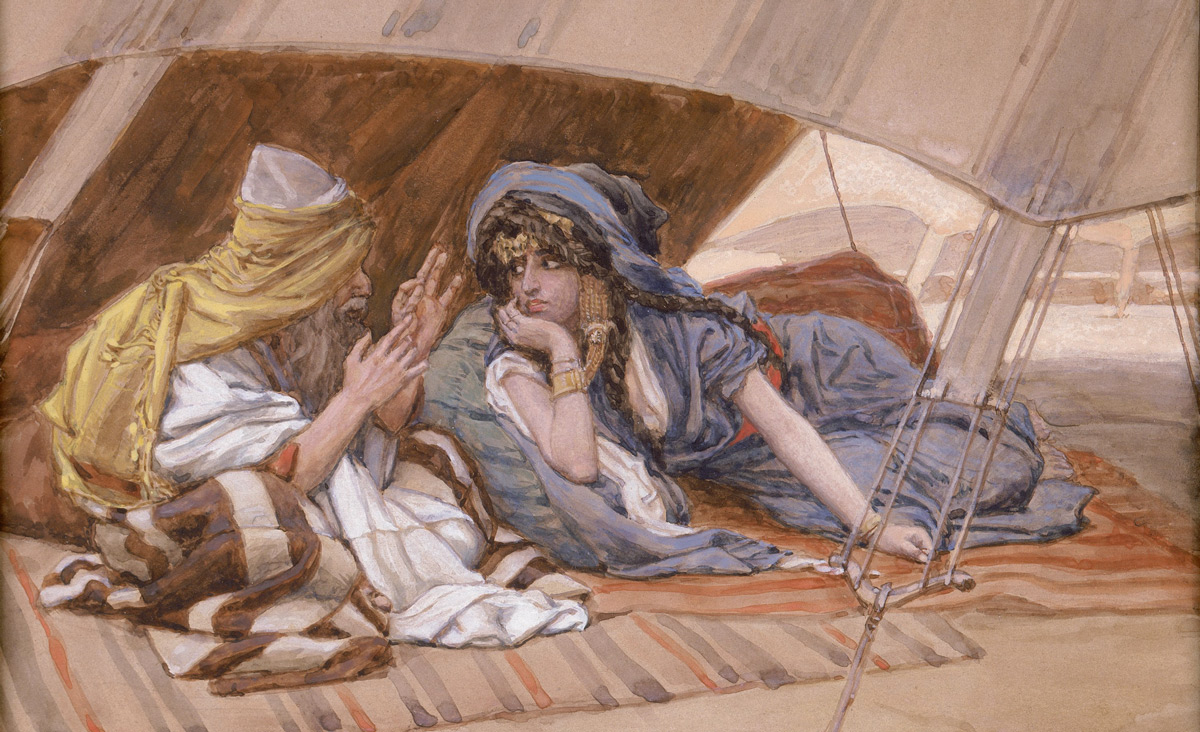
Furthermore, God cooperates with Abraham’s scams. Twice when Abraham arranges for his wife, Sarah, to be carried off to a king’s harem, God afflicts the king so he cannot have sex with her.18
In short, God spends a lot more time with Abraham than with Jacob, and the two of them have a real relationship. With Jacob, God is almost as distant as with Isaac.
Is Jacob the heir to Abraham’s God?
What about Klitsner’s proposal that Jacob wants Abraham’s god rather than Isaac’s?
Near the end of this week’s Torah portion, Jacob has left Charan and is heading to Canaan with his family, servants, and herds, when Lavan (his employer, uncle, cousin, and father-in-law) catches up with him in a mountain pass. Lavan accuses Jacob of stealing his daughters—Jacob’s wives. Jacob accuses Lavan of cheating him multiple times as his employer. Jacob concludes:
“Had not for the god of my father—the God of Abraham and the Pachad of Isaac—been for me, certainly now you would have sent me off empty-handed!” (Genesis 31:42)
pachad (פַּחַד) = terror.
Twenty years after he left home and dreamed of the ladder, Jacob now calls both Abraham and Isaac his father.
The two men set up stones to serve as a boundary, and they both swear not to cross it for any harmful purpose. Lavan says:

“May the God of Abraham and the God of Nachor judge between us—the God of their father.” (Genesis 31:53a)
Lavan is referring to a single god, Y-H-V-H, worshiped by the both Abraham and Nachor, their respective paternal grandfathers. We know that Abraham and his brother Nachor had the same god because earlier in Genesis Lavan and his father said Rebecca’s marriage to Isaac “went forth from Y-H-V-H” (Genesis 24:50).19
But Jacob swore by the Pachad of Isaac. (Genesis 31:53b)
Twice Jacob calls God the Pachad of Isaac. There is no indication in the book of Genesis that Isaac threatened Jacob, with a punishment from God or any other way. So Jacob must be thinking about the defining event in Isaac’s life, when God ordered Abraham to sacrifice him, and did not call it off until Abraham had bound his son on an altar and put a knife to his throat.20
Jacob invokes Isaac’s God as a source of terror in order to make an implied threat against Lavan. But when he left home twenty years before, he did not want the Pachad of Isaac. He wanted a protective God who would help him out of tight spots the way God helped Abraham get his wife back from two kings.
And that is what Jacob got at the end of his dream about the ladder. After saying that Jacob’s descendants will own the land and be a blessing to the world, God added:
“And hey! I myself am with you. And I will guard you wherever you go, and I will bring you back to this ground, because I will not leave you until I have done what I have spoken to you.” (Genesis 28:15)
Then Jacob wakes up. The God of Abraham has promised to protect him.
He has a new father figure.
- Genesis 25:29-34. (See my post: Bereishit & Toledot: Seeing Red.)
- Genesis 27:1-30. (See my post: Toledot: To Bless Someone.)
- Genesis 27:31-28:5.
- Genesis 28:3-4.
- Ever since Abraham bound Isaac as a sacrifice and almost cut his throat (Genesis 22:1-19). See my post: Vayeira: Stopped by an Angel.)
- Chayim ibn Attar, Or Hachayim, translation in www.sefaria.org.
- Samson Raphael Hirsch, The Hirsch Chumash: Sefer Bereshis, translated by Daniel Haberman, Feldheim Publishers, Jerusalem, 2002, p. 602.
- Shmuel Klitsner, Wrestling Jacob, Urim Publications, Jerusalem, 2006, pp. 82-83.
- Isaac hears God speak to him, and builds an altar for God, in Genesis 26:24-25.
- Genesis 35:1, 35:9-13.
- Genesis 31:9-13.
- Genesis 15:1-11, 17:1-22, 18:9-10, 18:17-33, 22:1-2, 22:11-12.
- Genesis 18:17-33. (See my post: Vayeira: Who Is the Teacher?)
- Genesis 32:10-13.
- Genesis 12:1-4, 12:7, 13:14-18, 15:12-21, 21:12-13, 22:15-18.
- Genesis 22:1-10.
- Genesis 35:1-7.
- Genesis 12:11-20, 20:1-18.
- See my post Vayeitzei: Awe versus Terror for the complete inbred family tree.
- Genesis 22:9-12.

 Questioning Torah