The first definite statement of monotheism—that there are no other gods—appears in this week’s Torah portion, Va-etchanan (3:23-7:11), in the book of Deuteronomy (Devarim).
Our god is better than your god
Although the Hebrew Bible repeatedly forbids Israelites from worshiping any other gods, the texts of Genesis and Exodus assume that other, lesser gods exist.1 On the sixth day of creation, God says:
“Let us make humankind in our image, like our likeness.” (Genesis 1:26)
Neither kings nor God use the royal “we” in the Hebrew Bible. God uses the first person plural only four times in the entire canon.2 In Isaiah 6:8, God’s “we” includes the serafim, six-winged angels hovering in attendance on God. But the first three times, all in Genesis, God’s first person plural can only be addressing lesser gods who assist God in acts of creation. The second time, after the two humans have eaten fruit from the Tree of the Knowledge of Good and Evil, God says:
“Humankind is becoming like one of us, knowing good and evil! And now, lest it stretch out its hand and take also from the Tree of Life and eat and live forever—!” (Genesis 3:22)
And the third time, after humans build the tower of Babel, God says:
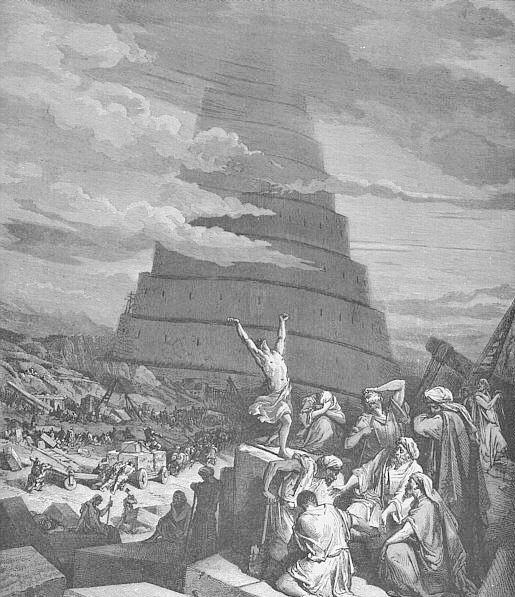
by Gustave Dore, 19th century
“Come, let us go down there and let us make their language fail, so that a man cannot understand the language of his neighbor.” (Genesis 11:6-7)
The book of Exodus also assumes the existence of other gods. For example, God tells Moses and Aaron:
“I will pass over the land of Egypt on that night, and I will strike down every first-born in the land of Egypt, from human to beast; and against all ha-elohim of Egypt I will execute judgments. I am Y-H-V-H.” (Exodus 12:12)
ha-elohim (הָאֱלֺהִים) = the gods; God.
How could God punish the gods of Egypt if they do not exist?
After Moses and the Israelites have crossed the Red Sea, they sing to God:
“Who is like you ba-eilim, Y-H-V-H?
Who is like you, majestic among the holy,
Awesome of praises, doer of wonders?” (Exodus 15:11)
ba-eilim (בָּאֵלִם) = among the gods. B- (בּ) = among, in, through + -a- (ָ ) = the + eilim (אְלִם) = gods. (Unlike elohim, eilim is never used to refer to the God of Israel.)
Here the God of Israel, addressed by God’s sacred personal name, Y-H-V-H, is compared with multiple other, less awesome gods. This verse (“Mi khamokha”) is chanted or sung at every evening and morning Jewish service to this day. Some prayerbooks translate the first line as “Who is like you among the mighty?”—perhaps so that people who cannot read the Hebrew will not ask embarrassing questions!
Our god is the only god

The book of Deuteronomy was expanded and reframed as Moses’ final speech to the Israelites in the 5th century B.C.E. after the Persians had conquered Babylon and given the exiled Israelites permission to return to Jerusalem. Second Isaiah, which also includes clear statements of monotheism, was written during the same period.3
The first monotheistic declaration in the Torah appears in this week’s Torah portion, Va-etchanan. Moses reminds the Israelites that their God created the universe, made miracles to rescue them from Egypt, and spoke to them out of the fire on Mount Sinai. He concludes:
You yourself have been shown in order to know that Y-H-V-H is ha-elohim; eyn od milvado. (Deuteronomy4:35)
ha-elohim (הָאֱלֺהִים) = the gods; God. Elohim (אֱלֹהִים) is the plural of eloha ((אֱלוֹהַּ = a god (in early Hebrew), and literally means “gods”. But elohim can also mean “God”—perhaps because the God of Israel had the powers of all the gods that other people worship.
eyn od (אֵין עוֹד) = there is no other, there is nothing else. (Eyn (אֵין) = there is no, there is not, none, nothing. Od (עוֹד) = other, else.)
milvado (מִלְּבַדּוֹ) = alone, by itself.
Technically, the Israelites whom Moses is addressing are not the ones who saw the miracles in Egypt and heard God’s voice from the fire 40 years before, when all but two4 of Moses’ present audience were either children or not yet born. Yet Moses speaks as if everyone in front of him was an eye-witness.
He elaborates on God’s deeds on behalf of the Israelites, then reiterates:
And you know today, and you must [continually] put back into to your consciousness, that Y-H-V-H is ha-elohim, in the heavens above and on the earth below; eyn od.(Deuteronomy 4:39)
But does this generation of Israelites really know that their God is the only god? After they pitched camp by the Jordan in the book of Numbers, many Israelite men joined the local women in ritual animal sacrifices to their god, Baal Peor.5
And the people ate and they bowed down to their elohim. And Israel attached itself to Baal Peor, and Y-H-V-H’s nose burned against Israel. (Numbers 25:3)
The God of Israel calls for impalements, but also sends a plague that kills 24,000 people. Moses mentions this recent episode in this week’s Torah portion:
“Your eyes saw what Y-H-V-H did regarding Baal Peor: that Y-H-V-H, your Elohim, wiped out every man from your midst who went after Baal Peor. But you who stuck to Y-H-V-H, your Elohim, all of you are alive today.” (Deuteronomy 4:3-4) Perhaps the surviving Israelites do know that there is only one god, Y-H-V-H. Or perhaps they think Baal Peor is a real god, but they know their own God is “a jealous god”6, so they avoid worshiping any other gods.
Hear this: God is one

Later in the portion Va-etchanan, Moses pronounces what has become a key Jewish prayer, recited twice a day since the first century C.E., and written on the scroll inside the mezuzah attached to a Jew’s doorpost.
Shema, Israel! Y-H-V-H is Eloheinu; Y-H-V-H is echad. (Deuteronomy 6:4)
shema (שְׁמַע) = Listen! Pay attention! Hear this!
Eloheinu (אֱלֺהֵנוּ) = our elohim: our gods, our God.
echad (אֶחָד) = one as the first of a series, one as singular, unique.
This verse certainly says that Y-H-V-H is the God of the Israelites. But is it also a statement of monotheism?
Some modern commentators have held that echad here merely means “first”, or, as Daniel Zucker expressed it, “the top god”.7 If Moses’ declaration appeared in the book of Exodus, I might agree. But since it is in the later book of Deuteronomy, in the same Torah portion that says of God eyn od (there is no other), I favor a different kind of “one”.
The word echad could also mean “unique”, i.e. that God is the only one of its kind. In the 14th century, Rabbeinu Bachya explained: “He is unique in the universe, there is no other God deserving the title. He has no partners, is not an amalgamation of different powers working in tandem.”8
18th century rabbi Chayim ben Moshe ibn Attar put it more bluntly: “Furthermore, we express our conviction that He is indeed the only God, there is no other independent power in the universe.”9
Whatever the Shema meant when Deuteronomy was rewritten in the 5th century B.C.E., Jews have long considered it a declaration of monotheism. During the First Crusade, in 1096 C.E., Christians massacred Jews in the Rhine valley as well as Muslims in the “Holy Land”. Some Jews killed themselves before the Christians reached them.
“Over and over, their rallying cry at death is the single verse of the Sh’ma. Like their Sefardic counterparts, and medieval Muslims, Ashkenazi Jews understood the Christian concept of the divine Trinity as a case of polytheism; thus their insistence on God’s unity is a vehement repudiation of Christian doctrine.” (Susan Einbinder)10
In this week’s Torah portion, Moses tells the next generation of Israelites that they know there is only one God because 40 years ago they saw God’s miracles in Egypt and heard God’s voice in the fire on Mount Sinai. Only God could make those things happen. So according to Moses, they had direct evidence that the God of Israel is the only god; there is no other.
Moses does not mention that he is speaking to the next generation of Israelites, who were either children or not even born at the time. They have to go by what their parents told them, or by what Moses is telling them now.
Anyone who reads the book of Deuteronomy is in the same position. Why should we believe that there is one and only one god?
Some people believe it because their parents or teachers told them. And some believe it because it says so in the Torah. Others have their own mystical experiences, which they interpret as manifestations of a single, universal god. And some people believe it because they find one of the philosophical arguments for the existence of one God sufficiently compelling.
But many people are atheists, unable to believe God is real according to any of the usual definitions of God. When I examine the standard medieval theologian’s definition of God as an omnipotent, omniscient, omni-benevolent, and personal being, I always conclude that such a god is impossible. According to that definition of God, I am an atheist.
I have been fumbling toward my own definition of what I mean by “God” for decades, and I might never reach it. Although some scholars claim that the name Y-H-V-H comes from an older god-name and has nothing to do with the various conjugations of the Hebrew verb “to be” or “to become” (which are made up of those four letters in Hebrew), something about God as becoming speaks to me. But I cannot turn it into a tidy definition.
Yet I can recite the Shema with conviction. I am a Jew, and Y-H-V-H is our God, and God is one.
- The books of Leviticus and Numbers warn the Israelites against worshiping other gods without saying whether other gods exist.
- See my post: Bereishit: How Many Gods?
- The portion Va-etchanan also promises that God is compassionate and will ultimately rescue the Israelites (Deuteronomy 4:29-31), which is a constant refrain in Second Isaiah.
- Caleb and Joshua, the two out of ten scouts who trusted God to help them conquer Canaan. See my post: Shelakh-Lekha: Mutual Distrust.
- See my post: Pinchas & Balak: Calming Zeal.
- You must not have other elohim in front of me … You must not bow down to them and you must not serve them, because I, Y-H-V-H, your Elohim, am a jealous god … (Deuteronomy 5:9 and Exodus 20:3-5)
- Rabbi Daniel M. Zucker, “Shema Yisrael: In What Way is ‘YHWH One’?”, https://www.thetorah.com/article/shema-yisrael-in-what-way-is-yhwh-one.
- Rabbi Bachya ben Asher, a.k.a. Rabbeinu Bachya, translated in www.sefaria.org.
- Chayim ben Moshe ibn Attar, Or HaChayim, translated in www.sefaria.org.
- Susan L. Einbinder, My People’s Prayer Book, Vol. 1: The Sh’ma and its Blessings, Jewish Lights Publishing, Woodstock, VT, p. 90.

 Questioning Torah
This is excellent!!! Shabbat shalom.