The Hebrew Bible rejects most efforts to force God to reveal inside information.1 But there are a few exceptions:
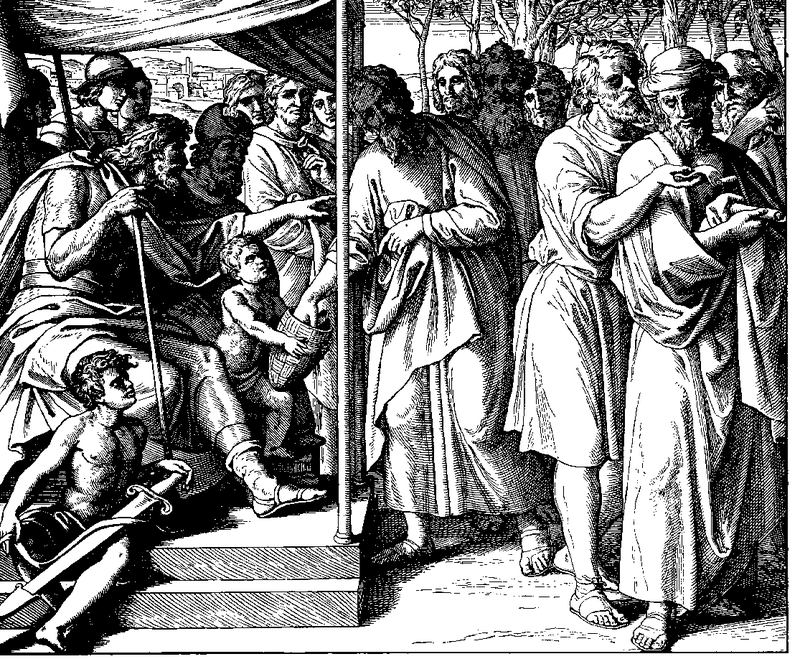
by Schnorr von Carolsfeld, Bibel in Bildern, 1860
- When the high priest consults two items called the urim and tumim, kept in the inside pocket of his jeweled breast-piece, for yes-or-no answers to a king’s questions.2 Yet once when King Saul tried it, God refused to respond.3
- When Joshua casts lots to find out how God wants the newly conquered lands of Canaan to be allocated among the tribes and their clans. He does not ask the high priest to check with God ahead of time, but simply orders men to travel and write descriptions of the geography, then casts lots on his own initiative as he stands next to the high priest at the entrance of God’s Tent of Meeting in Shiloh.4
- When a priest conducts a magic ritual to reveal whether a wife has been unfaithful to her husband.
The ritual of the jealous husband is described in this week’s Torah portion, Naso (4:21-7:89). The passage begins by attributing the authorship of the ritual to God:
And God spoke to Moses, saying: “Speak to the Israelites and say to them: Any man, if his wife tisteh and breaks faith with him faithlessly— (Numbers 5:12)
tisteh (תִּשְׂטֶה) = she goes astray, she deviates from the right path. (A form of the verb satah, שָׂטָה = turn aside, go astray.5 The noun from the same root, sotah (שׂוֹטָה), refers to this passage in Numbers, to a Talmud tractate about it, and to the wife who is under suspicion.)
Breaking faith
The first condition for a priest to conduct the magic ritual is that a wife breaks faith with her husband. This does not necessarily mean she is sexually unfaithful. The Talmud tractate Sotah opens:
“With regard to one who issues a warning to his wife not to seclude herself with a particular man, so that if she does not heed his warning she will assume the status of a woman suspected by her husband of having been unfaithful [sotah]… However, if after he told her not to speak with so-and-so, she entered into a secluded place and remained with that man long enough to become defiled, i.e., sufficient time to engage in sexual intercourse, she is forbidden to her home from that moment until she undergoes the sotah rite.” (Talmud Bavli, Sotah 2a)6
According to the mores of the Ancient Israelites, if a husband gives his wife an order, she is obligated to obey. According the mores of the West today, she is under no obligation unless she explicitly agrees that she will comply with his order. (But perhaps she has a moral obligation to tell him her own views on the matter, so she is not guilty of dishonesty.)
Secrecy
—and a man lay down with her, a lying-down of seed, and it was hidden from her man’s eyes, and she kept it secret, and she made herself tamei, and there is no witness, and she was not caught— (Numbers 5:13)
tamei = contaminated, ritually impure, unfit to enter God’s sanctuary, unfit for marriage.
This verse further defines the circumstances under which a priest should conduct the ritual for the sotah. It stipulates that the husband must suspect his wife of full intercourse including ejaculation with possible insemination (a lying-down of seed); that she has not confessed adultery to him (she kept it secret), and that nobody saw the guilty couple or caught them in the act.
Jealousy
—and a spirit of jealousy crossed over him, and he was jealous about his wife, and she has contaminated herself; or a spirit of jealousy crossed over him and he was jealous about his wife, but she has not contaminated herself—then the man shall bring his wife to the priest.” (Numbers 5:14-15)
What matters is the husband’s jealousy. The magic of the ritual will determine whether the wife is actually guilty of adultery.
The Torah portion does not offer a remedy if a woman is jealous and suspects her husband of adultery. But then, the Torah is providing laws for a patriarchal society. So married men are allowed to have sexual intercourse not only with their wives, but also with concubines, their female slaves, and prostitutes. But married women are forbidden to have sexual intercourse with anyone but their husbands. If they are caught in the act, and the court does not rule that it was a rape, both the wife and her lover get the death penalty.7
Revealing the truth
The Torah portion Naso provides a remedy if the husband only suspects his wife of adultery, but has no proof.
The jealous husband brings his wife to a priest at the temple, along with a small offering. The priest mixes dust from the floor of the sanctuary into a bowl of water, thereby making it holy. Then he declares:
“May this water of bitterness come inside you, making your belly inflate and your yareikh fall.” And the woman must say: “Amen, amen!” (Numbers 5:22)
yareikh (יָרֵךְ) = thigh, loins, or a euphemism for genitals.

The woman’s “Amen, amen!” counts as an oath that she will accept God’s verdict as to her innocence or guilt. The priest writes it all on a scroll, then dissolves the ink from the scroll into the holy water. He makes the sotah drink this mixture. If she is guilty, she suffers the described symptoms—perhaps a miscarriage or worse. If she is innocent, she remains healthy and bears a legitimate child to her husband. (See my blog post Naso: Ordeal of Trust.)
According to the Torah, it is God who opens or closes a womb.8 God determines whether a woman conceives, and whether she miscarries or gives birth. The ritual of the sotah forces God to determine the fate of the woman’s womb according to whether she committed secret adultery.
Why does the Torah provide a magical ritual to make God reveal whether a wife committed adultery or not?
A husband who suspects his wife of adultery could, according to Torah law, simply divorce her without proving anything.9 Alternatively, he could decide that he wants to continue the marriage no matter what she did or did not do.
But the Torah portion Naso addresses the case of a jealous husband—someone who wants the marriage to continue, but cannot shrug off the thought that his wife might have cheated on him. If he believes in the solemn and impressive ritual at the temple (and if his wife does not have a miscarriage), his jealousy will disappear and he will welcome his wife with open arms.
His wife, on the other hand, will have to live with the knowledge that her husband did not trust her, either to remain sexually faithful or to tell him the truth. In ancient Israelite society, she would probably be willing to settle for the good fortune of retaining her status as a married woman, continuing to live with her own children, and enjoying her husband’s financial support.
In modern western society, she might prefer to divorce a man who did not trust her. And we have no ritual to make God indicate whether a wife, or a husband, has broken a promise to be sexually faithful. Nor do we have an easy way to prove that a spouse was honest, or that a spouse will no longer be suspicious and jealous.
How can two people be contented lifelong companions without mutual trust?
- Three kinds of diviners are denounced in Deuteronomy 18:10-11; see my post: Shoftim: Is Magic Abominable? Part 1.
- E.g. Numbers 27:21.
- 1 Samuel 28:6.
- Joshua 18:4-10, 19:51.
- The verb satah appears only six times in the entire Hebrew Bible: four times in this week’s Torah portion, and twice in the book of Proverbs, a collection of advice from a father to a son. Proverbs 4:15 advises the son to “turn aside” from the path of the wicked. Proverbs 7:25 urges him not to “turn aside” from the right path toward the paths of prostitutes.
- William Davidson Talmud translation, from www.sefaria.org.
- Leviticus 20:10.
- E.g. Genesis 29:31, 30:22-23.
- Deuteronomy 24:1

 Questioning Torah