The first time Moses spends 40 days and 40 nights on the summit of Mount Sinai, God tells him everything the Israelites should make to create a portable sanctuary for God and vestments for God’s new priests. Moses also learns who should supervise the craftsmanship.
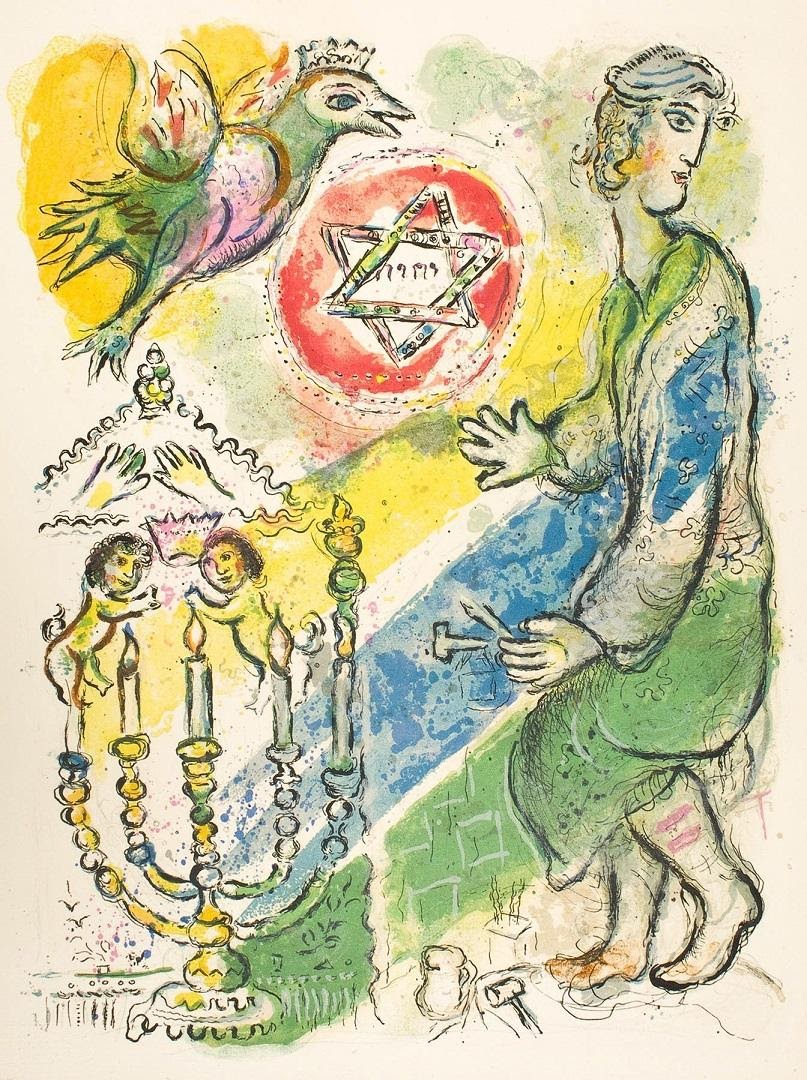
And God spoke to Moses, saying: “See, I have called by name Betzaleil son of Uri son of Chur of the tribe of Yehudah. And I have filled him with the spirit of God in wisdom and in insight and in knowledge, and in every craft.” (Exodus/Shemot 31:1-3)
Betzaleil (בְּצַלְאֵל) = In the shadow of God. (Be-, בְּ = in, at, by, with + tzeil,צֵל = shadow, shade + eil, אֵל = God, a god.)
When Moses comes back down from the mountaintop in last week’s Torah portion, Ki Tisa, he has to deal with the Golden Calf. Then he returns to the summit for another 40 days. This time he learns more about God’s character and gets replacement stone tablets.1 After he comes back down from this second stint, he finally gets to communicate God’s instructions for the sanctuary and the priests’ vestments to the people in this week’s Torah portion, Vayakheil (Exodus 35:1-38:20).
Moses calls for donations of the materials, and for artisans who are skilled in woodworking, metalworking, weaving, and jewelry-making. The donations pour in, and plenty of male and female artisans volunteer to do the work. Before they begin, Moses appoints the supervisor and master craftsman that God had named.
And Moses said to the Israelites: “See, God has called by name Betzaleil son of Uri son of Chur of the tribe of Yehudah, and has filled him with the spirit of God in wisdom, in insight, and in knowledge, and in every craft—to invent designs to make in gold and in silver and in copper; and in preparing stones for setting and in preparing wood for making; and in every craft of designing. And to give instructions …” (Exodus 35:30-34)
Both God and Moses begin talking about Betzaleil by using the imperative “See!” Everyone can see that Betzaleil is an inspired artist and designer, so it is easy to believe God has singled him out or “called him by name”.
And his name is appropriate for his mission. The name Betzaleil means “In the shadow of God”, but what does it mean to be, or to create, in God’s shadow?
Shadows in English and Hebrew
The Hebrew word tzeil (and its variant tzeilel, צֵלֶל) and the English word “shadow” have the same literal meaning: the dark area cast on a surface by an object between a light source (such as the sun) and that surface. Tzeil can also mean “shade”, which is another description of shadow in English
But when these words are used metaphorically, they have a different sense in English than in Biblical Hebrew. A shadow is usually attached to the spot where the person or thing that casts it touches the ground. (Shadows of birds and other airborne objects are the exception.) So in English, shadowing a person is following their every move.
In English, a shadow is also less noticeable or less significant than the person casting it. Being in someone’s shadow means going unnoticed. The shadow side of a person or institution is the unacknowledged, unconscious, or repressed side. People who have lost status, size, or ability are called shadows of their former selves.
In the Hebrew Bible, the word tzeil or tzeilel appears 51 times. It is used literally 17 times, as a metaphor for concealment and refuge 7 times (perhaps because it is harder to spot someone in dark shade), and as a metaphor for time stretching out like a shadow 3 times.
The word is also used in two ways that relate to Betzaleil’s name: 19 times as a metaphor for protection, and 5 times as a metaphor for transience.
Shade as protection
Those of us who live in more moderate climates might not think of shade or a shadow as protection, but in the deserts of the Ancient Near East shade meant protection from the burning sun and the risk of dehydration.
The first time tzeil appears is in Genesis, when Lot begs the men of Sodom not to sexually molest his two visitors:
“Hey, please, I have two daughters who have not known a man. Please let me bring them out to you, and you may do to them whatever is good in your eyes. Only don’t do a thing to these men, because they came into the tzeil of my roof!” (Genesis 19:8)
Here “the tzeil of my roof”, literally “the shade of my roof”, really means “under my protection”. Once Lot has offered the visitors the hospitality of his house, he feels honor-bound to protect them from the mob as long as they stay with him.
The word tzeil also indicates protection by a king, government, city, or nation. And it is used for protection by God. For example:
          God is your guardian;
          God is your tzeil at your right hand. (Psalm 121:5)
Since Betzaleil is “in the shadow of God”, God protects and shelters him. His inspiration for designing all the holy objects and his ability to instruct others come from the spirit of God, and therefore everything will come out right.
Shadow as transience
When the Hebrew Bible comments on the brevity of human life, it often compares humans with grass that sprouts up and then withers. But comparing humans with shadows is even more telling, since shadows outside vanish daily at nightfall, and shadows inside disappear into darkness the moment a lamp is snuffed out. Here is one example:
          A human, like a puff of air, comes to an end;
          His days, like a tzeil, pass by. (Psalm 144:4)
Since Betzaleil is human, his life is very short compared to God’s. By extension, Betzeleil’s creations, however beautiful and holy, are mere passing shadows compared to God’s creations.
Shadows and images
A literal shadow is like a silhouette; you see the outline of the original, but none of the details or colors. Similarly, the Hebrew word tzelem, which usually means image but can also mean “shadow”, has less reality than the original object. The word tzelem may well be related to the word tzeil. It appears in the first account of God’s creation of the universe:
And God said: Let us make humankind betzalmeinu, in our likeness, and they will rule over the fish of the sea and over the birds of the heavens and over the beasts, and over all the land, and over all creepers that creep on the land. (Genesis 1:26)
betzalmeinu (בְּצַלְמֵנוּ) = in our image. (Be-, בְּ = in, at, by, with + tzelem, צֶלֶם, = image, model, statute, shadow, something shadowy (without substance) + einu, ֵנוּ = our.)
One of the ways humans are shadows or images of God is that we have secondary creative powers. We cannot create a universe, but we can recombine existing elements to create new things within our universe. We cannot create life, but we can create beauty. When we humans are at our best, when we are inspired to create, like Betzaleil, we imitate or shadow the divine.
The entire work of art that served as the portable sanctuary, expanded later into the temple, inspired the children of Israel to keep returning to their God over the centuries. It kept their religion alive until it could metamorphose and survive without a temple.
We humans have more creative power than we think, for good and for ill. May we use it wisely.
- See my post Vayakheil & Ki Tisa: Second Chance.

 Questioning Torah
One thought on “Vayakheil: Shadow Creator”