Two kinds of rituals based on washing with water appear in God’s instructions to Moses about the new sanctuary and priesthood for the Israelites. One is immersion in water for ritual purification; the other is washing hands and feet as either an act of reverence or a form of sanctification.
Immersion in Tetzaveh
In this week’s Torah portion, Tetzaveh (Exodus 27:20-30:10), God tells Moses to purify the new priests by washing their whole bodies in water.
The instructions for consecrating Aaron and his sons as the first priests of the Israelites begin with some preparations before the ceremony begins. Moses must bring a bull, two rams, and a basket with three kinds of unleavened bread to the area in front of the new Tent of Meeting. Then, God says:
“And you will bring forward Aaron and his sons to the entrance of the Tent of Meeting, verachatzta them with water.” (Exodus 29:4)
verachatzta (וְרָחַצתָּ) = and you will wash. (Also a conjugation of the verb rachatz.)
Washing Aaron and his sons in water is the first step to prepare them for consecration as priests. The next step is to dress them in their vestments, the uniforms of priesthood that the Israelites are going to make out of precious materials.
“Then you will take the clothing, and you will dress Aaron in the tunic …” (Exodus 29:5)
The text is too polite to say so, but Aaron and his four sons must undress before Moses can wash and dress them. The implication is that their entire bodies will be washed, not just their hands and feet.
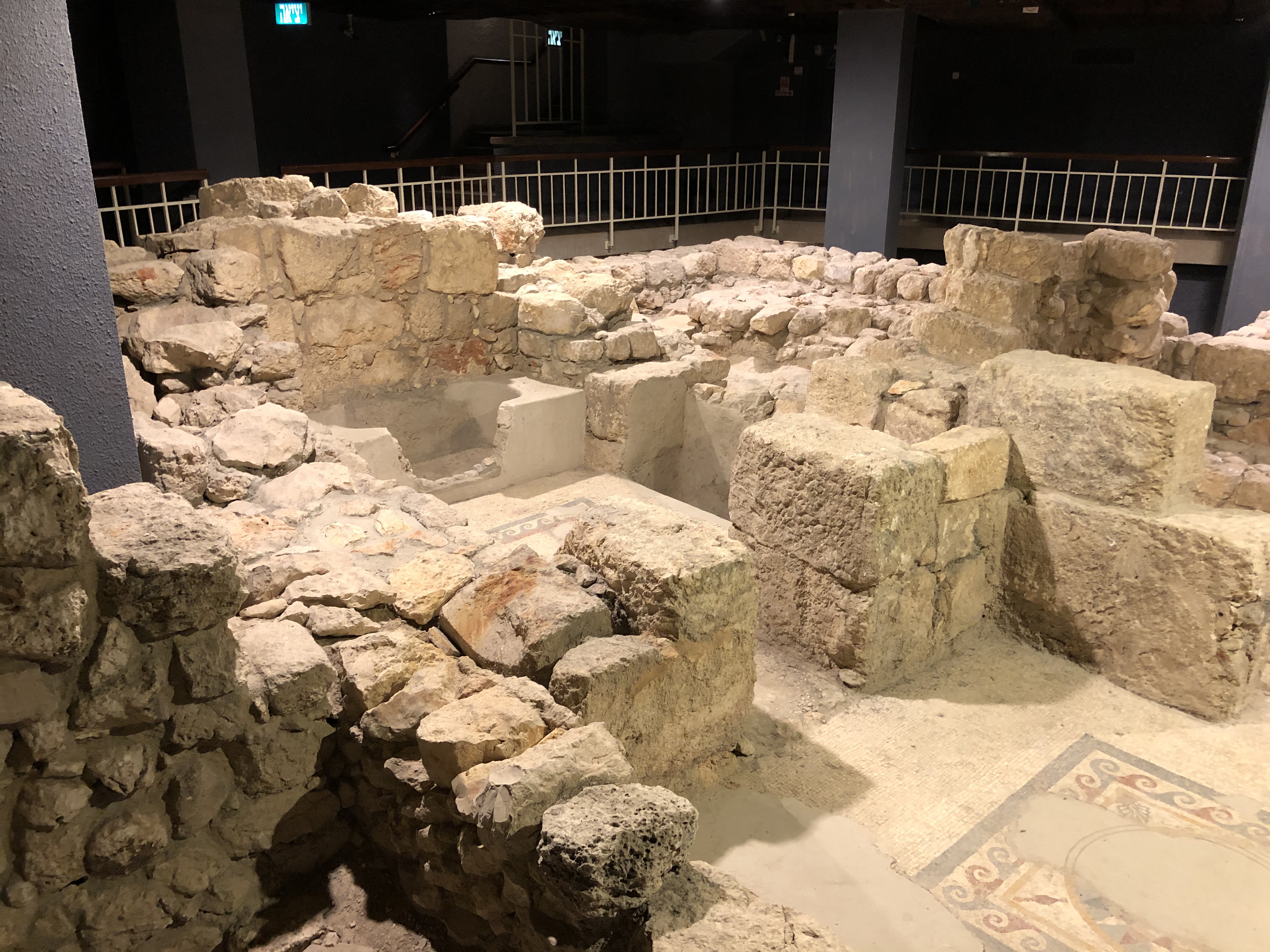
Jerusalem (photo by M.C.)
As early as the 2nd century C.E.,1 the ritual washing in this week’s Torah portion was identified with immersion in a mikveh, a pool of water fed by gravity from “living water”, i.e. a spring or a cistern filled with rain. Archaeologists have found these pools throughout Judea dating to the period the second temple stood in Jerusalem, 515 B.C.E.-70 C.E.. Many Jews today still use a mikveh for certain kinds of ritual purification.
Why does immersion in living water get rid of ritual impurity? 19th-century Rabbi Samson Raphael Hirsch noted that before God created the earth, there was water.
… and darkness was over the face of the depths, and a wind of God hovered over the face of the water. (Genesis 1:2)
He added that according to the Babylonian Talmud tractate Kelim, vessels made from parts of aquatic creatures cannot become ritually impure, and combining these two concepts, he concluded:
“Thus, immersion in water symbolizes complete departure from the human realm, the realm subject to tumah, and restoration to the original condition. Immersion removes man from his past connections and opens up for his future a new life of taharah. Through this immersion, Moses—as the nation’s highest representative—elevates Aharon and his sons, who are to be consecrated as priests, and removes them from their past connections.”2
Only after Aaron and his sons have been ritually purified by water can Moses proceed with their consecration, which includes anointing Aaron as the high priest by pouring olive oil over his head,3 and dedicating him and his sons to their new positions by daubing ram’s blood on their ears, thumbs, and toes.4
Washing hands and feet in Ki Tisa
The instructions for the new sanctuary and its priests continue in next week’s Torah portion, Ki Tisa (Exodus 30:11-34:35)—until God gives Moses the pair of stone tablets, which Moses smashes when he comes down from Mount Sinai and sees the people worshiping a golden calf.

wash-basin by
Temple Institute
And God spoke to Moses, saying: “You will make a wash-basin of bronze lerachtzah, and its stand of bronze. And you will place it between the Tent of Meeting and the altar, and you will put water there. Verachtzu, Aaron and his sons, their hands and their feet in it. When they are coming into the Tent of Meeting, yirchatzu with water, and they will not die. Or when they come up to the altar to attend to turning a fire-offering to God into smoke, yirchatzu their hands and their feet, and they will not die.” (Exodus 30:17-21)
lerachtzah (לְרָחְצָה) = for washing. (Also from the verb rachatz.)
verachtzu (וְרָחֲצוּ) = and they will wash. (Another conjugation of the verb rachatz.)
yirchatzu (יִרְחֲצוּ) = they must wash. (Ditto.)
Why do the priests only need to wash their hands and feet before entering the sanctuary tent or serving at the altar? And why would they die if they did not perform these ablutions?
Washing in water from the basin5 is not entirely symbolic. As Ramban pointed out in the 13th century,
“This washing was out of reverence for Him Who is on high, for whoever approaches the King’s table to serve, or to touch the portion of the king’s food, and of the wine which he drinks, washes his hands, because “hands are busy” [touching unclean things automatically]. In addition He prescribed here the washing of feet because the priests performed the Service barefooted, and there are some people who have impurities and dirt on their feet.” 6
But Ramban also noted that washing one’s hands before serving a king expresses deep respect or reverence:
“It is on the basis of the idea of this commandment that our Rabbis have instituted the washing of hands before prayer, in order that one should direct one’s thoughts to this matter.”6
Later Jewish commentators added that while immersion in water results in ritual purification (taharah), washing hands and feet before serving God is an act of sanctification—like dressing in the vestments for priests, or donning a tallit and tefillin before praying for Jews in the last two millennia.
“Purification involves the removal of a negative, impure element … whereas sanctification implies a spiritual elevation of an unworthy person or thing to the level required for the holy service of God.” (Elie Munk)7
So God’s instructions to Moses for the establishment of a religion with a sanctuary, priests, and procedures for worship include two kinds of washing in water: ritual purification through immersion before a new priest is consecrated, and sanctifying hands and feet by rinsing them before serving God.
I have not been in a mikveh for years. I used to have Shabbat dinner with observant Jewish friends, and say the whole series of blessings before eating, each one accompanied by an action. In between blessing and sipping the wine, and blessing and tasting the bread, was a ritual hand-washing: pouring water three times over each hand, then raising both hands and reciting the blessing that can be literally translated as: “Blessed are you, God, our God, Ruler of the Universe, who had sanctified us with commandments and commanded us about elevating hands.” Now I only do that on Passover.
The old reasons for water rituals no longer seem compelling to me. Yet when I have been exposed to a person shouting ugly things, I wish I could purify myself. And when I am about to teach or speak in public, I wish I could sanctify myself so my speech will be worthy.
I need new ways of performing ritual washing.
- Targum Jonathan, a 2nd-century translation of the Hebrew Bible into Aramaic, says Moses will wash them, and adds “in four measures of living water”.
- Samson Raphael Hirsch, The Hirsch Chumash: Sefer Shemos, translated by Daniel Haberman, Feldheim Publishers, Jerusalem, 2005, p. 680.
- Exodus 29:7.
- Exodus 29:19.
- In the second temple, the wash-basin had spigots. Since the bible does not mention a jug for dipping water out of the basin, and the basin was elevated by a stand, the basin in Exodus probably has spigots as well.
- Ramban (Rabbi Moshe ben Nachman) on Exodus 30:19, The William Davidson Edition translation, in www.sefaria.org.
- Rabbi Elie Munk, The Call of the Torah: Bereishis, Mesorah Publications, Rahway, N.J., 1994, p. 431.

 Questioning Torah