How did the Ten Commandments get into the two accounts of the revelation at Mount Sinai?
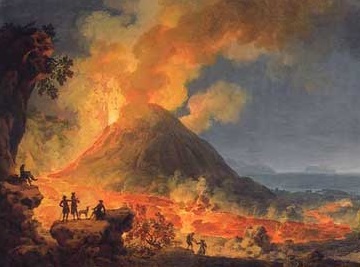
by Pierre-Jacques Volaire, 1774,
detail
In last week’s Torah portion, Yitro (Exodus 18:1-20:23), God manifests on the mountain as fire, smoke, thunderclaps, and horn blasts. The Israelites are terrified.
The story of this epiphany is interrupted by what we call the “Ten Commandments” or Decalogue. When the narrative resumes, God’s manifestation is intensifying, and the people experience synesthesia, SEEING the sounds of thunder and horns.
And they said to Moses: “You speak to us, and we will listen. But may God not speak to us, or else we will die!” (Exodus/Shemot 20:16)
In other words, the people have not heard God delivering the words of the Decalogue. They are afraid of any communication from God, especially in words. So they beg Moses to speak for God. (See my post Yitro & Va-etchanan: Whose Words?—Part 1.)
And the people stood at a distance, and Moses approached the dark cloud where God was. And God said to Moses: “Thus you will say to the Israelites …” (Exodus 20:18-19)
Then God tells Moses a long series of civil and religious laws on a variety of specific topics, a law code that runs from Exodus 20:19 through 23:33.
So why is the story interrupted by the Decalogue?
A later insertion
According to modern source criticism, the Decalogue was written in a different style and vocabulary than the text before and after it, and therefore that section was inserted later by a redactor.
The story does read smoothly if the Decalogue section, Exodus 20:1-14, is simply deleted. Then we have:
And God said to [Moses]: “Go down! Then you may come up, you and Aaron with you; but the priests and the people may not break through to come up to God, lest [God] burst out against them.” Then Moses went down to the people, and he spoke to them. (Exodus 19:24-25)
Then all the people were SEEING the kolot and the flames and the kol of the horn and the mountain smoking. When the people saw, they were shaken and they stood at a distance. And they said to Moses: “You speak to us, and we will listen. But may God not speak to us, or else we will die!” (Exodus 20:15-16)
kolot ( קֺלֺת or קוֹלוֹת) = thunderclaps.
kol (קֺל or קוֹל) = a noise, sound, voice.
Moses goes back up the mountain, where God gives him the law code in Exodus 20:20-23:33.
If a redactor inserted the Decalogue into Exodus, where did that text come from?
Ambiguity in Deuteronomy
The only other place in the Torah where the Decalogue appear is in Deuteronomy, the book in which Moses tells the next generation of Israelites what he remembers of the exodus from Egypt. Moses introduces the Decalogue in the Torah portion Va-ethchanan (Deuteronomy 3:23-7:11) by saying:
Face to face God spoke with you on the mountain, from the midst of the fire—I myself stood between God and you at that time to tell you the words of God, since you were afraid in the face of the fire, and you did not go up the mountain—saying: (Deuteronomy/Devarim 5:4-5)
The Decalogue follows. In this account, God speaks and Moses either repeats God’s words, or translates God’s communication into words.
The Decalogue in Deuteronomy is similar, though not identical, to the version in the book of Exodus; the biggest difference is the rationale for the commandment about Shabbat.1 After reciting the commandments, Moses says:

by Ephraim Moshe Lilien, 1908
These words God spoke to the whole assembly on the mountain, from the midst of the fire, the cloud, and the dark cloud, a great kol, and did not add more. And [God] wrote them on two stone tablets, and gave them to me. (Deuteronomy 5:19-20)
This sounds as if Moses remembers God speaking all the words of the Decalogue to the Israelites, and identifies them as the text on the stone tablets. (Exodus describes Moses coming down from Mount Sinai with two stone tablets that God had inscribed, but that book never says what God wrote.2 After Moses smashes the two tablets at the sight of people celebrating the Golden Calf, God tells Moses to prepare a second pair of tablets. The commandments Moses writes down on these stones include two of the “Ten Commandments” (on idols and Chabbat), but also command observing three annual holidays, redeeming or sacrificing firstborn livestock, and not boiling a kid in its mother’s milk.3)
No matter what was written later on the stone tablets, did the Israelites really hear God speaking the whole Decalogue? After reporting that God inscribed those words on the tablets, Moses says:
And it happened that you heard the kol from the midst of the darkness, and the mountain was blazing with fire, and you came up to me, all the heads of your tribes and your elders. And you said: “Hey! God, our God, has shown us his impressiveness and greatness, and his kol we heard from the midst of the fire! This day we have seen that God spoke and humans lived. And now, why should we die because this great fire consumes us? If we ourselves listen to his lips, the kol of God, our God, any more, then we will die! … You go closer and listen to everything that God, our God, says, and then you speak to us everything that God, our God, spoke to you, and we will listen and do it.” (Deuteronomy 5:21-24)
Moses says that God agreed, and then moves on to his next topic. In Moses’ account in Deuteronomy, the Israelites heard God’s kol, i.e. the sound or voice of God. But, as in Exodus, they begged Moses to tell them what God said, so they could avoid hearing God speak in words.
The mysterious source of the Decalogue
In the portion Yitro in Exodus, the transition to the Decalogue is ambiguous, so we do not know whether Moses pronounced them to the Israelites at Mount Sinai. In the portion Va-etchanan in Deuteronomy, the Israelites do not hear God’s words, but Moses does pass on the Decalogue at the mountain.
However, twenty-first century commentator Cynthia Edenburg argued that a redactor spliced the Decalogue into Deuteronomy as well as Exodus.
“In neither … does YHWH indicate that part of the event will be the revelation of laws to the people of Israel. And, indeed, when the day arrives, the text focuses its description on the impressive visual and auditory elements of the theophany.”4
In the first two or three commandments (including the prohibitions against “having” other gods or idols) in both Exodus and Deuteronomy, God speaks in the first person. Then starting with the third commandment (on swearing falsely by God’s name), God is referred to in the third person. The Talmud explained the switch by saying that the Israelites heard only the first two commandments before they begged Moses to be the go-between.5
But Edenberg pointed out that neither text indicates an interruption in the transmission of the Decalogue. The style of the writing in the first few commandments matches much of the book of Deuteronomy, so the redactor of Exodus could have borrowed them from Deuteronomy. But then where did the rest of the commandments come from?
Edenberg, citing the work of Erhard Gerstenberger,6 proposed:
“The basic form of the Decalogue as we now know it came into being as scribes attempted to reinterpret the essence of the Sinai/Horeb revelations in Exodus and Deuteronomy. They accomplished this by adding the YHWH commands now found at the beginning of the Decalogue to a list of moral instructions of universal validity, transforming it into a theological statement of principles for one group—Israel. The rules were now presented as a foundational agreement between Israel and their national god, established in the wilderness period.”4
Jews who insist that God dictated every word of the books of Genesis through Deuteronomy—along with everyone who insists that the entire bible is the word of God—have to either overlook the bad transitions and contradictory passages, or resort to forced explanations. I cannot help but believe that the bible has many authors. When possible, I prefer to trust the redactor of a biblical book, and read it as a complete work. But sometimes the seams show too much.
We can notice where the Decalogue is stitched into Exodus and Deuteronomy. We can agree that the first commandments, about our relationship to God, come from a different source than the remaining commandments, about our relationship with other humans.
But none of this reduces the importance of the commandments. Other lists of laws in the Torah are more specific, narrower in scope. Many were suited to ancient Israelite society, but not to our lives today. The Decalogue, on the other hand, presents basic, general rules that still deserve our attention.
- Exodus says “Because in six days God made the heavens and the earth and the sea and all that is in them, and [God] rested on the seventh day; therefore God blessed the day of Shabbat and made it holy” while Deuteronomy says “so that your male slave and your female slave may rest as you do; and remember that you were a slave in the land of Egypt and God, your God, brought you out from there with a strong hand and an outstretched arm; therefore God, your God, has commanded you to do the day of the Shabbat”. (Additionally, the commandment in Exodus begins “Remember the day of the Shabbat” while in Deuteronomy it begins “Observe the day of the Shabbat”.)
- They are called “two tablets of the eidut (pact, written witness)” in Exodus 31:18 and 32:15. Exodus 34:28 reports that “he” (either God or Moses) wrote on the second pair of tablets “the words of the covenant, the ten words”. The Torah does not say what the “ten words” are. Later commentators declared they were the commandments in the portion Yitro, and since then people have labored to turn the information in the Decalogue into exactly ten commandments.
- Exodus 34:17-28.
- Dr. Cynthia Edenberg, “The Origins of the Decalogue”, https://www.thetorah.com/article/the-origins-of-the-decalogue.
- Talmud Bavli, Makkot 23b-24a.
- Erhard S. Gerstenberger, “Covenant and Commandment,” Journal of Biblical Literature 84 (1965): 38–51.

 Questioning Torah
2 thoughts on “Yitro & Va-etchanan: Whose Words?—Part 2”