Moses often hears God talking to him. It begins when God speaks to him out of the burning bush on Mount Sinai:
“Moses! Moses! … Do not come closer! Remove your sandals from upon your feet, because the place where you are standing, it is holy ground.” (Exodus/Shemot 3:4-5)
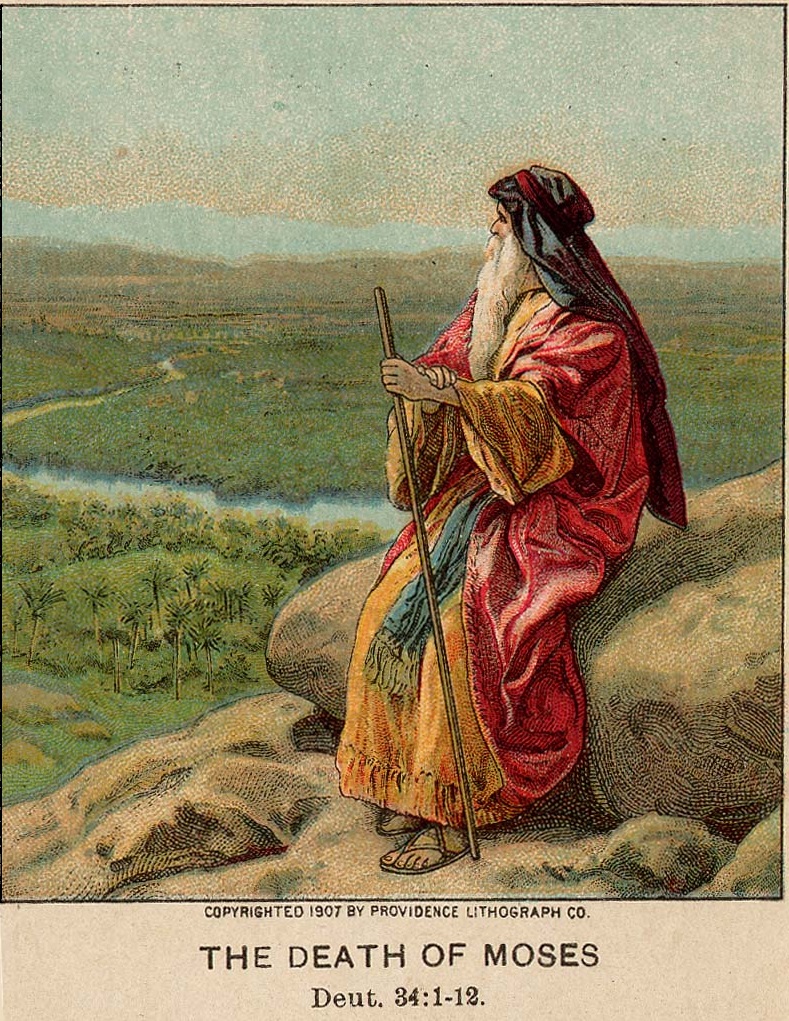
Lithograph Co. 1907
(Still listening to God)
And it ends with God’s final words before Moses dies on Mount Nevo overlooking Canaan:
“This is the land that I vowed to Abraham, to Isaac, and to Jacob, saying: ‘To your descendants I will give it.’ I have let you see it with your eyes, but you will not cross over there.” (Deuteronomy 34:4)
For roughly 41 years in between,1 the private conversations between God and Moses continue, and God also uses Moses as a middleman. Over and over again, God speaks to Moses and gives him new information or instructions, and then Moses passes God’s words on to the Israelites.
Moses’ brother, Aaron, only hears God speak 18 times.2 God speaks only once to their sister, Miriam, and once to Aaron’s son Elazar.3
The other Israelites hear God once, in this week’s Torah portion, Yitro (Exodus 18:1-20:23). Following God’s instructions (and God’s pillar of cloud and fire),4 Moses leads the refugees from Egypt to Mount Sinai before heading north toward Canaan. After they reach the mountain, God tells Moses:
“Here I am, coming to you in a thick canopy of cloud, so that the people will hear my words along with you, and also [so that] they will trust in you forever.” (Exodus 19:9)
Nevertheless, the Israelites may not hear God speaking in words, the way God speaks to Moses and his brother, sister, and nephew.
The voice of God: thunderclaps and horn blasts
And it was morning on the third day, and there were kolot and lightning flashes, and a heavy cloud over the mountain, and a very strong kol of a shofar; and all the people who were in the camp trembled. (Exodus 19:16)
kolot ( קֺלֺתor קוֹלוֹת) = thunderclaps. (Singular kol (קֺל or קוֹל) = a noise, sound, voice.)
shofar (שֺׁפָר) = a loud wind instrument made from the horn of a ram or goat.
Moses leads the people out of the camp and stations them at the foot of the small mountain, which resembles an erupting volcano.

by Jacob More, 1780 (detail)
And Mount Sinai was smoking, all of it, from the presence of God that had come down upon it in fire. Its smoke rose like the smoke of a furnace, and the whole mountain trembled very much. And the kol of the shofar went on and was very strong. Moses would speak, and God would answer him with a kol. And God came down on Mount Sinai, to the top of the mountain, and God called Moses to the top of the mountain, and Moses went up. (Exodus 19:18-20)
So far, the people at the foot of the mountain have heard no words, only sounds like thunder and horns. When Moses climbs to the top of the mountain, he and God have a brief conversation about whether the people below are standing far enough away for safety.
An ambiguous transition
And God said to [Moses]: “Go down! Then you may come up, you and Aaron with you; but the priests and the people may not break through to come up to God, lest [God] burst out against them.” Then Moses went down to the people, vayomer to them … (Exodus 19:24-25)
vayomer (וַיֺּמֶר) = and he said. (Less frequently, when there is no object of the verb, vayomer = and he spoke.)
Should vayomer be translated here as “and he spoke”, implying that Moses passed on God’s instructions in the previous verse about who was allowed to climb the mountain? Or should it be translated as “and he said”, implying that the next verse is what Moses said? The answer determines whether the punctuation after “to them” should be a period or a colon.
The next verse is:
Vaydabeir, God, all these words, saying: (Exodus 20:1)
vaydabeir (וַיְדַבֵּר) = and he spoke.
“All these words” turn out to be the basic rules known as the “Ten Commandments” or Decalogue.
So what is the correct punctuation at the end of “Then Moses went down to the people, vayomer to them”—a period or a colon?
The only punctuation in Biblical Hebrew is a sof passuk (which looks like a colon) at the end of a verse. These punctuation marks were added by the Masoretes about a thousand years ago—thus defining the verses, though not assigning any numbers to them. A sof passuk can be translated as a period, a colon, an exclamation point, a question mark, or even a dash.
In the 16th century, Christian bibles began dividing the text into chapters and numbering the verses in each chapter. Jewish bibles adopted their convenient system.
Exodus 19:25 could end with a colon. But since the next verse was assigned the number 20:1, starting a new chapter, most translations end Exodus 19:25 with a period. And because of the period, vayomer is translated as “and he spoke” instead of “and he said”.
The effect of translating vayomer as “and he spoke”, followed by a period and a chapter break, is to make it sound as if first Moses speaks, reminding the people not to climb the mountain, and then God speaks, telling the people the basic commandments.
But what if there were no chapter break after “Then Moses went down to the people, vayomer to them”? And what if the sof pasuk, the punctuation after this clause, were translated as a colon? Then we would have:
Then Moses went down to the people, and he said to them: “God spoke all these words, saying: I am God, your God who brought you out from the land of Egypt, the house of slavery. You will have no other gods before me.” (Exodus 19:25-20:2)
In this version, Moses tells the people the Decalogue, quoting what he heard God say at some unspecified earlier time.
I was attached to this alternative translation, until I started wondering if the Israelites at Mount Sinai heard the words of the Decalogue at all.
Back to the story
Immediately after the tenth commandment, the one about coveting, the Torah returns to the narrative:
Then all the people were seeing the kolot and the flames and the kol of the shofar and the mountain smoking. When the people saw, they were shaken and they stood at a distance. (Exodus 20:15)
In this description the Israelites are not hearing God speak words. They are experiencing synesthesia, seeing the sounds of thunderclaps and horn blasts along with the flames and smoke.
And they said to Moses: “You speak to us, and we will listen. But may God not speak to us, or else we will die!” (Exodus 20:16)
Here the people only know they are afraid of any communication from God, and they beg Moses to speak for God. Therefore they have not yet heard the Decalogue from either God or Moses.
And the people stood at a distance, and Moses approached the dark cloud where God was. And God said to Moses: “Thus you shall say to the Israelites: You yourselves saw that I spoke with you from the heavens. You must not make me silver gods or gold gods; you must not make them for yourselves. You must make me an altar of earth, and slaughter on it your rising-offerings …” (Exodus 20:18-19)
After a few more instructions about sacrifices at the altar, God goes on (in the next Torah portion, Mishpatim) to lay out a long series of civil and religious laws on a variety of specific topics. These are the rules God tells Moses to pass on to the Israelites.
So how did the Decalogue get into the Exodus account of the revelation at Mount Sinai?
See my next post, Yitro & Va-etchanan: Whose Words?—Part 2.
- The book of Exodus does not say how much time passes between Moses’ return to Egypt and the departure of all the Israelites for their 40-year journey to Canaan. If all of God’s ten plagues occur during the year preceding their departure, the story is more dramatic and the pressure on Pharaoh is more intense.
- To Aaron alone in Exodus 4:27, Leviticus 10:8-11, and Numbers 18:1-24; to Aaron and Miriam in Numbers 12:5-8; and to Aaron and Moses in Exodus 7:8, 9:8, 12:1-20, and 12:43-49, in Leviticus 11:1-47, 13:1-59, 14:33-57, and 15:1-32, and in Numbers 2:1-2, 4:1-20, 14:26-38, 16:20-22, 19:1-22, and 20:12.
- To Miriam in Numbers 12:5-8, and to Elazar in Numbers 26:1-2.
- See my post Beshalach: Pillar of Cloud and Fire.

 Questioning Torah
2 thoughts on “Yitro & Va-etchanan: Whose Words?—Part 1”