Pharaoh thinks his army of charioteers has trapped the Israelites on the shore of the Reed Sea. The Israelites think they are going to die. Then God splits the water long enough for them cross over on dry ground, and for the Egyptians to follow them onto the sea bed. At that point in this week’s Torah portion, Beshalach (Exodus 13:17-17:16), the water rushes back, and all the Egyptians drown.
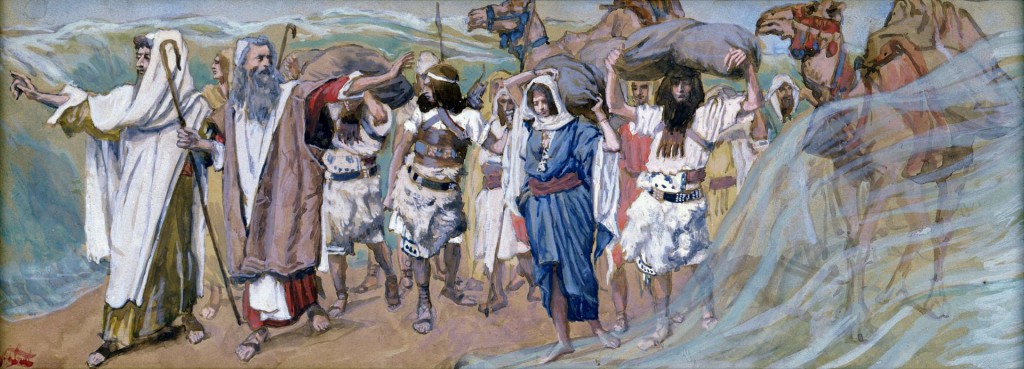
The Israelites saw the Egyptians dead on the shore of the sea. And the Israelites saw the great power that God had used against the Egyptians, and the people feared God … and they trusted in God and in God’s servant, Moses. That was when Moses and the Israelites sang this song to God. (Exodus 14:30-15:1)
The 18-verse “Song of the Sea” that follows may be the oldest text in the bible; Hebrew scholars date it to roughly 1100 B.C.E. (The rest of the book of Exodus, judging by the language, was written well after 900 B.C.E.) The song differs from the prose account leading up to it, but it does include descriptions of God drowning an army of Egyptian chariots.
This is the first time anyone sings in the bible, as well as the first time a human character addresses God with words of praise (instead of pleading or questions).
In the first part of the “Song of the Sea”, verses 4-10 describe God drowning the Egyptian charioteers (with no mention of Moses). In the second part, verses 14-16 describe the fear of the surrounding kingdoms when they hear about it (a theme that is premature at this point in the Exodus story). In between these two themes, there is a verse that Jews still sing at every morning and evening service:
Mi khamokhah ba-eilim, Adonai!
Mi kamokhah, nedar bakodesh,
Nora tehilot, oseh feleh!

  Who is like you among the eilim, Y-H-V-H!
  Who is like you, majestic in holiness,
  Too nora for praises, doing wonders! (Exodus 15:11)
eilim (אֵלִם) = Plural of eil (אֵל) = a god; the name of the father god in Canaanite mythology; a title of the God of Israel.
nora (נוֹרָא) = feared, fearsome, awesome. (A form of the verb yareh, יָרֵא = fear, be afraid.)
The verse beginning “Mi khamokhah” (often transliterated as mi chamocha) certainly counts as praising God. But what kind of praise is this, comparing God to other gods? Or saying that God is too fearsome to praise? In the book of Exodus, the Israelites who travel from Egypt to Canaan believe that there were many gods, all inhuman and frightening, and the best they could hope for was that their own God was the most powerful, and would help them—if not for their own sake, for the sake of God’s reputation. The straightforward translations of eilim as “gods” and nora as “feared” or “fearsome” match their point of view.
Nobody is like you
The Song of the Sea is not the only biblical text that contain references to other gods—usually serving under the God of Israel, who is the supreme creator and judge. The idea appears in the books of Genesis, Exodus, Psalms, and Job. (See my posts Yitro & Psalms 29, 82, & 97: Greater Than Other Gods and Bereishit: How Many Gods?)
However, two biblical books, Deuteronomy and Isaiah, present clear statements of monotheism.1 For example, God says:
And there are no gods [elohim] except for Me. (Isaiah 44:6)
Because I am Eil, and there is no other. (Isaiah 45:22)
Jewish theology was almost exclusively monotheistic by the first century C.E., when Philo of Alexandria, a Jewish Platonist, analyzed the Hebrew Bible and rabbinic laws in terms of Greek philosophical categories. Philo dealt with archaic ideas in the bible, such as an anthropomorphic god and references to other gods, by explaining that they were allegorical.
But Talmudic and medieval commentators were more attached to taking the bible literally. They strained to find alternate interpretations for the scattered references to other gods, including the comparison between God and the eilim in the Song of the Sea.
One ploy was to treat the word eilim (אֵלִם) as if it were a misspelling of the Hebrew word ilam (אִלָּם) = mute, unable to speak. This was a legitimate move, since the Hebrew in the bible was written without the diacritical marks commonly called vowel pointing until the Masoretic text was fixed in the 7th-10th centuries C.E. Theoretically, the Masoretes could have misinterpreted a word spelled simply אלם in the Torah scroll.
So the Talmud, extant around 500 C.E., reports:
“The school of Rabbi Yishmael taught that the verse: “Who is like You, O Lord, among the gods” (Exodus 15:11), should be read as: ‘Who is like You among the mute’, for You conduct Yourself like a mute and remain silent in the face of Your blasphemers.” (Talmud Bavli, Gittin 56b)2

Rashi (11th-century Rabbi Shlomoh Yitzchaki) went farther afield when he suggested reading eilim (אֵלִם) as its homophone eilim (אֵילִים), which is the plural of ayil (אַיִל) = ram; metaphorically, a powerful man or a mighty tree.
“באלם means ‘amongst the mighty’, just as (Ezekiel 17:13) ‘and the mighty of (אילי) the land he took away’.” (Rashi)2
Other rabbis chose to consider the eilim angels, i.e. celestial beings who have no existence apart from God. Ramban (13th-century Rabbi Moshe ben Nachman) wrote that “among the eilim” means “among those who serve before Thee in heaven”.2
An 18th-century commentator explained the events at the Sea of Reeds as a battle between the God of Israel and the guardian angel of Egypt:
“Israel describes that they had seen the guardian angel of Egypt die; hence they could say that absolutely no celestial force compares to the Lord our God.” (Or HaChayim)3
But in the 19th century, Rabbi Samson Raphel Hirsch identified the eilim as powerful natural forces:
“True, there are אֵלִם, active and effective forces in nature; but though men may worship them as gods, they are subject and bound by powerful bonds to the order You have ordained for them. You alone are free; You are not bound by the was of nature, the work of Your own hands.”4
The “Mi Khamokha” verse in modern prayerbooks is often translated so as not to raise questions about monotheism. Rashi’s proposal, “Who is like you among the mighty?” is a common translation. The traditional Artscroll Siddur goes with: “Who is like You among the heavenly powers?”
I like the approach in Rabbi David Zaslow’s prayerbook, Ivdu Et Hashem B’Simcha, which retains the literal definition of eilim as “gods” but adds a explanatory phrase: “Who is like you among the gods that are worshipped?”5
Too fearsome to praise
After the difficult question “Who is like you among the eilim?”, the rest of the verse extols God by saying:
Who is like you, majestic in holiness,
Too fearsome for praises, doing wonders! (Exodus 15:11)
A strictly literal translation of the phrase “Nora tehillot” would be “fearsome praises”, but the oldest Biblical Hebrew omits many of the connecting words we rely on in English. The consensus of translators is that the sense of the phrase is “too nora for praises”. But does the word nora (a past participle used as an adjective) carry its primary meaning of “feared” or “fearsome”? Or its secondary meaning of “treated with awe” or “awesome”?
Many medieval rabbis analyzed the phrase “Nora tehillot” in terms of being afraid of God.According to Rashi in the 11th century:
“Thou art an object of dread, so that people do not recount thy praises, fearing lest these may be enumerated less then they really are, just as it is written (Psalms 65:2) ‘To Thee, silence is praise’.”2
12th-century Rabbi Abraham ben Meir ibn Ezra added:
“However, they are obligated to praise Him because He alone does wonders.”2
In the 13th century, Ramban had another explanation for the use of the word nora:
“In my opinion, nora t’hilot means: “fearful with praises, for He does fearful things and He is praised for them, as when He wreaks vengeance on those who transgress His will, and thereby helps those who serve Him. Thus He is [both] feared and highly praised.” (Ramban)2
But in the 16th century, Rabbi Obadiah Sforno (who lived in Italy during the Renaissance) commented on the verse in terms of awe rather than fear.
“Anyone aware of the marvelous attributes of His cannot fail but recite these praises in awe, not because he is afraid of being punished but because the very nature of God inspires awe and reverence.”2
Yet in the 19th century, S.R. Hirsch wrote sternly:
“Songs of praise to God that do not lead to the fear of God, or that are even intended as substitutes for the fear of God, are nothing but a profanation of God’s Name.”6
Most modern prayerbooks translate nora (נוֹרָא) as “awesome”, rather than “feared” or “fearsome”, probably so as not to make God sound harsh and unloving.
I believe that literal translations of the Hebrew Bible reflect the viewpoint of the original authors, and are appropriate for everyone except readers who do not grasp concepts such as allegory or cultural history, and insist on taking every word in an English translation of the bible as a simple directive from God.
But in a Jewish prayerbook, literal translations of quotes from the bible are more problematic. Some readers are comfortable with the evolution of the religion, and can mentally adapt the ancient words—even while singing them—so that the prayer becomes worthy vehicle for their heartfelt feelings. For other readers, this approach seems unnatural, difficult, or contrary. Why should one sing or recite a prayer one does not believe in literally?
For these people, it might be better to adjust the translations of Hebrew words in prayers so as to avoid raising objections about whether there is only one God, or whether God is kind rather than frightening. Then they, too, might be able to use prayer to express gratitude for the wonders of creation.
- Deuteronomy 4:35, 10:14, and 32:39; Isaiah 37:16, 37:20, 41:4, 43:10-11, 44:6, 44:8, 45:5-6, 45:21-22, and 48:12. (Isaiah from chapter 40 on is called second Isaiah or Deutero-Isaiah, and was written in the 6th century C.E.)
- Translations from www.sefaria.org.
- Or HaChayim, by Rabbi Chayim ben Moshe ibn Attar, translation in www.sefaria.org.
- Samson Raphael Hirsch, The Hirsch Chumash: Sefer Shemot, translated by Daniel Haberman, Feldheim Publishers, Jerusalem, 2003, p. 247.
- Ivdu Et Hashem B’Simcha, compiled and edited by Rabbi David Zaslow, The Wisdom Exchange, 2010, pp. 81 and 82.
- Hirsch, ibid., p. 248.

 Questioning Torah