Moses hears God speak out of the burning bush on Mount Sinai, and learns that he must act as God’s prophet and lead the Israelites out of Egypt. He tries four times to get out of the job in this week’s Torah portion, Shemot (Exodus 1:1-6:1), and one of his efforts leads to God making his staff magical.
First Moses hints that he is not qualified, saying:
“Who am I, that I should go to Pharaoh and that I should bring the Israelites out from Egypt?” (Exodus 3:11)
Instead of saying why Moses meets the job qualifications, God replies:
“I will be with you, and this will be your sign I myself sent you.” (Exodus 3:12)
In other words, Moses will be frequently reminded that God sent him on this mission, because God will be present for him. As the story continues, God’s presence with Moses is indeed obvious, since God continues to speak to him.
Next Moses asks what name he should call God when he speaks to the Israelites, and God answers at length, giving him more information about his mission as well as about who God is. Then Moses makes his second protest:
“And if they do not believe me, and do not listen to my voice, but say: Y-H-V-H did not appear to you?” (Exodus 4:1)
This time God responds by showing Moses three “signs” he can perform in front of the Israelites to demonstrate that Y-H-V-H1 is with him. The first sign turns out to be the most important.
God said to him: “What is this in your hand?” And he said: “A mateh.” (Exodus 4:2)
mateh (מַטֶּה) = a shepherd’s staff; a staff serving as an official symbol of authority over a tribe or country; a tribe. (Plural: mattot, מַטּוֹת.)
Moses is holding a shepherd’s staff because he has just led his father-in-law’s flock through the wilderness all the way to Mount Sinai. But this is his last undertaking as a shepherd. After he returns to Egypt, Moses will use his staff to signal divine miracles. He will also become the leader of the thousands of Israelites who follow him out Egypt.
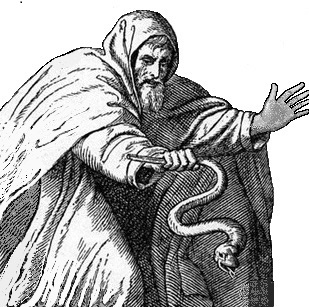
Now God demonstrates that Moses is no longer holding a mere shepherd’s staff.
Then (God) said: “Throw it to the ground.” So he threw it to the ground, and it became a nachash, and Moses fled from it. Then God said to Moses: “Reach out your hand and grasp it by its tail.” And he reached out his hand and took hold of it, and it became a mateh in his palm. (Exodus 4:3)
nachash (נָחָשׁ)= snake, serpent. (Words from the same root include the verb nichash, נִחַשׁ = practice divination, the noun nachash, נַחַשׁ = bewitchment, magic curse, and nechoshet, נְחֺשֶׁת = copper, copper alloy.)
Then God gives Moses two more signs for the Israelites. For the second sign, is he puts his hand into the fold at the bosom of his robe, and when he pulls it out his hand looks white and scaly. When he repeats the action, his hand returns to normal.2 For the third sign, God says, Moses will pour some water from the Nile on dry ground, and it will turn into blood.3
Once Moses has demonstrated the signs to the Israelites, God says, they will believe that God appeared to him.
Moses does perform all three signs in front of the elders of Israel when he arrives back in Egypt, and they believe he is God’s prophet.4 But the only one of these signs he uses in front of Pharaoh is the staff trick. (See next week’s post, Va-eira: Snake Staff, Part 2.)
But the three signs are not enough for Moses, who does not want to be a prophet in the first place. So he makes two more attempts to talk God out of giving him the job. He says he is a slow and clumsy speaker, but God promises to tell him what to say. Finally, Moses simply begs God to send someone else.5 God gets angry, then promises to appoint his brother Aaron to help him. And Moses resigns himself to returning to Egypt.
Moses’ staff could turn into anything surprising, and the transformation would prove that he is a channel for the miraculous power of God. So why does God choose a snake for this sign?
Snake as deceiver
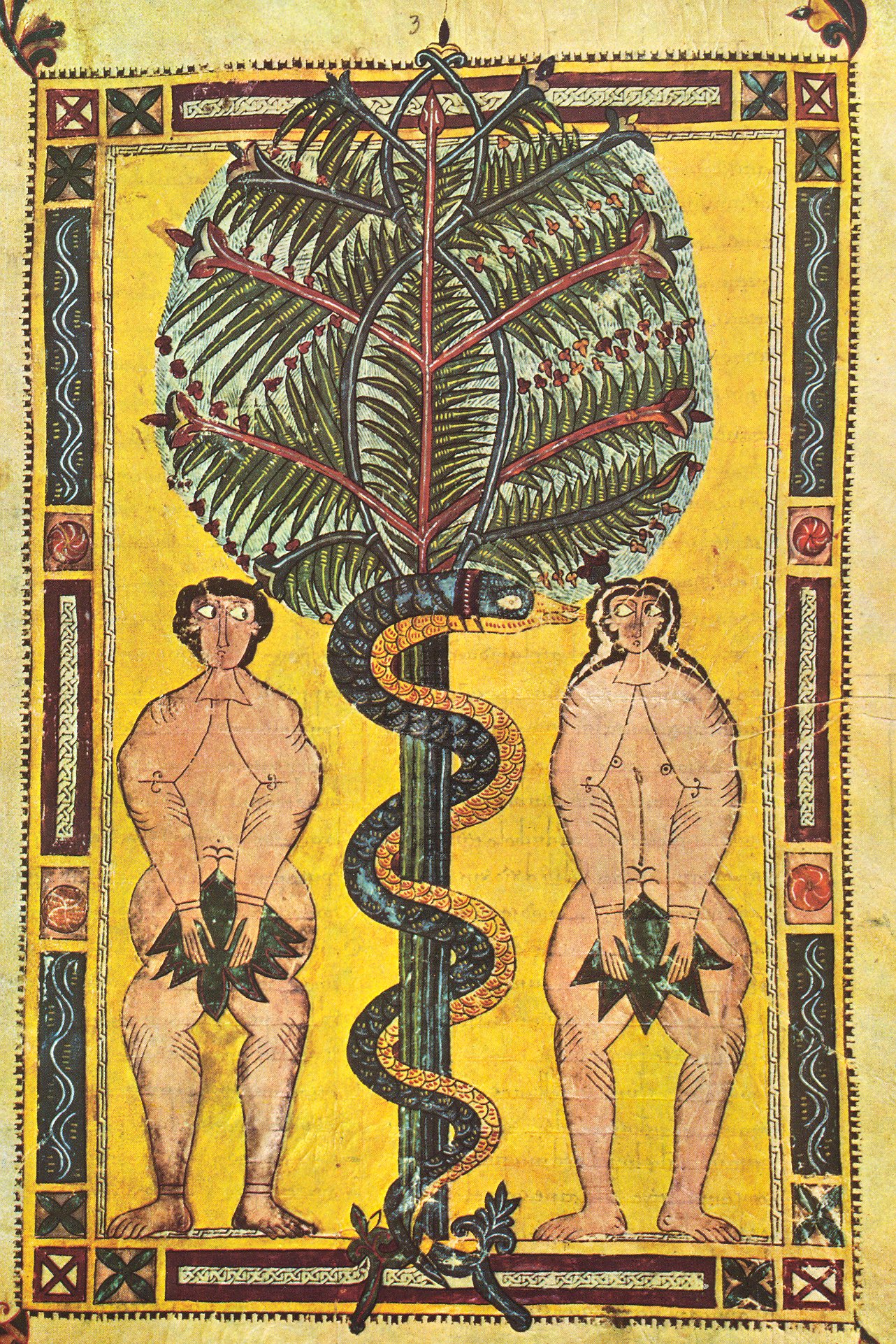
One explanation is that a snake is the opposite of a staff. A snake is a flexible animal that moves with whiplash speed. It can shed its dead skin and emerge alive. And in the story of the Garden of Eden, the snake is clever and deals in deception and half-truths.6
Some early commentators claimed that the first time God changed Moses’ staff into a snake, it was a personal message to Moses that he had slandered the Israelites when he said they would not believe him—just as the snake in the Garden of Eden had slandered God by implying that God had lied about the effects of eating fruit from the Tree of Knowledge of Good and Evil.7
A staff, on the other hand, is a long stick of dead wood, hard and inflexible. It is reliable, strong enough to lean against without breaking—and therefore a good symbol for a chieftain or a king. 19th-century Rabbi S.R. Hirsch wrote:
“… מטה [mateh] denotes (a) an extension of the hand, upon which man can lean for support as he stands on the ground; (b) an extension of man’s sphere of power; it is a symbol of his authority. This sign in Moshe’s hand will show the people that, if God so desires, the thing on which a person leans for support and with which he wields his authority can turn into the very opposite: a serpent. … Conversely, if He so desires, God can take a hostile force that is feared and shunned by man and place it into his hand as an accommodating support and tractable tool.”8
Snake as phallic symbol
Both a staff and a snake are obvious phallic symbols. I suspect that when this story was told orally, the verbal image of a snake stiffening into a staff in Moses’ hand drew snickers from the audience.
The staff and the snake represent two aspects of power. The staff stands for legitimate authority. The snake stands for creative subversion—the power of the trickster. Perhaps one way God uses the staff and snake is to demonstrate, first to Moses and then to the Israelites, that ultimate power over everything belongs to God.
Furthermore, God only makes the snake harmless enough for Moses to pick up with his bare hand when a demonstration of Moses’ status as God’s prophet is required. This demonstration happens first to Moses himself on Mount Sinai, then to the Israelites, then to Pharaoh and his court.
When Moses sets off for Egypt with his wife Tziporah and their two small sons,
Moses took the mateh of God in his hand. (Exodus 4:20)
Moses’ staff is now called the staff of God because God has imbued it with the power to miraculously turn into a snake (and to signal or initiate other miracles in the future).
An incident on Moses’ journey to Egypt shows that the snake can also be dangerous as a phallic symbol.
On the road, at a lodging-place, God confronted him and sought to kill him. Then Tziporah took a flint, and she cut the foreskin of her son, and she touched it to his raglayim, and she said: “Because a bridegroom of blood you are to me!” (Exodus 4:24-25)
raglayim (רַגְלַיִם) = a pair of feet, a pair of legs—or a euphemism for genitals.
The Torah does not say how God “sought to kill him”. But since the next sentence refers to a foreskin and genitals, the Talmud and Exodus Rabbah imagined the angel of death swallowing Moses from his head down to his genitals, where Moses’ circumcision stops the process.9 Rashi wrote:
“The angel became a kind of serpent and swallowed him [Moses] from his head to his thigh, spewed him forth, and then again swallowed him from his legs to that place. Tziporah thus understood that this had happened on account of the delay in the circumcision of her son.”10 (For a fuller discussion of the “Bridegroom of Blood” episode, see my post Shemot: Uncircumcised, Part 1.)
The staff that turns into a snake and back is God’s phallic symbol, not Moses’. Moses is merely another of God’s tools. In next week’s Torah portion, Vayeira, God makes Moses use the staff to impress the simple-minded people in Egypt, from Israelite slave to Egyptian monarch. It would be easy for me, as a feminist, to mock these displays of male power. Yet perhaps they are necessary to get some people’s attention.
And once they are paying attention, they might consider the difference between a man with a staff of office on whom you can depend, and a man in authority who is more like a poisonous snake. Which kind of authority is Pharaoh?
What about our leaders and authority figures today?
- For an explanation of God’s personal name, indicated by Y-H-V-H, see my post Lekh-Lekha: New Names for God.
- Exodus 4:6-7.
- Exodus 4:9.
- Exodus 4:28-31.
- Exodus 4:13.
- Genesis 3:1-6.
- C.f. Ramban on Exodus 4:3. (Ramban is the acronym of 13th-century Rabbi Moshe ben Nachman, also called Nachmanides.) For the snake’s implication that God was lying when God said eating from the Tree of Knowledge would result in death, see Genesis 3:2-5.
- Samson Raphael Hirsch, The Hirsch Chumash, Sefer Shemos, translated by Daniel Haberman, Feldheim Publishers, Jerusalem, 2005, p. 50. (Hirsch was a 19th-century German rabbi and commentator.)
- Talmud tractate Nedarim 32a, Exodus Rabbah 5:8, both written circa 300-600 C.E.
- Translation from www.sefaria.org. Rashi is the acronym for 11th-century Rabbi Shlomo Yitzchaki.

 Questioning Torah
One thought on “Shemot: Snake Staff, Part 1”