Vayigash to him, Judah did, and he said: “By your leave, my lord, please let your servant speak words to the ears of my lord, and do not get angry with your servant, for you are the equal of Pharaoh.” (Genesis 44:18)
vayigash (וַיִּגַּשׁ) = and he approached, and he came closer.
Judah steps closer to the viceroy of Egypt in order to make a plea and an offer at the beginning of this week’s Torah portion, Vayigash (Genesis 44:18-47:27).
Judah’s view
Even at close range, Judah does not recognize the Egyptian viceroy as his missing brother Joseph.1 It has been twenty years since he sold Joseph as a slave to a caravan headed for Egypt.
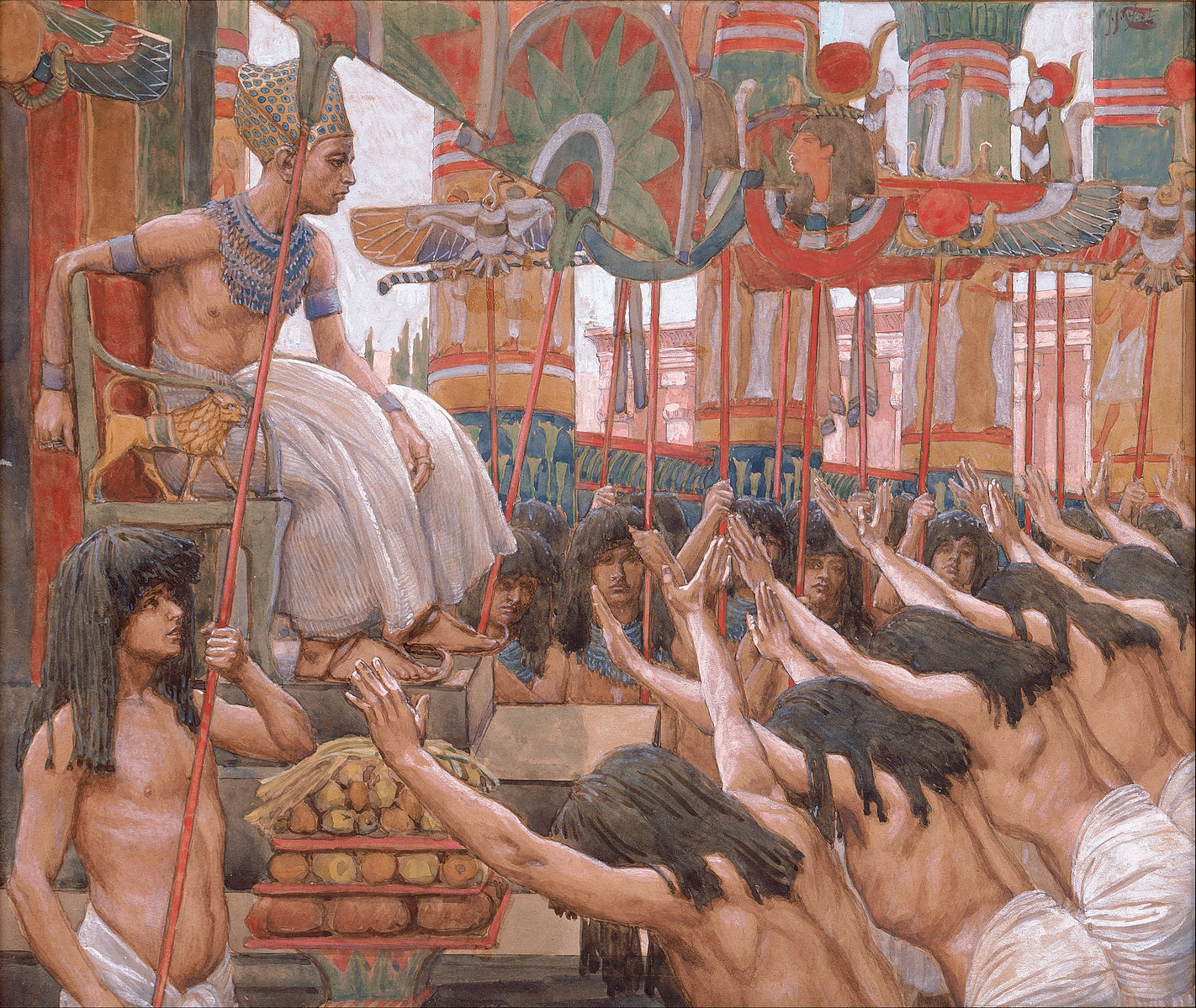
Judah sees an Egyptian nobleman wearing fine linen and gold, seated in a chair on a dais above him, speaking through an interpreter. This is a man with absolute power in Egypt. This is the man who sold Judah and his brothers grain the year before on the condition that they come back with their youngest brother—probably not imagining how hard it would be to meet that condition.
Now the viceroy seems to be playing a sadistic game with the brothers from Canaan. The day before, he welcomed them into his own palace and treated them to a feast. Today, he had them arrested for a crime they did not commit. At least he had one of them arrested: the youngest, Benjamin. Judah had vowed to their father, Jacob, that he would not return to Canaan without Benjamin.
But Judah is desperate. He has to persuade the viceroy to free Benjamin, and to do that he must get closer, and touch the man’s emotions.
Joseph’s view
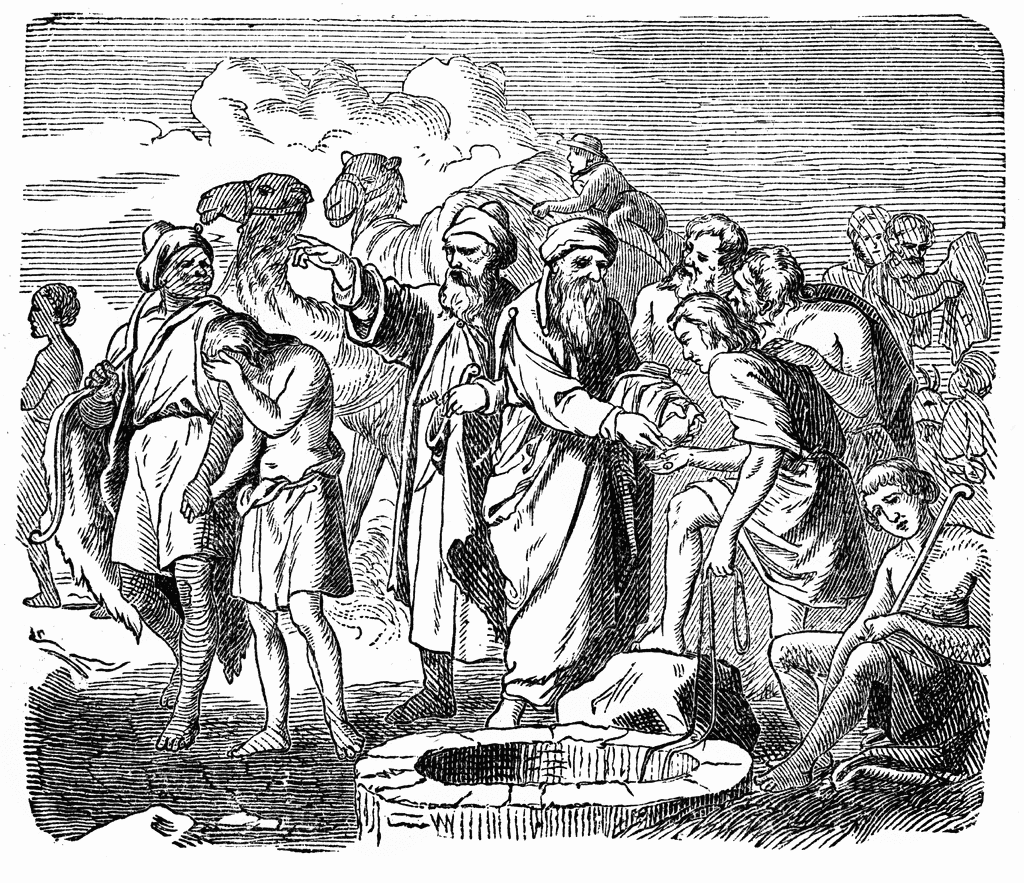
Joseph sees his brother Judah stepping closer. He does not trust any of his ten older brothers. Twenty years before, they stripped off his clothes and threw him into a pit, then discussed killing him until Judah saw the caravan and persuaded the others to sell him instead.
Back then, his brothers overpowered him physically in order to eliminate him from their lives. But now Joseph has all the power. In fact, when his ten older brothers came to Egypt to buy grain the year before, he imprisoned them all for three days while he figured out what to do.2
With a word, he could have had his brothers killed, or sold as slaves. But he overheard them telling each other that God was (finally) punishing them for their merciless behavior toward Joseph. So he embarked on a series of secret tests to see if his brothers had reformed. (See my posts Mikeitz: A Fair Test, Part 1 and Mikeitz & Vayigash: A Fair Test, Part 2.)
Joseph’s last test
Joseph knew the famine would continue in Canaan, and his brothers would have to return—with Benjamin—to buy more grain. The night before they head up to Canaan again, Joseph prepares his final test by ordering his assistant:
“Fill the sacks of the men with food, as much as they are able to hold, swelling. And put each man’s silver in the mouth of his sack. And my goblet, the silver goblet, put it in the mouth of the sack of the youngest one, along with the silver for his grain purchase.” (Genesis 44:1-22)
At dawn, as soon as his brothers leave, Joseph tells his assistant:

“Get up, chase after the men! Overtake them, and say to them: Why did you repay [the viceroy] with wickedness instead of good? Isn’t this what my lord drinks from, and he divines divinations in? What a wickedness you did!” (Genesis 44:4-5)
Then they tore their clothes. And each one reloaded his donkey, and they returned to the city. (Genesis 44:11-13)
The man catches up with them just outside the city and delivers the accusation. He searches their sacks of grain, from the oldest brother’s to the youngest, and pulls the goblet out of Benjamin’s.
Tearing one’s clothes is an act of mourning. Benjamin will never return to Canaan now. And without him, their father will die of grief.
When they are brought before the viceroy, he says:
“The man in whose possession the goblet was found, he will be my slave. And you, [the rest of] you, go back in peace to your father.” (Genesis 44:17)
Judah’s plea
At this point Judah steps closer to the viceroy, and the Torah portion Vayigash begins. After obsequiously begging the powerful man to listen, Judah gives his own version of what happened the year before.
“My lord questioned his servants, saying: ‘Do you have a father or another brother?’ And we said to my lord: ‘We have an old father, and a child of his old age, the youngest. And his [full] brother is dead, so he alone is left from his mother, and his father loves him.’” (Genesis 44:19-20)
This is not quite what happened. Actually, the viceroy accused the ten Canaanite men of being spies. Flabbergasted, they protested that they were all brothers, ten of their father’s twelve sons, and added:
“And hey! The youngest is now with our father, and the other is no more.” (Genesis 42:13)
The viceroy agreed to sell them grain, but ordered them to prove they were not spies by bringing back their youngest brother.
Now Judah decides not to bring up the viceroy’s accusation. He continues his story:
“And you said to your servants: ‘Bring him down to me, so I can set my eyes on him!’ But we said to my lord: ‘The young man is not able to leave his father; if he did leave, his father would die.’ But you said to your servants: ‘If your youngest brother does not come down with you, you will not see my face again.’” (Genesis 44:21-23)
Judah reports that this year, when their father told them to go back to Egypt and buy more grain, they reminded him that they could not go without their youngest brother.
Then your servant, my father, said to us: “You know that my wife bore two sons to me.” (Genesis 44:27)
Rachel is only one of Jacob’s four wives, but he thinks of Rachel and her two sons as if they were his only family. He loved rather Rachel far more than his other wives. After she died, Jacob treated her son Joseph with blatant favoritism—which contributed to the ten older brothers’ desire to get rid of him.3 After they did, and deceived their father so he believed his beloved son was dead, he transferred his attachment Rachel’s second son, Benjamin.
In last week’s portion, Mikeitz, Jacob finally agreed to let Benjamin go to Egypt, but warned his older sons that if anything happened to him, they would be sending his gray head down to Sheol in torment. (Sheol is a vague underworld where souls sleep forever after death.)
Judah phrases his father’s protest this way in his report to the viceroy:
“But the one is gone from me, and I said: Alas, he was certainly torn by a wild animal! And I have not seen him since. And you would take this one from in front of me, too? If a mortal accident happens, then you would send down my gray head to Sheol in misery.” (Genesis 44:28-29)
Then Judah comes to the point.
“And now, if I come back to your servant, my father, and the young man is not with us—and his [own] soul is bound up with his soul—then it will happen when he sees that the young man is not [with us]: he will die. And your servants will send down the gray head of your servant, our father, in torment to Sheol.” (Genesis 44:30-31)
After this attempt to rouse the viceroy’s compassion for the old father, Judah asserts his own responsibility.
“For your servant pledged himself for the young man to my father, saying: ‘If I do not bring him back to you, then I am guilty before my father all the days [to come].’ So now, please let your servant stay instead of the young man as a slave to my lord, and let the young man go up with his brothers! Because how can I go up to my father if the young man is not with me? Lest I see the evil that will find my father!” (Genesis 44:32-34)
Judah’s speech works—in a different way than he hoped. Joseph is impressed and moved by Judah’s choice to become a slave in Egypt himself, rather than see Jacob’s other favorite son in that position.
Without knowing it, Judah has passed the ultimate test, and proved to Joseph that he has reformed.
And Joseph was not able to control himself in front of all his attendants, and he called out: “Have everyone leave me!” So no one stood with him when Joseph made himself known to his brothers. And he gave his voice to weeping. And the Egyptians [nearby] heard, and then Pharaoh’s household heard. And Joseph said to his brothers: “I am Joseph. Is my father still alive?” (Genesis 45:1-2)
Compassion
Judah demonstrates compassion both for Jacob, the father who never loved him, and Benjamin, who swims in paternal affection.
When Joseph recognizes Judah’s compassion, he feels compassion himself. Although only Judah has passed the final test, Joseph is moved to welcome all of his brothers as his own family. And the first thing asks them about is the welfare of his father, with whom he has not communicated for twenty years, not since Jacob sent him off alone to confront the brothers who hated him.4
Both Judah and Joseph feel compassion for people whom they had resented for years. And both men act on it, changing their lives forever.
Feeling compassion does not necessarily mean acting on it. I am not the only person I know who can feel compassion for someone—such as a starving child in a distant land, whose photograph appears when I open my mail—and yet do nothing about it.
I am also not the only person who can doggedly go on doing the right thing, treating people as if I felt compassion for them even when my heart is not moved.
The story of Joseph reminds me that we humans tend to keep on doing whatever we’ve been doing. Like Joseph, we keep on ignoring a resented parent, or manipulating others, or setting a slew of conditions. We do not like to change.
But if compassion suddenly touches your heart, there is a moment when your egotism loses its grip. You might even weep, like Joseph. Then you could harden your heart and return to your old habits. But you could also change into a more generous person.
I am grateful that humans are capable of feeling compassion. Although the feeling does not last, it may trigger a change that does. And the whole world needs more generosity.
- And Joseph recognized his brothers, but they did not recognized him. (Genesis 42:8). Judah’s behavior when he makes his plea in Vayigash does not indicate that this has changed.
- Genesis 42:17.
- Other contributing factors were Joseph’s reports of dreams in which his brothers were bowing down to him, and the fact the Joseph, encouraged by their father, brought back bad reports on his brothers (Genesis 37:2-14).
- See my post Mikeitz: Forgetting a Father.

 Questioning Torah
One thought on “Vayigash: Compassion”