His brothers went to pasture their father’s flocks at Shekhem. And Israel said to Joseph: “Aren’t your brothers pasturing at Shekhem? Go, and I will send you to them.” And [Joseph] said to him: “Here I am.” And he said to him: “Go, please, see the welfare of your brothers and the welfare of the flock, and bring back word to me.” (Genesis 37:12-14)
This passage in the Torah portion Vayeishev (Genesis 37:1-40:23) sounds pleasant—as if there were nothing ominous about Shekhem, or dangerous about sending Joseph to report on his brothers. But someone who reads the book of Genesis up to this point knows that something dire is about to happen.
At Shekhem: Rape and murder
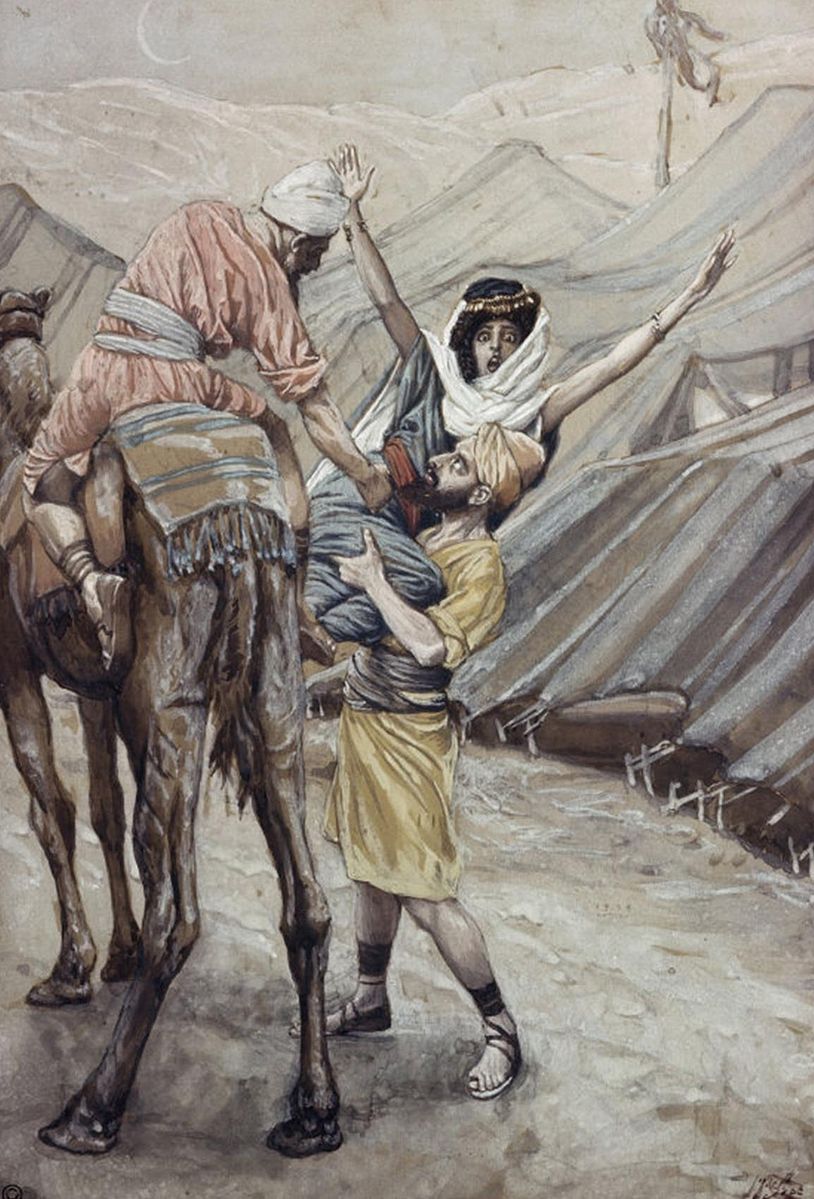
When Joseph and his half-sister Dinah were about twelve or thirteen years old, their father Jacob (a.k.a. Israel) brought his whole family to Shekhem1 and pitched camp next to the town. Jacob even purchased the land they were camping on, as if he intended to stay. Then one day Dinah walked into town alone “to see the daughters of the land”.2 Instead of making some female friends, she is abducted and raped by the son of the town’s ruler.
Jacob delayed taking action until his older sons came home from pasturing the flocks. By that time the ruler’s son, also named Shekhem, had fallen in love with Dinah and talked her into changing her mind about him.3 Shekhem and his father came to Jacob’s camp to arrange a marriage. The son offered to pay Jacob any bride-price he asked for. The father upped the ante, proposing that his people and Jacob’s people would intermarry and become one people.4
Jacob said nothing. His sons pretended to agree to intermarriage if all the men of the town circumcised themselves first. After the men of Shekhem had done so, and were disabled by pain, two of Jacob’s sons, Simon and Levi, came into town and killed every male. They took their sister and left. Then “the sons of Jacob” (which sons are not specified) plundered the town, seizing its women and girls as slaves, and its goods and livestock as booty.5
Then Jacob said to Simon and Levi: “You have stirred up trouble, making me stink among the inhabitants of the land, among the Canaanites and Perizites! And I am few in number, and they will gather together against me, and they will strike me and I will be destroyed, I and my household!” (Genesis 34:30)
To escape vengeance from neighboring towns, Jacob makes his whole household pack up and move south to Hebron.
Joseph was probably too young to participate in the massacre or the looting of Shekhem. His mother, Rachel, was protective of her only son; and when Jacob introduced his family to Esau and his soldiers, he placed Rachel and Joseph in back, the safest position.6
But Joseph saw his half-brothers Simon and Levi arm themselves with swords, go into Shekhem, and return covered with other men’s blood. Later that day Joseph saw his older brothers herding their new female slaves. And when the whole household packed up and took down the tents, Joseph knew that they were moving again to escape a possible counter-attack.
Now, only four or five years later, Joseph’s ten older brothers have taken the family flocks to
Shekhem, of all places. And his father wants him to go there and check up on them.
At Hebron: Joseph’s negative reports
Joseph is seventeen when Jacob sends him from their home in Hebron back to Shekhem. By this time Joseph’s ten older brothers hate him—partly because their father demonstrated blatant favoritism by giving only Joseph a garment fit for royalty; partly because Joseph told them two of his dreams, in which his brothers were bowing down to him; and partly because he maligns them when he reports to their father.7
Joseph, at age seventeen, was tending the flock with his brothers, and he was an assistant to the sons of Bilhah and Zilpah, his father’s women.8 And Joseph brought bad slander about them to their father.9 (Genesis 37:2)
Jacob may believe everything his favorite son says, and trust him to bring an honest report back from Shekhem. He may also be concerned that his ten older sons decided to take the flocks to Shekhem. (I assume that Jacob’s older sons are still making independent decisions without consulting their father, as they did several years before at Shekhem.) What if someone from a neighboring town recognized them from the time before the massacre?
On the other hand, what if someone in the vicinity of Shekhem recognizes Joseph? This possibility does not seem to occur to Jacob.
Perhaps he does not think logically where his favorite son is concerned, especially now that Joseph’s mother, Rachel, has died. It also does not occur to Jacob that his older sons might hate Joseph so much that they are a greater danger to him than any neighbors of the former Shekhemites.
At Shekhem: The question
Joseph answers his father, “Here I am!” With the blitheness of a spoiled adolescent, he heads off alone for Shekhem.
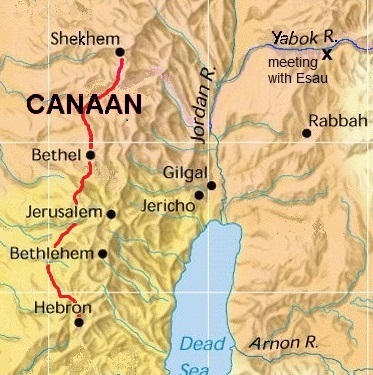
And [Jacob] sent [Joseph] away from the valley of Hebron. And he came to Shekhem. And a man found him, and hey! He was wandering in the fields. And the man asked him: “What tevakeish?” (Genesis 37:14-15)
tevakeish (תְּבַקֵּשׁ) = do you seek, will you seek, are you looking for. (A conjugation of the piel verb bikeish, בִּקֵּשׁ = seek, look for, try to get.)
Joseph probably wandered off the road and through the fields looking for his brothers and the flocks. The Torah never identifies the “man” who questions Joseph. It might be an ordinary man, or it might be a “man” like the “man” who wrestled with Jacob in Genesis 32:25 and turned out to be a divine being. Most classic commentators said it was an angel, i.e. a divine messenger who looked like a man,10 though Ibn Ezra wrote that the man was simply someone passing by.11
At Shekhem: Joseph’s answer
And he said: “My brothers I am mevakeish. Tell me, please, where they are pasturing.” (Genesis 37:16)
mevakeish (מְבַקֵּשׁ) = seeking. (Another piel form of bikeish.)
Why does Joseph assume that a man who happens to be crossing a field near the former town of Shekhem would know who his brothers are, or where they went?
Perhaps Joseph’s polite request implies “if you happen to know”.12 Perhaps Joseph intuitively senses that the “man” is actually a divine messenger from God.13 Or perhaps he simply figures he might as well ask, just in case the man has seen them.
Growing up with his family’s religion and stories, Joseph would know that God’s divine messengers sometimes look like men—until they disappear. So the question “What do you seek?” might be an inquiry from God. In that case, Joseph could take the opportunity to give a different answer, and receive a different response.
1) He could say: “I am seeking to find out what my brothers are doing wrong this time, so I can report back our father.”
He knows his father loves him more than any of his brothers, but he is old enough to wonder if it will last. Perhaps Joseph thinks that slandering his brothers helps to keep him in first place.
2) He could say: “I am seeking to find out what really happened when my family lived here in Shekhem.”
If Joseph had asked his mother and other adults in the household about Shekhem, their reactions combined with his own vivid but incomplete memories would give him a morbid fascination with the subject.
3) He could say: “I am seeking an interpretation of those two dreams I had in which my brothers were bowing down to me.”
His father and his brothers thought that Joseph was fantasizing that he would become a king and rule over them all.14 But what if the dreams were true prophecies from God? Was there something else he should know?
4) But he would not say: “I am seeking to know why my father sent me all the way to an abandoned city to check up on my brothers who hate me enough to kill me.”
If he had been more aware of his family’s psychology, Joseph would have been afraid of finding his brothers. Readers today might suspect Jacob of the psychological blindness of narcissism. (See my post: Mikeitz: Forgetting a Father.) We might also wonder about the Joseph’s older brothers, who were brought up in a family where two of their mothers were openly jealous of one another,15 where their father and grandfather were cheating one another,16 and where they literally got away with murder at Shekhem. Would these young men feel any ethical qualms about harming the little brother they hated?
Joseph has an excuse for giving up and going home, since he could not find his brothers near Shekhem. But he is determined to complete the mission his father sent him on. So instead of giving a more response, he merely tells the stranger that he is looking for his brothers.
Does Joseph feel some inner calling in the presence of God’s angel? Or does he simply believe, with the naivety of a spoiled seventeen-year-old, that he will return safely to his father in Hebron?
And the man said: “They pulled out from here, for I heard them saying: Let’s go to Dotan.” So Joseph went after his brothers and he found them at Dotan. (Genesis 37:17)
When the brothers at Dotan see Joseph approaching, some of them want to kill him right away and throw him into a nearby dry cistern. Reuben, the oldest, says they should throw him into the pit alive. So the brothers seize Joseph, strip off his royal clothing, and throw him in. Then a caravan headed for Egypt passes by, and the brothers sell him to the traders as a slave.17
They think they will never see him again. But the rest of the book of Genesis is a story about the complicated reconciliation between Joseph and his brothers, and how all the children of Israel ended up living in Egypt.
History haunts the story of Joseph and his brothers. They leave Shekhem with their father to make a fresh start; but then they return, and Shekhem becomes the place where Joseph makes the fateful decision to follow his brothers instead of going home. Jacob gives Joseph a royal tunic and Joseph blabs about his dreams and his brothers’ faults; and these relatively small errors in judgment lead to attempted murder, slavery, redemption, and four hundred years of exile in Egypt.
Everything is connected in the Joseph story. Everything he does matters.
I suspect this is true in our own lives as well. Before we act, before we speak, we might ask ourselves: What are we looking for?
- Shekhem was about 30 miles (50 km) north of Jerusalem, between two round hills, Mt. Gezerim and Mt. Eyval. (The common noun shekhem, שְׁכֶם, means “shoulders”.) The site is now part of the city of Nablus.
- Genesis 34:1.
- Genesis 34:2-4. See my post Vayishlach: Change of Heart, Part 1.
- Genesis 34:4-12
- Genesis 34:13-29.
- Genesis 33:1-2.
- Genesis 37:3-4. See my post Vayeishev: Favoritism.
- Jacob’s two wives, Rachel and Leah, gave him their slaves Bilhah and Zilpah as concubines in Genesis 30:3-9.
- The Hebrew word is dibatam (דִּבָּתָם), which could mean slander or negative gossip about them, reports of their own slander, or their bad reputation. See my post Vayeishev: What Drove Them Crazy.
- C.f. Aggadat Bereshit 73:3, Bereshit Rabbah 84:14, Midrash Tanchuma Buber, Rashi, Kli Yakar, Siftei Chakhamim.
- 12th-century rabbi Abraham Ibn Ezra.
- C.f. Ibn Ezra, Radak.
- C.f. Haamek Davar by 19th-century Naftali Zvi Yehuda Berlin.
- Genesis 37:5-11.
- Leah and Rachel in Genesis 29:31-30:24. Leah’s son Reuben, at least, knows about their competition for Jacob’s love when he gives his mother mandrake roots in Genesis 30:14.
- Lavan cheats his son-in-law Jacob in Genesis 29:18-27. Lavan and Jacob both try to cheat one another regarding Jacob’s wages in Genesis 30:31-30:2.
- Genesis 37:18-28.

 Questioning Torah
Judicial corruption and the consequence of exile unto Egypt.