Direct speech, or visions, or dreams, or divine messengers—the Hebrew Bible portrays God as communicating with human beings through all these methods. In this week’s Torah portion, Vayeira (“And he appeared”, Genesis 18:1-22:24), God speaks to Abraham both directly and through divine messengers, called malakhim; to Sarah directly; to King Avimelekh in a dream; and to Lot and Hagar through malakhim.
malakh (מַלְאָךְ) = messenger, emissary. (Plural: malakhim, מַלְאָכִים. While human characters in the Torah send fellow humans as malakhim, the God character sends divine malakhim. “A malakh of God” is often translated into English as “an angel”.)
One way or another, God speaks to more people in Vayeira than in any other Torah portion or haftarah reading. And Vayeira is the only place in the Hebrew Bible where God sends three malakhim at once. What does the God-character achieve?
Three “men”
Abraham is 99 when this week’s Torah portion begins. God spoke directly with him five times in last week’s portion, Lekh Lekha, both with and without accompanying visions.1 The portion Vayeira begins:
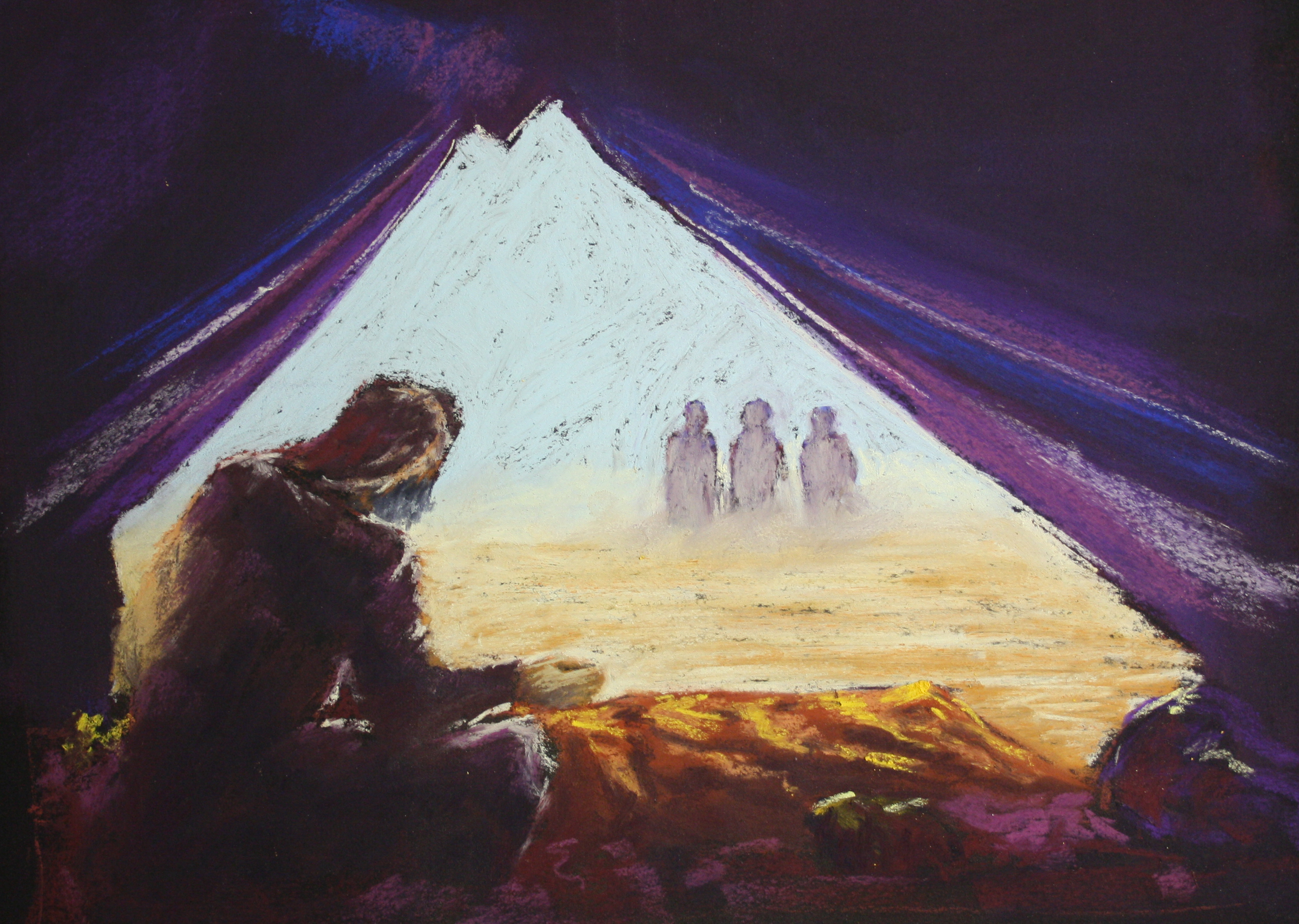
And God appeared to him by the great trees of Mamrei, while he was sitting at the entrance of the tent as the day grew hot. And he raised his eyes, and he saw—hey! Three men were standing near him. And he saw, and he ran from the entrance of the tent to greet them, and he bowed down to the ground. (Genesis/Bereishit 18:1-3)
When God appears in Mamrei, what Abraham sees is three men.2 At first Abraham assumes the three men are ordinary human beings, travelers passing through. He rushes to offer them hospitality: water for washing their feet, shade to rest in, and food to eat. He waits on them under the trees. Then one of the strangers speaks like a prophet, saying:
“I will definitely return to you when this season revives, and hey! A son for Sarah, your wife!” (18:10)
Sarah, who is 89 years old, overhears from inside the tent, and immediately thinks of the sexual act necessary to produce a son.
And Sarah laughed inside herself, saying: After I am all used up, will there be pleasure for me? And my lord is old. (Genesis 18:12)
Then God said to Abraham: “Why is it that Sarah laughed, saying: ‘Can I truly even give birth, when I am old?’ Is it too extraordinary a thing, from God?” (Genesis 18:13-14)
Abraham expresses no surprise that now God is talking to him, though the three “men” are still present. Perhaps he knows that God sometimes speaks through malakhim who look human, at least at first.
And Sarah lied, saying: “I did not laugh,” because she was afraid. But [God] said: “No, because you did laugh.” (Genesis 18:15)
Sarah’s fear shows that she, too, knows that God is speaking.
Does God make three malakhim manifest in the grove of Mamrei only in order to test Abraham’s hospitality and/or to announce Sarah’s future child? I doubt it. A single malakh could have achieved both these objectives.3
Then the men got up from there, and they looked down at Sodom. And Abraham was walking with them to send them off. And God said: Will I hide from Abraham what I am doing? … For I pay attention to him, so that he can instruct his sons and his descendants after him, so they will observe God’s path to do righteousness and justice … (Genesis 18:16-19)
After this thought, God addresses Abraham, saying:
“The outcry of Sodom and Gomorrah is great, because their abundant guilt is very heavy. Indeed I will go down, and I will see: Are they doing like the outcry coming to me? [If so,] Annihilation! And if not, I will know.” The men turned their faces away from there and they went to Sodom, while Abraham was still standing before God. (Genesis 18:20-22)
In other words, God sends two of the malakhim down to check out Sodom. The God in the Torah is not omniscient; in the story about the Tower of Babble, God comes down from the heavens to look at the city and tower before taking action.4 The God of Torah is not omnipresent either, but always has a specific location in our world or in the heavens.
After God’s opening statement about the outcry about Sodom and Gomorrah (presumably coming from victims),
Abraham approached and said: “Would you sweep away the tzadik with the wicked? What if there are fifty tzadikim inside the city? Would you sweep away and not pardon the place for the sake of the fifty tzadikim who are in it? Far be it from you to do this thing, to bring death to the tzadik with the wicked! Then the tzadik would be like the wicked. Far be it from you! The judge of all the earth should do justice!” (Genesis 18:23-25)
tzadik (צַדִּיק) = righteous, innocent. tzadikim (צַדִּיקִם) = people who are righteous or innocent.
And God agrees to pardon the whole city if fifty of its residents are innocent. Abraham continues until God agrees to spare Sodom even if it has only ten innocent people.
As we will see, this encounter between God and Abraham could have changed Abraham’s life about 30 years later—if only he had remembered that he could argue with God. As it is, Abraham does succeed in establishing that God is supposed to be a god of justice.
Two malakhim
And the two malakhim came to Sodom in the evening, and Lot was sitting in the gate of Sodom. And Lot saw them, and he rose to greet them, and he bowed down with his nose to the ground. (Genesis 19:1)
Abraham’s nephew Lot emigrated with him from Aram to Canaan 24 years before. They parted when the pastureland around Bethel was no longer sufficient to feed the increasing flocks and herds of both men. Abraham stayed in the hill country, and Lot went down to the fertile valley and settled in the city of Sodom.5
Now, when he sees two strangers enter the city, Lot is as hospitable as his uncle Abraham. He, too, bows to the ground. He begs the men to come home with him for the night, and he prepares a feast for them. That night, all the men of Sodom surround Lot’s house.
And they called to Lot and they said to him: “Where are the men who came to you tonight? Bring them out to us, and we will ‘know’ them!” (Genesis 19:5)
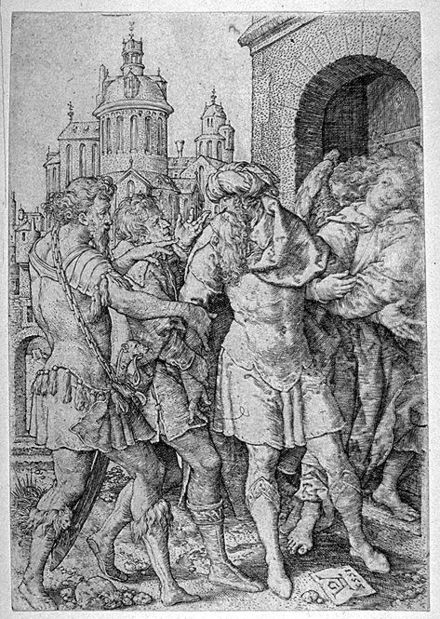
The men of Sodom believe that the two strangers in Lot’s house are ordinary men who can be degraded through rape. They do not care about other people; they only want to prove how powerful they are. Lot steps out, closing the door behind himself, and begs the men of Sodom not to do an evil deed. He volunteers to send out his own two virgin daughters for them to rape instead. (This offer indicates that he is not a tzadik, but his hospitality to strangers indicates that he is not wicked like the native Sodomites.)
The men of Sodom reject Lot’s offer.
And they moved forward to break the door. But the “men” [inside] stretched out their hands and brought Lot inside the house with them, and they shut the door. And the men who were at the entrance of the house, from small to big, they struck with a blinding light; and they were powerless to find the door.
The two malakhim urge Lot to collect his married daughters and their families, so they can all flee together before Sodom is annihilated. Although Lot believes the malakhim, he cannot persuade his sons-in-law to take the warning seriously. When he returns to his own house at dawn, the two malakhim urge Lot to leave at once with his wife and his two unmarried daughters. Lot hesitates, and the malakhim grasp the hands of all four humans and drag them out of the city.
Then God rained down on Sodom, and on Gomorrah, sulfur and fire from God, from the heavens. (Genesis 19:24)
We can deduce that God sends two malakhim to Sodom in order to confirm that all the men there (except Lot) really are evil, and to rescue Lot and his wife and virgin daughters. The rescue requires a magical power (blinding the Sodomites) and four hands with a firm grip.
The encounter with the two malakhim from God does save four human lives, but it does not redeem them. Lot’s wife ignores the warning of the malakhim not to look back, and turns into a pillar of salt. Lot gets drunk and has incestuous intercourse with his two remaining daughters, providing an excuse for the author to insult the kingdoms of their descendants, Moab and Ammon. (See my post Vayeira & Noach: Drunk and Disorderly.)
A dream
Abraham travels on to Gerar, where the Torah gives us a second version of the wife-sister story.6
And Abraham said about Sarah, his wife: “She is my sister.” And Avimelekh, the king of Gerar, sent for and took Sarah. Then God came to Avimelekh in the dream at night, and said to him: “Hey, you will die on account of the woman that you took, for she is the wife of a husband.” (Genesis 20:2-3)
In his dream, the king defends himself, protesting that Abraham and Sarah lied to him, and anyway he has not yet touched Sarah, so he is innocent. Avimelekh’s argument is successful.
And God said to him in the dream: “I also know that you did this with an innocent heart, and I also held you back from doing wrong to her. That is why I did not let you touch her.” Genesis 20:6)
After claiming credit for the disease that caused King Avimelekh’s delay, God orders him to restore Sarah to her husband. He does so, throwing in some portable wealth to be on the safe side, and God heals him.
In this case, God participates in Abraham’s scam, but then sends Avimelekh a dream that gives him a chance to defend himself. When he does, God remits his punishment. As in the first wife-sister story, Abraham goes unpunished.
About Ishmael
After Abraham and Sarah return from Gerar, Sarah does indeed have a son at age 90. Several years later, at her son Isaac’s weaning feast, she is disturbed by the behavior of Abraham’s first son, Ishmael. Sarah orders her husband to cast out Ishmael and his mother, the slave-woman Hagar, in order to prevent Ishmael from sharing Isaac’s inheritance. (See my post Vayeira: Failure of Empathy.) Abraham is not happy about this order from his wife.
But God said to Abraham: “Don’t let it be bad in your eyes about the boy and about the slave-woman. Everything that Sarah says to you, listen to her voice! … And also I will set the son of the slave-woman as [the founder of] a nation, because he is your seed.” (Genesis 21:12)
Perhaps this promise makes Abraham feel absolved of responsibility for the adolescent boy. He sends off Ishmael and Hagar with only some bread and one skin of water, and nothing to give them a start on a new life. The mother and son run out of water in the desert.

And God listened to the sound of the boy [crying], and a malakh of God called to Hagar from the heavens and said to her: “What is it, Hagar? Don’t be afraid. Because God has listened to the sound of the boy where he is. Get up, lift up the boy, and hold your hand firmly in his. Because I will make him a great nation.” Then God opened her eyes, and she saw a well of water. (Genesis 21:17-19)
The words of the malakh might make Hagar feel more optimistic, but the important change is that Hagar now sees the water.
Abraham obeys again
Abraham hears from God for the last time in his life near the end of the portion Vayeira.
And it was after these things, and God tested Abraham. And [God] said to him: “Abraham!” And he answered: “Here I am.” And [God] said: “Take, please, your son, your only one,7 whom you love, Isaac. And go for yourself to the land of the Moriyah, and offer him there as a burned offering on one of the hills that I say to you.” And Abraham got up early in the morning and he saddled his donkey and he took two [slave] boys with him, and his son Isaac. And he split wood for the burnt offering and he got up and went to the place that God had said to him. (Genesis 22:1-3)
Abraham simply obeys. He does not argue with God. Apparently he does not remember the time when he debated with God about justice and the city of Sodom; he does not even mention that Isaac is innocent.

On the summit of the hill in Moriyah,
Abraham stretched out his hand and he took the knife to slaughter his son. Then a malakh of God called to him from the heavens, and said: “Abraham! Abraham!” And he said: “Here I am.” (Genesis 22:10-11)
In the Torah, when the speaker repeats the name of the person addressed, it means there was no answer the first time. Abraham is not even listening for God’s voice.
Once he has Abraham’s attention, the malakh from God says:
“You must not stretch out your hand against the boy, and you must not do anything to him. Because now I know that you fear God, and you have not withheld your son, your only one, from me.” (Genesis 22:12)
Abraham looks up, sees a ram caught in the bushes, and sacrifices it instead of Isaac.8 But as a result of his unquestioning obedience, he is estranged from his only remaining son for the rest of his life. And although Abraham appears in several more scenes in the book of Genesis, God does not speak to him again.
What does God achieve in the portion Vayeira through all these conversations, speaking with Sarah, Lot, Avimelekh, and Hagar as well as Abraham?
Abraham argues in favor of sparing Sodom if it contains ten innocent people, but then he fails to argue for the life of his own innocent son. Sarah is unaffected by the annunciation of Isaac, though she defends him after he is born. God spares Lot’s life, but Lot does not appreciate it, and falls into immoral behavior. Avimelekh protests to God in his dream, and God heals him—of the affliction God caused in the first place. And God does not tell Abraham anything that motivates him to behave decently to Hagar and Ishmael.
We can see God’s involvement in the lives of all five people: Abraham Sarah, Lot, Avimelekh, and Hagar. But if God had remained silent and distant in the portion Vayeira, the five humans might have been better off. And although the generations after Abraham have benefited from his argument that God is supposed to do justice, this benefit has been undermined by the story of his unquestioning obedience to an unjust command.
But without God’s conversations, the stories would have been less entertaining.
- God manifests to Abraham as a voice only in Genesis 12:1-3, and 13:14-17; and as voice with an accompanying visuals in Genesis 12:7, 15:1-21, and 17:1-22.
- God might be invisible, or manifest in a fire, or use a malakh; but nobody can see what God actually looks like. As God tells Moses in the book of Exodus, “No man can see me and live” (Exodus 33:20). Moses, Aaron, two of Aaron’s sons, and 70 elders do see God’s feet on a sapphire pavement in Exodus 24:10, but this does not count.
- Cf. the single malakh who announces the coming birth of Samson in Judges 13:2-24.
- Genesis 11:5 in the portion Noach.
- Abraham and Lot separate in Genesis 13:1-13.
- The first wife-sister story is in Lekh-Lekha, in Genesis 12:11-20. See my posts Lekh Lekha, Vayeira, and Toledot: The Wife-Sister Trick, Part 1, Part 2, and Part 3.
- We know Abraham has two living sons, so why does God call Isaac “the only one” (yechidekha, יְחִידֶךָ)? I believe here the word means “the only one remaining to you”, since Ishmael has been banished.
- See my post Vayeira: Stopped by an Angel.

 Questioning Torah
4 thoughts on “Vayeira: On Speaking Terms”