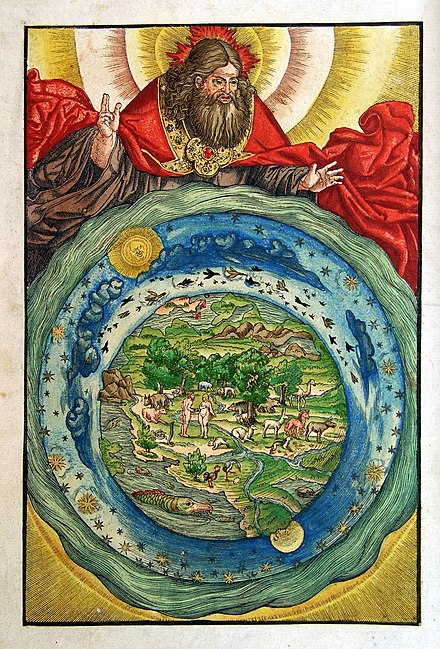
On the sixth “day” of creation God creates land animals, including humans.
And God saw everything [God] had made, and hey! It was very good. And it was evening and it was morning, the sixth day. (Genesis 1:31)
But by the end of this first Torah portion in Genesis, Bereishit, something has gone wrong.
Then God saw that the evil of humankind was abundant on the earth, and all the shapes of the plans of its mind were only evil all the time. And God had second thoughts about making the human being on the earth, and [God’s] heart was distressed. And God thought: “I will wipe out the human that I created from upon the face of the earth—from humankind to beasts to creeping animals to flying animals in the sky—because I have had second thoughts about making them.” But Noach found favor in the eyes of God. (Genesis 6:5-8)
Noach (נֺחַ) = rest, resting-place; the personal name “Noah” in English.
Humans are generating so much evil that God wants to roll back creation to somewhere on the fifth “day” and start over again.
What kind of evil? The beginning of this week’s Torah portion, Noach (Genesis 6:9-11:32), narrows it down a bit.
The earth had become ruined in front of God; the earth was filled with chamas. And God looked at the earth, and hey! It was ruined, because all basar had ruined its ways on the earth. And God said to Noach: “The end of all basar is coming before me! For the earth is filled with chamas because of them. So here I am, ruinging them along with the earth! Make for yourself an ark of gofer wood …” (Genesis 6:11-14)
chamas (חָמָס) = violence.
basar (בָּשָׂר) = soft tissue of a human or other animal, including skin, muscle, meat; animals in general. (See my post Bereishit & Noach: All Flesh.)
After giving instructions for building the ark, God tells Noach:“As for me, here I am bringing the flood waters over the earth, to ruin all basar with a breath of life in it under the skies.” (Genesis 6:17)
All flesh
In the Noach story, the phrase “all flesh” (kol basar) means all non-human land animals four times in order to emphasize that Noach and his family are saving a pair of every type of animal. “All flesh” means all land animals, including humans, eight times in the Noach story.1 For example:
And all basar expired: the crawlers on the earth, birds and beasts, and all swarming creatures that swarm on the earth, and all the human beings. Everything that breathed the air of life in its nostrils, out of all that were on dry land, died. (Genesis 7:21-22)
The portion Noach states at the beginning that all basar had “ruined its ways on the earth” (Genesis 6:12), and then God tells Noach: “the earth is filled with chamas because of them” (Genesis 6:13). It is reasonable to conclude that God floods the earth because all land animals, including humans, are ruining God’s creation through violence.
What kind of violence?
What kind of chamas has ruined the earth? Classic commentators suggested four answers2:
Robbery. For example, “There is a discussion between the sages as to the difference in meaning between the word: חמס (violence) and the word גזל (robbery) when used in the Holy Scriptures. According to Rabbi Chaninah, the difference is merely in the amount misappropriated by violent means.” (Chizkuni, in response to earlier commentary including Rashi).
I reject robbery as a candidate because although I can imagine one animal biting another in order to steal its stash of food, this kind of behavior is never mentioned in the Torah.
Idolatry. For example, “Ḥamas refers to idolatry, as it is stated [in Ezekiel 8:17—Is it so little for the house of Judah, doing the abominations that they do here, that] they filled the earth with ḥamas?” (Bereishit Rabbah 31:6).
I reject idolatry as a candidate for two reasons: 1) Ezekiel might have meant that the Judahites were violent in addition to committing abominations, and 2) Non-human animals exhibit no god-worshiping behavior, violent or otherwise.
Sexual misconduct. For example, “The dog would consort with the wolf, and the chicken would consort with the peacock.” (Bereishit Rabbah 28:8). “All flesh engaged in unnatural and perverted sexual acts.” (Ibn Ezra). “They raped women against their will.” (Chizkuni).
I reject this theory because no sexual violence or other sexual misconduct is mentioned in the Torah until after the flood.
Shedding innocent blood. For example, “Ḥamas refers to bloodshed, as it is stated: “[in Joel 4:19—Egypt shall be a desolation and Edom a desolate waste] due to the ḥamas against the children of Judah, that they shed innocent blood.” (Bereishit Rabbah 31:6).
Shedding innocent blood certainly counts as chamas, and too much of it might well make the God character conclude that the world is ruined. The quote from the book of Joel in Bereishit Rabbah refers to humans shedding the blood of other humans, but it is also possible that the word chamas applies to other kinds of bloodshed.
When God has second thoughts about the world, what innocent blood is being shed, and by whom? The Torah portions Bereishit and Noach support two different answers. In one, humans and some of the other animals are shedding the blood of innocent animals in order to eat them. In the other, evil humans are murdering innocent humans.
Carnivores versus herbivores
On the sixth “day” of creation, God tells the first humans:
“Hey! I give you all seed-bearing plants that are on the face of the whole earth, and all the trees with seed-bearing fruits; they shall be your food. And to all animals on the land, and all birds in the skies, and all crawlers on the ground that have the animating soul of life in them: all green plants for food.” (Genesis 1:29-30)
Thus God’s original plan is for all animals, including humans, to follow a vegan diet. No animals are created to be carnivores.
The next episode in the book of Genesis is an older creation story, in which the first living thing God creates is the human being. Then God plants the garden of Eden and transfers the androgynous human there. God gives it permission to eat fruit:
“From every tree of the garden you may certainly eat. But from the Tree of the Knowledge of Good and Evil, you should not eat from it …” (Genesis 2:16-17)
Then God makes animals and brings them to the human to name. The approved diet for these animals is not mentioned. Later, when God is about to banish the first two humans from Eden, along with the snake, God says that in the real world the snake will eat dust.
“On your belly you will go, and dust you will eat, all the days of your life.” (Genesis 3:14).
Eating dust might be an idiom, as in English, leaving the snake’s actual source of nutrition unspecified. But God does say what the man will eat after he is expelled from the garden of Eden:
“And your food will be the plants of the field. By the sweat of your face you will eat bread.” (Genesis 3:18-19)
Perhaps, over time, all flesh—humans and other predatory animals—ruin the world that God created by becoming carnivores. After all, eating meat, basar, requires the death of an animal—a violent act of bloodshed, since any animal struggles against its killer.
If this is the widespread chamas that is ruining the world, the flood makes sense as God’s solution. If all flesh were wiped out, God could repopulate the earth with creatures designed so they would stay vegetarian.
Yet after the flood is over, God decides to put up with the evil inclinations of humans. God specifically accepts the practice of eating meat, telling Noach and his sons:
“Fear and dread of you will be upon every beast of the earth, and upon every bird of the skies, in everything that crawls on the ground, and in every fish in the sea; into your hand I give them. Every crawler that is alive will be yours for eating; as with green plants, I give them all to you.” (Genesis 9:2-3)
The only caveats God makes are that humans must not drink an animal’s blood; and that neither a human nor a beast can shed human blood and get away with it.
Whoever sheds the blood of humankind, by humankind his blood must be shed.” (Genesis 9: 6)
Killing and eating animals is now an acceptable form of violence; but human murder is not.
Human versus human
After the expulsion from Eden and before God decides to flood the earth, there is another story about chamas—one in which the evil behavior is murder, not eating meat.
Adam and Eve’s first son, Cain, farms the soil, and their second son, Abel, tends a flock. This division of labor bothered some classic commentators, who tried to reconcile being a shepherd with following God’s instructions to eat only plants.
“The one who became the shepherd was interested in eating the dairy products obtainable from the sheep and goats. He was also in need of the wool of the sheep to make clothing. They restricted themselves to these vocations, seeing that God had not permitted the eating of meat but only grass, fruit of the trees, and bread …” (Radak)3
The Torah does not report that any of the first four humans eats a sheep or goat. But Abel does become the first human to kill an animal.
And Cain brought from the fruit of the ground an offering to God. And Abel, also he, brought from the firstborn of his flock and from their fattest. And God paid regard to Abel and to his offering. But to Cain and to his offering, [God] paid no regard. And Cain was very angry and his face fell. (Genesis 4:3-5)
In the Torah, every animal offering is butchered, and at least part of it is burned up into smoke, which God enjoys smelling. (See my post Pinchas: Aromatherapy.) Since God indicates approval of Abel’s offering in some way, we can conclude that God is not distressed when Abel kills an animal in his flock. Perhaps animal-killing is acceptable as an act of worship, even though eating its flesh is still unacceptable.4
Cain is so upset about God’s preference for Abel that he becomes the first human to commit murder. We can assume that the murder involves violent bloodshed, since God tells Cain:
“And now you will be more cursed than the ground, which opened its mouth to take in the blood of your brother from your hand!” (Genesis 4:11)
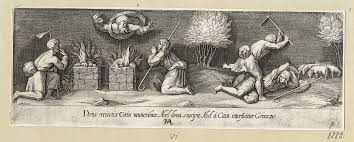
The next biblical reference to killing a fellow creature, human or beast, is when six generation later a man named Lemekh brags:
“I have killed a man for crushing me, and a boy for bruising me!” (Genesis 4:23)
Then (after a quick, unconnected story about lesser gods mating with human women to produce heroes) God sees that humankind has become evil, and all basar has filled the world with chamas.
One more indication that God does not object to humans killing beasts is that after the flood, Noah builds an altar, kills some extra animals, and burns them as offering to God. As in the story of Cain and Abel, God appreciates the animal offering.
And God smelled the soothing smell, and God said in [God’s] heart: Never again [will I] curse the ground on account of humankind, because the impulse of the human heart is evil from its youth. And never again [will I] strike down all life, as I have done.” (Genesis 8:20-21).
According to classic commentary, God decides that it is only natural for children to act on their bad impulses, but adults can learn to control these impulses and be good. Throughout the Torah, sacrificing animals to worship God is considered good behavior. God must think so, too, even before the flood. (See my post Noach: The Soother.)
“He ascribes merit to men because by their very creation they have an evil nature in their youthful days but not in their mature years.” (Ramban)5
After that, God explicitly gives Noah and his sons permission to eat meat—although presumably they will have to wait until the animals they saved on the ark have reproduced.
Why does God wipe out not only humankind, but all animals?
If the chamas that distresses God is carnivorous behavior, then why does God drown all the land animals, including herbivores? Is it too much work to create a plague that kills only the carnivorous species?
Similarly, if the kind of chamas that distresses God is human murder, then why does God make a flood that wipes out not only humankind, but also every land animal that is not on Noah’s ark?
The Talmud imagines God answering:
“Did I create domesticated animals and non-domesticated animals for any reason other than for man? Now that man sins and is sentenced to destruction, why do I need domesticated animals and non-domesticated animals?” (Talmud Bavli, Sanhedrin 108a)5
In other words, God drowns the other animals because they have no value apart from their usefulness to humans. After all, in the first creation story God tells the newly created humans:
“Be fruitful and multiply, and fill the earth and subjugate it, and rule over the fish of the sea and over the birds of the skies and over everything alive crawling on the land.” (Genesis 1:28)
In Genesis, non-human animals are clearly inferior to humans, and do not deserve the same respect. Therefore if a flood is the easiest way to wipe out the whole human population, the fact that it wipes out other animals as well is irrelevant to God—as long as enough are preserved on the ark to repopulate the world, and to be burned as offerings to God.
What is the chamas that makes God have second thoughts about creating the world? The book of Genesis provides evidence for both the theory that the world is ruined by carnivorous behavior, and the theory that the world is ruined by human murder. But God and humankind are made in the same “image”, and the death by violence of a fellow human usually causes the most despair in humans themselves.
Today, chamas (חָמָס) is the Hebrew spelling of the Arabic acronym Charakat al-Muqawama al-Islamiya (“Islamic Resistance Movement”)—spelled “Hamas” in English. This group, founded in 1987, has been the de facto government of the Gaza strip since 2007. As I write this post, Hamas is engaged in a terrorist invasion of Israel marked by personal violence.
Since “the impulse of the human heart is evil from its youth”, what will it take for all of humanity to learn to reject violence?
- Kol basar refers to all non-human animals in Genesis 6:19, 7:15, 7:16, and 8:17. Kol basar refers to all animals including humans in 6:12, 6:13, 6:17, 7:21, 9:11, 9:15 (twice), and 9:17. The phrase does not refer to all human flesh until Deuteronomy 5:23.
- Translations of Chizkuni (13th century) and Bereishit Rabbah (4th-5th century C.E.), are from www.sefaria.org.
- Radak (Rabbi David Kimchi),13th century; translation from www.sefaria.org. Also see Siftei Chakhamim, 17th century, on Genesis 4:2.
- Of course, it is also possible that the author of the story of Cain and Abel was unaware of the vegetarian diet commanded in the two creation stories. Scholars date the story of the six days of creation to the 6th century B.C.E., and the subsequent stories in the Torah portion Bereishit to an earlier date.
- Talmud Bavli, Sanhedrin 108a:20, William Davidson translation, www.sefaria.org.

 Questioning Torah