(If you would like to read one of my posts on this week’s Torah portion, click on “Categories” in the sidebar, then select “Deuteronomy” and “Ki Teitzei”.)
In last week’s Torah portion, Shoftim, Moses warns the Israelites:
When you enter the land that God, your god, is giving to you, you must not learn to act according to the to-avot of those nations. (Deuteronomy/Devarim 18:9)
to-avot (תּוֹעֲבֺת) = plural of to-eivah (תּוֹעֵבָה) = taboo; an abomination, a foreign perversion, a custom in one culture that is prohibited in another culture.
Then Moses lists nine abominable occult practices:
There shall not be found among you one who makes his son or his daughter go across through the fire; a koseim kesomim, a meonein, or a menacheish; a mekhasheif or a choveir chaver,or one who inquires of ov or yidoni, or one who seeks the dead. Because anyone who does these things is to-avot; and on account of these to-avot, God, your god, is dispossessing them [the Canaanite nations] before you. (Deuteronomy 18:10-12)
What are all these procedures?
I examined the first four practices in last week’s post, Shoftim: Is Magic Abominable? Part 1, and concluded that the first, making offspring cross the fire, is to-eivah because it involves worshiping a foreign god; and the next three, which all types of divining, are to-avot because they are not sanctioned ways to get information from God. Divining itself is acceptable, as long as the diviner consults the God of Israel (usually through casting lots).
This week we will look at the remaining five kinds of forbidden magic: two types of sorcery, and three ways to get information from people who have died.
A sorcerer: Mekhasheif
A mekhasheif (מְכַשֵּׁף) is someone who does sorcery or witchcraft: khisheif (כִּשֵּׁף) = practice sorcery. The Hebrew Bible does not specify what actions a mekhasheif performs, but in related Semitic languages the root of the word refers to cutting off, or to praying by cutting one’s skin.1 No one called a mekhasheif is included in any biblical story. Instead, the word usually appears in lists with other types of occult practitioners, as in the Torah portion Shoftim.2
One notable exception is the bald statement in the book of Exodus:
You must not let a mekhasheifah live. (Exodus 22:17)
(Mekhasheifah, מְכַשֵׁפָה, is the feminine form of the word, corresponding to the English “sorceress”.)
This injunction appears between a law giving the financial penalty for seducing a virgin, and a law giving the death penalty to anyone who lies with a beast. Perhaps a female’s sorcery also had a sexual element, but there is no corroboration elsewhere in the Hebrew Bible.
The bible mentions four people by name who employ a mekhasheif. One is the idol-worshiper King Menashe of Judah.3The other three are thoroughly reviled foreigners: a pharaoh, Queen Jezebel, and Nebuchadnezzar.4 Perhaps a mekhasheif or mekhasheifah is taboo, to-eivah, because the profession is associated with foreign religions.
A sorcerer: : Choveir chaver
Both choveir and chaver come from the root verb chaver (חָבַר) = join. Normally, a choveir (חֺבֵר) is “one who joins”, and a chaver (חָבֶר) or chever (חֶבֶר) is a group of comrades, a company, a band, or a gang.
But lexicons give alternate meanings for words from that root when the context indicates magic, suggesting that the magic involves conjuring, or tying knots, or chanting spells, or charming animals who act as familiars. Only one biblical passage provides more definite information:

The wicked are alienated from the womb;
The liars go astray from birth.
They have venom like the venom of a snake,
Like a deaf cobra who closes its ears
So it will not hear the voice of a whisperer,
An expert choveir chavarim. (Psalm 58:4-5)
In this simile, a choveir is a snake charmer who fails—because the snake is so fixated on biting its victim that it turns a deaf ear to the spells the charmer is whispering. Wicked people, particularly liars, also turn a deaf ear to any instruction.
Why would snake charmers be taboo in Deuteronomy? Maybe they were associated with the snake in the Garden of Eden, who encourages the first woman to eat from the Tree of the Knowledge of Good and Evil. Or maybe the problem was that other religions in the Ancient near East had snake-gods and religious symbols of snakes. Or maybe the bible discourages consulting any animal, because only humans are made in the image of God.
A necromancer: One who inquires of an ov or yidoni, or seeks the dead
The terms ov (אוֹב) and yidoni (יִדְּעֺנִי) usually appear together as synonyms.6 Both mean either a spirit of a dead person, or a necromancer who summons that spirit. The word yidoni comes from the verb yada (יָדַע) = know; and a dead spirit is assumed to know things that the living do not. The three references to ghosts in Leviticus are revealing.
Do not turn to the ovot or to the yidonim; do not seek them out, to become impure; I am God, your God. (Leviticus 19:31)
ovot (אוֹבוֹת) = plural of ov. Yidonim (יִדְּעֺנִים) = plural of yidoni.
Thus summoning a ghost makes people ritually impure, unable to serve God until they have been purified.
And the soul who turns to the ovot or to the yidonim to have illicit intercourse with them: I [God] will set my face against that soul and I will cut it off from among its people. (Leviticus 20:6)
The Hebrew Bible often calls worshiping other gods a act of prostitution, being unfaithful to the God of Israel. In this verse, consulting a ghost is also an act of infidelity.
And a man or a woman who has an ov or a yidoni must definitely be put to death by stoning; their bloodguilt is upon them. (Leviticus 20:27)
This sounds like a medium who calls up the same ghost repeatedly.
But in the one biblical story about someone who summons an ov, the identity of the ghost depends not on the medium, but on her employer.
And [the prophet] Samuel had died, and all Israel mourned for him, and he was buried in Ramah in his own town. And Saul had banished the ovot and the yidonim from the land. (1 Samuel 28:3)
When King Saul is facing a major battle with the Philistines, he sees the size of the Philistine camp and becomes afraid. At first he sticks to God’s rules, and asks for information only from God-approved sources.
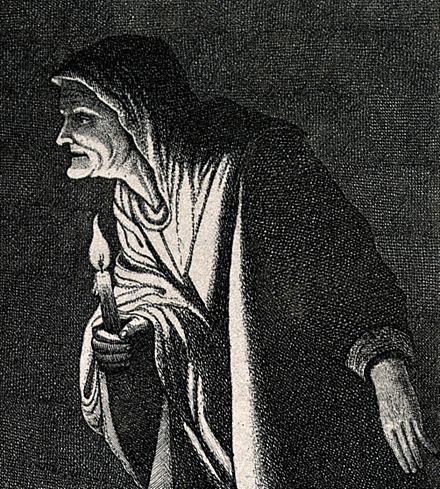
And Saul put a question to God, but God did not answer him, either by dreams or by the [high priest’s] oracular device or by prophets. Then Saul said to his attendants: “Seek out for me a woman who is a master of ov, and I will go to her and I will inquire through her.” And his attendants said to him: “Hey! A woman who is a master of ov is in Eyn Dor.” Then Saul disguised himself and put on different clothes, and he went, together with two men, and they came to the woman by night. And he said: “Please divine for me through an ov, and bring up for me the one whom I will say to you.” (1 Samuel 28:6-8)
The woman reminds him that King Saul made divination through an ov illegal. The disguised king reassures her. She asks him who to bring up from the dead, and he asks for Samuel.
Then the woman saw Samuel, and she shrieked in a loud voice and … said: “Why did you deceive me? You are Saul!” And the king said to her: “Do not be afraid. But what do you see?” And the woman said to Saul: “I see a god coming up from the ground.” Then he said to her: “What does he look like?” And she said: “An old man is rising up, and he is wrapped in a robe.” Then Saul knew that it was Samuel, and he bowed down to the ground and made obeisance. Then Samuel said to Saul: “Why have you bothered me, bringing me up?” (1 Samuel 28:12-15)
Saul explains. Then Samuel’s ghost says that God is giving the kingship to David, and Saul’s army will lose the battle. He blames Saul’s past disobedience in the war with Amalek for this outcome, and adds:
“And tomorrow you and your sons will be with me!” (1 Samuel 29:19)
In other words, they will be dead in Sheol underground, like Samuel.
Everything Samuel predicts comes true. But we do not know whether that is because he was God’s favorite prophet when he was alive, or because ghosts have secret knowledge.
The list of taboo occult practices in the book of Deuteronomy ends: “or one who seeks the dead”, but that description would cover necromancers who summon ovot or yidonim. Maybe the list ends that way to indicate that divination by speaking to the spirits of dead people is the ultimate insult to God.
Moses concludes:
Because anyone who does these things is to-avot; and on account of these to-avot, God, your god, is dispossessing them [the Canaanites] before you. You must be wholehearted with God, your god. Because these nations that you are taking possession of, they paid attention to meoneinim and to kesomim; but God, your god, did not set this out for you. God, your god, will establish for you a prophet from your midst, from your brothers, like myself. To him you should listen! (Deuteronomy 18:12-15)
To be “wholehearted with God”, the Israelites must avoid worshiping any other gods or engaging in Canaanite magic practices. They must not try to get foreknowledge through any divining practice that does not consult God, or through the familiars of animal charmers, or through consulting the spirits of the dead. If God will not tell you, through a prophet or a dream or a God-dependent oracular practice, then you should not seek to know. Because adopting a foreign occult practice is tantamount to adopting a foreign religious practice. And any substitute for God is taboo, to-eivah.
Humans are by nature anxious about the future. We want to know what will happen so we can make choices that turn out well for us. (Meanwhile, other people are making choices that change the future, but few people think of that.)
What we learn by observation and reason, and what we are told by experts or authority figures, is not enough to satisfy many of us. We want inside information.
Some people today still try to get inside information through magic. The craze for Ouija boards has faded, but there are still mediums for the dead, palm readers, and tarot card readers. Some still look for omens in tea leaves and crystal balls.
Is there any harm in these practices? Perhaps not, if we use them once in a while for entertainment. But if we believe we can use occult practices to manipulate our own futures, we distract ourselves from what we should really be doing with our lives. When we spend time and energy on indirect means to selfish ends, we have less time for the truly good things in life: enjoying creation, being kind to other humans, and improving our world.
- The Brown-Driver-Briggs Hebrew and English Lexicon.
- Other examples include Exodus 7:11, Isaiah 47:9-13, Jeremiah 27:9, and Daniel 2:2.
- 2 Chronicles 33:6.
- Pharaoh in Exodus 7:11, Queen Jezebel in 2 Kings 9:22, and King Nebuchadnezzar in Daniel 2:2.
- The snake “Python” in made oracular pronouncements in ancient Greek mythology. In Egyptian religion, the uraeus, a winged cobra, protects the pharaoh; but the giant snake Apophis attacks the sun-god every night as he sails underground to rise again in the east. And archaeologists have found artifacts suggesting religious roles for snakes and snake-gods throughout Mesopotamia and the region known as Canaan.
- The only exception is one reference in Job 32:19 to an ov as a wineskin.

 Questioning Torah