After grief, consolation. Every year, on the day of Tisha Be-Av, Jews engage in ritual mourning for the destruction of the temple in Jerusalem in 586 B.C.E. The shabbat after Tisha Be-Av, the haftarah reading from the Prophets (Isaiah 40:1-26) begins:
“Comfort, comfort my people,”
Says your God. (Isaiah 40:1)
These are the words of “second Isaiah”, the unknown prophet whose words begin with chapter 40 in the book of Isaiah.1 He (or she) offers comfort by promising that God will rescue the Israelites deported to Babylonia, return them to their own land, and make Jerusalem glorious again.2 Then second Isaiah reminds the exiles that their God is powerful enough to do the job.
The Tent-Maker
Do you not know?
Have you not listened?
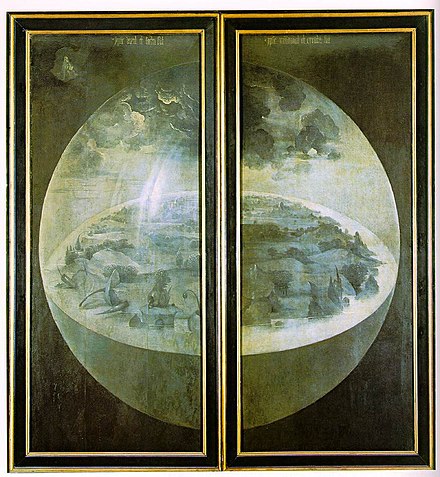
Have you not been told from the beginning?
Have you not discerned the earth’s foundation?
[By] the one who sits enthroned above the disk of the earth,
And its inhabitants are like grasshoppers;
The one who spreads out shamayim like gauze,
And stretches them out like a tent to dwell in. (Isaiah 40:21-22)
shamayim (שָׁמַיִם) = heavens, skies, firmament. (Always in the plural form, indicated by the suffix -im, or perhaps in the duplex form, in which the suffix -ayim indicates a pair.)
Let us take these metaphors one line at a time.
[By] the one who sits enthroned above the disk of the earth
When God is not in the sanctuary the Israelites built for God on earth, God is often described as enthroned in the shamayim, the heavens. From a vantage point that includes most of the horizon, the earth does look like a circular disk, and the sky looks like a dome.
And its inhabitants are like grasshoppers
To someone sitting at the top of the sky, human beings down on earth would indeed look tiny. The scouts in the book of Numbers use the same word for grasshoppers, chagavim (חֲגָבִים), to describe how they thought they looked to the giant people in Canaan.3 The grasshopper simile is an exaggeration for giants, who would be no more than twice as tall as the scouts. But it is an understatement for God, who looks down from the clouds and stars.
The one who spreads out shamayim like gauze
Clouds do look like gauze. The skies cannot be made entirely out of clouds, since there are also clear days. But poetry does not have to be technically accurate.
And stretches them out like a tent to dwell in
On a cloudy day the dome of the sky might look like the inside of a gigantic tent—which is a type of home. The description of God in a tent of sky is similar to Psalm 104, which begins:
May my soul bless God!
God, my god, you are very great.
You are clothed in majesty and splendor,
Wrapped in light like a robe,
Spreading out shamayim like tent-fabric. (Psalm 104:1-2)
The Master Gardener
After second Isaiah shows us God enthroned high in the sky—which God created in the first place—the prophet points out that compared to God, even the most powerful human beings are less important than grasshoppers. God is:
The one who appoints princes to nothingness,
Who makes judges of the earth tohu … (Isaiah 40:24)
tohu (תֺהוּ) = unreality; emptiness; chaos, confusion; worthlessness.
Here tohu means as insignificant as a “nothing”.
The word tohu appears 20 times in the Hebrew Bible. The most well-known appearance is in the first sentence of the first creation story in Genesis:
In a beginning, God created the shamayim and the earth, and the earth was tohu vavohu … (Genesis 1:1-2)
vavohu (וָבֺהוּ) = a rhyming addition to tohu used for emphasis. (It never appears except in “tohu vavohu”, and it does not add another shade of meaning.)
Before God begins creating the world (the heavens and earth) by saying “Let light be!”, there is tohu: a confused chaos without reality. God finds the state of tohu worthless, and therefore introduces order into the world.
Although the word tohu is a synonym for “nothingness” in Isaiah 40:24: “The one who appoints princes to nothingness, Who makes judges of the earth tohu”, the prophet’s audience would also remember the word tohu in Genesis, and think of those dignitaries as confused and worthless, as well as nothing compared to God.
After saying that God makes the princes and judges of the world mere tohu, the prophet finishes verse 4:24 with a metaphor from the plant world:

Hardly are they planted,
Hardly are they sown
Hardly have they rooted in the earth,
When [God] blows on them and they wither,
And the gale carries them off like chaff. (Isaiah 40:24)
From God’s point of view, a century is less than a month. But when God notices that a noxious empire has sprouted on earth, God pulls it out like a weed and it vanishes, carried off in the wind like chaff.
The Shepherd
The haftarah ends by declaring that God is so powerful, God even controls the “host” in the heavens.
“Then to whom can you liken me, so I can be compared?”

Says the Holy One.
Raise your eyes high and see:
Who created these?
The one who is mustering tzeva-am by number,
Who calls each by name.
Through [God’s] abundant power and might,
Not one is missing. (Isaiah 40:25)
tzeva-am (צְבָאָם) their “host”; tzava (צָבָא) = army, host, large organized force. (The tzeva of God in the Hebrew Bible seems to be either the stars and other heavenly bodies, or a group of lesser gods under God’s command, or both.)
Surely a God powerful enough to create the stars—or subordinate gods—will have no trouble returning the exiled Israelites to Jerusalem, and making their city flourish again.
And if God keeps track of every star in the sky, so not one is missing, perhaps God also keeps track of us grasshoppers down on earth.
The purpose of second Isaiah’s exhortation in this week’s haftarah is to encourage the exiled Israelites to return to Jerusalem after the fall of the Babylonian Empire. The Persian emperor Cyrus took Babylon in 539 B.C.E., only 47 years after the fall of Jerusalem, and instituted a policy allowing deportees to return to their homelands, rebuild their temples, and engage in local self-rule.
Why would the exiles need second Isaiah’s encouragement to return to Jerusalem, in these circumstances?
One answer is that they no longer believe their God is both powerful and on their side. After all, they or their parents remember when the Babylonian Army conquered all of Judah, burned down Jerusalem and its temple, deported their leading citizens, and left the rest (except for a puppet government) to starve. And their God did not lift a finger against their enemy.
During the siege of Jerusalem, the prophet Jeremiah insisted that God was collectively punishing the Israelites because too many of them they were unethical and worshiped other gods. Probably some Israelites considered the punishment out of proportion compared to the crime.
All the prophets promised that God would rescue and reward them if they worshiped only their own God, and refrained from unethical deeds such as cheating, stealing, bribing, and oppressing the poor. But could the Israelites reform enough to satisfy God? And could they count on their neighbors and leaders to do the same?
Life in Babylonia was not that bad, especially after the reasonable Persians took over. Why risk returning to Jerusalem? Even if they believe God has the power to reward them, why depend on such a touchy God?
- “First Isaiah”, Isaiah son of Amotz in Isaiah chapters 1-39, lived in the 8th century B.C.E. during the Assyrian attack on Jerusalem. “Second Isaiah” lived in the 6th century B.C.E. during the Babylonian destruction of Jerusalem and the subsequent exile of its citizens in Babylonia.
- See my blog post: Haftarat Va-etchannan—Isaiah: How to Comfort Yourself.
- Numbers 13:33. See my post: Shelach Lekha: Who Is Stronger.

 Questioning Torah
Great reading this morning. I suggest the gauze Isaiah is referring to is the Milky Way, and the tent the myriad of stars that he wuld have been able to see but we can’t due to light pollution. I remember spending a night in a tent in the Negev and looking out at the night stars – it’s very powerful.
I hadn’t thought of that! The Milky Way is an excellent candidate for gauze!