When a man dies with no sons, his daughters inherit his land, according to the new law God delivers in one of last week’s Torah portions, Pinchas. At the end of this week’s double portion, the men protest and win an amendment in the divine decision.
Once the Israelites have conquered Canaan, Moses says in Pinchas, a lottery will divide up all the land by tribe, clan, and household. Every male head of household will get a parcel of equal value, and his descendants will inherit that land down through the generations. (See my post: Pinchas: Tribal Loyalty, Part 1.)
The five daughters of Tzelofechad request a parcel of land in their deceased father’s name, since they have no brother to serve as the male head of household. Moses checks with God, who approves, and declares a general law:
“If a man dies and has no son, then you shall make his hereditary property pass over to his daughters.” (Numbers 27:8)
This ruling promotes women from chattels to second-class citizens who can inherit land—but only if their father dies without sons. If a daughter inherited and remained unmarried, she would have financial independence that no other women in society possessed.

But the male relatives of the daughters of Tzelofechad assume that all women want to marry and have sons. At the end of the book of Numbers/Bemidbar, in the Torah portion Masey (Numbers 33:1-36:13) there is a mass gathering of all the Israelites who are male heads of household. And the men of Tzelofechad’s clan—the clan of Gilad son of Makhir son of Menasheh son of Joseph—present their case to Moses.
First the men of Gilad summarize the new reality:
And they said: “God commanded my lord to give the land as hereditary property, by lottery, to the children of Israel. And my lord was commanded by God to give the hereditary property of Tzelofechad, our brother, to his daughters.” (Numbers 36:2)
But then who inherits the land from the daughters? Their sons, if they have any. But any son an Israelite woman has after marriage automatically belong to the tribe and clan of his father, not his mother. And if a woman who owns land dies without a son, but her husband is still alive, he inherits her land. Either way, the land now belongs to a different tribe, the male relatives of Tzelofechad point out.
“And if they become wives to any of the sons of the [other] tribes of the children of Israel, then their allotted hereditary property will be subtracted from the property of our fathers, and it will be added onto the property of the tribe that they will belong to. And so it will be subtracted from our allotted property!” (Numbers 36:3)
These men identify strongly with their own tribe, Menasheh, and with the Gilad branch of that tribe. Any reduction in the amount of land under the control of the Gilad clans of Menasheh seems like a personal loss to them.
To complete their case, the men point out that if land is sold outside the clan, the sale is only good until the next yoveil (“jubilee”), an event that happens every 50 years. In the yoveil year, every plot of land in the country is returned to the family of its original owners.1 But once a plot of land has been legally inherited by the son of a man from a different tribe, it will forever remain in his family line—in his tribe rather than his mother’s tribe. So they say:
“And if it is the yoveil for the children of Israel, then their hereditary property will be added onto the hereditary property of the tribe that they marry into. And the hereditary property of the tribe of their fathers will be subtracted from our tribe!” (Numbers 36:4)
Moses figures out a solution that will let daughters inherit their father’s land when he has no son or grandson to inherit, but also take care of the tribal loyalty of men. He answers Tzelofechad’s kinsmen in God’s name:
“This is the word that God commanded for the daughters of Tzelofechad, saying: They may become wives to whomever is good in their eyes; yet they shall become wives only within the clan of the tribe of their father.” (Numbers 26:6)
Then Moses makes it a general rule:
“And hereditary property must not go around for the children of Israel from tribe to tribe, because yidbeku, every man, the hereditary property of the tribe of his fathers. And every daughter coming into possession of hereditary property from the tribes of the children of Israel, she shall become a wife to someone from the clan of the tribe of her father, so that each of the sons of Israel shall possess the hereditary property of his fathers.” (Numbers 36:7-8)
yidbeku (יְִבְּחוּ)= they will/should/must cling to, stick to, be attached to. (A form of the verb davak, דָּבַק = clung to, stuck to, was attached to, fastened oneself to.)
But what if a male landowner dies without a son, and his daughter is already married to a man from another clan, or even another tribe? The Torah does not answer this question, but two medieval commentators insisted that in this case, the land would be inherited by the woman’s closest male relative, not by her son or husband.2
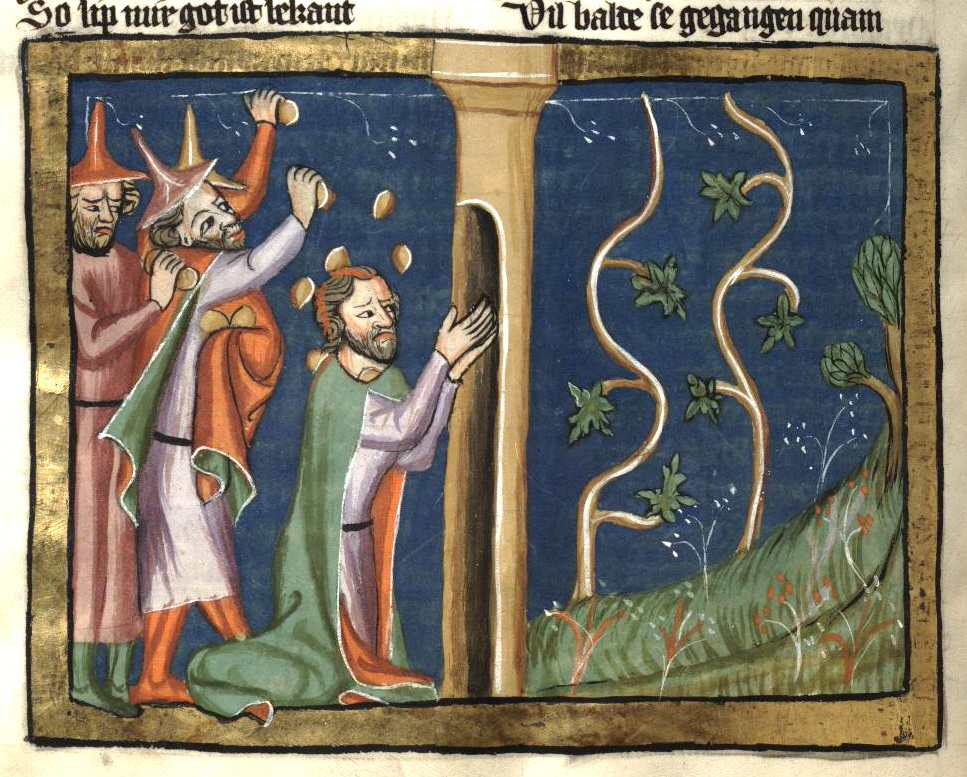
Inheriting land through the father’s line is so important in the Torah that the land cannot be truly sold, only leased until the yoveil year, when it returns to the original family. And the first book of Kings provides the example of Nabot, who refuses to sell his vineyard to King Ahab of Israel for any amount of silver, saying: “God forbid my giving the inheritance of my fathers to you!”3
The idea of clinging to your ancestral land is so important that Moses repeats it in this week’s Torah portion, Masey.
The hereditary property will not go around from one tribe to another tribe, because yidbeku, every man, his hereditary property in the tribes of the children of Israel. (Numbers 36:9)
Why should a man cling to tribal property?
One medieval commentator, Rabbeinu Bachya, offered a mystical explanation:
“At that time the twelve tribes of the Israelites on terrestrial earth corresponded to their exact counterparts in the celestial spheres (Zohar Bamidbar 118). If one tribe would have sold part of its ancestral territory to another, the result would have been an imbalance of the forces representing the tribes in the celestial regions.” 4
A more down-to-earth 19th-century commentator argued that the tribes needed to stay separate at first so that each one could develop its own subculture:
“This promotes the fulfillment of the nation’s one common calling in all the diversity of the unique characteristics of each tribe, and toward this end each tribe must be allowed to develop properly in the territory of its portion. … In all subsequent times, the tribes are not prohibited by the Torah to intermingle and to intermarry.”5
But is it a good idea to develop so many subcultures? Conquering Canaan could, theoretically, be an opportunity for the tribes of Israel to unite and become truly one people.6 Nevertheless, Moses tells the Israelite men to cling to the property that they inherit from their fathers so it will remain in their own tribe and clan. Perhaps the Torah views tribal loyalty as good practice for national loyalty, rather than a threat to it. Maybe the more you cling to one group, the more you become able to cling to a larger group.
Another reason to keep inheritance in the male line might be so t6hat tribes and clans will live together in contiguous areas. But excluding any heirs from another tribe resembles enforcing racially discrete neighborhoods through redlining. If your neighborhood of Menashites were interrupted by a farm owned by Danites, you might have to—well, learn tolerance and cooperation with an extended family from a different subculture.
But it is also possible that the ruling at the end of the book of Numbers reflects the reality that many people enjoy the ease and solidarity of belonging to an established group, and they identify with their group so much that when they believe the group was cheated, they feel personally outraged. In the Torah, those groups are clans, tribes, and “peoples”. In the west today, many identify with sports teams, religious sects, political factions, and nations. And whenever our own group is diminished, we feel outraged.
And Machlah, Tirtzah, and Chaglah, and Milkah, and Noah, the daughters of Tzelafechad, became wives to the sons of their uncles. From the clans of the children of Menasheh son of Joseph they became wives, and their hereditary possession became onto the tribe of the clans of their fathers. (Numbers 36:11-12)
Instead of insisting on marrying any men to whom they felt attached, or whom they wanted to fasten themselves to, the five women limited their choices to their first cousins. In the 19th century, Hirsch responded:
“They, however, chose in consideration of the national interest, and this was reckoned to their credit.”7
Which kind of attachment is the most important? Clinging to one’s marriage partner and nuclear family? Clinging to one’s heritage and tribal loyalties? Or clinging to a more abstract ethical or national ideal?
- Leviticus 25:8-16. See my post: Behar: Owning Land.
- Commentary by Ramban (Rabbi Moses ben Nachman, 1194–1270), and Tur HaAroch (written by Rabbi Jacob ben Asher, c. 1269-1343).
- I Kings 21:1-4.
- Rabbi Bachya ben Asher, 1255-1340, translation in http://www.sefaria.org.
- Samson Raphael Hirsch, The Hirsch Chumash: Sefer Bemidbar, translated by Daniel Haberman, Feldheim Publishers, p. 707.
- Or is such a union possible? This ideal was only partially realized when the thirteen colonies became the United States of America.
- Hirsch, p. 709.

 Questioning Torah
One thought on “Masey: Tribal Loyalty, Part 2”