Vayakheil+4: Not on Shabbat

“Hurry up and wait” describes a lot of life. Two weeks ago I was frantically getting ready to move my mother into assisted living. Now my effort to fulfill the Fifth Commandment and honor my mother is on hold until I get a moving date from the center—and wouldn’t you know it, she had another fall while she was alone in her house …

Talmud Readers, by Adolf Behrman, 1876-1943. What could be more absorbing?

I wish this period of waiting instead of doing labor were like the day of shabbat, the sabbath day of rest, but these days my soul is too heavy to rise to either refreshment or holiness. So this week I took my mind off my troubles by researching the commandment about shabbat. Here is a new post for this week’s Torah portion, Vayakheil—and four other portions in the book of Exodus, Beshallach, Yitro, Mishpatim, and Ki Tisa, that include variations on the command to desist from labor on the seventh day.

*

The first three of the Ten Commandments order us not to underestimate God.1 The last six are ethical precepts for human relations with other humans.2 In between, the fourth commandment combines holiness and ethics. It opens:

Remember the day of the shabbat, to treat it as holy. (Exodus 20:8) 3

shabbat (שַׁבַּת) = sabbath, day of rest. (From the same root as shavat, שָׁבַת = cease, stop, desist; stop working.)

This command is followed by explanatory notes in the Torah portion Yitro. More details are added every time the observance of shabbat is commanded in the book of Exodus—from the first time, in the portion Beshallach, when the Israelites are collecting manna, to the sixth time, in this week’s portion, Vayakheil, after God has given Moses a second set of tablets with the Ten Commandments carved in stone.

1) Don’t move

Manna Raining from Heaven, Maciejowski Bible, c. 1250 C.E.

Moses first mentions shabbat in the Torah portion Beshallach, when God provides manna for the hungry Israelites to gather up from the ground six, and only six, days a week. Moses says:

“See that God has given you the shabbat. Therefore on the sixth day [God] is giving you food for two days. Everyone in his place! No one go out from his spot on the seventh day!” (Exodus 16:29—Beshallach)

This introduces shabbat as a day of rest, at least in terms of going out and gathering food.

2) Holy break

The next order regarding shabbat is the one in the Ten Commandments in Yitro. The full fourth commandment states:

The Creation, by Lucas Cranach, 1534, Luther Bible

Remember the day of the shabbat, to make it holy. Six days you may work and you may do all your labor. But the seventh day is a shabbat for God, your God; you must not do any labor, you or your son or your daughter, your male slave or your female slave or your livestock or your immigrant within your gates. Because in six days God made the heavens and the earth and the sea and everything that is in them, and [God] took a break on the seventh day. Therefore God blessed the day of the shabbat and made it holy. (Exodus 20:8-11)

The emphasis in this commandment is on the holiness of shabbat. Since the day itself is holy, it must be set aside from mundane labor by all humans and animals in an Israelite’s household, and even by God.

3) Ethical refreshment

The third injunction about shabbat is in the portion Mishpatim:

Six days you may do your doings, but on the seventh day tishbot so that your ox and your donkey can take a break, veyinafeish, your slave and the immigrant. (Exodus 23:12)

tishbot (תּשְׁבֺּת) = you must cease, stop, stop working. (A form of the verb shavat.)

veyinafeish (וְיִנָּפֵשׁ) = and he can refresh himself, reanimate himself, catch his breath. (From the same root as nefesh, נֶפֶשׁ = throat, breath, appetite, mood, animating soul.)

This time Moses, speaking for God, gives a reason why even slaves, immigrants, and beasts must be given a day off from work on shabbat: so that draft animals can rest their muscles, and human laborers can rest their souls, becoming refreshed and revitalized.

Providing a day of rest is an ethical mandate; the moral principle of kindness calls for helping others to have a better life, and the moral principle of fairness supports giving everyone a day off when the landowner has a day off. Shabbat is the opposite of Pharaoh’s unethical subjection of the Israelite slaves to unremitting labor.4

4) Be holy or die

The fourth command about shabbat appears in the Torah portion Ki Tisa, after God finishes telling Moses what the Israelites must make to set up the sanctuary and the priests of their new religion. God warns that all of this construction must pause on the day of shabbat.

Nevertheless, you must observe shabtotai, because it is a sign between me and you for your generations, for knowledge that I, God, have made you holy. And you must observe the shabbat because it is holy for you. Whoever profanes it must definitely be put to death, because whoever does labor on it, his life will be cut off from among his people. (Exodus 31:12-14)

shabtotai (שַׁבְּתֺתַי) = my shabbats.

This order not only reiterates that shabbat is holy, but adds that observing it is a reminder that the Israelite people themselves are holy, i.e. set aside for God.

In addition, profaning shabbat by doing labor on that day is such a serious transgression that God assigns it the death penalty.

This rule about observing shabbat is the source text for the Talmud’s list of 39 categories of labor forbidden on the seventh day. The rabbis assume that since God warns that the work of building the sanctuary and fabricating the priests’ clothing must cease on shabbat, the labors involved in doing those tasks are the labors forbidden on shabbat from then on.5

This injunction in Ki Tisa continues:

The Israelites must observe the shabbat, doing the shabbat throughout their generations as a covenant forever. Between me and the Israelites it will be a sign forever, because for six days God make the heavens and the earth, and on the seventh day [God] shavat vayinafash. (Exodus 31:16-17)

vayinafash (וַיִּנָּפַשׁ) = and he refreshed himself, reanimated himself, caught his breath.   (A variant of veyinafeish.)

Since the divine life of the universe pauses every seven “days” for refreshment and redirection, so must our own souls. (See my earlier post,  Mishpatim, Ki Tisa, & 2 Samuel: Soul Recovery.)

5) No farming

Shabbat comes up again later in the portion Ki Tisa when God gives Moses additional instructions for the Israelites.

Six days you may work, but on the seventh day tishbot; at plowing and at grain-cutting tishbot. (Exodus 34:21)

The book of Exodus gives no reason why agricultural labor in particular is prohibited on shabbat. One possibility is that this sentence refers to the ethical law about shabbat in Mishpatim, since landowners used draft animals (oxen and donkeys) to plow, and teams of underlings including slaves and immigrants to scythe down ripe grain.

Sheaves of grain

On the other hand, the list in the Talmud of activities prohibited on shabbat includes farming chores that eventually lead to the bread that must be displayed on the gold-plated table in the sanctuary.6 The first eleven of the 39 prohibited labors in the Talmud are sowing grain, plowing, reaping, gathering sheaves, threshing, winnowing, selecting the edible kernels, grinding them into flour, sifting the flour, kneading dough, and baking bread. By this interpretation, the ban on plowing and reaping on shabbat might mean the holiness of the day surpasses the holiness of the sanctuary.

6) Light no fires

The sixth and final shabbat instruction in the book of Exodus occurs in this week’s Torah portion, Vayakheil. Again the seventh day is called holy, and doing labor on that day is punishable by death.

Six days you may do labor, but the seventh day must be holy for you, a shabbat shabbaton for God. Anyone who does labor on it must be put to death. You must not kindle a fire in any of your settlements on the day of shabbat. (Exodus 35:2-3)

shabbaton (שַׁבָּתוֹן) = most solemn shabbat, feast day of shabbat, day of absolute stopping.

Here Moses repeats God’s commands that the day of shabbat must be treated as holy and that anyone who does not desist from labor on that day must be executed.

The new information in Vayakheil is that lighting a fire is prohibited on shabbat. Before this, the only specific examples of labor forbidden on shabbat are agricultural: gathering manna, using draft animals, sowing and reaping . Now, in Vayakheil, Moses gives another example of labor: lighting a fire.

The purpose of this prohibition cannot be ethical, since lighting a fire is not in itself a heavy labor, and it benefits other humans by giving them heat, light, and a way to cook food.

Since the previous verse reminds us that the seventh day must be holy, refraining from kindling a fire must be another religious rule associated with holiness.

Kindling a fire is number 37 in the Talmud’s list of 39 labors banned on shabbat, right after extinguishing a fire. It may allude to the fire on the altar. Although burnt offerings continue during shabbat according to the Torah, the fire is not rekindled. In fact, it must never go out.7 The altar fire is holy because it is dedicated to God, and because God kindled it.8

*

Thus the book of Exodus presents the law against working on shabbat as a religious rule (guarding what is holy) three to five times.9 It presents the law as an ethical rule (promoting kindness and fairness) only twice.10

Yet when we observe the day of shabbat we can remember that it is not solely a religious requirement reminding us of holiness. We will not be put to death for doing forbidden work on shabbat, since that part of the order in this week’s Torah portion is no longer followed. But when we try to set aside mundane concerns in order to elevate our souls on the seventh day, we can also remember the ethical values in the last six commandments, which address kindness, fairness, and respect for other human beings.

And I can pray that soon I will be able to obey the fifth commandment, and treat my mother with kindness and respect by moving her into a safe place.

  1. See my upcoming post, Pekudei, Yitro, & Ki Tisa: Not Like Other Gods.
  2. See my posts Yitro, Mishpatin, & Va-etchanan: Relative or Relevant? Part 1, Part 2, and Part 3 on the last six commandments.
  3. This is the opening in Exodus. When Moses repeats the Ten Commandments in Deuteronomy, the fourth commandment opens: Observe the day of the shabbat and treat it as holy. (Deuteronomy 5:12)
  4. Exodus 5:1-9, 6:9.
  5. Talmud Bavli, Shabbat 73a, Mishna.
  6. Exodus 25:23-30.
  7. Leviticus 6:5-6.
  8. Leviticus 9:24 for the portable sanctuary in the wilderness.
  9. Exodus 16:29, 20:8 and 11, 31:12-13 at a minimum. According to the Talmud Exodus 34:21 and 35:2-3 are also rules for religious purposes.
  10. Exodus 20:9-10, 23:12.

Ki Tisa: Golden Calf, Stone Commandments

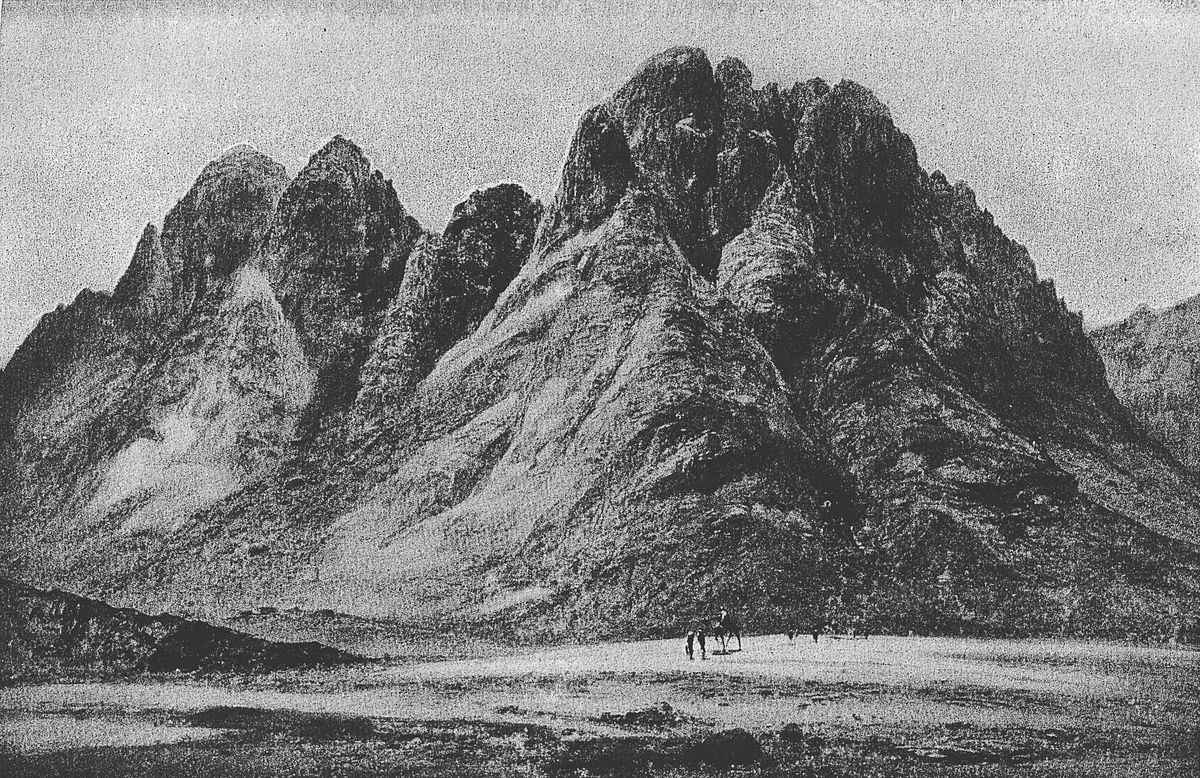
Mount Sinai, by Elijah Walton, 19th century

The Torah gives the Ten Commandments1 top priority out of all the rules and orders God gives to the Israelites through Moses. God utters them in the Torah portion Yitro after manifesting in smoke, fire, and thunder, and Moses tells the people what God said.

At the beginning of this week’s Torah portion, Ki Tisa, God engraves the Ten Commandments in stone.

Then [God] gave to Moses, as [God] finished speaking with him on Mount Sinai, the two tablets of the Testimony, stone tablets engraved by the finger of God. (Exodus/Shemot 31:18)

Aaron and the second commandment

While God is giving Moses the first pair of stone tablets, the Israelites at the foot of the mountain are losing hope that Moses will ever come back down. After they have waited for almost forty days, they tell Moses’ brother Aaron:

“Get up! Make us a god that will go before us! Because this Moses, the man who brought us up from the land of Egypt, we do not know what has happened to him!” (Exodus 32:1)

The people desperately want an intermediary between themselves and the invisible, remote, and terrifying God that Moses says has adopted them. Moses was a visible human being, and he could tell them what God wanted, so he was a satisfactory intermediary—until   he vanished into the cloud on top of Mount Sinai.2

Now the people demand a new intermediary. They know the “god” they ask Aaron to make could not speak, like Moses, but at least it would be visible and familiar, like the idols in Egypt.

Aaron is not only Moses’ older brother, but his second-in-command. Yet God has not yet spoken directly to him, and does not do so until Leviticus 10:8-11. The Israelites turn to Aaron as their default leader, but do not expect him to replace Moses as God’s prophet.

Aaron could ask the people to wait another day for Moses to return before taking any rash action. He could remind them of God’s second commandment, which Moses told them during the revelation at Sinai:

You must not make for yourself a statue or any likeness of what is in the heavens above or what is on the earth below or what is in the waters below the earth. You must not bow down to them, and you must not serve them … (Exodus 20:4-5)

He could frighten the people by predicting that their God would surely smite them all if they violated this commandment. But he does not.

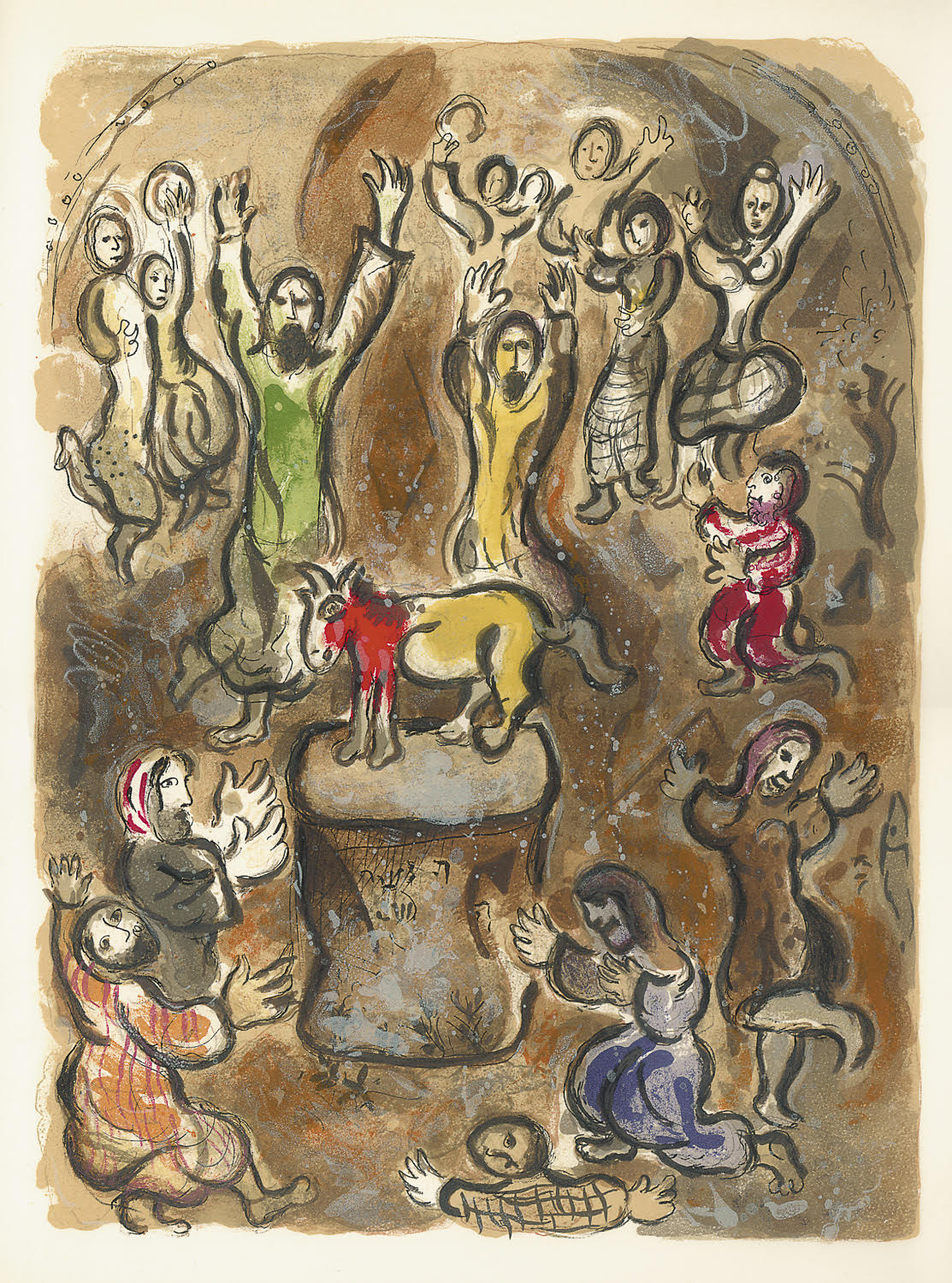
The Adoration of the Golden Calf, by Marc Chagall, 1966

Instead, Aaron asks the people to bring him their gold earrings, and casts the gold in the shape of a calf.

And they said: “This is your God, Israel, who brought you up from the land of Egypt!” And Aaron saw, and he built an altar in front of it. And Aaron made an announcement, and said: “Tomorrow is a festival for Y-H-V-H!” (Exodus 32:4-5)

Aaron uses the four-letter proper name of the God of Israel, so he is not violating the first commandment, “You must have no other gods before me.” But he is violating the second commandment, which prohibits making or worshiping an idol.

He has not had a chance to read the commandments on the stone tablets Moses is about to bring down from Mount Sinai. But he has heard Moses declare them. He cannot claim ignorance as an excuse.

Moses and the sixth commandment

The next day the Israelites make burnt offerings in front of the golden calf. By the time Moses reached the bottom of Mount Sinai, they are eating, drinking, and enjoying themselves.

Moses Breaking the Tablets of the Law, by Gustave Dore, 19th cent.

Moses smashes God’s stone tablets.3 Then he melts down the calf, grinds the gold into powder, mixes it with water, and makes the Israelites drink it. He questions his brother Aaron, who gives a feeble excuse, and Moses lets it pass.

Then Moses saw that the people were parua, because Aaron peraoh for a non-entity … (Exodus 32:25)

parua (פָּרֻעַ) = wild, out of control.

peraoh (פְּרָעֺה) = he let [them] get out of control.

Apparently after they have watched Moses melt the calf and grind its gold into dust, some of the Israelites feel wild agitation over losing their idol.

Then Moses stood in the gate of the camp and said: “Who is for Y-H-V-H? To me!” And all the Levite men gathered around him. And he said to them: “Thus says Y-H-V-H, the God of Israel: Every man, put his sword on his hip! Cross and return from gate to gate of the camp, and every man kill his brother and his fellow and his close relatives!” And the Levite men did as Moses spoke, and about 3,000 men of the people fell on that day. (Exodus 32:26-28)

Do the Levites violate the sixth commandment?

Lo tirtzach. (Exodus 20:13)

lo tirtzach (לֺא תִרְצָח) = you must not kill without a legal sanction. (From the verb ratzach, רָצַח.)

Other uses of the verb ratzach in the Torah indicate that this commandment only covers deliberate murder of a fellow Israelite. (See my post Yitro, Mishpatim, & Va-etchanan: Relative or Relevant? Part 1.) God does not prohibit causing accidental death, executing someone who was given the death penalty, or killing the enemy in war. But the Levites deliberately kill fellow Israelites who have not been tried in court with witnesses and sentenced to death.

If each Levite man were individually choosing a fellow Israelite to kill (presumably one who is still parua after the golden calf fiasco), then he would be violating the sixth commandment. But the Levites have to sweep through the camp and back with lightning speed before the other Israelites either escape or fight back. They do not have time to pause and identify who they are killing.

Individual Levite men make one conscious choice: Moses calls out “Who is for God? To me!” and they gather around him. After that they simply obey his orders in the name of God. If Moses had not announced that God wanted them to run through the camp killing people, the Levites would not have taken up their swords.

Bronze Age Short Sword

Moses bears the primary responsibility for the massacre. Does he merely pass on God’s orders word-for-word? Not according to Rashi,4 who wrote that Moses’ order to the Levites was based on an earlier order from God:

“Whoever offers a slaughter-sacrifice to any god except Y-H-V-H alone will be dedicated to destruction.” (Exodus 22:19).

This law in the Torah portion Mishpatim is an elaboration of the second commandment.

Moses might be applying God’s ruling in Mishpatim when he says God wants the Levite men to run through the camp killing people. Or he might be speaking impulsively in a potentially dangerous moment, based on God’s outrage over the golden calf worship, and perhaps a sense that God continues to feel outrage.

What he does not do is pronounce death penalties on about 3,000 men and ask the Levites to execute them. Moses is the chief judge for all the Israelites,5 so he certainly has the legal authority to pronounce death penalties. However, in the Torah a judge rules on individual cases, and only after hearing the testimony of witnesses concerning the accused. Moses asks only Aaron for information about his role in the golden calf fiasco. He calls no witnesses, and pronounces no individual sentences.

Moses violates the sixth commandment by ordering the men of his tribe, the Levites, to murder Israelites without the proper legal sanction. Does he at least achieve what God wants?

The primary effect of the Levites’ lightning-strike massacre would be shock and fear—which might be just what Moses intends. Fear may not be the best motivator for long-term obedience, but it does work in the short run, and Moses and God use it repeatedly in the Torah. The shattering of the stone tablets and the destruction and consumption of the golden calf are not enough to frighten all the Israelites into obedience, but the massacre by the Levites does the trick.

The next day, Moses asks God to forgive the Israelites for the sin of the golden calf. But apparently God is not fully satisfied with the results of the massacre.

And Y-H-V-H said to Moses: “Whoever has offended against me, I will wipe out from my record … and on the day of my accounting, I will bring them to account for their offenses.” And God struck a blow against the people over what they did with the calf that Aaron made. (Exodus 32:33-35)

Classic commentators6 interpreted God’s blow as a plague of disease that killed a particular group of golden calf worshippers who were still alive after the massacre by the Levites.


Neither Aaron nor Moses is punished for his violation of one of the Ten Commandments. Moses says in Deuteronomy 9:20 that he prayed for his brother Aaron, and God forgave him. Moses’ good relationship with God continues; in the remainder of the portion Ki Tisa, Moses asks God to resume leading the people in person (presumably as the pillar of cloud and fire) and God agrees. Then God tells Moses:

“Carve yourself two stone tablets like the first ones, and I will engrave upon the tablets the words that were on the first tablets, which you shattered.” (Exodus 34:1)

Moses climbs Mount Sinai again, carrying blank tablets, and God engraves them with the same ten commandments. Perhaps this shows that God both forgave Moses and reaffirmed that the Ten Commandments as fundamental precepts.

Or perhaps this shows that God plays favorites, approving of the death of thousands of Israelites because they worshiped an idol, but preserving the lives of his two darlings, Moses and Aaron.


  1. What we call “the Ten Commandments” in English are ten “statements” in the bible. Exodus introduces the ten with “And God spoke all these ” (Exodus 20:1) Devarim, דְּבָרִים = words, statements, things. Moses repeats them in Deuteronomy 5:6-18, then concludes: “These devarim God spoke to your whole congregation at the mountain, in a great voice from the midst of the fire and the cloud and the gloom, and … engraved them on two stone tablets.” (Deuteronomy 5:19)
  2. Exodus 24:15-18.
  3. Exodus 32:15-19.
  4. Rashi is the acronym of 11th-century Rabbi Shlomo Yitzchaki.
  5. Exodus 18:13-26.
  6. Including Rashi, Ibn Ezra (12th-century commentator Abraham ben Meir Ibn Ezra), and Ramban (13th-century Rabbi Moses ben Nachman).
  7. In Leviticus 10:1-3.

Taking the Fifth

Doing what I love includes writing about the Torah. Doing what I must includes honoring my mother (the fifth of the Ten Commandments) by moving her into assisted living so she can get the help she needs.

This heroic labor means that I will have little time for my blog over the next few weeks. I started working on a new essay for next week’s Torah portion, Ki Tisa, and I hope I can squeeze in enough writing time to finish it soon. Meanwhile, I will send out links to earlier posts every week until my mother is safe and settled.

If you want to read one of my earlier posts about this week’s potion, Tetzaveh, you can click on this link: Tetzaveh & Psalms 141, 51, and 40: Smoke and Prayer.

Or go to “POSTS BY TORAH PORTION OR BOOK” in the sidebar on the right side of this page, click the down-arrow next to CATEGORIES, and navigate to any previous post you want to read … while I am being a mother to my mother.

Mother and Child, by Mary Cassat


Yitro, Mishpatim, and Va-etchanan: Relative or Relevant? Part 3

Ten Commandments by Jekuthiel Sofer, 1768

Universal ethical principles are relevant in all places and times. While the first four of the Ten Commandments1 are religious injunctions rather than universal ethical rules, the last six are sometimes considered universal.

In my last two blog posts I discussed commandments five through eight,2 and suggested that the following versions would be more comprehensively relevant:

  1. Parents must respect their children, and children must respect their parents. (To replace “Honor your father and your mother.”)
  2. You must not kill except to prevent someone from being killed. (To replace “You must not kill-without-a-legal-sanction.”)
  3. You must not break a vow to another person without formally dissolving it first. (To replace “You must not commit adultery-between-a-man-and a married-woman.”)
  4. You must not covertly take what rightfully belongs to another. (To replace “You must not steal.”)

What about commandments nine and ten, on false testimony and coveting? Are they morally relative, guides to good behavior only within Ancient Israelite culture? Are they moral absolutes? Or do they, too, need some revision to become universal ethical precepts?

*

The Ninth Commandment

Witness stand, by Ida Libby Dengrove

Lo ta-aneh against your fellow [as] a witness to a falsehood. (Exodus/Shemot 20:13)

lo ta-aneh (ֺלֺא תַעֲנֶה) = you must not answer, testify; stoop.

Like the previous four commandments, the ninth is followed by more specific statutes in Mishpatim, last week’s Torah portion.

You must not take up an empty rumor. You shall not put in your hand with the wicked to become a malicious witness. (Exodus 23:1)

In other words, ethical witnesses in a court of law must testify only to what they have perceived with their own senses, discounting anything they have heard that might be a rumor, and ignoring what other witnesses say. (In Torah law, a person cannot be convicted without the testimony of at least two witnesses.3)

You must not follow rabim for evil, and lo ta-aneh on a legal dispute to turn aside [and] follow the majority4 to mislead. (Exodus 23:2)

Using that definition, this law specifies that a witness must not support popular sentiment against the defendant by making misleading statements.

Ibn Ezra pointed out that even a large number of witnesses can be wrong: “Thou shalt not follow a multitude to do evil. If you see many people testifying concerning something that you know nothing of, do not say to yourself all of these people cannot be lying.”5

The book of Exodus continues by warning witnesses not to give misleading testimony in order to help out the poor.6

And you must not favor the powerless in his legal dispute. (Exodus 23:3)

Kindness to the poor is an important moral value in the Torah,7 but when someone is being tried for a crime, honesty is more important.

Is honesty always the best policy? Many cultures consider a “white lie” harmless and even ethical when it is used to avoid hurting someone’s feelings and has no negative consequences. A “white lie” might include rejecting an invitation by falsely saying you are busy that night, or complimenting someone on a new haircut that you actually think is ugly.

The ninth commandment only addresses giving honest testimony as a witness. But is honesty always the best, most ethical policy when you are testifying to legal authorities? What if you live in a society that punishes the crime of shoplifting with death or the loss of a hand, and you hold the conviction that this punishment is unethical? Should you tell a falsehood?

Your society would consider it ethical to report everything you saw the shoplifter do. But if your own belief is morally better, complete honesty as a witness cannot be a universal ethical precept.

However, the ninth commandment only says: You must not testify against your fellow as a witness to a falsehood. It does not require full disclosure in a morally difficult situation, but only prohibits lying when a falsehood could result in conviction and punishment of an innocent person.

This strict interpretation of the ninth commandment is relevant in all cultures. It could even be rephrased to cover situations outside of court, and remain a universal principle:

You must not speak falsehood that might cause harm to another.

The Tenth Commandment

The other nine commandments all forbid or require certain actions. (Commandment five, “Honor your father and your mother”, requires certain actions rather than an internal feeling of honor or respect. See my post Yitro, Mishpatim, and Va-etchanan: Relative or Relevant? Part 1.) At first glance, the final commandment seems to be forbidding a feeling rather than an action.

Thou Shalt Not Covet Thy Neighbor’s House, postcard by The Rose Co., 1908

Lo tachmod your fellow’s house; lo tachmod your fellow’s wife, or his male slave, or his female slave, or his bull, or his donkey, or anything that belongs to your fellow. (Exodus 20:14)

lo tachmod (לֺא תַחְמֺד) = you must not covet, crave, desire to possess. (From the root verb chamad, חָמַד = desired and tried to acquire, coveted, craved.)

Although many of the other commandments are elaborated by statutes given in the Torah portion Mishpatim, no laws in Mishpatim refer to coveting or craving.8

Another way to determine the meaning of the tenth commandment is to look at how the verb chamad is used elsewhere in the Hebrew Bible.9 In ten of the twenty occurrences of the verb chamad, it is connected with taking possession of the thing coveted. Therefore some commentary has interpreted the tenth commandment as prohibiting robbery, under the assumption that coveting inevitably leads to an attempt to steal by force.10

The repetition of the tenth commandment in the book of Deuteronomy is worded slightly differently, putting another man’s wife first, and using a synonym to prohibit an unhealthy desire for any other possessions:

And lo tachmod your fellow’s wife, and lo titaveh your fellow’s house, his field, or his male slave, or his female slave or his bull, or his donkey, or anything that belongs to your fellow. (Deuteronomy/Devarim 5:18)

lo titaveh (לֺא תִתְאַוֶּה) = you must not crave. (A form of the verb aveh, אוּה = craved, longed for.)

Why does Deuteronomy use the verb chamad only for coveting someone else’s wife, and the verb aveh for everything else? The Mekhilta d’Rabbi Yishmael claims that craving leads to coveting, and coveting leads to robbing.11 Certainly the verb aveh indicates a visceral desire; out of the 27 times it appears in the Hebrew Bible, thirteen are about craving a particular food or drink.12

But why does the tenth commandment prohibit coveting rather than the action that follows it, the attempt to take by force? I suspect that the Torah is distinguishing between taking a fellow Israelite’s possessions when one is obsessed with desire, from taking foreigners’ possessions when one is authorized to do so in war. The Torah is full of commands to the Israelites to strip the Canaanites of all their possessions as they conquer the land. Other rules in the Torah discuss the correct ways of taking booty in battles with other countries. This is not the kind of robbing the Torah would include in the Ten Commandments.

Those who covet what belongs to others also harm themselves; envious obsession does not make for a happy life.  But is it possible to legislate feelings?

Yes, according to 11th-century commentator Abraham ben Meir Ibn Ezra. He wrote that just as a man does not desire to sleep with his mother, although she be beautiful, because he has been trained from his childhood to know that she is prohibited to him,” sensible people may notice that certain people or things owned by others are desirable, but they dismiss any covetous thoughts about possessions that are obviously off-limits.13

The remaining question is why the tenth commandment prohibits a feeling, when the other nine commandments prohibit or require an action.

While classic commentary claims that the tenth commandment really prohibits the act of robbery, I would argue that this final commandment caps the Decalogue by implying that obsessive thoughts about illegal deeds can lead to everything the Torah considers evil, from worshiping other gods (Commandment 1) to murder (6), adultery (7), and theft (8). Failing to honor one’s parents (5) could be the result of nursing resentment against them for their own bad deeds, and giving false testimony (9) could be the result of a consuming desire for popularity in the crowd that is accusing the defendant.

Therefore an appropriate update of the tenth commandment could be simply:

You must not covet anything that belongs to another person.

An alternative that encompasses a wider range of negative obsessions is:

You must not dwell on desires that would cause harm to others.

  1. The “Ten Commandments” is the popular English designation for the ten precepts God utters at Mount Sinai, listed in both Exodus 20:2-14 (in the Torah portion Yitro) and Deuteronomy 5:6-18 (in Va-etchanan).
  2. See Yitro, Mishpatim, and Va-etchanan: Relative or Relevant? Part 1 and Part 2.
  3. At least two witnesses are required for conviction in a legal case according to Deuteronomy 17:6, 19:15.
  4. Many English verstions of Exodus 23:2 including the standard JPS (Jewish Publication Society) translation, interpret the word rabim (רַבִּים) as the wealthy, even though its usual meaning is “the many”. But the Talmud, Rashi, and at least two careful modern translations interpret rabim as the many or the majority.4 Talmud Bavli, Bava Metzia 59b, Chullin 11a, Sanhedrin 2a. Rashi on 23:2. Robert Alter, The Five Books of Moses, W.W. Norton & Co., New York, 2004, p. 448. Everett Fox, The Five Books of Moses, Schocken Books, New York, 1983, p. 383.
  5. 17th-century commentator Abraham ben Meir Ibn Ezra, translated in sefaria.org.
  6. Exodus 23:6-8 instructs judges not to bend the truth to help or harm the poor, as well as to reject bribes—presumably from the wealthy. Also see Leviticus 19:15.
  7. g. Exodus 22:20-26 in the Torah portion Mishpatim, which also reiterates the commandment against favoring the poor in a legal case (Exodus 23:3).
  8. The laws in Mishpatim on theft (Exodus 21:37-22:3 and 22:6-8) are more closely related to the eighth commandment, “You must not steal”, and are covered in my post Yitro, Mishpatim, and Va-etchanan: Relative or Relevant? Part 2.
  9. See Leonard Greenspoon, “Do Not Covet: Is It a Feeling or an Action?”, https://www.thetorah.com/article/do-not-covet-is-it-a-feeling-or-an-action.
  10. The proof text given in Mekhilta d’Rabbi Yishmael 20:14:1-3 (2nd-3rd century C.E.) and other early commentaries is Micah 2:1-2. This line of reasoning considers the eighth commandment, “You must not steal”, a prohibition against kidnapping a man who is not the property of anyone else. (E.g. Sanhedrin 86a).
  11. Mekhilta d’Rabbi Yishmael 20:14:1-3, from sefaria.org.
  12. Numbers 11:4, 11:34, and 34:10; Deuteronomy 12:20 and 14:26; 1 Samuel 2:16; 2 Samuel 23:15 and 1 Chronicles 11:17; Micah 7:1; Psalm 106:13-14; Proverbs 23:3 and 23:6.
  13. Translation of Ibn Ezra in sefaria.org.