Yitro, Mishpatim, and Va-etchanan: Relative or Relevant? Part 2

Are the last six of the Ten Commandments universal ethical precepts, good for all places and times? Or are they morally relative, guides only to correct behavior within the ancient Israelite culture?

Last week’s post1 examined commandments five (honoring parents) and six (no killing). This week, Part 2 will assess commandments seven (no adultery) and eight (no stealing). Check in next week for the last two commandments, on false testimony and coveting.

*

The Seventh Commandment

Lo tinaf. (Exodus 20:13)

lo tinaf (לֺא תִנְאָף) = you must not commit adultery. (From the verb na-af, נַאַף = committed adultery between a man and a married or engaged woman.)

Bathsheba, by Jean-Leon Gerome, 1889. (King David, the peeping tom at the upper left, commits adultery with her.)

Adultery in the Hebrew bible is consensual sexual intercourse between a married or engaged woman and a man who is not her husband or fiancé. This type of liaison was such a serious transgression in Ancient Israel that the Torah prescribes the death penalty for both partners.

And a man who yinaf with a man’s wife, who yinaf with the wife of his fellow, he shall definitely be put to death, the no-eif and the no-afet. (Leviticus 20:10)

yinaf (יִנְאַף) = he commits adultery. (Another conjugation of the verb na-af.)

no-eif (נֺאֵף) = the male adulterer. (From the root verb na-af.)

no-afet (נֺאָפֶת) = the female adulterer. (From the root verb na-af.)

Yet it is not wrong in the Torah for a married man to have sex with a woman other than his wife, as long as she is single and not living with her father—i.e. if she is a prostitute, or perhaps an independent widow. It is also acceptable for a man to have a second wife, a concubine, or a female slave acquired for sexual purposes.

A woman, however, can belong to only one man.

Most women in the Torah are the property of their fathers, their husbands, or their owners. Therefore when a man commits adultery he is, in effect, stealing another man’s property.

What if a man has sex with a virgin who still belongs to her father? The law for this specific case is given in this week’s Torah portion, Mishpatim (“Laws”), and it applies whether the man is married or unmarried:

And if a man persuades a virgin who is not engaged, and lies down with her, he must give her a marriage contract to be his wife. [But] if her father definitely refuses to give her to him, he must weigh out the same amount of silver as in the marriage contract for virgins. (Exodus 22:15-16)

Either way, the seducer’s payment goes to the virgin’s father, since she is her father’s property.

When a society grants women equal rights and autonomy, so they are no longer property, the Hebrew Bible’s reason for condemning adultery vanishes. Does that mean it is not immoral in Western society today for a married person to have sex outside the marriage?

In that case, adultery is unethical for a different reason. When people of any gender commit themselves to fidelity in marriage, they make a vow in front of witnesses. This is a promise and a binding contract. It is unethical to violate the terms of a contract while it is still in force. Only after divorce proceedings have been filed to end that type of marriage can a person add a sexual partner without committing an immoral deed.

The seventh commandment would be universally relevant if it were phrased this way:

You must not break a vow to another person without formally dissolving it first.

This version would cover not only exclusive marriage vows but all formal vows, including employment agreements and other legal contracts. The Torah also considers vows sacred obligations whether they are made to God or to other humans.2

The Eighth Commandment

After the commandment prohibiting the theft of a man’s wife or fiancée comes a commandment prohibiting other kinds of theft.

Lo tignov. (Exodus 20:14)

lo tignov (לֺא תִגְנֺב) = you must not steal, you must not covertly take what rightfully belongs to another. (From the verb ganav, גָּנַב = stole.)

Pickpocket detail from The Fortune Teller, by Georges de La Tour, ca. 1630

The eighth commandment covers kidnapping a man or boy,3 as well as stealing livestock, silver, or other goods. This week’s portion, Mishpatim, gives the penalties for several kinds of stealing.

Vegoneiv a man and sells him, and [the man] is found in his possession, he shall definitely be put to death. If a man yignov a bull or a lamb and slaughters it or sells it, he must pay compensation with five cattle to replace the bull, or four sheep to replace the lamb. (Exodus 21:16-17)

vegoneiv (וְגֹנֵב) = and one who steals. (From the same root as ganav.)

yignov (יִגְנֺב) = he steals. (Another form of the verb ganav.)

A thief must also pay compensation for stealing an animal and keeping it:

If hagenavah is found alive in his possession, from a bull to a donkey to a lamb, he must pay compensation for double [the value]. (Exodus 22:3)

hagenavah (הַגְּנֵבָה) = the stolen item. (From the root verb ganav.)

In other words, someone who “steals” or kidnaps a male human being gets the death penalty;4 but someone who steals livestock (or an inanimate object) must pay the owner compensation worth significantly more than the stolen item.

Anyone but a sociopath would consider kidnapping a human worse than stealing an animal or object. And all human cultures consider it unethical to steal what really belongs to another. But cultures differ on what can be rightfully owned by an individual, and what is owned in common by the social group or the state.

When Pierre-Joseph Proudhon wrote “Property is theft!”,5 he expressed his opposition to private ownership of land. Karl Marx opposed the private ownership of both land and the means of production.6 Socialism approves of individual ownership of land and businesses up to a point, but reserves ownership of the largest and most indispensable industries and utilities for the state. Capitalism, which is becoming the dominant economic culture in the world, supports individual and corporate ownership of almost everything except human beings, accepting state ownership only in areas that serve the interests of corporations.

Theft certainly covers one individual stealing from another. But is it theft when a corporation or a government entity legally takes something from an individual? Who rightfully owns what?

Another issue is that stealing, goneiv (גֺּוֵב), implies taking what belongs to another by stealth, covertly. Appropriating something that belongs to another overtly, by force, is robbing, gozeil (גּוֹזֵל) in Biblical Hebrew.

I proposed rephrasing the eighth commandment slightly:

You must not covertly take what rightfully belongs to another.

We form our own opinions about what rightfully belongs to the state, to a corporation, or to an individual, and judge the morality of a particular covert appropriation of something accordingly. However, the legality of the particular appropriation is determined by the state.

  1. Yitro, Mishpatim, and Va-etchanan: Relative or Relevant? Part 1.
  2. g. Numbers 30:2-10.
  3. A woman “steals” (vatignov) an underage boy and hides him in 2 Kings 11:2.
  4. One girl is kidnapped in the Hebrew Bible in order to be seduced (Genesis 34:1-4). Women and girls are also seized as booty in war.
  5. Pierre-Joseph Proudhon, Qu’est-ce que la propriété? ou, Recherches sur le principe du droit et du gouvernement, Paris, 1840.
  6. Karl Marx, Das Kapital, Vol. III, Verlag von Otto Meisner, Publisher, 1867.
 

Yitro, Mishpatim, & Va-etchanan: Relative or Relevant? Part 1

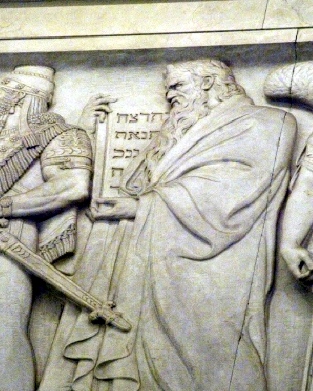
Moses on south frieze of Supreme Court building, by Adolph Weinman

The “Ten Commandments”1 are fundamental precepts, good for all time, right? Well, maybe.

The first four of the ten commandments (which appear in this week’s Torah portion, Yitro, in the book of Exodus, and again in Va-etchanan in the book of Deuteronomy) are religious injunctions. They prohibit having other gods,2 making or worshiping idols, swearing falsely in the name of God,3 and working on the holy seventh day of the week, Shabbat. These four commandments are hardly universal precepts, since they do not apply to people with other religions (including atheism).

The next six commandments, however, are about ethics, i.e. the right way to treat other people:

  1. Honor your father and your mother …
  2. You must not kill.
  3. You must not commit adultery.
  4. You must not steal.
  5. You must not testify falsely.
  6. You must not covet …

Not all of these commandments are easy to interpret outside the context of the social customs of the Ancient Near East.  Does that mean they are morally relative, guides only to correct behavior within the ancient Israelite culture? Or are they nevertheless moral absolutes, still relevant today?

This week’s post examines commandments five and six. Next week, Part 2 will assess commandments seven and eight. The week after that, Part 3 will explore the last two commandments.

*

The Fifth Commandment

Kabeid your father and your mother, so that your days will be long on the earth that God, your God, is giving to you. (Exodus/Shemot 20:12)

kabeid (כַּבֵּד) = honor, treat as important. (From the same root as the adjective kabeid, כַּבֵּד = heavy, weighty, impressive, oppressive, dull, hard.)

According to traditional commentary, if you honor your parents, your children will honor you.4 That means your adult children will make sure you are well fed and housed when you can no longer manage on your own, and therefore you will indeed live longer. (No wonder having children is a top priority in the Torah!)5

Maimonides wrote that in addition to making sure our parents have food, clothing, and shelter, we must be indulgent with them if they have dementia. When adult children can no long bear the strain of tending such a parent, they may hire others to take care of them.6

Honoring one’s parents goes beyond providing for their physical needs in the Torah. Next week’s Torah portion, Mishpatim, assigns the death penalty to the crime of hitting parents, or even speaking ill of them.

And one who strikes his father or his mother shall certainly be put to death. (Exodus 21:15)

And mekaleil his father or his mother shall certainly be put to death. (Exodus 21:17)

mekaleil (מְקַלֵּל) = one who belittles, one who curses.

There is no penalty in the Hebrew bible for a parent hitting or belittling a child. Hitting children in order to discipline them is considered a good deed in the book of Proverbs.7 Elsewhere parents are required to teach their children certain laws and traditions from the Torah,8 but the bible is silent about child abuse or neglect.9

This silence reflects the culture of the Ancient Near East, in which underage children were the property of their fathers and had no rights of their own. In other cultures, child abuse and neglect are considered criminal, and the ethical standard is for parents to treat their children with kindness and respect them as individuals, while still teaching them acceptable behavior in their society.

The fifth commandment implies that we should treat our parents with respect whether they deserve it or not.10 This may be a worthy aspiration, but when parents have seriously abused or neglected children while they were growing up, honoring and taking care of these bad parents could make the lives of their adult children unbearable.

I believe the fifth commandment should not be a universal ethical rule as it stands. I would amend it this way:

Parents must respect their children, and children must respect their parents.

The Sixth Commandment

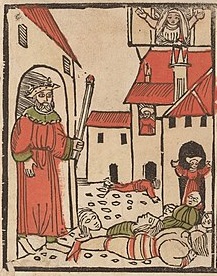
The Servants of Absalom Killing Amnon, Heinrich Aldegrever, 1540

Lo tirtzach. (Exodus 20:13)

lo tirtzach (לֺא תִרְצָח) = you must not kill without a legal sanction. (From the verb ratzach, רָצַח.)

This commandment is sometimes translated into English as “You shall not kill” and sometimes as “You shall not murder”. Does the Torah distinguish between accidental manslaughter and deliberate murder?

The death penalty is prescribed only for pre-meditated murder in next week’s Torah portion, Mishpatim.

One who strikes down a man so that he dies, he [the one who struck] shall certainly be put to death. [However, if it was] one who did not stalk him, but God let [the one who died] fall by his hand, I will appoint a place for you where he can flee. But if someone plots against his fellow to kill him with cunning, from [even] my altar you shall take him to die. (Exodus 21:12-14)

More specifics are given in the Torah portion Masey in the book of Numbers, which also uses a form of the same verb as in the sixth commandment: ratzach.11 Here God orders the Israelites to set aside six cities of refuge once they have conquered Canaan.

… cities of refuge they shall be for you, and a rotzeiach who struck down a life inadvertently will flee there.” (Numbers 35:11)

rotzeiach (רֺצֵַח) = someone who commits either  premeditated murder or involuntary manslaughter. (The participle form of the verb ratzach).

Then God tells Moses:

But if one struck with an iron implement and [the victim] died, he is a rotzeiach and the rotzeiach must certainly be put to death. … Or [if] in enmity he struck him with his hand and [the victim] died, he shall certainly be put to death. (Numbers 35:16, 35:21)

Someone who kills accidentally can live in exile; someone who kills deliberately (either out of hatred or by using an implement well-known to cause death) gets the death penalty. The executioner, in that case, is the “redeemer of bloodshed”, a designated avenger from the family of the deceased victim. The commandment against killing does not apply to the avenger.

Nor does it apply to soldiers who kill enemies in battle. The Torah never criticizes the Israelites for starting a war, regardless of the reason. Moses only rules (in the Torah portion Shoftim in Deuteronomy) that when the Israelites attack a town outside Canaan merely in order to expand their territory or get some booty, they must first offer the option of “peaceful” surrender.

And if [the town] answers you with peace and opens itself to you, then all the people found inside it will be yours for forced labor, and they must serve you. But if it does not make peace with you, and does battle, and you besiege it, and God places it in your hand, then you shall put all its males to the edge of the sword. However, the women and the little ones and the livestock and everything that is in the town, all its plunder you shall plunder for yourself … However, in the towns of these peoples [Canaanites] which God, your God, is giving you as a hereditary possession, you shall not let a soul live. (Deuteronomy/Devarim 20:11-16)

These two approaches to conquest were considered ethical in the Ancient Near East. But today, an increasing number of people believe that even when a killing is legal, it may not be ethical.

Many people would agree with the commandment lo tirtzach, you must not kill without a legal sanction. But standards have changed for when it should be legal to kill someone. The death penalty is now banned in a majority of countries in the world, and is controversial in the United States.

War, on the other hand, is still an option for every nation. But some acts during war are now considered war crimes, and there is more interest in minimizing the deaths of non-combatants. Most people condone killing in self-defense, whether it is killing an individual who is about to kill you, or fighting a nation that has attacked yours. But is initiating a war justified if the purpose is to defend the citizens of an allied nation, or to defend a principle such as democracy?

A basic moral rule must be brief and express an ethical ideal, even if there are gray and cloudy areas in its application. The sixth commandment, which merely says “You must not ratzach” (You must not kill without a legal sanction) meets this requirement as it stands.

But I believe that too many types of killing have been legal, in both ancient Israelite and modern Western societies. An ethical ideal, in my opinion, would be more restricted. So I would like to propose this amended sixth commandment:

You must not kill except to prevent someone from being killed.

*

Next week I will address what the seventh and eighth commandments mean when they prohibit adultery and theft—then and now.

  1. Exodus 20:1 introduces what we call “the Ten Commandments” in English with “And God spoke all these devarim”. Devarim, דְּבָרִים = words, statements, things. In Deuteronomy, Moses calls the ten “commandments” the devar of God; devar is the singular of devarim.
  2. See my 2011 post Yitro: Not in My Face.
  3. See my 2014 post Yitro: The Power of the Name.
  4. E.g. the Book of Sirach, 3:1-16 (second century B.C.E.)
  5. In first-world countries today, the whole society pays various taxes to take care of its aged population through various taxes. Yet when old people can no longer manage certain tasks themselves, their adult children are still expected to meet some obligations.
  6. Maimonides (12th-century Moses ben Maimon or “Rambam”), Mishneh Torah, book 14, treatise 3, chapter 6:10, as quoted in Edward Hoffman, The Wisdom of Maimonides, Trumpeter, Boston, 2008, p. 114-115.
  7. Proverbs 13:24, 19:18, 22:15, 29:15.
  8. E.g. Exodus 13:8; Deuteronomy 6:6-7 and 11:19.
  9. One father, Jepthah/Yiptach, vows that if God gives him success in battle he will offer to God whatever comes out of his house first when he returns. He is dismayed when his daughter runs out to greet him. But this father is portrayed as foolish, not abusive. He immediately grants her request for a two-month postponement so she can “cry over her virginity”. The cautionary tale ends without clarifying whether Yiptach’s daughter was slaughtered at the altar or given to the local sanctuary. (Judges 11:30-35)
  10. See my 2015 post Yitro: The Heaviness of Honoring Parents. The Book of Sirach adds: Help your father in his old age, and do not grieve him as long as he lives; Even if he is lacking in understanding, show forbearance …”
  11. For more on the words ratzach and rotzeiach, see Marty Lockshin, “Does the Torah Differentiate between Murder and Killing?”, thetorah.com.

Haftarat Beshalach—Judges: A Humble Commander

Red Sea in Golden Haggadah, c. 1320, Spain

Pharaoh lets the Israelites leave without conditions in last week’s Torah portion, Bo. But God hardens Pharaoh’s heart one last time in this week’s Torah portion, Beshalach, in order to have an excuse to create another miracle.1 When the Israelites are trapped between Pharaoh’s charioteers and the Reed Sea, they complain that Moses rescued them from servitude in Egypt only to so they would die in the wilderness.2 Moses raises his staff, God splits the Reed Sea, the Israelites cross over, and the water surges back and drowns the Egyptian army.

Moses, as usual, is the mediator between God and the Israelites. For the rest of his life he doggedly continues speaking to both sides and doing whatever it takes to keep the people moving toward Canaan.

He never wanted this role. Four times at the burning bush Moses tried to persuade God to send someone else.3 Finally God talked him into it—or perhaps the deciding factor was Moses’ compassion for the oppressed, which had already moved him to kill an Egyptian beating a Hebrew man, and defend seven shepherdesses from a gang of men who drove them away from a well.4

I admire Moses’ humility, as well as his courage and cleverness when he talks God out of killing all the Israelites after the golden calf fiasco.5 Most of all, I admire his unselfish dedication to others. He makes a few ethical mistakes, but overall he consistently labors for the welfare of the Israelites in his charge, ignoring his own interests.

*

This week’s haftarah reading from the book of Judges includes three admirable characters. Devorah and Ya-eil both act with courage and intelligence, like the women at the beginning of the book of Exodus: the two chief midwives, Shifrah and Puah,6 Moses’ mother, Yocheved,7 and Pharaoh’s daughter, who adopts the infant Moses and hires Yocheved to nurse him.8

But the character I admire most in this week’s haftarah is a man.

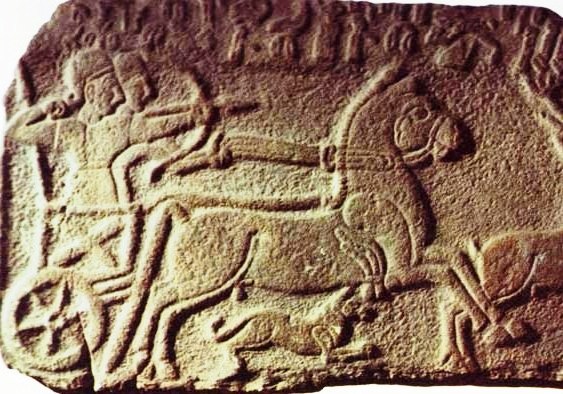
Just before the haftarah, the book of Judges says that the Israelites are once again oppressed, this time by a Canaanite king who has a large chariot regiment. God let it happen because the Israelites were straying after other gods again.

Assyrian war chariot

Then God handed them over into the power of Yavin, a king of Canaan who reigned in Chatzor. And the commander of his army was Sisera, who headquartered at Charoshet Hagoyim. And the Israelites cried out to God, because he had nine hundred iron chariots, and he had oppressed the Israelites violently for twenty years. (Judges/Shoftim 4:2-3)

The Israelite tribes have only foot soldiers, and no king to unite them. But they do have a prophetess named Devorah.

Devorah was a prophet-woman, wife of Lapidot. She was the judge of Israel at that time … and the Israelites went to her for legal decisions. (Judges 4:4-5)

This woman has the same role as Samuel in the first book of Samuel: she both interprets the word of God and makes rulings in disputes, including disputes between tribes. Devorah has the most authority among the Israelites, as Samuel did later, before the first Israelite king.

And she sent and summoned Barak, son of Avinoam, from Kedesh of Naftali, and she said to him: “Is it not [that] God, the God of Israel, commanded: Go umashakhta on Mount Tabor! And you shall take with you ten thousand men from Naftali and from Zevulun. Umashakhti toward you the stream of Kishon; Sisera, the commander of the army of Yavin; and his chariots and his force. And I will put them in your power.” (Judges 4:6-7)

umashakhta (וּמָשַׁכְתָּ) = and you shall pull together, draw to yourself, rally.

umashakhti (וּמָשַׁכְתִּי) = and I will pull, draw.

When Barak hears this command from God, he is hesitant. He does not doubt God’s power, but he doubts his own. Maybe he wonders if he could muster enough fighting men, or maybe he wonders if the men would obey his orders. He knows Devorah has the real authority.

And Barak said to her: “If you go with me then I will go, but if you do not go with me I will not go.” And she said: “I will certainly go with you. Only honor will not be yours on the road that you are following, because through the power of a woman God will hand over Sisera.” And Devorah got up and went with Barak to Kedesh. And Barak mustered Zevulun and Naftali at Kedesh, and ten thousand men went up on his heels, and Devorah went up with him. (Judges 4:8-10)

I admire Barak for his humility. He is more interested in freeing the Israelites from the oppressive rule of King Yavin than he is in his own honor. He accepts his loss of status if the men see him taking orders from a woman.

Barak and Devorah lead the Israelite troops to the top of Mount Tavor. Sisera orders all his chariots and troops to move to the almost dry Kishon River. Then Devorah tells Barak:

“Get up! Because this is the day when God will give Sisera into your power. Is it not God who goes before you?” (Judges 4:14)

Barak leads his foot soldiers in a charge down the slope of Mount Tavor.

And God threw into confusion Sisera and every chariot and every warrior [so they fell] to the edge of the sword before Barak. And Sisera descended from his chariot and fled on foot. And Barak pursued the chariots and the warriors as far as Charoshet Hagoyim, and every warrior of Sisera fell to the edge of the sword; not one remained. (Judges 4:15-16)

The poem following the narrative of Sisera’s defeat explains that God turns the Kishon into a raging torrent that sweeps away Sisera’s army9.

Barak rallies the troops, but in Devorah’s name. He leads the charge, but only when Devorah says it was time. Then God drowns Sisera’s army at the Kidron, just as God drowned Pharaoh’s army at the Reed Sea.10

Sisera, the commander of King Yavin’s army, flees on foot to the nearby campsite of Chever the Kenite. He assumes he can find shelter there, because that Chever’s family is one of King Yavin’s allies. Chever’s wife, Ya-eil (Jael), is alone inside her tent when Sisera arrives. Maybe Sisera chooses her tent because everyone else is gone, or maybe it is the first tent he reaches.

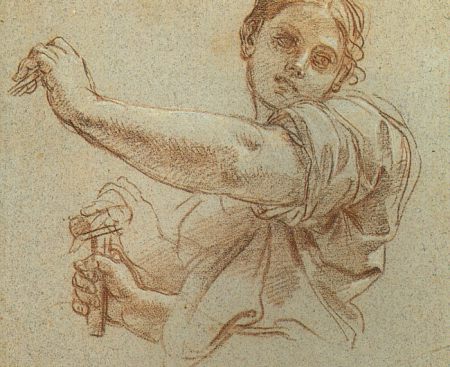
Study of Jael, by Carlo Maratta ca. 1700

When he asks Ya-eil for water she gives him milk. When he falls asleep she hammers a tent pin through his head.11

Ya-eil, like Devorah, is both courageous and clever. But is she ethical? The book of Judges does not say why Ya-eil kills Sisera. Does she empathize with the Israelite tribes? Is she feuding with her husband or her husband’s family, Sisera’s allies? Or does she have some private reason that did not make it into the book? Without knowing her motive for killing Sisera, we cannot judge Ya-eil’s moral character.

And hey! Barak was pursuing Sisera, and Ya-eil went out to greet him. And she said to him: “Come, and I will show you the man whom you are seeking.” (Judges 4:22)

Barak is prepared to kill Sisera, but he finds out that a woman beat him to it. Devorah’s prophecy that “through the power of a woman God will hand over Sisera” is fulfilled twice: Sisera’s army is defeated with the help of Devorah, and Sisera himself is killed by Ya-eil.

*

Yes, the two women are admirable for their courage, their quick thinking, and their refusal to play the role of submissive wife. But I think Barak is even more admirable. He does not lack courage; after all, he leads the charge down to the enemy forces with their dangerous iron chariots, and then he pursues Sisera single-handedly. But like Moses, Barak is also humble. Her publicly admits that Devorah, a woman, is more powerful and respected than he.

And Barak follows Devorah’s directions for an ethical reason: to rescue the Israelites from oppression.

  1. Exodus 14:4, 14:8-9.
  2. And they said to Moses: “Was it because there are no graves in Egypt that you took us out to die in the wilderness?” (Exodus 14:11)
  3. Exodus 3:10-12, 4:1, 4:10-13.
  4. Exodus 2:11-17.
  5. Exodus 32:7-14.
  6. Exodus 1:15-22. See my post Shemot: Disobedient Midwives.
  7. Exodus 2:1-4. See my post Shemot & Psalm 137: Cry Like a Baby.
  8. Exodus 2:5-10.
  9. Judges 5:20-21. The poem also adds troops from three other Israelite tribes (Efrayim, Benyamin, and Issachar) to Barak’s army. (Judges 5:14-15).
  10. Exodus 14:10-30.
  11. Judges 4:17-21.

Bo: Pride and Ethics

Haggadah by Judah Pinḥas, Germany, 1747

Pharaoh wants the Israelites to stay in Egypt and serve him as corvée laborers making bricks and building cities. God wants the Israelites to walk out of Egypt, take over Canaan, and serve “him”.  In an effort to terrorize Pharaoh into letting the Israelites go, God afflicts Egypt with ten “plagues” or miraculous disasters: blood, frogs, lice, mixed vermin, cattle pestilence, boils, hail, locusts, utter darkness, and death of the firtborn.

The God-character reveals another divine agenda in last week’s Torah portion, Va-eira, just before the plague of hail.

Shalach my people so they can serve me! Because this time I myself sholeiach all my scourges into your heart and against your courtiers and against your people, so that you will see that there is none like me on all the earth. Indeed, by now shalachti my hand and struck you and your people with the pestilence, and you would have been effaced from the earth. However, for the sake of this I have let you stand: so that I can show you my power and make my name known throughout the earth.” (Exodus 9:14-16)

shalach (שַׁלַּח) = Send! Send forth! Send out! Let go! Release!

sholeiach (שֺׁלֵחַ) = am sending, am sending forth, am sending out, am letting go, am releasing.

shalachti (שָׁלַחְתִּי) = I sent, I could have sent, I could have stretched out, I could have released.

(Throughout the story of the ten plagues, forms of the verb shalach are used both when God releases a plague, and when anyone talks about Pharaoh releasing the Israelites.)

Before sending the hail, the God-character reveals that “his” other goal is to prove to the whole world that “he” is the most powerful god. Being recognized as the most powerful seems more important to the God depicted in the book of Exodus than any moral considerations.1

The ethical problem with the God-character’s actions is that the plagues afflict not only Pharaoh, but also the native Egyptians. Why should ordinary Egyptians suffer? Pharaoh is the one who keeps refusing to let the Israelites go; his people have no say in the matter.

Some commentators have claimed that all the Egyptian people are on Pharaoh’s side, so they deserve to be punished. But there is nothing in the text of the Torah to indicate this. Pharaoh issues a general order for “all his people” to throw male Israelite infants into the Nile in last week’s Torah portion, Shemot.2 But the Torah never reports an Egyptian actually doing so. The only Egyptians who act against Israelites in the book of Exodus are:

  • Pharaoh, who issues commands calling for their oppression and death.
  • Egyptian taskmasters supervising the corvée labor, who oppress and beat the Israelites.3
  • Pharaoh’s armed regiment of charioteers, who pursue them after they leave Egypt.4

Yet the other native Egyptians also suffer from God’s ten plagues. Is their suffering unavoidable collateral damage in the war between Pharaoh and God? Or does God choose miracles that harm the most people on purpose, in order to make a more dramatic display of power?

*

Plague of the Firstborn, Spanish haggadah c. 1490

The tenth and final plague, described in this week’s Torah portion, Bo, is death of the firstborn.

And it was the middle of the night, and God struck down all the first-born in the land of Egypt, from the first-born of Pharaoh who sits on his throne to the first-born of the captive who was in the dungeon, to all the first-born of the livestock. (Exodus 12:29)

Only the Israelites receive God’s instructions to paint blood on their door frames and stay inside overnight to avoid the death of any of their first-born.5

Is this extreme unethical measure necessary in order to make Pharaoh submit? Or does the God-character kill every first-born in every Egyptian family merely in order to make a more dramatic display of power?

A necessary evil

The mass murder does appear to achieve the liberation of hundreds of thousands of oppressed Israelites.

And Pharaoh got up in the night, he and all his courtiers and all the Egyptians. And there was a great wailing outcry in Egypt, because there was no house without someone dead. And he summoned Moses and Aaron in the night and he said: “Arise, go out from among my people, you and also the Israelites, and go serve God, as you spoke! Take even your flocks and your herds, as you spoke, and go! And may you also bless me.” (Exodus 12:30-32)

Only after the death of the first-born does Pharaoh capitulate and tell the Israelites to go with everything Moses asked for. He even lowers himself by asking for a blessing, acknowledging that he cannot prosper again without God’s help.

Pharaoh loses his own first-born son, a blow that would shatter the hardest heart. But the wailing all over his capital city would reinforce his new despair. He may suspect that if he does not let the Israelites go now, the Egyptian people will revolt against him. The authority conferred upon him by the gods of Egypt no longer holds when the God of Israel is obviously more powerful.

A dramatic display

On the other hand, after three of the plagues (boils, locusts, and darkness) the Torah says that God hardens Pharaoh’s heart.6 What does this mean?

Pharaoh hardens his own heart after the plague of frogs, and continues to harden it four more times.7 He is in the habit of hardening his heart, and once we get into a habit, it can seem as if an outside force makes us keep doing it again and again. But in the text of Exodus, there is an outside force, and it is God. Before the plagues begin, the God-character tells Moses:

“And I myself will harden the heart of Pharaoh, and I will multiply my signs and my omens in the land of Egypt.” (Exodus 7:3)

The God-character follows up on this promise by deliberately hardening Pharaoh’s heart three times when Pharaoh is softening and might give in. The God-character does not want Pharaoh to let the Israelites go before “he” is ready. And the God-character is only ready after “he” has a chance to commit the tenth and most emotionally devastating plague: the death of the firstborn.

Apparently the God-character is so fixated on the goal of demonstrating power that the full ten-step dramatic display, from blood to death, is worth postponing the liberation of the Israelites. Demonstrating power is also far more important to this God-character than minimizing the suffering of innocent Egyptians.


Red Sea in Golden Haggadah, c. 1320, Spain

After the final plague, the Israelites march into the wilderness, but Pharaoh changes his mind about letting them go. The God-character hardens Pharaoh’s heart one last time in next week’s Torah portion, Beshallach, and Pharaoh commands his charioteers to pursue the Israelites. This gives the God-character a chance to create another memorable miracle: the splitting of the Reed Sea, and the return of the waters in time to drown the Egyptian chariot regiment.8

And Israel saw the great power that God wielded against Egypt, and the people were awed by God, and they had faith in God and in [God’s] servant Moses. (Exodus 14:31)

This miracle impresses both the Egyptians and the Israelites with God’s power. The fact that it also avoids killing any innocent bystanders is probably incidental in the book of Exodus.

Although Exodus is based on older oral traditions, modern scholars estimate that it was written down in the 6th and 5th centuries B.C.E. About a thousand years later, the rabbis of the Talmud imagined a different sort of God responding to the death of the Egyptian soldiers.

At that time the ministering angels wanted to recite a song before the Holy One, Blessed be He. The Holy One, Blessed be He, said to them: “My creatures are drowning in the sea, and you are reciting a song before me?” (Talmud Bavli, Sanhedrin 39b and Megillah 10b)

As the ethics of the Israelites advanced, so did the ethics of their God.


  1. See Jerome M. Segal’s treatment of this theme in his book Joseph’s Bones: Understanding the Struggle Between God and Mankind in the Bible, Riverhead Books, Penguin Group, New York, 2007.
  2. Exodus 1:22.
  3. Exodus 1:13-14 reports unspecified ruthless oppression by the taskmasters; Exodus 2:11 and 5:15-16 report beatings.
  4. Pharaoh and his charioteers pursue the Israelites after Pharaoh changes his mind about letting them go in Exodus 14:6-10. The disciplined Egyptian charioteers advance at the Reed Sea in order to kill some Israelites and capture the rest, but God intervenes with a miracle.
  5. Exodus 12:6-7, 12:21-23.
  6. Exodus 9:12, 10:20, 10:27.
  7. Exodus 8:11, 8:15, 8:28, 9:7, 9:34.
  8. Exodus 14:5-30.