Chayei Sarah: Arranged Marriage

This week’s Torah portion, Chayei Sarah (“Life of Sarah”), opens with Sarah’s burial, then tells the story of the arranged marriage of Sarah and Abraham’s son, Isaac.  The following essay comes from the first version of my book on moral psychology in Genesis, which I am now rewriting.
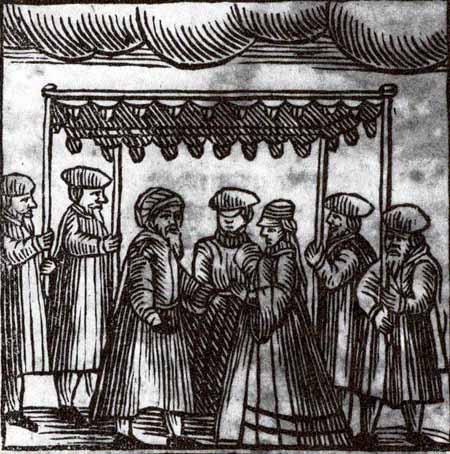
Wedding, Minhagim, 1707 Amsterdam

When is an arranged marriage ethical?  The story in Chayei Sarah offers some clues.

Ignorant groom

When Isaac turns 40 years old he is still unmarried.  So his father, Abraham, commissions his steward1 to get Isaac a wife.  Abraham asks him to swear a formal oath:

“… that you will not take a wife for my son from the daughters of the Canaanites among whom I am living.  Instead, you must go to my land and my homeland, and [there] you will take a wife for my son, for Isaac.”  (Genesis/Bereishit 24:3-4)

Abraham’s homeland is the town of Charan in northern Mesopotamia,2 where the family of Abraham’s nephew Betueil still lives.

Isaac is not present when Abraham gives these orders to his steward.  He has lived apart from his father for the past fourteen years, ever since Abraham put a knife to his throat to sacrifice him to God. 3  During that time Abraham has stayed at Beir-sheva, and Isaac has settled at Beir-Lachai-Roi.4  There is no indication in the book of Genesis of any communication between father and son after the near-sacrifice.

But since God promised that Isaac’s descendants would inherit the land of Canaan and his father’s covenant with God,5 Abraham decides it is high time for his son to marry.

And the servant said to him: “What if she does not consent to follow me to this land?  Shall I bring your son back to the land that you left?”  (Genesis 24:5)

Abraham rejects this option.

“And if the woman will not follow you, then you are free from this oath of mine.  Only you must not take my son there!”  (Genesis 24:8)

Abraham’s requirements are 1) that Isaac’s wife must come from Charan, and 2) that she must be willing to move to Canaan.

1) Why must the bride come from Charan?

I suspect that Abraham does not trust Isaac to continue worshiping his father’s god.  Since Isaac rejected his father after the attempted sacrifice, he might also reject God.  A Canaanite wife would probably persuade him to worship her own gods.  But Abraham’s extended family in Charan recognizes the God of Abraham as at least one of their gods.

When Abraham’s steward arrives at the well in Charan he prays to Abraham’s God for a particular sign.6

Rebekah Meets Abraham’s Servant, New World Encyclopedia

“May it be the young woman to whom I say: “Please lower your water jar so I may drink,” and she says: “Drink, and also I will water your camels”—may she be the one you assigned for your servant, for Isaac.”  (Genesis 24: 14)

At once Rebecca, the daughter of Abraham’s nephew Betueil, comes and does so.  After she has watered all ten camels, he asks for lodging for the night, follows her home, and tells his story to her brother and parents, including the four-letter name of Abraham’s God.  Their initial response defers to the same god.

And Lavan and Betueil answered, and they said: “From God [Y-H-V-H] the matter went out; we are not able to speak to you bad or good.  Here is Rebecca in front of you. Take [her] and go, and she will be a wife to the son of your master, as God [Y-H-V-H] has spoken.”  (Genesis 24:50-51)

2) Why must the bride be willing to move to Canaan?

One possible marriage arrangement in the Ancient Near East was for the husband to leave his parents and live with his wife’s family.7

But Abraham does not want to give Isaac any pretext to move out of Canaan, because God promised to give the land of Canaan to his descendants through Isaac.

Abraham’s steward journeys to Charan and arranges the marriage without the knowledge of the groom.  We can deduce that no one informs Isaac that a marriage is being arranged for him, because  Isaac is walking home from the well of Beir-Lachai-Roi one evening when he is surprised to see a string of camels.

… and he raised his eyes and he saw—hey!—camels coming!  (Genesis 24:63)

Recent archaeological evidence shows that domesticated camels were not introduced to Canaan until 930-900 B.C.E., when the pharaoh called Shishak conquered the kingdoms of Judah and Israel and used camels to transport copper.  The Abraham stories are set perhaps a thousand years earlier, when domesticated camels were only seen in Egypt and Arabia. But  Isaac would know that his father kept camels descended from the camels Pharaoh gives him in Genesis 12:16.

After fourteen years, the sight of Abraham’s camels surprises him.

Consenting bride

Before Abraham’s steward asks Rebecca if he can stay in her father’s house for the night, he gives her a gold nose-ring and two gold bracelets.  Rebecca would know that these gifts are preliminaries for a marriage arrangement.  The steward is kindly giving her an opportunity to speak up privately before he approaches her family.

She merely invites him, his camel drivers, and the camels home for the night.  Rebecca’s family agrees to the match, and the steward distributes gifts (the bride-price) to them.  Now all the needs to determine is whether she is willing to move to Canaan.  He asks Rebecca’s brother and mother to let him leave without delay.

And they called Rebecca and they said to her: “Will you go with this man?”  And she said: “I will”.  So they sent off Rebecca, their kinswoman, and her nursemaid and the servant of Abraham and his men.  (Genesis 24:58-59)

Rebecca is at least fourteen years old,8 so she is a legal adult, qualified to make vows—and ethically qualified to make her own decisions.  Rebecca’s brother Lavan is not morally upright in his dealings with Jacob later in the book of Genesis, but here he and his mother do the right thing by asking for the bride’s consent.  She willingly commits herself to a man she has never met and a land she has never seen.

Consenting groom

And Rebecca raised her eyes, and she saw Isaac and she fell down from on top of the camel.  And she said to the servant: “Who is that man, the one walking through the field to meet us?”  And the servant said: “He is my master.”  Then she took the tza-if and she covered herself.   (Genesis 24:64-65)

tza-if (צָעִיף) = shawl, veil.  (The story of Jacob’s first wedding in Genesis 29:21-25 depends on the assumption that brides cover their faces.)

A train of ten camels would be surprising enough.  Isaac must have been even more surprised to see a young woman suddenly put on a wedding veil.
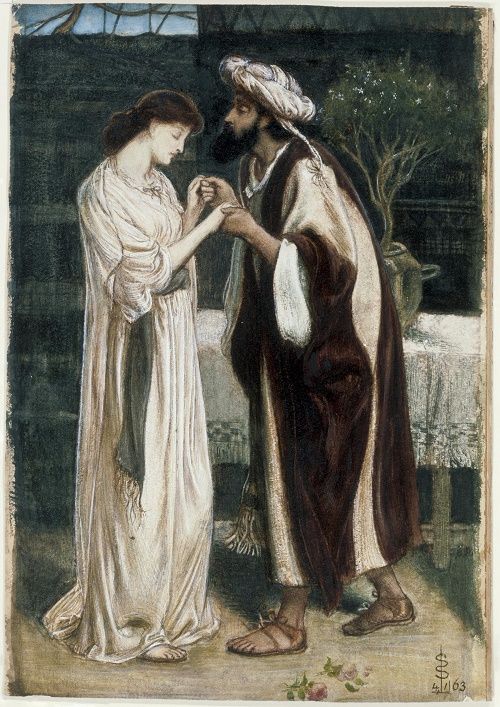
Isaac and Rebekah, by Simeon Solomon, 1863

And the servant related to Isaac all the things that he had done.  Then Isaac brought her into the tent of Sarah, his mother.  And he took Rebecca and she became his wife, and he loved her.  And Isaac felt a change of heart after [the death of] his mother.  (Genesis 24:66-67)

Isaac falls in love with Rebecca when he consummates the marriage with her. But why does he accept the marriage arrangement and bring her into his tent, which was once his mother’s tent?

One answer is that Isaac makes the ethical choice of considering Rebecca on her own merits, rather than rejecting her because his father arranged the marriage without his consent.

Another answer is that Isaac makes the ethical choice of refraining from doing harm to the young woman.  After Rebecca leaves her home and travels with the steward for about 650 miles (1046 km) to consummate her already-contracted marriage, she can hardly go back to her family in Charan and ask them to return the bride-price; her family would be shamed, and her chance of marrying someone else would be small.

Fortunately Isaac does not face a choice between ruining her life or his own, since he finds Rebecca more than acceptable.  But Abraham was morally wrong to impose a marriage that his son could not ethically refuse.

The arranged marriage could have been ethical, if Abraham had told his son what he was arranging, and Isaac had not objected.  But when he arranges the marriage without the groom’s consent he is treating Isaac as his property, like a prize ram whom he can unilaterally choose to slaughter or breed.

Abraham makes an unethical choice because he believes that Isaac is weak and easily influenced.  He does not trust his son to pick out the right wife, and he thinks that if Isaac visited the family in Charan before the wedding they might persuade him to stay there.  No wonder he sends his steward to arrange the marriage and bring back the bride!  But even if his assessment of Isaac’s character were true, an adult should have the right of consent to his own marriage.

An arranged marriage can be as ethical as one initiated by the couple themselves, but only if there are exit strategies for both balking brides and grudging grooms.

  1. The Torah calls him “the senior servant in his household who ruled in all that was his” (Genesis 24:2). He is not named in the Torah portion Chayei Sarah, but many commentators have identified him as Eliezer of Damascus from Genesis 15:2-3.
  2. Genesis 12:1-4.
  3. Sifrei Devarim 357:33 and Bereishit Rabbah 81:5 make a convincing argument that Isaac is 26 at the Akeidah, when Abraham almost slaughters him (Genesis 22:1-13). (See my post Lekh-Lekha & Vayeira: Going with the Voice.)  Isaac is 40 when he marries Rebecca (Genesis 25:20).
  4. Abraham is in Beir-sheva in Genesis 22:19. Isaac lives near Beir-Lachai-Roi in Genesis 24:62 and 25:11.
  5. Genesis 17:7-8, 17:19-21, 22:15-18.
  6. In other words, the steward specifies a young woman who is hospitable, generous, and strong. She must be strong to water ten camels; after a long journey, one camel can drink 25 gallons (95 liters) of water.
  7. The stories about Abraham’s family are probably set sometime between 1800 and 1500 BCE, when Aram was a region of Assyria in northern Mesopotamia, and would have followed the Babylonian customs during the reign of Hammurabi. The Code of Hammurabi includes three laws about when a married couple lives with the wife’s parents (Laws 159-161 listed in https://avalon.law.yale.edu/ancient/hamframe.asp).  Genesis 31:41 confirms that Jacob and his two wives live with their father for 20 years.
  8. In Genesis 22:20-23 Abraham receives news that his brother Nachor has a son called Betueil and a granddaughter called Rebecca (Rivkah) “after these things”, i.e. his near-sacrifice of Isaac. That makes Rebecca at least fourteen years old when Abraham’s steward comes to Charan.  A girl attains her majority six months after the first sign of puberty according to Talmud Bavli, Yevamot 6:4.
Vayeira: Failure of Empathy

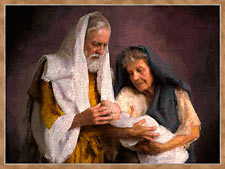
Abraham, Sarah, and Isaac (artist unknown)

The story of Sarah and Hagar continues in this week’s Torah portion, Vayeira (“And he saw”). When Ishmael is 14 and Sarah is 90, Sarah finally gives birth to a son of her own. She nurses her miraculous baby for several years, and then Abraham holds a drinking-feast to celebrate his weaning.

Then Sarah saw the son that Hagar the Egyptian had borne to Abraham metzacheik. And she said to Abraham: “Cast out that slave and her son! Because the son of that slave must not inherit with my son, Yitzchak.” (Genesis 21:9-10)

metzacheik (מְצַחֵק) = mocking, acting crazy, engaging in foreplay, making someone laugh. (The piel participle of the verb tzachak, צָחַק = laughed.)

Yitzchak (יִצְחָק) = (Isaac in English) he laughs, he will laugh. (An imperfect kal form of the verb tzachak.)

Ishmael might be innocently entertaining his little half-brother by acting crazy.1 Or he might be amusing himself at Isaac’s expense. He might be engaging in sexual impropriety with a toddler. Or Isaac might not even be present; Ishmael might be mocking the whole idea of Isaac as Abraham’s heir, telling some of the men at the feast that he, Ishmael, is Abraham’s firstborn son, so of course he will inherit twice as large a share of Abraham’s possessions as Isaac.2

We cannot judge the morality of Ishmael’s action when the Torah does not tell us what he is doing.  Sarah does not discuss Ishmael’s behavior with Abraham; she simply orders him to get rid of the boy so that Isaac will inherit all the family property.

Sarah still bears a grudge against Hagar, too. When she demands that Abraham “banish that slave”, she may be testing him to see if he retains any fondness for his erstwhile lover. Apparently he does not. But he is attached to his son Ishmael.

And the matter was very bad in the eyes of Abraham on account of his son. But God said to Abraham: “Don’t let it be bad in your eyes about the young man or about your slave. Everything that Sarah says to you, listen to her voice, because it is through Isaac your descendants will be identified. And the son of the slave, I will also make him a nation, because he is your seed.” (Genesis 21:11-13)

By speaking as if Abraham also has reservations about driving out Hagar, God implies that he ought to be concerned about her. Without a new master, where will Hagar live, and how will she get food, water, and clothing?

But Abraham washed his hands of any responsibility for Hagar long before. Now he fails to choose the ethical action of providing for Hagar’s welfare after she leaves.

There are no laws in the Torah about freeing a foreign slave like Hagar, or the foreign slave’s child. With the sole exception of the concubine captured in battle,3 the Torah considers foreign slaves as property to be sold or inherited. Yet Abraham obeys God by doing exactly what Sarah demands: instead of selling the mother and child, he frees them by banishing them from his household.

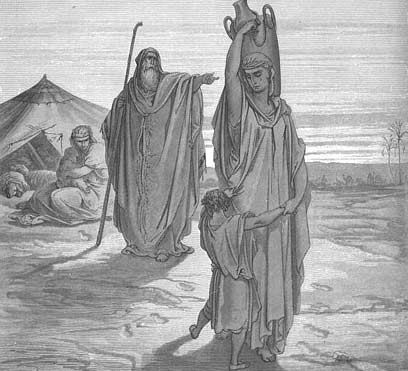
Abraham Sends Away Hagar, by Gustave Dore, circa 1850

And Abraham got up early in the morning and took bread and a goat-skin of water and gave them to Hagar. He put them on her shoulder and with the boy, and he sent her away. And she went astray in the wilderness of Beersheba. (Genesis 212:14)

Sarah says nothing about what her husband should give Hagar and Ishmael when he casts them out. It is Abraham’s decision to send them off with only a goat-skin of water and as much bread as they can carry on foot. He is a rich man; he could afford to give them several donkeys laden with food, water, clothing, and silver or trade goods. But he does not.

Abraham might assume Hagar would refill the goat-skin at every spring or cistern on the road south. It does not occur to him that as a woman protected only by a single adolescent boy, she might worry about being raped, and avoid the roadside places where trade caravans stop.

Since she takes a different route, Hagar gets lost in the wilderness.  She and her son drink the last of the water. Ishmael lies down under a bush, and Hagar sits a bow-shot away because she does not want to watch him die. They both cry in isolation.

And she went and she sat herself away from him, the distance of a bow-shot, because she said [to herself]: Don’t let me see the death of my boy! So she sat away from him, and she raised her voice and cried.  (Genesis 21:16)

Hagar can be excused for not following the trade road. She can be excused for not noticing the well when she is suffering from dehydration. But her decision to leave Ishmael to die alone is harder to excuse.

Like Abraham, she has not learned Cain’s lesson and acts as if she is not her own son’s keeper. She might find it painful to watch Ishmael die, but what about him? Ishmael would be comforted if his mother held his hand or said a few loving words as he faded away.

Then God opened her eyes and she saw a well of water. And she went and filled the goat-skin with water and she gave a drink to the young man. And God was with the young man, and he grew big and he settled in the wilderness and he became an archer with a bow. (Genesis 21:19-20)

Hagar in the Desert, by Gheorghe Tattarescu, 1870

Why do Sarah, Abraham, and Hagar all make choices that betray a lack of empathy?

Sarah

Sarah’s choice to use Hagar as a surrogate mother, then discard her and her son once she has her own child, is callous but understandable. Her original idea was that Hagar would remain her devoted slave after giving birth. But Hagar becomes self-important once she is pregnant, and Sarah blames Abraham for encouraging her. (See my post Lekh-Lekha: Belittlement.) Sarah does not adopt the baby after all.3

She feels estranged from both Hagar and Ishmael for fourteen years. It takes only a small incident at Isaac’s weaning feast to remind her that unless she gets rid of Ishmael, he will threaten her own son’s inheritance. She lacks empathy for Hagar and Ishmael, but in her society they are only slaves. At least she only tells her husband to banish them, not to sell them or punish them. And she places no limits on what supplies he can send with them.

Abraham

Abraham’s lack of empathy is more puzzling. Even if he is not interested in Hagar, the Torah states “And the matter was very bad in the eyes of Abraham on account of his son.” He is attached to his son Ishmael. Rationally, he might assume that since God promised Ishmael would have descendants, his son would survive being sent out into the desert with inadequate supplies. But if he felt empathy for Ishmael, his natural reaction would be to give him ample food, water, and gifts upon saying goodbye.

In the years before this episode, Abraham was much more generous with his nephew Lot. He gave Lot first choice of pasture land, fought the armies of four kings to rescue his nephew when he was captured, and argued with God about God’s plan to wipe out Sodom, where Lot lived.4

The difference might be that Abraham’s wife, Sarah, never expressed any objection to Lot. Abraham is not really hen-pecked; in this week’s Torah portion he banishes Ishmael only after God has told him to do what Sarah says. When Sarah asked him to impregnate Hagar in last week’s portion, Abraham cooperated, but he expressed no reluctance.

In two earlier episodes Abraham passed off Sarah as his sister in order to scam two kings out of bride-prices for her.5 Sarah cooperated, but her feelings about it must have been complicated, and caused complications in their marriage.  Perhaps Abraham’s troubled relationship with Sarah causes an inner denial of his feelings about Ishmael.

Hagar

And Hagar? She probably feels empathy for her son Ishmael when she believes he is dying, yet she leaves him alone and waits for his death at a distance.

Hagar expresses her empathy by sobbing.  Either she too self-centered to realize that she could comfort Ishmael at the end of his life, or she is not accustomed to overcoming her personal anguish to do the right thing. As a slave, she merely obeyed orders—except for the one occasion when she ran away from Sarah’s abuse, and God told her to go back.6

Sarah, Abraham, and Hagar all treat someone close to them callously. Sarah’s lack of empathy for her own son’s rival is an understandable fault. Hagar feels empathy for her son, but she is psychologically unequipped to do the right thing. Abraham is harder to excuse, since he goes out of his way to act on his empathy for his nephew Lot. His suppression of empathy for his son Ishmael leads to an ethical failure.


  1. One suggestion is that Ishmael got drunk at the drinking-feast. Pamela Tarkin Reis, Reading the Lines: A fresh Look at the Hebrew Bible, Hendrickson Publishers, Peabody, Mass., 2002, pp. 75-76.
  2. Robert Alter, The Five Books of Moses, W. Norton & Co., New York, 2004, p. 103.
  3. Jacob adopts Joseph’s first two sons for inheritance purposes in Genesis 48:5-12 through a declaration followed by holding them on his knees. Earlier in Jacob’s life, his wife Rachel tells him: Here is my slave, Bilhah. Come into her and she will give birth on my knees and I will be built up, even I, through her.” (Genesis 30:3) But the Torah never reports that Sarah holds Ishmael on her knees.
  4. Genesis 13:5-12, 14:11-16, and 18:20-32.
  5. See my posts Lekh-Lekha, Vayeira, & Toledot: The Wife-Sister Trick, Part 1 and Part 2.
  6. Genesis 16:6-9.

Lekh Lekha: Belittlement

Here is another essay from the first version of my book on moral psychology in Genesis, which I am now rewriting.  The Torah portion this week is the beginning of the Abraham story, Lekh-Lekha (“Get Going” or “Go for Yourself”).

 Belittled

And Sarah, the wife of Abraham, had not borne children to him, and she had an Egyptian domestic slave, and her name was Hagar. And Sarah said to Abraham: “Here, please! God has barred me from bearing [a child]. Come, please, into my domestic slave; perhaps I will be built up through her.” (Genesis 16:1-2)

Hagar (הָגָר) = ha- (הַ) = the + geir (גֵּר) = male resident alien; or ha- (הַ) = the + hitgar (הִתְגָּר) = opposed, struggled with. (Hagar is a foreigner who becomes Sarah’s opponent.)

Sarah is 75 years old and God has never “opened her womb”, enabling a first pregnancy. Maybe she concludes that God must intend Abraham to have descendants through a different woman, so he might as well do it now. Or maybe she hopes to adopt Hagar’s son as her own, so he will support her if she outlives her husband. Maybe she believes that once Abraham has impregnated one woman, God will make it easier for him to do it again, and she will finally give birth.1

Sarah Leading Hagar to Abraham, by Matthias Stom, 17th century

And Abraham paid attention to the voice of Sarah. And Sarah, the wife of Abraham, took Hagar the Egyptian, her domestic slave, at the end of ten years [that] Abraham had been dwelling in the land of Canaan; and she gave her to Abraham, her husband, as a woman for him. (Genesis 16:2-3)

Sarah does not ask Hagar if she is willing to have intercourse with an 85-year-old man. The whole premise of slavery is that one person gives orders and the other must obey. Later books in the Torah establish some rights for Israelites who become slaves because of debt,2 but foreign slaves have fewer protections.  There is no limit to how long a foreign slave must serve, and the foreign slave is considered property that can be sold or inherited, like a herd of cattle.3

Today a world-wide consensus of opinion considers slavery grossly unethical, though it still occurs. By our own standards it is unethical for Sarah to own Hagar, but not by the standards of the Torah.

And he came into Hagar and she became pregnant. And she saw that she was pregnant, vateikal, her mistress was, in her eyes. (Genesis 16:4)

vateikal (וַתֵּקַל) = and she was diminished, of no account. (A form of the verb kalal, קלל. Various stems of this verb mean to be small and unimportant, to demean oneself, to declare a curse, to reduce, to shake something or someone.)

Hagar upsets the premise of slavery when she stops treating Sarah with deference. The Torah does not say exactly what Hagar does. Perhaps she continues to visit Abraham’s bed after she is pregnant. Perhaps she does not follow Sarah’s orders as thoroughly as she used to, or perhaps she complains. All these actions would be unwise, but they may not be unethical.

Sarah becomes enraged when her pregnant slave belittles her by acting above her station.

Then Sarah said to Abraham: “The cruelty I suffer from is on account of you! I myself placed my domestic slave in your bosom. Now she sees that she is pregnant, va-eikal in her eyes. May God judge between me and you!” Then Abraham said to Sarah: “Hey! Your domestic slave is in your hand. Do to her whatever is good in your eyes.” (Genesis 16:5-6)

va-eikal (וָאֵקַל) = and I am diminished, of no account. (Another conjugation of the verb kalal.)

From Sarah’s point of view, Abraham is guilty of encouraging Hagar to treat his real wife as if she has no status. Maybe he was unusually considerate of the slave in his bed. Maybe he continued to take Hagar to bed even after she was pregnant.4 Regardless of whether Abraham did anything to contribute to Hagar’s new attitude, he refuses to take any responsibility for her future welfare.

Yet by agreeing to impregnate Hagar, Abraham implicitly accepted some responsibility for her. She is the future mother of his child, and therefore he is morally obligated to protect her.


When Sarah tells Abraham “May God judge between me and you!” she means that the situation is not fair. I can imagine her thinking: It’s not fair that I lose both my slave and my husband’s attention, when I’m the one who made the arrangement in the first place. I never asked to be barren. I was only promoting God’s plan. Why should I suffer?

I can imagine Hagar thinking: It’s not fair that my mistress elevates me to the position of a concubine, and then snatches it away from me again. I never asked for this role, but now that I have it, why should I suffer?

And I can imagine Abraham thinking: It’s not fair that I’m forced to choose between these two women, between my lifelong companion and the mother of my child. I never asked for this mess. Why should I suffer?

The situation is unfair to all three characters, but no one deliberately creates an unfair situation—until Abraham tells Sarah “Do to her whatever is good in your eyes” and Sarah does it.

Sarah vataneha, and [Hagar] ran away from her. (Genesis 16:6)

vataneha (וַתְּעַנֶּהָ) = then (she) oppressed her, humiliated her, overpowered her, violated her. (A piel form of the verb anah, עָנַה = was wretched.)

The Torah outlaws humiliating or overpowering an Israelite slave,5 but not a foreign slave. Nevertheless, the use of the verb anah implies that Sarah’s behavior is unethical.  The Torah uses a piel stem of anah to describe the unfair working conditions of the Hebrew slaves in Egypt, where they are the foreigners.6

Hagar runs away impulsively; she has no particular destination in mind, though she does head south, in the general direction of Egypt.  When she stops at a spring on the road and a messenger (a.k.a. an angel) from God asks her two questions, Hagar can only answer the first one.

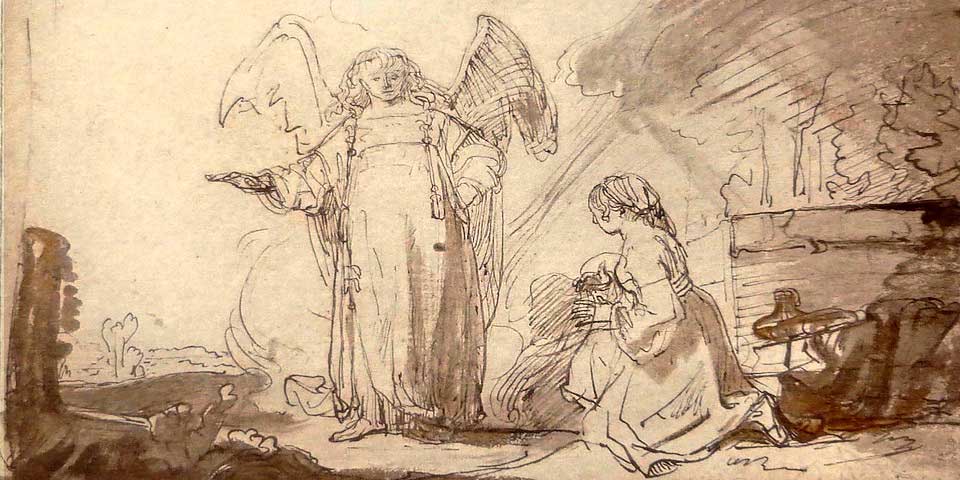
Hagar and the Angel, by Rembrandt. 17th century

And he said: “Hagar, domestic slave of Sarah, where have you come from, and where are you going?” And she said: “Me? I am running away from my mistress, Sarah.” And the messenger of God said to her: “Return to your mistress, vehitani under her hand.” (Genesis 16:8-9)

vehitani (וְהִתְעַנִּי) = and submit to being humiliated or tormented. (An imperative hitpael form of the verb anah.)

But Hagar does not obey, at least not immediately. Since she is silent, the divine messenger adds that Hagar will have too many descendants to count. Hagar still does not respond. The messenger adds that her son will be like a wild ass, impossible to discipline or domesticate, fighting everyone. After hearing that, Hagar obeys and returns to Sarah. She is willing to project her desires on her son and let him be the rebel.

She may also be having second thoughts about running away. If continuing south meant that she would escape slavery and her son would not be born a slave, then that would be a better moral choice that obeying God. But Hagar may now realize that if she stays on the road, sooner or later someone else will capture and enslave her, or worse. In that case it would be better to return to Sarah and Abraham, who at least want to keep Hagar’s unborn child alive and well.

For whatever reason, Hagar makes the most ethical choice open to her in a bad situation.


Sarah accuses Hagar of belittling her, but actually both Sarah and Abraham belittle Hagar.  The treatment of foreign slaves varies even within their household.  Abraham trusts and respects one of his foreign slaves, Eliezer of Damascus, enough to promote him to the post of steward.  If Abraham remains childless, Eliezer will be his heir.7

On the other hand, Sarah does not respect Hagar.  She assigns Hagar to Abraham long enough for her to get pregnant, but then instead of promoting her to the status of a concubine she takes full control over her slave again.  Even then, Sarah is insecure about her own value relative to the value of the woman carrying Abraham’s child.  When Hagar does something that triggers  Sarah’s insecurity, she abuses the woman who became pregnant at her own command. Sarah does not master her own emotional reaction in order to treat Hagar more ethically.

Abraham ducks his responsibility to protect Hagar.  He looks the other way when his wife is cruel to her, and he fails to promote Hagar to concubine over Sarah’s head, even though in his society the mother of a man’s heir is normally a wife or concubine.8 Abraham is motivated primarily by a desire to avoid confrontation with Sarah.  He does not master his own emotional complex in order to treat Hagar more ethically.

Even when biblical characters do not consider whether slavery itself is immoral, they still face moral choices about individual actions. Today, even when heads of governments do not consider whether war itself is immoral, they still face moral choices about how they conduct war. Even when we do not transcend the evils that are commonplace in our societies, may we still strive to transcend our selfish interests and emotions in order to protect other human beings as much as we can.


  1. Pamela Tamarkin Reis, Reading the Lines: A fresh Look at the Hebrew Bible, Hendrickson Publishers, Peabody, Mass., 2002, pp. 60-63.
  2. Exodus 21:2-11, Leviticus 25:39-43, Deuteronomy 15:12-17.
  3. Leviticus 25:44-46.
  4. Reis, p. 66-67.
  5. Leviticus 25:46 rules that one may not dominate an Israelite slave with violence.
  6. Genesis 15:13, Exodus 1:11-12, Deuteronomy 26:6-7.
  7. Genesis 15:2.
  8. Pilagesh (פִּילֶגֶשׁ) = concubine, lesser wife. Hagar is always called a shifchah (שִׁפְחָה) or an amah (אָמָה); both terms mean a female domestic slave. The term pilagesh first appears in Genesis 22:24, in a list of the children of Abraham’s brother Nachor: eight by wife, Milkah, and four by his concubine, Re-umah.  Abraham’s grandson Jacob has two wives, Rachel and Leah, who ask their domestic servants, Bilhah and Zilpah, to bear children to him. The Torah calls Bilhah and Zilpah Jacob’s domestic servants (Genesis 32:23), and later refers to Bilhah as Jacob’s pilagesh. All other references in the Hebrew Bible to a mother of a free man’s children call her either a wife or a concubine, not a slave.


Noach: Responses to Trauma

When I finished the first draft of my book about moral psychology in Genesis, I realized that examining why most of the characters do the wrong thing was not enough.  I needed an ongoing argument about why humans find it so hard to take the high road out of Eden. Now I am doing more research and rewriting my book.

Meanwhile, here is an essay from my first version.  The Torah portion this week is Noach (the Hebrew for “Noah”).  Many people know about the flood and Noah’s ark, but not everyone knows what Noah did after the waters dried up and he let the animals out.

Drinking and Incest

Noah begins by following all of God’s directions; then he sees God drown all life on land.  After the devastation of the worldwide flood, one might expect Noah’s first crop to be a plant that can produce food in a single growing season.  Instead, the Torah says:

And Noah began to be a man of the soil, and he planted a vineyard.  And he drank some of the wine, and he became drunk …  (Genesis 9:20-21)

Noah has to plan his drunkenness.  A grapevine cutting or rootstock must grow for about two years before it produces any grapes.  After that Noah has to wait while the grapes he crushes ferment into wine.

The Torah does not report Noah’s feelings, but he might be haunted by the deaths of everyone he knew outside his own immediate family.  (God told him to take only seven humans with him in the ark: his wife, his three sons, and his sons’ wives.)  Noah might have nightmares about children drowning.  He might even question the morality of his own behavior, and feel guilty for not trying to change God’s mind about flooding the world.

Noah’s attempt to escape into an altered state of consciousness, or unconsciousness, is understandable.  But his drunkenness subverts his ability to defend himself against incest.

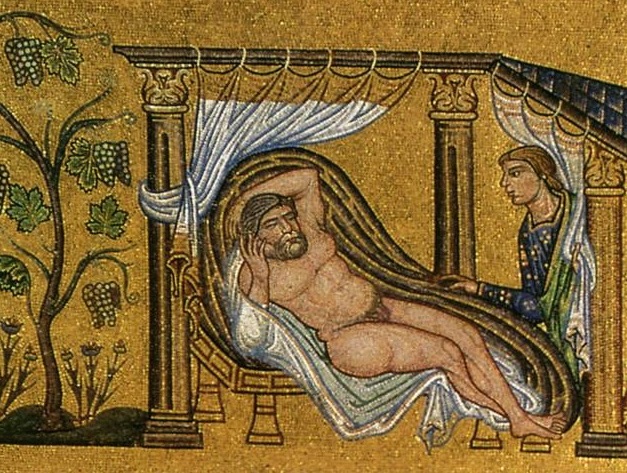
Noah and Cham, mosaic, Basilica di San Marco, Venice, circa 1215

And [Noah] drank some of the wine, and he became drunk, and vayitgal in the middle of his tent.  And Cham, the father of Canaan, saw the ervah of his father and he told his two brothers outside.  (Genesis 9:20-22)

vayitgal (וַיִּתְגַּל) = he uncovered himself, exposed himself.  (The hitpael form of the verb galah, גָּלָה = uncover, reveal.)

ervah (עֶרְוָה) = nakedness.

A modern reader might wonder what is so bad about lying down naked in the privacy of your own tent—even if one of your sons barges in and sees you.  But in the Torah, to “uncover the nakedness” of someone is a euphemism for a sexual act.  The fifteen incest laws in the book of Leviticus use the same words for “uncover” and “nakedness” as the passage above.  The first law covers any kind of incest:

Nobody may come close to any blood-relation of his flesh legalot ervah.  I am God.  (Genesis 18:6)

legalot (לְגַלּוֹת) = to uncover.  (A piel form of the verb galah.)

The next law begins as if it is prohibiting a son from copulating with his father, then corrects itself to a heterosexual formula:

The ervah of your father, or the ervah of your mother lo tegaleih; she is your mother, lo tegaleih her ervah.  (Leviticus 18:7)

lo tegaleih (לֺא תְגַלֵּה) = you must not uncover.  (lo = not + a piel form of the verb galah.)

The incest laws are phrased in terms of a male perpetrator “uncovering” a passive female.  Noah is not entirely a passive victim; the Torah says he uncovers himself.  Only then does his son Cham take advantage of the opportunity.

Then Cham tells his brothers what just happened—an indication that his motive is to degrade his father in their eyes, not to seek sexual satisfaction outside his marriage.

Modern scholars have pointed out that this story of incest provides propaganda that denigrates both Egypt and Canaan, which are listed as descendants of Cham right after the Noah story.1  Similarly, the introduction to first list of incest laws in Leviticus is:

You must not do as it is done in the land of Egypt, where you dwelt; and you must not do as it is done in the land of Canaan, where I am bringing you. You must not follow their decrees.  (Leviticus 18:3)

When Noah wakes up and realizes what happened, he lashes out and curses “his youngest son”, who is called Canaan rather than Cham in the actual curse (probably an interpolation from another source):

Cursed be Canaan!

A slave of slaves

He will be to his brothers.  (Genesis 9:25)

Neither Noah nor his son Cham have learned anything from Cain’s question, “Am I my brother’s protector?”  The whole human race after the flood consists of eight individuals in the same family.  They all count as brothers, for ethical purposes, and the story of Cain and Abel makes it clear that each one is responsible for protecting the others.  But Noah abandons responsibility for his family by deliberately drinking himself into a stupor, and Cham takes advantage of a chance to demean his father.

Neglect

Noah pursues his own escape from trauma through inebriation, but he does not pay attention to the effects of trauma on his family.  Perhaps on his good days he offers a few words of comfort to his wife, his sons, his daughters-in-law.  But he either does not notice or does not address Cham’s anger.  Trapped in his own misery, Noah drinks and carelessly exposes himself.

Maybe he undresses because it is hot inside his tent.  (Cham, חָם = hot.)  But then his hot-headed son named Cham comes in.

Noah’s feeling of guilty despair is understandable.  But his self-absorption subverts his ability to recognize and address his son Cham’s problem.

Abuse

While Noah is guilty of neglect, Cham is guilty of abuse.  Forcing a sexual act that the “partner” would avoid if he were sober is unethical because the perpetrator does not treat the victim as a fellow human being with rights and feelings.  Most human cultures also maintain that incest is unethical.  After the deed, Cham publicly dishonors his father, another ethical failure.2

What makes it hard for him to do the right thing and protect Noah instead of raping and degrading him?  Cham is hot with anger that the world was destroyed, just as Cain was hot with anger that his offering was not accepted.  Neither man can take out his anger on the actual perpetrator, God.  So just as Cain vents his anger on Abel, Cham vents his anger on Noah.  He can blame his father for following directions and enabling God to drown the world.

Cham’s angry resentment prevents him from feeling empathy for the old man.  It also prevents him from stopping to think about whether raping and telling is good or evil.

Revenge

Then Noah becomes guilty of uttering the curse against Cham (or Canaan).  A father’s blessing or curse has power in the book of Genesis.  By cursing Cham/Canaan, Noah dooms him and his descendants to enslavement—and also introduces slavery into the reborn world.3

Until this point, Noah has been submissive, following God’s instructions without question, making no effort to save any human or animal God has not mentioned, and figuring out that the extra animals God ordered could be used in a burnt offering to appease God.4

The Torah does not give us a clue about Noah’s attitude toward his own family until he wakes and realizes what Cham has done.  Then he lashes out with a curse, an act of revenge for his humiliation.  He does not stop to mull over the long-term effects of his curse.5

Kindness

Naturally the trauma of witnessing mass destruction can breed negative emotions including guilt, despair, and anger.  These emotions can all subvert our ability to make good moral choices, especially if, like Cain, we do not recognize them as beasts crouching outside our doors.

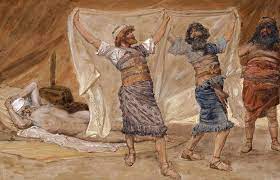
Noah’s Drunkenness, by James J.J. Tissot, 1902

Yet Cham’s brothers Sheim and Yefet, who also witnessed the destruction of their world, choose a modest act of kindness after Cham tells them about Noah’s shame.

And Sheim and Yefet took a cloak and placed it over their shoulders and walked backward, and they covered the erveh of their father, [which] they did not see.  (Genesis 9:23)

Even when we suffer from trauma, we owe it to our family members to stop ourselves from hurting them, and find acts of kindness we can do instead.


  1. Genesis 10:6.
  2. Dishonoring a parent was serious wrongdoing in ancient Israelite culture. The ten commandments require honoring parents in both Exodus 20:12 and Deuteronomy 5:16, and Leviticus 20:9 says anyone who curses his father or mother must be put to death.
  3. Tikva Frymer-Kensky, Reading the Women of the Bible, Schocken Books, New York, 2002, p. 205.
  4. Genesis 7:23, 8:20-21.
  5. For the author of this part of Noah’s story, the curse probably served as a justification for the conquest of Canaan by the Israelites many centuries later.