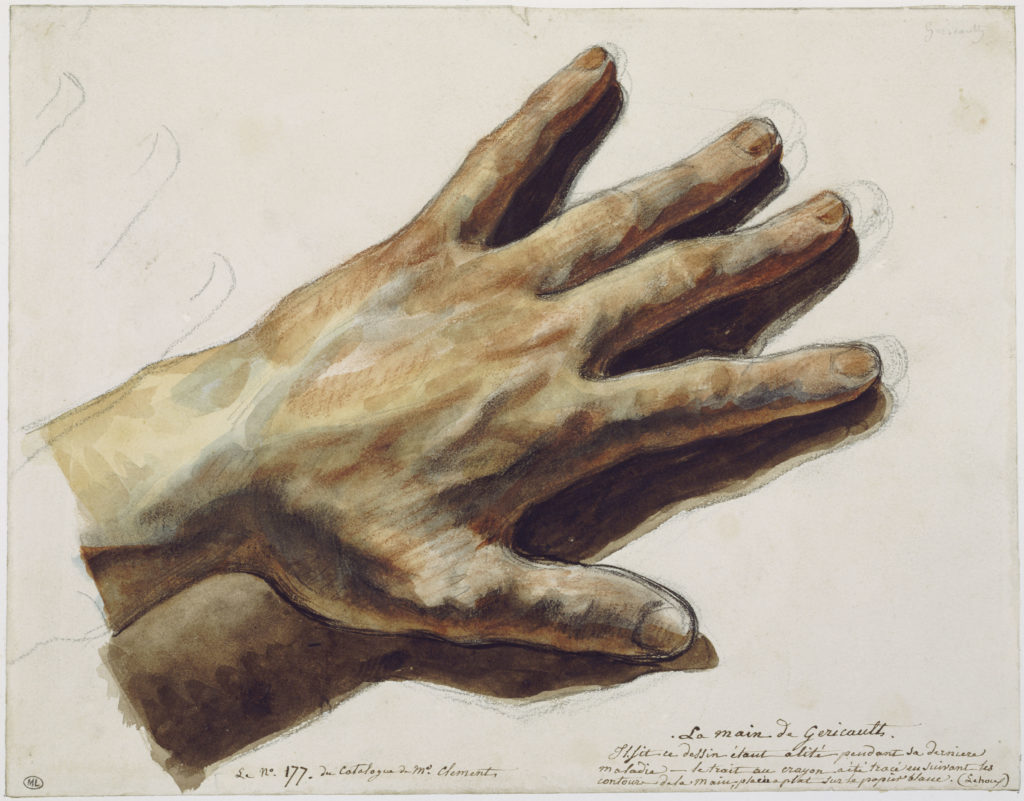
Beshalach & Vayeishev: By Hand

by Theodore Gericault, 1824

Hands are powerful.  Hands are personal.

Both modern English and biblical Hebrew use the word for “hand” (yad, יָד) in many idioms.  And sometimes an idiom in an English translation of the Hebrew bible was adopted into English just because the “Old Testament” had so many English-speaking readers.

Beshalach: a high hand

The Israelites leave Egypt “with a high hand” in this week’s Torah portion, Beshalach.  Here is the King James translation:

And the Lord hardened the heart of Pharaoh king of Egypt, and he pursued after the children of Israel: and the children of Israel went out with an high hand. (Exodus 14:8)

In English we say people are “high-handed” when they act as if they have the authority to accomplish something by themselves, without consulting anyone or considering anyone else’s concerns.  When the Israelites march out of Egypt, they feel arrogant for a change.  The pharaoh who oppressed them has begged them to go, they are taking everything Pharaoh wanted them to leave behind, and they have just commandeered  gold and other valuables from their Egyptian neighbors.  They act as if they are invincible–until the Egyptian army catches up with them. (See my 2013 post: Beshalach: High Handed.)

In English we say “He was caught red-handed,” because a man at a murder scene with blood on his hands is probably the murderer.  The idiom applies to anyone caught committing a violation in front of witnesses or with obvious, incontrovertible evidence.

But if you arrange for someone to die while you are elsewhere and there is no evidence that “your hand was in it”, you might never be implicated.  Biblical Hebrew would phrase that idiom as “your hand was with” the obvious perpetrator.  For example, King David asks a woman with an imaginary story about two sons “Is the hand of Joab with you in all this?” to find out if Joab’s hand is in her ploy to make him change his mind about his son Absalom (2 Samuel 14:19).

Vayeishev: don’t lay a hand on

This week I am writing the part of my book on Genesis about when Joseph’s brothers sell him as a slave to caravan bound for Egypt in the Torah portion Vayeishev.  Initially, most of Joseph’s ten older brothers want to kill him, then throw his body into one of the dry cisterns in the vicinity.  Reuben, the oldest brother, persuades them not to get blood on their own hands.

And Reuben said to them: “Don’t shed blood!  Throw them into this pit that is in the wilderness, but don’t extend a hand (yad) on him,” in order to rescue him from their hand (yad) and return him to his father.  (Genesis 33:22)

In colloquial English Reuben is saying: “Don’t lay a hand on him.”   All the brothers cooperate by seizing Joseph, stripping off his fancy tunic, and throwing him into the cistern alive.  Then Reuben wanders off while the rest of Joseph’s brothers sit down for a meal and Joseph pleads for his life from the bottom of the cistern.  An Ishmaelite caravan headed for Egypt approaches, and one of the brothers, Judah, says:

What profit if we murder our brother and cover up his blood?  Let’s go and sell him to the Ishmaelites, and our hand (yad) won’t be on him; for he is our brother, our flesh.”  (Genesis 33:26-27)

What Judah does not say is that a slave sold in Egypt would probably have a short life-span.

Thus the Torah provides an example of how humans excuse their own behavior when they put someone in harm’s way or incite someone to commit a crime.  If I didn’t do it with my own hands, they think, I’m not really guilty.

In Genesis, Joseph’s brothers realize that they are guilty after all, and that guilt haunts them the rest of their lives.
Vayishlach: Dark Night

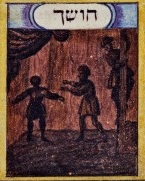
Plague of Darkness,
Haggadah by Judah
Pinchas, 1747

The penultimate plague in Egypt, just before the Death of the Firstborn results in the liberation of the Israelite slaves, is darkness.

For three days there is complete, impenetrable darkness, darkness so thick that it can be felt.  “No one could see his brother, and no one could get up from under it, for three days.”  (Exodus 10:23)

This is not only a physical darkness, but a psychological one.  Click here to read my blog post on the subject: Bo: Impenetrable Darkness.

The Egyptians in this week’s Torah portion, Bo, are immobilized by darkness–by their inability to recognize other human beings as their brothers.

Today I have been writing about Jacob’s wrestling match in the dark night before he sees his brother Esau face to face for the first time in 20 years.  Jacob wronged Esau by making him swap his firstborn rights for a bowl of lentil stew, and by tricking their father into giving him Esau’s blessing.  Like other characters in the book of Genesis/Bereishit, Jacob gave the wrong answer to Cain’s question, “Am I my brother’s protector?”

Guilt drives Jacob’s behavior for 20 years.  Now he is about to return home to Canaan, and he wants to make amends.  But how can he face Esau?

What will it take for Jacob to forgive himself?  Will he ever emerge from his inner darkness?

By the time I finish writing my book on moral psychology in Genesis, I will have some answers.

Vayeitzei: Idol Thief

I am still writing my book, Tasting the Fruit: Moral Psychology in Genesis. Today I wrote about how Rachel steals her father’s household idols as she leaves home, sneaking off toward Canaan with her husband (Jacob), her son (Joseph), and her three fellow wives and their children (Genesis 31:1-21 in the portion Vayeitzei).

Why would Rachel steal the idols?  Because they can be used for divination, and she does not want her father to know where she and her family are.

Idols (physical images of gods) are forbidden in the book of Exodus.  One of the Ten Commandments declares: “You may not make for yourself a statue or any likeness of what is in the heavens above or what is on the earth below or what is in the waters from under the earth.  You may not bow down to them or serve them.”  (Exodus 20:4-5)

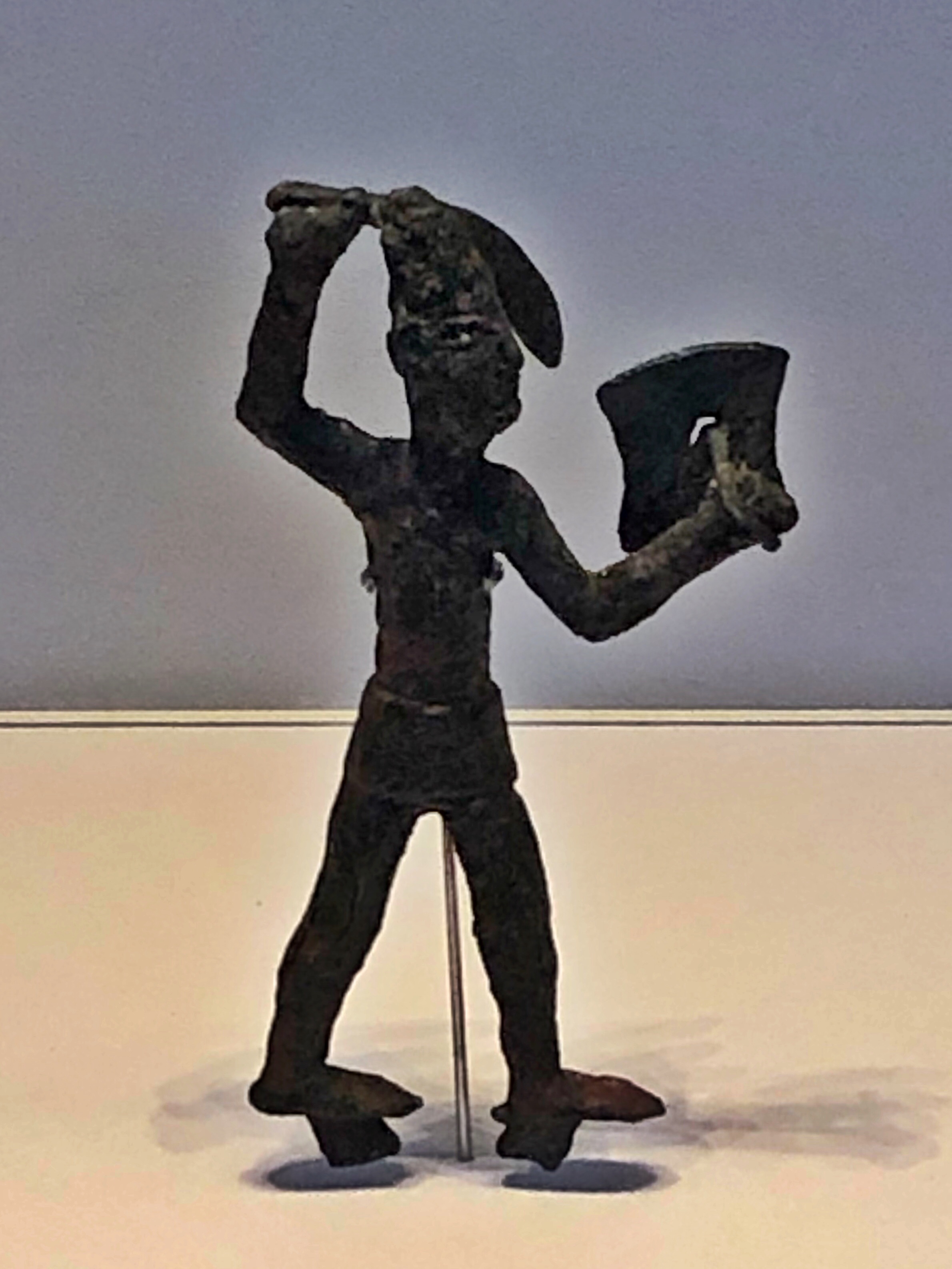
15th-13th century BCE storm god from Megiddo, Israel Museum

The books of Isaiah and Psalms make fun of idols, asking why anyone would treat a piece of inert wood, stone, or metal as if it could hear and speak.  But the book of Genesis is a different story.  The patriarchs Abraham, Isaac, and Jacob do not use idols, but Jacob’s father-in-law Lavan does, and his daughter Rachel believes they can speak to him.

The idols Rachel steals are small enough to fit into a camel pack.  They may look like the figurines of gods I saw last year in the Israel Museum in Jerusalem, all smaller than my hand.

Idols were standard religious equipment in Egypt during the 19th dynasty (1292–1190 B.C.E.), where Moses was born in this week’s Torah portion, Shemot.  He would have learned about all the gods of Egypt and their representations in painting and sculpture after he was adopted by Pharaoh’s daughter.  When he left Egypt as a young man, he went to live with a priest of Midian, and learned about the gods of the Midianites–probably including the god on Mount Sinai that later became the God of Israel.

Moses first encounters that god, God with a capital “G”, when he sees the  bush on Mount Sinai that burns but is not consumed.  God speaks out of the fire, not from an idol.  Click here to read about it in my post Shemot: Holy Ground.

Today most of us do not hear strange voices in our heads, only the familiar subvocalizations of our own psyches.  Yet many people engage in magical thinking.  I can imagine staring a long time at a bronze figurine, and hearing it speak inside your head.  And if the figurine said something that you did not consciously know, but that turned out to be true, you would stare at it again when you needed insight.

Unless it was gone when you got home, because someone had stolen it.