Korach: Dwelling Places

Two rebellions against the status quo coincide in this week’s Torah portion, Korach.  Korach leads 250 fellow Levites in a rebellion against the authority of the high priest, Aaron—Korach’s first cousin.  Apparently simultaneously, two Reubenite chieftains, Datan and Aviram, revolt against the leadership of Moses.1

They assembled against Moses and against Aaron, and they said: “[You take] too much upon yourselves!  For the whole community is holy and God is in their midst.  So why do you raise yourselves over the community of God?” (Numbers/Bemidbar 16:3)

It sounds like an argument for equal rights, but it turns out that Korach and his 250 men only want the Levites to have equal rights with Aaron, the high priest.  Datan and Aviram want to replace Moses as the political leader of the Israelites, not join him in a government by consensus or democracy.

Moses addresses Korach and the Levites first, telling them to test their argument by bringing incense to the tent-sanctuary in the morning.  Aaron will do the same, and God will reveal who is holy enough to serve as a priest.  Moses adds:

“Is it too little for you that the God of Israel distinguishes you from the community of Israel to let you come close to [God], to serve the service of the mishkan of God, and to stand before the community as [its] attendants?  [God] brought you close, and all your Levite brothers with you.  And now you seek the priesthood as well?”  (Numbers 16:9-10)

mishkan (מִשְׁכָּן) = dwelling-place; current abode or residence.  (From the root verb shakhan, שָׁכַן = dwell, inhabit, settle in, stay.)

Next the story switches briefly to the rebellion of Datan and Aviram against Moses.  Moses sends for the two Reuvenite chieftains, but they refuse to come at his summons.

We return to the Levite rebellion the next morning, when everyone comes to God’s mishkan, the Tent of Meeting, to watch the contest between the high priest Aaron and the 250 Levites.   No sooner have they gathered than the Torah portion puts the Levites on hold and returns to the revolt of Datan and Aviram.  And where is Korach, the spokesman and leader for the Levites?  This time the redactor who assembled the story lumps Korach together with the two chieftains from the tribe of Reuven.

And God spoke to Moses, saying: “Speak to the community, saying: Go up away from around the mishkan of Korach, Datan, and Aviram!”  (Numbers 16:23-24)

Until this point the Torah has only used the word mishkan for the tent-sanctuary that the Israelites construct as a dwelling-place for God.  But now God is referring to a mishkan of three human beings.

The three men and their families do not live together; they camp in separate spots to the south of God’s mishkan, which is always erected in the center of the Israelite camp.  So why does God speak of “the mishkan of Korach, Datan, and Aviram” instead of using the word mishkanot (מִשְׁכָּנוֹת), the plural for mishkan?

Perhaps the implication is that even though the rebels have two different goals (Korach argues that all Levites should be priests, while Datan and Aviram argue that someone from the tribe of Reuven should lead the Israelites instead of Moses), they are metaphorically under the same tent.  They are all rebelling against the leadership structure that God decreed at Mount Sinai.2

The three rebel leaders refuse to accept that structure any longer.  God refuses to change it.  So Moses warns the Israelites to stand back and keep their distance, because God is about to take action.

And they went up from around the mishkan of Korach, Data, and Aviram, from all around it.  And Datan and Aviram went out and stationed themselves at the entrance of their tents, along with their wives and the children and the little ones.  And Moses said: “By this you will know that God sent me to do all these deeds, that it was not in my mind.”  (Numbers 16:27)

In other words, it was all God’s idea to make Aaron the high priest and Moses the prophet and chief administrator of the Israelites.  The rebels are actually revolting against God, and they will be destroyed by a divine miracle.
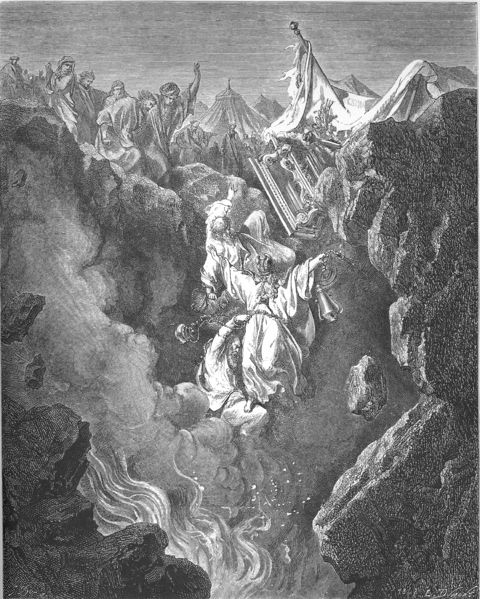
The Death of Korach, Datan, and Aviram, by Gustave Dore

Then the earth opened its mouth and swallowed them and their households and all the humans who belonged to Korach [and Datan and Aviram] and all their possessions.  And they and all who were theirs went down alive to Sheol, and the earth closed over them and they were lost from the assembly.  Then all the Israelites surrounding them fled at the sound of them, for they thought: “Lest the earth swallow us!”  And fire went out from God and consumed the 250 men who had approached with the incense.  (Numbers 16:32-35)

The Israelites survive because they obey the order to stand back from the physical area south of God’s tent-sanctuary.  But they do not grasp the idea that standing back from the homes of the three rebel leaders might also mean standing back from their beliefs—especially their belief that their own desires for more power were more important than preserving the government God had set up.

The people do not understand that if they follow God’s rules, they have nothing to fear.  So they foolishly side with the rebels that God has just wiped out.

And the whole community of Israel grumbled the next day against Moses and against Aaron, saying: “You yourselves brought death on God’s people!”  (Numbers 17:6)

The whole community still believes what the three rebel leaders claimed before the earth swallowed them: that Moses and Aaron are hogging all the power and running the show—even instigating God’s miracles.  This is an insult God will not tolerate.  God tells Moses and Aaron to go stand at a distance from all the other Israelites so God can annihilate everyone except his two favorites.

They disobey God instead.

Then Moses said to Aaron: “Take the censer and place fire from the altar on it, and put on incense, and walk over in a hurry to the community and atone for them!  Because fury has gone forth from God’s presence; the plague has begun!”  Aaron took it, as Moses had spoken, and he ran into the midst of the assembly … and he stood between the dead and the living, and the plague was checked.  (Numbers 17:11-13)

By that time it should be obvious to the surviving Israelites that God has the ultimate power, that Moses and Aaron are bravely defending the Israelites, and that the only reasonable course of action is to unite behind them.

But the Israelites said to Moses, saying: “We perish, we are lost, all of us are lost!  Everyone who comes close, who comes close to the sanctuary of God dies!  Will we ever be done with perishing?”  (Numbers 17:27-28)

They are panicking, too terrified by God’s power to learn the lesson.


In this first year of the Covid pandemic, we have seen both sheer panic and calls for a paradigm shift in how we operate as a community, both globally and in each country.  We cannot stop all the deaths from the virus, but we could check the “plague” if we all abandon the tents of rebel leaders who are more interested in personal power than in saving lives.  We could recognize that we humans are, indeed, all vulnerable—and decide that all lives matter, whether the danger comes from disease, pollution, or prejudice.  Just as Moses and Aaron work to save lives, we could choose the good side in every conflict: the side that cares about the health and well-being of every human being, rather than the side that only considers their own power or wealth.

Today we cannot stand aside from other people’s disasters and hope to survive intact.  Because today the whole planet is one mishkan, our only one.


  1. The opening of the Torah portion is confusing, with all three rebel leaders appearing at once before Moses and Aaron (along with a third Reuvenite, On, who is never mentioned again), along with 250 men who are described for the only time in the story as tribal chieftains rather than Levites. Modern biblical scholars explain that one or more redactors of the Torah stitched two different rebellion stories into one another, and the seams show.
  2. When the Israelites leave Mount Sinai, they are well-organized for their next task, occupying the land of Canaan. They march and camp in formation, like an army (Numbers 10:11-28). They conduct formal religious rituals at a tent-sanctuary guarded and transported by Levites under the supervision the priests, Aaron and his sons (Numbers 8:5-22).  And they have an administrative system consisting of 70 elders under the supervision of one head of government, Moses (Numbers 11:13-25).

But in last week’s Torah portion, Shelach-Lekha, the men refuse to cross the border, and God decrees that nobody of them will enter Canaan until 40 years have passed (Numbers 14:20-35).  The people spend most of those years living in safety at the oasis of Kadesh-Barnea in the wilderness south of Canaan.  Yet they camp in the same military formation, practice the same religion, and are governed by the same administration as when they set out to conquer Canaan.


Shelach-Lekha: Who Is Stronger

The Israelites start whining that they want to go back to Egypt only a few days after they leave Mount Sinai in last week’s Torah portion, Beha-alotkha.1

Fish and leeks

Then the riffraff who were among them felt a craving and they wept again, and the Israelites also wept, and said: “Who will feed us meat?  We remember the fish that we ate in Egypt at no charge, the cucumbers and the melons and the leeks and the onions and the garlic.  And now our throats are dry.  There is nothing but the manna before our eyes!”  (Numbers 11:4-6)

In this week’s Torah portion, Shelach-Lekha (“Send for yourself”), they camp at Kadesh-Barnea on the border between the Wilderness of Paran and Canaan.  Moses sends twelve men to scout out the land God promised them, and they return after forty days with mixed reviews.  All twelve scouts agree that Canaan is indeed a land “flowing with milk and honey”, and they bring back samples of the gigantic fruit.  But only two of the scouts, Caleb and Joshua, are in favor of continuing with God’s plan to capture the country.

Caleb hushed the people toward Moses, and he said: “We must certainly go up and we must certainly take possession of it, because we are certainly able to do it!”  But the men who had gone up with him said: “We will not be able to go up against those people, because they are stronger mimenu.”  (Numbers 13:30-31)

mimenu (מִמֶּנּוּ) = than us; than him/it (i.e. God).

Do the ten frightened scouts mean that the people already living in Canaan are stronger than the Israelites, or stronger than God?  Either way, the scouts go among the Israelites and exaggerate.

Grasshopper, photo by Artsajith,Wikimedia

“And there we saw the giants, the Anakites from the giants, and we were like grasshoppers in our own eyes, and so we were in their eyes!”  (Numbers 13:33)

The Israelites cry in despair all night.

And they said, each man to his brother, “Let us appoint a leader and return to Egypt!”  (Numbers 14:4)

Once again they think they would be better off in Egypt, the land where they were enslaved and the pharaoh tried to kill all their newborn sons.

Both Moses and God lose their tempers. After all, God rescued them from Egypt using Moses as a prophet, and God has fed them manna the whole trip.

Near the end of the Torah portion Shelach-Lekha, God decrees that the people must not enter Canaan until 40 years have passed since their exodus from Egypt.  By that time, the  generation of slaves will have died in the wilderness.  Then only Caleb, Joshua, and the Israelites who are currently under age 20 will cross the border and get a share of the land.

Is the 40-year delay a terrible punishment?  Or an act of mercy?

Click on this link to read my 2014 blog post answering this question:  Shelach-Lekha: Courage and Kindness.

And may we all remember not to make judgments about who is strong and who is weak, who is actually cowardly and who merely resists change.


  1. See my post Beha-alotkha: Cloud over Paran.

Beha-altokha: Cloud over Paran

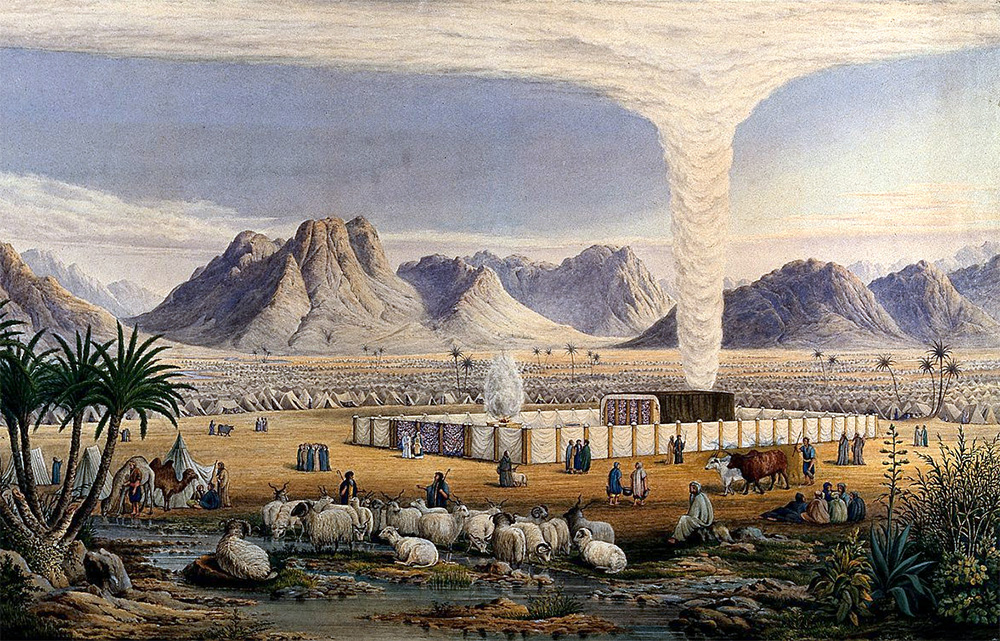
Tabernacle in the Wilderness, by J.J. Derghi, 1866

The Israelites wait for the signal from God before they leave Mount Sinai and head north toward Canaan.  At last God’s cloud, which has been hovering over the portable tent-sanctuary, ascends and glides off in the direction where God wants the Israelites to travel next.1

The Israelites spend the whole book of Leviticus/Vayikra at Mount Sinai, initiating the priests and the sanctuary and performing various religious rituals for the first time.  During the first two Torah portions of the book of Numbers/Bemidbar, they learn how to disassemble the Tent of Meeting and its courtyard, carry the pieces safely, and march in formation by tribe.  But they do not set off until this week’s Torah portion, Beha-alotkha (“When you bring up”):

On the twentieth of the second month of the second year, the cloud rose up from over the Mishkan of the Testimony.  The Israelites journeyed on their journey-stages from the Wilderness of Sinai.  Vayishkon, the cloud, in the Wilderness of Paran.  (Numbers 10:11-12)

mishkan (מִשְׁכָּן) = dwelling-place.  (From the root verb shakhan, שָׁכַן = dwell, inhabit, settle in, stay.)  The portable tent-sanctuary or “tabernacle” is made as a place for God to dwell, at least part-time, among the Israelites.2

vayishkon (וַיִּשְׁכֺּן) = and it settled, and it came to rest and dwelled.  (Also from the root verb shakhan.)

The first stage of the journey north toward Canaan lasts three days; then the cloud descends, and they camp for a month at an uninhabited spot in Paran.3  The Torah gives it two place-names: first Taveirah, then Kivrot Hata-avah.

The complaints begin after the cloud has come to a stop and the camp is set up.  The Torah does not say what the Israelites complained about; the important thing is that once they have left Mount Sinai they start whining again.

And the people were becoming complainers, and it was evil in the ears of God.  God listened, and [God’s] anger heated up and burned against them, and a fire of God ate up the edge of the camp.  Then they wailed to Moses for help, and Moses prayed to God, and the fire sank down.  And the name of that place was called Taveirah, because the fire of Hashem barah.  (Numbers 11:1-3)

Taveirah (תַּבְעֵררָה) = it burns.  (From the verb barah, בָּרעֲרָה = burned.)

But the people do not stop complaining.  They find a pretext: they do not like the food.

Then the riffraff who were among them felt a craving and they wept again, and the Israelites also wept, and said: “Who will feed us meat?”  (Numbers 11:4)

There is no lack of meat at the camp in Paran; the people brought all their livestock with them from Egypt, herds of cows and flocks of sheep and goats.4  At Mount Sinai they learned how to make wholeness-offerings, in which portions of the slaughtered animals were eaten along with  some of the bread by the priests and by the donors and their guests.5

If some of the “riffraff” among the people6 got left off the invitation lists, it might explain their complaint.  But then why do all the Israelites join in asking “Who will feed us meat?”

Perhaps their problem is not that a shortage of meat, but that they want to be fed, like children—or slaves.  Yet even though the people eat their own meat and bread, God is still providing them with the miracle of manna every morning.

We remember the fish that we ate in Egypt at no charge, the cucumbers and the melons and the leeks and the onions and the garlic.  And now our throats are dry.  There is nothing but the manna before our eyes!  (Numbers 11:5-6)

In other words, they miss Egypt.  They miss the food they ate in Egypt, and despise the food God gives them in the wilderness.  Egypt was where the Israelites were slaves to a government that wanted their eventual extermination.  Yet it was also their home.  The Wilderness of Paran does not feel like home, even though God is feeding them and taking care of them, even though everyone can see the cloud by day and fire by night over the mishkan, so they know their God is in residence.

The rules Moses has transmitted to them are clear; they know how to serve God instead of Pharaoh, they know what to do in terms of both cult ritual and communal life.  The divine cloud leads them on every journey, and tells them when to pitch camp and when to pull up stakes.  Life should be easy.

Common quail

But the Israelites whine so much that God gets angry and teaches them a lesson by sending flocks of quail that stack up two cubits deep on the ground.  The people gather more dead quail than they can eat.

The meat was still between their teeth, not yet chewed, when God’s anger heated up against the people and God struck a great blow against them.  And the name of that place was called Kivrot Hatavah, because there the people kavru those who were mitavim.  (Numbers 11:33-34)

Kivrot (קִבְרוֹת) = burial grounds of.  (From the same root verb as kavru, קָבְרוּ = they buried.)

Hata-avah (הַתַּאֲוָה) = the desire, appetite, craving.  (From the same root verb as mitavim, מִתְאַוִּים = feeling a craving, a longing.)

Thus the first camp in the Wilderness of Paran is named both Taveirah, after both God’s burning anger when the people began complaining again, and Kivrot Hatavah, after the burial of people who were too attached to their cravings for the former home in Egypt, the place of slavery, extermination, and comfort food.

*

Why did God’s cloud stop and settle for a while in the Wilderness of Paran, before the Israelites reached the border of Canaan?  Was it a test to find out if the people would revert to their old complaining ways, even after they had built the mishkan for God to dwell in?

In every human heart there is both a longing for a new life and a longing to return to the familiar and well-known.  There is courage to journey to a new land, and there is also entrenched discouragement.  Although the proportion of resilience to despair is different inside each individual, every person does get opportunities to lean one way or the other.

Are you leaning toward God or Pharaoh today?

  1. And when the cloud rose up from above the mishkan, the Israelites would pull out on each of their journeys. But if the cloud did not rise up, they would not pull out until the day it did rise. Because the cloud of God was over the mishkan by day, and fire was in it by night, in the sight of all the Israelites on all their journeys. (Exodus/Shemot 40:36-38)
  2. See my posts Terumah & Psalm 74: Second Home, and Bemidbar: Two Kinds of Troops.
  3. Numbers 10:33-34.
  4. Exodus 12:38.
  5. See my post Vayikra & Tzav: Fire Offerings Without Slaughter, Part 2.
  6. The Hebrew word sometimes translated as “riffraff” is asafsuf (אֲסַפְסֻף), based on the verb asaf (אָסַף) = gather in, gather against, take in, take away.

Naso: Raising a Blessing

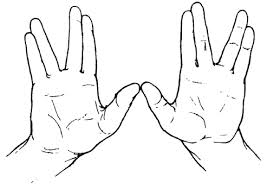
Hand position for Priestly Blessing

May God bless you and protect you!

May God shine the light of panav toward you and be compassionate to you!

May God yissa panav to you and grant you peace!  (Numbers/Bemidbar 6:24-26)

yissa (יִשָֹּא) = he will lift, raise; may he lift, raise.  (Imperfect form of the verb nasa = lift, raise.)

panav (פָּנָיו) = his face, his presence.

yissa panav = may he lift his face.  When God is the subject, this is an idiom meaning “May [God] be benevolent.”

This “Priestly Blessing” or “Threefold Blessing” is chanted at peak moments in Jewish services to this day.  (The first sentence has three words in Hebrew, the second has five words, and the third has seven words.  Chanting these lines out loud, with a pause or melodic phrase after each sentence, produces the effect of increasing blessing.)

The Threefold Blessing comes directly from this week’s Torah portion, Naso (“Lift up”).  The portion opens with God’s instructions to Moses for taking a census of the men between 30 and 50 in the Gershonite clan of the tribe of Levi and assigning them their duties.

Numbering of the Israelites, by Henri Felix Emmanuel Philippoteaux, 19th century

And God spoke to Moses, saying:  “Naso et rosh of the sons of Gershon also, by their ancestral houses and by their clans, from the age of 30 years up to the age of 50 years you will count them…  (Numbers 6:21-23)

naso (נָשֹא) = Lift!  Raise up!  (Imperative form of the verb nasa.)

rosh (רֺאשׁ) = head.

naso et rosh = Lift the head!  (An idiom meaning either “take a census” or “pardon”.)

You lift someone else’s head when you are taking a head count, or when you are pardoning that person.  You lift your own head, raising your face, when you acknowledge someone’s presence.  God lifts God’s face in order to face people with benevolence—like humans raising their heads to smile at someone.1

The idiom of lifting someone else’s head, which is used merely for counting at the start of the portion Naso, is later transformed into the idiom of lifting one’s own face, which God does to bless people with benign attention.

Initiating a blessing

The climax of this week’s Torah portion, in my opinion, is when God instructs Moses on the way the priests should bless the Israelites as a whole.

And God spoke to Moses, saying: “Speak to Aaron and to his sons, saying, ‘Thus you shall bless the Children of Israel.  Say to them: May God bless you and protect you!  May God shine the light of panav toward you and be compassionate to you!  May God yissa panav to you and grant you peace!’”  (Numbers 6:23-26)

After giving the three sentences of blessing, God concludes with this instruction:

Place my name upon the Children of Israel, and I myself will bless them. (Numbers 6:27)

In other words, the priests must recite the correct three-line formula in front of the people.  Then God, not the priests, will bless them.  God’s blessing is triggered not by the wishes of the priests, but by the words that the people hear, the three sentences that include the personal name of God.

If we imagine an external being called God, who bestows gifts like a good king or a loving parent, then the Threefold Blessing expresses what we want God to give us in the world. We want the universe, personified, to bless us with success; to protect us from harm; to shine with kindness toward us; to treat us with compassion; to give us benign attention; and to arrange for us to live in peace.

Traditional Jewish blessings, like the Threefold Blessing, follow the form “May God bless you with—”, perhaps because we know that even a parent blessing a child cannot actually make any of these good things happen.  Only God can do that—if God is a semi-anthropomorphic being who runs the universe.

Hearing a blessing

There is plenty of evidence that blessing in our universe does not work that way. Many people are hapless, damaged, confused, starved, or punished too harshly. That makes the Threefold Blessing either a fantasy, or a prayer that the whole universe will change.

But maybe there is a deeper truth in the instructions in this week’s Torah portion about how the priests can initiate God’s blessings.  Maybe something happens when the people who need blessing hear God’s name in the blessing formula.

The prophet Elijah learns that God is not in the wind, not in the earthquake, not in the fire, but in a soft murmur—a “still, small voice” in the King James translation.2  If we want to be blessed with a life in which God seems to be smiling at us and easing our way, then we must learn to hear the small voice of God inside us.

“May God bless you with—” is also a way to say “Listen for God and the blessing of—”.

May we all find a way to listen.

*

Last week, when other Jews were celebrating Shavuot and the giving of the Torah at Mount Sinai, I could only imitate the mountain, shaking uncontrollably.  This week, fortunately, I have a smaller set of (non-Covid) symptoms, less frightening than an earthquake, less painful than fire.  I continue to get medical tests and to hope for a fuller diagnosis and further improvement.  But I also notice that every time I lie down (which is often) I feel grateful for my life, for the bed underneath me, for my own thoughts, and for the soft murmur deep inside me that sometimes releases a word in a still, small voice.  God is blessing me.

  1. In a similar idiom, people’s faces “fall” (nafal, נָפַל) when they lower their heads in anger at whomever they are facing. When God does not welcome Cain’s offering, Cain became very hot with anger, and his face fell. (Genesis 4:5)  This idiom can also apply to God’s face.  God tells the prophet Jeremiah to say: Continue turning back [to me], declares God; I will not make my face fall at you, because I am kind, declares God.  (Jeremiah 3:12)
  2. 1 Kings 19:11-13.