Bereishit: Divine Inner Voices

The first Torah portion in the first book of the Torah (both called Bereishit, “In a beginning”) opens with God’s creation of the world. It closes with God’s decision to destroy the world and start over again.

Just before God makes this decision, the Torah gives us a curious story fragment:

And beney ha-elohim saw the daughters of the human, how tov they were, and they took themselves wives from whomever they chose. (Genesis 6:2)

The Nefilim were on the earth in those days, and also afterward, for beney ha-elohim came into the daughters of the human, and they bore children to them. They were the mighty ones from long ago, men of renown. (Genesis 6:4)

beney ha-elohim = the sons of God.

tov = good, attractive.

What does “the sons of God” mean? Some traditional commentary claims the phrase refers to superior human men, who make the mistake of marrying an inferior class of women. Other commentators say the “sons of God” are angels, angels of a lower grade than the malachim (“messengers”) that appear in the Torah in human form in order to speak as mouthpieces for God.

What strikes me is that the phrase beney ha-elohim appears only four times in the whole Hebrew Bible: twice in the passage above, and twice in the book of Job. The book of Job begins by describing how upright, good, and God-fearing Job is. Then the scene shifts to the court of God:

One day beney ha-elohim came to present themselves in front of God, and ha-satan came too, in the middle of them. And God said to ha-satan: Where do you come from? And ha-satan answered God, and said: From roving about on the earth and from going back and forth on it. (Job 1:6-7)

ha-satan = the adversary, the obstacle

God pays attention to ha-satan, and does not question any of the other “sons of God”. The Adversary doubts whether Job is genuinely good and God-fearing, and persuades God to test Job’s faithfulness. God assigns the Adversary to strike all Job’s possessions. Ha-satan eliminates Job’s wealth and all his children—for no good reason—but Job still blesses God.

Then one day beney ha-elohim came to present themselves in front of God, and ha-satan came too, in the middle of them, to present itself in front of God. And God said to ha-satan: Where do you come from this? And ha-satan answered God, and said: From roving about on the earth and from going back and forth on it. (Job 2:1-2)

Once again God only converses with ha-satan. The Adversary persuades God to test Job again, this time by afflicting his body, and God authorizes another injustice in order to find out what Job will do.

The book of Job is a theological conversation in the guise of a story about a man who lived long ago and far away. In order to set up the question of whether God is just, the story uses an allegory of God in His court, receiving His sons, the lesser gods (a scene obviously borrowed from one of the pantheistic religions in the region).

But on another level, I see both stories about beney ha-elohim as allegories for the human mind.

In the book of Job, I think God’s court represents the human mind. The decision-making ego is visited by various sub-personalities, including one that takes an adversarial role and obstructs the ego by planting doubt, then tempting the ego to abandon morality in order to find out for sure.

In the book of Genesis, the interaction between “the sons of God” and the “daughters of the human” can also represent the human mind. Like ha-satan in Job, beney ha-elohim in Genesis  visit the earth. The purpose of the visit in Job is to observe the human beings from a different perspective than God’s, and bring that perspective into the heavenly court that I think represents the human mind.

The purpose of the visit in Genesis is to marry and “come into” human women. When the book of Genesis says “for beney ha-elohim came into the daughters of the human, and they bore children to them”, we can read it as simply a description of the sons of God having sex with their wives, who then give birth to mighty and famous men. But we can also read it as a representation of subconscious aspects of the mind coming into the consciousness of human women, and inspiring them to give birth to new ideas and notions.

In the Bible divine inspiration, ruach elohim, can be good or bad; good when a prophet is moved to speak out and warn people they are doing wrong, but bad when King Saul is seized by divinely-induced madness. What if divine inspiration comes from different aspects of God, different “sons”? One aspect might give us an impulse to speak out against injustice. Another aspect (such as ha-satan in Job) might give us an impulse to commit any injustice in order to prove a point.

The “sons of God” in Genesis are apparently bad impulses, leading to bad thoughts and actions.

And God saw the abundant badness of the human on the earth, that the shape of every idea of his heart was only bad all the time. And God nicham that It had made the human on the earth, and It was heartbroken. (Genesis/Bereishit 6:5-6)

nicham = had a change of heart, reconsidered. (This verb covers at least two kinds of change of heart: regret, and consolation.)

Before the beney ha-elohim show up, the humans on earth seem like a mixed lot, more good than bad. Cain is a murderer, and his great-great-great grandson Lemekh boasts to his wives about vengeance, but the other people the Torah mentions seem innocent enough. When Enosh is born, people start invoking the four-letter name of God. One of Enosh’s descendants, Enoch (Chanokh), “walked with God”.

Only after the beney ha-elohim influence the human race does God consider the ideas of the human heart “only bad all the time”. Perhaps these “sons of God” are like ha-satan in Job. The Adversary in Job corrupts the ruling god with feelings of doubt. The sons of God in Genesis apparently introduce urges that corrupt the conscious mind of the human “daughter”, and become obstacles to good behavior.

And God said: I will wipe away the human that I created from the face of the earth, from human to beast to creeper to flyer in the sky, because I have nicham that I made them. But Noah found grace in the eyes of God. (Genesis/Bereishit 6:7-8)

In next week’s Torah portion, God decides to start the world over again with Noah and his family (as well as pairs of all the animals). This is like deciding to eliminate all those awkward feelings of beney ha-elohim, and reduce the mind to a single virtuous ego. Yet when the flood ends, God reaches the more mature conclusion that the human mind is always subject to evil, and decides to put up with it.

Today, we all hear the mental voices of divine inspiration inside our own minds. Sometimes they are Adversaries, trying to push us off the right path and make us act out of doubt or resentment or another negative urge. Sometimes they enter with enlightenment, and impregnate us with ideas that lead to good actions.

May we all learn to put up with the many shapes of our ideas, as the god in Genesis did. And may we all become more discriminating about our inner promptings than the god in Job.
Sukkot: Temporary and Permeable

Everything in life is temporary, including life itself.

The annual festival of Sukkot was once a pilgrimage to the temple to celebrate the harvest.  Since the second temple in Jerusalem was destroyed in 70 C.E., Sukkot has centered around this instruction in the Torah:

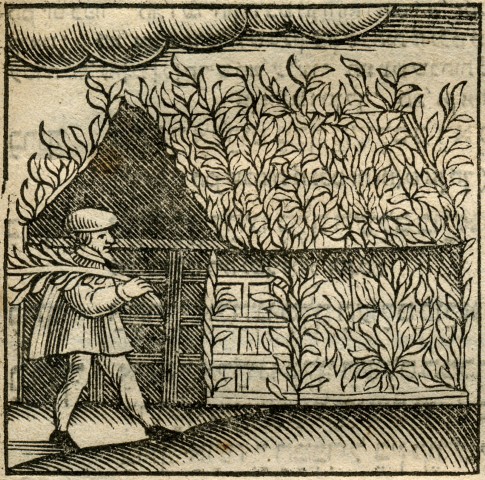
“Sukkot Customs”, 1662

In the sukkot you shall live seven days; all the citizens of Israel shall live in the sukkot, so that your generations will know that I made the children of Israel live in the sukkot when I brought them out from the land of Egypt.  (Leviticus/Vayikra 23:42-43)

sukkot  (סֻּכֹּֽת) = huts, temporary shelters constructed in fields during harvest (often translated as “booths”).  Singular: sukkah (סֻּכַּה).

The Sukkah

This week many Jews are eating meals and spending time in their sukkot.  A ritual sukkah must be a temporary structure.  While it can be attached to a wall of one’s house, it must also have temporary walls and a temporary roof.  The roof must also be permeable, made of plant materials such as branches or reeds—materials that leave gaps big enough to let in both rain and starlight.  One cannot seal oneself off from the world in a sukkah; the outside world is always coming in.

The Mishkan

The sukkah reminds me of another temporary dwelling-place in the Torah:

And let them make for me a holy place, and I will dwell in their midst.  Like everything that I am showing you, the pattern of the mishkan and the pattern of its furnishings, thus you shall make it.  (Exodus/Shemot 25:8-9)

mishkan (מִּשְׁכָּן) = dwelling-place, home.  (From the root verb shakan = stay, dwell, inhabit.)

Every time the Israelites camp in the Torah, the priests and Levites assemble all the pieces of the mishkan to rebuild the sanctuary.  Then when the Israelites move on, the Levites disassemble all the pieces and carry them on the journey through the wilderness.  The mishkan, the holy place where the presence of God dwells, is both temporary and portable.

Divine cloud rising from mishkan (artist unknown)

It is also permeable, but in the opposite direction from a sukkah.  Rain and light from outside a sukkah penetrate its roof and come inside. The mishkan has cloud by day and fire by night inside it, from the divine presence in its inner chamber. The cloud and fire inside penetrate the roof and appear outside, above the mishkan where people outside the sanctuary can see the divine manifestation.

Inside and Out

When we assemble a sukkah, it’s not only a dwelling-place for us, but also a mishkan for God.  In kabbalah, the aspect of God that dwells here in this world is the Shechinah, a feminine form of the noun for “dweller, inhabitant” (from the same root as mishkan).  As we sit in the sukkah, we invite God in, along with the rain and starlight.  And God dwells “in our midst”, inside us.  It is a mitzvah, a good deed, to invite other people to join you in your sukkah.  I can imagine this fellowship in a fragile structure radiating goodwill out to the world.

Like the mishkan, a sukkah is temporary.  Sitting in a temporary shelter can remind us that we are temporary visitors in our world.  Humans get attached to things; we crave permanence.  Yet in the Torah, the Israelites escape the slavery of Egypt and live in the wilderness for 40 years in tents, moving on whenever God’s pillar of cloud and fire lifts from the mishkan.

A sukkah is a reminder that we have the power to become free from attachments to material things, even from attachments to our homes and our familiar lives.  We can find shelter wherever we go.  Sometimes it’s hard to step out from under our solid roofs, but we can do it.

Sukkot is also called “The Season of our Rejoicing”.  May we all rejoice, knowing that everything in our lives is temporary and permeable—and knowing that accepting this fact of life brings us inner freedom.

Ha-azinu & Vezot Habrakhah: Upright, Devious, and Struggling

Would you like to belong to a group called the God-Strugglers? What about the Heel-Grabbers? Or the Upright-Ones?

Yisra-el (“Israel” in English) is the most common name in the Hebrew Bible for the people that God and Moses lead out of Egypt, instruct on God’s laws, and bring to the land of Canaan. Occasionally the bible also refers to the people as Ya-akov (“Jacob” in English), and a few times as Yeshurun (“Jeshurun” in English).

Yisra-el (יִשְׂרָאֵל) = He struggles with God. (Yisar, יִשַׂר = he struggles, he contends + eil, אֵל = god.)

Ya-akov (יַעַקֺב) = He grabs a heel; he supplants; he takes advantage. (From the root verb akav, עָקַב = grasp by the heel; cheat)

Yeshurun (יְשֻׁרוּן) = Upright ones; those on the level, straight, honest, law-abiding. (From the root verb yashar, יָשַׁר= be upright, be straight, be level.)

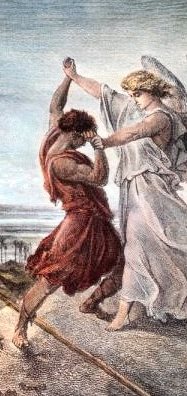
Jacob Wrestling with an Angel, by James Tissot, ca. 1900

Yisrael and Ya-akov are the two names of the patriarch in the book of Genesis who fathers the twelve sons whose names become the names of the twelve tribes. His first name, Ya-akov, refers to his devious efforts to pull down his brother Esau and replace him as the “firstborn” who will inherit not only twice as much wealth, but also God’s blessing and covenant. Ya-akov wins a second name, Yisrael, after wrestling all night with an angel of God, refusing to let go until the angel blesses him.

I find it significant that the Hebrew Bible does not call the twelve tribes after Abraham, or Isaac, but after the patriarch who began his career as a deceitful heel, and had to struggle with God to become the legitimate conduit for the divine covenant. At the end of the book of Genesis, Jacob-Israel is more straightforward and law-abiding than at the beginning of his story, but still far from perfect.

The name Yeshurun appears in the Torah for the first time in the long poem of Ha-azinu (“Use your ears”), the portion we read this Saturday, between Rosh Hashanah and Yom Kippur. Purportedly a prophecy written by Moses, the poem describes how after Moses has died and the Israelites have conquered and settled Canaan, God made them prosperous, but then they forgot the source of their wealth.

…[God] suckled them with honey from a rock,

And oil from a flinty boulder,

Sour cream from cattle and cream from sheep,

With the fat of lambs, and rams from Bashan, and he-goats,

With the fat of kernels of wheat,

And the blood of the grape you drink fermented.

And Yeshurun fattened, and it kicked;

You fattened, you became thick, you became gorged,

And abandoned the god who made him,

Dismissed as foolish the Rock who rescued him. (Deuteronomy/Devarim 32:13-15)

The ingrates in this poem are anything but upright.  16th-century rabbi Obadiah Sforno explained that the Israelites kicked like an animal that kicks the person feeding it. Their love of material pleasures, indicated by the rich foods, made them too “thick” to understand subtle truths.

19th-century rabbi Samson Raphael Hirsch added that God made the Israelites prosperous in order to show the world that it is possible to enjoy material pleasures and still lead a spiritual and moral life. When you are well-fed, Hirsch wrote, the correct behavior is to be more active and accomplish more. But the people who were supposed to be the Upright-Ones got lazy and fat instead.

In the last Torah portion of Deuteronomy, Vezot Habrakhah (“This is the blessing”), Moses calls the Israelites Yeshurun two more times, just before and just after his poetic prophecies for individual tribes. Here Moses uses the name Yeshurun without irony.

First he recalls the Israelites’ peak moment, when all the tribes gathered at Mount Sinai and pledged themselves to God.

He became king among Yeshurun,

When the heads of the people gathered themselves,

All together, the tribes of Yisra-el. (Deuteronomy 33:4)

Commentators disagree on who “he” is in this verse, Moses or God. According to Rambam (12th-century rabbi Moses Maimonides), the Israelites honored Moses like a king. This would make Moses the head of the Upright Ones. But according to the Talmud, the Israelites accepted God as their king. This would make them the Upright Ones who unite to obey God’s laws (even though it is a struggle, yisra, to serve the divine king).

After giving prophecies for individual tribes, Moses makes another positive statement about the Israelites as a whole.

There is none like the god of Yeshurun,

Riding through heavens as your rescuer,

…And Yisra-el will dwell in safety,

The well of Ya-akov left alone. (Deuteronomy 33:26, 33:28)

Ultimately, God will help the people, even though sometimes they are upright, sometimes struggling for God’s blessing, and sometimes they are devious supplanters.

After these three uses of Yeshurun at the end of Deuteronomy, the name occurs only once again in the whole Hebrew Bible:

Thus says God, your maker and your shaper,

Who helps you from the womb on:

Do not fear, My servant Ya-akov,

And Yeshurun whom I have chosen. (Isaiah 44:2)

I think Isaiah means that the descendants of Ya-akov, who grabbed his brother’s heel and used devious means to supplant him, need not fear as long as they serve God. If Ya-akov had pursued only the firstborn’s double portion of wealth, God would not have helped him. But since Ya-akov also pursued the firstborn’s blessing of the covenant with God, God gave him more chances to make good.

And Yeshurun, the upright ones, need not fear as long as they live up to the role God chose for them: to be the model of a nation that obeys God’s laws.


Do you identify with the God-Struggler (Yisra-el), the Heel-Grabber (Ya-akov), or the Upright One (Yeshurun)? Or perhaps a fourth name?

Personally, my default is to be law-abiding, probably because I grew up feeling the safest when I went unnoticed. That kind of uprightness is hardly a great model. Fortunately I also have a stubborn moral sense, so when I discover I have accidentally done something that might be devious, I rush to make amends. I do not want to be a heel-grabber, even when that seems to be the only means to a good end.

I think my highest self is a god-struggler, wrestling with the question of what God is, and how I can have at least a relationship, if not a covenant, with this mystery called God.

And I pray that all humans may find the names that they need to grow into.