Re-eih: The Right Place

The first four books of the Torah describe two kinds of encounters with God. One is having a conversation with God, or God’s “angel”. The other is going through a ritual to rededicate yourself to God. The ritual of choice was the animal sacrifice.

In the book of Genesis/Bereishit, Abraham, Isaac, and Jacob built altars for animal sacrifices in several places: Shekhem, Mount Moriyah (said to be the site of Jerusalem), Beersheva, Hebron/Chevron, Beit-El, and a spot between Beit-El and Aiy (probably the site later named Shiloh). Modern scholars have established that these places were also sites for Canaanite religious ritual. Perhaps they struck people as particularly good spots for numinous experiences.

In the book of Exodus/Shemot, Moses built an altar at the site of the Israelites’ first battle, in which they defeated Amalek; and his father-in-law carried out an animal sacrifice at the foot of Mount Sinai. But when Moses spent his first 40 days at the top of  Mount Sinai, God gave him lengthy instructions for building a portable sanctuary as a dwelling place (mishkan) for God, with the ark in the innermost chamber, and the altar for animal and grain offerings in the outer enclosure. This sanctuary could be dismantled, moved, and re-erected, so once the Israelites had made all the parts, they did their ritual offerings only at its altar, no matter where they were camping in the wilderness. The priests—at this point, Aaron and his sons—became necessary for all rituals.

But what would happen after the Israelites entered Canaan and settled down in scattered villages and towns? Would the head of every household build his own altar and lead his own rituals again?

The book of Deuteronomy/Devarim says no in this week’s Torah portion, Re-eih (“See!”). The first step is to banish any possibility of worshiping the God of Israel at any Canaanite religious sites.

You must utterly obliterate every makom where the nations that you are dispossessing serve their gods: upon the mountains, the high places, and upon the hills, and under every luxuriant tree. You must break up their altars and shatter their standing-stones and burn their tree-goddesses in fire and chop down the statues of their gods; and you must obliterate their sheim from that makom. (Deuteronomy/Devarim 12:2-3)

makom (מָקוֹם) = place; sacred place; religious site.

sheim (שְׁמָם) = name, reputation, standing.

Moses has told the Israelites many times to destroy all the religious items of the natives when they conquer Canaan. Now he also tells them to obliterate the places themselves. No longer can a Canaanite site be used to make offerings to the God of Israel.

You must not do thus for God, your god. Rather, you must seek out and come to the makom which God, your god, chooses out of all your tribes [tribal territories] to set Its sheim there, for it to dwell in. (Deuteronomy 12:4-5)

It will be the makom that God, your god, will choose for the dwelling of Its sheim. There you shall bring everything that I command you: your elevation-offerings and your slaughter-offerings and your tithes and the donation of your hands and all your choice vow-offerings that you vow to God. And you shall rejoice before God, your god, you and your sons and your daughters and your manservants and your maidservants … (Deuteronomy 12:11-12)

God Itself will not dwell in the single chosen place, only God’s name. This abstraction distinguishes the Israelite religion from the Canaanite belief that gods can inhabit wood and stone images.

Deuteronomy never says which place God will choose. Judging by the rest of the Hebrew Bible,  the Children of Israel alternated between short periods when there was no single makom and people constructed other altars at will; and long periods when all offerings were brought to a central sanctuary where priests conducted the rituals.

For the first 14 years after the Israelites cross the Jordan in the book of Joshua, the portable sanctuary with its altar and ark stayed in Gilgal, and the Israelites were free to set up their own altars to God elsewhere. Then Joshua assembled everyone to erect the portable sanctuary at Shiloh (possibly on the site of one of Abraham’s altars), in the territory of the northern tribe of Efrayim. Over time the sanctuary acquired stone walls and wooden doors, though its roof remained a tent woven out of goat-hair.

For 369 years Shiloh was one and only place to bring offerings. Its last high priest was Eli, who died when the city fell to the Philistines in the first book of Samuel. The Philistine army captured the ark, then returned it to Israelite territory seven months later. While the ark was kept in a private house in the Israelite town of Kiryat-Ye-arim, there were national altars in Nov and Giveon, but for 57 years individuals are allowed to build their own altars as well. Individual altars were prohibited again only after King Solomon built the temple in Jerusalem and put the official altar and the ark in the same enclosure once more.

This week’s Torah portion describes the three pilgrimage festivals, Pesach, Shavuot, and Sukkot, when everyone must travel to the central place of worship to make offerings, pay tithes, feast, and celebrate. Since the Israelites are settled all over the former land of Canaan, the journey to Shiloh or Jerusalem takes from one to several days for most people.

Re-eih gives no instructions for what a man should do in between festivals if he wants to ritually rededicate himself to God because he has done something wrong, or because he is full of gratitude and generosity, or because he just wants to be closer to God. Should he travel all the way to the temple? Or is there another way?

The modern biblical scholar James Kugel argues that Deuteronomy promotes serving God by obeying all the laws passed down by Moses, instead of by making offerings at an altar. Being conscientious about obeying all of God’s laws will naturally lead people to be loyal to God and cling to God with love.

After the fall of the second temple in Jerusalem in 70 CE, Rabbinic Judaism substituted prayer for offerings at an altar. But they continued to emphasize the importance of following both the rules in the Torah and the additional rules determined by the rabbis in the Talmud.

Today, many Jews (including myself) pick and choose which of the rules are really important and worth following. When we want to rededicate ourselves to God, we either go through a ritual with our own congregation, or we pray passionately, hoping to make a connection. Unless we are in Jerusalem, the idea of traveling to a single holy place for all our religious rituals can seem irrelevant and outdated.

Yet the 19th-century Chassidic rabbi Yehudah Leib Alter of Ger wrote in Sefat Emet that “darash  and come to the makom” means we should seek out the places, times, and souls in which holiness is revealed. They are where we can find God, and rededicate ourselves to holiness.

I believe an important caveat to this approach is that we must not unthinkingly adopt the holy places of others. Each individual must inquire whether a place, a community, a ritual, or even a time, is truly holy enough to succeed in reconnecting them with God, rededicating themselves to God. If something is lacking, the individual must keep on seeking for the makom where God’s name dwells.

This means there are multiple holy places—but I believe individual “altars” are not enough; a human being who yearns for the divine also needs a central place of worship. A numinous spot out in the woods can be a makom for silent connection between an individual and the divine. Yet in order to sustain our dedication to God and to the path of becoming holy, we need to find a makom in a community, with set times for prayer and ritual.

It may take a long journey to get there.
Eikev: 40 Days and 40 Nights

Moses spends most of the book of Deuteronomy/Devarim reminding the Israelites that for 40 years they have been rebelling against God and provoking God to anger. For 40 years Moses has been urging the people to change their ways and urging God not to wipe them out. After Moses dies and the people enter the Promised Land, he warns, he can no longer intercede for them.

In the middle of another harangue in this week’s Torah portion, Eikev (“on the heels of”), Moses is seized by a visceral memory from 40 years before.

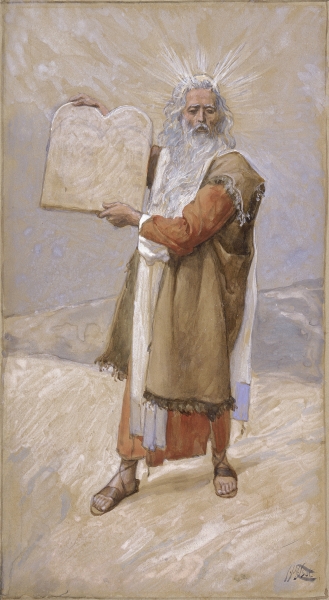
Moses and the Ten Commandments, by James J.J. Tissot, 1896

In Choreiv you provoked God, and God became furious enough to exterminate you. When I went up to the mountain to take the stone tablets of the covenant that God had cut with you, and I stayed on the mountain 40 days and 40 nights—bread  I did not eat and water I did not drink. Then God gave me the two stone tablets written by the finger of God, and on them were all the words that God had spoken with you on the mountain from the midst of the fire on the day of the assembly. And it happened at the end of 40 days and 40 nights, God gave me the two stone tablets, the tablets of the covenant. (Deuteronomy/Devarim 9:8-11)

Choreiv = dryness, drought; an alternate name for Sinai.

Moses does not mention the reams of information God gave him during those 40 days, according to the book of Exodus/Shemot: hundreds of laws, and instructions for making a portable sanctuary. What sticks in his memory—so much that he says it twice—is receiving the stone tablets after spending 40 days and 40 nights on the mountaintop with God.

The Torah often uses “40 days” or “40 years” to mean “a long time”. But the phrase “40 days and 40 nights” appears in only four stories: Noah and the flood in Genesis; Moses’ two long stints on Mount Sinai in Exodus; Moses’ recollection of that time in this week’s Torah portion in Deuteronomy; and the prophet Elijah’s stay in a cave on Mount Choreiv in Kings I.

In all of these passages, if something happens for 40 days and 40 nights, it is removed from the ordinary world.

On the last night of Moses’ first 40 days and nights on the mountaintop, God gives him the tablets. Then God tells him to hurry back down, because the Israelites have made themselves a cast-metal idol, a golden calf. In both the book of Exodus and Moses’ recollection 40 years later, God offers to wipe out those no-good Israelites and choose Moses’ descendants instead.

And God said to me: “I have seen this people, and look, it is a stiff-necked people. Leave me alone, and I will exterminate them and wipe out their name from under the heavens and make you into a greater and mightier nation than they.” (Deuteronomy 9:13-14)

In the Exodus account, Moses picks up on God’s hint and does not leave God alone. Instead, he argues that it would give God a bad reputation if God now killed the people God had personally brought out of Egypt. Only after God relents does Moses go down the mountain.

But 40 years later, Moses does not remember arguing with God. He merely says:

And I turned and came down from the mountain, and the mountain was burning with fire, and the two tablets of the covenant were in my two hands. (Deuteronomy 9:15)

His sensory impressions—the fire on the mountain, the stone tablets in his hands—come back to Moses so vividly that he misses an opportunity to remind the Israelites that he intervened for them again. He only remembers and patches it into his story later.

As Moses tells the story in this week’s Torah portion, he saw the people carousing in front of the golden calf, smashed the stone tablets, then went back up the mountain for another 40-day fast in order to appease God.

I grasped the two tablets and threw them from my two hands and shattered them before your eyes. Then I fell down before God, like the first time, 40 days and 40 nights—bread  I did not eat and water I did not drink—because of all your offense that you committed, doing what was bad in God’s eyes, angering God. (Deuteronomy 9:17-18)

Moses backtracks briefly, remembering that he ground the calf into gold dust. But he does not mention all the other things he did according to Exodus before climbing the mountain again, including ordering the Levites to kill about 3,000 men who worshiped the golden calf, and asking God to either bear with the offending Israelites or erase Moses from God’s book.

What matters to Moses is that he spent another 40 days and 40 nights with God on the mountaintop.

According to Exodus, during that that time Moses saw God’s back, hear God describe Itself, bargained some more, and received more laws. Then God told him to write the words of the Ten Commandments on the stone tablets, which Moses did.

In Deuteronomy, Moses does not mention any of this, not even seeing God’s back! But he repeats three times that he stayed before God on the mountain a second time for 40 days and 40 nights. And in Moses’ memory, he made an ark for the tablets, but God carved the words into the stone.

And God wrote on the tablets, like the first inscription, the Ten Commandments that God spoke to you on the mountain from the midst of the fire on the day of the assembly, and God gave them to me. Then I turned and came down from the mountain, and I put the tablets in the ark that I had made, and they were there, as God had commanded me. (Deuteronomy 10:4-5)

Moses brings up the 40 days and 40 nights one more time before he returns to preaching.

And I, I stood on the mountain, as on the first days, 40 days and 40 nights, and God listened to me this time as well, and God did not want to exterminate you. God said to me: Get up, go on the journey in front of the people… (Deuteronomy 10:10-11)

Moses’ overriding memories of “40 days and 40 nights” and “two stone tablets could be considered a distraction from his point that the Israelites rebelled against God even at Mount Sinai/Choreiv, and Moses kept on interceding for them. Maybe now that he is 120 years old, Moses’ mind is wandering.

Or maybe these are the two most important things in the story after all:

1) The basic rules for human behavior are written in stone. Even if you shatter them, they will return.

2) When you spend 40 days and 40 nights above the world, like Noah in his ark or Moses on the mountain, you may be so high you forget to eat and drink. But God will bring you back down to deal with life on the ground, life with other people.

Haftarat Devarim—Isaiah: Ignoring the Divine

Every weekly Torah portion is paired with a haftarah (“what emerges”), a passage from Prophets/Neviim. For nearly 2,000 years, in traditional Saturday Torah services, the chanting of the haftarah follows the chanting of the Torah portion. This week, Jews read the first Torah portion in the book of Deuteronomy/Devarim, which is also called Devarim (“Words”). The haftarah this week is Isaiah 1:1-27. Both the Torah portion and the haftarah contain the word eykhah, which means “how” as in “Oh, how could this happen?” This is also the opening word of the book of Lamentations, which we read on Tisha Be-Av, the fast day shortly after this Shabbat. (See my post: Devarim, Isaiah, & Lamentations: Desperation.)

All three readings accuse the Israelites of rebellion against God. But Isaiah offers the most hope for change. The Shabbat before Tisha Be-Av is called Shabbat Chazon (Sabbath of Vision) because the book of Isaiah begins with the word chazon (vision or revelation).

The vision of Yeshayahu, son of Amotz, who had vision concerning Judah and Jerusalem … (Isaiah 1:1)

The Hebrew for Isaiah is Yeshayahu, which means “Rescue of God”. Again and again, even as Isaiah points out how despicably the children of Israel are behaving, he promises that eventually God will rescue them.

After the opening sentence, which also dates Isaiah’s prophecies by listing the names of the kings of Judah during his time, Isaiah’s first poem begins:

Listen, heavens, and use [your] ears, earth;

Because God has spoken:

I brought up children, and I made them high,

And they? They rebel against me.

An ox knows his koneh,

And a donkey the feeding-trough of his ba-al.

Israel does not know;

My people do not hitbonan. (Isaiah 1:2-4)

koneh = owner, buyer; creator.

ba-al = master, ruler; local god.

hitbonan = consider. (From the same root as binah = understanding, analysis.)

In these verses, the ox is the most knowledgeable because it recognizes its owner. Next comes the donkey, which recognizes the place where its owner provides nourishment. Last come the Israelites, who do not even recognize that someone is giving them nourishment.

The reverse order applies to the role of God. God, who creates all creatures, is only the creator (an earlier meaning of koneh) as far as the ox is concerned. God is the ba-al, the local god, of the donkey. But when it comes to the children of Israel, God is also like a parent, bringing them up, making them high (superior), and considering them “My people”.

Does this mean that the more God does for someone, the less that creature recognizes God? Not necessarily. The tragedy in these opening verses is that God elevates human beings in general by endowing us with both the intelligence to consider, analyze, and understand, and the desire to distinguish between good and bad. The Israelites, like any people, have the God-given ability to figure out that God is their creator, sustainer, and parent. They also have the ability to feel gratitude, and to choose good behavior. Yet they do not take the trouble to stop and consider any of this.

Isaiah views this willful ignorance not as laziness, but as deliberate denial: They rebel against me. Furthermore, in Isaiah’s view, those who turn their backs on God also turn their backs on ethical behavior. He calls them People heavy with crooked deeds. (Isaiah 1:4)

Willful ignorance is not bliss. Isaiah mourns how much the Israelites have suffered at the hands of the Assyrians, whose attack on the two Israelite kingdoms began around 740 B.C.E. The Assyrians conquered the northern kingdom, and besieged but did not capture Jerusalem, the capital of the southern kingdom of Judah. Isaiah, like most of the prophets, assumes that if the Israelites had been upright and ethical, God would not have permitted their enemies to defeat and burn their cities. Isaiah calls God the God of Armies, including Assyrian armies. He uses God’s complete destruction of Sodom and Gomorrah to remind his audience that God destroys immoral peoples.

If the God of Armies had not left us a few survivors,

We would be like Sodom,

We would resemble Gomorrah. (Isaiah 1:9)

Nevertheless, the surviving Israelites are not doomed. They still have the ability to change, and God still wants them to turn back from evil. Isaiah reports God saying:

Give up doing evil!

Learn to do good!

Seek out the rule of law.

Step on the oppressor.

Get justice for the orphan.

Defend the case of the widow. (Isaiah 1:16-17)

God assures the people that they can, indeed, be redeemed from their immorality, if they pay attention and obey God. Then Isaiah mourns over how far the people of Jerusalem have fallen, beginning with the line: Eykha (Oh, how) has it become a prostitute, [this] faithful city? (Isaiah 1:21)

Nevertheless, at the end of the haftarah, Isaiah says that if the surviving Israelites in Judah (also called Zion) learn to do good, then God will save them.

Zion will be redeemed through lawful justice,

And those who turn back, through righteousness. (Isaiah 1:27)


Isaiah’s poetry calls for the repentance of the people of Judah. But does it address any people today?

Certainly human beings are still endowed with the intelligence to figure out that we did not create ourselves, nor the world that supports us. We might also notice that our elaborate intelligence and our ethical intuitions are extraordinary gifts. Yet like the Israelites of the 8th century B.C.E., we often do not take the trouble to stop and consider.

Someone who does stop and consider today might conclude that human abilities are merely an accidental result of evolution, and have nothing to do with anything that might be called God. For atheists, Isaiah’s claim that turning away from God means turning away from moral behavior makes no sense. When I was an atheist myself, I still felt gratitude for the world and humanity, and I believed that the human condition came with its own ethical imperatives.

Someone with a traditional Jewish or Christian background who stopped to consider might conclude that God is sufficiently anthropomorphic to prefer some types of human behavior over others. Such a person might analyze the Bible as well as the world, and conclude that God prescribes moral behavior such as honoring parents and protecting orphans, and proscribes immoral behavior such as cheating, adultery, and murder. Someone who believes in a somewhat anthropomorphic God, but takes the Bible with a grain of salt, might conclude that God desires whatever human behavior promotes harmony, cooperation, and mutual respect.

What if someone who is neither an atheist nor a believer in a semi-anthropomorphic God stops to consider? My intellectual analysis deduces that God is the condition of “becoming” implied by the four-letter name of God (sometimes written in Roman letters as YHVH) based on the Hebrew verb for “to be” or “to become”. Another part of my mind concludes that the word “God” covers various mysterious forces in the world. I believe God is evolving along with the universe, and our human attitudes and actions affect God’s evolution. If we become more ethical, the forces of God become more ethical.

Does this mean that eventually God will not let the army of one country devastate another country? Maybe so—if God works through the human psyche.

The lesson I draw from the Isaiah’s opening poem is that if we learn to do good as individuals, the whole world will improve. And the first step toward learning to do good is to stop and consider that our existence depends on forces outside our control; and therefore we owe gratitude to other human beings, to the whole universe, and—yes—to God.

Masey & Pinchas: Daughters and Loyalty

As the book of Numbers/Bemidbar comes to an end, the Israelites are camped on the east bank of the Jordan, ready to begin their conquest of Canaan. Moses knows he will die before they cross the river, so he is handing down rules that will only apply after the people settle the new land and switch to a different economy. Instead of being nomads, most of the Israelites will become farmers or ranchers in Canaan. Wealth will be measured in land rather than herds.

Last week I wrote about God’s directions in the Torah portion Pinchas on how to divide up Canaan into hereditary properties—after the Canaanites have been driven off their land. (See Pinchas: Fairness). First Moses takes a census of men aged 20 and older. Every man counted in that census will get a tract of land in Canaan for his household. His land will be in the district of his clan, and his clan’s district will be in the territory allocated to his tribe.

Women, of course, do not count. Ancient Israelite society was patriarchal, and women were dependents. Apart from their personal effects, women’s possessions were nominal. In a marriage contract, any property that a woman’s father assigned to her was passed directly to her husband. If her husband died or divorced her, “her” possessions became the property of her sons. Women did not inherit, and if they were given land, they did not control it. They belonged to the clan and tribe of whichever man supported them, and only men could be leaders in a clan.

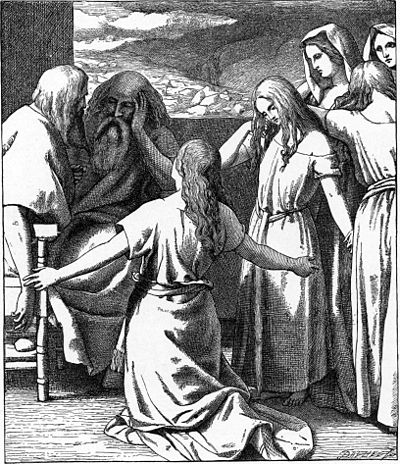
Daughters of Tzelofchad, print after Frederick R. Pickersgill, by Dalziel Brothers, Charles Foster Bible 1897

Yet in the Torah portion Pinchas, five women take a bold and independent action. The daughters of Tzelofchad come to Moses and the assembly of all-male leaders at the entrance of the Tent of Meeting. They ask for the property that would have gone to their father, if he had lived long enough to be counted in Moses’ census.

Why should the name of our father be removed from his family because he had no son? Give us property amidst the brothers of our father.” (Numbers/Bemidbar 27:4)

The women are careful to ask for property not for their own sake, but in order to perpetuate their father’s name. Moses checks with God, who replies:

“Rightly the daughters of Tzelofchad speak; you shall certainly give them possession of a hereditary property amidst the brothers of their father, and you shall make the property of their father pass over to them. And you shall speak to the children of Israel, saying: If a man dies and has no son, then you shall make his property pass over to his daughters.” (Numbers 27:7-8)

God’s answer promotes women from chattels to second-class citizens who can inherit land—but only if their father dies without sons. This solution rescues women who would otherwise be dependent on the goodwill of distant male relatives. The Torah never praises independence, but it does praise compassion for the unfortunate, and a woman without a father, husband, brother, or son to support her is considered unfortunate. A side-effect of the new law was that a daughter who inherited and remained unmarried would have a financial independence no other women possessed. But the Torah assumes all women marry and try to have sons.

This assumption raises an issue about the daughters of Tzelofchad in this week’s double Torah portion, at the end of Masey (“Journeys”). The heads of other clans in the Gilad branch of the tribe of Menasheh come to Moses and say:

“God commanded my lord to give the land, by lot, as hereditary property for the children of Israel; and my lord was commanded by God to give the property of Tzelofchad, our brother, to his daughters. But if they become wives to any of the sons of the [other] tribes of the children of Israel, then their property will be removed from the property of our fathers, and it will be added onto the property of the tribe that they will belong to; so it will be removed from our allotted property.” (Numbers 36:2-3)

In other words, if a daughter who inherited land married a man from another tribe, then she and her land would automatically become her husband’s property—and therefore the property of her husband’s tribe. These men identify strongly with their own tribe, Menasheh, and with the Gilad branch of the tribe. Any reduction in the amount of land under the control of the Gilad clans of Menasheh seems like a personal loss to them.

Moses approves of their sentiment. He does not stop to check with God this time, but he answers the men in God’s name.

“This is the word that God commanded for the daughters of Tzelofchad, saying: They may become wives to whoever is good in their eyes; yet only within the clan of the tribe of their father they shall become wives. And landed property shall not go around for the children of Israel from tribe to tribe, for each man shall daveik to the landed property of the tribe of his fathers. And every daughter coming into possession of landed property from the tribes of the children of Israel, she shall become a wife to someone from the clan of the tribe of her father, so that each of the children of Israel shall possess the landed property of his fathers.” (Numbers 36:6-7)

daveik  = cling to, stick to, be attached to; catch up with

The idea of clinging to your ancestral land is so important that Moses repeats it.

“The property will not go around from one tribe to another tribe, because each man shall daveik to his hereditary property in the tribes of the children of Israel.” (Numbers 36:9)

The Hebrew Bible uses the verb daveik when physical things stick to each other, and when one person pursues and overtakes another. But daveik is also used when one person is devoted to another, and when it sets out the ideal that the Israelites should cling to God with loyal devotion. The only time the Bible uses a form of daveik to indicate a person’s attachment to land is in Numbers 36:7 and 36:9, translated above. But land here is not just real estate; it is the expression of family lineage and tribal loyalty.

Conquering Canaan could, theoretically, be an opportunity for the tribes of Israel to unite and become truly one people (as the thirteen colonies became the United States of America). However, the Torah tells men to cling to the property they inherit from their fathers, and to the territory of their tribe. Why?

My theory is that instead of viewing tribal loyalty as a threat to national loyalty, the way many nations do today, the Torah views tribal loyalty as good practice for for national loyalty. The more you cling to one thing, the more you become able to cling to something else.

Most of all, Moses repeats that everyone must love God. But does practicing  passionate attachment to another person, to a tribe, or to a country, make it easier to love God?

I grew up in an atheist household in 20th-century America. I have always valued independence more than loyalty. I love my husband and my son, and give them my passionate allegiance. But I have never been interested in loyalty to my ancestry, or hometown, or school, or state, or country. I grew fond of several of the houses and yards where I have lived, but I still moved and sold the property to strangers. Maybe I have not practiced attachment enough, and that is why I find it hard to become attached to God.

In the Torah, many of the Israelites wandering in the wilderness also find it hard to cling devoutly to God. The first generation of the exodus from Egypt frequently complains about the food and expresses a desire to abandon God and return to Egypt. When Moabites invite the second generation to worship Baal-Peor, most of the men quickly abandon any loyalty to their own god. (See my earlier post, Balak: Carnal Appetites.)  No wonder Moses encourages them to practice passionate loyalty, if only to their families and tribes!

If you have not practiced a lot of clinging, is there any other way to develop a love for God? In Chassidic Judaism of the last two centuries, a key aspiration is deveikut, attachment or clinging to God. The Chassidic masters recommended developing deveikut through personal prayer, meditation, and intention (though it also helps to learn from a wise rabbi).

But first a modern, independent person without a religious upbringing must decide whether deveikut is even desirable. And that includes figuring out what it is that we are calling “God”.

I wonder if my life would be easier if I had inherited my religion and my god. On the other hand, a good life is not necessarily easy.