Noach: Spoiled

Noah’s ark is a favorite theme for children’s illustrators. Who can resist the animals climbing into, or out of, the ark in pairs? But the larger story is unnerving for adults: God decides to wipe out all life on earth because humans have “spoiled” it, and the most righteous man around makes no protest. His name, and the name of this week’s Torah portion, is Noach in Hebrew.
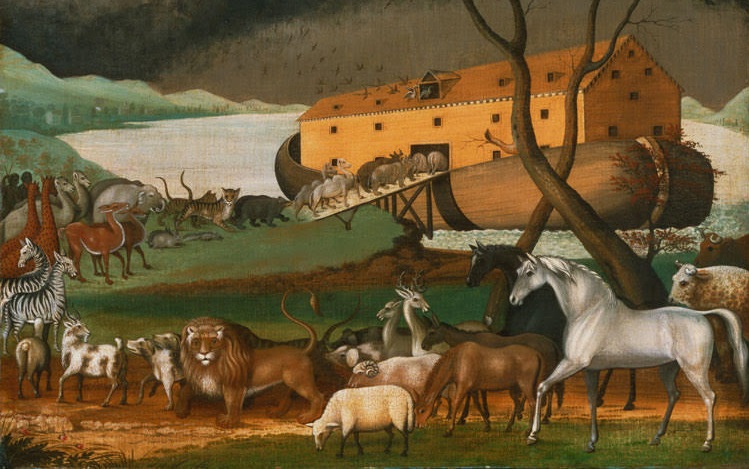
Noah’s Ark, by Edward Hicks, 1846 (detail)

God looked at the earth, and hey! nishechatah, because all flesh hishechit its way upon the land. And God said to Noah: “The end of all flesh is coming before Me, because the earth is filled with violence on account of them, so hey! —mashechitam along with the land. Make for yourself an ark … (Genesis/Bereishit 6:12-6:14)

nishechatah (נִשְׁחָתָה) = it had become spoiled, ruined. (A form of the verb shachat, שׁחת = spoil, ruin, corrupt.)

hishechit (הִשְׁחִית) = has spoiled, ruined; has wiped out. (Also a form of the verb shachat.)

mashechitam (מַשְׁחִיתָם) = spoiling themselves, ruining themselves. (Another form shachat.)

The God-character here sounds like a small child wailing, “They spoiled my toys!  Now everything is ruined! I’m going to kill them all, and wipe out the whole world! But me and my friends, we’ll build a boat and escape …”

Is God actually being childish in this passage? Is the Flood an overreaction? Or is humanity in this story irredeemable?

And is there any reason for wiping out all the other living things on the land?

One clue about the people of Noah’s generation is that the Torah calls them neither “humanity” (adam) nor “men” (anashim), but “all flesh” (kol basar). Perhaps the relationship between flesh and spirit in those early humans is spoiled; people’s spirits are unable to master their physical cravings. (See my post Bereishit & Noach: All Flesh.)

In the previous Torah portion, God creates the human out of two materials: dirt and the divine breath. Body and soul. Flesh and spirit. By Noah’s time, according to traditional commentary, the desires of human “flesh” have taken over. People think only of gratifying their physical appetites, and the desires of their spirits disappear.

According to some commentary, the people of Noah’s generation avoid having children, so they can devote more time to their own animal pleasures. Modern commentator Avivah Gottleib Zornberg argues that the real problem is the narcissism of these pleasure-seekers. If someone has no curiosity, no interest in other people, then love and kindness are impossible.1 I would add that if you do not care about other people, then you will speak and act with violence  whenever you feel like it (and believe you can get away with it).

According to the Torah, before the Flood all humans are wallowing in selfish sensuality, their souls beyond recovery, except for Noah (and possibly the other seven people God allowed on the ark: Noah’s wife, sons, and daughters-in-law). Noah is not a paragon; the Torah portion opens with this description:

These are the histories of Noah: Noah was a righteous man–he was unblemished in his generations–Noah walked with God. (Genesis 6:9)

In other words, compared to everyone else at the time, Noah is good. Presumably he retains the proper balance between his spirit and flesh, paying enough attention to his divine side to “walk with God”. But he never questions God’s plan to wipe out all life on earth. He is deficient in compassion, yet there is hope for him or his descendants.

So God decides not to give up on the human experiment altogether, but instead to destroy the failures, and start over again with Noah and his family. Then why does God choose to flood the earth, and wipe out millions of land animals and birds along with the irredeemable humans?

Traditional commentary claims that God made all the other animals, and everything else on earth, only for the sake of the human. Non-human life on earth has no value in itself. When humans use other living things for corrupt purposes, they have to be destroyed, too.

To me, this opinion demonstrates a lack of interest in, or curiosity about, the rest of the world. When a  commentator views other animals as merely tools for humans to use in carrying out God’s laws, he is committing the same error as the antediluvian man who views other animals as merely tools to use in the pursuit of selfish pleasure.

This is the kind of selfish attitude that leads people today to “spoil” nature: to pollute the air and water, to cut down forests, to disregard extinctions of species, and to do nothing about global climate change. They focus only on their own immediate desires, and take no interest in the earth and its life.

Clearly, human beings are still spoiled, and still spoiling the earth. In the Torah, after the Flood is over and Noah makes an animal sacrifice, God says to God’s heart:

Never again will I draw back to curse the earth (adamah) for the sake of the human (adam), because the shapings of the human heart are evil from its adolescence; and never again will I strike down every living being, as I have done. (Genesis 8:21)

God reseeds the earth with human beings who are still mixtures of dirt and divine breath, body and soul. God continues to grant humans free will, and accepts that sometimes adolescents and adults, people who are old enough to know better, will nevertheless choose evil. God’s experiment with humanity continues.

Today, we do not need an anthropomorphic God to create a flood. We humans have the ability to strike down every living being, all on our own. We are the ones melting the glaciers and ice caps, threatening to flood the earth. I just hope we have not completely spoiled it.


  1. Avivah Gottlieb Zornberg, The Beginning of Desire: Reflections on Genesis, Doubleday, New York, 1995, p. 46, 53, 54, 63.
Bereishit: A First-Rate Beginning

In the beginning God created the heaven and the earth. (Genesis/Bereishit 1:1, King James Version)

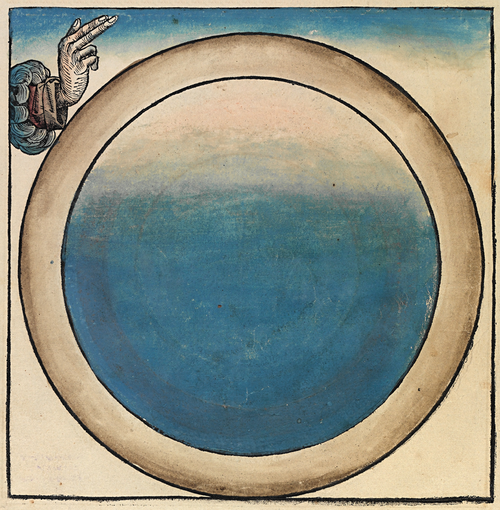
First Day of Creation, Nuremberg Chronicle, 1493

I used to find flaws in the King James translation of the first line of the Bible: 

Bereishit bara Elohim eit hashamayim ve-eit ha-aretz— (Genesis 1:1)

Consider the first word, a compound of be- (בְּ) = a prefix meaning “in”, “at”, “by”, “through”, or “when”, depending on context and idiomatic usage.

+ reishit (רֵאשִׁית) = (noun) beginning, first step, starting point; (adjective) first-rate, choicest, best.

I knew that “in the” was ba(בַּ), not be- (בְּ). So I preferred modern translations of bereishit, such as “In a beginning”. Then I checked all the other places where the word reishit appears in the Hebrew bible, and I discovered that reishit is an unusual word, in that it does not take a definite article even in contexts where the English translation would be “the beginning” or “the first step”. So in 50 of the 51 times that reishit appears in the Hebrew Bible, there is no prefix indicating a definite article (“the”).1 And the word bereishit appears four times in the book of Jeremiah in the phrase “at the beginning of the reign of”.2 I had to conclude that the King James version’s “In the beginning” is an acceptable translation after all.

The second Hebrew word is bara (בָּרָא) = “created”. Before I learned Biblical Hebrew grammar, I made the translation mistake that the Talmud warns against3, and wondered if bereishit bara Elohim meant that “In-a-beginning” created God. Then I found out that the subject follows the verb in Hebrew, so the correct translation of bara Elohim is “God created”, not “created God”.

What about the word Elohim? It is a plural noun, used in the Torah for both God and for other peoples’ gods. But the book of Genesis/Bereishit would hardly say that other peoples’ gods created the heavens and the earth!

The word translated in the King James version as “the heaven” is hashamayim (הַשָּׁמַיִם) = the heavens. But insisting on the plural is nit-picking.

When I began researching this blog, I still hoped I could come up with a more interesting, yet accurate, translation. Over the years I have enjoyed reading alternate translations, especially when they lead to intriguing ideas about the nature of God.

For example, here is one of 19th-century Rabbi Raphael Samson Hirsch’s translations: 

From the very beginning God created the heaven and the earth.4 

I notice that this version implies not only that God is the original, and perhaps the only, creator, but also that creating the heavens and the earth is an ongoing process.

Another is Rabbi David Cooper’s 20th-century translation: 

With a beginning, [It] created God (Elohim), the heavens and the earth.5 

Cooper explained that in kabbalah, the ein sof (“without end”) precedes Nothingness, and out of Nothingness comes Beginningness. From Beginningness comes Elohim, the plural name of God, and then plural creation follows, starting with the heavens and the earth. The first part of this amazing progression occured before the first word of the Torah. The word bereishit catches the kabbalistic progression at the stage of Beginningness.

Yet the 17th-century King James translation, prosaic as it seems, is closer to the original Hebrew. So then I wondered if I could invent an interesting alternate translation by using one of the other meanings of reishit.

The word reishit appears in the Hebrew bible 50 times. It is used most often (23 times) to indicate one kind of offering to the temple: an offering of the first or the finest sample of an agricultural product–usually fruit or grain, but sometimes bread, oil, or livestock. Another common use of the word (10 times) is to indicate that something else is first-rate: a person, a group of people, a father’s vigor, a land’s fertility, a fig’s flavor.

If the reishit part of the first word in the Bible meant “first-rate”, the first sentence could be translated: With the best, God created the heaven and the earth. We would learn that our universe is first-rate (or at least the best of all possible worlds), and that God also created other, inferior universes!

Is this stretching too far? The Hebrew bible uses reishit to mean “the beginning” at least 17 more times after the opening Bereishit. Twelve of these occurrences refer to the beginning of something that unfolds over a period of time: a year, an episode in someone’s life, a king’s reign, a person’s lifetime, a kingdom’s duration. Two more occurrences refer to the beginning of a process of divine creation: the book of Job claims the behemoth was the beginning of God’s creation of animals, while the book of Proverbs claims wisdom was the beginning of God’s creation of the world. The word reishit is also used three  times for a more abstract beginning, as in Psalm 111:10: The beginning of wisdom is awe of God.

The compound word bereishit shows up four times in the book of Jeremiah.2 All four times, bereishit merely gives the approximate date of a prophecy, by placing it “in the beginning of the reign of” a certain king. So the bereishit in the first sentence of the Torah must also be the beginning of something that unfolds over time, like a king’s reign. But this beginning came before everything. It is the beginning of time as we know it (one new thing after another), or the beginning of being.

Maybe Elohim, the god of plurals, means God the Creator, the God of Time, and the God of Endless Beginnings. Then what came before the beginning of time and creation, before Elohim? If the answer is God, this is a god we cannot even imagine. The Ein Sof (“Without End”) of kabbalah is, by definition, inconceivable. As the Zohar says, “No thought can grasp You at all.” Yet Elohim, the God that we can think about, points back at the Ein Sof, the inconceivable God  that began Rabbi David Cooper’s kabbalistic progression.

In the beginning God created the heaven and the earth” is more profound than I thought.


  1. The exception is the word lareishit (לָרֵאשִׁית) = “for the first [fruits]” (Nehemiah 12:44).
  2. Jeremiah 26:1, 27:1, 28:1, and 49:34.
  3. Talmud Bavli, Megillah 9a.
  4. Samson Raphael Hirsch, The Hirsch Chumash, English translation by Daniel Haberman, Feldheim Publishers, Jerusalem, 2002, p. 1.
  5. David A. Cooper, God is a Verb, Riverhead Books, Pernguin Putnam Inc., New York, 1997.

Vezot Habrakhah: Broad Daylight

And this is the blessing with which Moses himself, the man of God, blessed the children of Israel, before his death. (Deuteronomy/Devarim 33:1)

The book of Deuteronomy/Devarim is a series of speeches by Moses, sometimes in God’s name, sometimes in his own words, to the generation that is about to cross the Jordan without him. Moses repeatedly tells the Israelites that they have screwed up before, and God will punish them if they screw up again. The second-to-last Torah portion, Ha-Azinu, is God’s rather dark poem prophesying that they will, indeed, screw up again. But the last portion in Deuteronomy (the very last one in the Torah scroll) takes a brighter tone.

In this portion, Vezot Habrakhah (And this is the blessing), Moses blesses each tribe with prophesies of good outcomes: life, strength, religious knowledge, security, and plenty. After these unusually positive parting words, Moses climbs Mount Nevo and dies.

Before Moses blesses the first tribe, Reuben, he introduces his blessings with a few obscure poetic verses.  Modern scholars view these verses as quoted from a much older poem, with some bits lost in the transmission. One piece of evidence for this theory is that the mountain where the Israelites received the “Ten Commandments” is called Mount Sinai, just as it is in the book of Exodus/Shemot.  This is the only appearance of the name “Sinai” in the whole book of Deuteronomy; the rest of the time, Deuteronomy calls the mountain Choreiv (Horeb).

Here is the first obscure verse:  And he [Moses] said:

God entered from Sinai

and dawned from Se-ir for them;

shone out from a mountain of Paran,

and came from holy myriads;

from Its right side is אשדת for them. (Deuteronomy/Devarim 33:2)

אשדת = ?  These four Hebrew letters do not make a word anywhere else in the Hebrew bible. Commentators generally agree they indicate a compound word beginning with eish = fire.  For the second part of the word, we have only the two letters ד and ת, corresponding to “d” and “t”.   Traditional commentary assumes the two letters stand for dat = edict, a word borrowed from Persian that does not appear in Hebrew texts until  centuries later. They translate the whole word as “fiery law”.  Most modern scholars assume that d-t is a fragment of the word daleket = flaming, and translate the whole word as “fire-bolts” or “lightning”.

What does the verse mean? Se-ir is the land southeast of Canaan where, in the book of Genesis/Bereishit, Esau founds the kingdom of Edom.  The Talmud associates Se-ir with Rome. Paran is a wilderness south of Canaan where Ishmael settles in Genesis. The Talmud associates Paran with Islam.

Most commentary from the Talmud through the 19th century assumes that Moses is once again insisting that the religion of the Israelites is the only acceptable creed. The light of God, they said, is the Torah, and this verse means that God offered to Torah to the Israelites at Sinai, to the  Edomites (standing in for Romans or Christians) at Se-ir, and to the Ishmaelites (standing for Muslims) at Paran. But only the Israelites accepted the Torah. The “holy myriads” are God’s angels, who do not need the Torah to instruct them on how to live properly in the world. So God’s right hand gives Israel alone  the eish-dat, the fiery law.

I am not persuaded. Yes, Moses spends 40 years denigrating other religions and reminding the Israelites that God chose them– 40 years of warning and criticizing and yelling and laying down the law. But in Vezot Habrakhah, Moses finally drops that role and blesses the tribes with good fortune and plenty. He wants to leave the world with blessings rather than curses. In his softened mood, maybe he quotes part of an old poem not to reinforce Israelite triumphalism, but to hint that divine enlightenment can reach people who belong to other groups, other religions.

The simple meaning of the verse appears to be that God’s light shone on at least three different peoples south of Canaan. And I think the next verse continues this theme, despite traditional commentary’s insistence that it must mean God has power over all peoples, but loves only Israel.

One difficulty in translating verse 33:3 is that it seems to switch back and forth between referring to God in the second person singular and the third person singular. But this is not unusual in the Torah. To make the verse easier to read, I will use [God] instead of a confusing pronoun.

Indeed, [God] is a lover of peoples;

all of [God’s] holy ones are in [God’s] hand;

and they place themselves at [God’s] feet;

yissa from [God’s] pronouncements. (Deuteronomy 3:3)

yissa = he/it lifts; he/it carries

Traditional translations ignore the fact that the word amim means “peoples”, and change the word to “tribes” or “the people” in the singular. These translators assume that God would never be described as a lover of more than one people:  the people Israel.

But why not take the Hebrew word for “peoples” literally? What if God really is a lover of many “peoples”, many ethnicities, many religions? Then, as the next line says, all of God’s holy ones, from every population, are in God’s hand.  And they humbly position themselves at God’s feet.

In the last line of the verse, God lifts, or carries, from God’s pronouncements. Modern scholar Robert Alter, who translated the line as “he bears your utterances”, noted that its meaning is so unclear, it must have been altered in transmission from the original poem.

True, pronouncements are normally neither lifted nor carried nor borne. But I wonder if the word yissa is an abbreviation of an idiom. One common biblical Hebrew idiom is yissa rosh, “he lifts the head of”, and means “he pardons”. Maybe God pardons the holy ones at God’s feet for disregarding God’s pronouncements. Maybe, contrary to Talmudic thinking,  God pardons the more righteous members of many religions when they transgress God’s decrees.

With such obscure Hebrew, it is all guesswork.  But my guess is that the two verses together mean that the divine light is not like a laser focusing on just the children of Israel, but rather like the sun, that rises over every height where a people seeks inspiration. God offers enlightenment to everyone, in broad daylight.  Furthermore, God loves not just the Israelites, but many peoples. The Roman Christians of Se-ir and the Muslims of Paran can also count as holy. God does pronounce laws and requirements; but all holy ones who transgress them can be pardoned, if they place themselves humbly at God’s feet.

This is the poem Moses quotes before he blesses the tribes of Israel and climbs up the mountain to die. After spending 40 years of his life browbeating his people into committing themselves to God, maybe Moses feels that his great task is finished. Now, at last, he can let go of his anger and frustration and give blessings–not just to the tribes of Israel, but to all peoples.

If only we let go of our prejudices, and listen.