Terumah: Heavy Metals

The Torah portion Terumah (“raised donations”) begins with God telling Moses to ask everyone whose heart is so moved to donate materials to make a sanctuary:  three kinds of metals, three colors of expensive dye, linen, wool, two kinds of hides, wood, oil, incense spices, and gems.  Then God says:
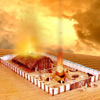
They shall make for me a sanctuary, and I will dwell among them.  (Exodus/Shemot 25:8)

God has already promised to be the god of the Israelites and their fellow-travelers.  But, as we see in the golden calf incident two Torah portions later, the Israelites cannot believe God is still with them without some visual aid.  God refuses to inhabit a golden statue of a calf.  Instead, the people will be reassured by the sight of the sanctuary.

The list of materials for this sanctuary begins:

And this is the raised donation that you will take from them:  zahav, and kesef, and nechoshet …  (Exodus 25:3)

zahav (זָהָב) = gold.

kesef (כֶּסֶף) = silver; the common currency in the Middle East.

nechoshet (נְחֺשֶׁת) = copper, brass, bronze.  (From the root verb nicheish, נִחֵשׁ = practiced divination.)

Gold and Silver

We know why the Israelites had gold and silver to donate.  After the final plague in Egypt, they followed God’s order to “ask” their Egyptian neighbors for silver items, gold items, and clothing.  The Egyptians complied.

Besides using silver and gold for ornamental vessels and jewelry, Egyptians and other peoples in the Middle East made idols (statues for gods to inhabit) out of precious metals.  That is why, after the revelation at Mount Sinai, God says:

With me, do not make gods of silver or gods of gold; you shall not make them for yourselves.  (Exodus/Shemot 20:20)

Accustomed to thinking of gold as the metal of highest status, the Israelites would feel reassured that their donated gold would go into all the holy objects in the inner chamber of the sanctuary:  the lamp-stand, the table, the incense altar, and the ark itself.  Silver was less precious, so it is not surprising that God tells Moses to use silver for the sockets in the framework around the inner chamber.  This framework supports the curtains and tent-roof, and is made of wood planks plated with gold.

The use of gold and silver reinforces the high status and the holiness of the sanctuary’s inner chamber of the sanctuary.  I believe the requirement that these two metals be donated also has a psychological value.  After all, the people know that the gold and silver objects do not really belong to them; the Egyptians handed over the objects when they were desperate to end the plagues.  And the gold is also a reminder of the golden calf.  Donating their gold and silver for God’s sanctuary would relieve the people’s guilt on both counts.

Once the inner chamber of the sanctuary is assembled, the people see only its outer walls—the gorgeous curtains fastened to the gold-plated planks that are fitted into silver sockets.  Only priests are allowed into the area with the incense altar, table, and lamp-stand, and only Moses and the high priest, Aaron, can enter the innermost Holy of Holies, where the ark is concealed.  But everyone knows that God manifests and speaks in the empty space above the gold-plated ark.

Bronze

Another area of the sanctuary is open to every Israelite: the outer courtyard, which contains the altar for animal sacrifices.  This altar, and all its tools, are made out of copper or bronze.

Where does the copper come from?  The Israelites only took silver, gold, and clothing from the Egyptians.  The word for copper, nechoshet, appears only once before this in the Torah: the list of Cain’s descendants includes Tuval-Kayin, who made cutting tools out of nechoshet and iron.1

The book of Exodus is set in a historical period when the Bronze Age is ending, and iron is just beginning to come into use.  Bronze, an alloy of copper and zinc, was the most common metal for tools and blades.  It was also the most common metal for making mirrors, since bronze reflects well when it is polished.  And mirror-like surfaces were used for divination, the type of magic practiced by people who want to see the future.

The snake in the garden of Eden is a nachash, נָחָשׁ, another word from the root nicheish.  The role of the snake is to arouse a desire in Eve for a different kind of knowledge, the knowledge that God has.  Only after her conversation with the snake does she taste the fruit of the Tree of Knowledge of Good and Evil.2

When Moses first demonstrates God’s power to Pharaoh, his staff turns into a nachash.  He is trying to give Pharaoh knowledge about God, though Pharaoh is too defensive to pay attention. Pharaoh’s magicians turn their own staffs into crocodiles, but Moses’ snake eats them.3   (Later, in the book of Numbers/Bemidbar, Moses halts a plague of poisonous snakes, nechashim, with a bronze snake on a pole, a nechash nechoshet.4)

In the book of Genesis, both Lavan and Joseph claim to practice divination when they are trying to impress their troublesome relatives.5  But in  Deuteronomy/Devarim, God warns the Israelites not to practice divination, or any other kind of magic.  One must not try to force information out of God.6

Traditional Jewish commentary explains that the altar in the courtyard of God’s sanctuary is made of copper or bronze because it is a third-rate metal, less valuable than gold or silver but good enough for the area that is merely holy, not the Holy of Holies.  Another explanation might be that the tools for the altar had to be bronze so they would hold an edge, and it seemed appropriate to make the altar itself out of the same metal.

Or maybe the Israelites needed to surrender not only the silver and gold they took from the Egyptians, but also their own snakiness, their own desire for divination and divine knowledge.

Maybe even today, we need to give up the idea that we can predict and control the future.  Can we accept that we are not gods, and we cannot make our own gods?  Can we resist the promise of magic?  Can we donate what knowledge we have, all our copper and all our serpentine wisdom, to building a sanctuary for the whole world?  If we can, then maybe God will dwell among us.

  1. Genesis 4:22.
  2. Genesis 3:1-6.
  3. Exodus 7:8-13.
  4. Numbers 21:9.
  5. Lavan in Genesis 30:27, Joseph in Genesis 44:15.
  6. Deuteronomy 18:10.

Mishpatim: Passionate Arson

Last week’s Torah portion, Yitro, begins with the reunion of Moses and his father-in-law, then moves into the mind-bending revelation of God at Mount Sinai.  This week’s Torah portion, Mishpatim (Laws) gives a long list of laws, then ends with a vision of God’s feet on a sapphire pavement.  (See my blog “Mishpatim:  After the Vision, Eat Something”.)

I’m always tempted to rush straight from the vision of God as fire and thunder to the vision of God’s feet.  But imagine someone who had two mystical experiences in a row, with no time in between to come down to earth.  Their mental balance would be hard to recover.  It would  actually be a blessing to spend an interval on practical matters, in between mystical experiences.  Maybe reading case law in between  the stories of visions at Mount Sinai serves an analogous purpose for Torah scholars.

So this year I paid attention to the case law, and found one law that might addresses unbalancing mental states.

If a fire goes forth, and it finds thorn-bushes, a heap of grain or the standing grain, or the field, and they are consumed, the burner who starts the burning shall certainly make complete restitution.  (Exodus/Shemot 22:5)

On a peshat (simple) level, this law refers to legal responsibility for negligence in a certain farming practice.  On the next level of traditional Torah interpretation, remez (alluded extension), the Talmud tractate Baba Kama (60a) treats this law as a paradigm for all cases in which someone deploys a fire, an animal, a tool, or anything that is not fixed in place, and then it causes damage because the person did not keep it under control.

Going up another rung, at the level of drash (investigation), I see that the law embodies two ethical principles:  that we should make every effort to avoid doing any harm through negligence; and that if it happens anyway, we must make restitution.

At the fourth level of Torah interpretation, sod (secrecy, intimacy), the verse speaks to our own psychological and spiritual condition.  In the Torah, as in colloquial English, fire and burning are often used to describe human passions such as anger, or lust, or even an overwhelming longing for God.  Any consuming passion is likely to get out of control.  Unless people in the throes of passion pay attention and take special care, their negligence can result in significant damage, both to themselves and to others.

Let’s look at the verse again, to see what the fire of passion might consume.

If a fire goes forth, and it finds thorn-bushes, a stack of grain or the standing grain, or the field, and they are consumed, the burner who starts the burning shall certainly make complete restitution.

kotzim = thorn-bushes, thorns.  (A verb with the same root is kutz = awaken; feel sick and tired of.)

gadish = a stack or heap of grain.

hakamah = the standing.  (Standing grain is implied in a simple reading of the verse.)

hasadeh = the field (cultivated or open); the plot of land owned by an individual; the domain of a city.

bo-eirah = burning, kindling or maintaining a fire; sweeping away; being stupid as a cow.

In a reading at the sod level, if a fiery passion is not guarded, it first consumes thorn-bushes.  Applied to your own soul, the burning anger or desire is at first beneficial, eating up those annoying, thorny habits of thought that you are sick and tired of.  Your passion is so strong, it sweeps aside the inner voice that keeps saying “You’re not good enough”, or the one that always says, “It’ll never work”, or—well, we each have our own mental habits.  When a passion sweeps them away, it feel as if you are waking up to a new and better self.

But your consuming passion also burns up the people around you who are thorns in our sides, the people whom you are sick and tired of.  Speaking from rage, or passionate conviction, or overwhelming desire, you impatiently mow right over the  people you find difficult.  In the long run, this is not beneficial to either you or them.

Next, your inner conflagration burns up the grain you have cut and stacked for future nourishment.  In the heat of the moment, preserving the other aspects of your life seems unimportant.  All that matters is the pursuit of the object of your anger or desire.  Yet if you are not careful, you can damage a relationship or a job or even your own body.

After that, the fire can destroy your own standing—both your reputation, and your uprightness or moral compass.  It is tempting, in the heat of passion, to cross lines you would never cross in your cooler moments.  And with uncontrolled, passionate speech, you may also destroy the reputation of others, or incite them to react in a way that they will feel guilty about later.

Finally, if your passion continues unchecked, you will cross the line in another way, failing to respect the boundary between yourself and another human being.  The whole word looks as if it is lit with fire, so it all appears to be part of the same passion that is consuming you.   Of course the person you are talking to feels the same way you do!  Of course they want the same things!  Of course they will do exactly what you want!  Of course they will be happy if you make it easier for them to do what you want by interfering with their lives!

Most of us know about the hazards of unchecked anger or lust.  Most of us do not want to be negligent when these passions seize us.  We work on paying attention and controlling ourselves.

But the Torah focuses most often on the passionate desire for God, which rises like a flame.  And the Torah’s most common metaphor for God is fire.  Sometimes God manifests as a fire that does not consume, like the one Moses saw in the burning bush (which, by the way, was not a thorn-bush).  But often God manifests in the Torah as a fire that does consume, and sometimes kills.

When we are filled with a passion that seems as if it comes from God, because we are burning for justice, or for a religious experience, that is when we are most in danger of being negligent and causing unforeseen damage to ourselves and others.

The law in this week’s Torah portion rules that the person who starts a fire and fails to control it must make complete restitution for all damages.  But some damage cannot be repaired.

May each of us be blessed with the ability to pay attention when we feel any passion, even the most righteous passion, begin to consume us; to remain aware of everything we would normally consider; and to control our speech and our actions so we do no harm.  May we burn brightly without consuming, and without being stupid as a cow.